A daily dose of odds and sods, some interesting, some bizarre, some funny, some thought provoking items which I have stumbled across the web. All to be taken with a grain of daily salt!!
Tuesday, August 16
Historical GDP growth rates
Tuesday, February 16
Catholicism and Violence in Late Chosŏn Korea
http://dissertationreviews.
Wednesday, January 27
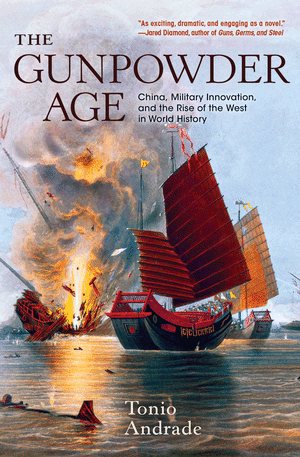
The Gunpowder Age: China, Military Innovation, and the Rise of the West in World History
This book review made me blink and reconsider the dominant narrative that the west has always been smarter at weapons. Not so when you consider some of the times that China has been good.
Today I was reading the guardian son and found that the uk is selling huge quantities of arms and planes and ammo and advice to the Saudis who are using them to break the laws of war and expected human rights in Yemen. I'm just sad that we are now associated with that dreadful regime. All that brainpower and it's going into doing shitty things like killing people.
Sad. Very sad.
Hate war! Such a waste of talent people and money. And nobody remembers after a few years. Who remembers the dead in Iraq and Afghanistan? Nobody. Bah.
Love
Baba
The Gunpowder Age: China, Military Innovation, and the Rise of the West in World History
http://imperialglobalexeter.com/2016/01/27/the-gunpowder-age-china-military-innovation-and-the-rise-of-the-west-in-world-history/
(via Instapaper)
The Gunpowder Age: China, Military Innovation, and the Rise of the West in World History by Tonio Andrade (Princeton University Press, 2016).
Reviewed by Francis P. Sempa
Cross-posted from Asian Review of Books
Tonio Andrade, a professor at Emory University, has written a well-researched, balanced, and comparative history of military innovation in Asia and the West in which he challenges the traditional notion—set forth most compellingly by Victor Davis Hanson in Carnage and Culture and Niall Ferguson in Civilization—that Western culture largely explains Western global predominance in the post-medieval world.
Saturday, January 16
Gen. Stanley McChrystal’s Lessons Learned
First of all, I absolutely hate this idea of national service and conscription. That's a clear violation of individual rights. So the general is talking out of his arse.
Second, his recommendation for teams of teams is rubbish. Clearly shows that he has no idea about running a business. You need to make organisational life sustainable. You need governance. You need processes. You need technology and data. Teams of teams. Rubbish. This will work in very limited circumstances and for a limited period of time.
And finally thinking that ISIS is a motorcycle gang just shows the man is a blithering idiot with no idea of history or Islam. For 1400 years, Islamic warriors and priests have constantly tried to impose their views by force. Constantly. On their own people or on others or both. There hasn't been a single year in recorded history that this fight hasn't happened. The dream and desire for a caliphate. An idealised Jerusalem if you will and if you don't mind the pun.
How did they get sorted? By giving them a right royal thumping. And then religiously thumping people who dare raise anything against secularism. All this education business is bollocks. Hasn't worked in 1400 years and will not work in the future.
His views about China exhibit a shocking level of ignorance. He says it will become bigger than USA and to fix it we need to educate Americans? What? So China rose because of education? Bloody hell. The man is a moron. But people pay tons of money to listen to him. You can fool some people some of the time eh?
Hope you're having fun son. I'm missing you :)
Love
Baba
Gen. Stanley McChrystal’s Lessons Learned
http://www.wsj.com/articles/gen-stanley-mcchrystals-lessons-learned-1431122717
(via Instapaper)
Saturday, December 5
What pollution does.
Wednesday, October 28
A Man in Full: To Hell and Back in the Chinese Healthcare System
It was good speaking to you yesterday Kannu. I think you did just fine. You were able to answer most of the questions. It's a tough interview. It's a tough bank. That's why it's at the top son. You're already in the top ranks by being in Oxford. But they want even more selectivity even from Oxford and rest of the top universities. And this brutal meritocracy keeps on going on. It doesn't stop son. This isn't to discourage you. This is a constant challenge for you to constantly improve yourself. Constantly learn and improve. While having a good sense of humour. And I was so proud of you yesterday. Your tone was confident and calm. Very good son.
That's the stuff of hero's son. Like this man. Can you imagine having to saw off your own leg? Holy crap. I've been there to a much smaller extent. When I used to really suffer from the HS boils. Once I got a giant one in my left armpit when I was in Frankfurt and I had to give a hugely important presentation to the European Central Bank. Usually my way of handling large painful boils is to gobble a fistful of painkillers till the boil burst. But that made me dozy and would slur and basically look and behave like a drunk.
So I decided to sort out the boil. I used to carry a Swiss knife back then in 1998. So ran it under loads of very hot water in the hotel bathroom. And then knotted my hanky for a teeth guard. Filled the bath with the hottest water I could stand and then popped in, and cut out the boil. Not fun. Specially since it was in the right armpit. And was using a mirror which kept fogging up. With my wet left hand. Clutching a tiny Swiss knife. But the sodding bleeding wouldn't stop. It kept on weeping blood and pus. As you know, joints are a pain to bandage. So I wrapped up my armpit and over the shoulder with a plastic bag. Tied it into place with a piece of rope. And then went to work looking like a teapot with my right arm akimbo. Mamma was quite accustomed to looking at my clothes all blood stained. Not a fun time.
My PwC partner paul betts asked me what the hell was I doing? So I told him. He just shook his head and said, you're a nutter! But pain is pain. Just one more thing to overcome and conquer :)
Anyway. Have fun son. Busy days now for you with your assignments tutorials and interviews and events. It will all be worth it.
Can't wait to see you this weekend son. I will be making your dishes with a smile :)
Love
Baba
A Man in Full: To Hell and Back in the Chinese Healthcare System - SPIEGEL ONLINE
http://www.spiegel.de/international/world/a-terrifying-odyssey-through-the-chinese-healthcare-system-a-1035765.html
(via Instapaper)
When a farmer and migrant worker got thrombosis in his legs, China failed him. In the end, he had to saw off his own rotting leg in order to survive. Zheng Yanliang’s story is an allegory of the struggle to the Chinese healthcare system.
His shroud had already been purchased when, on April 14, 2012, Zheng Yanliang, 48, a Chinese man from Hebei Province, summoned up the last of his strength to lean out of his bed and reach for his toolbox. He took out a hacksaw. Then he wrapped the handle of a backscratcher in a piece of material, which he stuck in his mouth so that he could bite on it. He did not hesitate. He had thought about his options and concluded that he had only one choice, this unthinkable, monstrous deed. He placed the saw against his right leg, a hand’s breadth below his hip, and began to saw.
Thursday, April 9
Noodles were made in Italy first? :O
What a fascinating story. So the origin of noodles was always known to be in China and was thought to be brought to Europe by Marco Polo. But looks like noodles were made even before.
I quote
An unusual coin type recently sold at auction depicts an ancient industry, hitherto unrecorded on coinage or sculptural reliefs: the production of noodles. The coin, which fetched 30,000 GBP at the London-based Ceres Auction House, was minted at Ephesus in the reign of the Roman emperor Geta (209-212) and depicts two figures using an ancient form of noodle machine.
As clearly depicted on the coin, one figure feeds the device, which is shaped like a goddess, with dough while the other lays the finished product out to dry (although a recent theory put forth by Dr. Brett Teigleman of the University of Lower Minnesota has proposed the theory that the figure on the right is scraping spätzle from a board by hand, just as is done today in Southern Germany, Switzerland and Austria). We can see that the dough is forced out of the machine at high pressure in regularly shaped portions.
Although it is commonly held that noodles originated in China before being brought to Italy by Marco Polo, they were in fact widely enjoyed throughout the ancient world: the geographer Strabo and Pliny the Elder describe the production of alicia or chondroi from spelt in Campania (Natural History 18.8), although the earliest reference to chondroi occurs in an unfortunately largely unintelligible fragment of Aristophanes’ comedy Mageiroi, “The Cooks”, from 414 B.C. (Kock, Frag. 496b). This coin suggests that the production of spätzle was widespread in the grain-rich districts of Ionia, and epigraphic evidence also records the presence of guilds of ‘Hypochondroi’ or artisan noodle-makers there and their worship of Artemis Chondriates, to whom they offered sacred dough products (IG 2.II,40 (Ionia), 570-572b, ll. 2,8).
Tuesday, March 3
Love, money, and old age support : does parental matchmaking matter ?
Abstract
Parental involvement in matchmaking may distort the choice of spouse because parents are willing to substitute love for market and household production, which are more sharable between parents and their children. This paper finds supportive evidence in a survey of Chinese couples. In both rural and urban areas, parent matchmaking is associated with less marital harmony between the couple, more submissive wives, and a stronger belief in old age support for the son. In contrast, its association with couple income differs by rural and urban regions, perhaps because of differences in earning opportunities and in the enforcement of the one-child policy. Moreover, parent matchmaking is associated with more children for the couple and lower schooling for wives only in rural areas. Thus, in places with a stronger need for old age support, parents tend to be involved in matchmaking and use it to select submissive daughters-in-law to ensure old age support. The results render support to Becker, Murphy and Spenckuch (2015), who imply that parents would meddle with children's preferences to ensure their commitment to providing old age support.
http://documents.worldbank.org/curated/en/2015/02/23950160/null
whilst this was a Chinese study, based upon the little I know of many traditional societies in Asia, Africa and also Latin America, this definitely has legs to stand true. It makes perfect sense. I have heard so many times that people look at their kids as their pensions. That’s the inter-generational compact if you will. One more reason perhaps why some mother in law’s in India are terrible to their daughter in laws despite the fact that they were also subject to similar inhumane treatment when they were daughter in laws.
Saturday, January 24
The Battle for China: Essays on the Military History of the Sino-Japanese War of 1937-1945.
Kannu
Wars have the unsettling ability to make countries lose their equilibrium. And normal trajectory. One of the reasons why I hate wars. They end up wasting resources on a colossal magnitude. If the uk had not got involved in the Iraq and afghan wars, all that material and money and men could have helped the country recover from recession better. Our leaders got distracted. And this will keep on rumbling on for a long time.
Second, history is very west centric at least what's taught here in the uk. But for you son, china will be important. Just like USA was/is for me. So you need to know and learn where they are coming from. The rivalry between Japan and china is important. China has had geopolitical disputes with pretty much every neighbour. It's a strange country. Spend much time learning about it.
Love
Baba
H-Net Reviews
https://www.h-net.org/reviews/showrev.php?id=35560
Mark R. Peattie, Edward J. Drea, Hans J. van de Ven, eds. The Battle for China: Essays on the Military History of the Sino-Japanese War of 1937-1945.Stanford: Stanford University Press, 2010. Illustrations, maps. 664 pp. $65.00 (cloth), ISBN 978-0-8047-6206-9.
Reviewed by Roger H. Brown (Saitama University)
Published on H-War (December, 2012)
Commissioned by Margaret SankeyThe Sino-Japanese War of 1937-45 was immense both in its scale and consequences. Nevertheless, Western military histories of World War II have focused overwhelmingly on the campaigns of the European and Pacific theaters, and those specialized studies of the conflict that do exist deal primarily with such matters as diplomacy; politics; mass mobilization; and, in more recent years, Japanese atrocities and public memory. Indeed, as the editors of the volume under review attest, “a general history of the military operations during the war based on Japanese, Chinese, and Western sources does not exist in English” (p. xix). In 2004, Japanese, Chinese, and Western scholars gathered to remedy this situation and in the belief that such a close study of the operations and strategy of the Sino-Japanese War would “illustrate that, in this period, warfare drove much of what happened in the political, economic, social, and cultural spheres in China and Japan.” They further recognized that because “much of the best scholarship on WWII in East Asia is naturally produced in China and Japan,” there was a need to “bring the fruits of Chinese and Japanese work to the attention of a wider public” (p. xx). Granting that the resulting volume is not exhaustive, the editors seek to bridge the inevitable gaps with “a general overview of the military campaigns, an accompanying chronology, and introductions to the several sections into which the chapters are grouped” (p. xxi). With that caveat behind them, coeditors Mark R. Peattie, Edward J. Drea, and Hans J. van de Ven declare that the contributors have provided “an authoritative introduction to the military course of one of the greatest conflicts of the twentieth century” (p. xx). Their confidence is not misplaced, for The Battle of China beautifully fulfills the objectives they have laid out for it and will be gratefully utilized by readers interested in the history of the Sino-Japanese War, World War II, and modern warfare in general.
Tuesday, July 8
Spiritual-Religious Groups in the PRC after 1978
Kannu
I know I've been talking too much about religion recently and promise we will go back to more interesting topics :)
Here's an example of research done on how cults emerge, in this case in China. Cults emerge in strange and wonderful and not really well understood ways. What's fascinating is how normal people will give up one belief system and suddenly become disciples of some guru, faith, or something like that. Nothing wrong with this. As long as somebody else does it. And not you. Look up 'cult' in Wikipedia. People who follow organised religion or cults exhibit this kind of behaviour. Follow irrational beliefs and exhibit strange behaviour.
I sometimes feel like I'm in a human zoo. Looking at these fascinating exhibits of strange and weird behaviour. And yes, I'm in a cage as well. With others looking at me and honking that I'm a complete nutter lol
Love
Baba.
---------
Tiny screen, old eyes, ham fisted hands. apologies for typos and formatting.
Begin forwarded message:
From: Dissertation Reviews <donotreply@wordpress.com>
Date: 13 May 2013 08:02:22 BST
To: bdasgupta@gmail.com
Subject: [New post] Spiritual-Religious Groups in the PRC after 1978
New post on Dissertation Reviews
![]()
Spiritual-Religious Groups in the PRC after 1978
by Francis Khek Gee LimA review of Emergence and Development of Spiritual-Religious Groups in the People’s Republic of China after 1978, by Kristin Kupfer.
December 2012 witnessed a seemingly curious case of convergence of Mayan civilization, Christianity, and Chinese popular religion. Many members of a group called “Church of the Almighty God,” believing the Mayan prophesy that the end of the world was imminent, began to organize mass demonstrations exhorting the Chinese people to repent their sins, to prepare for the coming apocalypse, and to overthrow the ruling Communist Party. What happened next was highly expected by most watchers of China’s affairs: the authorities initiated a crackdown on the group by arresting its many members, and stepped up their surveillance over unregistered religious groups in the country. Many people inside and outside of China have heard about the Falungong, the previous high profile case that involved a so-called “evil cult.” But who are the Church of the Almighty God? When Kristin Kupfer defended her dissertation on the emergence and development of “spiritual-religious groups” in China, she probably had not anticipated the events of 2012 and the Mayan connections. But for those who wish to gain further understanding of groups such as “Church of the Almighty God” and the Falungong, Kupfer’s research will be an excellent source.
Tuesday, October 1
How India lost the cotton war to the British
First the paper.
During the early modern period, India was the world's main producer of cotton textiles, with a substantial export trade. Indian textiles were exported to Britain on a large scale from the seventeenth century.2 By the early nineteenth century, however, Britain had become the world's most important cotton textile producer, dominating world export markets, and even exporting to India.3 This dramatic change in international competitive advantage, which must surely rank as one of the most important developments of the industrial revolution period, is often described entirely in terms of developments within Britain, without any reference to India, and with little or no reference to factor prices.4 This paper attempts to redress the balance.
……..
As early as the seventeenth century, an unskilled labourer earned four to five times as much in Britain as in India.10 In the middle of the nineteenth century, an unskilled labourer earned less than twice as much in America as in Britain.11 Similarly, the British unskilled silver wage during the second half of the eighteenth century was also less than twice as high as in much of western Europe.12 The Anglo-Indian factor price comparison is of particular importance in cotton textiles, where India was Britain's major competitor. ………However, there appears also to be a second reason, arising from a reluctance to characterize Britain as a high-wage economy during the industrial revolution, a period where the focus has been on the slow growth rather than the high level of British wages…….The story of Anglo-Indian competition in cotton textiles begins with the growth of cloth imports into Britain via the East India Company from the seventeenth century. The new cloths, patterns, and designs became increasingly fashionable and thus threatened the livelihood of domestic producers of fine woollens and linens, which were the closest substitutes for printed cottons from India.17 The pressure from these groups led to protective legislation that remained in force between 1701 and 1774, and opened up new opportunities for British manufacturers via a strategy of import substitution.18 However, high silver wages in Britain meant that cotton textiles produced domestically using labour-intensive production methods could not compete with Indian goods in third markets. This stimulated a two-stage process of technological change.
First, high wages led to the adoption of a more capital-intensive technology in Britain. Second, this choice of technology resulted in a faster rate of productivity growth in Britain, because of the greater incentive to devote resources to improving technology where capital intensity is higher. This is consistent with the positive relationship between capital intensity, resources devoted to research and development, and the rate of technological progress, highlighted in Schumpeterian models of economic growth.19 This effect can be explained partly by the greater learning potential on capital-intensive technology.20 In Britain, however, the effect was amplified by the existence of an effective patent system.21
There was thus a stronger incentive to devote resources to innovation in the machine-intensive industry of Britain, compared with the labour-intensive industry of India. As productivity increased in the machine-intensive British cotton textile industry and stagnated in India, a shift in competitive advantage occurred. However, the shift was delayed in international markets during the late eighteenth and early nineteenth centuries by a temporary rise in raw cotton prices in Britain, as the increase in production put pressure on factor markets. The shift of competitiveness in the Indian market was delayed further by transport costs, which prevented the British from breaking into the Indian market on a large scale until after 1830
And this is again a rather salutary lesson about how one has to keep running after productivity, invest in people, equipment and technology improvements. Also interesting, and something not quite discussed, is how the import protection works. As it did in the 18th century UK.
India does the stupid thing, it has import protection, but doesn't do anything to invest. So the opportunity costs increases all the time and we become poorer and poorer. At this moment, China is eating India’s lunch…guess the old adage, people who do not learn from history are condemned to repeat it.
Monday, September 23
Wages, prices, and living standards in China, 1738–1925: in comparison with Europe, Japan, and India
This was the formative years of modern democracy. So the economic background to these years is important, as a matter of fact, the authors actually analyse the wages, prices and living standards in various countries over this period with reference to what the great old man, Adam Smith, thought. I quote the conclusion:
Our investigation of Asian and European wages and prices shows that the situation differed somewhat from Adam Smith's impressions. Money wages were in accord with his view: in China, they were certainly lower than wages in the advanced parts of western Europe in the eighteenth century and similar to those in the lagging parts of Europe. By the twentieth century, however, wages in all parts of Europe were higher than in China. Contrary to Smith, the cost of living was similar in China and in Europe in the eighteenth century.
The upshot of the wage and price comparisons is that living standards were low in China. In the eighteenth century, advanced cities like London and Amsterdam had a higher standard of living than Suzhou, Beijing, or Canton. The standard of living in the Chinese cities we have studied was on a par with the lagging parts of Europe, the Ottoman Empire, India, and Japan. By the twentieth century, enough progress had occurred in even the backward parts of Europe that their standards of living were beginning to creep above those in China. Wages seemed to have slipped in China in the eighteenth century. Still, most of the difference between Europe and China in 1913 was due to European advance rather than Chinese decline.
In spite of the above, a major surprise is our finding that unskilled labourers in major cities of China and Japan—poor as they were—had roughly the same standard of living as their counterparts in central and southern Europe for the greater part of the eighteenth century. This calls into question the fundamental tenet of the large ‘rise of the west’ literature that sees western Europe—as a whole—surpassing the rest of the world in the early modern era. Our article suggests that it was only England and the Low Countries that pulled ahead of the rest. The rest, in this context, includes not only Asia but also much of Europe.52
In this regard, Adam Smith neglected regional variation and thereby over-generalized the comparison of Europe and China. But our findings also dispute the revisionists' claim that the advanced parts of China, such as the Yangzi Delta, were on a par with England on the eve of the industrial revolution, for we find real wages for unskilled labourers in the Yangzi Delta to have been no higher than those in Beijing or Canton. Clearly, our database on China could be greatly improved and we do not claim to have given the final answer to this question. Nevertheless, any newly discovered data would have to be very different from what is currently available in order to convince us that pre-industrial Chinese living standards were similar to those in the leading regions of Europe.53 In this regard, Adam Smith's pessimism looks closer to the truth than the revisionists' optimism. Of course, establishing the existence of an income gap between north-western Europe and China in the early modern era only takes us halfway towards the resolution of the great divergence debate. The search for a causal explanation of the great divergence still looms large as a future research agenda.
Much to think about but let me link to one existing situation. People complain about stagnating wages/incomes in so many OECD countries. See here, here, here and here for some examples. And this too over one decade or so. But China saw wage stagnation for a very long period of time. Not only that, vast swathes of Europe was also stagnant for many many moons. So it is of interest when people claim that the West rose on the back of the industrial revolution, erm, no, only the low countries and UK rose.
crucially, the lesson to be learnt from here is to focus on productivity. USA does brilliantly on productivity, we in the UK and India are crap at it. We do not educate our folks well enough, we are not innovative enough, we do not use technology enough, and we do not encourage investment enough. Bah!
Wages, prices, and living standards in China, 1738–1925: in comparison with Europe, Japan, and India
This was the formative years of modern democracy. So the economic background to these years is important, as a matter of fact, the authors actually analyse the wages, prices and living standards in various countries over this period with reference to what the great old man, Adam Smith, thought. I quote the conclusion:
Our investigation of Asian and European wages and prices shows that the situation differed somewhat from Adam Smith's impressions. Money wages were in accord with his view: in China, they were certainly lower than wages in the advanced parts of western Europe in the eighteenth century and similar to those in the lagging parts of Europe. By the twentieth century, however, wages in all parts of Europe were higher than in China. Contrary to Smith, the cost of living was similar in China and in Europe in the eighteenth century.
The upshot of the wage and price comparisons is that living standards were low in China. In the eighteenth century, advanced cities like London and Amsterdam had a higher standard of living than Suzhou, Beijing, or Canton. The standard of living in the Chinese cities we have studied was on a par with the lagging parts of Europe, the Ottoman Empire, India, and Japan. By the twentieth century, enough progress had occurred in even the backward parts of Europe that their standards of living were beginning to creep above those in China. Wages seemed to have slipped in China in the eighteenth century. Still, most of the difference between Europe and China in 1913 was due to European advance rather than Chinese decline.
In spite of the above, a major surprise is our finding that unskilled labourers in major cities of China and Japan—poor as they were—had roughly the same standard of living as their counterparts in central and southern Europe for the greater part of the eighteenth century. This calls into question the fundamental tenet of the large ‘rise of the west’ literature that sees western Europe—as a whole—surpassing the rest of the world in the early modern era. Our article suggests that it was only England and the Low Countries that pulled ahead of the rest. The rest, in this context, includes not only Asia but also much of Europe.52
In this regard, Adam Smith neglected regional variation and thereby over-generalized the comparison of Europe and China. But our findings also dispute the revisionists' claim that the advanced parts of China, such as the Yangzi Delta, were on a par with England on the eve of the industrial revolution, for we find real wages for unskilled labourers in the Yangzi Delta to have been no higher than those in Beijing or Canton. Clearly, our database on China could be greatly improved and we do not claim to have given the final answer to this question. Nevertheless, any newly discovered data would have to be very different from what is currently available in order to convince us that pre-industrial Chinese living standards were similar to those in the leading regions of Europe.53 In this regard, Adam Smith's pessimism looks closer to the truth than the revisionists' optimism. Of course, establishing the existence of an income gap between north-western Europe and China in the early modern era only takes us halfway towards the resolution of the great divergence debate. The search for a causal explanation of the great divergence still looms large as a future research agenda.
Much to think about but let me link to one existing situation. People complain about stagnating wages/incomes in so many OECD countries. See here, here, here and here for some examples. And this too over one decade or so. But China saw wage stagnation for a very long period of time. Not only that, vast swathes of Europe was also stagnant for many many moons. So it is of interest when people claim that the West rose on the back of the industrial revolution, erm, no, only the low countries and UK rose.
crucially, the lesson to be learnt from here is to focus on productivity. USA does brilliantly on productivity, we in the UK and India are crap at it. We do not educate our folks well enough, we are not innovative enough, we do not use technology enough, and we do not encourage investment enough. Bah!
Tuesday, September 10
Thursday, March 21
Buy India, Sell China
Kannu
You were asking if its good to sell the xtrata and rio and buy virgin. My answer was ambiguous. What you need to think about is what's the best stock or fund to purchase which will give you the best return over the coming say 1 year. So you have to do some analysis. What's the projected return from virgin media? Versus say an Italian or Indian fund? Or say the ft 100 or 250 fund? Or an oil firm? Etc etc? Did you do a comparison?
Love
Baba
Buy India, Sell China - Forbes
http://www.forbes.com/sites/jamesgruber/2013/03/09/buy-india-sell-china/
Until recently, India saw itself as an emerging economic powerhouse, the next China so to speak. Those delusions of grandeur led to complacency and the end-result is that GDP growth has slumped to a ten-year low. Most investors are now writing India off as an economic and political basket case. For Asia Confidential,that spells potential opportunity. While India has many problems, they’re unlikely to get much worse from here. At 13x forward earnings, with a cyclically low earnings base, the India market looks reasonable value.
India’s rival, China, has far bigger problems, in my view. Current consensus suggests China’s economy is recovering, its politicians will ensure this continues and stocks are poised to rebound. I think this will prove very wrong. To prevent a steep economic decline in the middle of last year, China’s politicians effectively doubled down on the investment driven, debt fuelled growth strategy which got the country into trouble in the first place. That’s led to spiralling asset bubbles and this week’s news of likely further monetary tightening confirms the government is worried. It should be.
Two weeks ago, I recommended that investors sell Chinese stocks, after suggesting to buy them in October last year (and realising a nice gain). Today, I’ll outline why Indian stocks offer better prospects over the next 2-3 years.
Tuesday, March 12
A History of Future Cities: The Rise of New Shanghai
Shanghai is very impressive son. It was very cold when I was there late last year. But it's a Potemkin village in some ways (look this up), its a facade. Almost farcically it's a great example of history repeating itself. In this case, Shanghai was exactly here just about 80 years back and then it all fell to ruins. You will see it when you visit china later this year.
But you have to think of cities as a layered cake. Tens of hundreds of thousands of layers. Cities have very long histories. The trick is to surf between these layers and that's the fun of it. These layers can be historical. They can be social. They can be economic. They can be geographical. They can be cultural. Various kinds of layers. Fascinating to delve and dig around.
Given that now more people in the world live in cities, one phenomena which you should remember. And cities are hugely resilient. They recover from huge disasters and still live on.
Love
Baba
A History of Future Cities: The Rise of New Shanghai: Places: Design Observer
http://places.designobserver.com/feature/the-rise-of-new-shanghai/37674/
Essay: Daniel Brook
Pudong New Area and the Huangpu River, Shanghai. [Photo by wecand]Shanghai, 1989
Two decades ago, when Shanghai’s leaders looked out over the new New China born of Deng Xiaoping’s economic reforms, it seemed history had gone off the rails. It wasn’t Shanghai, the city that invented Chinese capitalism, but Deng’s new experimental instant metropolis, Shenzhen, on the border with Hong Kong, that was brimming with factories and drawing thousands of ambitious young people from across the country. It was as if Deng had held a great national casting call for China’s next business hub and upstart Shenzhen had gotten the part Shanghai assumed she was destined to play. Hoping to set things right, Shanghai officials lobbied their superiors in Beijing, urging them to reopen to the world China’s historic global gateway city and financial center.Back then even Deng’s pro-market political allies were wary of Shanghai. Some officials worried that unleashing China’s cradle of cosmopolitanism and revolution could upend their rule. Others fretted that the symbolism alone would aid their ideological enemies. Deng was already beset by anti-market factions within the Party who warned that his new Special Economic Zones for international investment would become “foreign concession zones” reborn. Though Deng had been able to overrule them in creating Shenzhen, the symbolism of their critique would be much more salient in Shanghai, a city that had actually been a grouping of foreign concessions during China’s “Century of Humiliation,” from the Opium War through World War II.
But the Shanghai city government kept pushing. In the 1980s, “when we prepared the master plan,” Zhang Rufei, a former Shanghai city planning official, explained, “we had the idea to build the [Pudong] side of the river [and] we tried to sell [the central government on] this idea.” The ambitious plans for Pudong were seemingly the perfect antidote to the charge that the new Shanghai would be a revival of the foreign concessions of the old. Shanghai planners called for building a sparkling new downtown directly across the Huangpu River from the Jazz Age skyline that the British and American Shanghailanders had erected on the Bund. By towering over the edifices of foreign-dominated Shanghai, the new development would symbolize the rise of a powerful, independent China. And beyond just dwarfing the foreign-built city, the new downtown would literally rise above Old Shanghai’s shame. The skyscrapers would sprout from the mud of Pudong, the notorious district of foreign-owned factories and Chinese workers’ shacks, where the Chinese had toiled for a pittance to enrich Western companies like British American Tobacco and Standard Oil.
Tuesday, January 8
Saturday, September 8
So you think you love your parents?
Filial piety is well known and is thought to be a good characteristic to have. I grew up reading and listening to stories about Shravan Kumar who exhibited devotion to his parents. I quote his story
Shravan Kumar belonged to the time when King Dashratha ruled Ayodhya. He was born to a Vaishanava Brahmin father Shantnav and a Vaishnav Shudra mother Gyanvati
One day his parents told him that they had become quite aged. They, therefore, wanted him to take them to the forty places of pilgrimage, it is a typical Hindu belief that a pilgrimage to the various shrines and holy places under- taken in old age, purifies the soul.
The blind hermit and his wife mourn their son, who was slain accidentally by Dasaratha
In those days means of transport were scarce and costly, and Shravan Kumar could not afford it. He, therefore, decided to place his parents in two baskets and carry the baskets on his shoulder to the various places of pilgrimage. He took a strong bamboo- stick, at its two ends he tied the two baskets with strong ropes, and placed his father in one of the baskets and his mother in the other. Carrying on his shoulder this bamboo stick with a basket at either end, Shravan started on the pilgrimage.
According to the legend in Ramayana, while hunting in the forest of Ayodhya, King Dashratha heard a sound near a lake and unleashed an arrow, hoping to hit an animal.
When he crossed the lake to collect his kill, he found that his arrow had struck a boy who was bleeding.The boy, Shravan Kumar, told Dashratha, that he had come to the lake to collect water for his sick and aged parents, who were both blind and who he had been carrying on a sling.He requested the king to take water to his parents. After telling his tale, Shravan succumbed to his wounds and when the king took water for his parents and told them of his tragic mistake, they were unable to bear the shock.
And the real life one.

In Asian culture you will find this phenomena. Here is a list of 24 things that a son must do to exhibit as written by Guo Jujing who is a Confucian scholar who lived in 1260-1368AD in Datian Xian.
1. Filial Conduct That Impressed The Gods: Shun The Great
2. Personally Checking His Mother's Prescriptions: The Learned Emperor Of Han
3. His Heart Was Pained When His Mother Bit Her Finger: Zeng Shen
4. Clad In A Threadbare Jacket, He Tolerated His Cruel Stepmother: Min Ziqian
5. Carrying Loads Of Rice On His Back To Feed His Parents: Zi Lu
6. Entering Servitude To Pay For His Father's Funeral: Dong Yong
7. Bringing Deers' Milk To His Ailing Parents: Young Master Tan
8. Taking On Menial Labor To Support His Mother: Jiang Ge
9. Stealing Oranges To Take Home For His Mother: Lu Ji
10. Never Tiring Of Feeding Milk To Her Mother-In-Law: Lady Tang
11. Attracting Mosquitos To Drink His Blood: Wu Meng
12. Lying Down On The Ice To Get Carp For His Stepmother: Wang Xiang
13. Burying His Son To Save His Mother: Guo Ju
14. Wrestling With A Tiger To Save His Father: Yang Xiang
15. Resigning Office To Search For His Mother: Zhu Shouchang
16. Deeply Concerned, He Tasted His Father's Stool: Yu Qianlou
17. Costumes And Pranks To Amuse His Parents: Lao Laizi
18. Picking Mulberries For His Mother: Cai Shun
19. He Fanned The Pillow And Warmed the Sheets: Huang Xiang
20. A Bubbling Spring And Leaping Carp: Jiang Shi
21. Crying By The Grave When Thunder Rolled: Wang Weiyuan
22. Serving Wooden Statues Of His Parents: Ding Lan
23. Tears That Brought Bamboo Shoots From The Frozen Earth: Meng Zong
24. Personally Scrubbing His Mother's Chamber Pot: Huang Tingjian.
The page has more background to each of these. BLOODY HELL!
Friday, August 24
Why carry a water bottle? Do a cucumber
This is a brilliant idea. Well packaged food, and the remainder is bio degradable. I quote:
In these dog days of summer it’s a pretty good idea to carry around a bottle of water or sports drink to stay safe from heat stroke. However, in China, home of the melt-proof ice pop, people are into a much more low tech way to keep cool.
One of our reporters was standing at a traffic signal in Shanghai when he spotted an attractive businesswoman rummaging through her purse. Finding what she was looking for, she pulled out a huge cucumber and started munching on it as nonchalantly as one would drink a cup of coffee from Starbuck’s. Mildly aroused, he decided to investigate this spontaneous act more deeply.
Taken aback by seeing such a thing in a cosmopolitan economic hub like Shanghai, the reporter gradually started to notice that this wasn’t an isolated incident. People everywhere, young and old, we pulling cucumbers out of their bags and eating them in public places. Does everyone in China carry a cucumber? Are there that many cucumbers available?
A group of tourists from a rural part deep inside China confirmed. “All Chinese people eat cucumbers,” one of them remarked as many in the group were nibbling on their lengthy green gourds. Surely she can’t mean “everyone” literally, but it seems a lot of people are into the habit.
When talking to a Japanese woman who works at an amusement center she confirmed, “Cucumbers are rampant in the summer. People carry them around in their bags and pull them out just like taking a drink from a plastic water bottle. A lot of people are out selling them too since they know cucumbers sell well.”
Since cucumbers are 90% water many people think they are low in nutrition, but they do have a healthy balance of vitamins and minerals. The reason for this phenomenon is it’s widely believed that cucumber has a cooling effect on the body and can actually combat the onset of heat stroke. In contrast to this belief, cucumbers are actually diuretics which may lead to dehydration.
It seems like a pretty good alternative to bottled drinks. Healthy and natural they are healthy for the body as well as the environment avoiding any non-biodegradable waste.
On principle, I refuse to drink bottled water here in the UK. In the office, I have a bottle and that gets refilled every day, despite signs saying that i shouldn't due to the risk of infection. That pisses me off. So its ok to ruin the earth with zillions of plastic bottles but not good to refill? stupid health and safety muppets. So I am forced to use tiny plastic cups to drink. What stupidity.
And then this bloody sign on the damn water fountain irritates me even more.
Sunday, August 5
The China USA conflict
When I was growing up son, the Olympics rivalry was Between the USA and USSR. Now the rivalry has morphed into one between USA and china.
People write off USA at their peril, that country has some amazing properties and characteristics that gives it amazing strength in conflicts and competitions.
One of the things you should try to understand is how East Germany, USSR or China, who created a state directed system to pick winners start failing when the state fails while USA's sports infrastructure, which is built up individual and ground up, keeps on working and producing champions.
You have to learn and work in the USA son, otherwise your education will not be completed.
Here's an Interesting episode from the time of the Balkan wars about china and USA.
Love
Baba
China Matters: Whatever You Do, Don’t Read China’s Global Times…
Saturday, November 05, 2011
Whatever You Do, Don’t Read China’s Global Times…
…You Might Learn Something
I’m not crazy about Global Times (the house organ of Chinese hypernationalism) but I like the sniggering condescension of Foreign Policy magazine(the house organ of neo-lioberalism) even less.
Actually, Christine Larson’s recent profile of Global Times in Foreign Policy is reasonably even-handed.
FP’s editors, however, couldn’t resist juicing the story—and signaling to its readership that GT and its views are not be taken seriously—by titling the piece “China’s Fox News” and adding a sidebar, “The Top 10 Screeds in China’s Global Times,” with takedowns by Uri Friedman.
Example:
Money Quote: ” Living in an international environment that China temporarily cannot change, we need to be alert to foreign interference as well as keep a sober mind, clean house and constantly improve governance … No country is fond of interference from the outside. China is no exception. In addition to hostile forces originating in foreign countries, China also has to face the mixed chorus formed by Tibet separatists, East Turkistan terrorists and the Falun Gong cult, who have gone abroad. Inner calm is specially needed when dealing with the collusions of the above-mentioned forces.”
Context: The editorial, which reflects on China’s rise in a globalized world, sounds a lot like the paranoia about foreign interference expressed by dictators during the Arab Spring. The appeal at the end to “inner calm” may sound tranquil, but one can’t help but wonder whether it’s a euphemism for a crackdown.
In case you don’t see the out-of-control dingbattery you’re supposed to detect in these excerpts, in the interest of full disclosure, I should say that I’m on Global Times’ side of the fence on about half of the pieces, which concern America’s cynical stirring of the South China Sea pot.
Pop Quiz:
Which nation is more likely to pose a long-term threat to freedom of navigation in the South China Sea?
China, which imports most of its oil through the region?
Or the United States, which routinely uses unilateral and multilateral sanctions as a tool of foreign policy, keeps a carrier strike force on tap in the west Pacific, has something of an obsession with bottling up the Chinese strategic nuclear submarine fleet stationed in Hainan, and adores the idea of building an anti-China bloc around the South China Sea conflict?
If you answered China, well, that puts you squarely in Foreign Policy’s preferred demographic: people for whom the US system of liberal democracy and free market capitalism a priori put it in the right in any disagreement with China.
Nevertheless, the US model, which has recently displayed a pretty strong bias toward military coercion and financial dysfunction, has its own flaws.
The Occupy Wall Street movement has, I think, generated a certain amount of cognitive dissonance among Chinese democracy advocates.
The Chinese government can, of course, be mocked for its anxious banning of the word “Occupy” from search engines and microblogs. Crowds of disgruntled, idealistic people showing up in high-profile downtown venues is the ultimate nightmare for the CCP.
At the same time, the OWS movement is a statement that US democracy in the age of Citizens United, runaway corporatism, and abjectly craven politicians is simply not delivering the goods for many Americans.
Hurrah! Americans can impotently demonstrate against the fact that their system isn’t working!
Global Times has a pretty tough row to hoe, of course. Authoritarianism and state capitalism are not popular among the Chinese or foreign intelligentsia.
But their writers are trying to make some sense out of the world beyond regurgitating government propaganda.
I was struck by a statement in a Global Times editorial on the OWS movement that I found charming in its awkward truthfulness:
Western countries can withstand street demonstrations better, since their governments are elected.
The editorial, presumably written by editor-in-chief Hu Xijin (according to Larson he keeps an iron grip on the editorial page) continues:
People think the street demonstrations will not lead to the overthrow of the Western political system. They are merely valves that can help ease pressure built up in democratic societies while the pressure and dissatisfaction on the streets could end up helping the opposition party seize office.
The conflicts may be minor or serious, but it will not bring significant change.
This is a fair argument, but it also reveals one of the core reasons why the western world lacks determination for real change. Political parties have been taking advantage of dissatisfaction in their societies, manipulating them to serve their own short-term political interests, rather than eliminating the causes.
It’s a worthwhile observation that democracy provides a measure of political stability but may also serve as an obstacle to political and economic solutions by empowering forces that want to block a solution.
That’s something that Global Times, which is trying to make the case for the advantages of China’s authoritarian system, is eager to point out; it’s also something that liberal periodicals like Foreign Policy are constitutionally unable to confront.
Like I said, if you read Global Times you might learn something.
I have to admit what really set me off about the article was this passage, which also provided an interesting perspective on where Hu Xijin is coming from:
In 1989, Hu joined the People’s Daily as a reporter; from 1993-1996 he was a correspondent in Yugoslavia covering the war in Bosnia and Herzegovina. He returned to Beijing in 1996, and at age 36 joined the new Global Times newspaper as deputy editor.
… “But Global Times has been increasingly relevant since 1999,” says Anti, “since the bombing of the Chinese embassy in Yugoslavia.” — i.e., the accidental bombing of the Chinese embassy by U.S. and NATO forces, which stirred conspiracy theories in China and happened to take place in Hu’s old reporting stomping grounds.
That “i.e. the accidental bombing” is, to me, redolent of smug ignorance. How dare China accuse us of bombing their embassy!
There is plenty of evidence—including an investigative report by England’s The Observer, presumably amply endowed with North Atlantic neoliberal cred in the eyes of FP—that the bombing was intentional and, indeed, was a watershed in elite Chinese attitudes toward the United States.
Because of Foreign Policy’s transgressions, I must perforce repost one of my articles on the Belgrade bombing, with a few minor edits:
Friday, January 26, 2007
Why China Hates Satellite Guided Munitions, Part 1: The Bombing of the Chinese Embassy in Belgrade in 1999
Read further.