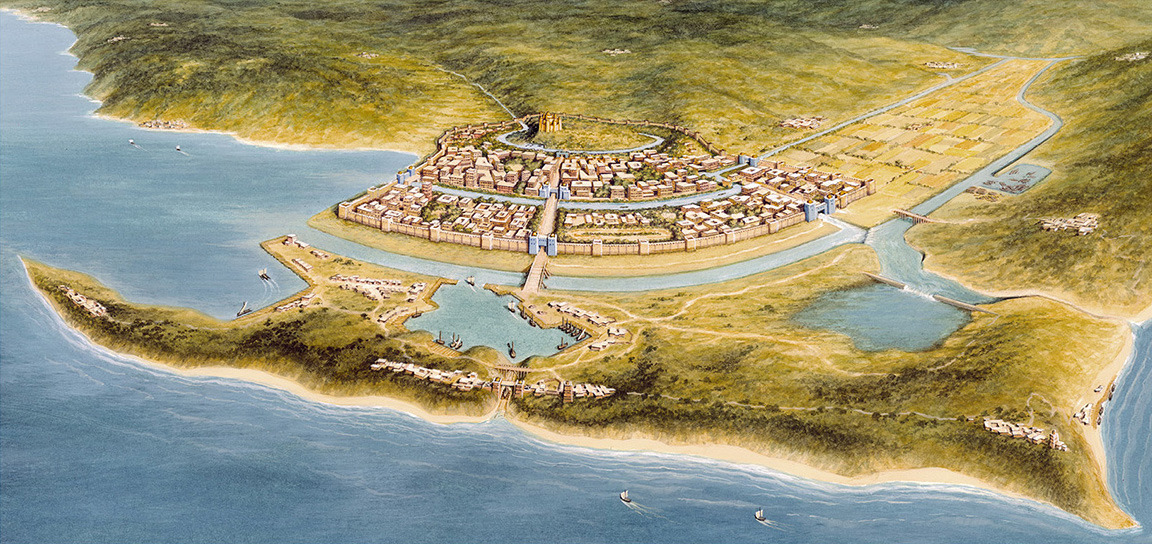
So this is an illustration of how Troy looked like. We think. It is a fascinating perspective, when you read Homer, you can actually imagine where he took liberties and where my imagination failed. Most fascinating.

It's sooooo easy to grow the state son. Nobody will complain as everybody pays for that and somebody else will worry about it. You either manage the beast or somebody else will force you to do this. The leviathan that is the state has to be kept under control. And the best time to do this is when there are boom times. Otherwise you will have to do during bust times.
Read and weep son. Your taxes are going to Greece to fix this issue.
Love
Baba
Top Job Cutter in Greece Worries about Going Too Far - SPIEGEL ONLINE
http://www.spiegel.de/international/europe/top-job-cutter-in-greece-worries-about-going-too-far-a-901234.html
Antonis Manitakis has the most thankless job in Greece. Tasked with slashing the grotesquely bloated public sector, he is hounded by troika officials, reviled by his countrymen and afraid of cutting too deep.
Appearances are deceiving on Klafthmonos Square in downtown Athens. Three imposing bronze statues, the “Monument to National Reconciliation,” shimmer in the bright spring sunshine. But demonstrators at the base of the monument bring to mind the original purpose of the square, the name of which translates into “Lamentation Square.” Until 1911, when the Greek constitution guaranteed all civil servants jobs for life, government bureaucrats who had been let go after a change in government used to come to the square to publicly express their outrage.


there’s a huge amount of context to this quote, but be that as it may, whenever a society starts sucking on the hind tit of society and not taking up individual responsibility, then its destined to be kicked in the proverbials…History is a vast early warning system and it sure does repeat itself…and will keep on doing it…
Kids
Here's the story of a fascinating mythical character. We were in Athens long time back. Kannu was 4 or 5 years old when we were there. It's a beautiful city. I had the most wonderful time there. Lovely food. Great history. Wonderful friends. Great work. And you're surrounded with so so so much history. Walking in the same streets where Aristotle or Plato or Solon or Theseus also walked is an indescribable feeling. I also met god there in a tiny church in Plaka.
We will go there again one day :)
Love
Baba
Theseus - Wikipedia, the free encyclopedia
http://en.wikipedia.org/wiki/Theseus
Here's one of the men who as the leaders of Athens drove it to defeat in the Peloponnesian war.
This kind of leader is quite common son. Populist leaders are very very dangerous. They appeal to the base instincts. And thus seem popular in polls and there are short term gains but the country suffers in the long term. One extreme example is Chavez of Venezuela. Another is ex president Ahmadinejad of Iran. Same with bibi Netanyahu of Israel. And our own David milliband with his stupid idea of price controls on energy bills.
Be wary of people who are like this son. Look at them with the deepest suspicion. Even though David milliband's proposals will help me right now by reducing the electricity bill for 2 years, you and Diya then run the high risk of having no electricity or load shedding. Short term gain for long term pain. Not fun.
Love
Baba
Cleon - Wikipedia, the free encyclopedia
http://en.wikipedia.org/wiki/Cleon
Cleon (English pronunciation: /ˈkliːən/; Greek: Κλέων, Ancient Greek: [kléɔːn], Kleon) (died 422 BCE) was an Athenian statesman and a strategos during thePeloponnesian War. He was the first prominent representative of the commercial class in Athenian politics, although he was an aristocrat himself. Contemporaries Thucydides and Aristophanes represented him as a warmonger and a demagogue.
Contents
Public service
Opposition to Pericles
Cleon first came to notice as an opponent of Pericles in the late 430s through his opposition to Pericles' strategy of refusing battle against the Peloponnesian League invaders in 431 BC. As a result, he found himself acting in concert with the Athenian aristocratic parties, who also had no liking for Pericles. During 430 BC, after the unsuccessful expedition by Pericles to the Peloponnesus, and when the city was devastated by the plague, Cleon headed the opposition to Pericles' rule. At this time, Pericles was accused by Cleon of maladministration of public money, with the result that Pericles was found guilty and removed from office (see Grote's History of Greece, abridged ed., 1907, p. 406, note 1). However, Pericles' setback was temporary and he was soon reinstated.
Rise in popularity
The death of Pericles from the plague in 429 BC left the field clear for new leadership in Athens. Hitherto Cleon had only been a vigorous opposition speaker, a trenchant critic and accuser of state officials, but he now came forward as the professed champion and leader of the democracy and, as a result, dominated Athenian politics. Although rough and unpolished, he was charismatic, being gifted with natural eloquence and a powerful voice, and he knew how to work upon the emotions of the Athenian populace. He strengthened his support amongst the poorer citizens of Athens by increasing the pay of the jurymen, which provided many of the poorer Athenians with a means of livelihood.
The fondness of the Athenians for litigation increased his power; and the practice of "sycophancy" (raking up material for false charges), enabled him to remove those who were likely to endanger his ascendancy. In 426 BC, Cleon brought an unsuccessful prosecution against Laches based on his generalshipin the unsuccessful first Sicilian expedition. This is one of the very few times that an Athenian general escaped civil punishment for a defeat. Having no further use for his former aristocratic associates, he broke off all connection with them, and thus felt at liberty to attack the secret combinations for political purposes, the oligarchical clubs to which they mostly belonged. Whether he also introduced a property-tax for military purposes, and even held a high position in connection with the treasury, is uncertain.
War against Sparta, subsequent death
While studying the destruction of Judah at the hands of the Babylonians, I came across an interesting mention of India. Citron was imported from India to Ancient Persia / Babylon and from there it came to Jerusalem. And then I bumped into those in Sicily. Here’s the wiki entry. Some interesting factoids…
The citron could also be native to India where it borders on Burma, in valleys at the foot of theHimalayas, and in the Indian Western Ghats.[23][24] It is thought that by the time of Theophrastus, the citron was mostly cultivated in the Persian Gulf on its way to the Mediterranean basin, where it was cultivated during the later centuries in different areas as described by Erich Isaac.[25]Many mention the role of Alexander the Great and his armies as they attacked Persia and what is today Pakistan, as being responsible for the spread of the citron westward, reaching the European countries such as Macedonia and Italy.[26] The citron is mentioned in the Torah as being required for ritual use during the Feast of Tabernacles (Lev. 23:40). According to this tradition, the Jews brought it back to Israel from their exile in Egypt, where the Egyptologist and archaeologist Victor Loret claimed to have identified it depicted on the walls of the botanical garden at the Karnak Temple, which dates back to the time of Thutmosis III, approximately 3,000 years ago.[27]
how fascinating, eh? I love this fruit, delicious….and a commentary by Theophrastus..
In the east and south there are special plants... i.e. in Media and Persia there are many types of fruit, between them there is a fruit called Median or Persian Apple. The tree has a leaf similar to and almost identical with that of the andrachn (Arbutus andrachne L.), but has thorns like those of the apios (the wild pear, Pyrus amygdaliformis Vill.) or the firethorn, Cotoneaster pyracantha Spach.), except that they are white, smooth, sharp and strong.
Spines of the Firethorn.
The fruit is not eaten, but is very fragrant, as is also the leaf of the tree; and the fruit is put among clothes, it keeps them from being moth-eaten. It is also useful when one has drunk deadly poison, for when it is administered in wine; it upsets thestomach and brings up the poison. It is also useful to improve the breath, for if one boils the inner part of the fruit in a dish or squeezes it into the mouth in some other medium, it makes the breath more pleasant.
The seed is removed from the fruit and sown in the spring in carefully tilled beds, and it is watered every fourth or fifth day. As soon the plant is strong it is transplanted, also in the spring, to a soft, well watered site, where the soil is not very fine, for it prefers such places.
And it bears its fruit at all seasons, for when some have gathered, the flower of the others is on the tree and is ripening others. Of the flowers I have said[30] those that have a sort of distaff [meaning the pistil] projecting from the middle are fertile, while those that do not have this are sterile. It is also sown, like date palms, in pots punctured with holes.
This tree, as has been remarked, grows in Media and Persia.
So for friends in Europe and USA, when you are squeezing a lemon on yourself or on your dishes, remember the antecedents of this lovely little fruit.
This ancient war son, has had a hold on human history and still has lessons for us. Not just because Thucydides wrote about this war, we've got a copy of the book so do read it when you get a chance, but because it had implications on democracy, ethics etc.
We praise democracy but democratic Athens became a hegemonistic state. Athens protected against the Persian imperial power but it itself became imperial and setup an empire. If you get a chance son, read Kennedy's rise and fall of the great powers.
Sparta, a fascist state which relied on slavery and was heavily militaristic won this war. So the bad guys own and the good guys lost? Turns the usual story of good versus evil on its head no?
But you don't hear about this son. People don't like to hear about facts that don't fit into a narrative. Like the joke I read today. God's good but he allows evil so that you can recognise goodness. Well if that's the case, logically god can be evil who allows good to happen so that you can recognise evil.
Fascinating.
Love
Baba
Peloponnesian War - Wikipedia, the free encyclopedia
http://en.wikipedia.org/wiki/Peloponnesian_War
The Peloponnesian War (431-404 BC) was an ancient Greek war fought byAthens and itsempire against thePeloponnesian League led bySparta. Historians have traditionally divided the war into three phases. In the first phase, the Archidamian War, Sparta launched repeated invasions ofAttica, while Athens took advantage of its naval supremacy to raid the coast of thePeloponneseattempting to suppress signs of unrest in its empire. This period of the war was concluded in 421 BC, with the signing of the Peace of Nicias. That treaty, however, was soon undermined by renewed fighting in the Peloponnese. In 415 BC, Athens dispatched amassive expeditionary force to attack Syracuse in Sicily; the attack failed disastrously, with the destruction of the entire force, in 413 BC. This ushered in the final phase of the war, generally referred to either as the Decelean War, or the Ionian War. In this phase, Sparta, now receiving support from Persia, supported rebellions in Athens' subject states in the Aegean Sea and Ionia, undermining Athens' empire, and, eventually, depriving the city of naval supremacy. The destruction of Athens' fleet at Aegospotami effectively ended the war, and Athens surrendered in the following year.
I popped into the British Museum the other day and I swung by the Parthenon Sculptures to wonder at them.


Here’s one of my most favoured sculptures, came out behind from the East Pediment. These are the Lapith Women. And boyo, do they get me all tingly and excited. Absolutely beautiful and exquisite. I have also seen the Parthenon and whilst I was unable to see the marbles there (the museum in Athens wasn't constructed when I was there late last century), I can see them here.
The argument whether or not the Marbles should be sent back is a difficult one and has been argued for many many moons. Here’s one recent argument which I read. I quote
Lord Elgin’s theft was the most ignoble act of the neo-classical era. Today, his actions seem as redundant and repulsive as slavery and colonialism, and I am being quite serious when I say we should see the Marbles continued presence in London as vestiges of both, for had the Greeks not been enslaved to the Ottomans, they would surely never have allowed this vandalism and theft to take place. I won’t go on - it will be bad for all our blood pressure. But I will just say that there is a moral imperative to try to right the wrongs past, just as Her Majesty’s Government has done by apologising for illegal acts committed in Northern Ireland and Kenya.
As it so happens, I did a small course on Ancient Greece around this time. And I learnt how Athens demanded protection monies from other Greek Cities and then Pericles used the money to beautify Athens with temples and statues including the Parthenon. I quote from Plutarch
But that which brought most delightful adornment to Athens, and the greatest amazement to the rest of mankind; that which alone now testifies for Hellas that her ancient power and splendour, of which so much is told, was no idle fiction, — I mean his construction of sacred edifices, — this, more than all public measures of Pericles, his enemies maligned and slandered. They cried out in the assemblies: "The people has lost its fair fame and is in ill repute because it has removed the public moneys of the Hellenes from Delos into its own keeping,2 and that seemliest of all excuses which it had to urge against its accusers, to wit, that out of fear of the Barbarians it took the public funds p37from that sacred isle and was now guarding them in a stronghold, of this Pericles has robbed it. And surely Hellas is insulted with a dire insult and manifestly subjected to tyranny when she sees that, with her own enforced contributions the war, we are gilding and bedizening our city, which, for all the world like a wanton woman, adds to her wardrobe precious stones and costly statues and temples worth their millions."
3 For his part, Pericles would instruct the people that it owed no account of their moneys to the allies provided it carried on the war for them and kept off the Barbarians; "not a horse do they furnish," said he, "not a ship, not a hoplite, but money simply; 159and this belongs, not to those who give it, but to those who take it, if only they furnish that for which they take it in pay. 4 And it is but meet that the city, when once she is sufficiently equipped with all that is necessary for prosecuting the war, should apply her abundance to such works as, by their completion, will bring her everlasting glory, and while in process of completion will bring that abundance into actual service, in that all sorts of activity and diversified demands arise, which rouse every art and stir every hand, and bring, as it were, the whole city under pay, so that she not only adorns, but supports herself as well from her own resources."
So before people get too excited, this is what the Athenians did.
But then comes the question of if its right for the Brits to gob on to the Marbles. Question is whether its right or wrong in terms of justice. And I was reminded of this when I read the Melian Dialogue. Written by Thucydides in his History of the Peloponnesian War, it talks about the confrontation between Athens and Melos. Melos wanted to be independent but Athens said that questions of justice does not arise between unequal powers, and ended up besieging Melos, killed the men and sold the women and children into slavery. I know Melos wasn't strictly independent as they had relations with the Lacedaemonians or Spartans if you will. Let me quote the operative paragraphs of this discussion.
89. Athenians. For ourselves, we shall not trouble you with specious pretences--either of how we have a right to our empire because we overthrew the Mede, or are now attacking you because of wrong that you have done us--and make a long speech which would not be believed; and in return we hope that you, instead of thinking to influence us by saying that you did not join the Lacedaemonians, although their colonists, or that you have done us no wrong, will aim at what is feasible, holding in view the real sentiments of us both; since you know as well as we do that right, as the world goes, is only in question between equals in power, while the strong do what they can and the weak suffer what they must.
In your face! one of the most famous sentences in the history of human relations and international politics. The British took the marbles and keep it because they can. Greece has to suffer what they must. I am sure the Greeks can appreciate this, eh?
So its going to be interesting to see how this turns out. The Turks and Egyptians have successfully managed to get their antiquities back, no?
A fascinating article by Professor Andrew Szegedy-Maszak. who lead the Ancient Greeks course which I read recently. If you ever wanted to know WHY one should read Homer then this is a great article to read. Great professor and his video lectures were really nice and interesting :)
thank you Professor, really appreciate you taking the time to educate the world!
Kannu
You'll be reading about philosophy and politics and economics at university.
Constitutions are funny old things son. They are what I call as the nation's dreams and hopes captured on paper. They define what the country is. There's a website where all the constitutions of the world are stored. I read this Athenian way back in the 1990's.
The philosophy of the country and how it's trajectory performs can be seen if you check it's constitution. More importantly, although not that visible, are the people who frame the constitution. Usually constitutions are written and framed by the biggest minds in that country and frequently assume mythical characteristics like in India or in USA. Ussr has so many constitutions but it imploded.
Even the first one, like this Athenian one, shows that the first draconian constitution was changed by Solon. Solon the lawgiver created a new constitution (not the link to philosophy and economics by forgoing debt and changing social structures) and assume that the constitution will last for 100 years. It barely lasted few years before a tyrant took over.
The American constitution is perhaps one of the best. It has been the model for so many other constitutions ranging from India to Japan to Germany. Very good. I'll write more about America over the next few years to you.
Think about the European constitution which was one of the latest to be released. A more pathetic constitution cannot be imagined. Another absolutely horrific one was the one which the Egyptian Muslim brotherhood drew up and you know what the sad thing is? The new military arseholes in charge of egypt are going to come up with another garbage constitution. And we in the uk don't have one. Typical.
Fascinating.
The Athenian Constitution
By Aristotle
Commentary: Several comments have been posted uaboutThe Athenian Constitution.
Download: A text-only version is available for download.
The Athenian Constitution
By Aristotle
Written 350 B.C.E
Translated by Sir Frederic G. KenyonTable of Contents
Section 1
![Go to next]()
Part 1
...[They were tried] by a court empanelled from among the noble families, and sworn upon the sacrifices. The part of accuser was taken by Myron. They were found guilty of the sacrilege, and their bodies were cast out of their graves and their race banished for evermore. In view of this expiation, Epimenides the Cretan performed a purification of the city.
Part 2
After this event there was contention for a long time between theupper classes and the populace. Not only was the constitution at this time oligarchical in every respect, but the poorer classes, men, women, and children, were the serfs of the rich. They were known as Pelatae and also as Hectemori, because they cultivated the lands of the rich at the rent thus indicated. The whole country was in the hands of a few persons, and if the tenants failed to pay their rent they were liable to be haled intoslavery, and their children with them. All loans secured upon the debtor's person, a custom which prevailed until the time of Solon, who was the first to appear as the champion of the people. But the hardest and bitterest part of the constitution in the eyes of the masses was their state of serfdom. Not but what they were also discontented with every other feature of their lot; for, to speak generally, they had no part nor share in anything.
Part 3
Now the ancient constitution, as it existed before the time ofDraco, was organized as follows. The magistrates were elected according to qualifications of birth and wealth. At first they governed for life, but subsequently for terms of ten years. The first magistrates, both in date and in importance, were the King, the Polemarch, and the Archon. The earliest of these offices was that of the King, which existed from ancestral antiquity. To this was added, secondly, the office of Polemarch, on account of some of the kings proving feeble in war; for it was on this account that Ion was invited to accept the post on an occasion of pressing need.The last of the three offices was that of the Archon, which most authorities state to have come into existence in the time of Medon. Others assign it to the time of Acastus, and adduce as proof the fact that the nine Archons swear to execute their oaths 'as in the days of Acastus,' which seems to suggest that it was in his time that the descendants of Codrus retired from the kingship in return for the prerogatives conferred upon the Archon.Whichever way it may be, the difference in date is small; but that it was the last of these magistracies to be created is shown by the fact that the Archon has no part in the ancestral sacrifices, as the King and the Polemarch have, but exclusively in those of later origin. So it is only at a comparatively late date that the office of Archon has become of great importance, through the dignity conferred by these later additions. The Thesmothetae were many years afterwards, when these offices had already become annual, with the object that they might publicly record all legaldecisions, and act as guardians of them with a view to determining the issues between litigants. Accordingly their office, alone of those which have been mentioned, was never of more than annual duration.
Such, then, is the relative chronological precedence of these offices. At that time the nine Archons did not all live together. The King occupied the building now known as the Boculium, near the Prytaneum, as may be seen from the fact that even to the present day the marriage of the King's wife to Dionysus takes place there. The Archon lived in the Prytaneum, the Polemarch in the Epilyceum. The latter building was formerly called the Polemarcheum, but after Epilycus, during his term of office as Polemarch, had rebuilt it and fitted it up, it was called the Epilyceum. The Thesmothetae occupied the Thesmotheteum. In the time of Solon, however, they all came together into the Thesmotheteum. They had power to decide cases finally on theirown authority, not, as now, merely to hold a preliminary hearing. Such then was the arrangement of the magistracies. The Council of Areopagus had as its constitutionally assigned duty the protection of the laws; but in point of fact it administered the greater and most important part of the government of the state, and inflicted personal punishments and fines summarily upon all who misbehaved themselves. This was the natural consequenceof the facts that the Archons were elected under qualifications of birth and wealth, and that the Areopagus was composed of those who had served as Archons; for which latter reason the membership of the Areopagus is the only office which has continued to be a life-magistracy to the present day.
Part 4
Such was, in outline, the first constitution, but not very long after the events above recorded, in the archonship of Aristaichmus, Draco enacted his ordinances. Now his constitution had the following form. The franchise was given to all who could furnish themselves with a military equipment. The nine Archons and the Treasurers were elected by this body from persons possessing an unencumbered property of not less than ten minas, the less important officials from those who could furnish themselves with a military equipment, and the generals [Strategi] and commanders of the cavalry [Hipparchi] from those who could show an unencumbered property of not less than a hundred minas, and had children born in lawful wedlock over ten years of age. These officers were required to hold to bail the Prytanes, the Strategi, and the Hipparchi of the preceding year until their accounts had been audited, taking four securities of the same class as that to which the Strategi and the Hipparchi belonged. There was also tobe a Council, consisting of four hundred and one members, elected by lot from among those who possessed the franchise. Both for this and for the other magistracies the lot was cast among those who were over thirty years of age; and no one might hold office twice until every one else had had his turn, after which they were to cast the lot afresh. If any member of the Council failed to attend when there was a sitting of the Council or of the Assembly, he paid a fine, to the amount of three drachmas if hewas a Pentacosiomedimnus, two if he was a Knight, and One if he was a Zeugites. The Council of Areopagus was guardian of the laws, and kept watch over the magistrates to see that they executed their offices in accordance with the laws. Any person who felt himself wronged might lay an information before the Council of Areopagus, on declaring what law was broken by thewrong done to him. But, as has been said before, loans were secured upon the persons of the debtors, and the land was in the hands of a few.
Part 5
Since such, then, was the organization of the constitution, and the many were in slavery to the few, the people rose against the upper class. The strife was keen, and for a long time the two parties were ranged in hostile camps against one another, till at last, by common consent, they appointed Solon to be mediator and Archon, and committed the whole constitution to his hands. The immediate occasion of his appointment was his poem, which begins with the words:
I behold, and within my heart deep sadness has claimed itsplace,
As I mark the oldest home of the ancient Ionian race
Slain by the sword.
In this poem he fights and disputes on behalf of each party in turn against the other, and finally he advises them to come to terms and put an end to the quarrel existing between them. By birth and reputation Solon was one of the foremost men of the day, but in wealth and position he was of the middle class, as is generally agreed, and is, indeed, established by his own evidence in these poems, where he exhorts the wealthy not to be grasping.
But ye who have store of good, who are sated and overflow,
Restrain your swelling soul, and still it and keep it low:
Let the heart that is great within you be trained a lowlier way;
Ye shall not have all at your will, and we will not for ever obey.
Indeed, he constantly fastens the blame of the conflict on the rich; and accordingly at the beginning of the poem he says that he fears 'the love of wealth and an overweening mind', evidently meaning that it was through these that the quarrel arose.
Part 6
As soon as he was at the head of affairs, Solon liberated the people once and for all, by prohibiting all loans on the security of the debtor's person: and in addition he made laws by which he cancelled all debts, public and private. This measure is commonly called the Seisachtheia [= removal of burdens], since thereby the people had their loads removed from them. In connexion with it some persons try to traduce the character of Solon. It so happened that, when he was about to enact the Seisachtheia, he communicated his intention to some members of the upper class, whereupon, as the partisans of the popular party say, his friends stole a march on him; while those who wish to attack his character maintain that he too had a share in thefraud himself. For these persons borrowed money and bought up a large amount of land, and so when, a short time afterwards, all debts were cancelled, they became wealthy; and this, they say, was the origin of the families which were afterwards looked on as having been wealthy from primeval times. However, the story of the popular party is by far the most probable. A man who was so moderate and public-spirited in all his other actions, that when it was within his power to put his fellow-citizens beneath his feetand establish himself as tyrant, he preferred instead to incur the hostility of both parties by placing his honour and the general welfare above his personal aggrandisement, is not likely to have consented to defile his hands by such a petty and palpable fraud. That he had this absolute power is, in the first place, indicated by the desperate condition the country; moreover, he mentions it himself repeatedly in his poems, and it is universally admitted. We are therefore bound to consider this accusation to be false.
Part 7
Next Solon drew up a constitution and enacted new laws; and theordinances of Draco ceased to be used, with the exception of those relating to murder. The laws were inscribed on the wooden stands, and set up in the King's Porch, and all swore to obey them; and the nine Archons made oath upon the stone, declaring that they would dedicate a golden statue if they should transgress any of them. This is the origin of the oath to that effect which they take to the present day. Solon ratified his laws for a hundred years; and the following was the fashion in which he organizedthe constitution. He divided the population according to property into four classes, just as it had been divided before, namely, Pentacosiomedimni, Knights, Zeugitae, and Thetes. The various magistracies, namely, the nine Archons, the Treasurers, the Commissioners for Public Contracts (Poletae), the Eleven, and Clerks (Colacretae), he assigned to the Pentacosiomedimni, the Knights, and the Zeugitae, giving offices to each class in proportion to the value of their rateable property. To who ranked among the Thetes he gave nothing but a place in the Assembly and in the juries. A man had to rank as a Pentacosiomedimnus if he made, from his own land, five hundred measures, whether liquid or solid. Those ranked as Knights who made three hundred measures, or, as some say, those who were able to maintain a horse. In support of the latter definition they adduce the name of the class, which may be supposed to be derived from this fact, and also some votive offerings of early times; for in the Acropolis there is a votive offering, a statue of Diphilus, bearing this inscription:
The son of Diphilus, Athenion hight,
Raised from the Thetes and become a knight,
Did to the gods this sculptured charger bring,
For his promotion a thank-offering. And a horse stands in evidence beside the man, implying that this was what was meant by belonging to the rank of Knight. At the same time it seems reasonable to suppose that this class, like the Pentacosiomedimni, was defined by the possession of anincome of a certain number of measures. Those ranked as Zeugitae who made two hundred measures, liquid or solid; and the rest ranked as Thetes, and were not eligible for any office. Hence it is that even at the present day, when a candidate for any office is asked to what class he belongs, no one would think of saying that he belonged to the Thetes.
Part 8
The elections to the various offices Solon enacted should be bylot, out of candidates selected by each of the tribes. Each tribe selected ten candidates for the nine archonships, and among these the lot was cast. Hence it is still the custom for each tribe to choose ten candidates by lot, and then the lot is again cast among these. A proof that Solon regulated the elections to office according to the property classes may be found in the law still in force with regard to the Treasurers, which enacts that they shall be chosen from the Pentacosiomedimni. Such was Solon's legislation with respect to the nine Archons; whereas in early times the Council of Areopagus summoned suitable persons according to its own judgement and appointed them for the year to the several offices. There were four tribes, as before, and four tribe-kings. Each tribe was divided into three Trittyes [=Thirds], with twelve Naucraries in each; and the Naucraries had officersof their own, called Naucrari, whose duty it was to superintend the current receipts and expenditure. Hence, among the laws of Solon now obsolete, it is repeatedly written that the Naucrari are to receive and to spend out of the Naucraric fund. Solon also appointed a Council of four hundred, a hundred from each tribe; but he assigned to the Council of the Areopagus the duty of superintending the laws, acting as before as the guardian of the constitution in general. It kept watch over the affairs of the state in most of the more important matters, and corrected offenders, with full powers to inflict either fines or personal punishment. The money received in fines it brought up into the Acropolis, without assigning the reason for the mulct. It also tried those who conspired for the overthrow of the state, Solon having enacted a process of impeachment to deal with such offenders. Further, since he saw the state often engaged in internal disputes, while many of the citizens from sheer indifference accepted whatever might turn up, he made a law with express reference to such persons, enacting that any one who, in a time civil factions, did not take up arms with either party, should lose his rights as a citizen and cease to have any part in the state.
Part 9
Such, then, was his legislation concerning the magistracies. There are three points in the constitution of Solon which appear to be its most democratic features: first and most important, the prohibition of loans on the security of the debtor's person; secondly, the right of every person who so willed to claim redress on behalf of any one to whom wrong was being done; thirdly, the institution of the appeal to the jurycourts; and it is to this last, they say, that the masses have owed their strength most of all, since, when the democracy is master of the voting-power, it is master of the constitution. Moreover, since the laws were not drawn up in simple and explicit terms (but like the one concerning inheritances and wards of state), disputes inevitably occurred, and the courts had to decide in every matter, whether public or private. Some persons in fact believe that Solon deliberately made the laws indefinite, in order that the final decision might be in the hands of the people. This, however, is not probable, and the reason no doubt was that it is impossible to attain ideal perfection when framing a law in general terms; for we must judge of his intentions, not from the actual results in the present day, but from the general tenor of the rest of his legislation.
Part 10
These seem to be the democratic features of his laws; but in addition, before the period of his legislation, he carried through his abolition of debts, and after it his increase in the standards of weights and measures, and of the currency. During his administration the measures were made larger than those of Pheidon, and the mina, which previously had a standard ofseventy drachmas, was raised to the full hundred. The standard coin in earlier times was the two-drachma piece. He also made weights corresponding with the coinage, sixty-three minas going to the talent; and the odd three minas were distributed among the staters and the other values.
Part 11
When he had completed his organization of the constitution in themanner that has been described, he found himself beset by people coming to him and harassing him concerning his laws, criticizing here and questioning there, till, as he wished neither to alter what he had decided on nor yet to be an object of ill will to every one by remaining in Athens, he set off on a journey to Egypt, with the combined objects of trade and travel, giving out that he should not return for ten years. He considered that there was no call for him to expound the laws personally, but that everyone should obey them just as they were written. Moreover, his position at this time was unpleasant. Many members of the upper class had been estranged from him on account of his abolition of debts, and both parties were alienated through their disappointment at the condition of things which he had created.The mass of the people had expected him to make a complete redistribution of all property, and the upper class hoped he would restore everything to its former position, or, at any rate, make but a small change. Solon, however, had resisted both classes. He might have made himself a despot by attaching himself to whichever party he chose, but he preferred, though at the cost of incurring the enmity of both, to be the saviour of his country and the ideal lawgiver.
Part 12
The truth of this view of Solon's policy is established alike bycommon consent, and by the mention he has himself made of the matter in his poems. Thus:
I gave to the mass of the people such rank as befitted their need,
I took not away their honour, and I granted naught to their greed;
While those who were rich in power, who in wealth were gloriousand
great,
I bethought me that naught should befall them unworthy their
splendour and state;
So I stood with my shield outstretched, and both were sale in its
sight,
And I would not that either should triumph, when the triumph was
not with right.
Again he declares how the mass of the people ought to be treated: But thus will the people best the voice of their leaders obey, When neither too slack is the rein, nor violence holdeth the sway; For indulgence breedeth a child, the presumption that spurns control,
When riches too great are poured upon men of unbalanced soul.
And again elsewhere he speaks about the persons who wished to redistribute the land: So they came in search of plunder, and their cravings knew no hound, Every one among them deeming endless wealth would here be found. And that I with glozing smoothness hid a cruel mind within. Fondly then and vainly dreamt they; now they raise an angry din, And they glare askancein anger, and the light within their eyes Burns with hostile flames upon me. Yet therein no justice lies. All I promised, fully wrought I with the gods at hand to cheer, Naught beyond in folly ventured. Never to my soul was dear With a tyrant's force to govern, nor to see the good and base Side by side in equal portion share the rich home of our race.
Once more he speaks of the abolition of debts and of those whobefore were in servitude, but were released owing to theSeisachtheia:
Of all the aims for which I summoned forth
The people, was there one I compassed not?
Thou, when slow time brings justice in its train,
O mighty mother of the Olympian gods,
Dark Earth, thou best canst witness, from whose breast
I swept the pillars broadcast planted there,
And made thee free, who hadst been slave of yore.
And many a man whom fraud or law had sold
For from his god-built land, an outcast slave,
I brought again to Athens; yea, and some,
Exiles from home through debt's oppressive load,
Speaking no more the dear Athenian tongue,
But wandering far and wide, I brought again;
And those that here in vilest slavery
Crouched 'neath a master's frown, I set them free.
Thus might and right were yoked in harmony,
Since by the force of law I won my ends
And kept my promise. Equal laws I gave
To evil and to good, with even hand
Drawing straight justice for the lot of each.
But had another held the goad as
One in whose heart was guile and greediness,
He had not kept the people back from strife.
For had I granted, now what pleased the one,
Then what their foes devised in counterpoise,
Of many a man this state had been bereft.
Therefore I showed my might on every side,
Turning at bay like wolf among the hounds.
And again he reviles both parties for their grumblings in the timesthat followed:
Nay, if one must lay blame where blame is due,
Wer't not for me, the people ne'er had set
Their eyes upon these blessings e'en in dreams:-
While greater men, the men of wealthier life,
Should praise me and should court me as their friend. For had any other man, he says, received this exalted post,
He had not kept the people hack, nor ceased
Til he had robbed the richness of the milk.
But I stood forth a landmark in the midst,
And barred the foes from battle.
Part 13
Such then, were Solon's reasons for his departure from the country. After his retirement the city was still torn by divisions. For four years, indeed, they lived in peace; but in the fifth year after Solon's government they were unable to elect an Archon on account of their dissensions, and again four years later they elected no Archon for the same reason. Subsequently, after a similar period had elapsed, Damasias was elected Archon; and he governed for two years and two months, until he was forcibly expelled from his office. After this, it was agreed, as a compromise, to elect ten Archons, five from the Eupatridae, three from the Agroeci, and two from the Demiurgi, and they ruled for the year following Damasias. It is clear from this that the Archon was at the time the magistrate who possessed the greatest power, since it is always in connexion with this office that conflicts are seen to arise. But altogether they were in a continual state of internal disorder. Some found the cause and justification of their discontent in the abolition of debts, because thereby they had been reduced to poverty; others were dissatisfied with the political constitution, because it had undergone a revolutionary change; while with others the motive was found in personalrivalries among themselves. The parties at this time were three in number. First there was the party of the Shore, led by Megacles the son of Alcmeon, which was considered to aim at a moderate form of government; then there were the men of the Plain, who desired an oligarchy and were led by Lycurgus; and thirdly there were the men of the Highlands, at the head of whom wasPisistratus, who was looked on as an extreme democrat. This latter party was reinforced by those who had been deprived of the debts due to them, from motives of poverty, and by those who were not of pure descent, from motives of personal apprehension. A proof of this is seen in the fact that after the tyranny was overthrown a revision was made of the citizen-roll, on the ground that many persons were partaking in the franchise without having a right to it. The names given to the respective parties were derived from the districts in which they held their lands.
Part 14
Pisistratus had the reputation of being an extreme democrat, andhe also had distinguished himself greatly in the war with Megara. Taking advantage of this, he wounded himself, and by representing that his injuries had been inflicted on him by his political rivals, he persuaded the people, through a motion proposed by Aristion, to grant him a bodyguard. After he had got these 'club-bearers', as they were called, he made an attack with them on the people and seized the Acropolis. This happened in the archonship of Comeas, thirty-one years after the legislation of Solon. It is related that, when Pisistratus asked for his bodyguard, Solon opposed the request, and declared that in so doing he proved himself wiser than half the people and braver than the rest,-wiser than those who did not see that Pisistratus designed to make himself tyrant, and braver than those who saw it and kept silence. But when all his words availed nothing he carried forth his armour and set it up in front of his house, saying that he had helped his country so far as lay in his power (he was already avery old man), and that he called on all others to do the same. Solon's exhortations, however, proved fruitless, and Pisistratus assumed the sovereignty. His administration was more like a constitutional government than the rule of a tyrant; but before his power was firmly established, the adherents of Megacles and Lycurgus made a coalition and drove him out. This took place in the archonship of Hegesias, five years after the first establishment of his rule. Eleven years later Megacles, being in difficulties in a party struggle, again opened-negotiations with Pisistratus, proposing that the latter should marry his daughter; and on these terms he brought him back to Athens, by a very primitive and simple-minded device. He first spread abroad a rumour that Athena was bringing back Pisistratus, and then, having found a woman of great stature and beauty, named Phye (according to Herodotus, of the deme of Paeania, but as others say a Thracian flower-seller of the deme of Collytus), he dressed her in a garb resembling that of the goddess and brought her into the city with Pisistratus. The latter drove in on a chariot with the woman beside him, and the inhabitants of the city, struck with awe, received him with adoration.
Part 15
In this manner did his first return take place. He did not, however,hold his power long, for about six years after his return he was again expelled. He refused to treat the daughter of Megacles as his wife, and being afraid, in consequence, of a combination of the two opposing parties, he retired from the country. First he led a colony to a place called Rhaicelus, in the region of the Thermaic gulf; and thence he passed to the country in the neighbourhood of Mt. Pangaeus. Here he acquired wealth and hired mercenaries; and not till ten years had elapsed did he return to Eretria and make an attempt to recover the government by force. In this he had the assistance of many allies, notably the Thebans and Lygdamis of Naxos, and also the Knights who held the supreme power in the constitution of Eretria. After his victory in the battle at Pallene he captured Athens, and when he had disarmed the people he at last had his tyranny securelyestablished, and was able to take Naxos and set up Lygdamis as ruler there. He effected the disarmament of the people in the following manner. He ordered a parade in full armour in the Theseum, and began to make a speech to the people. He spoke for a short time, until the people called out that they could not hear him, whereupon he bade them come up to the entrance of theAcropolis, in order that his voice might be better heard. Then, while he continued to speak to them at great length, men whom he had appointed for the purpose collected the arms and locked them up in the chambers of the Theseum hard by, and came and made a signal to him that it was done. Pisistratus accordingly, when he had finished the rest of what he had to say, told the people also what had happened to their arms; adding that they were not to be surprised or alarmed, but go home and attend to their private affairs, while he would himself for the future manage all the business of the state.
Part 16
Such was the origin and such the vicissitudes of the tyranny ofPisistratus. His administration was temperate, as has been said before, and more like constitutional government than a tyranny. Not only was he in every respect humane and mild and ready to forgive those who offended, but, in addition, he advanced money to the poorer people to help them in their labours, so that they might make their living by agriculture. In this he had two objects, first that they might not spend their time in the city but might be scattered over all the face of the country, and secondly that, being moderately well off and occupied with their own business, theymight have neither the wish nor the time to attend to public affairs. At the same time his revenues were increased by the thorough cultivation of the country, since he imposed a tax of one tenth on all the produce. For the same reasons he instituted the local justices,' and often made expeditions in person into the country to inspect it and to settle disputes between individuals, that they might not come into the city and neglect their farms. It was in one of these progresses that, as the story goes, Pisistratus had his adventure with the man of Hymettus, who was cultivating the spotafterwards known as 'Tax-free Farm'. He saw a man digging and working at a very stony piece of ground, and being surprised he sent his attendant to ask what he got out of this plot of land. 'Aches and pains', said the man; 'and that's what Pisistratus ought to have his tenth of'. The man spoke without knowing who his questioner was; but Pisistratus was so leased with his frank speech and his industry that he granted him exemption from all taxes. And so in matters in general he burdened the people as little as possible with his government, but always cultivated peace and kept them in all quietness. Hence the tyranny of Pisistratus was often spoken of proverbially as 'the age of gold'; for when his sons succeeded him the government became much harsher. But most important of all in this respect was his popular and kindly disposition. In all things he was accustomed to observe the laws, without giving himself any exceptional privileges. Once he was summoned on a charge of homicide before the Areopagus, andhe appeared in person to make his defence; but the prosecutor was afraid to present himself and abandoned the case. For these reasons he held power long, and whenever he was expelled he regained his position easily. The majority alike of the upper class and of the people were in his favour; the former he won by his social intercourse with them, the latter by the assistance which he gave to their private purses, and his nature fitted him to win the hearts of both. Moreover, the laws in reference to tyrants at that time in force at Athens were very mild, especially the one whichapplies more particularly to the establishment of a tyranny. The law ran as follows: 'These are the ancestral statutes of the Athenians; if any persons shall make an attempt to establish a tyranny, or if any person shall join in setting up a tyranny, he shall lose his civic rights, both himself and his whole house.'
Part 17
Thus did Pisistratus grow old in the possession of power, and hedied a natural death in the archonship of Philoneos, three and thirty years from the time at which he first established himself as tyrant, during nineteen of which he was in possession of power; the rest he spent in exile. It is evident from this that the story is mere gossip which states that Pisistratus was the youthful favourite of Solon and commanded in the war against Megara for the recovery of Salamis. It will not harmonize with their respectiveages, as any one may see who will reckon up the years of the life of each of them, and the dates at which they died. After the death of Pisistratus his sons took up the government, and conducted it on the same system. He had two sons by his first and legitimate wife, Hippias and Hipparchus, and two by his Argive consort, Iophon and Hegesistratus, who was surnamed Thessalus. For Pisistratus took a wife from Argos, Timonassa, the daughter of a man of Argos, named Gorgilus; she had previously been the wife of Archinus of Ambracia, one of the descendants of Cypselus. This was the origin of his friendship with the Argives, on account of which a thousand of them were brought over by Hegesistratus and fought on his side in the battle at Pallene. Some authorities say that this marriage took place after his first expulsion from Athens, others while he was in possession of the government.
Part 18
Hippias and Hipparchus assumed the control of affairs on grounds alike of standing and of age; but Hippias, as being also naturally of a statesmanlike and shrewd disposition, was really the head of the government. Hipparchus was youthful in disposition, amorous, and fond of literature (it was he who invited to Athens Anacreon, Simonides, and the other poets), while Thessalus was much junior in age, and was violent and headstrong in his behaviour. It was from his character that all the evils arose which befell the house. He became enamoured of Harmodius, and, since he failed to win his affection, he lost all restraint upon his passion, and in addition to other exhibitions of rage he finally prevented the sister of Harmodius from taking the part of a basket-bearer in the Panathenaic procession, alleging as his reason that Harmodius was a person of loose life. Thereupon, in a frenzy of wrath, Harmodius and Aristogeiton did their celebrated deed, in conjunction with a number of confederates. But while they were lying in wait for Hippias in the Acropolis at the time of the Panathenaea (Hippias, at this moment, was awaiting the arrival of the procession, while Hipparchus was organizing its dispatch) they saw one of the persons privy to the plot talking familiarly with him. Thinking that he was betraying them, and desiring to do something before they were arrested, they rushed down and made their attempt without waiting for the rest of their confederates. They succeeded in killing Hipparchus near the Leocoreum while he was engaged in arranging the procession, but ruined the design as a whole; of the two leaders, Harmodius was killed on the spot by the guards, while Aristogeiton was arrested, and perished later after suffering long tortures. While under the torture he accused many persons who belonged by birth to the most distinguished families and were also personal friends of the tyrants. At first the governmentcould find no clue to the conspiracy; for the current story, that Hippias made all who were taking part in the procession leave their arms, and then detected those who were carrying secret daggers, cannot be true, since at that time they did not bear arms in the processions, this being a custom instituted at a later period by the democracy. According to the story of the popular party, Aristogeiton accused the friends of the tyrants with the deliberate intention that the latter might commit an impious act, and at the same time weaken themselves, by putting to death innocent men who were their own friends; others say that he told no falsehood, but was betraying the actual accomplices. At last, when for all his efforts he could not obtain release by death, he promised to give further information against a number of other persons; and, having induced Hippias to give him his hand to confirm his word, as soon as he had hold of it he reviled him for giving his hand to the murderer of his brother, till Hippias, in a frenzy of rage, lost control of himself and snatched out his dagger and dispatchedhim.
Part 19
After this event the tyranny became much harsher. In consequence of his vengeance for his brother, and of the execution and banishment of a large number of persons, Hippias became a distrusted and an embittered man. About three years after the death of Hipparchus, finding his position in the city insecure, he set about fortifying Munichia, with the intention of establishing himself there. While he was still engaged on this work, however, he was expelled by Cleomenes, king of Lacedaemon, in consequence of the Spartans being continually incited by oracles to overthrow the tyranny. These oracles were obtained in the following way. The Athenian exiles, headed by the Alcmeonidae, could not by their own power effect their return, but failed continually in their attempts. Among their other failures, theyfortified a post in Attica, Lipsydrium, above Mt. Parnes, and were there joined by some partisans from the city; but they were besieged by the tyrants and reduced to surrender. After this disaster the following became a popular drinking song:
Ah! Lipsydrium, faithless friend!
Lo, what heroes to death didst send,
Nobly born and great in deed!
Well did they prove themselves at need
Of noble sires a noble seed.
Having failed, then, in very other method, they took the contractfor rebuilding the temple at Delphi, thereby obtaining ample funds, which they employed to secure the help of the Lacedaemonians. All this time the Pythia kept continually enjoining on the Lacedaemonians who came to consult the oracle, that they must free Athens; till finally she succeeded in impelling the Spartans to that step, although the house of Pisistratus was connected with them by ties of hospitality. The resolution of the Lacedaemonians was, however, at least equally due to the friendship which had been formed between the house of Pisistratus and Argos. Accordingly they first sent Anchimolus by sea at the head of an army; but he was defeated and killed,through the arrival of Cineas of Thessaly to support the sons of Pisistratus with a force of a thousand horsemen. Then, being roused to anger by this disaster, they sent their king, Cleomenes, by land at the head of a larger force; and he, after defeating the Thessalian cavalry when they attempted to intercept his march into Attica, shut up Hippias within what was known as the Pelargic wall and blockaded him there with the assistance of theAthenians. While he was sitting down before the place, it so happened that the sons of the Pisistratidae were captured in an attempt to slip out; upon which the tyrants capitulated on condition of the safety of their children, and surrendered the Acropolis to the Athenians, five days being first allowed them to remove their effects. This took place in the archonship of Harpactides, after they had held the tyranny for about seventeen years since their father's death, or in all, including the period of their father's rule, for nine-and-forty years.
Part 20
After the overthrow of the tyranny, the rival leaders in the statewere Isagoras son of Tisander, a partisan of the tyrants, and Cleisthenes, who belonged to the family of the Alcmeonidae. Cleisthenes, being beaten in the political clubs, called in the people by giving the franchise to the masses. Thereupon Isagoras, finding himself left inferior in power, invited Cleomenes, who was united to him by ties of hospitality, to return to Athens, and persuaded him to 'drive out the pollution', a plea derived from the fact that the Alcmeonidae were suppposed to be under the curse of pollution. On this Cleisthenes retired from the country, and Cleomenes, entering Attica with a small force, expelled, as polluted, seven hundred Athenian families. Having effected this, he next attempted to dissolve the Council, and to set up Isagoras and three hundred of his partisans as the supreme power in the state. The Council, however, resisted, the populace flocked together, and Cleomenes and Isagoras, with their adherents,took refuge in the Acropolis. Here the people sat down and besieged them for two days; and on the third they agreed to let Cleomenes and all his followers de art, while they summoned Cleisthenes and the other exiles back to Athens. When the people had thus obtained the command of affairs, Cleisthenes was their chief and popular leader. And this was natural; for the Alcmeonidae were perhaps the chief cause of the expulsion of the tyrants, and for the greater part of their rule were at perpetual war with them. But even earlier than the attempts of the Alcmeonidae, one Cedon made an attack on the tyrants; when there came another popular drinking song, addressed to him:
Pour a health yet again, boy, to Cedon; forget not this duty to do,
If a health is an honour befitting the name of a good man and true.
Part 21
The people, therefore, had good reason to place confidence in Cleisthenes. Accordingly, now that he was the popular leader, three years after the expulsion of the tyrants, in the archonship of Isagoras, his first step was to distribute the whole population into ten tribes in place of the existing four, with the object of intermixing the members of the different tribes, and so securing that more persons might have a share in the franchise. From this arose the saying 'Do not look at the tribes', addressed to thosewho wished to scrutinize the lists of the old families. Next he made the Council to consist of five hundred members instead of four hundred, each tribe now contributing fifty, whereas formerly each had sent a hundred. The reason why he did not organize the people into twelve tribes was that he might not have to use the existing division into trittyes; for the four tribes had twelve trittyes, so that he would not have achieved his object of redistributing the population in fresh combinations. Further, he divided the country into thirty groups of demes, ten from the districts about the city, ten from the coast, and ten from the interior. These he called trittyes; and he assigned three of them by lot to each tribe, in such a way that each should have one portion in each of these three localities. All who lived in any given deme he declared fellow-demesmen, to the end that the new citizens might not be exposed by the habitual use of family names, but that men might be officially described by the names of their demes; and accordingly it is by the names of their demes that the Athenians speak of one another. He also instituted Demarchs, who had the same duties as the previously existing Naucrari,-the demes being made to take the place of the naucraries. He gave names to the demes, some from the localities to which they belonged, some from the persons who founded them, since some of the areas no longer corresponded to localities possessing names. On the other hand he allowed every one to retain his family and clan and religious rites according to ancestral custom. The names given to the tribes were the ten which the Pythia appointed out of the hundred selected national heroes.
Part 22
By these reforms the constitution became much more democratic than that of Solon. The laws of Solon had been obliterated by disuse during the period of the tyranny, while Cleisthenes substituted new ones with the object of securing the goodwill of the masses. Among these was the law concerning ostracism. Four year after the establishment of this system, in the archonship of Hermocreon, they first imposed upon the Council of Five Hundred the oath which they take to the present day. Next they began to elect the generals by tribes, one from each tribe, while the Polemarch was the commander of the whole army. Then, eleven years later, in the archonship of Phaenippus they won the battle of Marathon; and two years after this victory, when the people had now gained self-confidence, they for the first time made use of the law of ostracism. This had originally been passed as a precaution against men in high office, because Pisistratus took advantage of his position as a popular leader and general to make himself tyrant; and the first person ostracized was one of his relatives, Hipparchus son of Charmus, of the deme of Collytus, the very person on whose account especially Cleisthenes had enacted the law, as he wished to get rid of him. Hitherto, however, he had escaped; for the Athenians, with the usual leniency of the democracy, allowed all the partisans of the tyrants, who had not joined in their evil deeds in the time of the troubles to remain in the city; and the chief and leader of these was Hipparchus. Then in the very next year, in the archonship of Telesinus, they for the first time since the tyranny elected, tribe by tribe, the nine Archons by lot out of the fivehundred candidates selected by the demes, all the earlier ones having been elected by vote; and in the same year Megacles son of Hippocrates, of the deme of Alopece, was ostracized. Thus for three years they continued to ostracize the friends of the tyrants, on whose account the law had been passed; but in the following year they began to remove others as well, including any one who seemed to be more powerful than was expedient. The first person unconnected with the tyrants who was ostracized was Xanthippus son of Ariphron. Two years later, in the archonship of Nicodemus, the mines of Maroneia were discovered, and the state made a profit of a hundred talents from the working of them. Some persons advised the people to make a distribution of the money among themselves, but this was prevented by Themistocles. He refused to say on what he proposed to spend the money, but he bade them lend it to the hundred richest men in Athens, one talent to each, and then, if the manner in which it was employed pleased the people, the expenditure should be charged to the state, but otherwise the state should receive the sum back from those to whom it was lent. On these terms he received the money and with it he had a hundred triremes built, each of the hundred individuals building one; and it was with these ships that they fought the battle of Salamis against the barbarians. About this time Aristides the son of Lysimachus was ostracized. Three years later, however, in the archonship of Hypsichides, all the ostracized persons were recalled, onaccount of the advance of the army of Xerxes; and it was laid down for the future that persons under sentence of ostracism must live between Geraestus and Scyllaeum, on pain of losing their civic rights irrevocably.


