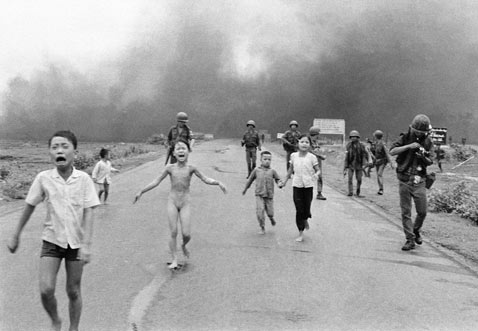
This is a difficult moral and ethical question son. And made me think. When you read the two examples quoted, leaving aside the legal points, I'm afraid I would have pulled the trigger in both cases. Just because a child is at rest doesn't mean the gun on his side will not be picked up.
A boy was recently killed in USA. He was playing with a toy pistol which looks exactly like a real one. And somebody called the police. Who came in and almost immediately shot the boy. You can say the police are trigger happy. Or racist (the boy was black). But the question arises, where do you draw the line.
Think about another problem with age. You were able to join the army by 16. But you aren't allowed to vote. So you can kill for your country but you can't vote for your leaders. Bit inconsistent eh? So the Tories are bothered by not wanting the voting age for the brexit referendum to be reduced. Why? Stupid excuses.
Something to think about.
Love
Baba
Targeting Child Soldiers
http://www.ejiltalk.org/targeting-child-soldiers/
(via Instapaper)
A boy was recently killed in USA. He was playing with a toy pistol which looks exactly like a real one. And somebody called the police. Who came in and almost immediately shot the boy. You can say the police are trigger happy. Or racist (the boy was black). But the question arises, where do you draw the line.
Think about another problem with age. You were able to join the army by 16. But you aren't allowed to vote. So you can kill for your country but you can't vote for your leaders. Bit inconsistent eh? So the Tories are bothered by not wanting the voting age for the brexit referendum to be reduced. Why? Stupid excuses.
Something to think about.
Love
Baba
Targeting Child Soldiers
http://www.ejiltalk.org/targeting-child-soldiers/
(via Instapaper)
Despite the numerous volume on child soldiers in legal literature over the last few decades, very little has been said on targeting child soldiers. It seems to be something international lawyers would rather not talk about. The fact that legal literature doesn't say much about targeting child soldiers doesn't mean that no such practice exists, or that soldiers haven't discuss the matter. In 2002, the US Marine Corps Warfighting Laboratory organised a 'Cultural Intelligence Seminar' on the implication of child soldiering for US forces. One trigger for that discussion was the fact that the very first US soldier killed in Afghanistan reportedly was a Special Forces Sergeant shot by a 14-year-old boy. The year before, in Sierra Leone, a squad from the Royal Irish Regiment was taken prisoner by a group consisting mostly of armed children called the West Side Boys, as the British soldiers were hesitant to open fire. After they had been held hostage for two weeks, an assault was launched by an SAS unit supported by suppression fire from helicopters, leading to between 25 to 150 dead among the West Side Boys. Finally, during the civil war in Sri Lanka, a Government aircraft bombed what was deemed an LTTE training camp, killing a reported 61 minors, mostly girls. Although the LTTE was widely known to use child soldiers, and the specific facts were contested, the Sri Lanka Government was adamant that if a child took up arms, then he or she could be targeted and killed.
The phenomenon of child soldiers remains widespread, and their activities does include direct participation in hostilities. It is imperative that international humanitarian law provide guidance as to what opposing forces can do if they are confronted with that reality. In this piece, I suggest that there are elements in international humanitarian law that support adapting a child-specific approach to targeting. Under this approach, the fact that a potential target is a child should prima facie raise a doubt as to whether he or she is targetable. Although the doubt may be dissipated in light of available facts, overcoming the presumption of civilian status might require more than would be the case for an adult. In addition, even if a child is deemed targetable, the allowable means and methods must nevertheless reflect the protected status of children in international law.
Direct participation in hostilities for kids
The issue of targeting child soldiers raises two distinct legal questions: first, whether child soldiers are combatants like any other combatants and, second, if so whether the means used to target then follow the same rules as for adult combatants.
In order to discuss this, it is useful to consider two scenarios as ideal-type situations that give rise to the legal regulation of the targeting of child soldiers: a first scenario corresponds to a minor enrolled in the FARC rebels in Colombia, wearing a uniform, spotted by a government drone while having a nap against a tree, his gun lying next to him. A second scenario is one of a child wearing civilian clothes running towards government troops firing an AK 47 in the context of the civil war in Uganda. . In one case as in the other, can the government forces targets the child as if he or she were an adult?
Are these two child soldiers to be considered combatants under accepted principles of international humanitarian law? The starting points are articles 4(A) of the 1949 Third Geneva Convention and article 43 of the 1977 Additional Protocol I, which provides for the definitional elements of what a combatant is under international humanitarian law, albeit overtly in the context of an international armed conflict. If a child is enrolled in the armed forces of a party to an international armed conflict, there seems to be no apparent basis in current international humanitarian law to characterize that child as anything other than as a combatant. For a non-international armed conflict, which would correspond to the situations in Uganda and Colombia that I provided as my two ideal-type scenarios, the legal concept of the combatant is contested. Article 1 of Protocol I defines the scope of application of the protocol as covering only conflicts between the states armed forces and "dissident armed forces or other organized armed groups", which implies that there is a legal concept of insurgent armed forces. Seeing this, it is possible that a child may be fully incorporated into the insurgent armed forces and, as such, be a 'regular' fighter on a footing prima facie equal to other armed participants in a non-international armed conflict. According to the ICRC Interpretive Guidance on Direct Participation in Hostilities, individuals who can be said to have a "continuous combat function" are not civilians in non-international armed conflict, and can therefore be targeted. There is nothing in the Interpretive Guidance that suggests that children cannot have a continuing combat function and, as a result, be combatants. In a short post, Frédéric Mégret suggests that children should be considered as non-combatant members of the armed forces and not targeted unless they are directly participating in hostilities, implying that there would be no continuous function possibility for children. The underlying assumption seems to be that, because of their age, children can never become combatant in the full sense of the concept. Somehow, that does not appear to square with the reality in the field in many armed conflicts in which, as with the West Side Boys unit in Liberia, children can become ruthless fighters on a strategic footing equal to adults. There may be space in international humanitarian law to reflect an imperative to treat child soldiers differently than adult ones, as I will suggest shortly, but not in the impossibility that a child may have a continuous combat function or, for that matter, be a member of the armed forces.
A somewhat different approach can be taken by inquiring whether a child is directly participating in hostilities. The standard is expressed as regards international armed conflicts in article 51(3) of Protocol I, and for non-international armed conflicts in Common Article 3 of the 1949 Geneva Conventions and Article 13 of Protocol II. According to the approach adopted by the ICRC in its Interpretive Guidance, individuals who do not have a continuous combat function are therefore to be seen as civilians that may temporarily lose their entitlement to protection against targeting. For individuals in this class, direct participation refers to a specific act that meets three distinct criteria: a threshold of harm, linked to the likely effect of the act on the enemy; direct causation, linking the civilian act to that harm; and a belligerent nexus, intentionally linking the act and harm to the conflict. According to this approach, an individual who is not a member of the armed forces or a fighter in an armed group remains a civilian entitled to protection against targeting, except for the time that this individual engages in acts that meet the three elements of direct participation as defined by the Interpretive Guidance. This 'revolving door' approach has been challenged by some as not flowing from accepted treaty and customary humanitarian law. Be that as it may, there is nothing in any of these elements that connects in a particular manner with children. This aligns with the 2015 US Law of War Manual which states that "whether a civilian is considered to be taking a direct part in hostilities does not depend on that person's age" (§4.20.5.3). Decisions of the International Criminal Court and Special Court for Sierra Leone on the crime of recruiting and using child soldiers have confirmed, in that context, that children can directly participate in hostilities, and indeed have adopted a broad approach to participation. Although these courts did not articulate any ensuing consequences as regard the targeting of such children, they would seem to logically follow. Indeed, the ICRC explicitly confirms this in the commentary to the Interpretive Guidance, finding that "Children below the recruitment age may lose protection against direct attack" (page 60).
It bears noting that the recruitment age cut-off referred to in the Interpretive Guidance is 15 years old, as provided in article 77(2) of Protocol I, article 4(3)(c) of Protocol II, and Rule 137 of the ICRC study on customary law. Indeed, the structure of article 77 of Protocol I mirrors the general approach to the targeting of child soldiers under international humanitarian law: a first paragraph proclaims a duty to respect and protect children in armed conflicts; a second paragraph declares a duty of the belligerents not to enroll or involve children in hostilities; and three further paragraphs specify special protection for children that have been detained after taking direct part in hostilities. Perhaps as a lingering remnants of the distinction between Hague and Geneva law, international humanitarian law elides entirely the middle phase in which the child is taking active part in hostilities.
It was suggested by the author of one volume on child soldiers that children are 'civilian by nature'. There seems to be no basis for such a view. Upon closer consideration of applicable law, it appears that children can be combatants in largely the same way that an adult can. I offer this qualified statement to suggest that despite the analysis offered up to now, there are elements in international humanitarian law that support adapting a child-specific approach to targeting. Article 50(1) of Protocol I provides that "[i]n case of doubt whether a person is a civilian, that person shall be considered to be a civilian." It is not unreasonable to offer that, as regards the application of both the continuous combat function and 'revolving door' principles, the fact that the individual in question is a child should prima facie raise a doubt as to whether he or she is targetable. That doubt may be dissipated in light of facts available to those making a determination of the targetability of the child in question, but it requires that a presumption of civilian status be overcome, in a manner that would not obtain for an adult. For the three elements listed in the Interpretive Guidance as constituting direct participation, this presumption would imply that the threshold of harm, the direct causation, and the nexus to the conflict are not met unless the facts are sufficiently clear to overcome the presumption that a child is not directly participating. Likewise, a presumption in favour of the civilian character of children would structure the understanding of what is required for a child combatant to unambiguously opt out or withdraw from direct participation in hostilities, lowering the evidentiary threshold that corresponds to a conclusion that a child has regained a civilian status. For example, an adult fighter in uniform running away from battle may not be considered as unambiguously opting out of hostilities, as this could be a mere strategic fallback, but that same behaviour by a child fighter would meet a lower threshold.
In conclusion on this point, direct participation in hostilities for kids does not exclude the possibility that a child may be a combatant, either continuously or periodically, but the test is comparatively more restrictive than for adults as a reflection of the presumption that children are civilians.
Means and ends
The fact that a child soldier can be a combatant or a civilian taking direct part in hostilities implies that this child soldier can be directly targeted. The conclusion that it is lawful to directly target child soldiers does not necessarily entail that it is lawful to target them as if they were adult soldiers. Here again, the moral intuition that children remain children even if they take direct part in hostilities has an impact on applicable legal standards.
The starting point is the principle that, even in war, a belligerent's right to injure its enemy is not unlimited. More specifically, treaty and customary international law proscribe superfluous injury and unnecessary suffering (Art. 35, Protocol I). In a general manner, this is taken as a statement that the injury and suffering that is lawful under international humanitarian law is limited by what is necessary to achieve a military objective. As a foundational statement of the laws of war, this principle has acted as the basis for the specific prohibition of a number of weapons over the last century and a half, including the prohibition of dum-dum bullets, poison, blinding lasers, anti-personnel landmines, etc. But the principle is offered in Protocol I as a broad rule that is meant to have an effect on the lawfulness of means and methods of war generally, and not merely as a basis for a decision by states to regulate specific weapons by way of subsequent agreement. At its broadest, the norm against superfluous injury and unnecessary suffering calls for an appreciation of the necessary use of any means or methods of war in every case, to balance the military advantage against the injury and suffering caused in the operation. Authors likes Dinstein and Meyrowitz have challenged the suitability of a balancing approach in this context, arguing that the principle does not call to import here a balancing that is required only in relation to the impact of an attack on civilians. Still, this suggests that if available means and methods of warfare can achieve the same military advantage while causing a lesser degree of injury or suffering, then international humanitarian law requires that they be used. For example, if a military radar station must be disabled in order to prevent detection of a military operation, and this can be achieved either by kinetic means (bombing the station) or cyberwarfare (a virus attack to disable the computers running the radar), then the latter option must be selected. This finds some support in Art 52(2) of Protocol I which restricts military objectives to those the destruction of which brings a definite military advantage. What could be termed the 'most favoured weapons' doctrine can be extended even further, to suggest that if it is possible to wound instead of killing, or to capture instead of wounding (or killing), then that must be done. Whether international humanitarian law really confers upon belligerent a licence to kill enemy combatants, and whether the rules are different in international and non-international armed conflicts, has generated an intense debate (on 'capture or kill', see eg the contributions of Melzer, Hays Parks, Schmitt, Goodman, Kretzmer).
What I want to suggest is that, regardless of the validity of a general duty to use the least injurious means or method of warfare in any category of armed conflict, such a duty ought to obtain when directing an attack against child soldiers who qualify as combatants or as taking direct part in hostilities. It speaks to the moral intuition that, even in the context of war, the intentional targeting of children is a calamity. In law, it reflects the multiple norms in international humanitarian law and international human rights that demand special protection for children against harm. A duty to use the least injurious means or method of warfare against a child soldier can find some support in the French version of the prohibition of superfluous injury and unnecessary suffering, which speaks of maux superflus. As noted by several authors, the French is actually the original, taken from the 1868 St-Petersburg Declaration and later reproduced in the 1899 and 1907 Hague Regulations. The notion of maux superflus appears broader than its English translation, in that maux can be taken to refer not only to injury or suffering, but also to an evil; indeed, the idea of a mal superflu necessarily evokes its pendant, the mal nécessaire. In other words, war may be a necessary evil, but evils unnecessary for the pursuit of the legitimate aims of war (also defined in the St-Petersburg Declaration) are illegitimate. Returning to child soldiers, direct targeting can be considered permissible only to the extent that it is a necessary evil, meaning that no viable option can be identified and that there is a tangible military necessity for this attack, otherwise it violates the treaty and customary prohibition of superfluous injury and unnecessary suffering.
To go back to the two scenarios I sketched at the start, it seems quite clear that a child fighter with the LRA running towards government troops while firing an AK47 can be directly targeted using lethal force. It seems unlikely that there is another way to stop the attack that involves merely wounding or capturing a child soldier in this context. The second scenario of a drone spotting a FARC child soldier in uniform taking a nap, on the other hand, demands that the specific military advantage of targeting this child be clearly demonstrated and, if that can be done, that there is no available alternative that would be less harmful to this child while maintaining the military advantage.
The aim of this approach is to avoid the pitfalls of moralising idealism and ruthless instrumentalism, to reflect both the reality that child soldiers can sometimes present a direct and significant threat and the moral impulse to try to shield children from war as much as possible.
The phenomenon of child soldiers remains widespread, and their activities does include direct participation in hostilities. It is imperative that international humanitarian law provide guidance as to what opposing forces can do if they are confronted with that reality. In this piece, I suggest that there are elements in international humanitarian law that support adapting a child-specific approach to targeting. Under this approach, the fact that a potential target is a child should prima facie raise a doubt as to whether he or she is targetable. Although the doubt may be dissipated in light of available facts, overcoming the presumption of civilian status might require more than would be the case for an adult. In addition, even if a child is deemed targetable, the allowable means and methods must nevertheless reflect the protected status of children in international law.
Direct participation in hostilities for kids
The issue of targeting child soldiers raises two distinct legal questions: first, whether child soldiers are combatants like any other combatants and, second, if so whether the means used to target then follow the same rules as for adult combatants.
In order to discuss this, it is useful to consider two scenarios as ideal-type situations that give rise to the legal regulation of the targeting of child soldiers: a first scenario corresponds to a minor enrolled in the FARC rebels in Colombia, wearing a uniform, spotted by a government drone while having a nap against a tree, his gun lying next to him. A second scenario is one of a child wearing civilian clothes running towards government troops firing an AK 47 in the context of the civil war in Uganda. . In one case as in the other, can the government forces targets the child as if he or she were an adult?
Are these two child soldiers to be considered combatants under accepted principles of international humanitarian law? The starting points are articles 4(A) of the 1949 Third Geneva Convention and article 43 of the 1977 Additional Protocol I, which provides for the definitional elements of what a combatant is under international humanitarian law, albeit overtly in the context of an international armed conflict. If a child is enrolled in the armed forces of a party to an international armed conflict, there seems to be no apparent basis in current international humanitarian law to characterize that child as anything other than as a combatant. For a non-international armed conflict, which would correspond to the situations in Uganda and Colombia that I provided as my two ideal-type scenarios, the legal concept of the combatant is contested. Article 1 of Protocol I defines the scope of application of the protocol as covering only conflicts between the states armed forces and "dissident armed forces or other organized armed groups", which implies that there is a legal concept of insurgent armed forces. Seeing this, it is possible that a child may be fully incorporated into the insurgent armed forces and, as such, be a 'regular' fighter on a footing prima facie equal to other armed participants in a non-international armed conflict. According to the ICRC Interpretive Guidance on Direct Participation in Hostilities, individuals who can be said to have a "continuous combat function" are not civilians in non-international armed conflict, and can therefore be targeted. There is nothing in the Interpretive Guidance that suggests that children cannot have a continuing combat function and, as a result, be combatants. In a short post, Frédéric Mégret suggests that children should be considered as non-combatant members of the armed forces and not targeted unless they are directly participating in hostilities, implying that there would be no continuous function possibility for children. The underlying assumption seems to be that, because of their age, children can never become combatant in the full sense of the concept. Somehow, that does not appear to square with the reality in the field in many armed conflicts in which, as with the West Side Boys unit in Liberia, children can become ruthless fighters on a strategic footing equal to adults. There may be space in international humanitarian law to reflect an imperative to treat child soldiers differently than adult ones, as I will suggest shortly, but not in the impossibility that a child may have a continuous combat function or, for that matter, be a member of the armed forces.
A somewhat different approach can be taken by inquiring whether a child is directly participating in hostilities. The standard is expressed as regards international armed conflicts in article 51(3) of Protocol I, and for non-international armed conflicts in Common Article 3 of the 1949 Geneva Conventions and Article 13 of Protocol II. According to the approach adopted by the ICRC in its Interpretive Guidance, individuals who do not have a continuous combat function are therefore to be seen as civilians that may temporarily lose their entitlement to protection against targeting. For individuals in this class, direct participation refers to a specific act that meets three distinct criteria: a threshold of harm, linked to the likely effect of the act on the enemy; direct causation, linking the civilian act to that harm; and a belligerent nexus, intentionally linking the act and harm to the conflict. According to this approach, an individual who is not a member of the armed forces or a fighter in an armed group remains a civilian entitled to protection against targeting, except for the time that this individual engages in acts that meet the three elements of direct participation as defined by the Interpretive Guidance. This 'revolving door' approach has been challenged by some as not flowing from accepted treaty and customary humanitarian law. Be that as it may, there is nothing in any of these elements that connects in a particular manner with children. This aligns with the 2015 US Law of War Manual which states that "whether a civilian is considered to be taking a direct part in hostilities does not depend on that person's age" (§4.20.5.3). Decisions of the International Criminal Court and Special Court for Sierra Leone on the crime of recruiting and using child soldiers have confirmed, in that context, that children can directly participate in hostilities, and indeed have adopted a broad approach to participation. Although these courts did not articulate any ensuing consequences as regard the targeting of such children, they would seem to logically follow. Indeed, the ICRC explicitly confirms this in the commentary to the Interpretive Guidance, finding that "Children below the recruitment age may lose protection against direct attack" (page 60).
It bears noting that the recruitment age cut-off referred to in the Interpretive Guidance is 15 years old, as provided in article 77(2) of Protocol I, article 4(3)(c) of Protocol II, and Rule 137 of the ICRC study on customary law. Indeed, the structure of article 77 of Protocol I mirrors the general approach to the targeting of child soldiers under international humanitarian law: a first paragraph proclaims a duty to respect and protect children in armed conflicts; a second paragraph declares a duty of the belligerents not to enroll or involve children in hostilities; and three further paragraphs specify special protection for children that have been detained after taking direct part in hostilities. Perhaps as a lingering remnants of the distinction between Hague and Geneva law, international humanitarian law elides entirely the middle phase in which the child is taking active part in hostilities.
It was suggested by the author of one volume on child soldiers that children are 'civilian by nature'. There seems to be no basis for such a view. Upon closer consideration of applicable law, it appears that children can be combatants in largely the same way that an adult can. I offer this qualified statement to suggest that despite the analysis offered up to now, there are elements in international humanitarian law that support adapting a child-specific approach to targeting. Article 50(1) of Protocol I provides that "[i]n case of doubt whether a person is a civilian, that person shall be considered to be a civilian." It is not unreasonable to offer that, as regards the application of both the continuous combat function and 'revolving door' principles, the fact that the individual in question is a child should prima facie raise a doubt as to whether he or she is targetable. That doubt may be dissipated in light of facts available to those making a determination of the targetability of the child in question, but it requires that a presumption of civilian status be overcome, in a manner that would not obtain for an adult. For the three elements listed in the Interpretive Guidance as constituting direct participation, this presumption would imply that the threshold of harm, the direct causation, and the nexus to the conflict are not met unless the facts are sufficiently clear to overcome the presumption that a child is not directly participating. Likewise, a presumption in favour of the civilian character of children would structure the understanding of what is required for a child combatant to unambiguously opt out or withdraw from direct participation in hostilities, lowering the evidentiary threshold that corresponds to a conclusion that a child has regained a civilian status. For example, an adult fighter in uniform running away from battle may not be considered as unambiguously opting out of hostilities, as this could be a mere strategic fallback, but that same behaviour by a child fighter would meet a lower threshold.
In conclusion on this point, direct participation in hostilities for kids does not exclude the possibility that a child may be a combatant, either continuously or periodically, but the test is comparatively more restrictive than for adults as a reflection of the presumption that children are civilians.
Means and ends
The fact that a child soldier can be a combatant or a civilian taking direct part in hostilities implies that this child soldier can be directly targeted. The conclusion that it is lawful to directly target child soldiers does not necessarily entail that it is lawful to target them as if they were adult soldiers. Here again, the moral intuition that children remain children even if they take direct part in hostilities has an impact on applicable legal standards.
The starting point is the principle that, even in war, a belligerent's right to injure its enemy is not unlimited. More specifically, treaty and customary international law proscribe superfluous injury and unnecessary suffering (Art. 35, Protocol I). In a general manner, this is taken as a statement that the injury and suffering that is lawful under international humanitarian law is limited by what is necessary to achieve a military objective. As a foundational statement of the laws of war, this principle has acted as the basis for the specific prohibition of a number of weapons over the last century and a half, including the prohibition of dum-dum bullets, poison, blinding lasers, anti-personnel landmines, etc. But the principle is offered in Protocol I as a broad rule that is meant to have an effect on the lawfulness of means and methods of war generally, and not merely as a basis for a decision by states to regulate specific weapons by way of subsequent agreement. At its broadest, the norm against superfluous injury and unnecessary suffering calls for an appreciation of the necessary use of any means or methods of war in every case, to balance the military advantage against the injury and suffering caused in the operation. Authors likes Dinstein and Meyrowitz have challenged the suitability of a balancing approach in this context, arguing that the principle does not call to import here a balancing that is required only in relation to the impact of an attack on civilians. Still, this suggests that if available means and methods of warfare can achieve the same military advantage while causing a lesser degree of injury or suffering, then international humanitarian law requires that they be used. For example, if a military radar station must be disabled in order to prevent detection of a military operation, and this can be achieved either by kinetic means (bombing the station) or cyberwarfare (a virus attack to disable the computers running the radar), then the latter option must be selected. This finds some support in Art 52(2) of Protocol I which restricts military objectives to those the destruction of which brings a definite military advantage. What could be termed the 'most favoured weapons' doctrine can be extended even further, to suggest that if it is possible to wound instead of killing, or to capture instead of wounding (or killing), then that must be done. Whether international humanitarian law really confers upon belligerent a licence to kill enemy combatants, and whether the rules are different in international and non-international armed conflicts, has generated an intense debate (on 'capture or kill', see eg the contributions of Melzer, Hays Parks, Schmitt, Goodman, Kretzmer).
What I want to suggest is that, regardless of the validity of a general duty to use the least injurious means or method of warfare in any category of armed conflict, such a duty ought to obtain when directing an attack against child soldiers who qualify as combatants or as taking direct part in hostilities. It speaks to the moral intuition that, even in the context of war, the intentional targeting of children is a calamity. In law, it reflects the multiple norms in international humanitarian law and international human rights that demand special protection for children against harm. A duty to use the least injurious means or method of warfare against a child soldier can find some support in the French version of the prohibition of superfluous injury and unnecessary suffering, which speaks of maux superflus. As noted by several authors, the French is actually the original, taken from the 1868 St-Petersburg Declaration and later reproduced in the 1899 and 1907 Hague Regulations. The notion of maux superflus appears broader than its English translation, in that maux can be taken to refer not only to injury or suffering, but also to an evil; indeed, the idea of a mal superflu necessarily evokes its pendant, the mal nécessaire. In other words, war may be a necessary evil, but evils unnecessary for the pursuit of the legitimate aims of war (also defined in the St-Petersburg Declaration) are illegitimate. Returning to child soldiers, direct targeting can be considered permissible only to the extent that it is a necessary evil, meaning that no viable option can be identified and that there is a tangible military necessity for this attack, otherwise it violates the treaty and customary prohibition of superfluous injury and unnecessary suffering.
To go back to the two scenarios I sketched at the start, it seems quite clear that a child fighter with the LRA running towards government troops while firing an AK47 can be directly targeted using lethal force. It seems unlikely that there is another way to stop the attack that involves merely wounding or capturing a child soldier in this context. The second scenario of a drone spotting a FARC child soldier in uniform taking a nap, on the other hand, demands that the specific military advantage of targeting this child be clearly demonstrated and, if that can be done, that there is no available alternative that would be less harmful to this child while maintaining the military advantage.
The aim of this approach is to avoid the pitfalls of moralising idealism and ruthless instrumentalism, to reflect both the reality that child soldiers can sometimes present a direct and significant threat and the moral impulse to try to shield children from war as much as possible.


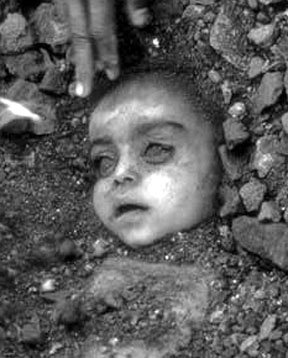
![bhopal.jpeg[1]](https://blogger.googleusercontent.com/img/b/R29vZ2xl/AVvXsEjPqRXfu6Y3tP1-m7kYeqqxXJ2u9E3shZ6Y4pWWx1Z2m6FSzERm_EjzOdT3XXUm7Yhlbe7lS-YaSXxlcQ6CgyfTGngt1tyIxLU4Cw0R9QGmYeU0anzP3jwFUkQp5lJa7nVwnfnNE1sTiwM/s1600-h/bhopal.jpeg12.jpg "bhopal.jpeg[1]")