Wednesday, July 20

How Sharia Courts actually lead to lack of industrial development

this was a fascinating paper. I never figured that this could be a reason behind the Arabic world falling behind in industrial development...there you go, one more reason to consider having secular commercial courts. 

I quote

The courts of 17th and 18th century Istanbul were Sharia courts grounded in Islamic law and tradition, not unlike the courts that are gaining sway in today's Middle East. At the start of the project, Kuran and co-author Jared Rubin of Chapman University knew the courts were heavily biased in favor of men, titled elites and Muslims. By contrast, they strictly punished women, commoners and religious minorities such as Christians and Jews.
Yet as he reviewed the records, Kuran noticed that the very groups the courts favored -- Muslims, men and high-status individuals -- paid significantly higher interest rates for loans. Conversely, society's less fortunate -- women, commoners and religious minorities -- paid lower interest rates.
The reason? Because the courts went easy on Muslims, men and titled elites, lenders could not count on recouping their money and loaning to those groups became a high-risk proposition. Lenders responded by charging privileged individuals higher interest rates to cover their risk.
"The biases of the courts made it risky to lend to privileged groups," Kuran says. "The courts gave privileged groups incentives to break contracts. Judicially favored groups paid more for credit precisely because their promises were relatively less credible."
Men in particular paid significantly higher interest rates than women -- as much as 26 percent more, the study states. Women represented a better credit risk precisely because courts held them accountable, Kuran says. Also, women of the time were not free to travel alone, much less flee their creditors. Men, by contrast, represented a flight risk.
The findings help shed light on the contemporary Middle East, Kuran says. For one, they help explain why the once-prosperous region fell behind Europe economically, a lag from which the region is still recovering, he says.
As the Industrial Revolution took off in the 18th and 19th centuries and factories began springing up across Britain and Europe, access to capital became increasingly important, Kuran says.
Across Britain and Europe, industrialization was financed by wealthy investors who could secure large loans. Istanbul was a thriving commercial center at the time. The high interest rates faced by the city's elites help explain why a similar industrial expansion was slower to take root there.
"To succeed in mass production, one needed much more capital than in the past," Kuran says. "So it became a handicap to face very high borrowing costs."

Monday, July 18

Top Ten James A. Michener Books

I love James Michener kids. He has few things which I admire. He has a vast sweep of history. A huge imagination. A great attention to detail. And a great ability to write prose. So his books take you through the great spread of history on the topic and dip into interesting segments of the history. 
Just last weekend I was reminded of his book Hawaii while researching one of the great feasts thrown by the last king of Hawaii. Truly amazing. And yes. If you want to take one book with you on holiday, you can do worse than to take one of his books. Very highly recommended. 
Love
Baba


Top Ten James A. Michener Books
http://blog.bookstellyouwhy.com/top-ten-james-a-michener-books
(via Instapaper)

Feb 3, 2016. 9:00 AM.
Topics: Literature, History
James A. Michener is well known for his historical fiction, in-depth research, and lengthy volumes. His books are strong narratives that take an intimate look at the human experience through the lens of historical events and times now past. They will also make long layovers, lazy beach weekends, and stretches of time disappear in a sea of historical fascination. These are ten of his biggest and best books of all time.

1. Tales of the South Pacific

Michener is well known for this tome, and it won him his Pulitzer Prize. It was adapted for the stage as the Rodgers and Hammerstein musical South Pacific. The book is not only based on true facts of World War II, but also on his own experiences while stationed in the New Hebrides Islands. What makes this one such an enjoyable read is the engaging multiple characters and the riveting tales of human interaction across cultures.

2. Return to Paradise

If you loved Tales of the South Pacific, you'll be glad to know that there is a sequel. Return to Paradise picks up where Tales of the South Pacific leaves off and is yet another collection of short stories that depict life in the South Pacific in the late 1940s: a great read and a welcome return to an evocative and exciting narrative.

3. The Bridges at Toko-Ri


Saturday, June 25

Pillows for a King

All that you wanted to know about headrests..most fascinating story behind this amazing piece of bedroom furniture, click here.

A Headrest is made in a variety of materials, unique in shape, form and meaning and is considered strange to modern society. Discoveries of headrests in many tombs and burials would first answer the query of use with the fact that using one was considered essential to everyday life, sleeping well and most every ancient household possessed one. Naturally taken into the tomb at death, little is known of Middle Eastern and Egyptian bedroom furnishings with the exception of bedsteads and sleeping mats. Sitting and sleeping took place mostly on the floor on a reed mat or linen sheets and on a higher elevation or roof with the necessity for catching the night breeze, especially under one’s neck. Simple headrests were made of perishable woods like sycamore, tamarisk or acacia, and were very simplistic in design. Materials such as earthenware, stone and ivory were also used. The early headrests appear to be a simplistic columnar style with solid block pedestals and a curved end for the head. Stone headrests were not uncommon and thought to be made solely for use in the afterlife and a tomb object only due the durability of the hard material perhaps not intended for everyday use.

Monday, June 20

Those who pray, those who work, those who fight - Medievalists.net

There's the Hindu caste system. Where everybody is divided into castes based upon what you do. And then a bewildering array of sub castes. It's all rubbish of course but still exists I'm afraid. I read about how Dalits, the untouchables and lowest caste people were sold off as slaves by upper classes to the Dutch in the 18th century in India. Tragic. 
But it was curious to read how this kind of work/profession based societal classification and how it was in the Middle Ages in England and France eh? It took a revolution to remove it in France. You still have it in England but hopefully the class based society will get removed soon without a revolution. 
Have a lovely day kids. 
Love 
Baba


Those who pray, those who work, those who fight - Medievalists.net
http://www.medievalists.net/2016/01/31/those-who-pray-those-who-work-those-who-fight/
(via Instapaper)

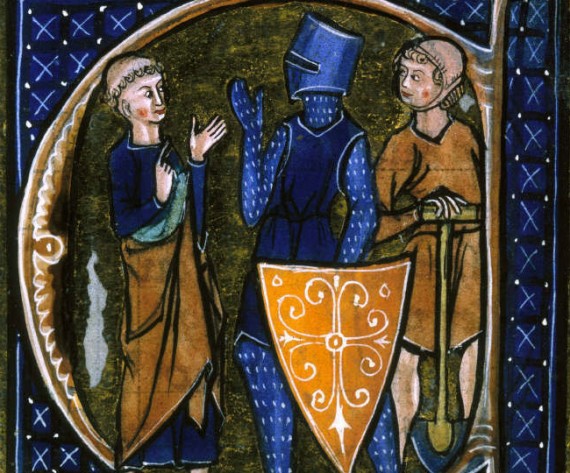
When people first start learning about the Middle Ages, one of the first concepts they are told was that medieval society was divided into three groups – those who pray, such as priests and monks; those who work, like farmers; and those who fight, the warrior class. How did this idea get started and what does it actually mean?

Cleric, Knight and Workman representing the three classes – from British Library Ms Sloane 2435, f.85 '
The concept of the three orders for society is not something you find in the Bible, or in classical sources. The closest thing that to it comes from the seventh-century encyclopedia writer Isidore of Seville, who makes a short reference to the Romans having divided themselves into three groups: senators, soldiers and plebeians.
It seems that our first reference to the idea of three orders comes from a curious source – an Old English translation of Boethius' The Consolation of Philosophy. This work was written by King Alfred the Great (probably with a team of scholars to help him) in the late-ninth century, and he often included his own commentary. It is here that you can find this statement:
I wished for tools and resources for the task that I was commanded to accomplish, which was that I should virtuously and worthily guide and direct the authority which was entrusted to me. You know of course that no-one can make known any skill, nor direct and guide any enterprise, without tools and resources; a man cannot work on any enterprise without resources. In the case of the king, the resources and tools with which to rule are that he have his land fully manned; he must have praying men, fighting men and working men. You know also that without these tools no king may make his ability known. Another aspect of his resources is that he must have the means of support for his tools, the three classes of men.
In his article, "The 'Three Orders' of society in Anglo-Saxon England" Timothy Powell explains some of the thinking behind this statement:
Alfred's formula is descriptive rather than prescriptive. He is not instructing the three orders in their duties, he is doing the reverse; he is meditating on his own duty to the effect that it is incumbent upon the king to ensure the three orders have the wherewithal they need to fulfil their functions. Alfred does not dwell on the theme; he mentions it as an aside. The point of the passage is not social commentary but a reflection on how he, King Alfred, should exercise his talents to ensure that his memory not be forgotten.

Sunday, June 19

The Double Victoria Cross Winner who never fired a shot in anger and how I am connected to him


A simple cross, right? a simple wooden cross. I went to my son's college at Oxford yesterday, a parent lunch. In the Chapel, there was a drinks reception and I was just wandering around doing my usual church investigation. And that's where I spotted this. 

so what's the story? This cross was the first wooden cross erected on the grave of Noel Godfrey Chavasse. His father, Rev Francis Chavasse, founded St. Peter's College where my son studies. 


Here's the gentleman concerned and his story is amazing. The master of the college alluded to him and then it was so fascinating that I went looking for more details. The man was an olympian. He got a first from Trinity College Oxford. Became a doctor. Joined the Army and then went over to France during World War 1. He won the Military Cross. Then was promoted. And then was mentioned in Dispatches. And then two citations follow when he became the only double VC winner in the war. 

Captain Noel Godfrey Chavasse, M.C., M.B., Royal Army Medical Corps.For most conspicuous bravery and devotion to duty.During an attack he tended the wounded in the open all day, under heavy fire, frequently in view of the enemy. During the ensuing night he searched for wounded on the ground in front of the enemy's lines for four hours.Next day he took one stretcher-bearer to the advanced trenches, and under heavy shell fire carried an urgent case for 500 yards into safety, being wounded in the side by a shell splinter during the journey. The same night he took up a party of twenty volunteers, rescued three wounded men from a shell hole twenty-five yards from the enemy's trench, buried the bodies of two officers, and collected many identity discs, although fired on by bombs and machine guns.Altogether he saved the lives of some twenty badly wounded men, besides the ordinary cases which passed through his hands. His courage and self-sacrifice, were beyond praise.

this was on 9th August 1916. Then next year around the same time..

War Office, September, 1917.
His Majesty the KING has been graciously pleased to approve of the award of a Bar to the Victoria Cross to Capt. Noel Godfrey Chavasse, V.C., M.C., late R.A.M.C., attd. L'pool R.
For most conspicuous bravery and devotion to duty when in action.
Though severely wounded early in the action whilst carrying a wounded soldier to the Dressing Station, Capt. Chavasse refused to leave his post, and for two days not only continued to perform his duties, but in addition went out repeatedly under heavy fire to search for and attend to the wounded who were lying out.
During these searches, although practically without food during this period, worn with fatigue and faint with his wound, he assisted to carry in a number of badly wounded men, over heavy and difficult ground.
By his extraordinary energy and inspiring example, he was instrumental in rescuing many wounded who would have otherwise undoubtedly succumbed under the bad weather conditions.
This devoted and gallant officer subsequently died of his wounds. 

The other two double VC winners ever were related to him. The first one, Lt. Col. Arthur Martin Leake actually treated Chavasse for his wounds. The second double VC winner in WW2, Captain Charles Upham, was related to Chavasse by marriage. He was engaged to Frances Gladys Ryland Chavasse, one of his cousins who was also mentioned in dispatches in 1945 at Monte Cassino.

I am simply dumb-struck at the man and the connections thereof. Can you believe it? this chap, got a first at oxford, then studied medicine, then showed bravery of a level that you cannot imagine (and not that of anger, but of mercy and healing which I believe is of a higher level than just shooting) and then the most incredible coincidences.

most extraordinary story. You can read his letters here. The letter show him as a most humble man..and then his courage! I am totally amazed and humbled.


Tuesday, June 14

The Mystery of Mummy Paper

I had heard about this before. That mummies were used to make paper but this is the first time I'm seeing something more concrete. If this was done, then it's shocking no? In rider haggard 'a She, mummified bodies were used as torches! Life imitating art eh? 
Curious
Hope you're having fun with your friends Kannu
And best of luck with the exam today Diya. 
Love
Baba


The Mystery of Mummy Paper
http://blog.bookstellyouwhy.com/the-mystery-of-mummy-paper
(via Instapaper)


Paper. We grab a scrap to jot down a phone number, we see movie posters, exchange greeting cards, hold paper books in our hands. We come in contact with so much paper, it's hard to keep track, and this is during a so-called "digital age" when we should be immersed in a nearly paperless world. And yet, it continues to be necessary, wanted, and part of the fabric of our routines and desires.
Imagine now, a world in which we need paper even more, for nearly everything. From communication to profit, paper is necessary. It's basically the internet of the day, and the civilized world finds itself in desperate need and facing a real shortage. Enter: Mummy Paper!
Mummy Paper is the stuff of legends, much like the mummies it was supposedly torn from. American paper, made from cotton and linen rag fiber, became in short supply due to the huge newspaper boom. The rags, imported from Europe for the most part, were not sufficient to feed the newspaper industry properly.
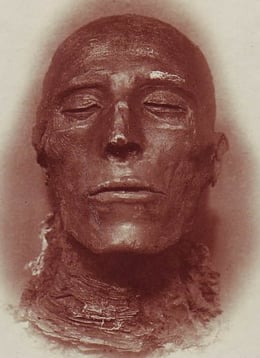
The man on a mission to save the newspaper industry and locate a new source for linen rags was Dr. Isaiah Deck, who was a geologist, archeologist, and explorer. Visiting Egypt on another task, he discovered "Mummy pits" which were large burial sites full of mummies and parts of mummies, all wrapped in linen. He crunched some numbers and reasoned that there must be at least five hundred million mummies in and around Egypt, and the amount of linen they might provide would be substantial.
This is where fact and fiction part ways, and no one can truly tell what did or did not happen with any amount of certainty.
There are some specific primary sources that give the idea of importing and using mummy rags to make paper some credibility. Daniel Stanwood, son of I. Augustus Stanwood, communicates that his father told stories of importing mummies from Egypt and using the wrappings to make paper in his mills. There is also a letter from a Mrs. John Ramsey who had a father, who had a friend, who remembered unrolling the mummies, and that the "cocoon" used to resemble the human form, even after it had been stripped away, because it had been in that shape for so long.

Saturday, June 11

My adolescent daughter and the mirroring of myself – Marina Benjamin | Aeon Essays

Choti
This is a long article but I thought I'll share with you. You're now growing up rapidly. I can see you changing in front of my eyes. Your tastes are changing. Your humour is changing and is a total delight. I love your jokes and puns. I love how hard you work and your expressions when you're focussing on your studies. How you wear your clothes. I just love it. 
And I'm seeing how your relationship with mum is changing. I don't think it's changed that much with me but with mum, it's definitely changing. Nothing wrong with this change. It's the natural order of things and is for the better. But it's so fascinating to hear that. Like how mum reacted yesterday with the sunflower seeds. That was so cute :) 
Anyway this article may tell you a bit more. Very interesting and I've copied mum into this email :) 
And do you know why your relationship with me isn't going to change? Because you'll remain that tiny gorgeous adorable baby girl that I first saw who stole my heart and wrapped me around her tiny finger. 
Love
Baba


My adolescent daughter and the mirroring of myself – Marina Benjamin | Aeon Essays
https://aeon.co/essays/my-adolescent-daughter-and-the-mirroring-of-myself
(via Instapaper)

Every few weeks my daughter and I stand back-to-back in the kitchen, socks off, our bare feet cooling on the tiled floor, and we measure up. I can feel her body elongate itself against mine, squaring pre-teen shoulders on my sloping ones, our bottoms taut with tension. We look like a totem pole – bodies melded together, stony faces pointing outward, chins up and arms pressed against our sides. My husband circles us, bending his knees to get all the angles and squinting like a surveyor. 'Not quite there yet,' he says. 'There's about two inches in it.' Later he confesses to being spooked. 'Looking at the two of you is like witnessing time travel,' he tells me.
My daughter, who initiated this household ritual, has already dispensed with one yardstick: a month ago, just before turning 12, she overtook my mother. In her stride now, she is visibly delighted to be gaining on me. Standing on tiptoe and flinging an arm round my shoulders, she tries out equality and likes it. Soon enough there'll be no need for any artificial elevation; we will be peers, in the matter of height, if nothing else.
My husband has already lost his way with the laundry. My daughter's knickers, candy-striped and tartan-checked, regularly turn up in my drawers, while my tights have begun disappearing into hers. She wears them in the new fashion – opaque black legs under cut-off denim shorts. All the girls dress this way, come rain or shine, their toenails poking holes into their mothers' tights.
I've begun to see my husband's category errors as a way of re-drawing the boundaries of parenting. Having shared the job with me in a genuinely egalitarian, straight-down-the-middle sort of way for the first 11 years of our daughter's life, he now, however unconsciously, seems to see our concerns forking into he-matters and she-matters. Underwear has become my domain, and now he need not think too hard about it. My own need to recalibrate my relationship to our daughter is just as pressing. But it is of a different order.
Every mother meets the paradox that the more their daughters are drawn into womanhood, the more they pull away. It is a confusing social induction that appears to obey strange magnetic rules: daughters are attracted to the adult world of women, but repelled by their actual mothers. Their resistance is primal, and fundamentally self-protective; how is a girl to acquire a distinct sense of her identity when every pubescent change in her body threatens to blend her into a confusing mélange with the woman who birthed her?
It is little wonder the father-daughter bond is often so strong – another thing that mothers must contend with. In my household, watching Star Trek re-runs and end-to-end episodes of The Simpsons are both folies à deux: as are American pancake feasts, not caring that the dog stinks, loafing in baggy T-shirts, confecting new-fangled desserts late at night, ice-skating, camping, and more. I'd be lying if I said I didn't mind being excluded, even if this all sets a reassuringly high bar for the men who might come into our daughter's life later. But I take her affinity for difference to be largely unavoidable. If a daughter is to separate properly from her mother, it stands to reason that she will cement that opposition by forging closer ties with her father.