A daily dose of odds and sods, some interesting, some bizarre, some funny, some thought provoking items which I have stumbled across the web. All to be taken with a grain of daily salt!!
I had heard about this before. That mummies were used to make paper but this is the first time I'm seeing something more concrete. If this was done, then it's shocking no? In rider haggard 'a She, mummified bodies were used as torches! Life imitating art eh? Curious Hope you're having fun with your friends Kannu And best of luck with the exam today Diya. Love Baba The Mystery of Mummy Paper http://blog.bookstellyouwhy.com/the-mystery-of-mummy-paper
(via Instapaper)
Paper. We grab a scrap to jot down a phone number, we see movie posters, exchange greeting cards, hold paper books in our hands. We come in contact with so much paper, it's hard to keep track, and this is during a so-called "digital age" when we should be immersed in a nearly paperless world. And yet, it continues to be necessary, wanted, and part of the fabric of our routines and desires.
Imagine now, a world in which we need paper even more, for nearly everything. From communication to profit, paper is necessary. It's basically the internet of the day, and the civilized world finds itself in desperate need and facing a real shortage. Enter: Mummy Paper! Mummy Paper is the stuff of legends, much like the mummies it was supposedly torn from. American paper, made from cotton and linen rag fiber, became in short supply due to the huge newspaper boom. The rags, imported from Europe for the most part, were not sufficient to feed the newspaper industry properly.
The man on a mission to save the newspaper industry and locate a new source for linen rags was Dr. Isaiah Deck, who was a geologist, archeologist, and explorer. Visiting Egypt on another task, he discovered "Mummy pits" which were large burial sites full of mummies and parts of mummies, all wrapped in linen. He crunched some numbers and reasoned that there must be at least five hundred million mummies in and around Egypt, and the amount of linen they might provide would be substantial.
This is where fact and fiction part ways, and no one can truly tell what did or did not happen with any amount of certainty.
There are some specific primary sources that give the idea of importing and using mummy rags to make paper some credibility. Daniel Stanwood, son of I. Augustus Stanwood, communicates that his father told stories of importing mummies from Egypt and using the wrappings to make paper in his mills. There is also a letter from a Mrs. John Ramsey who had a father, who had a friend, who remembered unrolling the mummies, and that the "cocoon" used to resemble the human form, even after it had been stripped away, because it had been in that shape for so long.
Choti This is a long article but I thought I'll share with you. You're now growing up rapidly. I can see you changing in front of my eyes. Your tastes are changing. Your humour is changing and is a total delight. I love your jokes and puns. I love how hard you work and your expressions when you're focussing on your studies. How you wear your clothes. I just love it. And I'm seeing how your relationship with mum is changing. I don't think it's changed that much with me but with mum, it's definitely changing. Nothing wrong with this change. It's the natural order of things and is for the better. But it's so fascinating to hear that. Like how mum reacted yesterday with the sunflower seeds. That was so cute :) Anyway this article may tell you a bit more. Very interesting and I've copied mum into this email :) And do you know why your relationship with me isn't going to change? Because you'll remain that tiny gorgeous adorable baby girl that I first saw who stole my heart and wrapped me around her tiny finger. Love Baba My adolescent daughter and the mirroring of myself – Marina Benjamin | Aeon Essays https://aeon.co/essays/my-adolescent-daughter-and-the-mirroring-of-myself (via Instapaper)
Every few weeks my daughter and I stand back-to-back in the kitchen, socks off, our bare feet cooling on the tiled floor, and we measure up. I can feel her body elongate itself against mine, squaring pre-teen shoulders on my sloping ones, our bottoms taut with tension. We look like a totem pole – bodies melded together, stony faces pointing outward, chins up and arms pressed against our sides. My husband circles us, bending his knees to get all the angles and squinting like a surveyor. 'Not quite there yet,' he says. 'There's about two inches in it.' Later he confesses to being spooked. 'Looking at the two of you is like witnessing time travel,' he tells me.
My daughter, who initiated this household ritual, has already dispensed with one yardstick: a month ago, just before turning 12, she overtook my mother. In her stride now, she is visibly delighted to be gaining on me. Standing on tiptoe and flinging an arm round my shoulders, she tries out equality and likes it. Soon enough there'll be no need for any artificial elevation; we will be peers, in the matter of height, if nothing else.
My husband has already lost his way with the laundry. My daughter's knickers, candy-striped and tartan-checked, regularly turn up in my drawers, while my tights have begun disappearing into hers. She wears them in the new fashion – opaque black legs under cut-off denim shorts. All the girls dress this way, come rain or shine, their toenails poking holes into their mothers' tights.
I've begun to see my husband's category errors as a way of re-drawing the boundaries of parenting. Having shared the job with me in a genuinely egalitarian, straight-down-the-middle sort of way for the first 11 years of our daughter's life, he now, however unconsciously, seems to see our concerns forking into he-matters and she-matters. Underwear has become my domain, and now he need not think too hard about it. My own need to recalibrate my relationship to our daughter is just as pressing. But it is of a different order.
Every mother meets the paradox that the more their daughters are drawn into womanhood, the more they pull away. It is a confusing social induction that appears to obey strange magnetic rules: daughters are attracted to the adult world of women, but repelled by their actual mothers. Their resistance is primal, and fundamentally self-protective; how is a girl to acquire a distinct sense of her identity when every pubescent change in her body threatens to blend her into a confusing mélange with the woman who birthed her?
It is little wonder the father-daughter bond is often so strong – another thing that mothers must contend with. In my household, watching Star Trek re-runs and end-to-end episodes of The Simpsons are both folies à deux: as are American pancake feasts, not caring that the dog stinks, loafing in baggy T-shirts, confecting new-fangled desserts late at night, ice-skating, camping, and more. I'd be lying if I said I didn't mind being excluded, even if this all sets a reassuringly high bar for the men who might come into our daughter's life later. But I take her affinity for difference to be largely unavoidable. If a daughter is to separate properly from her mother, it stands to reason that she will cement that opposition by forging closer ties with her father.
whilst i have been poor, poor to the level of not knowing where the next meal is going to come from and doing garbage diving for food is horrendous. My first experience of this was when i was about 4 maybe 5 years of age and we had gone to calcutta for a wedding. At that time, 1971, the bangladesh war was in its full height and calcutta was full of refugees who were desperately poor. the food at the wedding used to be served on plates made out of leaves and once you finish your food, you just fold it up and chuck it into the bin. And suddenly i heard snarling. So I peeked outside the marriage tent and saw these leftover food parcels being fought over by dogs and humans. its an image seared into my mind, kids. this level of poverty is truly atrocious and horrendous. But you can say that this situation in calcutta happened because of war (not that this wasn't avoidable, it was but slightly different scenario) but look at it here in Venezuela, where bad economics has directly lead to a total disaster where citizens have to walk through trash to find food. Its not just socialism, its also bad capitalism which lead to this disaster.
read and reflect on how humans can drive people into such levels of poverty.
CARACAS, Venezuela — Until recently, Julio Noguera worked at a bakery. Now he spends his evenings searching through the garbage for food.
"I come here looking for food because if I didn't, I'd starve to death," Noguera said as he sorted through a pile of moldy potatoes. "With things like they are, no one helps anyone and no one gives away meals."
Across town, unemployed people converge every dusk at a trash heap on a downtown Caracas sidewalk to pick through rotten fruit and vegetables tossed out by nearby shops. They are frequently joined by small-business owners, college students and pensioners — people who consider themselves middle class even though their living standards have long ago been pulverized by triple-digit inflation, food shortages and a collapsing currency.
Venezuela's poverty had eased during the administration of the late President Hugo Chávez. But a study by three leading Caracas universities found that 76 percent of Venezuelans are now under the poverty line, compared with 52 percent in 2014.
Staples such as corn flour and cooking oil are subsidized, costing pennies at the strongest of two official exchange rates. But fruit and vegetables have become an unaffordable luxury for many Venezuelan families.
You may like this article on how somebody manages to retire early. Fascinating example. I didn't get into the habit of savings till I was 30. Way too late. But you guys are doing well by saving now. So I'm very happy.
I went to the Jewish school today to talk about maths and banking careers. It was very good. Year 9 students. They were brilliant. I've never seen or met a group of more intelligent students. Some of them were more intelligent than post graduates. Very impressed. I talked about both of you and how I've encouraged you to invest and save at least 1/3of your income always. And how you're comfortable with money.
There was also huge amounts of security. Quite extraordinary. Bigger security than Heathrow. Holy moly. I was amazed but the sad thing is that Jews have realised that they have to rely on their own for their security, they cannot rely on the state. Frequently it's the state which actually gets involved in this. History tells us this.
But happy days. Have a lovely day. The weather is great isn't it? After the huge rains?
This guest post is from Todd Tresidder who retired at age 35… 13 years ago. He wrote a book teaching you when to retire and publishes the web site FinancialMentor.Com providing various retirement planning tools including articles and calculators.
I retired at age 35 (I'm now 48) and learned a few lessons along the way. Hopefully you will benefit from my experience because I did many things right and a few things wrong that I would like to share with you.
The first thing I did right was actually an accident because I had no clue what I was doing or why. I stumbled upon the first step to retiring early — commitment to the goal — without knowing what commitment was or the reasons why it was the make or break step early retirement.
It happened while I was a student at U.C.L.A. walking in Santa Monica Park along the Pacific ocean. Most of my college friends had already graduated and were spending their days in office cubicles with stressful jobs in pursuit of a BMW: I was finishing off my last few classes and enjoying a beautiful day in the park. Frankly, I preferred the latter.
I can still remember looking at the many street people lounging away on that sunny day and realizing I would sooner be a bum on the street spending my days in the park or library reading books than be a hamster on the wheel of the corporate machine in pursuit of needless lifestyle. This was a bizarre thought for a college kid majoring in Economics, but that's what went through my head. I wanted experience out of life, not money, and I knew the 9-to-5 grind was not my path. This important realization never left me: it became the basis for my commitment from that day forward. I wanted something different.
The second piece of my commitment to early retirement came with the common sense realization that if I had to lead an economic life then it might as well be designed to achieve financial freedom. Nothing less made sense to me. After all, why would anyone design their life for financial mediocrity (or less)?
Just to be clear, I'm not talking about "wanting' more money or success like most people. Instead, I'm talking about studying the subject of wealth accumulation and making constructive plans so that every aspect of my financial life was directed toward early retirement and financial freedom. I was plotting war against a meaningless life. I wanted the flexibility of freedom. If I had to deal with money then all my money dealings would be designed with financial freedom in mind. Again, nothing less made sense.
These two realizations, while simple on the surface, were critical to cementing my commitment to the path of financial freedom and early retirement. They were a statement of my values, established my priorities, and motivated my actions. They left me no way out with no viable alternative path. I would pursue financial security until I succeeded because there was no better alternative.
Whenever I had a setback on the journey to financial freedom I always remembered these two key realizations and how they left me no real choice but to get back on the horse and try, try again. I was committed, and the commitment gave me the persistence necessary to succeed. That was critical.
Anyways, I share this with you at length because my experience in coaching people is most aren't lucky enough to have a clear commitment from the outset. They have to develop their commitment. It can't be something superficial like "tell the boss to take this job and shove it". That won't work. It must be a motivation rooted in your deepest values that drives action. It is the critical first step to early retirement that nobody succeeds without first completing.
What I Did Right On The Path To Early Retirement
The first thing I did right will be familiar to many readers – I kept my expenses down so that I could save my earnings. When I was single some might have called me frugal although next to Jacob I would probably be deemed a spendthrift. My formula was simple – keep my expenses at college lifestyle level and bank the difference. As my income grew I banked progressively more.
I never raised my lifestyle and never suffered or experienced sacrifice. I was living in Lake Tahoe running a hedge fund working from before dawn until mid-day making good money. During the afternoons I hung out with the ski bums who were having fun and just getting by thus I never had pressure to spend lavishly or keep up with the Jones's. We would ski half-days in the afternoon during winter and play volleyball or mountain bike during the summer. Life was good, I saved 50%-70% of what I earned, and never felt any sacrifice whatsoever. I was on track to achieving my goals and having a great time as a single guy living the outdoor recreation lifestyle.
The second thing I did right was learn everything I could about investing and risk management right from the very beginning. My belief was the lifetime compounded value of investment skill was worth far more than any salary could ever amount to. Run the numbers yourself and you will see the truth in that statement. A few percentage points change in ROI compounded over your lifetime can make or break your financial security.
The math is simple: there is a very narrow spread between inflation and passive investment returns. You live on that spread so if you can figure out how to add a few percentage points to your ROI then you can double or triple the spread. The affect is geometric – not arithmetic. It is important stuff to understand if you want to play the early retirement game.
In fact, my clarity on this issue motivated me to reject a high paying career to accept an initially low paying position with a start up hedge fund. The reason I did this was because the low paying position had a large upside if we succeeded (which we did) and my job duties centered around researching and developing active investment strategies with risk management systems. The knowledge I gained from that work has been invaluable, and I remain grateful to this day for that experience. It is the foundation on which my financial freedom was built.
Finally, the last thing I did right was I built a business as an owner (actually, a partner). If you research how wealth is built the most common source is business with most of the remainder coming from real estate. The third asset class – paper assets – is typically a parking place for wealth built in business and real estate rather than being a source of wealth in itself. I was just following a well proven path.
The reason wealth building works this way is simple: business and real estate offer leverage and tax advantages whereas paper assets do not. The leverage and tax advantages are essential to amassing capital rapidly for early retirement.
With that said, I was a bit of a freak because more of my wealth has come from the growth of my investments (paper assets) than from the business I helped build. This is based on my unusual investment skill built on more than a decade of intensive research and is not something most readers can expect to duplicate. Instead, you should go with the proven formula and focus on business and real estate to grow your wealth and use paper assets as a parking place for wealth built elsewhere.
In summary, the things I did right were frugality to create savings, investment knowledge to create compound growth, and business building to create leverage. Fortunately, that was enough to reach early retirement despite making a variety of other mistakes that I will share below…
What I Did Wrong On The Path To Early Retirement
There are a few things I would do differently if I could do it all over again.
The first thing I would do different is buy an apartment building while I was young. I would get as big a property as I could convince the lenders to finance. I would live in the building, manage it, and do whatever maintenance was necessary to enjoy free rent and positive cash flow. Had I walked that talk in my 20's instead of paying rent or buying my first house then I would own a rental property today that is fully paid for and cash flowing like a big dog.
Think about it – most people in their 20's are living in apartment style housing anyway so this strategy doesn't force any reduction in lifestyle. Additionally, if you manage the property and do the maintenance yourself then you gain inside knowledge on how the business works that will serve you for a lifetime. On top of that, by the time you reach my age the property will be paid for providing perpetual income that adjusts for inflation, has virtually no risk of failure, and can never be depleted. That combination of features is a rare and beautiful thing for early retirees – something you would never regret.
Another mistake I made early on was retiring as a single man then promptly getting married and having kids thus multiplying my expenses several times their previous level. Don't get me wrong: I don't regret getting married and having kids. In fact, I'm thankful beyond words. However, I completely failed to figure in the impact on my expenses. I know it sounds laughably dumb in hindsight, but I just didn't think through the various phases of my life and how my expenses would change. I just ignored the whole issue until reality forced me to look it in the eye. That was a mistake I don't recommend you repeat.
Finally, the last mistake I want to share was switching cold-turkey from a strong business income that provided a fat contribution to savings straight into living off those savings. The culture shock of such a dramatic financial change was not a good thing. It required too many emotional adjustments in my brain over too short a time period. I highly suggest phased retirement as a wiser alternative.
In summary, there are many dimensions to the early retirement game. It isn't just about frugality or leverage or stocks or internet marketing or any other recipe you may read. You can create your own custom mix based on your unique skills, values and interests. What worked for Jacob or I may not be the right formula for you.
Instead, find your own path while obeying the proven principles that get results. Don't worry about making mistakes as I'm ample proof you can make lots of mistakes and still reach the goal. The key is to get committed, develop a plan, and put that plan into action. If you persist then the goal will become a question of "when" – not "if".
Google Inc., 1600 Amphitheatre Parkway, Mountain View, CA 94043, United States
*************************************************** This message originated from the Internet. Its originator may or may not be who they claim to be and the information contained in the message and any attachments may or may not be accurate. ****************************************************
----------------------------------------- SAVE PAPER - THINK BEFORE YOU PRINT!
This E-mail is confidential.
It may also be legally privileged. If you are not the addressee you may not copy, forward, disclose or use any part of it. If you have received this message in error, please delete it and all copies from your system and notify the sender immediately by return E-mail.
Internet communications cannot be guaranteed to be timely secure, error or virus-free. The sender does not accept liability for any errors or omissions.
When I was growing up in Bhopal, we were quite poor. Buying books was very difficult. Still used to manage to get some books from here and there, also inherited loads from didu's uncle and her fathers library. Dadu only had scientific and engineering books. Then we got the British council library but that only had British publications.
At that time ussr was still extant and they had huge soviet publishing houses. The books they would publish would be hugely subsidised. So I would pick up whole rows of Russian literature in English plus science, mathematics and engineering texts. You may have seen them when you were there in February.
So actually ended up getting a great grounding in Russian literature. Much more than American, European, Chinese, Japanese or Spanish literature. Be that as it may, it was an education of sorts son.
Russian literature is a funny one. It's frequently cold and morose. It's very long winded but full of terrible feelings which emerge slowly but when they do, they overwhelm you.
Russian literature therefore closely mirrors Russian culture. They are a tragic people son. Their history is one of horrible pain, sorrow and great tribulation. The typical Russian peasant is perhaps one of the lost ones. Capable of great patience and great losses.
Chekhov was one of the cosmopolitan writers. He can legitimately be called as one of the greatest short story writers son. Another chap who I rate very highly is guy de Maupassant but that's for another time. As mum what she thinks about short stories as she has won awards for her short stories which have been published. Interesting genre.
Read his stories with care kids, it may sound depressing at first but the stories reflect some serious emotions. Huge ones.
NEW YEAR'S EVE. Nellie, the daughter of a landowner and general, a young and pretty girl, dreaming day and night of being married, was sitting in her room, gazing with exhausted, half-closed eyes into the looking-glass. She was pale, tense, and as motionless as the looking-glass.
The non-existent but apparent vista of a long, narrow corridor with endless rows of candles, the reflection of her face, her hands, of the frame -- all this was already clouded in mist and merged into a boundless grey sea. The sea was undulating, gleaming and now and then flaring crimson. . . .
Looking at Nellie's motionless eyes and parted lips, one could hardly say whether she was asleep or awake, but nevertheless she was seeing. At first she saw only the smile and soft, charming expression of someone's eyes, then against the shifting grey background there gradually appeared the outlines of a head, a face, eyebrows, beard. It was he, the destined one, the object of long dreams and hopes. The destined one was for Nellie everything, the significance of life, personal happiness, career, fate. Outside him, as on the grey background of the looking-glass, all was dark, empty, meaningless. And so it was not strange that, seeing before her a handsome, gently smiling face, she was conscious of bliss, of an unutterably sweet dream that could not be expressed in speech or on paper. Then she heard his voice, saw herself living under the same roof with him, her life merged into his. Months and years flew by against the grey background. And Nellie saw her future distinctly in all its details.
Picture followed picture against the grey background. Now Nellie saw herself one winter night knocking at the door of Stepan Lukitch, the district doctor. The old dog hoarsely and lazily barked behind the gate. The doctor's windows were in darkness. All was silence.
"For God's sake, for God's sake!" whispered Nellie.
But at last the garden gate creaked and Nellie saw the doctor's cook.
"Is the doctor at home?"
"His honour's asleep," whispered the cook into her sleeve, as though afraid of waking her master.
"He's only just got home from his fever patients, and gave orders he was not to be waked."
This was a funny episode indeed. Slightly related to my research as well as the Dutch were, by this time, shipping vast quantities of spices from the East Indies and India over to Europe. Plus the east India company and Dutch east India company (VOC) were competing as well for trade routes and spice supplies.
Anyway, it was funny reading about how people went into a war and nobody knew it :)
Some historians consider England's Scilly conflict to be the longest war in known history, dragging on for a staggering 335 years. Yet one side was not a country in its own right, there were no casualties for the entire duration, and not a single shot was fired. Neither side even remembered they were still at war until someone checked the paperwork.
All of which begs the question: if war is declared but neither nation remembers, does it still count?
The Isles of Scilly are five inhabited islands and a multitude of other uninhabited rocks off the coast of Cornwall at the southwestern tip of England. With a population of roughly 2,000, the islands rely on fishing and tourism as the main sources of income. It is doubtful that anyone would consider them an international threat. Yet, somehow, they were at war with the Netherlands from 1651 until a mere 30 years ago.
Cromwell's Castle, a 17th-century fort, on the island of Tresco, in the Isles of Scilly. (Photo: Nathan Siemers/flickr)
To understand the origins of the 335-Years' War, we need to go back in English history to the time of the Second Civil War (1642-1648), fought between Oliver Cromwell's Parliamentarians and the Royalists, better known as the Roundheads and the Cavaliers. Cornwall was one of the last Royalist strongholds, but in 1648, it too fell into Cromwell's hands. Britain being an island nation, it had one asset in its Navy, which had declared its support for the Royalists. And so, as the Parliamentarians swept across the country, the Navy was pushed further back until its only possible safe harbor was the Isles of Scilly. At the time, the Isles were owned by Sir John Grenville, a close friend of Prince Charles (later King Charles II), and therefore a staunch Royalist.
Meanwhile, across the English Channel, the Dutch were winning their independence from Spain in the Eighty Years War. The English had been allies with the Dutch since the war's beginning, thanks to the protestant Queen Elizabeth 1. As the Netherlands gained independence they naturally wanted to maintain good relations with England, but with Civil War underway, they had to decide whom to support. Since it looked as though the Parliamentarians would overthrow the Royalists, the Dutch chose to ally with them. This included the support of the Dutch Navy. The Royalist Navy, down in the Scilly Isles, put up quite a strong resistance, seizing a number of Dutch ships and a great deal of cargo.
In the spring of 1651, Admiral Maarten Tromp of the Dutch Navy landed to demand reparations. Seeing that none were forthcoming, he reputedly declared war on the Isles of Scilly.
A painting showing the Siege of the Schenkenschans, part of the 80 year war between the Dutch and the Spanish. (Photo: Public Domain/WikiCommons)
Within a matter of weeks, a final push by the Parliamentarians led to the surrender of the remaining Royalist ships. The Dutch knew that they no longer faced any sort of threat and set sail for home. It seems they forgot one minor detail: the Scilly Isles weren't technically a nation in their own right and so no one remembered to make the peace.
Years turned into decades, turned into centuries, and the war with the Dutch fell into local folklore. Generations passed on the tale that the islands remained at war with the Netherlands. No officials seemed to know if it was true or not.
Admiral Maarten Tromp of the Dutch Navy, who reputedly declared war on the Isles of Scilly. (Photo: Public Domain/WikiCommons)
Finally in 1985, a member of the island council and a keen local historian, Roy Duncan, decided to investigate the story for himself. He wrote to the Dutch Embassy, asking them to look into the matter. A response came back: after much searching, it seemed that no record existed of a peace treaty ever being signed. On April 17, 1986, the Dutch Ambassador visited the Isles of Scilly to sign said peace treaty, thereby putting an end to what is now fondly referred to as the 335-Years' War.
Whether the declaration of war was legally binding remains in doubt to this day. Some historians argue that Tromp had no authority to declare war, and was simply blustering in the hopes of receiving compensation for damaged and lost goods. Furthermore, even if his declaration had merit, it surely would have been resolved in the 1654 treaty between England and the newly-formed Netherlands.
The ceremony marking the signing of the peace treaty in 1986 was more of a publicity move than it was an important event in international relations. Even Duncan admitted that the issue of the war had been "a joke for many years". The signed declaration of peace remains on display in the Council Chambers in Hugh Town on St. Mary's Island, and a quirky incident of British history has allowed the Isles of Scilly to lay claim to a place in the record books.
This chap was one of the greatest ever. Seriously good son. His clarity of thought was amazing and gave rise to some of the greatest of ideas when some of the worst of ideas like the holocaust was around. I got so pissed with the Labour Party this week. The politicians were of tiny tiny minds son. The Muslim MP. Red Ken. Jeremy corbyn. The lot. Truly atrocious men and women with tiny minds. Lacking basic humanity. Racist and anti Semitic to boot. And then I read this uplifting statement. If there has to be a religion, then just take the universal declaration of human rights and enshrine it. Amazing man son. Truly great. Love Baba Roosevelt declares the Four Freedoms - WWII Today http://ww2today.com/6th-january-1941-roosevelt-declares-the-four-freedoms (via Instapaper) A pre war portrait of United States President Franklin D. Roosevelt
Franklin D. Roosevelt recognised the need to support Britain and other countries in the war. At this time he sought to persuade many Americans that it was in their interests to align themselves against Nazism and dictatorship. Earlier he had argued the case for Lend Lease, which would allow military aid to foreign nations. In his fireside chat of the 29th December 1940 he had declared that America would become the 'Arsenal of Democracy'.
Now he went further with his vision of what America stood for. The Four Freedoms include two values that went beyond the United States' constitution – freedom from want and freedom from fear. The ideas expressed here were to become the cornerstone of the Universal Declaration of Human Rights, and the establishment of the United Nations. They assert a moral purpose that was in direct contradiction Hitler's rambling war aims:
In the future days, which we seek to make secure, we look forward to a world founded upon four essential human freedoms.
The first is freedom of speech and expression – everywhere in the world.
The second is freedom of every person to worship God in his own way – everywhere in the world.
The third is freedom from want – which, translated into world terms, means economic understandings which will secure to every nation a healthy peacetime life for its inhabitants – everywhere in the world.
The fourth is freedom from fear – which, translated into world terms, means a world-wide reduction of armaments to such a point and in such a thorough fashion that no nation will be in a position to commit an act of physical aggression against any neighbor – anywhere in the world.
That is no vision of a distant millennium. It is a definite basis for a kind of world attainable in our own time and generation. That kind of world is the very antithesis of the so-called new order of tyranny which the dictators seek to create with the crash of a bomb.
From Franklin D. Roosevelt's State of the Union Address to the Congress, January 6, 1941
This was not a call to war but it was an unmistakeable declaration of which side the United States stood by.


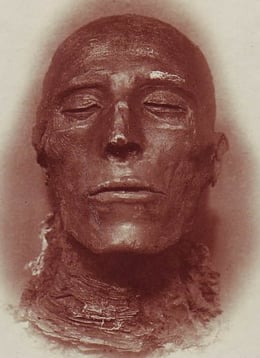 Mummy Paper is the stuff of legends, much like the mummies it was supposedly torn from. American paper, made from cotton and linen rag fiber, became in short supply due to the huge newspaper boom. The rags, imported from Europe for the most part, were not sufficient to feed the newspaper industry properly.
 Every few weeks my daughter and I stand back-to-back in the kitchen, socks off, our bare feet cooling on the tiled floor, and we measure up. I can feel her body elongate itself against mine, squaring pre-teen shoulders on my sloping ones, our bottoms taut with tension. We look like a totem pole – bodies melded together, stony faces pointing outward, chins up and arms pressed against our sides. My husband circles us, bending his knees to get all the angles and squinting like a surveyor. 'Not quite there yet,' he says. 'There's about two inches in it.' Later he confesses to being spooked. 'Looking at the two of you is like witnessing time travel,' he tells me.


