Showing posts with label Colonies. Show all posts

Saturday, October 13

Starving the natives

Just read a fascinating story about Salt Starvation which I got hold of after reading this book, Great Hedge of India.

I quote:

Salt Starvation in British India – Consequences of High Salt Taxation in the Bengal Presidency, 1765 to 1878.

Roy Moxham

Little seems to have been written by modern historians about the physiological consequences of salt deprivation that might have resulted from the high Salt Tax in British India. Occasionally, there are brief references to salt being “a basic necessity of life” (Brown 1989, 236), but without amplification. Writers on famine in British India seem generally to have ignored salt intake as a nutritional factor. The indexes to Bhatia’s Famines in India (Bhatia 1967), and Seavoy’s Famine in Peasant Societies (Seavoy 1986), for example, have no references to salt. In recent years there has been much publicity about the evils of excessive salt consumption, and this may have caused some to suppose that salt was unnecessary. Thus, Weber writes of Gandhi: “Generally, however, the thrust of his medical arguments, which should be much applauded by those stressing the link between salt and hypertension, was that a normal diet provided the salt needed for the body without the addition of sea or rock salt which in fact was toxic” (Weber 1997, 80). Probably the best overview of the Salt Tax and the need for salt in India is in Denton’s The Hunger for Salt but, understandably given the massive scope of the book, this is restricted to a one-page summary and is mostly concerned with the twentieth century (Denton 1984, 84-5).

Gandhi’s salt march has tended to focus attention on to the Salt Tax in the twentieth century, whereas the Salt Tax was much greater in the earlier period of British rule – especially in the Bengal Presidency. Consequences could be expected to have been greater, and thus easier to observe, when the tax was higher. For this reason, this essay concentrates on the situation in the Bengal Presidency from 1765 to 1878. It seeks to investigate the level of salt taxation over that period and its effect on the retail price of salt relative to wages; the physiological necessity for salt and the peculiar nature of salt hunger; the minimum salt intake necessary to maintain health and to recover from illness; actual salt consumption; and the particular consequences of a high Salt Tax in times of famine.

Its freely available, but reading about this made me really wonder if the defenders of Colonialism really know the sheer level of problems and injuries and sickness and death they caused? And also another example of what taxation can do to ordinary folks.

As the research by Amartya Sen has shown, famine is pretty much caused not just by weather patterns but by active or idiotic responses by governments. Here is a list of famines in British India. Simply adding it up gives me an idea of about 40-50m killed. Now there’s a fair few but only darkies, eh? Who cares…We are already hurting here as well, while its nowhere near starvation time (perhaps we could think about it given the rates of obesity..?) rising food prices are troublesome…Given the level of taxation in the food production value chain, people need to think about what and how much to tax..

Sunday, January 31

1818, the first shots in a casteist war?

I received the following email on new year’s day:

ON 1ST JANUARY 1818, MERE 500 BAHUJAN SOLDIERS COURAGEOUSLY FOUGHT AGAINST 50,000 TYRANNICAL FORCES OF MANUWADI PESHWAS AND GAVE THEIR LIVES TO END THE OPPRESSIVE MANUWADI REGIME

EMPIRICAL RULE OF BRITISHERS IN RECOGNITION OF THE GREAT BRAVERY OF BAHUJAN SOLDIERS UNDER THE CAPTAINCY OF SIDNAK MAHAR, ERECTED A MONUMENT AT KOREGAON-BHIMA, PUNE ON THE BANK OF RIVER BHIMA.

DR. B. R. AMBEDKAR, THE BODHISATTVA WHO FOUGHT THROUGHOUT HIS LIFE AGAINST THE AGE OLD MANUWADI OPERATIONS, INVARIABLY USED TO VISIT AND SALUTE THE "VIJAY STAMBHA"- MEMORIAL OF BAHUJAN WARRIORS

LET BAHUJANS NOT FORGET THEIR MARTYRDOM AND OFFER THEIR SALUTATIONS TO THE GREAT MEMORIES OF THOSE GREAT BAHUHAN SOLDIERS WHO RELENTLESSLY FOUGHT TO BREAK THE SHACKLES OF OUR AGE OLD SLAVERY.

LET'S NARRATE THE HISTORY TO FUTURE GENERATIONS SO AS TO MAKE THEM STRONG ENOUGH TO WITHSTAND MANUWAD.

Very impressive. I had never heard of this before, so went looking for more information. Here’s another site where there is more background. Hmmm, fascinating stuff. So if I understood the essence, it was a group of 500 Dalit soldiers who fought approximately 25000 Brahmins. And why is this important? I quote:

First, the British army fought this battle with a minuscule army expecting the worst, especially after their experience of the Pune Regency. Secondly, the battle of Koregaon was one of the most important events which helped tear down the Peshwa Empire and subsequently the Peshwa had to abdicate. Thirdly and most importantly, it was an attempt by the untouchables of Maharashtra to break the shackles of the age-old caste order.

That sort of didnt really jibe with what I had read about the Maratha Wars. So I went to do a bit of poking around.

1. The Maratha Wars:

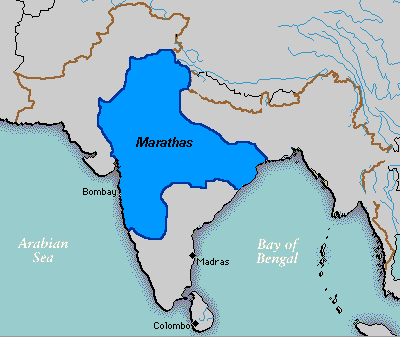
While I can understand the desire of Dalits to home into that skirmish and claim that to be the be all and end all of all, skirmishes like this have to be grounded in the greater framework. The Maratha Empire brought to life by Shivaji attained its greatest strength by 1760 as shown in the image below.

And I should point out that Shivaji was not a Brahmin. While they claimed Kshyatriya status later on, there are some arguments that he was originally a Dalit, a Shudra to be precise. See here for an overview of this argument. Finally, Shivaji’s army was largely composed of people like him, so it was a Dalit Army anyway which got promoted, so to say. Then comes the first Anglo Maratha War 1777-1783 where first the Maratha’s won and then the British won. In both cases, native soldiers were far too frequently Dalits. Anyway, more land was captured by the Brits and the power of the Maratha’s was further reduced. Peshwa Baji Rao II and his father basically got up to no good. In 1802, BajiRao went and sucked up to the British after being defeated by Holkars in the Battle of Poona. This pissed off the other Maratha warlords and they got into a bit of a fight with the British which ended with more loss of territory for the Marathas. Then comes the crucial 3rd War which our Dalit friends might now appreciate.

This relates to the 3rd Anglo Maratha War 1817-1818 or the Pindari War. The Pindari’s were highly mobile cavalry units which were not on the payroll of any ruler but associated with rulers in return for protection and permission to plunder. Guess what? These Pindari’s were low caste, Ladul and also had quite a lot of Muslims (mainly Afghans and Pusthun). Anyway, all this plundering was not good for the British and a really very big army of 120,000 men and 300 artillery pieces was put into gear by Lord Hastings to exterminate these Pindari’s. The attacks happened from the east in Bengal, from the South in the Deccan and from the west from Gujarat and Bombay. Look at the map above and see who is the nut in this 3-way nutcracker? The Marathas.

2. The immediate predecessor to the 1st Jan 1818 Battle of Koregaon.

Once the British invaded Maratha territory to go after the Pindari’s, there were skirmishes between the Peshwa’s forces and the British forces such as the sack of the British Residency in Pune, and then the British routed another Peshwa force at Khirki. Then the main battle was fought in the Battle of Khadki on November 5, 1817 where the Peshwa Baji Rao was routed pretty much comprehensively and then the British took over the Peshwa’s seat at Shaniwarwada by November 17, 1817. The Peshwa, by this time, was running ragged. There was another battle between the Nagpur forces and the British at Sitabalsi on November 27 1817. The next battle to be fought was the Battle of Mahidpur on 20th December where the Holkar’s fought and lost to the British, after being betrayed by one of the Pindari (who killed Tulsibai).

3. The Battle of Koregaon:

A good description of the battle can be found here. This is a book by WC Taylor, A Popular History of British India published in 1847. See page 268-269 for details of the battle. Sounds like a pretty good bash. Taylor says that the Peshwa’s forces numbered about 25,000 although it should be noted that counting was pretty vague at that time. Still, it wasnt 50,000. But here’s the crucial thing, the Peshwa’s forces then retreated not because they were defeated by Captain Francis Staunton’s forces, but because they got to hear that British reinforcements were coming over. The British forces lost 200 soldiers out of 500, and 6 out of 7 British officers. Good defensive battle without food or water at this village. You can see the layout of the land here although there are no records extant of how the battle actually went, the defences and the lay of the land.

4. The soldiers.

The soldiers who did most of the dying were Mahars. And again ironically, they got their start in being soldiers by no other than Shivaji to become scouts and fortress guards. They were highly mobile light infantry, which is the reason why they were in the 2nd Battalion, 1st regiment of ‘Bombay Native Light Infantry’ as part of the Maratha Light Infantry. The Peshwa’s soldiers were also by and large lower caste soldiers including Mahars, in any case, not Brahmins. So the fighting basically was between lower castes, only the people who were ordering them around were the British and the Peshwas. This Mahar Regiment still exists and has provided two of the most brilliant Indian Army Chiefs: Gen (Retd) K V Krishna Rao and Gen (Retd) K Sunderji. Also, there is no caste element to the regiment from 1963 onwards and it is now a fully mixed regiment.

5. The aftermath of the Battle of Koregaon:

There was another fight between the fleeing Peshwa’s forces and the British at Ashti on February 20th 1818 and he remained under pressure till he surrendered to Sir John Malcolm on June 3, 1818 and was given the pension of an annual payment of 8 lakhs rupees. The Battle of Koregaon was celebrated by raising of an Obelix which commemorated this.

So all in all, I am afraid what my research threw up was in sharp variance with the mythology is being provided. It was frankly a small battle / skirmish in a much bigger war, the Peshwa’s forces were not defeated in this skirmish, the British Army did not fight this battle expecting the worst because they had been winning every battle in this war, this battle of Koregaon was not really that important as fighting kept on happening for months after this battle and I am afraid there is absolutely no evidence that any kind of caste based ideology was involved in the fight.

So all in all, good myth but a rather more calm reading of the historical record tells differently. I can also see why the Dalit hotheads want to use this battle to burnish their credentials. After all, all revolutions need their battles. Google for “Battle of Koregaon” to see how this myth is being built up, but I am afraid the reading is slightly different. If they do want to celebrate the success of lower caste soldiers, they should celebrate Shivaji, the Indian Soldier, the bravery that these soldiers showed to whoever paid them. See here for the campaigns that the Maratha Light Infantry got involved in. But to bring this casteism into the Indian Army? Not really cricket, old chaps. But I am very happy to be corrected if I have not referred to any other source or documentation. Happy to learn more.

Friday, January 8

Nation on a Platter

You might have heard about this quote: "Tell me what you eat, and I will tell you what you are", by Anthelme Brillat-Savarin who was a gourmet and lawyer in his book, The Physiology of Taste, published in 1825. It is quite true, we form some significant social and cultural frameworks around what we eat. What is also very interesting is how the cuisine has changed or has changed because of external influences. For example, I am hearing so much about the rise in the eating of meat + diary products in India and China and how that is driving the increased carbon emissions across the world as well as leading to something of a food crisis.

Over the past few years, my interest in food has grown after having had dropped into a hiatus. Grew up in a Bengali household which loved food, and Ma has won many prizes in cooking all kinds of wonderful dishes in the continental, desserts, Bengali, Mughlai etc culinary ranges. And of course you have macher jhol bhaat (fish curry and rice) which is the staple food for all Bongs. Then for various reasons, went off food as a thing to be savoured and it became something that needs to be done. Had the opportunity to eat in many countries but never really managed to enjoy and savour it till few years back when I left smoking. That's when I rediscovered my palate. Also, it allowed me to spend time in the kitchen with the kids, with my little princess being the chef in charge of the recipe book, my son as the helper, me as the general dogsbody and my wife as the helper/saver/firefighter/advisor, etc. Quite a lot of fun to be had and these days, the entire deciding on the recipe, shopping for the ingredients, the preparation, the cooking, the eating has become a weekend family activity. Much fun to be had.

But besides that, I am also exploring the history and culture behind the various cuisines of the world and have made friends with some good gastronomic experts, such as Vikram Doctor of the Economic Times who is an absolute giant in this area, my friend Luca who is a Cordon Bleu chef etc. So it was with interest that I noticed a paper (details at the bottom) which talks about the food and cuisine in Colonial Bengal times. The basic underlying argument is interesting. When the Brits came over, they felt that eating tons of meat was a clear distinction between themselves and the natives in Bengal. Here's an example of a menu at an ordinary British household in Calcutta.

We dine too at two o’clock in the very heat of the day . . . I will give you our bill of fare . . . . A soup, a roast fowl, curry and rice, a mutton pie, a fore-quarter of lamb, a rice pudding, tarts, very good cheese, fresh churned butter, fine bread, excellent Madeira (that is expensive but eatables are very cheap).

another one:

Our chota haziri, or little breakfast, was at five-thirty to six, and consisted of tea, eggs boiled or poached, toast and fruit . . . . Breakfast at eleven consisted of fried or broiled fish, a dish or two of meat—generally fowl cutlets, hashes and stews, or cold meat and salad followed by curry and rice and dessert. We drank either bottled beer—the universal Bass—or claret . . . . Between four and five there was tea and cakes, . . . . Dinner at half past seven or eight consisted of soup, and entr´ee, roast fowls or ducks, occasionally mutton, and in cold weather once or twice beef, an entremet of game or a savoury, and sweets

I feel full just reading the damn description. Can you imagine this kind of food being ingested? But this is what was considered as "masculine" behaviour, the antithesis of the feminine Indian Hindu man, who mostly ate rice and vegetables. I quote:

According to the eighteenth-century historian, Robert Orme, the diet of the ‘people of Indostan’ exacerbated these shortcomings, dependent as it was on rice, an ‘easily digestible’ food, obtained with little labour, and thus ‘the only proper one for such an effeminate race’. Even among such ‘generally lethargic’ people, Bengalis were especially known for their feeble, ‘effeminate’ ways, and for their slothful habits. Herbert Risley, the amateur British ethnologist and physical anthropologist, observed that Bengali effeminacy had much to do with the ‘relaxing climate’, the ‘enfeebling diet’, and the premature maternity of women

This was discussed at great length around the 1870's in the Hindu Mela Meetings and a quote gives an interesting view of the reaction of the grand poo bah's in Bengali society. See the links with marital race, military powers, etc.

Consider, for example, the following passage from a treatise on food written by Chunilal Bose, a Chemistry Professor at the Calcutta Medical College and one-time Chemical Examiner to the Government of Bengal: The health and physique of the Bengalis were not so poor a few generations ago. Time was when the people of this province were not unaccustomed to military life and service, for they formed regiments which successfully fought against the disciplined army of the Mughal Emperors of Delhi. In the latter half of the 18th century . . . they showed their prowess, courage, endurance and the other manly qualities of a soldier in successfully counteracting the military operations of the French in the struggle for supremacy in South India. There was then plenty of nourishing food (such as milk and fish) available in the land, and people could afford to take them in the right quantity. It is the dearth of these two staple articles of food in Bengal at the present moment that has made the diet of the generality of the people so poor in its nutritive value and has contributed to the deterioration of the health and the lowering of the resisting power against the onslaught of diseases. It is the duty of every true son of Bengal to devise means and adopt measures for the increased supply of milk and fish throughout the province. This will improve the diet of the people and make the country smile once again in health and prosperity.

So what's the recommendation?

In order to make up for the deficiency in protein, he prescribed ‘a more liberal allowance of protein-foods of animal origin [e.g. milk, fish, meat and eggs] in the present-day diet of the people’.

Because of all these pressures, couple of interesting changes came up and that are cookbooks and the expression of what a proper housewife should be able to cook/serve in her household. A typical bhadramahila in the Bengali household should be able to (and this was in 1874):

Native Brahmin dishes of rice and curry; meat in the Moghul style; sweetmeats made from chhana, coconut, semolina, lentils, pumpkin, and thickened milk; western-style pickles and jams, cakes, biscuits, puddings, and bread; and Indian roti, luchi, and puri

Funny that I can recognise this in my own mother's cuisine. Not much has changed, eh? But at the same time, to aid the lady, cookbooks started coming out. The first one came out in 1831 and a second edition in 1854. The first magazine dedicated to cooking emerged in 1883. See this quote from a book published in 1900 as an example of how far cuisine and martial feelings got involved:

In our Bengal, some aspects [of life] are characterized by a lack of orderliness (bidhibaddha bhav). In this country, there is no discipline (srinkhala) and finesse (paripatya) in any matter. This [distinctively] Bengali trait is especially noticeable in the way we eat. Fish and cream (kshir) freely go together to make an abra-ca-dabra of our diet; such a diet is asmuch detrimental to health as it is against the scriptures (shastra). One of my principal objectives is to rescue the Bengali cuisine from this chaos, and to give it a disciplined character. Unless this is done, Bengali cuisine will never develop a backbone. It is not of much use to collect a few recipes and publish them in a book. Just as a disciplined regiment of even a few soldiers is of much greater use in war than the mobilization of millions of troops, so is discipline a crucially important matter in the writing of cookbooks. This discipline is not evident in the few books on food that have been written in Bengal. It is for this reason that I have started with the staple vegetarian food of rice, and [then] systematically moved on to other categories.

But now comes the other pressure point, and that is the nationalistic pressures to create an Independent India. And that meant that the cuisine again had to show some difference between the natives and the British. Guess where this goes? It goes to the vegetarian versus non-vegetarian business. While the author does not mention this, but this also leads to the rise of Hindu nationalism via the vegetarianism versus the Muslim non-vegetarianism. There is much discussion on the dharmic (both Hindu and Buddhist) nature of  vegetarianism. Anyway to show the civilisational refinement of the East versus the materialistic West, this quote is great:

‘To this date, the Europeans have not mastered the exquisite art of combining different vegetables [into a marvellous dish] . . .. Many a century will pass before the Western race will manage to learn these mysteries of vegetarian cooking’.

Swami Vivekananda, interestingly enough, took the opposite view:

As long as men have to practise rajas, as required by the modern age, there is no other alternative than meat-eating. It is true that king Asoka saved the lives of a couple of millions of animals by his sword, but is not a thousand years’ slavery even more terrible than this? Which is a greater sin—to kill a few goats, or to fail to protect the honour of my wife and daughter, and to fail to prevent others from plundering the food meant for my children? Let those who belong to the elite, and do not have to win their bread by physical labour, shun meat. But as for those who have to provide for their subsistence by means of continuous physical toil, forcing them to be vegetarians is one of the reasons for the eclipse of our national independence. Japan is an illustration of what good, nutritious food can achieve.

The debate still keeps on going. As I mentioned, 100 years on from the above debate, its still raging but now its an issue of climate change.
I quote:

“The first elephant is the huge increase in demand from emerging countries like China and India. These countries are eating more meat. It takes about 4 kg of cereals to produce one kg of pork, and about two kg of cereals to make one kg of poultry meat. So a dietary shift towards meat in countries with populations of over 1 billion people each has an enormous impact on commodity markets,” noted the Danish commissioner.

Read some more about this. 

This is something that I have seen quite a lot, specially in USA and EU, their carbon consumption is not really going down, but they are now getting concerned about the carbon consumption of China and India. Well, tough, you cannot stop the change in dietary requirements, folks. Here's an idea, think about GM foods, but no, that's not good either. Anyway, I dont want to go banging on and on about this, but I thought this historical argument was quite interesting to see how one part of the culture of India has changed due to pressures coming in from outside as well as inside.

Nation on a Platter: the Culture and Politics of Food and Cuisine in Colonial Bengal, by JAYANTA SENGUPTA, Department of History, University of Notre Dame, 219 O’Shaughnessy Hall, Notre Dame, IN 46556, USA.
Modern Asian Studies 44, 1 (2010) pp. 81–98. C Cambridge University Press 2009 doi:10.1017/S0026749X09990072

Thursday, September 27

The EU's sugar policy is also a total mess

I talked about the EU's fisheries policy being a mess, its regulatory impact analysis regime being totally unfit for purpose and now as it turns out, its sugar policy sucks. The FT reported:

Relations between the European Union and its former colonies soured further on Wednesday after Brussels was accused of “coercion” for planning to scrap a 30-year-old deal on sugar imports while talks continue on its replacement.

The European Commission said scrapping the measure by October 2009 was vital to ensure duty- and quota-free access for all 70-plus African, Caribbean and Pacific (ACP) countries when new EU trade rules came into effect.

The preferential access regime was ruled illegal by the World Trade Organisation, and a waiver granted in Geneva expires at the end of the year.

The EU is also struggling to remove 6m tonnes of domestic production by 2010, when the cut takes full effect, to bring European prices closer to world levels.

The road to hell is paved with good intentions, and this is what the pathetic EU subsidies have done to the 70 odd ACP countries (mostly African and Caribbean). It has made them dependent upon feeding on the public trough and left them indolent. Rest of the sugar producing countries managed to become more efficient and produce sugar with less effort and less cost. So now the situation is that the EU is struggling to reconcile its finances, its commitments to its previous colonies and its commitments to the WTO. I love it, couldn't have happened to a better organisation. Again, violate the laws of economics at your peril, you ignorant twits!

Technorati Tags: , , ,