Showing posts with label Argentina. Show all posts

Wednesday, May 29

My Hyperinflation Vacation

Day before, I raised a cheer son. This was when I read that USA was paying back it's debt after many years. While I recognise that a debt market is required for the proper functioning of a modern economy, too much debt can be bad. 

At end of the day, somebody has to lend to you. You have a choice, you do thus voluntarily or involuntarily. Voluntarily is fine, you can ask for higher returns commensurate with the potential higher risk. But when this avenue is cut off, then govt's will go down the involuntary route by forcing banks insurance companies and pension funds to hold govt debt. 

And the returns are paltry. Like India and Egypt and Argentina, so many countries have done so. And when govt's spend too much, like now, they have to print money when debt financing is not possible. Then inflation raises its head. Inflation is the silent economy killer son. 

This is another reason why govt's and govt spending must be kept on check because inflation hits the poorest and eldest who are on low or fixed incomes without any way out. 

Love

Baba

My Hyperinflation s Vacation - Graeme Wood - The Atlantic
http://www.theatlantic.com/magazine/archive/2013/04/my-hyperinflation-vacation/309263/?single_page=true


Vets  

Continue to the TheAtlantic.com

Advertisement

The Money Report April 2013

A trip to the Iranian resort island of Kish illuminates the pressures, limits, and strange consequences of economic sanctions.

Graeme Wood Mar 20 2013, 9:50 PM ET

Kevin van Aelst

For years, I have been advising my cash-poor friends: the secret to an ultracheap international holiday is a Google News search for the words runaway inflation. The place listed in the dateline of any recent articles including that phrase should be your destination. En route to your home airport, visit the bank and withdraw U.S. dollars in crisp hundreds and fifties. At your beleaguered landing place, the local currency’s value will be melting away like a snowman in July. Your greenbacks will remain pleasantly solid. Everyone at your destination—hoteliers, restaurant staff, tour guides—will covet them and cut you deals. For you, luxuries will suddenly become affordable. Until your return flight (assuming you make it back safely, and are not robbed by an increasingly desperate local mob), you will experience the dismal science at its most cheery.

Economists’ name for truly berserk runaway inflation is hyperinflation. America’s most nightmarish bout of inflation—in recent memory, at least—came and went at the end of the Carter administration, when prices rose by about 14 percent in 1980, the peak year. Hyperinflation, by contrast, is beyond nightmarish: a rise in prices of at least 50 percent amonth, according to the generally accepted definition. Thankfully, it is rare. Steve Hanke, an economist at Johns Hopkins University, has documented 56 instances since 1795, ranging from a comparatively benign monthlong burst in Taiwan in 1947 (prices rose by a little more than half in that month, then the increase slowed), to a truly surreal year in Hungary in 1945–46, when at one point prices doubled every 15 hours. In Slobodan Milošević’s Yugoslavia in 1994, hyperinflation stopped only when the presses at the national mint, in Topčider, overheated to their breaking point.

Friday, April 6

Argentina Bans Book Imports due to ‘Human Health Concerns’

lol, talk about being stupid..These Argies are really muppets. I quote

The new rules for importing books and any artwork is justified: the care of human health. At least today they justified the third vice president of the Industrial Union of Argentina, Juan Carlos Sacco, who warned that it may be dangerous "handle" a book that contains amounts of lead greater than 0.05 and 0.06 percent.

In a radio interview, Sacco categorically denied that Argentina is prohibited to import books,although the new provision of the Internal Trade Secretariat generate delays in receiving artwork purchased abroad.

With the new rules, every buyer should check the Ezeiza airport customs that the ink does not contain publications amounts of lead greater than 0.05 and 0.06 percent in its chemical composition.

"Resolution 453 is of an environmental nature," said Sacco in dialogue with radius 10, and explained that it can be "dangerous" if a book is handled with the greatest amount of lead allowed. "One fingering the book. And possibly put the finger in the language to change the blade. This is a serious step," said industry response to a question of journalist Marcelo Longobardi.

Sacco declined it locks the import of graphics. "There is nowhere in the slightest any regulatory prohibition to bring out books," he said, adding that the standard also intends to promote the production of books in the country.

"In the last five years were imported 140 thousand tons of books for $ 550 million. And in 2011 we had an imbalance of 78 percent, about $ 125 million against," Sacco explained

The Economist reports

Ms Fernández, like her husband and predecessor, Néstor Kirchner, has relentlessly pursued economic growth. This is getting harder. Public finances have fallen into deficit thanks to bloated subsidies used mainly to keep utility and transport tariffs low. As the current-account surplus diminishes, the government has imposed curbs on imports and stricter capital controls. The latest protectionist measure requires buyers of books from foreign websites to collect them personally from the airport and pay a fee of up to $80.

Guess what? no books being imported. At all. Do they want to convert Argentina into an Arab country or what?

Sunday, December 26

How Europe is seizing your pension assets

And this is happening all legally. Remember, you chaps, your money is not save from these grasping politicians who will rob the people who scrimp and save to give to the feckless and useless. Bloody thieves. Argentina did the same. And then these buggers want you to increase your pension contribution. Bah!, no wonder pensions are the furthest things from people’s minds.

I quote:

People’s retirement savings are a convenient source of revenue for governments that don’t want to reduce spending or make privatizations. As most pension schemes in Europe are organised by the state, European ministers of finance have a facilitated access to the savings accumulated there, and it is only logical that they try to get a hold of this money for their own ends. In recent weeks I have noted five such attempts: Three situations concern private personal savings; two others refer to national funds.

The most striking example is Hungary, where last month the government made the citizens an offer they could not refuse. They could either remit their individual retirement savings to the state, or lose the right to the basic state pension (but still have an obligation to pay contributions for it). In this extortionate way, the government wants to gain control over $14bn of individual retirement savings.

The Bulgarian government has come up with a similar idea. $300m of private early retirement savings was supposed to be transferred to the state pension scheme. The government gave way after trade unions protested and finally only about 20% of the original plans were implemented.

A slightly less drastic situation is developing in Poland. The government wants to transfer of 1/3 of future contributions from individual retirement accounts to the state-run social security system. Since this system does not back its liabilities with stocks or even bonds, the money taken away from the savers will go directly to the state treasury and savers will lose about $2.3bn a year. The Polish government is more generous than the Hungarian one, but only because it wants to seize just 1/3 of the future savings and also allows the citizens to keep the money accumulated so far.

The fourth example is Ireland. In 2001, the National Pension Reserve Fund was brought into existence for the purpose of supporting pensions of the Irish people in the years 2025-2050. The scheme was also supposed to provide for the pensions of some public sector employees (mainly university staff). However, in March 2009, the Irish government earmarked €4bn from this fund for rescuing banks. In November 2010, the remaining savings of €2.5bn was seized to support the bailout of the rest of the country.

The final example is France. In November, the French parliament decided to earmark €33bn from the national reserve pension fund FRR to reduce the short-term pension scheme deficit. In this way, the retirement savings intended for the years 2020-2040 will be used earlier, that is in the years 2011-2024, and the government will spend the saved up resources on other purposes.

It looks like although the governments are able to enforce general participation in pension schemes, they do not seem to be the best guardians of the money accumulated there. 

Wednesday, August 26

Argentina May Import Beef First Time as Herds Die

I would say that besides Kobe in Japan, perhaps the only other country at top of the best steak in the world is Argentina. It is absolutely brilliant, loved the place since my mum taught me about the pampas, the soft sweet grass and the huge herds of cows. So it was with disbelief that I read that Argentina may have to import its beef. I quote:

Argentina, the biggest beef- consuming nation, may resort to imports for the first time within two years as a drought kills cattle and export controls prompt ranchers to quit the business.
Pastures have dried up and forage prices gained so much that farmers are allowing livestock to die in the fields, said Arturo Llavallol, a director of Buenos Aires-based farm group The Rural Society. Ranchers are killing higher than usual numbers of breeding stock, compromising future output, he said.
The nation’s herd has dwindled 7 percent since 2006, when the government restricted beef exports to boost supplies in the local market, Llavallol said in a telephone interview from his farm in Saavedra, southwest Buenos Aires province. The country may need imports within a couple of years, he said.

Argentina is being ruined by basic economic incompetence. The ruling family is frankly stupid, starting from the debt crisis, then the export restrictions, then the very silly and clearly stupid grab for the pensions, this country, which was supposed to be the jewel of the world, has now slowly got completely buggered up. At the beginning of the 20th century, Argentina was one of the top 10 richest nation’s in the world. And now? between stupid left wing governments  and even worse bellicose right wing governments, they have totally mucked up the country. Read this lament.

And all this while the chances of getting a good beef steak are slowly reducing…

Sunday, May 11

Run for the barricades, the Chinese are coming

So now the Chinese Ministry of Agriculture is planning to support Chinese firms to purchase farmland outside the Chinese mainland in other countries so that those farmlands can then be used for farming and providing food security to China. Typically beggar thy neighbour approach. Remember when you are talking food security, you are talking factory farming, because that's much more efficient. I quote:

A proposal drafted by the Ministry of Agriculture would make supporting offshore land acquisition by domestic agricultural companies a central government policy. Beijing already has similar policies to boost offshore investment by state-owned banks, manufacturers and oil companies, but offshore agricultural investment has so far been limited to a few small projects.

Other countries are thinking about doing so as well.

Libya is talking with Ukraine about growing wheat in the former Soviet republic, while Saudi Arabia has said it would invest in agricultural and livestock projects abroad to ensure food security and control commodity prices.

I talked about Argentina just a few posts ago. Now refer that story to this quote:

It imported up to 60 per cent of the soybean it consumed last year and the crop would be a focus of policy support for companies acquiring land overseas, along with bananas, vegetables and edible oil crops, said an official familiar with the ministry’s proposal. The ministry is already talking to Brazil about the possible acquisition of land for soybean, according to this official.

In other words, China would want to grow soybeans in Argentina and Brazil directly so that the food prices and issues of availability does not impact the Chinese consumer.

This is getting massively complicated and wars have broken out for lesser reasons. And while all this will happen, the price of soybeans and other agricultural commodities will keep on going up because inefficient country level decisions will be carried out. See here. Argentina is perfectly fine to raise export duties to raise money. Argentinean farmers are perfectly fine to reduce planting because incentives are reduced. Chinese farmers dont have enough land. China wants to increase land acreage. All this means that more people running after lesser amounts of more expensive crops. End result? the whole world loses out....

Saturday, May 10

Argentine farmers announce fresh action

Remember what I said before about Argentina heading into economic problems? The problems for Argentina and rest of the world just went worse. I quote from the FT>

Argentine farmers yesterday announced a return to their roadblocks just over a month after a crippling 21-day strike sparked by a rise in export tariffs, causing an immediate spike in international grain prices.

News of another strike in Argentina, the world's third-biggest exporter of soyabeans and biggest of soya oil, immediately pushed soyabean futures up 2.5 per cent in Chicago to $12.96 a bushel.

Analysts say anything more than a few days of action by Argentine farmers, combined with strong buying by China ahead of the Olympic Games, would be enough to send prices back to record levels, as happened during the earlier Argentine farm strike in March.

The impact of the farm turmoil could also be more far-reaching: despite record world prices, Argentine farmers are already cutting back on wheat planting by up to 15 per cent this season because of the impact of tariffs and the government's decision to periodically close exports in a bid to keep domestic prices low.

There will be trouble ahead....

Only hope is that the WTO takes a stance on this very quickly, no other body has the governance or the authority to step in because individual country action will make matters worse.

Tuesday, May 6

Why is Argentina boosting Air Force Spending?

Argentina is in a spot of economic trouble, well, for many years now. This week's Economist had this to say.

Argentina is worse off on all three counts....provoked a tax revolt by farmers...lost its most important new face when Martín Lousteau resigned as economy minister over a policy disagreement.... The price of Argentina's bonds has plunged as investors show little confidence in the government......According to unofficial calculations, inflation has reached 25% (officially, it is 9%).....But overheating and inflation are already bringing Argentines some of these woes.... The statistics agency has stopped releasing poverty figures. Using an independent estimate of inflation, the poverty rate has risen from 27% in 2006 to 30%, with 1.3m Argentines descending into poverty last year....

Pretty much standard for a Latin American country, and I did not worry about it that much. But this raised serious worries for me when I got to read about the fact that more budget and aircraft were promised for the Argentine Air Force (hat tip: DefenceTalk).

You know that the United Kingdom is not going to be unable to mount another Falkland's campaign, not with most of our troops tied up in Iraq and Afghanistan, Bosnia and other places. See here for a great graphic. Those 1300 soldiers in Falklands will not be able to stop the Argentines if they attack. At the most, they are supposed to provide a speed bump till reinforcements arrive. How will they arrive? Our main heavy lift aircraft, Hercules, is up on the blocks because it has cracks. Our naval aviator Harrier pilots are no longer fully trained or up to date on carrier landings. Our political system is currently undergoing massive upheaval and the economy is whimpering. If the Argentines wanted to pick a time to attack the Falklands, then they couldn't have picked a better one.

Am I crying wolf? I might be biased because my supervising professor is the official historian of the previous campaign and wrote about it in 2 vols, here and here. But remember what happened the first time around? They went to war because the country had economic difficulties and the military government tried to divert attention by launching into a war. That nebulous link with neighbours as mentioned in the Uruguayan newspaper is worrying, is that a reference to Venezuela? If not that, why or which other neighbour will have Air Force links with Argentina?

Dont know, but not getting a good feeling about this.

In the meantime, here's a good video of that war.
Technorati Tags: ,,

Thursday, November 8

Interpol Puts Iranians on Wanted List

Now this was a bit bad of the Iranians. But the wheels are turning, if ever so slowly.

MARRAKECH, Morocco (AP) - Interpol put five Iranians and a Lebanese man on its most-wanted list Wednesday in connection with a 1994 bombing that killed 85 people at a Jewish community center in Argentina.

Iranian delegates said the annual Interpol general assembly in Morocco voted 78-14, with 26 abstentions, to issue wanted notices for the six suspects.

``We have achieved something that we have been hoping for for a long time,'' said Alberto Nisman, the chief Argentine prosecutor in the case.

Argentine prosecutors alleged that Iranian officials orchestrated the bombing in Buenos Aires - Argentina's worst terror attack - and entrusted the Lebanon-based militant group Hezbollah with carrying it out.

Before you moan, see who are being addressed:

The six wanted notices are for former Iranian intelligence chief Ali Fallahian; Mohsen Rabbani, former cultural attache at the Iranian Embassy in Buenos Aires; former diplomat Ahmad Reza Asghari; Mohsen Rezaei, former leader of the elite Revolutionary Guards; Ahmad Vahidi, a general in the Revolutionary Guards; and Hezbollah militant Imad Moughnieh, one of the world's most sought-after terror suspects. Moughnieh, whose whereabouts are unknown, is wanted for his alleged role in the kidnapping of Westerners in Lebanon in the 1980s, and suicide attacks on the U.S. Embassy and a Marine base in Lebanon that killed more than 260 Americans.

Who was it who was saying that the Revolutionary Guards are whiter than white and are only meant for nation building purposes? Right!

Technorati Tags: , ,

Saturday, October 20

Entrepreneurship Rates and Countries

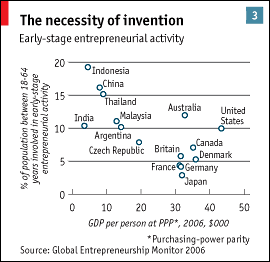
I read this very very interesting article in the Economist which made me go Hmm. The article was talking about Innovation and referred to this graph.

Photo Sharing and Video Hosting at Photobucket

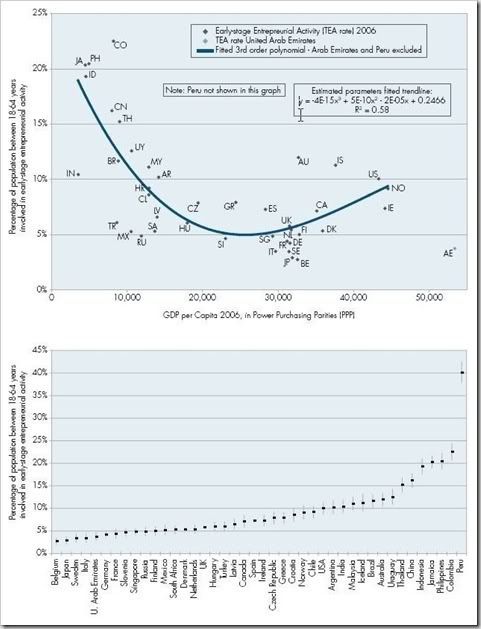
The Economist graph was simplified but the original graph shown below is much better as it provides more information.

Photo Sharing and Video Hosting at Photobucket

Based upon the curve fitting line, you will see that as countries grow and become richer, their rate of entrepreneurship reduces, and that too pretty steeply. Now why would this happen? I can hazard some guesses but no certainty. The first would be that as and how you get richer or the welfare safety net becomes better and better, the hunger for creating value progressively diminishes. The second would be that it would be easier to get jobs rather than worry about raising capital and push for a difficult enterprise. The third factor which I could think of is that as a country becomes richer, it makes it progressively difficult for entrepreneurs to be entrepreneurs, by making it more difficult to fire people, putting in more and more onerous conditions such as Health and Safety, etc. All these combine to make entrepreneurship a losing proposition.

Also, at a particular point in time, they seem to either get stuck or struggle with the next stage which seems to be more difficult. This seems to be the natural trough and despite quite a lot of efforts, the hunger is simply not there. Or it would take superhuman efforts to break through the thicket of regulations. I can well agree to this, while starting up a company is simple in European Countries, the other rules and regulations simply make it way too difficult for a person to embark on entrepreneurship.

But then there are some countries which do make a breakthrough, which is the curious aspect. To what do you ascribe the success of USA and Australia in pushing to develop entrepreneurs? Is it the national ethos? Or the innate hunger? Or their financial system? Or their education system? Why are they so much more risk taking? Or perhaps their time limited welfare system forces them to go about generating value themselves if they do not have a job?

Entrepreneurship is good, it is generating value, creating jobs and ensuring that assets are churned and made use of. Some percentage figures of population engaged in entrepreneurial activity: Indonesia has 19% of its population between 15 and 64 years as entrepreneurs, China 16% and Thailand 15%. India, Malaysia, Australia, USA, Argentina at 10-12% and then Czech, UK, Canada, Denmark, France, Germany, Japan at about 5% or below.

So Mr. Gordon Brown of the UK, what do you have to say about the fact that UK is only showing 5% of its population as entrepreneurs? What is stopping you from doing the same as Australia, USA, India (they are your ex-colonies, my friend - the child excelling over the father?)

As for Mr. Manmohan Singh of India, you need to think deeply, because you are below and behind the curve. You need to make it easier for people to start their own business. Others are leaving you to lag behind!


Sunday, September 23

The seabed land grab continues

Before we had many debates around the Northwestern Passage, then the Russians went in and claimed the Arctic Ocean sea bed as their own and planted a flag. (graphic from BBC)

Arctic map

Another area which has been under debate for a long time is the Caspian sea! See this map which shows the debates by the surrounding states. Its not just sturgeon but also oil which is the reason for the fights.

The image “http://www.wws.princeton.edu/wws401c/1998/caspiandivision.gif” cannot be displayed, because it contains errors.

This map shows the potential for disputes as the war for resources underwater heats up. See how many countries overlap!

http://www.oceansatlas.org/unatlas/-ATLAS-/IMAGES/HIGH/m302.jpg

The UN Commission on the Limits of the Continental Shelf has poked a hornet's nest by asking countries to submit their claims. The submissions can be done on the basis of nice quiet diplomatic debates and civilised agreements such as this one between France, Ireland, Spain and the United Kingdom of Great Britain and Northern Ireland, or otherwise.

Now the British are claiming thousands of square miles of the sea floor around the Falkland Islands, Ascension Island and Rockall. (Check out the picture of Rockall!, very amusing, its just a poxy rock, but that allows the UK to claim a big chunk of the sea floor!) That has immediately made the Argentinians go up in smoke, remember they have had a spat with the UK before over these islands.

The Argentinians call them as the Malvinas and there is a very long history of competing claims and control by various countries. And while before it was nationalism and a desire for some sheep farming land, now the fact that the sea areas can have resources - specially oil - means that the issue is more serious now!

Be prepared for big furballs. Watch this space, I will be tracking this.