- If your foot touches or hits another person's foot, you will get into a fight with that person, unless you shake hands right away.
- It is bad luck to cut your nails at night. Some say hunger and poverty will enter a house if someone cuts their nails at night. Also, it is bad luck to cut your toe nails and finger nails on the same day. Others say that it is bad luck to cut your nails at night, as well as cutting both finger and toe nails right after each other because you will always have all happy events in your life happen at the same time that sad things happen to you...In other words your life will always be bittersweet.
- If a boy chews gum, his beard will grow uneven.
- It's not good to let someone compliment your child or other loved one too much, because they may become jinxed and bad luck may fall on them ( This is called "Nazar"-ing a child). For example, if you say a child is beautiful, the child may become sick. You can ward this off by either saying "Nazar Nakona", or by reciting a surah from the Quran.
- If your cross under a rainbow, a sex change will occur. A boy will turn to a girl and a girl will turn into a boy.
- Jingling your keys will cause a fight to occur.
- If the palm of your hands itch, you will soon receive money.
- If the soles of your feet itch, you will soon travel.
- If you draw lines on the ground you will be in debt.
- If a bowl of water spills out with a sound, it means that you will soon receive guests.
- If flour spills, it means you will soon receive guests.
- Water is thrown on the floor where the person just walked, when a person leaves the front door ( While also walking under the Quran) to go on a long trip. This is done so the person will have a safe and pleasant trip, and return unharmed.
- If you bite your tongue, someone must be talking bad about you (backbiting).
- If your ears itch, someone is talking (gossiping) about you.
- Spotting a sitting magpie bird means you will soon receive a message.
- If your eye twitches, it means good luck will come soon.
- If you drink water and it goes down the wrong tube, causing you to cough, this means that either someone is thinking of you or someone is talking about you.
- After praying, you should fold a side of the prayer matt or the devil will come and pray on it.
- After reading the Quran, you should close it immediately, or the devil will come and read from it.
- You will be falsely accused of something if you feet touches a broom.
- On new year's eve, you should be at home, or for the rest of the year, you will not be at home.
- Don't look in the mirror at night, because someone will tell a lie about you.
- Bad luck will come if you open and close scissors without a reason.
- The smoke from burning incense (called span) will keep bad luck and bad spirits away.
- During an eclipse if pregnant woman scratches herself, a black mark will appear on her baby.
- If your baby is born with a belly button that is an "outie", place a clean coin on top of it and secure it around the waist for three days and it will become an "innie".
- If a baby has jaundice, let it lick on cleaned gold and the jaundice will go away.
- If a male child is circumcised, fasten a piece of feroza (pure turquoise) jewelry to it's bedding above the head and his cut will heal faster and nicely.
- When a new born is brought into the house and placed into his or her bed, hanging something (jewelry etc..) with the name of Allah on it will help keep the baby safe from harm when they sleep.
- Marriage between the two holidays Eid ul Fitr and Eid ul Adha is prohibited.
- Shaving a baby's hair will make their hair grow thicker.
Showing posts with label culture. Show all posts
Showing posts with label culture. Show all posts
Wednesday, March 30
Superstitions and popular myths in Afghanistan


Friday, May 11
What do you expect out of marriage?
Amusing study here.
I quote the abstract
This study examines whether communication and culturally embedded concepts influence cross-cultural similarities and differences in marital role conceptions. Young adults from the US, China, South Korea, Japan, India and Malaysia responded to a series of open-ended questions about marriage and marital roles. Analytic induction methods produced categories across six topics (good wife/bad wife, good husband/bad husband, good marriage/bad marriage). Results showed even greater variation in marital role conceptions than hypothesized. Only East Asians nominated a family home focus more and only Chinese and Koreans considered respectfulness and gentleness more for the good wife role than did US participants. Loving/caring nominations did not differ across the cultural groups except for greater nominations by US participants for the good marriage and good wife role conceptions, and proportions of controlling/abusive behaviors did not differ except for the Indian group's higher nominations for the bad wife role. Communication expectations for marital roles showed some cross cultural similarity, as both US and Asian participants rated communication characteristics as more important than attractiveness/ability characteristics, but only for the good wife/husband roles.
its a bit of a d’oh question, but would help raise a chuckle at the entrenchment of national stereotypes. Indian groups seem to be highly interested in the bad wife role, lol
Friday, May 4
When it happens in Africa
This was pretty powerful.

I was reminded of this article by Manu Joseph, which is frankly stupid. The broad generalisations immediately make it clear that the man does not have the intellect to understand the subtleties of life and the fact that he was unable to understand that western families look after their kids just as much means that he is ignorant. But we aren't here to talk about Manu Joseph’s stupid article, NYT seems to publish any odd sod crap from India these days.
But leave that aside for the moment. Look at the list above, pretty clear, no? When it happens in the UK or USA, then its fine, but when it goes into Africa or even Asia, then it has a different perspective. I know there are exceptions, and then there is the ideological difference, for example the last one is a classic left/right argument.
But the irony is so thick I could use it to butter my bread. Which reminds me, I have to go eat my muesli.
Thursday, April 5
History of culture
I read this from here.
The entire history of culture is dominated by an effort to become as independent as possible from the whims of nature. The more developed a civilization is, the more an individual is protected from nature and natural influences and knows how to create around him a constant or controllable environment to his liking. Our menu is no longer dependent on harvests, the presence of wild game, or the seasons….
Nowadays we usually perceive unspoiled nature as an ideal of beauty and purity, but most Western-type people would not survive for long in nature’s untouched locations. It is not a world of people.
It was fascinating. Just think about it and we are ok with this. We like our civilisation around us. But once I read about a quote, “civilisation is just 3 days away from barbarism”. Let me explain. In our interconnected world, in our civilised worlds, in our massive supply chain connected world, we have everything instantly. We have water on tap. We have food in the fridge and if that runs out, we can just pop to the shop and get everything or get it ordered in. We can get a hotel room or house very simply.
But all this is very finely balanced and this entire edifice is very finely made, with there being significant points of failure. For example, the entire country has gone into a mild panic and is purchasing petrol like muppets simply because some lorry drivers threatened to go on strike. If say 2-3 ports are devastated, then the country will come to a grinding halt. The water supply here can be literally turned off by a suitable application of some bits in some bits. Our civilisation is getting to a point that truly independent living is difficult. Put it in another way, if a hurricane comes across and devastation is across a variety of point, society as we know it collapses, within 3 days. That’s how long it takes for your home supplies of water, food, shelter, wax candles, money, etc. etc. to run out. Generally. Points to ponder.
Friday, March 18
Raising Kids–the tiger mother method
I quote:
Chua has accepted, in a way that the good mothers will not, that most children today can’t have it both ways: they can’t have a fun, low-stress childhood and also an Ivy League education.
I agree with Amy Chua. Life is a matter of choices and every choice has a set of positive returns and a set of negative returns. The way I am raising our kids, well, hopefully we are ok with this but I push both of them. I am called as paranoid and many have said that I should let them play a bit more. Yep, tick, they do play and have fun, but at the same time, I keep on showing them that there is much more that they can do. How else are you going to get them to excel? To know their boundaries? For heaven’s sake, I haven't found my boundaries yet and that’s not for the lack of trying either. Also, if you don't push yourself, how do you find out what you don't want to do? Sometimes that is more important than knowing what to do.
Take his internship ideas which I talked about before. Had an idea to give him some international internship experience. He can go to India or USA to work with some of the family / friends and get some experience during his summer holidays. What is extraordinary is how many people say no or have objections to this idea. Very few actually agree to the idea that he can spend 2 weeks out of 6 weeks of his summer holiday improving himself. Including him. But tough, he will be doing this. Why? because he will be the 1 person out of 10000 who can show international working experience on his cv when the time comes for him to apply to Harvard, Oxford or what have you. And lets see, 2 weeks of summer holiday versus a top class education. No contest at all.
Lets put this in another way, I would much rather they regretted how hard they worked as a kid when they are old rather than regretted that they did not work harder when they were a kid. If that means that I have to hear that I am paranoid, pushy and and and, so be it. In the meantime, go read the article which I linked above.
It could be cultural as well, and the socio economic statistics in the USA and UK point out the importance of education. I take the following graph from National Statistics UK.

Who are the top 3 in the lowest exclusion rates?
Ok, so how about people in managerial or professional occupations?

Who are the above average ethnic minorities? So tough titty, kids, be prepared to be pushed.
Thursday, February 21
Criminalise forced marriage? You bet!
When I read this, I was nodding in approval. Forced marriages are a blot on society and no culture can agree or approve this to be done to their children. I quote the main proposals:
Lets not forget that its not the children who are frequently at fault, its the parents and relatives, they need to be brought into the ambit of this proposal as well.
All this to be taken with a grain of piquant salt!!!
- increasing the minimum age for any spouse coming to Britain and their British partner to 21 to ensure they are old enough to make such a big decision;
- making the groom and bride take part in private and separate interviews to check they are happy with the proposed marriage;
- demanding that every spouse who comes to Britain has basic English;
- making every prospective British spouse who intends to marry abroad register before leaving the country. They would be asked to provide the name of their intended spouse and be given a deadline by which time the marriage must take place
Lets not forget that its not the children who are frequently at fault, its the parents and relatives, they need to be brought into the ambit of this proposal as well.
All this to be taken with a grain of piquant salt!!!
Saturday, January 26
Photo Essay: A Dastarkhan in Lucknow
A Dastarkhan is the name of the white sheet which is spread out on the floor of a room and then food served on top of it. You can find the usage of this word from Iran to Afghanistan to Pakistan to India, and I bumped into this in Lucknow. So it can be called as a the place where very fragrant food dishes are served and so it turned out in Lucknow.
Lucknow is famous for its cuisine. Specially its kebabs which are so soft that they melt in your mouth and there are a variety of Kebabs in Lucknow. Kakori Kebabs, Tunde Kebabs, Skek Kebabs, Hariyali Kebabs, Galawat Kebabs etc. etc. (also try Shreemal) (Also see here for a good overview of Kebabs in India). There are two reasons why they are so soft that they would melt in their mouth.
The first is that the Nawabs of Lucknow were so indolent that they did not want to even chew. The second reason given is that because they were so spoilt, by the time they hit their twenties, their teeth had rotted away due to drug usage and over-indulgence in the Lucknow desserts and sweets.
Be that as it may, I have all my teeth and boyo, the kebabs were brilliant. But I do not like the food served in the big restaurants and given that my-laws are vegetarian, it means that we have to order in. So I decided to go buy some good meat stuff and what I wanted was from the road-side stalls.
And my father-in-law pointed me into this direction. It was a short street, hardly 50 meters long, with about 6 shops on the left and 2 on the right.
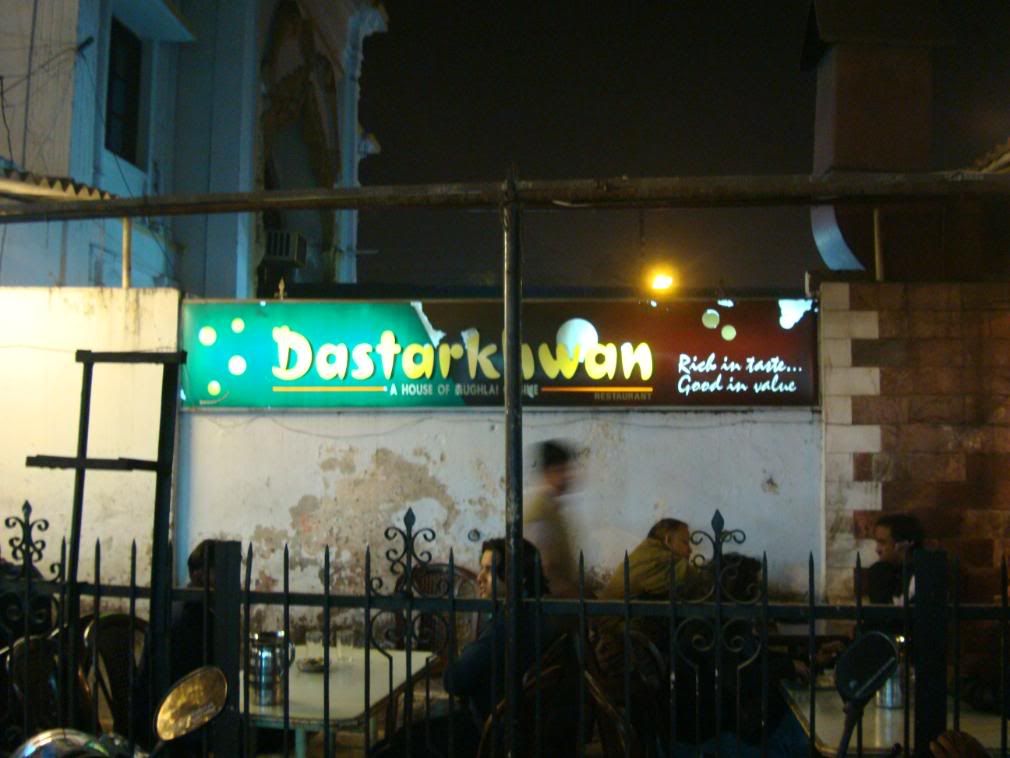
We went to dastarkhan which was the second shop on the right.
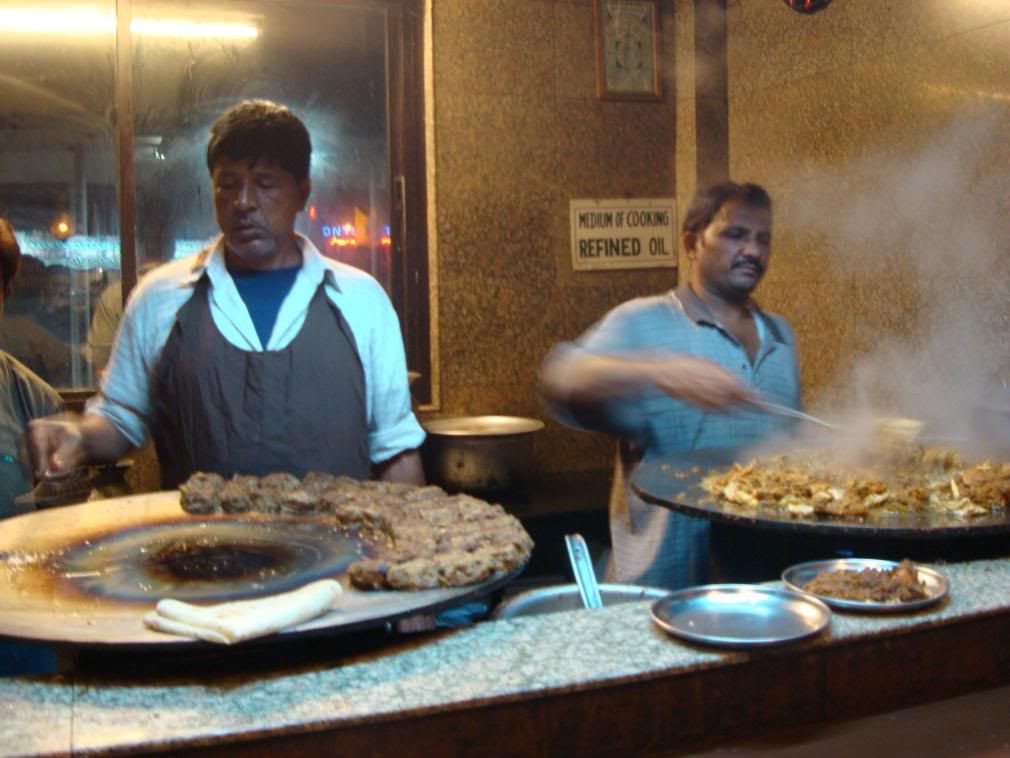
And the cooks were busy cooking. Notice the sign in the background, only refined oil is used. What is India coming to???? refined oil? what happened to engine oil?
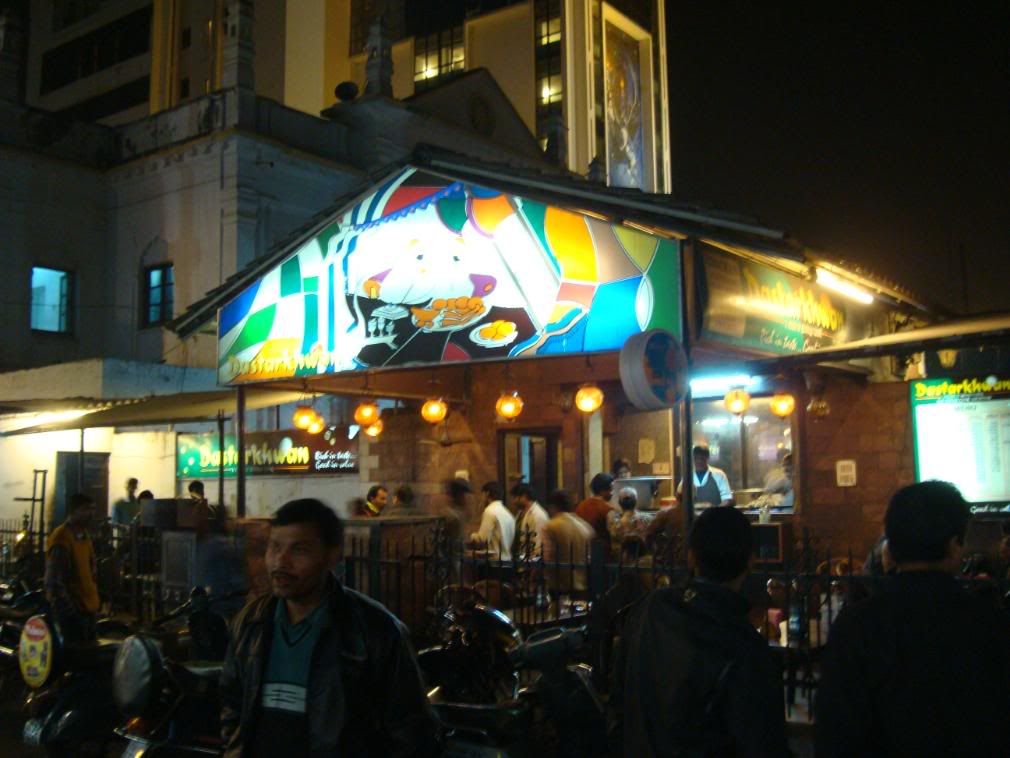
It was quite crowded with people queued out outside
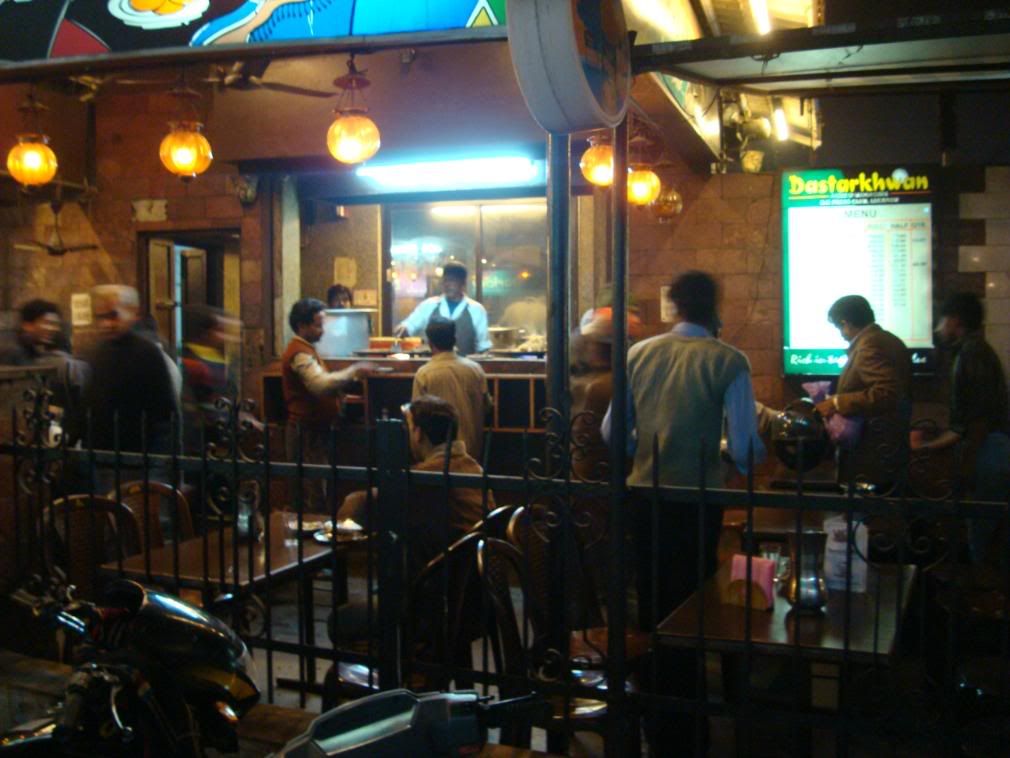
people eating inside quickly, this was in December, it was cold, but still was heaving outside

There were people wanting take away as well.

Here's your menu. I personally thought it was a bit expensive. Compared to other places that I have eaten, that is. A full chicken for 150 rupees? That's expensive. But then, the aroma was brilliant.
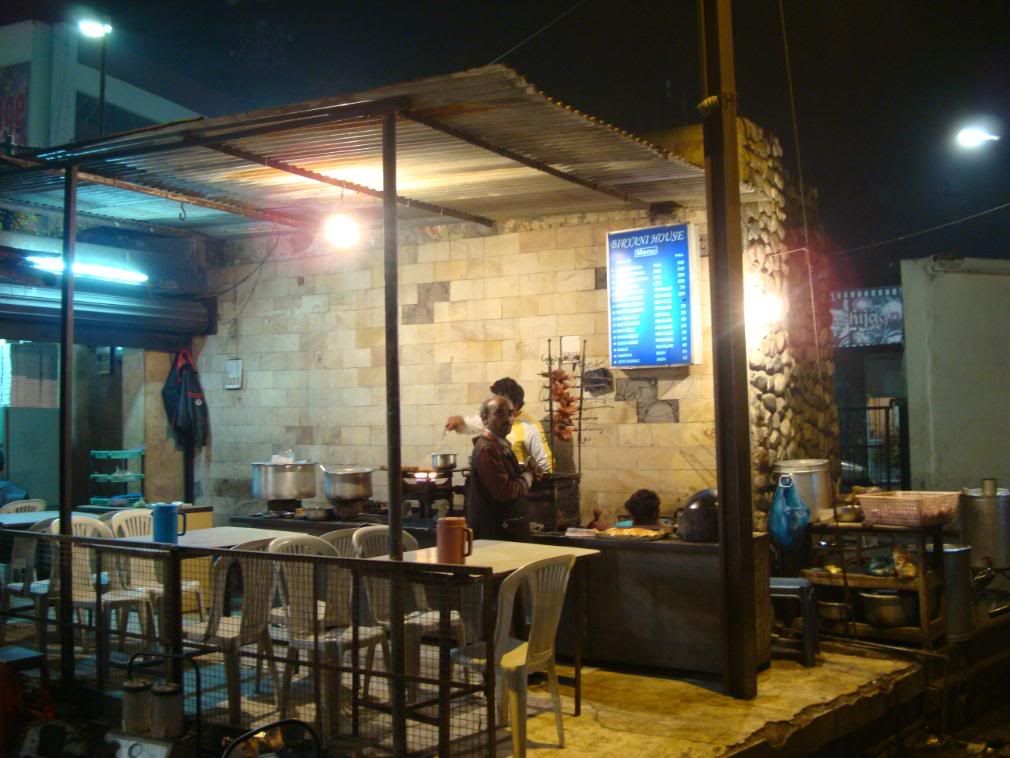
The order for the kebabs and biryani was taking some time, so I went walkabout. This was the shop opposite Dastarkhan
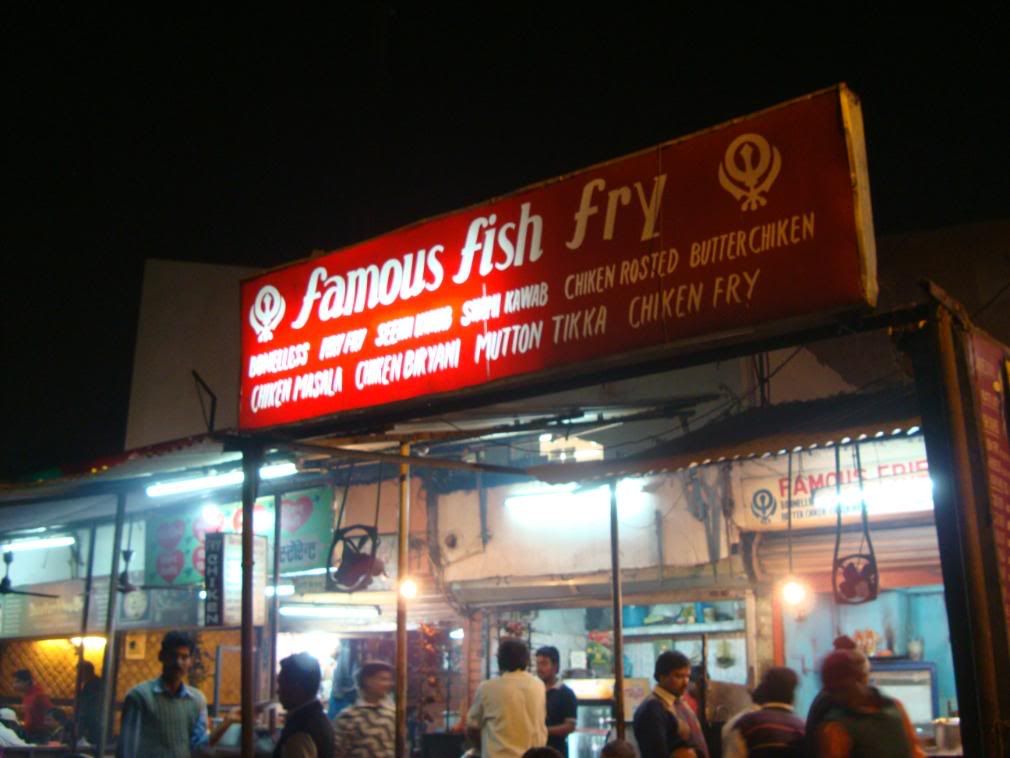
Famous Fish Fry. It wont be India without spelling mistakes on shop front. Would Sir like to have some Chiken Rosted?
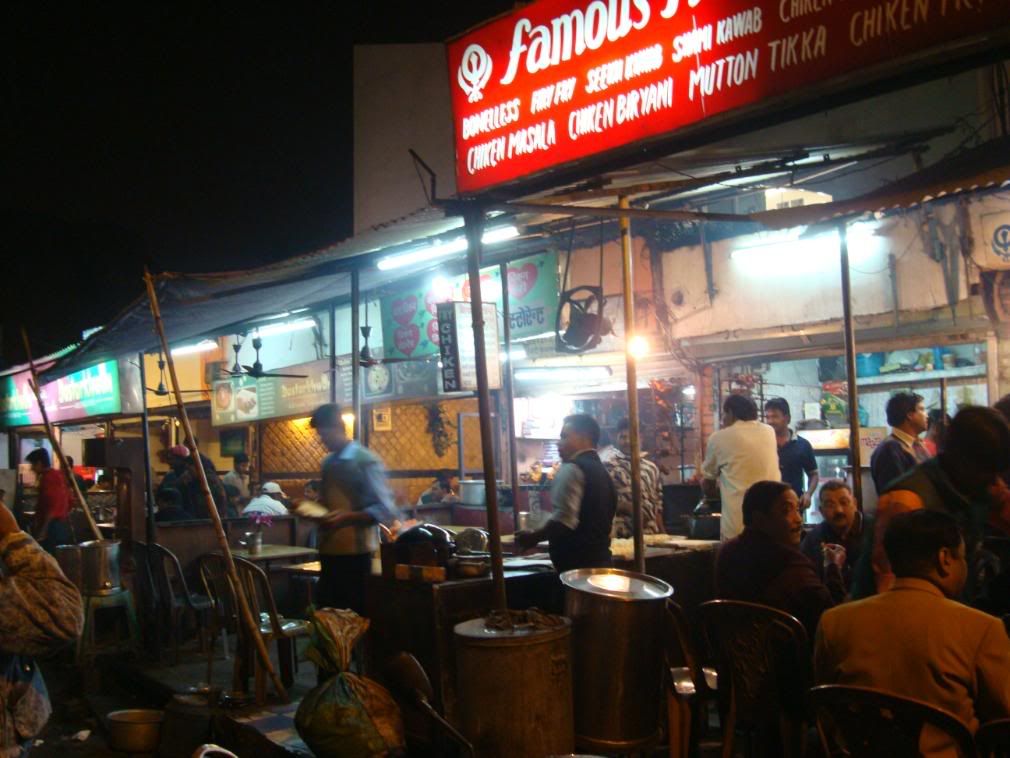
This place was also heaving.
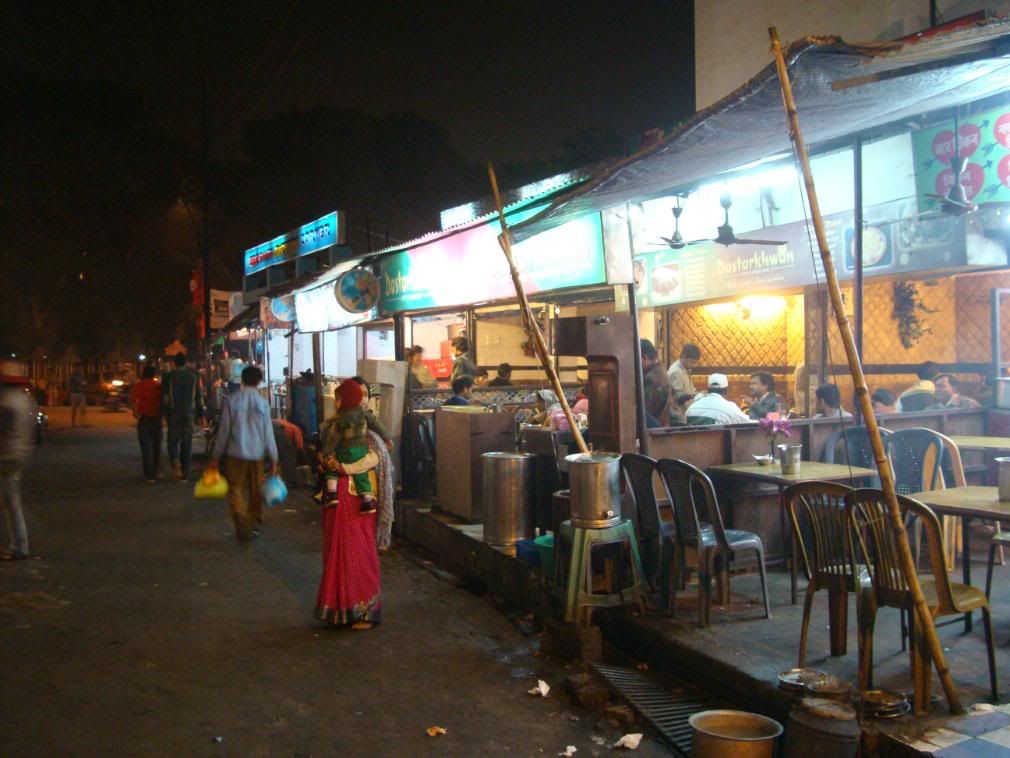
Some of the other shops were a bit emptier.
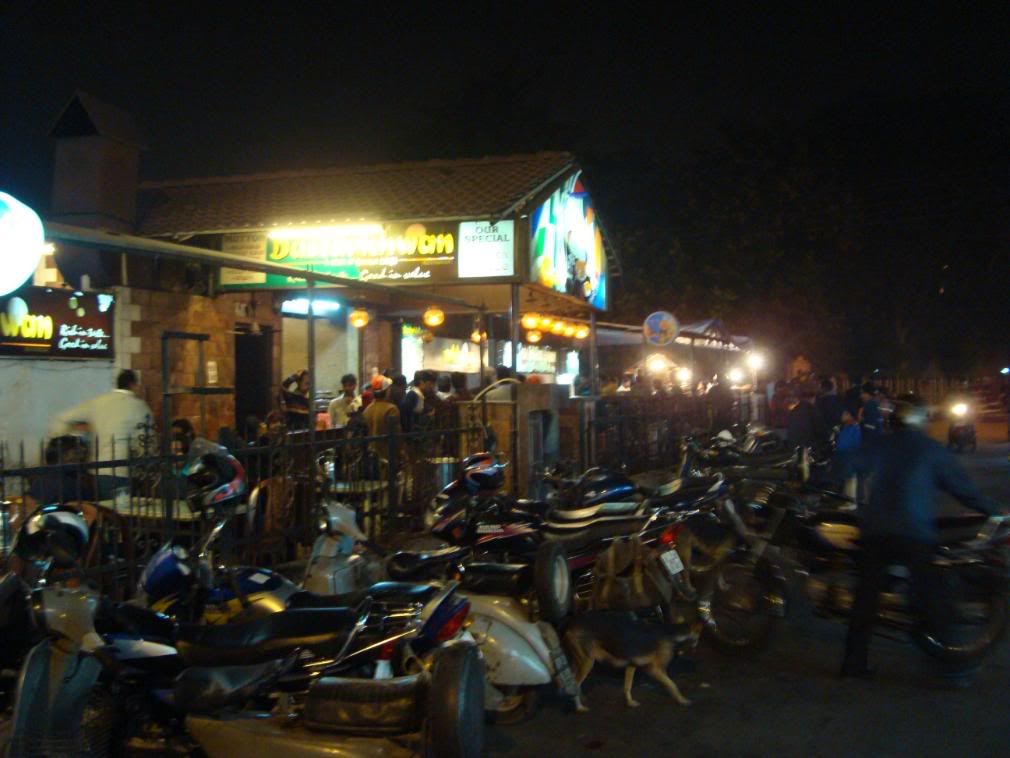
Quite a crowd, eh? including the doggie!
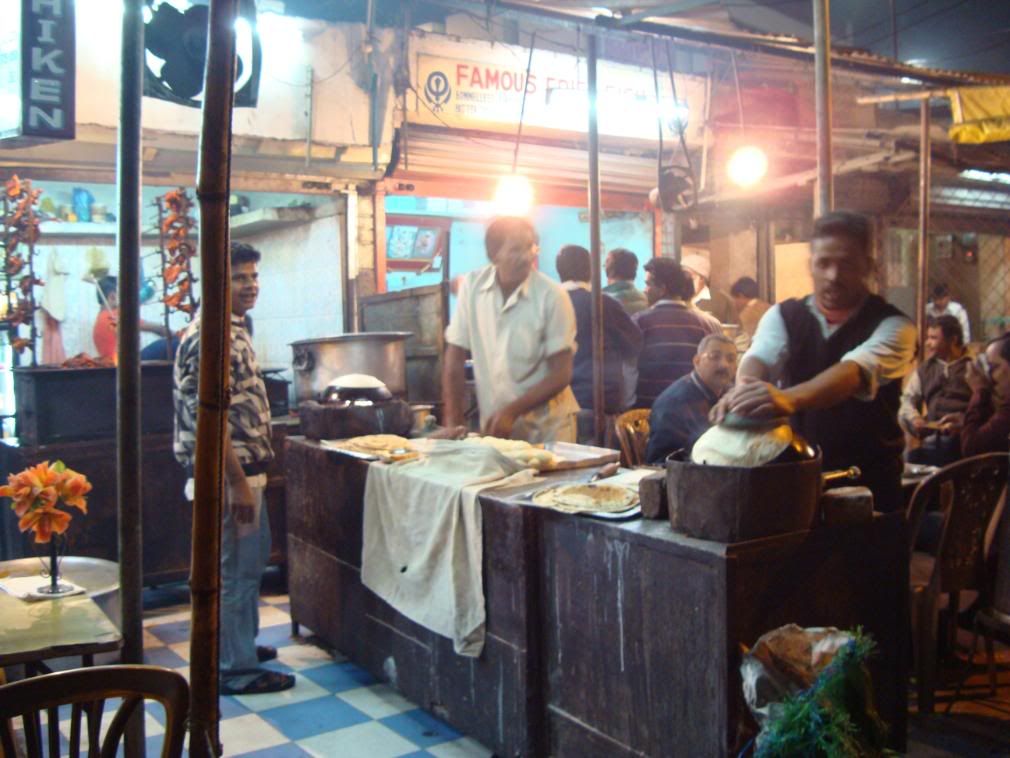
the making of a rumali roti
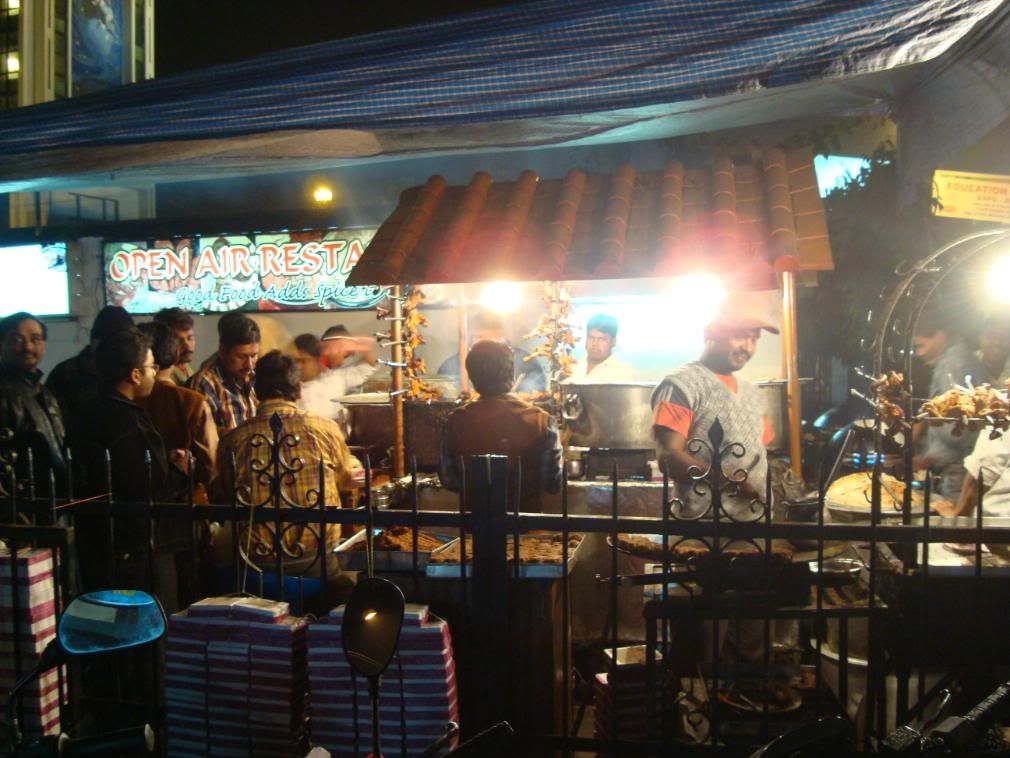
the first shop on the right which makes fried stuff, you can see chicken and fish pieces hanging up around the thela.

And the crowd around the thela. Can you see the building behind the shops? the tall one? That's Gemini Intercontinental Hotel and we got a biryani from there as well.
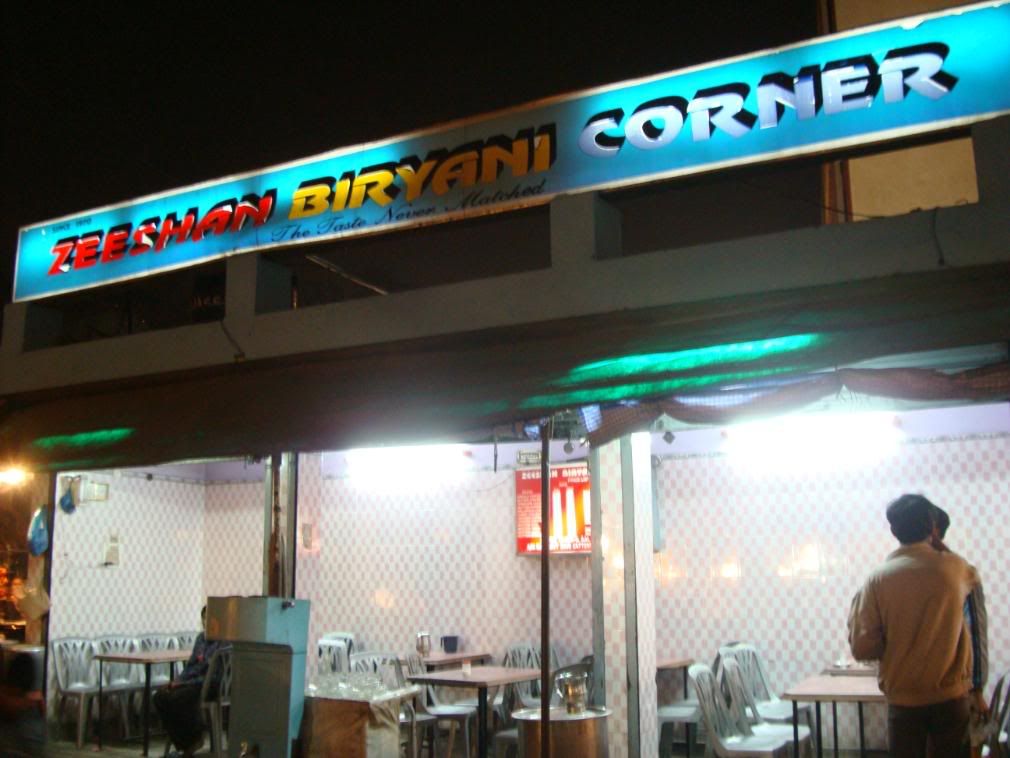
I am not sure that the Biryani corner was that good, so I avoided it as well. Needless to say, the food was brilliant. I did a blind comparison test of the biryani from Gemini Intercontinental Hotel and from Dastarkhan. I am afraid Dastarkhan won hands down! (my daughter preferred the other one, but I pulled rank and weight and overruled her for the next time, she WILL learn who's the daddy!)
But again, if you are ever in Lucknow, do make it a point to visit Dastarkhan and enjoy!
Technorati Tags: Photo Essay,Cuisine
Tuesday, September 18
World's languages dying off rapidly
The world's languages are dying off rapidly according to a report by the NYT. I wrote something earlier on this in a more philosophical frame of mind, but this is tragic, we are losing the human DNA, the cultural and linguistic history of our human race. I am not sure how much we can do about it, but it is indeed sad.
All this to be taken with a grain of piquant salt!!
Technorati Tags: Languages
World’s Languages Dying Off Rapidly
By JOHN NOBLE WILFORD
Of the estimated 7,000 languages spoken in the world today, linguists say, nearly half are in danger of extinction and are likely to disappear in this century. In fact, they are now falling out of use at a rate of about one every two weeks.
Some endangered languages vanish in an instant, at the death of the sole surviving speaker. Others are lost gradually in bilingual cultures, as indigenous tongues are overwhelmed by the dominant language at school, in the marketplace and on television.
New research, reported today, has identified the five regions of the world where languages are disappearing most rapidly. The “hot spots” of imminent language extinctions are: Northern Australia, Central South America, North America’s upper Pacific coastal zone, Eastern Siberia and Oklahoma and Southwest United States. All of the areas are occupied by aboriginal people speaking diverse languages, but in decreasing numbers.
The study was based on field research and data analysis supported by the National Geographic Society and the Living Tongues Institute for Endangered Languages, an organization for the documentation, revitalization and maintenance of languages at risk. The findings are described in the October issue of National Geographic magazine and at www.languagehotspots.org.
At a teleconference with reporters today, K. David Harrison, an assistant professor of linguistics at Swarthmore College, said that more than half of the languages have no written form and are “vulnerable to loss and being forgotten.” When they disappear, they leave behind no dictionary, no text, no record of the accumulated knowledge and history of a vanished culture.
Dr. Harrison; Gregory D. S. Anderson, director of the Living Tongues Institute in Salem, Ore., and Chris Rainier, a filmmaker with the National Geographic Society have traveled in recent years to many parts of the world, the beginning of what they expect to be a long-term series of projects to identify and record endangered languages.
The researchers interview and make recordings of the few remaining speakers of a threatened spoken language, and collected basic word lists.
The projects, some of which extend over three to four years, involve hundreds of hours of audio recordings, development of grammars and preparation of children’s readers in the subject language. The research has especially concentrated on preserving language families that are on their way out.
In Australia, where nearly all of the 231 spoken aboriginal tongues are endangered, the researchers came upon such tiny language communities as the three known speakers of Magati Ke, in the Northern Territory, and the three Yawuru speakers, in Western Australia. In July, Dr. Anderson said, they met the sole living speaker of Amurdag, a language in the Northern Territory that had already been declared extinct.
“This is probably one language that cannot be brought back, but at least we made a record of it,” Dr. Anderson said, noting that the Amurdag speaker strained to recall words he had last heard from his late father.
Many of the 113 languages spoken in the Andes Mountains and Amazon basin are poorly known and are rapidly giving way to Spanish or Portuguese, or in a few cases, to a more dominant indigenous language. In this region, for example, a group known as the Kallawaya use Spanish or Quechua in daily life, but also have their own secret tongue, used mainly for preserving knowledge of medicinal plants, some of which were previously unknown to science.
“How and why this language has survived for more than 400 years, while being spoken by very few, is a mystery,” Dr. Harrison said news release.
The dominance of English threatens the survival of the 54 indigenous languages of the Northwest Pacific plateau of North America, a region including British Columbia, Oregon and Washington. Only one person remains who speaks Siletz Dee-ni, the last of many languages once spoken on a reservation in Oregon.
In Eastern Siberia, the researchers said, government policies have forced speakers of minority languages to use national and regional languages, such as Russian or Sakha.
Forty Native American languages are still spoken in Oklahoma, Texas and New Mexico, many of them originally used by indigenous tribes and others introduced by Eastern tribes that were forced to resettle on reservations there, mainly in Oklahoma. Several of the languages are moribund.
Another measure of the threatened decline of many relatively obscure languages, Dr. Harrison said, is that speakers and writers of the 83 languages with “global” influence now account for 80 percent of the world population. Most of the thousands of other languages now face extinction at a rate, the researchers said, that exceeds that of birds, mammals, fish or plants.
Subscribe to:
Posts (Atom)