Showing posts with label environment. Show all posts

Wednesday, November 11

The high environmental cost of our oasis fix

Here's an interesting take on something that you already know son. Water scarcity is a fact of life across so many countries and England included. Two years back, there was a hose pipe ban in the uk. Despite it raining so much. There are tons of reasons but mainly it's because we don't manage water properly and the stresses are huge. Despite a slowly reducing population, many countries are severely water stressed. There was a nasa hydrological map which showed how much ground water aquifers have been depleted in Asia Middle East and Africa. This will blow up the economics terribly. 

But oases are truly beautiful son. I've seen them in india and Saudi Arabia. To see them emerge out of the dusty desert is extraordinary. The feeling of happiness and joy. The feeling of being alive. It's fecund. It's fertile. The water. The brilliant green. Truly amazing sights. 

I'm running a small project in Nicaragua with the university of Bedfordshire where we will be trying to help a village become water sustainable. By using water harvesting techniques, improved irrigation methods, aquifer replenishment, and so on and so forth. This 5 year plan will be fascinating. I've never worked with water before. Hsbc is also sponsoring water charities and I'm getting involved there as well. This is going to be a big strategic issue for us. 

Look forward to speaking to you tonight son. 

Love you

Baba


The high environmental cost of our oasis fix – Rebecca Lawton – Aeon
http://aeon.co/magazine/science/the-high-environmental-cost-of-our-oasis-fix/
(via Instapaper)


Seen from the air, the single verdant parcel of land with its straight borders and sharp edges resembles a green postage stamp pasted on a great expanse of manila envelope. Inside the boundary, a screen of trees hides a palatial estate, acres of emerald turf, a paved circular driveway, and an extensive array of tumbling, marble fountains. Outside the rectangle, a hot, rock-strewn fan of tan alluvium extends unvegetated and unwatered for half a kilometre to another such parcel, then another, then another. Toward the city centre eight kilometres away, residences cluster closer together but emulate the lush feel of the outlying estates with their surfeit of palm trees, water features and improbably green turf.


Wednesday, February 4

Why the Passenger Pigeon Became Extinct

This is a curious if a bit saddening story kids. Man is truly the most destructive species on the planet. This is a cautionary tale of how we are driving the planetary Eco system to destruction. Slowly and surely the natural world is being compressed heavily. Polluted to kingdom come. Over fishes. Over mined. Over engineered. 

One day literally we will end up with a blighted world. Not a fun thing. That's why kids, make sure that you reduce, reuse and recycle. And try to make sure that your footprint is low. It helps :) 

But I still hate the bloody pigeons. 

Love

Baba

Jonathan Rosen: Why the Passenger Pigeon Became Extinct
http://www.newyorker.com/arts/critics/books/2014/01/06/140106crbo_books_rosen

Thursday, March 14

Another consequence of plastic bag bans

#1 was here when we talked about banning plastic bags leads to increased health hazard

And now Shoplifters in Seattle: thefts rise after plastic bag ban

Seattle prohibited use of the bags eight months ago, encouraging people to bring their own reusable bags or pay a five cent tax for paper carriers.

But thousands of dollars of extra produce has since gone missing, with store owners saying it is easy for thieves to walk in with reusable bags, conceal items in them and then walk out.

Asking shoppers to leave their bags or backpacks at the front of stores while they shop has been deemed impractical.

In a survey, more than one in five businesses in the city said shoplifting had become a problem because of the ban.

Shopper Ramona Lund said: "I've actually seen it happen. You can just see when they walk through and they load up their bag and they just go out the door."

Related Articles

Mike Duke, who runs the Lake City Grocery Outlet, said that since the ban started in July he has lost at least $5,000 (£3,300) in produce, and up to $4,000 (£2,700) in frozen food. He told the Seattle Post-Intelligencer newspaper: "We've never lost that much before."

heh. The law of unintended consequences strikes again

Monday, February 18

Consequences of Plastic Bag Bans

now i always thought that banning plastic bags was a no brainer, no? they are disgusting and end up creating crappy landscapes such as this.

plastic-bags[1] Manila-Bay-covered-with-p-007[1] bags-2[1] white-pollution-plastic-bags[1]

 4839812876_c772521f43_z[1] wingpig_2012-01-28_jpg1328272299[1]

I guess i shouldn't have been surprised that this happens. The law of unintended consequences, eh?


Most alarmingly, the industry has highlighted news reports linking reusable shopping bags to the spread of disease. Like this one, from the Los Angeles Times last May: “A reusable grocery bag left in a hotel bathroom caused an outbreak of norovirus-induced diarrhea and nausea that struck nine of 13 members of a girls’ soccer team in October, Oregon researchers reported Wednesday.” The norovirus may not have political clout, but evidently it, too, is rooting against plastic bags.

Warning of disease may seem like an over-the-top scare tactic, but research suggests there’s more than anecdote behind this industry talking point. In a 2011 study, four researchers examined reusable bags in California and Arizona and found that 51 percent of them contained coliform bacteria. The problem appears to be the habits of the reusers. Seventy-five percent said they keep meat and vegetables in the same bag. When bags were stored in hot car trunks for two hours, the bacteria grew tenfold.

That study also found, happily, that washing the bags eliminated 99.9 percent of the bacteria. It undercut even that good news, though, by finding that 97 percent of people reported that they never wash their bags.

Jonathan Klick and Joshua Wright, who are law professors at the University of Pennsylvania and George Mason University, respectively, have done a more recent study on the public-health impact of plastic-bag bans. They find that emergency-room admissions related to E. coli infections increased in San Francisco after the ban. (Nearby counties did not show this increase.) And this effect showed up as soon as the ban was implemented. (“There is a clear discontinuity at the time of adoption.”) The San Francisco ban was also associated with increases in salmonella and other bacterial infections. Similar effects were found in other California towns that adopted such laws.

Thursday, September 6

The link between fish and climate change

HSBC released a report on climate change. I quote the summary

This past week, two publications highlighted the effect of carbon dioxide (CO2) and climate change on oceans and marine life. We believe the related consequences for Asian economies will serve to increase pressure on governments to reduce emissions.
CSIRO published its 2012 report card on Marine Climate Change in Australia and Nature Climate Change a paper which called on adaptation strategies for ocean conservation. Oceans absorb around one-quarter of all the CO2 that we emit resulting in rising surface acidity levels, which in turn affect marine life. Moreover, the consequences of CO2 also include warmer water (oxygen depletion) for certain fish, as well as changing currents, which drive fish towards cooler waters. We think the pressure on governments to curb emissions will only rise as the impact of CO2 on oceans becomes more recognised.
Globally, the production and consumption of fish and aquaculture have been rising (Chart 1) and this sector sustains the livelihoods of around 10% of the global population. Ocean acidification coupled with warming water - both consequences of CO2 emissions -disrupt marine life, impacting livelihoods and economies. Asian economies are most exposed to the fisheries and aquaculture sector, as Asia accounts for the top six producers of aquaculture (Chart 2) and 87% of all persons employed in the sector globally.
Fish provide 15-20% of animal protein for around half of the world's population. As marine life is disrupted by, amongst many factors, CO2 emissions, diets may turn to more meat for appropriate protein intake. Recent data from Japan shows that the consumption of meat and fish has been converging (Chart 3), suggesting that less fish means more meat. This switch has the potential to further exacerbate existing water scarcity problems in many Asian countries since meat requires more water to produce. In our view, the pressure on Asian governments to reduce emissions is only going to grow.

I guess the countries who have a well organised aqua culture and export industry will do something about it, but for countries where there is no organisation such as India, it wouldn't matter. Unlike pretty much most countries who have recognised the issue of climate change, need for sustainability and carbon capture, India is blissfully proceeding down the track of severe environmental degradation. And the fault directly lies with the citizenry second and the government first.

Monday, January 23

Plant a tree to reduce crime

Now there’s a great idea.

The authors estimate the relationship between trees and three crime aggregates (all crime, violent crime, and property crime) and two individual crimes (burglary and vandalism) in Portland, Oregon. During the study period (2005-2007), 431 crimes were reported at the 2,813 single-family homes in our sample. In general, the authors find that trees in the public right of way are associated with lower crime rates. The relationship between crime and trees on a house’s lot is mixed. Smaller, view-obstructing trees are associated with increased crime, whereas larger trees are associated with reduced crime. The authors speculate that trees may reduce crime by signaling to potential criminals that a house is better cared for and, therefore, subject to more effective authority than a comparable house with fewer trees.

Source: "The Effect of Trees on Crime in Portland, Oregon" from Environment and Behavior

We need to plant more trees

Monday, April 25

The unconsidered impacts of Jatropha biodiesel

Fairly typical situation here. People are getting all excited about biodiesel and thinking its the next thing to sliced bread. Let me quote the abstract.

Governments around the world see biofuels as a common solution to the multiple policy challenges posed by energy insecurity, climate change and falling farmer incomes. The Indian government has enthusiastically adopted a second-generation feedstock – the oilseed-bearing shrub, Jatropha curcas – for an ambitious national biodiesel program. Studies estimating the production capacity and potential land use implications of this program have typically assumed that the ‘waste land’ slated for Jatropha production has no economic value and that no activities of note will be displaced by plantation development. Here we examine the specific local impacts of rapid Jatropha plantation development on rural livelihoods and land use in Rajasthan, India. We find that in Jhadol Tehsil, Jatropha is planted on both government and private land, and has typically displaced grazing and forage collection. For those at the socioeconomic margins, these unconsidered impacts counteract the very benefits that the biofuel programs aim to create. The Rajasthan case demonstrates that local land-use impacts need to be integrated into decision-making for national targets and global biofuel promotion efforts.

So they have conveniently given some research highlights

► Hardy biofuel crops like Jatropha replace edible feedstocks that use arable land.

► In Rajasthan, Jatropha displaces grazing and forage on both public and private land.

► As Jatropha plantations mature, the loss of grass becomes more pronounced.

► Unconsidered impacts negate the benefits that the biodiesel program aims to create.

► Local land-use impacts need to be integrated into decision-making.

The authors further state

the science of Jatropha is seriously lacking. Although many university, government and industry researchers are working to refine planting materials and management techniques, the plant's five-year maturation period has so far impeded quick progress. The formal, peer-reviewed publication of scientific research has also been slow, which may result, in part, from concerns about intellectual property rights in an industry that has garnered substantial interest from investors. Without refined management techniques and planting materials, rapid plantation development may limit benefits for decades. Since the plants can live for 50 years, the impact of poor planting materials and early pruning mistakes will be magnified in the long term. Overall, it is unlikely that Jatropha will become a successful cash crop within the current scientific and policy climate, given the poor state of knowledge of the plant's agronomy and the disappointing seed yields in block plantations.

More work required before thinking this is a panacea for India and the world’s fuel issues.

Sunday, July 25

A debate over climate change

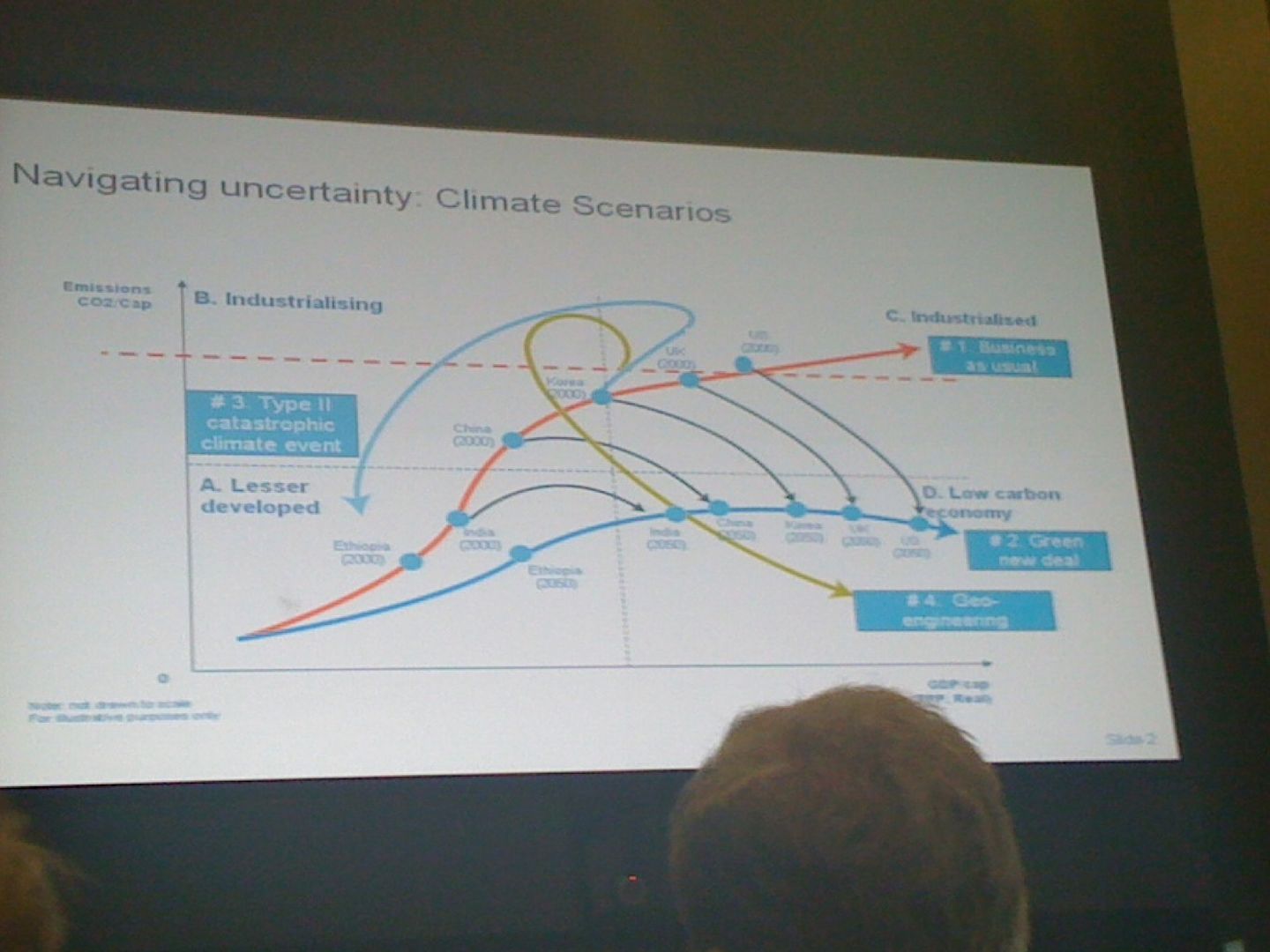
We had a presentation on climate change in the office and I just want to pick up on one part of it. Here is the particular slide.

Let me explain the slide first. The X axis shows GDP growth while the Y axis shows the Emissions CO2 per capita. So you end up with (a) Lesser Developed, (b) Industrialising, © Industrialised, and (d) Low Carbon Economy. The last fourth quadrant being the nirvana land, yes?

So what’s the trajectory like? If we do nothing, then the red line is operational and we will keep on going up the increased wealth with increased emissions route. The parallel bottom descending lines from the red line to the dark blue line are due to green new deals, a climate change deal if you will. The top light blue line relates to a catastrophic climate event which will pull the entire world or the country back into lesser developed status while the yellow line exhibits what will happen if we have a technological breakthrough via carbon sequestration or some other fancy technology.

This is just an illustrative slide to show what potential trajectories there can be, but I have 3 issues

1. cost: This slide does not talk about what will be the impact of adopting the green deals or the geo engineering technical solutions. If you factor that in, then the optimistic blue line at the bottom will be pulled up sharply increasing the trend line. In other words, if a country like India has to actually pay for carbon storage or other carbon emission technologies, it can very well decrease its growth rate.

2. combination: There is a strong possibility that all four elements are simultaneously applied, we can have growth, we can have new green deals, we can have geo engineering and we can end up with a catastrophic climate event such as typhoons or cyclones or something like that. Then where do we go? In other words, the choice is frankly now out of our hands.

3. Other factors such as water shortage: What happens if we have a catastrophic non climate event such as volcanic eruptions? Or severe drought? or water shortage? What then?

I further pointed out that the cost of getting people to work on this via the private sector seems to be a bit wonky, the PE ratio’s of green tech companies are hovering around the 60-100 mark. That’s ridiculous. What on earth are those valuations telling me? That’s a clear and present danger of a huge bubble.

So I am going to sit this one out I am afraid, not very clear and until and unless there is more clarity, not going to invest in this sector. This doesnt mean that I am going to stop my attempts to reduce pollution and the like, that’s on the supply side but on the demand and fixing side? Jury is still out.

Saturday, April 24

Sheer Chutzpah in Spanish corruption

Can you imagine? they claimed for power generation during the night for solar powered plants. I quote:

The Ministry for Industry uncovers a serious fraud on solar energy' , El Mundo reveals today with the newspaper's main feature story, quoting government data on photovoltaic energy production, according to which several solar plants were actually working at night. It is suspected the solar panels are plugged into power generators or electricity-producing apparel at night, to simulate production and obtain the public grants allowed for the photovoltaic sector. According to the newspaper's sources, solar plants in Castilla y Leon, Castilla-La Mancha, Andalusia and the Canary Islands are supposedly producing energy at night-time, without the sun. Between November and January in particular, more than 4,500 megawatt per hour would have been produced at night, and the amount of State-granted frauded funds would be about 2,6 million euros. Until last year's November the energy production in Spanish photovoltaic plants didn't undergo today's severe controls, which are regulated by the National Energy Commission (CNE, where all data from authonomous communities and energy distribution companies are processed.) The responsible Minister, Miguel Sebastian, pushed CNE to further inspections and open an inquiry to investigate "fraudulent practices.

This huge outpouring of funds into this green energy, carbon trading, non conventional sources of energy stuff is like honey to all these fraudsters.

Wednesday, November 11

Pen mightier than the sword?

dont think so if this story is right. If this does happen, then people will be wincing at the poor bureaucrat. But this quote was great:

"With the slip of a Whitehall pen, the UK government has opened the way for the Spanish to lay claim to Gibraltar's waters," he said. "It's lucky that British ministers weren't sent to fight the Spanish Armada. They'd have rocked up in Hull when the fleet was in the Channel."

Wednesday, June 3

Welcome to the land of plenty


My sister chucked this over to me with just one word, “shudders”. I could see what she meant, some of these photographs are seriously shuddersome, makes you wonder what we are doing to our world. Here’s you have a shudder as well. Most if not all of the photographs seem to be from South Asia.
 
image
image
image
image
image
image
image
image
image
 

Technorati Tags:

Sunday, July 20

Want to wind up a Green? Whisper Lomborg to her

I just love Bjorn Lomborg. If nothing else, just the whisper of his name to any kind of green person is guaranteed to send that person into a foaming apoplectic fit of frustrated anger. Just stand back and dont let the foam drop on you. It is very amusing.

Whether online or while talking, if somebody starts talking global warming and you are bored with this boring old subject, just say that but for the past 10 years, the temperature has not rises, it has actually declined as well. And boom, sit back and watch them go apoplectic again.

Very amusing. Here's the guru in action again.

Technorati Tags: ,

Update: 20 July 2008: And here is another example of how the greens are so humour challenged and frankly stupid. You see, this is why I sometimes think that the great and good are having their nuts exchanged with their eyes. The academics sometimes are way too stupid and moronic. Just read the story to see how this kind of scaremongering and stupidity makes them take stupid decision (like bio fuels) and treat us like morons (piss off!)

Thursday, April 10

The BBC and its much vaunted neutrality

Jennifer Marohasy: The BBC Changes News to Accommodate Activist

this was the most amazing thing I have ever read. A journalist doing something like this? Do they not know that the BBC is used, for example by my son, to learn things? And this is what their knowledge is based upon? Is this related to being this? So you could be liberal but you are definitely stupid and biased.

Criminal. What has been done about this?

All this to be taken with a grain of piquant salt!!!

Tuesday, November 20

Fish in the sea - the law of unintented consequences

When there is a limited resource such as fish and more demand, with price pressures, the resource will get diminished rapidly. Given that scenario, governments try to step in. And invariably cock it up. Look at the situation with fishing in the north sea. So you put in limits to how much cod you can catch. So in 2 days of fishing, you catch your quota. After that, if you catch any cod, you have to throw it back into the sea, dead and rotting. Multiply this with hundreds of boats. People recognise that the situation is bad. But because of the stupidities of the European Union, there is no solution. Nobody is responsible and at the end of the line, their collective political mismanagement will lead to fishstocks collapsing as we saw with Newfoundland.

EU commissioner Joe Borg acknowledges the problem but sees no clear solution. sighs, no solution? stop fishing, you blithering git. Give alternative training to the fishermen, stop fishing for 25-30 years, TODAY!.

Read and pity the European bureacrats and politicians for not having brains.

All this to be taken with a grain of piquant salt!!!

Monday, November 19

Food Miles are useless as a measure of environmental damage

This was quite interesting and rather counterintuitive. I quote:

Local is the new organic. If you believe the hype, every environmentally minded, socially conscientious shopper should be buying food from local farms. We are meant to fret about the vast distances traveled in airplanes by Kenyan beans or Chilean grapes. The movement uses the censorious label “food miles,” designed to echo “air miles.”

Those Chilean grapes aren’t flying first class: They’re packed tight to save money, which incidentally saves on pollution. The most wasteful part of the journey is when you and I hop in our cars and drive to the shops and back with a bag of potato chips in the trunk of the car.

The local food movement would argue that local food is about more than just the environmental cost of transportation. Fair enough. But the connection between local food and some of its supposed benefits is pretty tenuous. If it's fresher food, cheery farmer's markets and decent conditions for farm workers that we want, let’s address those aims directly without this fetish for localism.

There’s a twist in the tale, too. Two-thirds of the social costs of the food distribution system have nothing directly to do with the environment at all: They are attributable to accidents and congestion. More than half of those costs are caused by driving to the shops. My socially responsible advice to you, then, is not to worry about from how far away your food came, but to walk--not drive--to the supermarket.


All this to be taken with a grain of piquant salt!!!

Friday, September 14

Citizens without a country, a language without speakers and a God without worshippers

So what happens to people who lose their country to war or nature like Spiegel is reporting about Tuvalu. If the islands disappear, they can go join another state and replace their passports, like with Australia. But we are talking only few people here. Think about Bangladesh, whose 75% land area is only 6 feet above sea level. If the sea levels rise, then? Where will all those hundreds of millions of people go? What will they do?

But I was a bit of a ruminative mood. Its like languages, when people stop speaking it, it dies. The only place where it lives is in dusty libraries and museums and research laboratories, on mp3 files and old wax cylinders. It is extinct. Its as dead as the Norwegian blue parrot. Only fit for people watching the scratchings or marks on the walls like we do with the Sumerian clay tablets or Egyptian hieroglyphics?

But here's a tough question, when the worshippers of a god die out, what happens to the God? where does she/he/it go? Do they fade away? Do they go fight with another God? or do they end up like languages? graven dusty images in glass cases of museums? Like museums? How about Horus? Or Baal?

Given the current kerfuffle over Lord Ram in India, Allah/Christ in rest of the world, Yawveh in Israel and Buddha in Pakistan, what happens if their worshippers do not worship them any more?

All this to be taken with a grain of piquant salt!!!

Monday, August 6

Chase opens 'green' branch in Denver

I spoke about the Equator Principles before but that relates to how the banks contribute on the supply side to environmental impact. This is an example of how banks try to reduce their own (demand side) environmental impacts. We check out printers which are low impact, furniture and furnishing is low impact, recycling mobile phones, etc. etc. This is what our clients want and it behoves all intermediaries such as financial institutions to be low impact as well!

==============
Chase opens 'green' branch in Denver
Reflecting its worldwide focus on the environment, Chase has opened its first "green" bank branch, incorporating features from Energy Star office equipment, appliances and lighting to a comprehensive recycling program and even a branch manager who bikes to work.
The branch at Wynkoop and 16th Street in Denver's LoDo District is Chase's first branch constructed under Leadership in Energy and Environmental Design guidelines, and will be followed soon by four more - another in Colorado and three in Texas.
"Our Denver branch shows how we can respect the environment without compromising on serving our customers exceptionally well," said Todd Munson, president of Chase in Colorado. "In fact, many customers won't even notice because so many initiatives were incorporated into the construction."
Among the distinct green building practices are:
Behind the scenes elements such paints with low volatile organic compounds, specially sealed ductwork and state-of-the-art plumbing.
Top-to-bottom finishes such as carpet and ceiling tiles made from recycled materials and environmentally conscious - and sharp-looking - bamboo flooring.
Choosing a location near Denver's mass transit hub to encourage customers and employees to leave their car at home.
Comprehensive plan that began with the sorting of construction waste for recycling and continues with green cleaning products and use of recycled paper that is then recycled.
"Many of these efforts are subtle, but they will make a real impact on reducing our environmental footprint and having a positive effect on the community," said Peter Smith, the branch's manager who bicycles 10 miles to work each day and can now shower at the office using the new low-flow water system. Not coincidentally, the branch is in the Environmental Protection Agency's new building which, like the Chase branch, is seeking Silver LEED certification for leadership in energy and environmental design. No other bank branch in Colorado is currently LEED certified.
JPMorgan Chase, Chase's parent company, also is taking an environmentally friendly approach to both the renovation of its 48-story New York City headquarters and a new skyscraper planned for the World Trade Center area in downtown Manhattan. Both New York projects will seek the prestigious Platinum LEED certification.
The grand opening celebration for the branch at Wynkoop and 16th St. is from 5-7 p.m. Thursday and will feature branch tours, a sweepstakes to win a commuter bike and giveaways of organic cotton tote bags. Chase also will present a $15,000 check to Volunteers for Outdoor Colorado, a statewide organization supported by both Chase volunteers and company philanthropy.
"Chase demonstrates its constant care for Colorado as one of our steady supporters," said Ann Baker Easley, executive director of Volunteers for Colorado. "Chase is making a statement that big business is embracing its role in environmental sustainability."

Tuesday, July 31

Banking on the Equator. Are Banks that Adopted the Equator Principles Different from Non-Adopters?

The Equator Principles are a series of principles by which financial institutions judge project finance lending so that the projects are socially responsible and environmentally sound. Now we all know what people generally think of "green stuff" in the brutal world of financial institutions and trading. So it is definitely worthwhile to ask, does it make a difference if a bank has adopted these principles? Well, according to this research article, it does! It is a very strong signal and as it so happens, the bank's shareholders love it, or at least, don't hate these principles!

Bert Scholtens and Lammertjan Dam, Banking on the Equator. Are Banks that Adopted the Equator Principles Different from Non-Adopters?, World Development, Volume 35, Issue 8, August 2007, Pages 1307-1328. (http://www.sciencedirect.com/science/article/B6VC6-4P3M2C2-1/2/130644d162a770d1a28f81bb5d37c6a3)
Abstract: Summary We analyze the performance of banks that adopted the Equator Principles. The Equator Principles are designed to assure sustainable development in project finance. The social, ethical, and environmental policies of the adopters differ significantly from those of banks that did not adopt the Equator Principles. They are also significantly larger. Most other bank characteristics do not show significant differences. Shareholders did not react negatively to the announcement of the adoption of the Equator Principles. We conclude that adoption of the Equator Principles is used to signal responsible conduct. Keywords: corporate social responsibility; project finance; banks; Equator Principles; financial performance; event study