Showing posts with label Woman in Islam. Show all posts

Friday, June 20

Appropriating Wives’ Income: New Form of Dowry

Dear son

Here's something that you will find of interest. How men steal the earnings of their wives. Despite the fact that it's religiously not mandated. There are two philosophical questions here. 

One, how can you ensure proper division of rights? Between man and woman, husband and wife. And what needs to be done from a legal perspective. Is that law from the sharia law? Or shall you do this from the perspective of universal law like the convention of rights of women or United Nations universal declaration of human rights. 

Second is what is religion? What has been written down or what is practised? Take this example in this situation. Islam in the majority version clearly says they the monies due to the wife are her's. But the way Islam is practised in Bangladesh is different. Then the question is, who determines who is right? Acres and tomes have been written on pretty much every topic under the sun and there's no consistency. 

For both questions, it's vital to remove religion from the public sphere. Absolutely vital son. Because most if not all religions are a way of controlling the populace and more importantly are skewed towards male patriarchy. It's one when you kick out morons of the religious orders that true civilisation exists. 

But it will be a long haul. Specially with these abhrahamic religions. Christianity has been controlled by and large. Judaism is still having challenges in Israel and well you know what's happening with Islam across the world. Both your and my generation will struggle with this religious genie son. It has to be forced into the bottle and capped hard. Long fight. 

Love

Baba

Appropriating Wives’ Income: New Form of Dowry - Dissertation Reviews
http://dissertationreviews.org/archives/7942


A review of  Appropriation of Wives’ Income: a New Form of Dowry in Bangladesh, by Farah Deeba Chowdhury.

Farah Deeba Chowdhury’s dissertation investigates the interrelationship between law, culture, patriarchy, and Islam in the context of contemporary Bangladesh.  The dissertation has nine chapters.

Chowdhury has concentrated on the situation of Muslim married women in her dissertation. In the introduction, she argues that many practices in Bangladeshi society are based on misinterpretation of Islam and the main purpose of such manipulation is to seek control over wives’ income, financial resources and other assets. The author characterizes such practice as “appropriation of wives’ income as a new form of dowry” (p. 1). As the dowry system has been legally banned in Bangladesh, the income of working women is now considered as a source of earning for their husbands.  The author argues that the root of such practice lies in the norms of patriarchal society. Women are deprived as the patriarchal society never conveys their role to the broader society. Instead, the dominant fallacy is women are only obliged to perform duties towards their in-law’s family.

Monday, January 6

Women Around the World Are Being Stoned to Death. Do You Know the Facts?

the world's law codes are full of stupidities and idiocies. Mostly arising from the religious underpinning of most modern law systems. But thankfully most modern law systems have removed crap like this. But when people say laws are religiously mandated is when all kinds of alarm bells go off. 

Morons. 

Women Around the World Are Being Stoned to Death. Do You Know the Facts?
http://www.policymic.com/articles/68431/women-around-the-world-are-being-stoned-to-death-do-you-know-the-facts


Stoning still happens today. There are 15 countries in which stoning is either practiced or authorized by law, even if it has never been practiced. In Iran, Mauritania, Nigeria (in one-third of the country's states), Pakistan, Qatar, Saudi Arabia, Somalia, Sudan, the United Arab Emirates, and Yemen, stoning is a legal punishment. However, out of these countries, only in Iran, Pakistan and Somalia have stonings actually occurred, and all instances in Pakistan have occurred outside the legal system.

By comparison, three of the remaining five countries (Afghanistan, Iraq, and Mali) do not condone stoning in national legislation, but sentences and executions have been carried out by non-state actors. In the Aceh region of Indonesia and Malaysia, stoning is sanctioned regionally but banned nationally.

Wednesday, April 20

Medieval Arab Lesbians and Lesbian-Like Women

Fascinating article. Here’s the abstract if you dont want to read the full paper.

If the absence of a specific terminology to denote lesbianism in medieval Europe seems to have compromised the production of scholarship about same-sex love and desire among women, the existence of the label sahq and sihaqa, musahaqat al-nisa’, or sahiqa(Arabic words for “lesbianism” and “lesbian,” respectively) in medieval Arabic writings did not result in a richer critical production. In fact, if relatively little research has been conducted on female same-sex desire in medieval Europe, even less has been produced on homosexuality in the medieval Arabic literary or Islamicate tradition, and almost no research at all has been done on medieval Arab Islamicate lesbianism. This state of scholarship into alternative sexual practices in the Arab Islamicate world is especially astonishing considering the survival of a noteworthy body of primary texts dealing precisely with this topic. Furthermore, if one broadens the category of medieval Arab lesbian to include women who were “lesbian-like,” as Judith Bennett has invited us to do in our construction of the history of Western female homosexuality, we uncover additional expressions of medieval Arab lesbian presence. For indeed, the cultural and social life of some women in certain medieval Arab courts, including their work and lifestyle, may well unveil unsuspected spaces in which same-sex activities might have occurred. If it is not always clear that these practices could be dubbed lesbian, they may well be considered lesbian-like.

But one should read this paper (its free to access), it talks about much that the current crop of mullah’s and morons say absolutely drivel about like the punishment for homosexuality etc. I quote:

Because the Qur’an did not prescribe a specific punishment for homosexuals, and despite general agreement among Islamic jurisprudents that homosexuality was one of the major sins (kaba’ir), there existed no onsensus regarding its punishment, which varied according to the traditional schools of Islamic legal thought (madhahib).
The Maliki school (which was the strictest one in this regard and followed especially in North Africa during the medieval era) considered liwat to be more serious than zina and thus deserving the harshest of hadd penalties (those defined in the Qur’an and the Sunnah and not left to the judge’s discretion), namely, stoning to death for both partners. This school is said, however, to have permitted homosexual practices between a man and his male slaves. The Shafi`i school (followed especially in Egypt and Syria) assimilated zina and liwat and thus
distinguished between married and unmarried homosexuals and between active and passive partners. It condemned partners accordingly to be stoned to death (if married) or lashed (if unmarried). The most “liberal” school, the Hanafi (the school associated with Iraq and with the Persian- and Turkishspeaking regions of the Islamic world), prescribed a ta`zir punishment, that is, a discretionary penalty aimed to punish, reform, and deter others and that amounted to no more than ten lashes and a term of imprisonment. It must be noted that all these punishments addressed liwat understood only as anal penetration by a man. Kissing, caressing, tafkhidh (intercrural intercourse), and the like, while considered reprehensible, were technically not liwat and
thus were not subject to these penalties. Though also considered a sin, sahq was generally deemed to be a less serious offense than liwat and the least serious form of zina, since it did not involve penetration by a man. It was hence given a lesser punishment than either liwat or zina, although its sentence varied also among different jurisprudents. While some theologians prescribed one hundred lashes, the eleventh-century
theologian from Córdoba, ibn Hazm, prescribed the ta`zir punishment (ten lashes, and it remains unclear whether a prison term was also required or not), and others did not penalize it at all. In most legal compendia of fiqh (Islamic jurisprudence) sahq is not even regularly addressed.

While reading this, an irreverent thought popped into my head, i wished that i could send this article to all the assorted mullahs and made them read it, i betcha several of the woollier sort will spontaneously self combust, heh.

Thursday, February 3

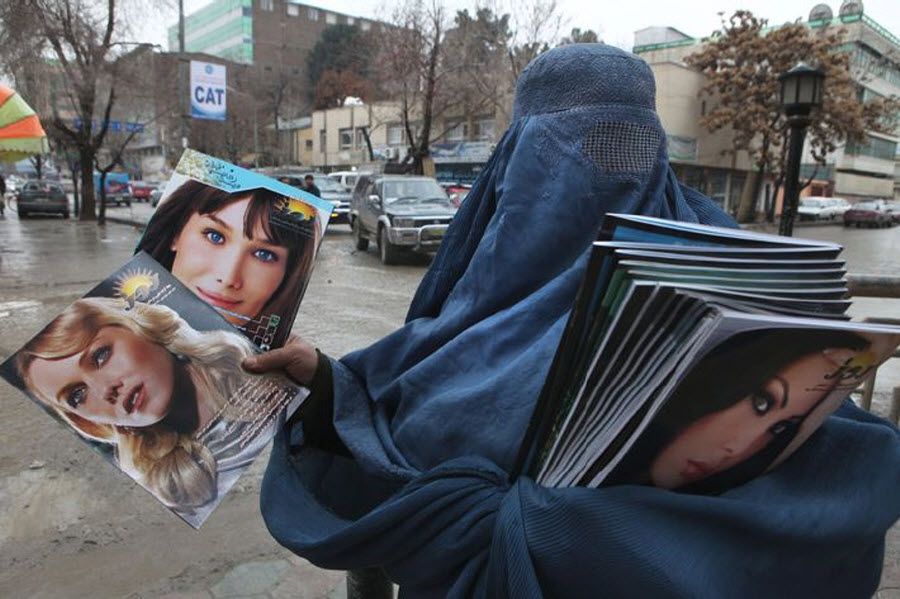
Selling Magazines

A photo which says a million words. Welcome to Afghanistan, look what the Afghan traditions and their interpretation of Islam has done to them. Mind you, all religions are interpretations anyway, but here you are. What irony

Shame.

Tuesday, March 30

Bangla hospital bans burqas for female staff to prevent theft

Another reason to ban the burqa, lol.

A leading state-run health facility in Dhaka banned burqas for its female staff on Monday and enforced strict uniform regulations to prevent growing incidents of theft of mobiles and wallets at the hospital wards.

"We have just enforced the regulation asking women staff to wear the prescribed hospital uniform and carry ID cards while they are on duty inside the patients wards," Abdul Majid Bhuiyan, administrative director of Bangabandhu Sheikh Mujib Medical University, the largest hospital of Bangladesh, told PTI.

He said the order was issued for the female staff only against the backdrop of growing incidents of theft of wallets or mobile phones particularly from female and children wards. In most of the cases, the outsider women identifying them as hospital staff, were found to be involved in the thefts.

"This part of the disciplinary measures also to ensure hygienic standards of the facility...The female staffs are allowed to use the burqas outside the (hospital) wards," he said.

Bhuiyan, however, added that the visitors or patients were "in no way" come under the purview of the order.

So only the doctors and staff in burqa’s can be the thieves and not the people who come in from outside? nice way to show trust.

Saturday, February 20

Egypt: Female Judges Barred from Council Positions

Very nice, the world is moving forward while Egypt is moving backwards. I think of the advertisements for Egypt which say that its the cradle of civilisation and looking at this, I think its also moving back to that time. People keep on asking why Muslim countries do not have the wherewithal to go and rejoin the golden age of Islam? Well, why do you think? If you keep on shoving your women into veils and bar them from everything other than pregnancy, teaching and shopping, what do you think your country will be? Its like having a one legged man running with two legged men in a race. Here, read this.

I quote:

Dozens of Egyptian women and human rights activists have staged a protest in Cairo against a recent decision that bars women from holding judicial positions.

Thursday's protest came after the Council of State's association voted on Monday by an overwhelming majority against the appointment of women as judges in the council, an influential court which advises Egypt's government. "Three-hundred and eighty judges took part in the general assembly and voted, with 334 rejecting the appointment of females to judicial posts and 42 agreeing, with four abstentions," the Egyptian MENA news agency reported on Tuesday.The country's supreme judicial council, which has jurisdiction over criminal and civil courts, selected 31 women in 2007, who were later appointed by presidential decree.

But the decision angered conservatives who said women were not suited for the role.

Up until 2007, Egypt had only one woman serving as a judge who was appointed by Hosni Mubarak, the president, to the constitutional court.


And then I read that the Malaysian women who were caned for extramarital sex said that they deserved it. Good grief.

Wednesday, December 16

Women protest against gender equality law

You couldn't make this up. I quote:

Tens of thousands of people in Mali's capital, Bamako, have been protesting against a new law which gives women equal rights in marriage.

The law, passed earlier this month, also strengthens inheritance rights for women and children born out of wedlock.

The head of a Muslim women's association says only a minority of Malian women - "the intellectuals" as she put it - supports the law.

Several other protests have taken place in other parts of the country.

The law was adopted by the Malian parliament at the beginning of August, and has yet to be signed into force by the president.

One of the most contentious issues in the new legislation is that women are no longer required to obey their husbands.

Hadja Sapiato Dembele of the National Union of Muslim Women's Associations said the law goes against Islamic principles.

"We have to stick to the Koran," Ms Dembele told the BBC's Focus on Africa programme. "A man must protect his wife, a wife must obey her husband."

"It's a tiny minority of women here that wants this new law - the intellectuals. The poor and illiterate women of this country - the real Muslims - are against it," she added.

This is like medieval barbarism….

Wednesday, December 9

Difference between Madrassah and Secular School Students

So its pretty well established that generally the madrassah is considered to be not really very good in raising modern students and citizens. The common argument is that they teach medieval stuff at best and obscurantist stuff at worst. So what’s the real truth? Well, here’s one answer from Bangladesh. So what did the researchers do? But before we go there, some points.

In the early 1980’s, the Bangladeshi government made sure that the madrassah’s teach English, Bengali, Science and Mathematics along with the religious subjects in return for government funding for teachers and official registration. This is, of course, in stark contrast with the majority of madrassah’s elsewhere in the Muslim countries where teaching of modern subjects is a tad lacking. God (rather Allah) only knows what their output is but that’s not the point.

So the researchers went and asked questions on attitudes toward working mothers, desired fertility, higher education for boys vis-à-vis girls, and a number of political regimes such as military rule, democracy, and Islamic rule. Interviewing 1280 teachers over 94 madrassahs and 231 public secular schools with each school providing a rough 20 students sample size.

Teacher Responses:

On the question of desired fertility, teacher responses differ significantly: madrasa teachers either favor larger families or are more likely to rely on ‘destiny’ to decide on the desired number of children. Compared to their secular school colleagues, they significantly favor boys over girls for higher education and men over women for political leadership. They are also significantly sympathetic to religious leadership in political affairs. For instance, relative to secular school teachers, they significantly prefer Islamic rule, are at greater ease should religious leaders influence people’s voting choice, like to see more religious people in public offices, and are more likely to support religious leader’s interference in government affairs.

Graduate Responses:

Even after controlling for earlier religious education (maktab schooling), madrasa graduates are 31% more likely to prefer an unspecified number of children.

Female graduates in our sample were interviewed on whether they agreed with the following questions:

1. “Compared to housewives, working mothers are more cordial with children”

2. “A married working woman and a married housewife are equal”

3. “Both, the husband and the wife should contribute towards family income”

On the question of whether housewives, instead of working women, are better mothers, there is no madrasa effect. A negative association with religious school attendance prevails in the other two outcomes. Madrasa graduates do not agree that both husband and wife should contribute to family income

Even after controlling for educational histories (maktab attendance, class rank in grade 6 and grade completed), parental background, and socio-economic conditions, madrasa graduates are 21% more likely to conclude that higher education is a preserve for boys.

Lastly, females in our sample were asked three questions related to the desirability of various regimes for governing the country:

1. Military rule as a political regime for ruling the country is good

2. Democratic rule as a political regime for ruling the country is good

3. Islamic rule as a political regime for ruling the country is good

A large and significant madrasa effect prevails in all three cases: madrasa students are significantly opposed to military rule, support democracy and favor Islamic rule

In sum, the analysis of graduate responses reveals that madrasa attendance is not associated with perverse attitudes toward working women and military rule. They are more likely to support democracy although they have a preference for religious political representation. At the same time, these female madrasa students have a perverse attitude toward higher education for girls and larger family size. Also, our female madrasa respondents are more likely to delegate the choice of desired number of children to destiny.

Well, as you can see, a much more complex and richer set of results are emerging. For one, they are against the military rule which is a great step but then they desire islamic rule which is frankly like jumping from the frying pan into a fire. Surprising coming from females where an islamic state actively drops them in the order of priority on almost every aspect.

Then you have the other problem of fertility. Bangladesh and other Muslim countries are facing a massive problem in feeding, educating and raising their young. As it turns out, the problem is not going to get better but going to become worse if they all leave it up to God. God unfortunately doesnt have anything to do with contraception. All these kids will ruin the women’s lives. And they want this to continue. Bloody strange. But one very positive thing comes out, more female teachers the lower is the madrassah influence. Unfortunately, it conflicts with the other finding that its boys who deserve education more.

Sighs, more complexity….

Sunday, November 29

Muslim women and micro loans

This causes me no end of frustration. I mean, it's tough enough to get the economic status of women up and running. And then you have these bloody medieval obscurantists who come and bollox it up. I quote:

Ramesh Bellamkonda heads BSS Microfinance, the worst hit of several microfinance institutions (MFIs) in Karnataka. He says BSS has provided microcredit for two years in Kolar, three-and-a-half in Mysore, and eight in Ramanagaram, enjoying excellent relations with its Muslim borrowers and virtually 100% repayment. Today, repayment is down to almost zero, because of non-repayment directives by the anjumans and their goons, who threaten and even assault BSS staff. Muslims constitute a substantial proportion of borrowers, so the anjuman directives can bankrupt entire MFIs, affecting other community borrowers too. Other Karnataka MFIs in several towns face the same problem, and have been obliged to halt lending to Muslims. It is a triumph for the most reactionary Muslims, and a tragedy for Muslim women denied empowerment through finance.

The anjumans say interest on loans is un-Islamic, and so borrowers need not repay, and no further microloans should be given to Muslims…….Because the anjumans will not take on moneyed males, only poor women. They don’t like female empowerment through micro-credit, and so use the bogus rhetoric of Islamic finance to promote their gender agenda.

Can you imagine these pillocks? How on earth can they justify this kind of loser behaviour? Interest in loans is not un-Islamic, you idiots. If you think that’s wrong, go check out what happens in Saudi Arabia, they merrily lend away on interest. And if you think that they are wrong, why do you suck up to them starting from Hyderabad Airport to their hotel rooms? Sheesh.

Tuesday, June 9

Miss Morals National Contest

Now this is an interesting take on carrying out female contests. We know of Miss World, Miss Universe, Miss Congeniality, Miss Personality, now we have Miss Morals.  I quote:

Sukaina al-Zayer is an unlikely beauty queen hopeful. She covers her face and body in black robes and an Islamic veil, so no one can tell what she looks like. She also admits she's a little on the plump side. But at Saudi Arabia's only beauty pageant, the judges don't care about a perfect figure or face. What they're looking for in the quest for Miss Beautiful Morals is the contestant who shows the most devotion and respect for her parents. "The idea of the pageant is to measure the contestants' commitment to Islamic morals... It's an alternative to the calls for decadence in the other beauty contests that only take into account a woman's body and looks," said pageant founder Khadra al-Mubarak. "The winner won't necessarily be pretty," she added. "We care about the beauty of the soul and the morals."
So after the pageant opens Saturday, the nearly 200 contestants will spend the next 10 weeks attending classes and being quizzed on themes including "Discovering your inner strength," "The making of leaders and Mom," "paradise is at your feet" - a saying attributed to Islam's Prophet Muhammad to underline that respect for parents is among the faith's most important tenets.
"Pageant hopefuls will also spend a day at a country house with their mothers, where they will be observed by female judges and graded on how they interact with their mothers," al-Mubarak said. Since the pageant is not televised and no men are involved, contestants can take off the veils and black figure-hiding abayas they always wear in public.

Quite interesting, what? I am sure most of the other winners in other contests will lose this one, eh? and what’s with the mother’s bit, eh? lol, how interesting :)

Sunday, June 1

Kill the women to protect their honour!

I spoke about honour killings before. But here is another example of this tragic situation. This is the reason why this is not going to go away any time soon and I quote:

But there were other mutterings that were clearly audible. 'I could hear people talking on the corridors and the only thing that they had to say was that Leila was wrong for defending her daughter's mistakes and that her death was God's punishment.

And what did Leila's killers say?

Death to betrayers of Islam who don't deserve God's forgiveness. Speaking less you will live more.'

Nice one there, chaps. God is punishing women and God has so many willing volunteers to his work.

Saturday, May 31

Who speaks for Muslim women?

This is a curious blog-post which TBS chucked over to me. We have our differences over these three ladies that the post mentions, Asra, Ayaan and Irshad. I have written about Asra Nomani. Well, the post refers to two other women, namely, Ingrid Mattson and second is Zarqa Nawaz. I have heard of those two ladies definitely. But I think there are few questions came to mind.

  1. Why do Muslim Women need spokesmen (pun intended)?  (Compare to Hindu or Jewish or Christian women). I dont know much about the Christian or Jewish role models or spokespersons of today but thinking about it, I have never heard of anybody who is a purely Hindu female spokesperson. We have had spokespersons who spoke for Hindu Women like Raja Ram Mohon Roy. We have had Hindu Females who were leaders ranging from Indira Gandhi to Mayawati, but I never got the feeling that they were speaking purely for women. I have to admit that I dont know much about this area so am willing to be corrected, but boy, oh! boy, as soon as you talk about Muslim women, there are absolutely legions and battalions of men and women who form up to speak on their behalf. Curious, no?
  2. How do we decide on who speaks for whom? See my previous post on who is the best judge.
  3. Do you need to be outside the fold to speak about the fold or inside the fold? (abused women - do they escape the abusive household first or do they stay inside and try to reform the bad husband)
  4. Who are the other ladies in the west that are being followed? I mean, if Asra, Ayman and Irshad are on the far left of the scale, Ingrid and Zarqa are sort of in the middle, who is on the right? Yvonne Ridley? I have to admit that I find Yvonne Ridley a bit of a clown, but hey, she wears a hijab and says all the right things I guess that all Muslims like to hear, no? But she still does not have a following (i hope she doesnt!) How about Farhat Hashmi? Or Raheel Raza? (See my book review here.  And and and?
  5. Looking at the comment given below, you can see immediately how two identities are colliding. Women generally look at these 3 ladies as ladies first and all women as women first. Obviously, the author of the post looks at herself and others as Muslims first and women second.
  6. All reformers face resistance. So the fact that these 3 women's are feeling resistance is not a problem at all. I mean, look at Jesus, how many Jews took up his call? Christ, they even helped to crucify him (just kidding and punning!). Or talking about meeting resistance, even Prophet Mohammad met resistance all through his life. Very few followed him for a very long period of time, no?
  7. At end of the day, what seems to be the problem is if somebody gets money and/or publicity which seems to be a problem. I am not very sure why that is a problem. I mean, this criticism seems to be driven more by jealousy than anything that is logical. For example, what exactly is wrong with earning money? It is not like we do not have examples of preachers and mullah's who do exactly the same thing for money, going on TV, banging on and on about how to be a good Muslim and earning quite a lot of dosh for that (see the above example of Farhat Hashmi). Nothing wrong with getting publicity or getting money is there? Until and unless you are a socialist or an introvert, in which case, the problem is economic philosophical or emotional, neither of which applies in this case.
  8. And at end of the day, I am curious why people rush to judgement to that extent specially when it comes from a religiously mandated angle. I mean, if it is indeed religiously driven, then should not they believe in "Narrated Umar Ibn Al-Khattab: "Allah's Apostle said, "The reward of deeds depends upon the intention and every person will get the reward according to what he has intended." And its even in Bukhari Volume 5, Book 58, Number 238!. So this judging of niyaat is curious to say the least. (On a separate basis, this bloody publishing of Hadith's for the same author has to be fixed, somebody says that Hadith is Book 1, number 1, somebody says its 5, 58, 238, somebody says 86, 85, someone says, 1, 2, 51. etc. Go ahead, search the net.

Still, some strange questions indeed.

Technorati Tags: ,

3 Legal Systems and child rape

This was fascinating to discuss. The barebones of the argument are clear, it is a case of child rape and the fellow is sentenced to death. Incidentally, if it was up to me, I would bring back pre-historic punishments for child rape such as tearing apart limb by limb or boiling alive for these child rapists till they are near death but not quite dead yet. I am a firm anti death penalty man, but that doesn't mean that some nice chaps cannot be taken to a situation where they would wish they had crossed the boundary and seen the white light. But unfortunately, since it is not up to me, I have to leave emotion aside and think about some interesting comparisons.

Here we have 3 legal situations and I am just talking about child rape right now, ceteris paribus. First legal system (the domestic US Legal system) is what is currently in play, that the death penalty is only given for murder but the consensus which seems to be brewing is that the death penalty is fine for child rape.

The second legal system, which relates to international (read European and British) law, relates to the fact that the death penalty should not be extended to crimes which it did not cover. I quote:

International authorities have long agreed that nations that retain the death penalty must refrain from expanding the death penalty to crimes to which it currenlty does not apply--a principle that has been codified in a regional convention and reaffirmed by the jurisprudence of human rights bodies. There is an equally strong global consensus that nations should gradually narrow the categories of offenses for which the death penalty may be imposed.

Both are discussed here. But further to this, consider the legal situations relating to this in the Sunni schools of law (see here for example) . Punishment of rape (forget about child rape) is death but it is not "mandatory". In other words, it is up to the judge to evaluate if capital punishment is allowed. But bear in mind, this is slowly changing as well and this entire gamut of rape is being slowly modified. See here for example. While this story concentrates on the women side and not on the punishment side, it still bears quoting:

Under the Hudood ordinance, rape is included in matters covered under Islamic law, like marriage and divorce. A woman who reports that she has been raped must produce four male witnesses to prove it. If she fails to do so, she can be prosecuted for adultery. Thousands of women have been punished under the law, often on the flimsiest evidence. That risk has kept many women from trying to bring their attackers to justice.

The legislation passed Wednesday will move rape cases to criminal courts rather than Islamic courts. The new legislation allows forensic and circumstantial evidence to be used as a basis for convictions, as with other crimes.

Now the question is, if you move to the secular (chuckle) criminal court, what does that do for punishments? Do they follow model 2 and let the child rapist escape capital punishment? Or do they follow model 1 and leave the Islamic punishment of capital punishment in? So many questions. If this happens, then women will lose out (4 witness issues, women punished...) but on the other hand, the child rapists will escape capital punishment.

Three legal systems, 3 situations, 3 rapists and 3 victims. Justice is served where? how? for whom?

Friday, November 16

Saudi gang-rape victim is jailed

This is so bizarre that I cannot believe it. You get gang raped by 14 animals, and then sentenced to 90 lashes for being in a car of a strange man. Then on appeal, the sentence is increased to 200 lashes and a 6 month jail sentence for, get this, trying to influence the judiciary through the media.

Unbelievable!

All this to be taken with a grain of piquant salt!!!

Saturday, September 22

Defining ‘Modern’ Malay womanhood and the coexistent messages of the veil

A difficult paper to read, the jargon was unfortunately too obtuse for me, but I could extract some interesting snippets. What this is telling me is that if the women are educated, specially having a tertiary education, then the fact that they are wearing a veil allows them to skate over the patriarchal theological requirement of veiling and actually dramatically change the male/female power dynamics of the country. The fact that there are more women than men in university, marriage age is getting delayed and delayed, assets are in the hands of the women, all while they wear the veil means that the conceptual framework around the veil, the patriarchy, the religion, and male-female relationship is undergoing a silent revolution.

Very interesting indeed and women all over the world should take not just a leaf but whole shrubs and trees from this study.

Audrey E. Mouser, Defining `Modern' Malay womanhood and the coexistent messages of the veil, Religion, Volume 37, Issue 2, Negotiating Women's Roles and Powers: The Practice of World Religions in Contemporary Asia, June 2007, Pages 164-174.

Abstract: The gender constructions and performances of Malay women are often perceived by outside researchers as `shrouded under a veil' of increasing Islamic conservatism. Urban Malay women, however, argue that women actively engage in the construction and performance of gender identities. Based on research conducted in Kuala Lumpur, Malaysia, during 2001 and 2003, this article argues that women advantageously alter, transform and utilise the constructs placed upon them by Islam, by ethnic identification and by conceptions of `modernity'. Often one image of `womanhood' is presented and in public - an image that is socially accepted, honoured and respected - while less publicly alternative forms of `womanhood' articulate individual goals and aims. Using an agent-oriented perspective, this article further includes an analysis of women's individual renegotiations of larger cultural constructs and the ways in which the tudong, or headscarf, has become a symbol by which individual women express their understanding of social position and personal freedoms in an industrialised Islamic context.

==========

Some quotes:

Urban Malay women between the ages of twenty and fifty were invited to participate in the study because they were raised in the context of the revitalisation of Malay ethnic and Islamic identity. The metropolitan area of Kuala Lumpur and Klang Valley are areas dominated by middle-class populations. In order to illustrate diversity within a population and still see whether there are cultural commonalities, I identified a stratified sample of women to achieve a maximum level of population variation. To understand current attitudes towards gender and marital patterns, I used a wide variety of approaches in the fieldwork process, including participant observation, open-ended and semi-structured interviews, life histories and in-depth interviews. The interviews were conducted on specific issues such as Islam and Muslim identity, marital history and relationships with partners, the importance of children and family, satisfaction with the implementation of syariah2 family law, and concern over industrialisation.

.....

While middle-class women utilised the dominant ideology of the Islamic revival and governmental policy to meet certain personal and familial goals, working-class women worked on the periphery, utilising industrial development and economic gains to obtain social capital. Their wages were used to help defray the costs of raising younger siblings. This economic capital was converted into social capital as these young women acquired a more forceful role in household decision-making because of their contributions to the family income. In turn, they often delayed marriage and child-bearing, and they gained enough personal buying power to ‘flex their economic muscles’ within the domestic market. As a result, they were often accused of being ‘pleasure-seekers’, ‘un-Malay’, or ‘un-Islamic’ by a Malay population unhappy with how young Malay women were defining womanhood

....

Zaleha, a twenty-four-year-old female medical student at University Malaya who wears the tudong, is concerned about her marital future. She is the eldest of four children, and her parents have recently divorced. Her father had been engaged in numerous extra-marital affairs through the course of the marriage, and remarried only after her parents had divorced. She was witness to his verbal and psychological abuse of her mother, followed by neglect of the children after the divorce. Although she is interested in marriage after her education is complete, she is cautious. She is concerned that her marital choices are limited because of her advanced education. Additionally, even if she were to find a potential spouse in her class he would also be prone to abuse her or to engage in extra-marital affairs, neither of which she is willing to accept. Zaleha is also hesitant because she has witnessed her mother's experiences with the family court system in Malaysia, and argues that there is no way for a woman to protect herself once she is married. ‘Men can do anything they want’, she says. She has decided to focus her energies on becoming a doctor, and she will consider marriage and children only later. Zaleha's story exemplifies a change in gender roles, increased education, and awareness of potential marital difficulties that embody the changing nature of ‘womanhood’.

......

Malay women, such as Zaleha, have utilised the availability of government funded Malay-only scholarships for higher education for more than their male counterparts.6 In fact, the article ‘PM challenges males to balance varsity gender ratio’ in The Star, August 27, 2003, noted that nearly 70% of all college students at Malaysian universities are female. Women are becoming more educated than men and are becoming active, visible, and powerful in industry, academia, government and social activism, and therefore economically independent. As a result, women are postponing marriage and are altering the nature of relationships, of courting and of sexual activity.

This delay in marriage contradicts the prevailing pronatal position of the previous generation and of national goals. The unequal representation of male and female students in Malaysian universities and the subsequent changing nature of gender and sexual codes of conduct are of great concern to the government. Young Malay men are encouraged to attend universities so as not to let the women of the nation surpass them in education. Recently, the television and print media have focused on the ‘problem’ of so few male students on university campuses. Officials highlight the need for women to remain modest, and they challenge men to achieve higher goals than women in order to ensure that women do not become able to provide for themselves without the assistance of male partners.

....

In conjunction with this trend of women's educational achievement is the importance of women's gender roles through the wearing of the tudong, a headscarf or ‘veil’ (a form of purdah) that covers a woman's hair from public view. When tudong was initially adopted as part of common dress in Malaysia, it was representative only of women actively involved in the Dakwah movement. Today, however, wearing tudong has increasingly become a social expectation for Malay women in general. Women are often blamed for sexual crimes, rapes and illicit behaviour if they fail to cover themselves sufficiently so as not to elicit the uncontrollable desires of men. They bear the onus of maintaining the social conformity of men and women, for it is the proper performance of their gender that supposedly dictates the appropriateness of men's behaviours (see Zamani, 2002, p. 345). This expectation – that if women dress modestly, men will act accordingly – was challenged when Noor Suzaily Mocktar, a twenty-four-year-old Malay computer engineer was raped, sodomised and murdered by a bus driver in Kuala Lumpur on October 7, 2000. According to the article ‘Incident also by Sabah Minibus Driver’ in the Daily Express, October 14, 2000, she was dressed in baju kurong and tudong, appropriate dress by Malay-Muslim standards, and yet was still a victim of violence. As stated by Datin Paduka Marina Mahathir on July 19, 2003, at the memorial service of a recent violence victim, ‘It doesn't matter if we took care to keep our bodies and our hair out of the view of men; it still does nothing to protect us, as Noor Suzaily … found out’ (Women's Aid Organisation, 2003). Nevertheless, social pressure, challenges to women's purity for those who did not wear the tudong, and concern for personal safety from unwanted sexual advances by men have encouraged many women to make it a part of daily attire, regardless of their level of religiosity.

.....

In many ways, however, wearing the tudong has become a ‘free pass’ for movement through society. By wearing the socially sanctioned ‘uniform’ of tudong and modest dress, women gain silent, unrestricted movement through society. In contrast, those women who choose not to wear the tudong are under constant public surveillance in order to ensure that they behave appropriately.

.....

Conclusion
Women who were raised or matured during the Dakwah movement in Malaysia are choosing and directing the expression of gender roles in the post-Dakwah era. As individuals articulate the conjoining of industrialisation, ‘modernisation’ and a cultural revitalisation movement, so educational and occupational opportunities, gender roles, and family behaviours among Malays will change. Malay women are faced with change at the level of the meta-narrative and are therefore subject to conflicting norms and pressures on various fronts. As women redefine Malay gender roles, gender performance is no longer a matter of social class or participation in the global market economy. Gender performance has instead become a combination of both public images of virtue and dutiful religiosity, and the pursuit of economic, social and personal independence.
The tudong has become the stage upon which the articulation of gender performances often takes place. Individual choices about when, where and how to wear the tudong have come to symbolise opinions on the place of women in society and religion. That symbol is then reinterpreted by the larger Malaysian society, representing the public and private images of ‘womanhood’ as they are played out in the daily lives of women. Based on their perceptions of the changing nature of marriage, the syariah legal system, and social expectations contemporary Malay women express individual goals through their use of tudong.

Technorati Tags: , , ,

Friday, September 7

Pakistan 'prostitutes' beheaded

Here's another brilliant piece in the annals of Pakistani History. Prostitutes beheaded for being SUSPECTED of being prostitutes. And what about the filthy men who visited them? You know something?

Between them pushing the women into burqa's, in to kitchens, pregnant, barefoot, no education, no business, no visibility, no nothing and they are personally leading their people into either being a flock of snot running illiterate moronic men or extinction. Not so much of a problem if the latter considering the gene pool but the former leads one to worry. If these taliban treat all women as broodmares, and only you donkeys mate with them, then all you end up are with hinny's?

And the saddest part is that far too many people will agree with this step.


All this to be taken with a grain of piquant salt!!!

Monday, September 3

Top 10 excuses given by British Muslim women for not wearing the Hijab/Jilbaab

Now this is a curious email which i received. It is supposed to be funny but I am afraid I did not find the amusing bit nor the theological bit nor the intellectual bit which was supposed to make this funny. I have written about the veil before here and here but this kind of patriarchal control freaky arguments from make me feel real sad. You really do not need this kind of pressure, girls.


Read and Weep.

1. Friends will reject me

The people I hang around with and really tight with none of them wear hijab/ jilbaab and they take the mickey out of those that do. Especially the hijabies who check out boys and do dirty dancing at college.uni parties. Names like fundies, molvies, hypocrites and they cover coz they are ugly. If I wear the hijab then I will lose all my friends and have the piss taken out of me as well.

2. Harm my career

I worked my arse of to get where I am now in my career. I got a big salary, status and I enjoy the respect I get from colleagues and community. I can't risk all that for a piece of cloth, besides I would look weird in board meetings and work parties in the pub and nightclubs. InshAllah when I get married in my 30s and have kids in my mid 30s, I'll cover as I'm supposed to then.

3. My family are westernized

No one in my family wears hijab, even my grandmother wears bright coloured stylish clothes. If I were to wear the hijab I'd feel strange coz we have family gatherings where all the women dress in sarees and other revealing clothes and at our weddings we have a DJ playing bhangra music and we all dance to bollywood tunes, even my grandmother does a few funky moves on the dance floor.

4. Non-Muslims will stare

I've noticed since 7/7 that non-Muslims regard anyone who looks like a Muslim as a potential terrorist and by wearing the hijab I would attract attention. By wearing western clothes I get away with non-Muslims thinking I'm a Hindu, Sikh or moderate non-practicing Muslim. I've even had white guys trying to chat me up coz they think I'm up for it based on the tight western clothing that I wear.


5. I'm still young

I'm only 27 I've got my whole life ahead of me. I'm still enjoying life, u know what I mean, flirting with guys, clubbing, hanging out with mates in shopping centres. When I get married and have kids I'll wear it then

6. I wont get attention from guys

I love the attention I get from guys and the way they look at me u know what I mean. I'm checking out 3 guys at the moment. Ones my age, ones older and one is older and married. I guess we all need a toy boy as well as a father figure /sugar daddy. I'll choose one of them, although I've got a few my age from uni as back up. After I've lived my life to the max and played the field and settled down then I might consider wearing it, even cover my face coz I don't wanna meet any of my ex's now do I ? Shoot 2 birds with 1 stone, appear pious and avoid hassle with former boyfriends , great idea, hijab. Jilbab and niqab.

7. I dress modestly

I wear loose modest clothes which cover and hide my curves, I know my hair is exposed but at least I'm more or less covered, better than a lot of girls/women who dress like tarts.

8. People will think I'm a fundamentalist

There is so much in the media nowadays about Muslims getting radicalised and rejecting western values and becoming fundamentalists. I just don't want people to think that I am one also. Although I know that the west and its values are decadent and filthy, I don't think it's wise to express this. I pray and fast etc, I don't need to wear Islamic clothing to be a good Muslim coz Islam is in my heart.

9. I worked hard to get this figure

After going to the gym and Pilates for 6 months I've finally achieved the hourglass figure which men find attractive. I enjoy the attention I get and feel attractive. By wearing the hijab/jilbaab I would just be an ordinary woman in the eyes of men and only religious types with big beards would be interested in me.

10. When in Rome do as the Romans

We live in the UK and not in a Muslim country so why follow Islam rigidly? Also compared to non-Muslim women who practically walk around naked I dress and behave quite respectably. Whenever I visit back home I wear different clothes coz I don't want people to think bad of me and my family. One day in my 60's after I have lived my life I will go to hajj and then become the perfect Muslimah, not now coz I believe "when in Rome do as the Romans".


All this to be taken with a grain of piquant salt!!!

Sunday, September 2

The place of women in a mosque should follow the example of the Prophet's Mosque

I saw this note by somebody in the MPAUCK which is one of the Muslim bodies in the UK. Some of the points raised were rather distressing such as

A week before, I had given a Khutba in another, brand-new mosque in the heart of Chicago. After the prayer, while in the elevator, I overheard four Muslim sisters speaking angrily about their experience in the Masjid. "If I wanted to watch TV, I'd stay home," said one of the women, disgusted. I asked them what was wrong, and they told me how they could only see the Imam through a TV system set up in the women's section. Moreover, the space was inconvenient, uncomfortable and was changed twice that day.

And there are more along the same lines. I once wrote a review of another Muslim lady's fight for getting good prayer space and representation in a mosque. But this writer at MPAUCK also speaks that the model of praying in a mosque should be like the Prophet's Mosque in Saudi Arabia.

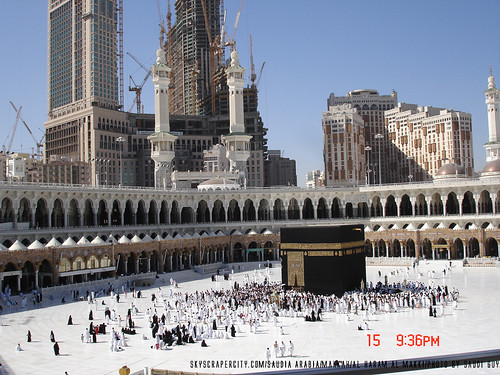
Which leads me to the second point. This is a picture of the Prophet's Mosque in Mecca.


See the towering buildings behind the Ka'aba? Those are huge tall hotels, mostly american owned. I had the feeling that what I was looking at was a Las Vegas or a Macau Scene.

So I am not really very sure if the model is right. If the choice is between being crammed into a tiny room or worshipping in a place which looks like Las Vegas, not sure if the choice is right!


All this to be taken with a grain of piquant salt!!!

Monday, August 13

Muslim women caught between would-be liberators and would-be saviours

Muslim Women do indeed have it tough as this article shows. The veil is a strange piece of clothing which we have already explored before in this essay. Very good article showing that women go through.

Me, on the other hand, am rather ambivalent towards this veil business. Sometimes I feel that any woman who is wearing a veil (of whatever kind) is rather silly for having given into some medieval blather about male defined modesty. On the other hand, so what? if it is up to choice, then by all means. Then, usually its the men who impose these definitions, so its wrong. Then we have burqa wearing men who are security risks, and finally, if you are afraid to show your face to me, you are rejecting a basic social and human contract that i have with you that I do not want to have to do anything with you. So dont expect the English public services or any job which requires people contact to have any sympathy. Confusing or what?

Ah! well!, read the article, very good and very moving.

Tuesday, August 7

Divorce Moroccan-style

The French Le Monde is reporting that the Moroccan women are doing great in terms of their fights for justice. Specially divorce. Plus, women in Morocco are now able to become Imam's, they arent wearing face veils (bizarre!!!) and modernity seems to be arriving!, I was quite impressed to hear that the birth rate per woman has declined from 5.5 to 2.5. This makes women more economically active and reduces the pressure on resources in resource constrained countries. Mind you, Morocco has a long way to go in many other ways such as democracy, free speech, human rights, etc., but small steps, my friends, small steps.