Kids
I thought you'd appreciate this article. There is no harm in being particular about food. At all. But that shouldn't be at the expense of being open to new experiences. You both will find your boyfriends/girlfriends may have particular tastes. But given that eating is something you do very regularly, why become boring? That's one of the things you can enjoy and have fun. And explore. Create new experiences. So some of the suggestions given in here are good. I was quite impressed when Diya agreed to have the noodle dosa. That's what I try to do, whenever I see a menu. What a new thing I can try. 4 times order the same but the 5th time, try a new one. What's the harm? You'll know what you don't want to eat or better still something great that you never experienced :) good odds there.
Can't wait for Kannu to get back home so that I can try out some of my medieval recipes on him :)
Love
Baba
http://www.bloombergview.com/articles/2016-03-18/when-your-spouse-is-a-picky-eater
Showing posts with label Food Cuisine. Show all posts
Showing posts with label Food Cuisine. Show all posts
Monday, March 21


Saturday, January 16
How Intermarriage Created One of the World's Most Delicious Foods
It's fascinating how things come together son. One of my favourite foods since I started working in Singapore is Laksa. It is a totally delicious concoction of noodles tofu chicken prawns beans spices and and and. Add and subtract according to taste and location. Bloody heavy but oh good Lord so bloody delicious.
By the way the best laksa you can get in London is a tiny Malaysian / Singaporean restaurant off Euston. It's a very basic place. Hardly 20 feet by 8 feet. And they've stuffed few rickety tables and chairs in there. They cook the food in the side of the restaurant and it's so bloody popular that people queue up for hours to get in. Cheap and cheerful. I'll take you there son.
But this story of laksa is also connected to the spice trade. I'll let you read this story and the map. The author talks about how Indians came to south east Asia and it was fascinating to read how a Malaysian dish in Penang got called as Assam Laksa.
The last piece is what really got my attention. I've talked about the peranakan culture - the amazing mix of Chinese and south East Indian Malay and Indian cultures. There's a museum in Singapore relating to this culture and it's quite an emotional museum. You can see people from mainland China coming over and then marrying locally. You can see their food. Their clothes. Furniture. The pain and bloodshed during the wars. Absolutely fascinating. And spices ran through it all.
Hope your first week back at Oxford is working out well son
Love
Baba
How Intermarriage Created One of the World's Most Delicious Foods
http://www.atlasobscura.com/articles/how-intermarriage-created-one-of-the-worlds-most-delicious-foods
(via Instapaper)
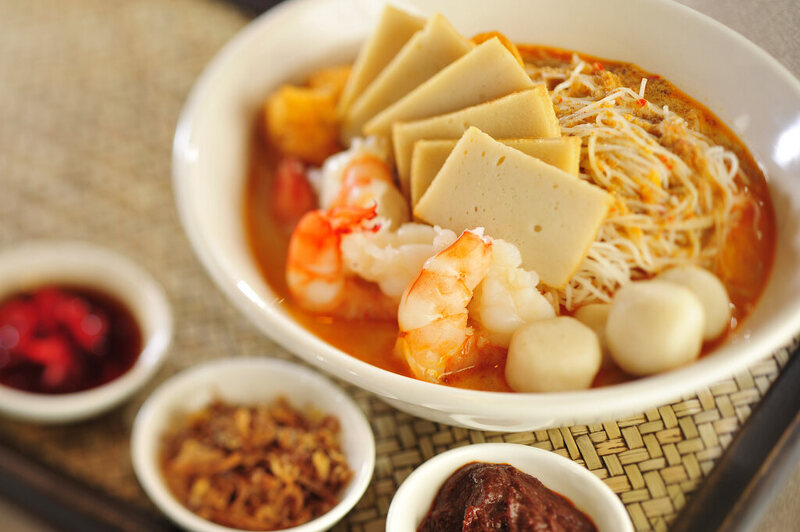
Laksa is said to get its name from the Sanskrit word "lakh," which means 100,000. (Photo: InterContinental Hong Kong/Flickr)
A few things are definitive of an afternoon on the coasts of Southeast Asia: inescapable heat, the smell of the sea, and a steaming bowl of laksa. If you haven't been fortunate enough to sample laksa before, picture an addictively spicy noodle soup brimming with chillies, coconut milk, tamarind and fresh seafood. If you need additional convincing, laksa was ranked seventh on CNN's list of the World's 50 best foods in 2011.
There is nothing quite like laksa, and no two laksas are the same. The soup can be found in different iterations in four Southeast Asian countries, from the coasts of Thailand and Malaysia down to Singapore and Indonesia, but its origins are more elusive. Where did laksa really come from, and how did it spread through all the regions that now claim it as their own?
To begin tracing the laksa trail back through time, we need to plot its three modern variations—curry, Siamese, and Assam—on the map.
Curry laksa is spicy and likewise includes coconut milk. It is found in Malaysia's Malacca and Johor states, and pops up in Singapore as Katong laksa, and in Indonesia as Bogor, Cibinong and Betawi laksa, to name a few. Each region has added its own unique ingredients to the mix, such as kaffir lime leaves, shredded chicken, or even snakehead fish.
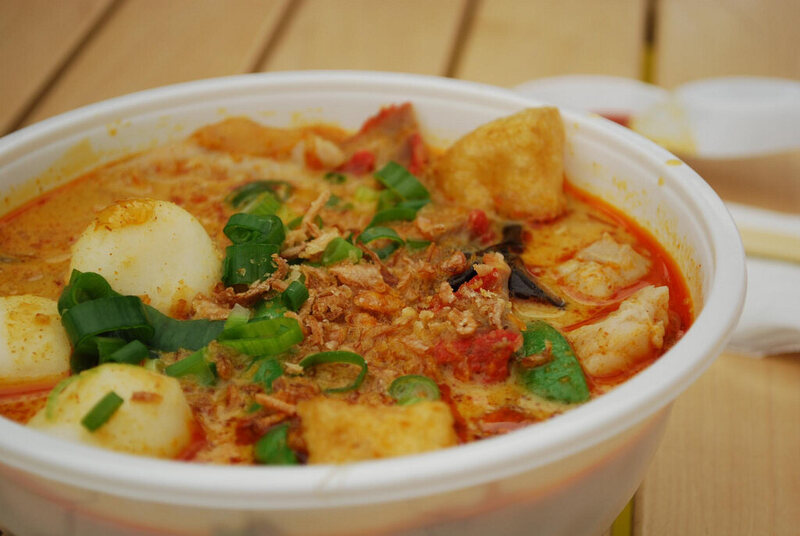
Curry laksa. (Photo: Alpha/Flickr)
Siamese laksa, found in Thailand, contains coconut milk and is informed by traditional Thai flavors such as red curry paste, while Assam laksa (which has tamarind but no coconut milk) is found in the Penang state of Malaysia.
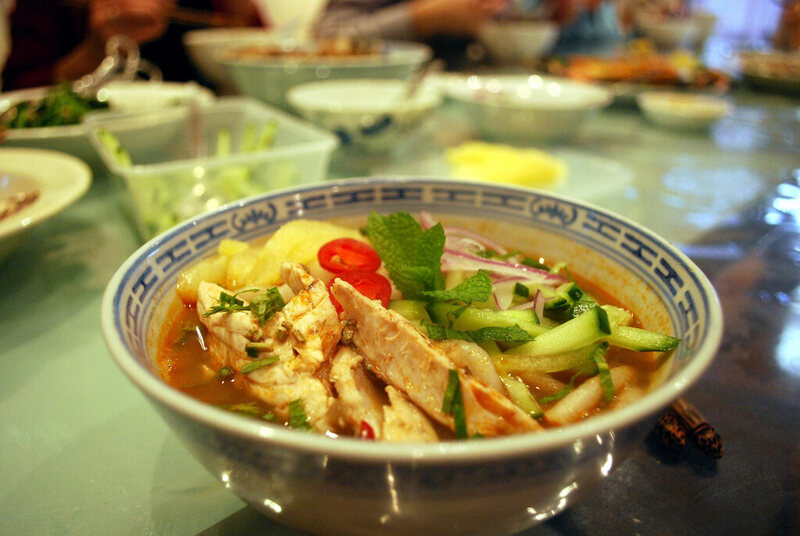
Assam laksa. (Photo: Alpha/Flickr)
Because of all the different varieties, it's difficult to say whether laksa had a specific point of origin. The history of Southeast Asia has been one of trade, with the port cities of Singapore, Malacca and Penang being major stops along the spice route. As a result, laksa began popping up in multiple regions as the marriage of different cuisines brought over by traders.
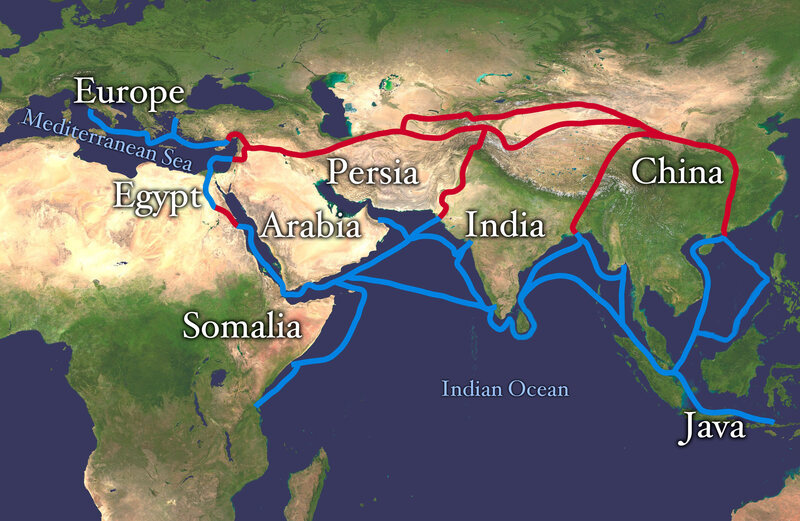
A map showing the Silk Road in red and the spice trade routes in blue. On the right, the routes stretch from India down through the Strait of Malacca, past Singapore and Indonesia and up to China. (Photo: Public Domain/Wikipedia Commons)
Southeast Asia had an early period of intense interaction with China and India, which largely influenced the culture of the region, and therefore its cuisine. According to Professor Penny Van Esterik in Food Culture in Southeast Asia, Indian traders arrived in Southeast Asia as early as 200 BC, while the Chinese had settlements in Indonesia by the 16th century.
The descendants of these Chinese traders were called the Peranakans, and the tradition of laksa was born out of the Peranakan desire to marry Chinese food with existing Southeast Asian flavors like coconut milk, and those brought over by South Asian traders, like chillies. Often, the desire to marry cuisines resulted from literal marriages between Peranakans and locals. In Indonesia, for example, the origin story of laksa traces back to the Chinese coastal settlements. Chinese sailors set out to find local wives, and these women began incorporating chilli peppers and coconut milk into Chinese noodle soup. Similarly, the arrival of laksa in Malaysia can be traced back to marriages of Chinese traders to local women in Malacca in the early 19th century.
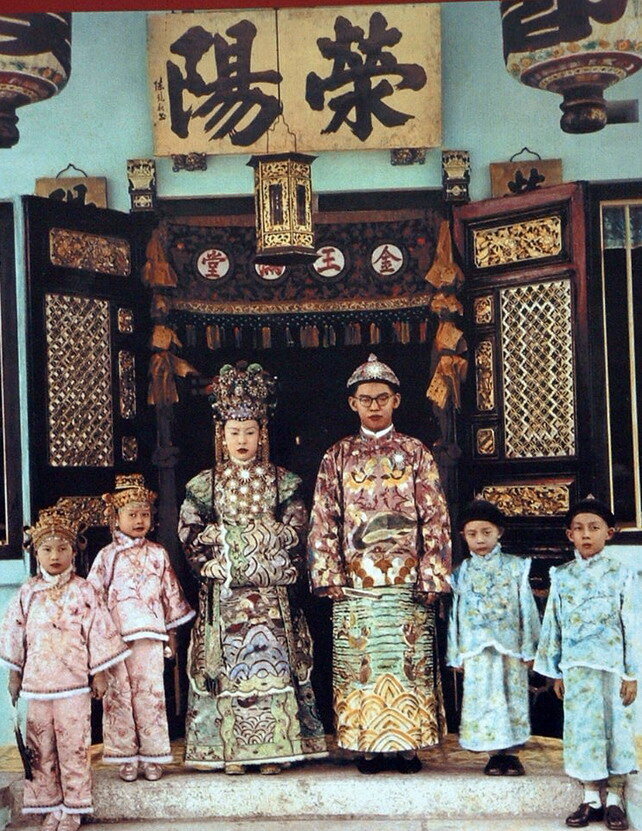
A Peranakan wedding takes place in Penang, Malaysia in May 1941. (Photo: Public Domain/Wikipedia Commons)
In Singapore, laksa arrived in the town of Katong when the Peranakans travelled down to the island from the Malaysian peninsula. Southeast Asian food expert Dr. Jean Duruz followed a laksa trail in Singapore to uncover that Peranakan laksa evolved with interaction with local Singaporeans. This happened via "[t]raditions of working for, or 'marrying into,' Peranakan families" as well as "rituals of exchange of festive foods and recipes between neighbors," writes Duruz in The Taste of Retro: Nostalgia, Sensory Landscapes and Cosmopolitanism in Singapore.
Of all the food that the Peranakans brought with them, it was laksa that spread most rapidly and extensively through trade channels in Southeast Asia. Why? Laksa's wide popularity is largely due to its adaptability, which makes it an appealing meal across many cultures and contexts. Even the name itself metaphorically empowers laksa's cultural flexibility. The word "laksa" originates from the Sanskrit word for one hundred thousand, and refers to the large variety of ingredients used in making the dish. Local women were able to manipulate the noodle soup brought over by their Chinese trader husbands to include their own plethora of existing ingredients. Because laksa was so easily adaptable into new varieties, it was able to serve as a bridge between cultures when traders and locals began intermarrying.
"The successful story of Laksa challenges the idea that people always like to eat familiar food," writes Veronica Mak Sau Wa in Southeast Asian Chinese Food in Hong Kong. There is nothing quite like laksa, and no two laksas are the same. Its unique adaptability is why it was able to build bridges between traders and locals on the Southeast Asian spice routes and continues to cross new borders today.
By the way the best laksa you can get in London is a tiny Malaysian / Singaporean restaurant off Euston. It's a very basic place. Hardly 20 feet by 8 feet. And they've stuffed few rickety tables and chairs in there. They cook the food in the side of the restaurant and it's so bloody popular that people queue up for hours to get in. Cheap and cheerful. I'll take you there son.
But this story of laksa is also connected to the spice trade. I'll let you read this story and the map. The author talks about how Indians came to south east Asia and it was fascinating to read how a Malaysian dish in Penang got called as Assam Laksa.
The last piece is what really got my attention. I've talked about the peranakan culture - the amazing mix of Chinese and south East Indian Malay and Indian cultures. There's a museum in Singapore relating to this culture and it's quite an emotional museum. You can see people from mainland China coming over and then marrying locally. You can see their food. Their clothes. Furniture. The pain and bloodshed during the wars. Absolutely fascinating. And spices ran through it all.
Hope your first week back at Oxford is working out well son
Love
Baba
How Intermarriage Created One of the World's Most Delicious Foods
http://www.atlasobscura.com/articles/how-intermarriage-created-one-of-the-worlds-most-delicious-foods
(via Instapaper)
Laksa is said to get its name from the Sanskrit word "lakh," which means 100,000. (Photo: InterContinental Hong Kong/Flickr)
A few things are definitive of an afternoon on the coasts of Southeast Asia: inescapable heat, the smell of the sea, and a steaming bowl of laksa. If you haven't been fortunate enough to sample laksa before, picture an addictively spicy noodle soup brimming with chillies, coconut milk, tamarind and fresh seafood. If you need additional convincing, laksa was ranked seventh on CNN's list of the World's 50 best foods in 2011.
There is nothing quite like laksa, and no two laksas are the same. The soup can be found in different iterations in four Southeast Asian countries, from the coasts of Thailand and Malaysia down to Singapore and Indonesia, but its origins are more elusive. Where did laksa really come from, and how did it spread through all the regions that now claim it as their own?
To begin tracing the laksa trail back through time, we need to plot its three modern variations—curry, Siamese, and Assam—on the map.
Curry laksa. (Photo: Alpha/Flickr)
Siamese laksa, found in Thailand, contains coconut milk and is informed by traditional Thai flavors such as red curry paste, while Assam laksa (which has tamarind but no coconut milk) is found in the Penang state of Malaysia.
Assam laksa. (Photo: Alpha/Flickr)
Because of all the different varieties, it's difficult to say whether laksa had a specific point of origin. The history of Southeast Asia has been one of trade, with the port cities of Singapore, Malacca and Penang being major stops along the spice route. As a result, laksa began popping up in multiple regions as the marriage of different cuisines brought over by traders.
A map showing the Silk Road in red and the spice trade routes in blue. On the right, the routes stretch from India down through the Strait of Malacca, past Singapore and Indonesia and up to China. (Photo: Public Domain/Wikipedia Commons)
Southeast Asia had an early period of intense interaction with China and India, which largely influenced the culture of the region, and therefore its cuisine. According to Professor Penny Van Esterik in Food Culture in Southeast Asia, Indian traders arrived in Southeast Asia as early as 200 BC, while the Chinese had settlements in Indonesia by the 16th century.
The descendants of these Chinese traders were called the Peranakans, and the tradition of laksa was born out of the Peranakan desire to marry Chinese food with existing Southeast Asian flavors like coconut milk, and those brought over by South Asian traders, like chillies. Often, the desire to marry cuisines resulted from literal marriages between Peranakans and locals. In Indonesia, for example, the origin story of laksa traces back to the Chinese coastal settlements. Chinese sailors set out to find local wives, and these women began incorporating chilli peppers and coconut milk into Chinese noodle soup. Similarly, the arrival of laksa in Malaysia can be traced back to marriages of Chinese traders to local women in Malacca in the early 19th century.
A Peranakan wedding takes place in Penang, Malaysia in May 1941. (Photo: Public Domain/Wikipedia Commons)
In Singapore, laksa arrived in the town of Katong when the Peranakans travelled down to the island from the Malaysian peninsula. Southeast Asian food expert Dr. Jean Duruz followed a laksa trail in Singapore to uncover that Peranakan laksa evolved with interaction with local Singaporeans. This happened via "[t]raditions of working for, or 'marrying into,' Peranakan families" as well as "rituals of exchange of festive foods and recipes between neighbors," writes Duruz in The Taste of Retro: Nostalgia, Sensory Landscapes and Cosmopolitanism in Singapore.
Of all the food that the Peranakans brought with them, it was laksa that spread most rapidly and extensively through trade channels in Southeast Asia. Why? Laksa's wide popularity is largely due to its adaptability, which makes it an appealing meal across many cultures and contexts. Even the name itself metaphorically empowers laksa's cultural flexibility. The word "laksa" originates from the Sanskrit word for one hundred thousand, and refers to the large variety of ingredients used in making the dish. Local women were able to manipulate the noodle soup brought over by their Chinese trader husbands to include their own plethora of existing ingredients. Because laksa was so easily adaptable into new varieties, it was able to serve as a bridge between cultures when traders and locals began intermarrying.
"The successful story of Laksa challenges the idea that people always like to eat familiar food," writes Veronica Mak Sau Wa in Southeast Asian Chinese Food in Hong Kong. There is nothing quite like laksa, and no two laksas are the same. Its unique adaptability is why it was able to build bridges between traders and locals on the Southeast Asian spice routes and continues to cross new borders today.
Monday, November 16
Kitchen Rhythm: A Year in a Parisian Pâtisserie
Kids
Here's something that you may have experienced but may not have really understood. The power of sound when you are eating something. Frequently you would close your eyes when you're eating to understand how the various food elements sound like. Not just taste like or look like. Highly underrated kids, highly underrated.
Try it out with your breakfast cereal. Or with your rice. Or with the fries. Or with the crispy skin of the chicken. Or the snap when you bite into a chocolate shell. Or when you bite into an apple - the wet crunch. Simple thing kids but they add much more flavour to your food. Look on the bright side, you will end up having more fun and benefits from your food than others.
And the girl is an oxford graduate Kannu :) I'm envious that she has a job baking. I would love that but I don't think I have the patience or the artistry to do the detailed work that desserts demand (nice alliteration eh?). Plus I'm not supposed to do desserts anyway. Diya will be upset with me.
Love
Baba
Kitchen Rhythm: A Year in a Parisian Pâtisserie
http://blog.longreads.com/
(via Instapaper)
http://blog.longreads.com/
(via Instapaper)
 Illustration by Kjell Reigstad
The Longreads Exclusive below is based on Frances Leech’s ebook of the same name, published in 2013 by Vintage UK.
***
To make chocolate mousse, enough for 150 people, say, first whip the cream — liters and liters of it. Then, separately, whisk the egg yolks. Boil sugar and water and add to the yolks, still whisking, in a thin drizzle. Melt the chocolate, then stir, fold, and whisk everything together with some gelatin.
What is missing from this description, the bare-bones sketch in the red address book that alphabetizes all of my work recipes, is the physical sensations. When I started my apprenticeship in Paris a year ago, I learned that baking can be at once precise and vague. Measure everything to the last gram, simple enough. Harder to describe what the meringue mixture should look like when it is just right, hard to put the steady pressure of a hand piping cream into words. I looked and looked and was frustrated over and over.
Then I started listening. When the dough for puff pastry is sufficiently kneaded it will start to clunk in the mixer. When the cream for the chocolate mousse is softly whipped it will fall with a slap slap slap into the bowl. Drifts of cream, like rumpled silk, not stiff damask. Pour the boiling sugar onto the egg yolks and listen as the hornet’s nest whir changes to a pata-pata-pat-a-pat.
Sound is so important in baking. White chocolate squares clink like Scrabble tiles. Properly tempered chocolate makes a slight crack when you bite through the shell to a yielding ganache, as all the molecules have been neatly lined up — a different guilty pleasure altogether from the cottony thunk of a cheap candy bar. There is a perfect word in Japanese for the thin chocolate sheets we use for decoration, pakipaki, the sound they make when snapped into shards. One of the quiet moments in the otherwise doom-laden film Perfect Sense shows a candle-lit restaurant with a couple of patrons — they had all lost their senses of smell and taste in a global pandemic — carefully breaking a long cheese biscuit in half and in half again, holding it up to their ears.
Thursday, April 9
Noodles were made in Italy first? :O
What a fascinating story. So the origin of noodles was always known to be in China and was thought to be brought to Europe by Marco Polo. But looks like noodles were made even before.
![16615_d554009b[1]](https://blogger.googleusercontent.com/img/b/R29vZ2xl/AVvXsEjpGL4dp_WJaYqJp_7xaO3AHtC-Y1QXOFxorfR9dZuqb-Qg-nHTZiEf_Tjrpk3YEGdqcom-2IjNc7km0GKCwvHrHCyI64WhoHTd_0GwFlurq5TMSp74gy3ij8IM1pHeSVpsAgWZAiWjwak/s1600-h/16615_d554009b12.jpg "16615_d554009b[1]")
I quote
An unusual coin type recently sold at auction depicts an ancient industry, hitherto unrecorded on coinage or sculptural reliefs: the production of noodles. The coin, which fetched 30,000 GBP at the London-based Ceres Auction House, was minted at Ephesus in the reign of the Roman emperor Geta (209-212) and depicts two figures using an ancient form of noodle machine.
As clearly depicted on the coin, one figure feeds the device, which is shaped like a goddess, with dough while the other lays the finished product out to dry (although a recent theory put forth by Dr. Brett Teigleman of the University of Lower Minnesota has proposed the theory that the figure on the right is scraping spätzle from a board by hand, just as is done today in Southern Germany, Switzerland and Austria). We can see that the dough is forced out of the machine at high pressure in regularly shaped portions.
Although it is commonly held that noodles originated in China before being brought to Italy by Marco Polo, they were in fact widely enjoyed throughout the ancient world: the geographer Strabo and Pliny the Elder describe the production of alicia or chondroi from spelt in Campania (Natural History 18.8), although the earliest reference to chondroi occurs in an unfortunately largely unintelligible fragment of Aristophanes’ comedy Mageiroi, “The Cooks”, from 414 B.C. (Kock, Frag. 496b). This coin suggests that the production of spätzle was widespread in the grain-rich districts of Ionia, and epigraphic evidence also records the presence of guilds of ‘Hypochondroi’ or artisan noodle-makers there and their worship of Artemis Chondriates, to whom they offered sacred dough products (IG 2.II,40 (Ionia), 570-572b, ll. 2,8).
Tuesday, March 17
Book Review: the story of sushi
so whilst I was pottering around a bookstore in Singapore, I noticed this book and snaffled it. Its called as the Story of Sushi written by Trevor Corson. It is one of the most extraordinary foodie books I have ever read. Its a non-fiction book so I can give away the plot. Its about Sushi :).
it follows a group of trainee Sushi Chefs who are getting trained on a sushi course in a Japanese restaurant in USA. Very personalised and I loved it. Week by week, the author takes us through how the trainees learn how to do Sushi. In each chapter, he delves into the history of sushi, the history of each of the fish, the anatomy – bio chemistry – bio engineering of all the fish. How to prepare them, how different chefs did sushi, how to make nigiri and and and.
Seriously recommended for anybody who likes sushi, buy this. If you like making sushi, then I am not sure how much this will be of use. I like making sushi for the kids and I love cooking as well, but the level at which these chefs operate, the knowledge you need, the practise you need to have, is at a level that I can never achieve. Will require just way too much investment in time, energy and money that I can devote. So all I can do is to try to do some basics. I will never be able to get the quality of tuna, salmon, etc. etc. that you require. I might be able to make the rice rectangles (right now, they end up looking like demented torpedoes).
the author talks about rice, the religion of sushi – the idea that every grain of rice has a deity inside, it talks about how to carve radishes and cucumbers. How the sushi chef is more a counsellor than a chef. How to order sushi at a restaurant. How and when to use chop sticks. Where is the fatty portion on a tuna. How to distinguish between fast twitch and slow twitch muscle in a fish and how they taste. He talks about unami, the 5th sense.
Seriously, I loved this book. Anybody, as i mentioned, anybody who likes sushi, should have a copy of this book. And you can also use this book, but forget being a sushi master…that’s at a level where gods roam, not for mortals like me.
oh! he also talks about knives and the discipline to keep your cooking station clean. How to avoid waste. sighs, this is a real foodie book, comes highly recommended.
End of the day
1. Dont dip your rice into the soy sauce
2. dont use chopsticks to eat sushi, use fingers
3. dont put wasabi in the soy sauce
4. the pickled ginger is meant as a mouth cleanser between courses
Wednesday, October 8
The Way of All Flesh
A rather interesting life of a slaughterhouse inspector. We don't see this. We see the beef steaks nicely packaged in the supermarket but how does it get there? These inspectors check the process.
Very interesting life.
there is an art to removing the meat from the bones from an animal. I don't have that art, I tend to hack about but guess what? your Didu knows how to do this :) she is an amazing lady, you have to spend time with her son, she has so many skills and qualities that you will be gobsmacked. hunting, swimming, acting, playing, teaching, researching, directing, radio, TV, stage, translations, songs, drama, interior decoration, exterior decoration, languages, geography, history, ecology, environmentalism, Sanskrit, etc. etc. etc.
anyway, happy meat eating son :)
Monday, September 15
The Gut-Wrenching Science Behind the World’s Hottest Peppers
Kannu
I've eaten this ghost chilly. One bite. One chomp. Once. Spat it out. And cried for 2 hours. Involuntarily. It was pain like I've never experienced and I thought that the knee ligament break was bad. Terrifying. I wanted to die but even that wasn't possible. Seriously bad. And then there's the lady who's on YouTube who rubs bhoot jolakia on her eyes. Mad.
Nagaland is also beautiful son. Go there is you get a chance. You also get dog curry :) it's an acquired taste heh.
Love
Baba
The Gut-Wrenching Science Behind the World’s Hottest Peppers | Science & Nature | Smithsonian Magazine
http://www.smithsonianmag.com/science-nature/The-Gut-Wrenching-Science-Behind-the-Worlds-Hottest-Peppers-208350211.html?c=y&story=fullstory#Burning-Desire-peppers-1.jpg
Chiliheads crave the heat that hurts so good, but nothing compares to the legendary superhot that spices life in remote India
- By Mary Roach
- Smithsonian magazine, June 2013, Subscribe
Chilis being transported to the Nagaland’s chili competition. Gloves need to be worn because the chili oils can harm the skin. (Aaron Joel Santos / Novus Select)
The 17 tribes of Nagaland are united, historically, by an enthusiasm for heads. The Nagas: Hill Peoples of Northeast India—my reading matter on the two-hour drive from Dimapur to Kohima, in the state of Nagaland —contains dozens of references to head-taking but only one mention of the item that has brought me here: the Naga King Chili (a.k.a. Bhut Jolokia), often ranked the world’s hottest. “In the Chang village of Hakchang,” the anthropologist J. H. Hutton is quoted as saying in 1922, “…women whose blood relations on the male side have taken a head may cook the head, with chilies, to get the flesh off.” Hutton’s use of “cook” would seem to be a reference to Chang culinary practice. Only on rereading did I realize the Chang weren’t eating the chilies—or the flesh, for that matter—but using them to clean the skull.
Thursday, January 30
Compassion and contamination. Cultural differences in vegetarianism
I don't get Vegetarians. :P
that said, here’s a fascinating study
A growing body of research has shown that Western vegetarians report more concern for animal welfare and environmental sustainability, and endorse more liberal values than do Western omnivores. However, despite the prevalence of Indian vegetarianism, its psychological associations and underpinnings remain largely unexamined. In Study 1, we find that Euro-American vegetarians are more concerned than omnivores with the impact of their daily food choices on the environment and animal welfare, show more concern for general animal welfare, and endorse universalistic values more, yet among Indian participants, these differences are not significant. In Study 2, we show that Indian vegetarians more strongly endorse the belief that eating meat is polluting, and show a heightened concern for the conservative ethics of Purity, Authority, and Ingroup relative to their omnivorous peers, whereas these differences are largely absent among Euro-Canadians and Euro-Americans.
In effect, if you are an Indian vegetarian, then you are conservative. If you are a western vegetarian, then you are liberal (to use the American sense of liberalism – bah). .
Means and standard deviations of omnivore and vegetarian concern for the impact of daily food choices on the environment, animal welfare, Animal Attitudes, and endorsement of Right-Wing Authoritarianism and Universalism.
Euro-American Indian Omnivore Vegetarian Omnivore Vegetarian Ecological Welfare 2.62 (.97) 3.56 (.62) 3.20 (.71) 3.21 (.85) Animal Welfare 2.50 (1.03) 3.34 (1.08) 2.83 (.84) 3.07 (.88) Animal Attitudes 64.26 (14.53) 80.32 (15.77) 61.92 (8.64) 65.06 (11.55) Right-Wing Authoritarianism −4.79 (26.39) −26.86 (25.23) 6.14 (11.39) 5.29 (10.35) Universalism 4.46 (.75) 5.07 (.86) 4.17 (.49) 4.29 (.56)
how about study 2?
Means and standard deviations of omnivore and vegetarian meat pollution beliefs, religiosity, and concern for the Five Moral Foundations.
| Omnivore | Vegetarian | Omnivore | Vegetarian | Omnivore | Vegetarian | Omnivore | Vegetarian | |
| Meat Pollution | −3.27 (1.11) | −1.73 (2.22) | −3.16 (1.46) | −1.41 (2.03) | −1.76 (1.96) | 1.34 (2.28) | −2.61 (2.24) | 2.69 (1.73) |
| Religiosity | 2.12 (1.51) | 2.65 (1.69) | 2.86 (1.94) | 2.31 (1.58) | 4.59 (1.84) | 5.30 (1.46) | 4.73 (1.62) | 5.60 (1.01) |
| Purity | 3.56 (1.19) | 3.35 (1.69) | 3.60 (1.34) | 3.13 (.89) | 3.85 (1.10) | 4.38 (.95) | 3.21 (1.29) | 5.32 (1.03) |
| Authority | 3.56 (.91) | 3.32 (1.31) | 3.45 (1.10) | 3.00 (1.01) | 3.82 (1.08) | 4.24 (.88) | 3.20 (1.42) | 5.16 (1.15) |
| Ingroup | 3.90 (1.03) | 3.91 (1.36) | 3.67 (1.27) | 3.74 (.97) | 3.88 (1.08) | 4.39 (1.01) | 3.50 (1.36) | 5.23 (1.03) |
| Harm | 4.94 (.83) | 4.91 (1.12) | 4.88 (.98) | 5.29 (.88) | 4.12 (1.28) | 5.04 (.84) | 3.44 (1.69) | 5.39 (.83) |
| Fairness | 4.55 (.88) | 4.73 (.85) | 4.47 (1.04) | 4.98 (.65) | 4.05 (1.21) | 4.64 (.83) | 3.92 (1.50) | 5.22 (1.18) |
Fascinating. While you would have considered this to be self evident if you were a desi who has experience of western cultural mores, this would come as a surprise…
Friday, August 30
Italian archaeologists have grape expectations of their ancient wine
Kids
I thought you will like to read about what the Italian archaeologists are doing. Specially given that we were in Sicily couple of weeks back. Fascinating exercise eh? I wonder how their wine will turn out.
Love
Baba
Italian archaeologists have grape expectations of their ancient wine
http://www.theguardian.com/world/2013/aug/22/italy-wine-archaeology
![roman-wine-vines]()
The University of Catania's vines are secured with canes and woven juniper leaves. Photograph: Mario Indelicato
Archeologists in Italy have set about making red wine exactly as the ancient Romans did, to see what it tastes like.
Based at the University of Catania in Sicily and supported by Italy's national research centre, a team has planted a vineyard near Catania using techniques copied from ancient texts and expects its first vintage within four years.
"We are more used to archeological digs but wanted to make society more aware of our work, otherwise we risk being seen as extraterrestrials," said archaeologist Daniele Malfitana.
Monday, June 3
Review of Rachel Duffett’s The Stomach for Fighting: Food and the Soldiers of the Great War
Kannu
Hope you liked the omelette of last night. Perhaps too many greens in there but have them son, it gives you a nice high protein diet with tons of vitamins and minerals.
This is a great book review about food. Food for soldiers. Remember I told you the quote? Amateurs talk about tactics. Professionals talk about logistics. In whichever field of work son, you have to have a firm grasp of logistics. Most activities are won or lost due to logistics. In the business world as well. That's what is going to give you the reputation of competence. As and how you rise through the ranks, your job is to ensure that men materials and money are available in the right time at the right place at the right amounts. Alexander said, if I lose a battle I come back and kill my logistician.
Details son details. That's the key. Think of the logistics of feeding a million soldiers in the middle of wartime.
Love
Baba.
Canadian Military History – Review of Rachel Duffett’s The Stomach for Fighting: Food and the Soldiers of the Great War by Matthew Walthert
http://www.canadianmilitaryhistory.ca/review-of-rachel-duffetts-the-stomach-for-fighting-food-and-the-soldiers-of-the-great-war-by-matthew-walthert/
Rachel Duffett, The Stomach for Fighting: Food and the Soldiers of the Great War (Manchester: Manchester University Press, 2012). 269 pages.
Reviewed by Matthew Walthert (Carleton University)
Anyone who has studied the First World War has read about the food. Complaints about bully beef, alternate uses for rock-hard biscuits, and generals fattening themselves behind the lines while the troops suffered from ration shortages at the front are common features of many Great War histories. Despite these oft-repeated stories, the enlisted man’s relationship with his food (official ration and otherwise) has not been the subject of a scholarly, book-length study, until now. Using the diaries and memoirs of the rank-and-file soldiers of the British Expeditionary Force (BEF), Rachel Duffett has put together a detailed review of ordinary soldiers’ experiences with food on the Western Front.
In The Stomach for Fighting, Duffett exposes truisms – such as the enlisted men having better diets in the military than in pre-war, working-class England – which have crept out of sometimes self-congratulatory official statistics and histories, or overly-optimistic army ration scales. In The Last Great War, Adrian Gregory explored some of these clichés, particularly as they related to the British home front. Here, Duffett turns to the actual soldiers, whose caloric needs were being met, but were often less-than-thrilled with their food. Using a variety of published and unpublished letters, diaries and memoirs, she breaks new ground in looking not only at what (and how much) enlisted men ate, but also their reactions to their food.
Thursday, March 7
Letter from Italy: Slippery Business
Dear son
My friend Vikram Doctor shared this with me. As you know we cook with olive oil assuming that its nice and healthy. As it turns out, the world of olive oil is full of dodgy characters. And extra virgin is not so virginal at all
So why am I sending this to you? For you to see how government subsidies and rules distort the marketplace. And why a dis functional government can really screw up basic operating principles of a good society and economy.
Fraud and crime is not stoppable. But incentives like subsidies etc will always encourage crime. And think of one statement. You can make more money and be punished less by stuff like this than by pushing drugs!
Fascinating.
Love
Baba
Letter from Italy: Slippery Business : The New Yorker
http://www.newyorker.com/reporting/2007/08/13/070813fa_fact_mueller
On August 10, 1991, a rusty tanker called the Mazal II docked at the industrial port of Ordu, in Turkey, and pumped twenty-two hundred tons of hazelnut oil into its hold. The ship then embarked on a meandering voyage through the Mediterranean and the North Sea. By September 21st, when the Mazal II reached Barletta, a port in Puglia, in southern Italy, its cargo had become, on the ship’s official documents, Greek olive oil. It slipped through customs, possibly with the connivance of an official, was piped into tanker trucks, and was delivered to the refinery of Riolio, an Italian olive-oil producer based in Barletta. There it was sold—in some instances blended with real olive oil—to Riolio customers.
Between August and November of 1991, the Mazal II and another tanker, the Katerina T., delivered nearly ten thousand tons of Turkish hazelnut oil and Argentinean sunflower-seed oil to Riolio, all identified as Greek olive oil. Riolio’s owner, Domenico Ribatti, grew rich from the bogus oil, assembling substantial real-estate holdings, including a former department store in Bari. He bribed two officials, one with cash, the other with cartons of olive oil, and made trips to Rome, where he stayed at the Grand Hotel, and met with other unscrupulous olive-oil producers from Italy and abroad. As one of Italy’s leading importers of olive oil, Ribatti’s company was a member of ASSITOL, the country’s powerful olive-oil trade association, and Ribatti had enough clout in Rome to ask a favor—preferential treatment of an associate’s nephew, who was seeking admission to a military officers’ school—of a high-ranking official at the Finance Ministry, a fellow-pugliese.
However, by early 1992 Ribatti and his associates were under investigation by the Guardia di Finanza, the Finance Ministry’s military-police force. One officer, wearing a miniature video camera on his tie, posed as a waiter at a lunch hosted by Ribatti at the Grand Hotel. Others, eavesdropping on telephone calls among Riolio executives, heard the rustle of bribe money being counted out. During the next two years, the Guardia di Finanza team, working closely with agents of the European Union’s anti-fraud office, pieced together the details of Ribatti’s crime, identifying Swiss bank accounts and Caribbean shell companies that Ribatti had used to buy the ersatz olive oil. The investigators discovered that seed and hazelnut oil had reached Riolio’s refinery by tanker truck and by train, as well as by ship, and they found stocks of hazelnut oil waiting in Rotterdam for delivery to Riolio and other olive-oil companies.
The investigators also discovered where Ribatti’s adulterated oil had gone: to some of the largest producers of Italian olive oil, among them Nestlé, Unilever, Bertolli, and Oleifici Fasanesi, who sold it to consumers as olive oil, and collected about twelve million dollars in E.U. subsidies intended to support the olive-oil industry. (These companies claimed that they had been swindled by Ribatti, and prosecutors were unable to prove complicity on their part.)
In 1997 and 1998, olive oil was the most adulterated agricultural product in the European Union, prompting the E.U.’s anti-fraud office to establish an olive-oil task force. (“Profits were comparable to cocaine trafficking, with none of the risks,” one investigator told me.) The E.U. also began phasing out subsidies for olive-oil producers and bottlers, in an effort to reduce crime, and after a few years it disbanded the task force. Yet fraud remains a major international problem: olive oil is far more valuable than most other vegetable oils, but it is costly and time-consuming to produce—and surprisingly easy to doctor. Adulteration is especially common in Italy, the world’s leading importer, consumer, and exporter of olive oil. (For the past ten years, Spain has produced more oil than Italy, but much of it is shipped to Italy for packaging and is sold, legally, as Italian oil.) “The vast majority of frauds uncovered in the food-and-beverage sector involve this product,” Colonel Leopoldo Maria De Filippi, the commander for the northern half of Italy of the N.A.S. Carabinieri, an anti-adulteration group run under the auspices of the Ministry of Health, told me.
Monday, January 14
Tuesday, January 8

Sunday, October 28
Isn't that Blasphemy? Brits do more cheese than Frogs?
Read this and gulp!
Sales of stilton, real ale and chicken tikka masala are up in France. Are the French learning to love British food?
You're eating at a pavement cafe in France. "You are Engleesh?" the waiter asks.
His pitying expression says it all. Whatever you order will be a delight after the boiled nursery food you've been brought up on.
You can't trust a country with such bad food, Jacques Chirac said of the UK.
To many French people the English are les rosbifs - a people unhealthily obsessed by roasting cows. That, and fish and chips and a few messy puddings and you have the extent of the UK's culinary repertoire, went the argument.
But something is changing across the Channel. People are buying British.
Did you know that they now like Scottish Beef better than French Beef? And that UK produces more different varieties of cheese compared to France? and best of all?
A blind tasting organised by the Financial Times last year gave English cheese a 5-1 win over their French equivalents.
I am dancing a hornpipe here, lol
Tuesday, October 9
Nigella Lawson: Erotic?
Kannu
This is a story about a lady who cooks. We have her books, we watch her show and we discuss her. So you can read about her but I wanted to mention why I like her.
She is what I would call as a zinda dil. A live heart. A person who lives life to the full. As you can read about her, she has had some pretty awful experiences but she comes across as somebody who has made peace with those sorrows and she enjoys life to the full. That's the crucial element son, totally enjoy fully whatever you do. And don't give a shit about what others say. You will constantly have people (including your parents) who will keep on telling you what to do but like nigella, be confident and just do it. She is beautifully plump during a time that women are desperate to be stick thin. She tells them to bog off. She does what she does with passion and verve and thoroughly enjoys being her own self and decadent.
I try to be the same, unfortunately have seen far too much death and destruction, read too much about cruelty and pain and betrayal and and and. I was speaking to somebody yesterday who was a bit unlucky in their life and company and I said, I trust and have faith in mankind. 95% of the time, my openness, happiness, faith, love, passion, fun and games is returned. There are some who betrayed me or are depressing or what have you but keep loving and living life to the full son.
Love
Baba.
Nigella Lawson: Erotic? Ms Lawson furiously denies she dishes up food porn | Mail Online
http://www.dailymail.co.uk/femail/article-2071324/Nigella-Lawson-Erotic-Ms-Lawson-furiously-denies-dishes-food-porn.html?ito=feeds-newsxml
Nigella, Goddess of Pleasure: Erotic? How dare you says a caramel dripping Ms Lawson who furiously denies she dishes up food porn…
Last updated at 8:54 AM on 8th December 2011
What an exquisite riposte to those who criticised her for wearing that frumpy burkini on Bondi Beach: Nigella Lawson has posed for a magazine cover, heavily made up and looking ‘rapturous’ with salted caramel sauce dripping down her face.
That pale penguin-lookalike, photographed in a full cover-up against the late-summer Sydney sun, is ancient history.
Nigella, on the cover of the free magazine Stylist, has become a human toffee apple. They should release the image as an Athena poster for hungry men everywhere.

Tuesday, September 11
The End of Cheap Coffee
Kannu
People can get very snobbish about coffees. Like I get about scotch whiskey. Or book reading. I suppose son, Everybody has something that they care about. So we have an interesting phenomena. For me, people going nuts about coffee or wine are just strange. But then I'm sure people think I'm nuts about books.
Still, you need to read this. Know what people are being snobbish about. At some point this information may come in use, when you are trying to impress a girl, or tell some snobs that they are talking out of their backsides.
:)
The End of Cheap Coffee [longform.org]
http://www.good.is/post/the-end-of-cheap-coffee/
On a rainy Wednesday afternoon in Venice, California, Dan Kougan spreads out three shot glasses in front of a curious audience. The champagne-colored liquid bubbling on the left is a homemade hops soda. The creamy, tan shot in the middle is a barley-chocolate malt topped with a tuft of steamed milk. And the chestnut-hued beverage on the right, the raison d’être of this whole ordeal, gives off the unmistakable scent of fresh espresso, extracted from the highest-quality coffee beans the developing world has to offer.“Thanks, Dan, I’m really excited!” says Elaine Levia. She smiles as she eyes the Flight of Three—the name given to the triptych of shot glasses on the glass-top bar before her. “Do you have drinking instructions?” she asks.
Of course he does. For a month, Kougan has been planning the details of each beverage for his hops-themed menu. It’s his week to curate the Slow Bar, the backspace of the coffee shop Intelligentsia, where baristas take turns designing and executing a custom menu. The venue is part laboratory, part classroom, and part theater. Coffee groupies sit on bleacherlike benches in a precaffeinated state of awe, waiting for a barstool to open up.
Sip from lightest to darkest, instructs Kougan. “The hops will kind of ramp up in bitterness and effervescence. And then the chocolate malt will curb that flavor, and the espresso will take it back up.”
Levia complies. The coffee alchemy works its magic. “Absolutely phenomenal,” she says. As a fellow barista at the shop, she’s no stranger to the Slow Bar’s signature blend of high-quality espresso—from a refurbished 1972 La Marotta machine— and baroque flourishes. During her week as curator, Levia opted for a “vintage coffee experience,” pairing each brew with a different bite-sized pastry. “It turned into a focus on the drinkware, actually,” she admits. “I served Turkish coffee in Moka pots and tried to make it really, like, ’50s housewife style.” She laughs. “With Fiesta ware.” Another barista highlighted alternative milks—from macadamias, cashews, and Brazil nuts.
The idea of the Slow Bar is to “give the customer an experience that expands their idea of what coffee is,” says Charles Babinski, who trains the staff in different brewing techniques and hosts educational events for customers. It’s a place where customers can sit down and ask questions about coffee, but it’s “not meant to be beating people over the heads with education as much as just creating different coffee experiences.”
“Customer education” and “coffee experiences” are terms you hear a lot when talking to the roasters and baristas who make up the ultra-high-end coffee movement, a trend that’s been percolating for the past decade. If you visit a shop like Intelligentsia—or Blue Bottle in San Francisco or Stumptown in Portland or Third Rail Coffee in New York City—you’ll encounter a staff eager to discuss the distinct regional characteristics (or terroir) and flavor profile of each coffee on the menu, sourced from a handful of elite farms known as “microlots” in places like El Salvador, Kenya, and Indonesia. You’ll be encouraged to try a cup of lightly roasted, brewed coffee, which had become all but passé with the Starbucks-backed ascendancy of dark roasts, espressos, and lattes in the late 1990s. You’ll look on as a brewer takes several minutes to unleash a stream of boiling water from a silver kettle into a cone full of coffee grounds—the meticulous process behind every mug of individually brewed “pour over” coffee—to unlock the beverage’s most subtle flavors.
But perhaps the most memorable part of the experience comes at the register: a cool $5 for an unadorned cup of brewed coffee. And that’s if the bean is more common. This fall, a cup of Intelligentsia’s Kenya Tegu was selling for $6.50. “Ethereal and luminous,” a description on the company’s website reads. “Lychee, persimmon and botanical notes bring a weightlessness to the muscular and expansive Tegu. Marmalade and sweet herbs float in the background while the finish hangs onto a hint of spice.”


Monday, September 3
Why Do People Eat Too Much?
Now this is an interesting study although I'm not so sure that I agree with the conclusion fully.
Yes the portion sizes are important for status but not just that. Companies find that giving more for the same price is a good signalling mechanism to get more customers. That's not driven by status but the human tendency to like bargains.
Still one to think about for myself. Smaller portions with more control over junk food and more exercise!
Love
Baba
Why Do People Eat Too Much? | Wired Science | Wired.com
http://www.wired.com/wiredscience/2011/11/why-do-people-eat-too-much/
“It seems to me that our three basic needs, for food and security and love, are so mixed and mingled and entwined that we cannot straightly think of one without the others.”
- M.F.K. FisherHuman beings are notoriously terrible at knowing when we’re no longer hungry. Instead of listening to our stomach – a very stretchy container – we rely on all sorts of external cues, from the circumference of the dinner plate to the dining habits of those around us. If the serving size is twice as large (and American serving sizes have grown 40 percent in the last 25 years), we’ll still polish it off. And then we’ll go have dessert.
Consider a clever study done by Brian Wansink, a professor of marketing at Cornell. He used a bottomless bowl of soup – there was a secret tube that kept on refilling the bowl with soup from below – to demonstrate that how much people eat is largely dependent on how much you give them. The group with the bottomless bowl ended up consuming nearly 70 percent more than the group with normal bowls. What’s worse, nobody even noticed that they’d just slurped far more soup than normal.
(
Monday, August 20
Now that is an interesting way to eat watermelon
I never ate it like this. It was always sliced into half moon shapes or in chunks. As a matter of fact, I have never eaten seedless watermelons. I think this would be a bit of an issue with the seeds..
But the last bloody ingredient at 7:50 is a total disaster, that’s against so many religions. Bloody Americans!
and this bizarre one
Wednesday, August 8
Show me what you eat and I will tell you what you are
This article is brilliant in terms of providing a window on how the Middle Ages in Egypt played out under the Mamluks. I quote:
Food and Cooking during the Mamluk Era: Social and Political Implications
By Amalia Levanoni
Mamluk Studies Review, Vol.9:2 (2005)
Introduction: Food has been a long-standing object of attention in ethnographic and sociological research. Anthropologists of the nineteenth century focused on the ritual supernatural aspects of food consumption. Their twentieth-century successors, especially field anthropologists, studied rituals surrounding food and then food in the wider context of social systems. Among historians, too, leading historians of the Annales School pioneered attempts to develop a “total history” emphasizing the macro-historical analysis of societies over long periods and the study of all aspects of human experience, especially material culture. A salient example is Fernand Braudel’s major works, The Mediterranean and the Mediterranean World in the Age of Philip II and Capitalism and Material Life 1400–1800, in which the author underscored the influence of long-term changes in material culture, including food, on the social systems in Europe. Braudel’s monumental works provided an incentive for the study of social history. Norbert Elias’ The Civilizing Process, one of the most important studies written in the last decades in this field, traces the origins of the norms of conduct in today’s western Europe in late medieval royal courts. The western European way of conduct, including table manners, was modeled by cultural factors in royal courts in a long-term political process related to the formation of states and power monopolization in them.
In the last decades, scholars studying the history of Islam have also begun to focus on the study of material culture, including food. The collection Culinary Cultures of the Middle East, edited by Sami Zubaida and Richard Tapper, examines Middle Eastern cuisine mainly in the modern era, while studies by David Waines and Manuela Marín focus on the medieval period. In David Waines’ In a Caliph’s Kitchen and A. J. Arberry’s “A Baghdad Cookery-Book” an attempt was made to learn about the culinary culture of medieval Baghdad from recipe books. Eliyahu Ashtor’s “Essai sur l’alimentation des diverses classes social dans l’Orient médiéval” looks at social stratification in medieval Near Eastern populations by way of their patterns of food consumption. In his Al-Matbakh al-Sultani Nabil Muhammad ‘Abd al-‘Aziz examines the royal kitchen during the Ayyubid and Mamluk periods. Geert Jan Van Gelder explored food manifestations in Arabic literature and G. S. Reynolds studied the Sufi approach to food in adab literature. Late medieval humoristic and allegorical “debates” between foods were studied and edited by Manuela Marín and Ibrahim Kh. Geries. Two articles are especially interesting for the research of food and cooking in medieval Islam: Maxime Rodinson’s “Recherches sur documents arabes relatifs a la cuisine” is a valuable bibliography of the Arabic sources on cuisine, and David Waines’ “Prolegomena to the Study of Cooking in Abbasid Times: A Circuitous Bibliographical Essay” is an excellent survey of the modern study of cooking and methodological issues connected with this field of research.
Some of the interesting points which made me wonder:
The preparation of food during the
Mamluk era was similarly affected by social stratification, within both the ruling
Mamluk elite and the general population. Only people of means could maintain
kitchens in their homes, not only because of the great expense involved but also
because of the danger entailed in keeping fire indoors since no effective means
were available to extinguish it.Another difficulty in maintaining a kitchen was the high cost of cooking
utensils. The ownership of pots and their quality were symbols of social status.
While the elite had kitchens equipped with "astounding utensils" (al-alat al-‘aj|bah), ≠
the lower classes sometimes had to rent utensils in the marketMembers of the civilian middle class, those who earned a respectable living
but were not well off, prepared their food at home in "kitchenettes." These were
most likely without fire and running water, as borne out by evidence that the
water was supplied by water vendors and the food sent to the market to be
cooked, at the shop of the butcher (shara≠’ih˝|), the cook (t¸abba≠kh), or the baker
(khabba≠z), who also baked bread that had been prepared at home.
The preparation of food was of interest mainly to the top echelon of the Mamluk
ruling elite, to members of the civilian upper class who were able to cook food at
home, and to the professional cooks who kept shops catering to the vast urban
lower classes. The latter's attitude toward food preparation was simple, pragmatic,
and aimed at the maximization of profit. The cooks used countless tricks to
adulterate the food, while muh˝tasibs used counter-methods to expose their deceit.
As a result, the quality of food prepared in the market, though it varied, was
generally poor. Mud˝|rah, a sour milk soup sold by weight, was deviously made
heavier by the addition of ground rice flour. Ways of adulterating meat dishes
included the incorporation of much fat and little meat; the replacement of mutton
with goat meat or with the meat of impure animals like dogs, and the use of
spoiled, cooked meat or carrion masked by the liberal use of spices.
Appreciation of fine food was a trait associated with the owning class, and
therefore they dabbled in culinary adventures. To some of the elite, cooking was a
hobby. The vizier Maj|d Ibn Khas˝|b owned seven hundred slave girls, two of
whom were experts at preparing fried dishes. To illustrate the vast wealth he
accumulated during his period of service, al-Maqr|z| relates that large quantities
of food were cooked "in his kitchen at home." Sultan al-S˛a≠lih˝ S˛a≠lih˝
(752–55/1351–54) was an amateur cook. He himself laid the table at a banquet he
held in honor of his mother, Qutlubak, and he served her and other close associates ≠
dishes he had cooked "with his own handsTraditional Muslim table manners involved partaking food in common meals
from one central dish, as was the standard among the upper class of western
Europe at the time. As there was no recommendation in Muslim tradition to use
personal utensils like plates or spoons, the diner was required to take a small
morsel with three fingers and deposit it in his mouth without making contact with
his saliva. This also held true for drinking: the drinker was required to drink
without touching the vessel with his lips. Licking one's fingers and then putting
them into the common dish was considered abhorrent. Licking the fingers at the
end of the meal, on the other hand, was allowed as this was equal to wiping one's
hand with a napkinAs mentioned earlier, dishes of horseflesh were included in meals served at
their banquets. After the Oirat, the Mongol warriors who had fled the Mongol
Ilkhanate of Persia (695/1295), found refuge in the Mamluk Sultanate, they were
allowed into the Mamluk army and their children into the majority of the amirs'
households. Since they kept their homeland tradition without intervention, they
consumed horseflesh as was the custom in the Eurasian steppes. This was abhorrent
to the Muslims because they used to tether the beast and beat it to death.
The Muslim tradition, however, forbids the flesh of animals beaten to death. Furthermore, it provides detailed prescriptions of how to slaughter the animal with minimum suffering and purify it for consumption by setting aside its blood. Such blatant deviations from Muslim codes of behavior by the ruling elite made it easier for the ulama to level sharp criticism against the Mamluks' cultural repertoire and bar its dissemination to the general population
Tuesday, July 31
Around the Table
Some rather interesting vignettes on food.
What I really liked was on the last section. You remember the small things such as where you had a good meal or when you cooked yourself.
That's why I love cooking. It's a fun thing to do and gives me so many wonderful memories when you two have fun with me in the kitchen.
Love
Baba
CyipAround the Table [letsgetcritical.org]
http://lareviewofbooks.org/post/12281501080/around-the-table
LOS ANGELES REVIEW OF BOOKS | Around the Table Welcome to the TEMPORARY HOME of the Los Angeles Review of Books JUST $10 FROM EVERY READER KEEPS US GOING--DONATE TODAY!
LOS ANGELES REVIEW OF BOOKS
PART IV: THE JERRY SPRINGER MOMENT:
WHAT HAVE WE LEARNED HERE TODAY?
Years ago, when I was completing a round-the-world voyage on Semester at Sea, one of my shipmates observed that, of the hundreds of pictures I’d taken, the snapshots that would hold the most meaning would be the ones with people in them. The rest were just postcards. So it is with our meals; the ones we remember most fondly aren’t generally the grandest examples of haute cuisine served in exotic locales. They’re the tiny triumphs (and minor disasters) we’ve shared with people whose lives intertwined with ours, if only for an evening; the gracious hosts and hostesses who poured themselves onto the plate and into the glass. Gopnik, Calder, Eisenpress, and Lapine understand this most essential fact of eating, and I’d like to say to them, if they’re listening: You’re welcome at our table any night of the week.
¤
Subscribe to:
Posts (Atom)