Showing posts with label agriculture. Show all posts

Wednesday, December 10

the migration of Citron

While studying the destruction of Judah at the hands of the Babylonians, I came across an interesting mention of India. Citron was imported from India to Ancient Persia / Babylon and from there it came to Jerusalem. And then I bumped into those in Sicily. Here’s the wiki entry. Some interesting factoids…

The citron could also be native to India where it borders on Burma, in valleys at the foot of theHimalayas, and in the Indian Western Ghats.[23][24] It is thought that by the time of Theophrastus, the citron was mostly cultivated in the Persian Gulf on its way to the Mediterranean basin, where it was cultivated during the later centuries in different areas as described by Erich Isaac.[25]Many mention the role of Alexander the Great and his armies as they attacked Persia and what is today Pakistan, as being responsible for the spread of the citron westward, reaching the European countries such as Macedonia and Italy.[26] The citron is mentioned in the Torah as being required for ritual use during the Feast of Tabernacles (Lev. 23:40). According to this tradition, the Jews brought it back to Israel from their exile in Egypt, where the Egyptologist and archaeologist Victor Loret claimed to have identified it depicted on the walls of the botanical garden at the Karnak Temple, which dates back to the time of Thutmosis III, approximately 3,000 years ago.[27]

how fascinating, eh? I love this fruit, delicious….and a commentary by Theophrastus..

In the east and south there are special plants... i.e. in Media and Persia there are many types of fruit, between them there is a fruit called Median or Persian Apple. The tree has a leaf similar to and almost identical with that of the andrachn (Arbutus andrachne L.), but has thorns like those of the apios (the wild pear, Pyrus amygdaliformis Vill.) or the firethorn, Cotoneaster pyracantha Spach.), except that they are white, smooth, sharp and strong.

Spines of the Firethorn.

The fruit is not eaten, but is very fragrant, as is also the leaf of the tree; and the fruit is put among clothes, it keeps them from being moth-eaten. It is also useful when one has drunk deadly poison, for when it is administered in wine; it upsets thestomach and brings up the poison. It is also useful to improve the breath, for if one boils the inner part of the fruit in a dish or squeezes it into the mouth in some other medium, it makes the breath more pleasant.

The seed is removed from the fruit and sown in the spring in carefully tilled beds, and it is watered every fourth or fifth day. As soon the plant is strong it is transplanted, also in the spring, to a soft, well watered site, where the soil is not very fine, for it prefers such places.

And it bears its fruit at all seasons, for when some have gathered, the flower of the others is on the tree and is ripening others. Of the flowers I have said[30] those that have a sort of distaff [meaning the pistil] projecting from the middle are fertile, while those that do not have this are sterile. It is also sown, like date palms, in pots punctured with holes.

This tree, as has been remarked, grows in Media and Persia.

So for friends in Europe and USA, when you are squeezing a lemon on yourself or on your dishes, remember the antecedents of this lovely little fruit.

Tuesday, October 1

How India lost the cotton war to the British

First the paper.

During the early modern period, India was the world's main producer of cotton textiles, with a substantial export trade. Indian textiles were exported to Britain on a large scale from the seventeenth century.2 By the early nineteenth century, however, Britain had become the world's most important cotton textile producer, dominating world export markets, and even exporting to India.3 This dramatic change in international competitive advantage, which must surely rank as one of the most important developments of the industrial revolution period, is often described entirely in terms of developments within Britain, without any reference to India, and with little or no reference to factor prices.4 This paper attempts to redress the balance.

……..

As early as the seventeenth century, an unskilled labourer earned four to five times as much in Britain as in India.10 In the middle of the nineteenth century, an unskilled labourer earned less than twice as much in America as in Britain.11 Similarly, the British unskilled silver wage during the second half of the eighteenth century was also less than twice as high as in much of western Europe.12 The Anglo-Indian factor price comparison is of particular importance in cotton textiles, where India was Britain's major competitor. ………However, there appears also to be a second reason, arising from a reluctance to characterize Britain as a high-wage economy during the industrial revolution, a period where the focus has been on the slow growth rather than the high level of British wages…….The story of Anglo-Indian competition in cotton textiles begins with the growth of cloth imports into Britain via the East India Company from the seventeenth century. The new cloths, patterns, and designs became increasingly fashionable and thus threatened the livelihood of domestic producers of fine woollens and linens, which were the closest substitutes for printed cottons from India.17 The pressure from these groups led to protective legislation that remained in force between 1701 and 1774, and opened up new opportunities for British manufacturers via a strategy of import substitution.18 However, high silver wages in Britain meant that cotton textiles produced domestically using labour-intensive production methods could not compete with Indian goods in third markets. This stimulated a two-stage process of technological change.

First, high wages led to the adoption of a more capital-intensive technology in Britain. Second, this choice of technology resulted in a faster rate of productivity growth in Britain, because of the greater incentive to devote resources to improving technology where capital intensity is higher. This is consistent with the positive relationship between capital intensity, resources devoted to research and development, and the rate of technological progress, highlighted in Schumpeterian models of economic growth.19 This effect can be explained partly by the greater learning potential on capital-intensive technology.20 In Britain, however, the effect was amplified by the existence of an effective patent system.21

There was thus a stronger incentive to devote resources to innovation in the machine-intensive industry of Britain, compared with the labour-intensive industry of India. As productivity increased in the machine-intensive British cotton textile industry and stagnated in India, a shift in competitive advantage occurred. However, the shift was delayed in international markets during the late eighteenth and early nineteenth centuries by a temporary rise in raw cotton prices in Britain, as the increase in production put pressure on factor markets. The shift of competitiveness in the Indian market was delayed further by transport costs, which prevented the British from breaking into the Indian market on a large scale until after 1830

And this is again a rather salutary lesson about how one has to keep running after productivity, invest in people, equipment and technology improvements. Also interesting, and something not quite discussed, is how the import protection works. As it did in the 18th century UK.

India does the stupid thing, it has import protection, but doesn't do anything to invest. So the opportunity costs increases all the time and we become poorer and poorer. At this moment, China is eating India’s lunch…guess the old adage, people who do not learn from history are condemned to repeat it.

Friday, August 9

Case studies: A hard look at GM crops

Kannu

Two topics specifically raise more heat than light, global warming and Genetically Modified crops ( if you excuse the inadvertent pun). 

So what we have to do is not to get into debates but listen carefully to the arguments. 

Climate change is happening and we need food productivity. Between these two conceptual positions and the public debate, there is too much noise. 

Love

Baba. 

Case studies: A hard look at GM crops : Nature News & Comment
http://www.nature.com/news/case-studies-a-hard-look-at-gm-crops-1.12907


Palmer amaranth has taken root as a herbicide-resistant ‘superweed’ in many US cotton fields.

Polaris/eyevine

In the pitched debate over genetically modified (GM) foods and crops, it can be hard to see where scientific evidence ends and dogma and speculation begin. In the nearly 20 years since they were first commercialized, GM crop technologies have seen dramatic uptake. Advocates say that they have increased agricultural production by more than US$98 billion and saved an estimated 473 million kilograms of pesticides from being sprayed. But critics question their environmental, social and economic impacts.

Researchers, farmers, activists and GM seed companies all stridently promote their views, but the scientific data are often inconclusive or contradictory. Complicated truths have long been obscured by the fierce rhetoric. “I find it frustrating that the debate has not moved on,” says Dominic Glover, an agricultural socioeconomist at Wageningen University and Research Centre in the Netherlands. “The two sides speak different languages and have different opinions on what evidence and issues matter,” he says.

Here, Nature takes a look at three pressing questions: are GM crops fuelling the rise of herbicide-resistant ‘superweeds’? Are they driving farmers in India to suicide? And are the foreign transgenes in GM crops spreading into other plants? These controversial case studies show how blame shifts, myths are spread and cultural insensitivities can inflame debate.

GM crops have bred superweeds: True

Jay Holder, a farming consultant in Ashburn, Georgia, first noticed Palmer amaranth (Amaranthus palmeri) in a client’s transgenic cotton fields about five years ago. Palmer amaranth is a particular pain for farmers in the southeastern United States, where it outcompetes cotton for moisture, light and soil nutrients and can quickly take over fields.

Monday, May 13

War and Famine in Late Colonial Bengal

This was a raw read. A snippet: ]

A review of Hungry Bengal: War, Famine, Riots, and the End of Empire 1939-1946, by Janam Mukherjee.

Janam Mukherjee’s dissertation is a thorough study of late colonial Bengal in the context of war, famine, and riots leading up to the eventual dissolution of empire. The central argument of the dissertation is built on the claim that famine was the “most profound factor influencing the structural, political, social, economic and communal fabric of Bengal” during this period (p. 5). The author provides a vivid illustration of the famine’s “awesome magnitude” in terms of its impact on the socio-political landscape of Bengal (p. 7). Before proceeding to the core content of the work, the author makes three important revisions to our understandings of the famine: first, he complicates the chronology of the famine, which is otherwise more commonly referred to as the Bengal Famine of 1943. Secondly, he shows that the war efforts and business interests, both centered in Calcutta, were responsible in equal measure for the devastation that ravaged rural Bengal, thus leading to the famine. And by looking beyond the actual famine victims and drawing a more explicit link between rural and urban Bengal, this work also demonstrates that the Bengal Famine was indeed “man-made.” Finally, contrary to the claim that the famine victims “died without a murmur” (Sugata Bose,Agrarian Bengal: Economy, Social Structure, and Politics, 1919-1947. Cambridge: Cambridge University Press, 1986) the author argues that by broadening the chronology of the famine the active resistance of the victims becomes evident.

I have spoken before about witnessing the raw hunger and pain in Calcutta when I was a teeny weeny chappie, around the war of independence in 1971. Seeing people fighting over scraps of food in the rubbish bins with dogs and others was a horrible sight. But to see that the British actually had direct responsibility over the death of millions of Bengali’s is a big big issue.

Sad.

Here is the wiki entryhttp://en.wikipedia.org/wiki/Bengal_famine_of_1943 for the Bengal Famine.

Saturday, October 13

Starving the natives

Just read a fascinating story about Salt Starvation which I got hold of after reading this book, Great Hedge of India.

I quote:

Salt Starvation in British India – Consequences of High Salt Taxation in the Bengal Presidency, 1765 to 1878.

Roy Moxham

Little seems to have been written by modern historians about the physiological consequences of salt deprivation that might have resulted from the high Salt Tax in British India. Occasionally, there are brief references to salt being “a basic necessity of life” (Brown 1989, 236), but without amplification. Writers on famine in British India seem generally to have ignored salt intake as a nutritional factor. The indexes to Bhatia’s Famines in India (Bhatia 1967), and Seavoy’s Famine in Peasant Societies (Seavoy 1986), for example, have no references to salt. In recent years there has been much publicity about the evils of excessive salt consumption, and this may have caused some to suppose that salt was unnecessary. Thus, Weber writes of Gandhi: “Generally, however, the thrust of his medical arguments, which should be much applauded by those stressing the link between salt and hypertension, was that a normal diet provided the salt needed for the body without the addition of sea or rock salt which in fact was toxic” (Weber 1997, 80). Probably the best overview of the Salt Tax and the need for salt in India is in Denton’s The Hunger for Salt but, understandably given the massive scope of the book, this is restricted to a one-page summary and is mostly concerned with the twentieth century (Denton 1984, 84-5).

Gandhi’s salt march has tended to focus attention on to the Salt Tax in the twentieth century, whereas the Salt Tax was much greater in the earlier period of British rule – especially in the Bengal Presidency. Consequences could be expected to have been greater, and thus easier to observe, when the tax was higher. For this reason, this essay concentrates on the situation in the Bengal Presidency from 1765 to 1878. It seeks to investigate the level of salt taxation over that period and its effect on the retail price of salt relative to wages; the physiological necessity for salt and the peculiar nature of salt hunger; the minimum salt intake necessary to maintain health and to recover from illness; actual salt consumption; and the particular consequences of a high Salt Tax in times of famine.

Its freely available, but reading about this made me really wonder if the defenders of Colonialism really know the sheer level of problems and injuries and sickness and death they caused? And also another example of what taxation can do to ordinary folks.

As the research by Amartya Sen has shown, famine is pretty much caused not just by weather patterns but by active or idiotic responses by governments. Here is a list of famines in British India. Simply adding it up gives me an idea of about 40-50m killed. Now there’s a fair few but only darkies, eh? Who cares…We are already hurting here as well, while its nowhere near starvation time (perhaps we could think about it given the rates of obesity..?) rising food prices are troublesome…Given the level of taxation in the food production value chain, people need to think about what and how much to tax..

Thursday, September 6

The link between fish and climate change

HSBC released a report on climate change. I quote the summary

This past week, two publications highlighted the effect of carbon dioxide (CO2) and climate change on oceans and marine life. We believe the related consequences for Asian economies will serve to increase pressure on governments to reduce emissions.
CSIRO published its 2012 report card on Marine Climate Change in Australia and Nature Climate Change a paper which called on adaptation strategies for ocean conservation. Oceans absorb around one-quarter of all the CO2 that we emit resulting in rising surface acidity levels, which in turn affect marine life. Moreover, the consequences of CO2 also include warmer water (oxygen depletion) for certain fish, as well as changing currents, which drive fish towards cooler waters. We think the pressure on governments to curb emissions will only rise as the impact of CO2 on oceans becomes more recognised.
Globally, the production and consumption of fish and aquaculture have been rising (Chart 1) and this sector sustains the livelihoods of around 10% of the global population. Ocean acidification coupled with warming water - both consequences of CO2 emissions -disrupt marine life, impacting livelihoods and economies. Asian economies are most exposed to the fisheries and aquaculture sector, as Asia accounts for the top six producers of aquaculture (Chart 2) and 87% of all persons employed in the sector globally.
Fish provide 15-20% of animal protein for around half of the world's population. As marine life is disrupted by, amongst many factors, CO2 emissions, diets may turn to more meat for appropriate protein intake. Recent data from Japan shows that the consumption of meat and fish has been converging (Chart 3), suggesting that less fish means more meat. This switch has the potential to further exacerbate existing water scarcity problems in many Asian countries since meat requires more water to produce. In our view, the pressure on Asian governments to reduce emissions is only going to grow.

I guess the countries who have a well organised aqua culture and export industry will do something about it, but for countries where there is no organisation such as India, it wouldn't matter. Unlike pretty much most countries who have recognised the issue of climate change, need for sustainability and carbon capture, India is blissfully proceeding down the track of severe environmental degradation. And the fault directly lies with the citizenry second and the government first.

Wednesday, August 10

African famine blamed on Chinese land grab

This is an interesting view.

Germany's Africa policy coordinator on Thursday blamed China's practice of buying up land in the Horn of Africa for contributing to the devastating famine ravaging the region.

Günter Nooke told the daily Frankfurter Rundschau it was clear that "this catastrophe is also man-made."
"In the case of Ethiopia there is a suspicion that the large-scale land purchases by foreign companies, or states such as China which want to carry out industrial agriculture there, are very attractive for a small (African) elite," he said.
"It would be of more use to the broader population if the government focused its efforts on building up its own farming system."
He said that the Chinese investments were focused on farming for export which he said can lead to "major social conflicts in Africa when small farmers have their land und thus their livelihoods taken away."
"Not everything the Chinese are doing in Africa is bad," Nooke said. "Chinese investment has perhaps an advantage: it will show how industrial farming in Africa can be carried out effectively."
He said that Germany supported a gradual phase-out of European agriculture subsidies so African farmers could have a shot at exporting their produce but admitted that there was still strong resistance.
Somalia is the Horn of Africa country worst affected by a prolonged drought - the region's worst in 60 years - that has put some 12 million people in danger of starvation and spurred a global fund-raising campaign.
The catastrophe has also hit parts of Ethiopia, Djibouti, Kenya and Uganda.

I am not sure this argument holds. The famine in the horn is a very complex beast and for somebody like Gunter to say that this is a problem due to chinese land holdings is very strange.

Saturday, January 9

Who is the big cheese then? Surprise – the UK

Hot diggity dog, i would never have thought this. I quote:

“How can anyone govern a nation that has two hundred and forty-six different kinds of cheese?” General Charles de Gaulle famously asked.

But a burst of innovation among Britain’s cheesemakers in the past 15 years means Gordon Brown might now have grounds to ask the question even more plaintively than France’s postwar leader.

A new cadre of artisan cheese producers and a middle-class obsession with the provenance of produce have helped propel Britain to the top of an international league table that measures varieties of cheese produced per head of population.

Britain’s “innovation score” of 11.4 cheese variants for every million people puts it ahead of Switzerland with 9.6 types of cheese per 1m people, and France with 9.2.

Now something else to crow over those damn frogs :). I love my cheese despite it being horrible for my health, lol. Here’s some of the good stuff I have got for the Christmas dinner :)

DSC03775

It has Red Leicester, Cheddar, Cornish Camembert and a fruity cheese. Also in the fridge is a big lump of Bavarian Smoked Cheese. Yummy :)

Friday, January 8

Nation on a Platter

You might have heard about this quote: "Tell me what you eat, and I will tell you what you are", by Anthelme Brillat-Savarin who was a gourmet and lawyer in his book, The Physiology of Taste, published in 1825. It is quite true, we form some significant social and cultural frameworks around what we eat. What is also very interesting is how the cuisine has changed or has changed because of external influences. For example, I am hearing so much about the rise in the eating of meat + diary products in India and China and how that is driving the increased carbon emissions across the world as well as leading to something of a food crisis.

Over the past few years, my interest in food has grown after having had dropped into a hiatus. Grew up in a Bengali household which loved food, and Ma has won many prizes in cooking all kinds of wonderful dishes in the continental, desserts, Bengali, Mughlai etc culinary ranges. And of course you have macher jhol bhaat (fish curry and rice) which is the staple food for all Bongs. Then for various reasons, went off food as a thing to be savoured and it became something that needs to be done. Had the opportunity to eat in many countries but never really managed to enjoy and savour it till few years back when I left smoking. That's when I rediscovered my palate. Also, it allowed me to spend time in the kitchen with the kids, with my little princess being the chef in charge of the recipe book, my son as the helper, me as the general dogsbody and my wife as the helper/saver/firefighter/advisor, etc. Quite a lot of fun to be had and these days, the entire deciding on the recipe, shopping for the ingredients, the preparation, the cooking, the eating has become a weekend family activity. Much fun to be had.

But besides that, I am also exploring the history and culture behind the various cuisines of the world and have made friends with some good gastronomic experts, such as Vikram Doctor of the Economic Times who is an absolute giant in this area, my friend Luca who is a Cordon Bleu chef etc. So it was with interest that I noticed a paper (details at the bottom) which talks about the food and cuisine in Colonial Bengal times. The basic underlying argument is interesting. When the Brits came over, they felt that eating tons of meat was a clear distinction between themselves and the natives in Bengal. Here's an example of a menu at an ordinary British household in Calcutta.

We dine too at two o’clock in the very heat of the day . . . I will give you our bill of fare . . . . A soup, a roast fowl, curry and rice, a mutton pie, a fore-quarter of lamb, a rice pudding, tarts, very good cheese, fresh churned butter, fine bread, excellent Madeira (that is expensive but eatables are very cheap).

another one:

Our chota haziri, or little breakfast, was at five-thirty to six, and consisted of tea, eggs boiled or poached, toast and fruit . . . . Breakfast at eleven consisted of fried or broiled fish, a dish or two of meat—generally fowl cutlets, hashes and stews, or cold meat and salad followed by curry and rice and dessert. We drank either bottled beer—the universal Bass—or claret . . . . Between four and five there was tea and cakes, . . . . Dinner at half past seven or eight consisted of soup, and entr´ee, roast fowls or ducks, occasionally mutton, and in cold weather once or twice beef, an entremet of game or a savoury, and sweets

I feel full just reading the damn description. Can you imagine this kind of food being ingested? But this is what was considered as "masculine" behaviour, the antithesis of the feminine Indian Hindu man, who mostly ate rice and vegetables. I quote:

According to the eighteenth-century historian, Robert Orme, the diet of the ‘people of Indostan’ exacerbated these shortcomings, dependent as it was on rice, an ‘easily digestible’ food, obtained with little labour, and thus ‘the only proper one for such an effeminate race’. Even among such ‘generally lethargic’ people, Bengalis were especially known for their feeble, ‘effeminate’ ways, and for their slothful habits. Herbert Risley, the amateur British ethnologist and physical anthropologist, observed that Bengali effeminacy had much to do with the ‘relaxing climate’, the ‘enfeebling diet’, and the premature maternity of women

This was discussed at great length around the 1870's in the Hindu Mela Meetings and a quote gives an interesting view of the reaction of the grand poo bah's in Bengali society. See the links with marital race, military powers, etc.

Consider, for example, the following passage from a treatise on food written by Chunilal Bose, a Chemistry Professor at the Calcutta Medical College and one-time Chemical Examiner to the Government of Bengal: The health and physique of the Bengalis were not so poor a few generations ago. Time was when the people of this province were not unaccustomed to military life and service, for they formed regiments which successfully fought against the disciplined army of the Mughal Emperors of Delhi. In the latter half of the 18th century . . . they showed their prowess, courage, endurance and the other manly qualities of a soldier in successfully counteracting the military operations of the French in the struggle for supremacy in South India. There was then plenty of nourishing food (such as milk and fish) available in the land, and people could afford to take them in the right quantity. It is the dearth of these two staple articles of food in Bengal at the present moment that has made the diet of the generality of the people so poor in its nutritive value and has contributed to the deterioration of the health and the lowering of the resisting power against the onslaught of diseases. It is the duty of every true son of Bengal to devise means and adopt measures for the increased supply of milk and fish throughout the province. This will improve the diet of the people and make the country smile once again in health and prosperity.

So what's the recommendation?

In order to make up for the deficiency in protein, he prescribed ‘a more liberal allowance of protein-foods of animal origin [e.g. milk, fish, meat and eggs] in the present-day diet of the people’.

Because of all these pressures, couple of interesting changes came up and that are cookbooks and the expression of what a proper housewife should be able to cook/serve in her household. A typical bhadramahila in the Bengali household should be able to (and this was in 1874):

Native Brahmin dishes of rice and curry; meat in the Moghul style; sweetmeats made from chhana, coconut, semolina, lentils, pumpkin, and thickened milk; western-style pickles and jams, cakes, biscuits, puddings, and bread; and Indian roti, luchi, and puri

Funny that I can recognise this in my own mother's cuisine. Not much has changed, eh? But at the same time, to aid the lady, cookbooks started coming out. The first one came out in 1831 and a second edition in 1854. The first magazine dedicated to cooking emerged in 1883. See this quote from a book published in 1900 as an example of how far cuisine and martial feelings got involved:

In our Bengal, some aspects [of life] are characterized by a lack of orderliness (bidhibaddha bhav). In this country, there is no discipline (srinkhala) and finesse (paripatya) in any matter. This [distinctively] Bengali trait is especially noticeable in the way we eat. Fish and cream (kshir) freely go together to make an abra-ca-dabra of our diet; such a diet is asmuch detrimental to health as it is against the scriptures (shastra). One of my principal objectives is to rescue the Bengali cuisine from this chaos, and to give it a disciplined character. Unless this is done, Bengali cuisine will never develop a backbone. It is not of much use to collect a few recipes and publish them in a book. Just as a disciplined regiment of even a few soldiers is of much greater use in war than the mobilization of millions of troops, so is discipline a crucially important matter in the writing of cookbooks. This discipline is not evident in the few books on food that have been written in Bengal. It is for this reason that I have started with the staple vegetarian food of rice, and [then] systematically moved on to other categories.

But now comes the other pressure point, and that is the nationalistic pressures to create an Independent India. And that meant that the cuisine again had to show some difference between the natives and the British. Guess where this goes? It goes to the vegetarian versus non-vegetarian business. While the author does not mention this, but this also leads to the rise of Hindu nationalism via the vegetarianism versus the Muslim non-vegetarianism. There is much discussion on the dharmic (both Hindu and Buddhist) nature of  vegetarianism. Anyway to show the civilisational refinement of the East versus the materialistic West, this quote is great:

‘To this date, the Europeans have not mastered the exquisite art of combining different vegetables [into a marvellous dish] . . .. Many a century will pass before the Western race will manage to learn these mysteries of vegetarian cooking’.

Swami Vivekananda, interestingly enough, took the opposite view:

As long as men have to practise rajas, as required by the modern age, there is no other alternative than meat-eating. It is true that king Asoka saved the lives of a couple of millions of animals by his sword, but is not a thousand years’ slavery even more terrible than this? Which is a greater sin—to kill a few goats, or to fail to protect the honour of my wife and daughter, and to fail to prevent others from plundering the food meant for my children? Let those who belong to the elite, and do not have to win their bread by physical labour, shun meat. But as for those who have to provide for their subsistence by means of continuous physical toil, forcing them to be vegetarians is one of the reasons for the eclipse of our national independence. Japan is an illustration of what good, nutritious food can achieve.

The debate still keeps on going. As I mentioned, 100 years on from the above debate, its still raging but now its an issue of climate change.
I quote:

“The first elephant is the huge increase in demand from emerging countries like China and India. These countries are eating more meat. It takes about 4 kg of cereals to produce one kg of pork, and about two kg of cereals to make one kg of poultry meat. So a dietary shift towards meat in countries with populations of over 1 billion people each has an enormous impact on commodity markets,” noted the Danish commissioner.

Read some more about this. 

This is something that I have seen quite a lot, specially in USA and EU, their carbon consumption is not really going down, but they are now getting concerned about the carbon consumption of China and India. Well, tough, you cannot stop the change in dietary requirements, folks. Here's an idea, think about GM foods, but no, that's not good either. Anyway, I dont want to go banging on and on about this, but I thought this historical argument was quite interesting to see how one part of the culture of India has changed due to pressures coming in from outside as well as inside.

Nation on a Platter: the Culture and Politics of Food and Cuisine in Colonial Bengal, by JAYANTA SENGUPTA, Department of History, University of Notre Dame, 219 O’Shaughnessy Hall, Notre Dame, IN 46556, USA.
Modern Asian Studies 44, 1 (2010) pp. 81–98. C Cambridge University Press 2009 doi:10.1017/S0026749X09990072

Wednesday, November 18

Pain and animals/vegetables

Ok, right off the bat, I have to confess that I love meat and eat it as much as I can, meat, fish, eggs, you name it. I also like eating vegetables. But what gets my goat are the vegetarian Nazi's who want to stop me from enjoying my fried eggs or a big juicy steak. And perhaps the most common explanation is that I cause pain or take life. When i respond that you are worse, you kill and eat the babies (fruit, vegetables, seeds, etc.), I just eat adults, I get bewildered stares. And less spoken about the religious nuts, the better. Anyway, here’s some links that I got when there were some good discussions on this topic on a list.

For the religious nuts who think that halal killing is less painful to animals, here, choke on this.

BRAIN signals have shown that calves do appear to feel pain when slaughtered according to Jewish and Muslim religious law, strengthening the case for adapting the practices to make them more humane. "I think our work is the best evidence yet that it's painful," says Craig Johnson, who led the study at Massey University in Palmerston North, New Zealand.

Johnson summarised his results last week in London when receiving an award from the UK Humane Slaughter Association. His team also showed that if the animal is concussed through stunning, signals corresponding to pain disappear (New Zealand Veterinary Journal, vol 57, p 77).

But how about the fact that plants also do react when you cut them? The sap release or the protection that they give by withdrawal or coagulation of the end. Remember the experiments carried out by Jagdishchandra Bose? The plants show clear cut chemical and biological responses to heat, cutting or any other kind of damage. They give out chemical signals when they are under attack from pests and so on and so forth. So while they dont react to pain as we define pain, but a reaction is definitely there. And its the height of total hypocrisy to claim that we are happy to go about only saving animals when our definition is involved but not other responses.

You might say that this plant reaction to being cut or boiled is an automatic reaction. But lets stick your hand in fire and then see what’s your automatic reaction. See what I mean?

On a more serious note, the damn Taliban have now picked up on this. I quote:

Waziristan, Pakistan. In an apparent attempt to appear forward looking and scholarly, Taliban has declared that Plant Psychology, a disputed field of study under Plant Physiology, is compatible with their own disputed version of Islam. After researching and vegetating investigating for decades, Taliban scholars have finally concluded that plants and vegetables have life and they react to physical and psychological stimuli i.e. plants don’t only feel pain and agony, but they can even hate you for mistreating them.

“Subhanallah! This is a tight slap on the face of infidels who have been calling us backward and enemies of modern science, even though we love RDX, AK47s and audio-video messages. But finally our wise men have been able to conclude what the kaafirs couldn’t even comprehend for so many years. Inshallah, now we will spread the light of our knowledge everywhere.” Taliban CMO Maulana Mushroom Azahar declared from a mountain top.

This is the first time Taliban has discovered something in the field of science, even though they have been pretty regular with discovering new meanings of religion, crime and punishment each day. But this discovery by Taliban has caused them to issue a rather quirky command for the whole Muslim world, which has been already implemented in the Swat Valley and South Waziristan.

Taliban scholars have concluded that since plants and vegetables can feel pain and agony and can even hate you, they are as good as animals and birds. They have declared that halaal, or the prescribed method of slaughtering in Islam, will apply to plants and vegetables too.

Are these halaal or jhatka vegetables?

Are these halaal or jhatka vegetables?

“With this new information bestowed upon us by Allah, it’s beyond doubt that chopping or cutting of vegetables is as good as slaughtering of an animal. Undoubtedly, the current style of vegetable cutting is haraam. Muslims all over the world are indulging in this sin unknowingly, but now that we have shown them the true path they must reform themselves, or we will have to punish them.” Mushroom Azahar warned the gathering and asked his supporters to behead anyone chopping vegetables in jhatka style i.e. briskly slicing the vegetables apart.

This new command is reportedly causing a lot of inconvenience to the local population, especially to the housewives, who are now spending almost the whole day preparing food. According to the way prescribed by Taliban scholars, people have to first swipe vegetables with a sharp knife without splitting it into two or more disjoint pieces and then wait for the moisture or natural juice of the vegetables to dry up. Taliban scholars have declared these moisture or juices as being equivalent to an animal’s blood. Once the vegetables are considerably dried up, people are allowed to cut the vegetables into separate and smaller pieces.

Local people, especially the women, have been unable to do anything else other than cooking food since the command has been implemented in the area. Restaurants in the region too have been seeing huge backlog as they have been unable to meet demand for vegetables from customers. Such developments have caused everyone in the area to spend more time on food preparation and consumption than anything else. But surprisingly, not everyone is complaining.

“After they banned playing football, watching television, celebrating local festivals, and going to school, we had a lot of free time and we didn’t know what to do. Now all of us are busy cutting and chopping vegetables. I guess they have done a nice job.” Assif Zordari, a local resident told our reporter.

Wednesday, September 2

Organic Wines are fertilized excrementally

I was falling about laughing when I was reading this. I quote:

Helen Comoutos is a winemaker who knows about faeces.  “Sheep manure is the secret ingredient,” Comoutos says during a stroll through her 25 acres of aromatic vineyards on the Ionian Sea island of Zakynthos, the place where legend has it Zeus came for his wine.

“No chemical fertilizers, no industrial weed killers,” the octogenarian Greek vineyard owner adds, proudly prodding the roasting loam with her walking stick on a hot August afternoon. “We’ve mostly made our $15 Verdea Grande Reserve this way since 1638. And now the rest of the world is following us.”

Either way, all organic wines must be fertilized excrementally. In Burgundy, for instance, homemade compost mixtures based on cattle dung are handed down from father to son. One recipe, according to wine consultant and historian Clive Coates, calls for droppings to be stuffed inside a cow horn, buried in the earth on a special date and dug up on another before being diluted by 10 million parts of water and applied to the soil.

I am not that much of a wine drinker, the idea of drinking fermented grape juice somehow just doesnt fit into my world view, but the idea that one is drinking stuff made from grapes grown in manure… go figure.

Sunday, August 30

The Forest Jihad

A very interesting paper indeed. I quote:

Recent Al Qaeda threats and related jihadi propaganda potentially herald a new weapon in the terrorist arsenal: the deliberate setting of forest fires and other conflagrations both to terrorize society and wreck untold economic damage. Beyond the immense, new burdens that would be placed on emergency response personnel, these fires could also create grave environmental crises causing severe pollution from gases escaping into the atmosphere. The strategy of “Forest Jihad,” now being championed by Al Qaeda strategists, is supported and justified theologically by radical Islamic scholars. With this new weapon, the terrorists believe, maximum physical and financial damage can be inflicted to targeted countries at comparatively little risk.

The paper was an eye opener for me. I didn't realise the sheer prevalence of using forest fires as a terrorist weapon. Over the 2 decades in Palestine/Israel, terrorism driven arson in the forest area was quite prevalent. Here’s the message posted as an example:

image

I quote

English translation of the statement:

“summer has begun so do not forget the Forest Jihad.”

“In the name of God, the Gracious, the Merciful.”

“We pray for God to aid us and heed our calls.”

“Summer has begun so do not forget the Forest Jihad.”

“I call on all Muslims in the United States, in Europe, in Russia,

and in Australia to start forest fires.”

“Praise God and praise God once more.”

“Peace and blessings upon his prophet.”

“The active intellectual scholar, the jihadist Abu Mus'ab Al-Suri, may God set him free, says: Jihad is an art just like poetry, music, and the fine arts. There are people that draw and there are others that are jihadists. They both act upon inspiration.”

“May God ease his calamity and set him free along with all of our imprisoned brothers. It is by the glory of God that his imprisonment has not prevented him from publishing his writings in the form of books and media. The idea of forest fires is attributed to him, may God set him free, as is in this short clip:”

“This call goes out to Muslims in Europe, in the United States, in Australia,

and in Russia to start forest fires.”

“Forest Fires.”

“The Jurisprudence of forest fires, as in 'an eye for an eye'; the amazing results;

and the operational instructions.”

“The Jurisprudence:

Is it permissible to burn trees?”

“Yes, under certain circumstance, such as when the prophet, PBUH

[peace be upon him], burned the Jews' palm trees in Al-Nadir.”

“Ibn Al-Qayyim narrated in [a book entitled] 'I'lam Al-Muwaqqa'in,' that: You should retaliate in the same manner as that in, which you were attacked. He goes on to say that: The punishment for a sin should be a similar sin. He also mentions that: If you should punish, punish as you were punished. This, in essence, justifies that. This suggests that the punishment should fit the crime, for instance in life, in matters of honor, and where assets are involved. Scholars have justified chopping down and burning the infidels' forests when they do the same to our lands.”

“God Almighty agreed to allow the companions to cut down the Jews' palm trees in order to dishonor them [Jews]. This was the Almighty's intention when He said: 'Whether ye cut down (O ye Muslim!) the tender palm-trees, or ye left them standing on their roots, it was by leave of Allah, and in order that He might cover with shame the rebellious transgressors. [Koranic Verse; Al-Hashr, 59:5].' This proves that God Almighty wishes to punish the unjust aggressor. The justification for burning their belongings is their aggression against Muslims and their deception. It is they who burn the Muslims' wealth.”

“This section was taken from a book by active and anonymous [as received] jihadi scholar Yusuf al-Ayiri28 may God accept him, entitled: 'The Truth about the New Crusade.' This is particularly evident in the Chapter regarding the times when it is permissible to kill those among the infidels who would be otherwise protected. The first case in this chapter addresses this topic. This is in the event the book entitled 'I'lam Al-Muwaqa'in' Shaykh Yusuf, may God have mercy on his soul, is unavailable.”

“Ibn Qudamah Al-Maqdasy writes in [his book entitled] 'Al-Muqni' [The Convincer], in the chapter on killing infidels and shelling them with manganese, as well cutting off their water supplies and destroying their fortresses: Concerning the issue of uprooting or burning their trees and plants, there are two views. The first is that it is permissible to do so as long as it does not harm Muslims. The second is that it is not permissible to do so unless it is justified to do so to them, for instance when they have done the same to us. An eye for an eye.”

“Shaykh Sulayman Bin Abdallah Bin Muhammad Bin Abd-al-Wahhab narrates in 'Al-Muqni' that trees and plants can be divided into three groups. The first group comprises [those trees and plants] which need to be cleared for a particular purpose, and can thus be uprooted or burned. This, however, solely on the basis of an undeniable need, as the narrator explains. The second is that group whose uprooting will cause Muslims harm. In this case, it is totally forbidden to uproot or to burn them. The third encompasses all other cases, which can be further divided into two subgroups. The first is a group that it is considered permissible to uproot or burn in the Hanbali [Muslim scholar] school of thought, where the scholars Malik, Shafi'i, and Ibn Al-Muthir followed the Hadith of the Prophet, PBUH, in the case of the burning of the palm trees in Bani Nadir, where God sent down the following: 'Whether ye cut down (O ye Muslim!) the tender palm-trees, or ye left them standing on their roots, it was by leave of Allah, and in order that He might cover with shame the rebellious transgressors.' [Koranic Verse; Al-Hashr, 59:5].”

“This has been taken from page 486 of the book entitled 'Al-Muqn'i Ma'a Hashiyatihi,' published by the Al-Salafiyyah [Salafist] Publishing House in Cairo.”

Wednesday, July 22

Restaurants, chefs and local foods

The utilisation of local food and avoidance of food miles is considered to be a good thing these days, it reduces the carbon footprint and is a way to encourage local agricultural development, away from the mass factory farming which people would hate, despite the low prices. And I am interested in this topic because of a new good friend, Madhu, the madman knifeman :).

Anyway, so what do you do? One idea is to utilise the services of your local chef.

So it was interest to read this paper. I quote the abstract:

Chefs have been recognized as potentially important partners in efforts to promote local food systems. Drawing on the diffusion of innovation framework we (a) examine the characteristics of chefs and restaurants that have adopted local foods; (b) identified local food attributes valued by restaurants; (c) examine how restaurants function as opinion leaders promoting local foods; (d) explored network linkages between culinary and production organizations; and (e) finally, we consider some of the barriers to more widespread adoption of local foods in the culinary community. Analyzing quantitative and qualitative data collected from interviews with individuals from 71 restaurants, we compare and contrast restaurants that utilize relatively large amounts of locally-produced ingredients with restaurants using few, if any, local products. Results reveal that chefs are most interested in intrinsic food qualities, such as taste and freshness, and less interested in production standards. As opinion leaders, chefs utilize signage, wait staff, and cooking classes to promote local foods; however, the diffusion process across restaurants, and between restaurants and producers, is limited by network associations. Structural barriers such as distribution problems and lack of convenience were identified as limiting more widespread use of locally-grown foods. We offer several implications of this research for further work that seeks to engage chefs as opinion leaders who are important to building greater support for local food systems.

The researchers come up with some very interesting results: I further quote:

Themes & Findings

Characteristics of sample restaurants: Early adopting, high volume users are more likely to operate moderately and expensively priced restaurants.

Local food attributes valued by restaurants: Taste was consistently reported as one of the most important purchasing criteria, regardless of level of local food use. Restaurants expressed a widespread view that local generally has superior taste attributes; Convenience and price are important purchasing criterion for No to Low volume users of local foods.High volume users were more willing to pay higher prices for local foods.All categories of restaurants expressed low concern for specific production standards (such as organic) and substantial trust and deference to the expertise of farmers.

Opinion leader restaurants communication methods: High volume users used menus, specials and wait-staff to promote and educate diners about local foods. Limiting factors to communication and opinion leadership include: supply inconsistency issues, cognitive limitations of customers, and time constraints.

Restaurant networks: None of the restaurants studied were members of production based organizations and interview reports indicate a bias toward local networks and direct relationships with local producers. High and Medium volume users were more likely to be members of professional chef organizations.All categories of restaurants had fairly high membership in local Chambers of Commerce.

Structural barriers: Perception of inadequate distribution infrastructure existed among all categories of restaurants.Preference among all categories for a local distributor. Many High volume users did report development of own food provisioning systems via direct relationships, but supply inconsistencies still existed.

This was done in Ohio, but looking at the data, methodology and results, to me it looks like you could see the similar behaviour all across the OECD world at least. But I am not clear why getting chef’s to sign up to local produce is going to push the normal grocery shopper (male or female) to purchase locally? Grocery shopping is a very complex buying behaviour, which struggles with cost and convenience much more than say local food miles. So while an interesting idea, I am not sure if this is going to work out broadly. Given a choice, specially in these recessionary times, local food which is more expensive, is going to be not that high up on the list. I quote from here:

British consumers who in the past were willing to pay a premium for organic, Fairtrade and eco-friendly goods are now turning their backs on buying ethical in favour of cheaper shopping bills, according to a survey. It is a trend that is likely to be long-term, according to research, which indicated that three in every five shoppers (69%) say they plan to continue cutting back on organic food after the downturn. Two-thirds (61%) claim they will seek to pay less for ethically sourced foods, such as Fairtrade, when the downturn ends.

Where do you end up? Go for factory farmed high carbon low cost food or locally sourced, organic, lower carbon cost food? Short term gain versus long term gain? Not sure what the answer is…

Sunday, July 19

What happened after Vasco da Gama came to India?

While looking at this site with some lovely photographs, I was reminded of a paper I had read about how the spice trade in Europe was impacted by Vasco da Gama’s trip to India. Quite simply, the pattern of the spice trade changed:

image

Here’s the abstract:

This article explores the impact of the 'Voyages of Discovery' on European spice markets, asking whether the exploits of Vasco da Gama and others brought European and Asian spice markets closer together. To this end we compare trends in pepper and fine spice prices before and after 1503, the year when da Gama returned from his financially successful second voyage. Other authors have examined trends in nominal spice prices, but this article uses relative spice prices, that is, accounting for inflation. We find that the Voyages of Discovery had a major impact on European spice markets, and provide a simple model of monopoly and oligopoly to decompose the sources of the Cape route's impact on European markets. Finally, we offer some speculations regarding the impact of the Cape route on intra-European market integration.

Opening new trade routes help in improving competition and is good for the consumer. When people talk about globalisation, they forget the long history behind this increasing trade amongst nations and how it has been very good for the consumer broadly. And the sad thing is, people will keep on trading between themselves, just like the air and intellectual ideas, you cannot stop the propagation of trade.

Tuesday, February 17

Frankenstein or Frankincense crops

Quite an interesting story. And personally speaking, I like the idea of having more GM food around the world. Just because the prices are falling a bit, does not mean that the pressure for more food has gone away. The middle classes of the world are demanding higher quality food, meat and the lot. They still need to be fed and watered. Given the lack of additional farm land, water, the only thing to do is to improve productivity of the existing cropland. GM foods provides one with a way to do this. Here are some interesting quotes:

The International Service for the Acquisition of Agri-Biotech Applications (ISAAA) said the global area of GM crops increased from 114m ha in 2007 to 125m ha in 2008, producing a harvest worth $7.5bn. The number of farmers planting GM crops rose from 12m in 22 countries to 13.3m in 25 countries.

Clive James, ISAAA chairman, said the most significant development last year was the first commercial planting of biotech crops in two African countries: maize in Egypt and cotton in Burkina Faso. Both crops contain “Bt genes” from bacteria, which kill insect pests. In 2007 South Africa had been the only country on the continent with GM plants (cotton, maize and soya).

Look at some of the benefits:

Of the cumulative economic gains of $44bn over 10 years of growing GM crops, the report attributed 44 per cent to yield increases and 56 per cent to reduced production costs, including the use of 359,000 tonnes less pesticide.

Now isn't that just peachy? Good stuff to read that not only you increase productivity, but production costs are reduced and less pesticide is used therefore reducing pollution as well. Yes, there are quite a lot of issues in this relating to the sale of patented seeds, potential for gene mutation, and the lot, but I think the risks are well worth it. Here is a good report from Friends of the Earth as a counterpoint to this argument. Anyway, I really dont want to get into a head banging argument about this.

One thing which is quite interesting is that if you increase the usage of GM foods, then the sustainability size factor of farms reduces as well. What do I mean by this? Well, in vast swathes of the world, you will see that the actual plot sizes are tiny. Plus with more and more children, the plots of land become smaller and smaller down every generation, till the end where the land is practically too small to support even one family and poverty increases dramatically. But with increase in crop productivity, less production costs, the level at which land sizes are no longer sustainable or able to support even one family increases. So for countries like India and China, this is good news indeed.

But beyond that, countries are now getting desperate for food security. Here’s a great example of what South Korea is planning to do in Madagascar. I quote:

South Korea's Daewoo Logistics this week announced that it had negotiated a 99-year lease on some 3.2 million acres of farmland on the dirt-poor tropical island of Madagascar…….Daewoo plans to put about three quarters of it under corn. The remainder will be used to produce palm oil — a key commodity for the global biofuels market. A Daewoo manager, Hong Jong-wan, told the Financial Times that the crops would "ensure our food security" and would use "totally undeveloped land which had been left untouched."

Here is another example of how Saudi Arabia is doing the same in Pakistan. I quote:

To this end, the Saudis, the Emiratis, and the Bahrainis have been in talks with Egypt, Pakistan, Ukraine, Sudan, Turkey, Yemen, South Africa, the Philippines and Thailand to buy up or rent arable land and expand agricultural production in these countries.

This is actually good, I dont have an issue with this. This is pushing investments in poorer countries and combined with new types of crops, the food situation in the world will get a desperately needed fillip. So instead of these crops being Frankenstein type of horror for the world, I suspect they will more be frankincense.

Technorati Tags: ,,

Saturday, July 19

Even in USA, Food starvation

This is a serious problem facing developed economies as well, welfare cheque's are not really meant for permanent support, but as you can see, these people are getting hit by the counter-intuitive problem of being poor as well as obese because all they can afford are fattening and starchy food.

Read and wonder.

Technorati Tags: ,,

The £ 5.50 Monkey Picked Tea

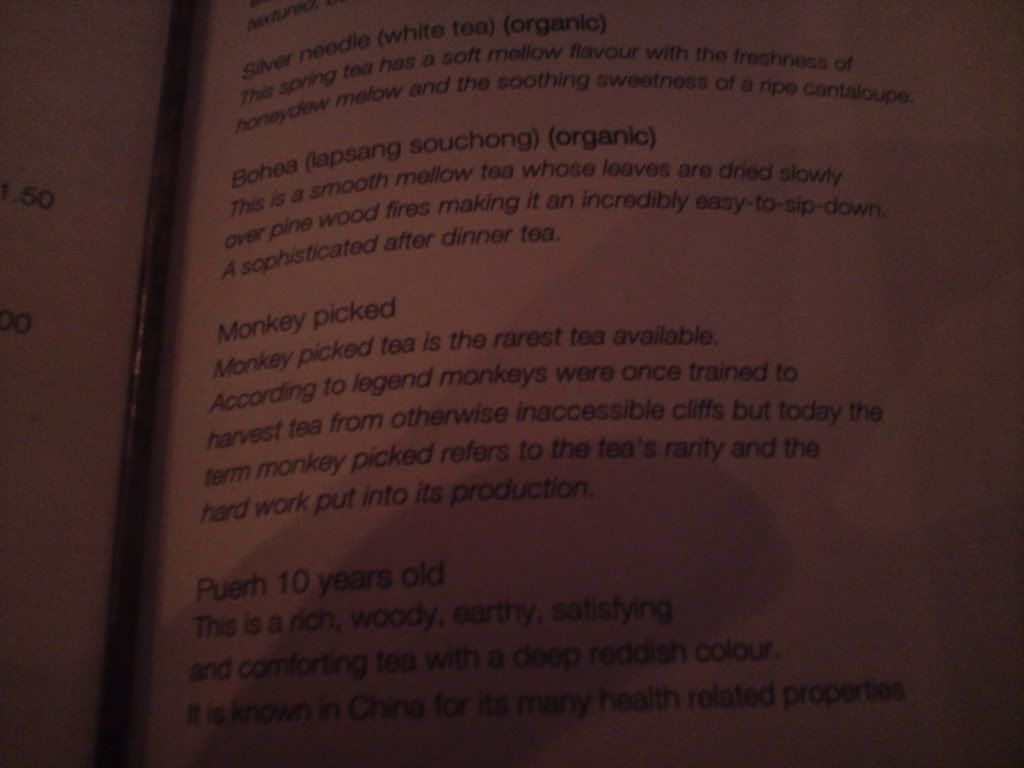
I went to a swanky restaurant in London the other day and after a great cocktail, some very good Argentinean red wine and English rose (yes, I kid you not, it was very nice), an excellent thick rare 700 gram steak, sat back and thought about having a good port and a nice cheese platter, when my eyes fell on this item on the dessert menu.


Monkey Picked Tea: Monkey picked tea is the rarest tea available. According to legend, monkeys were once trained to harvest tea from otherwise inaccessible cliffs but today the term monkey picked refers to the tea's rarity and the hard work put into its production.

It was for £5.50 if I am not wrong, and being the sucker for new and innovative things that I am, I went for it. First of all, my boss took the piss out of me unmercifully by saying, you have simply ordered PG tips, and the restaurant is taking you for a ride. Mainly because of the Monkey bit which advertises the bloody PG Tips.  You can buy all kinds of PG Tips monkey stuff here. But more on the end result later.

But took a photo and then came back to look it up. The basic story is simple and I quote:

This rare Chinese tea is carefully picked by specially trained monkeys in a remote mountain region of China. Legend has it that monkeys were first used to collect tea ten centuries ago, because upon seeing it's master trying to reach some tea growing wild on a mountain face, the monkey climbed up the steep face and collected the tea growing there and brought it down to his master. This wild tea was considered so delicious that other people began to train monkeys to collect this rare wild tea. Nowadays the practice of monkeys picking tea has all but died out, except in one small remote village where they still continue this remarkable tradition.

This video seems to be showing a monkey which the zoo commentator claims to be a tea picking monkey. All I can hope is that I hope the bloody monkey washed his hands after picking its nose but before picking the tea leaves.

Here's an example of the pack. And here's an interesting discussion on this tea.

But I was a bit suspicious because nobody actually mentions the type of tea leaves, all this monkey picking business is good and fine, but what is the actual name of the tea plant? And then found it. Can you purchase this? Well, here it is. I quote the product description:

These finest grade tightly hand-rolled leaves are bursting with flavor and have a lingering fruity aftertaste. This is perhaps the most fabled tea in China, prized for its complexity. This lot was grown in Fujian Province. Legends relate the story of how the tea is named after Kuanyin, the goddess (or bodhisattva) of compassion. This tea is greener than other Tieguanyins, in the style which is popular throughout China.

The often-used term "Monkey Picked" comes from another legend: Local monks convinced monkeys to climb the tall, wild tea trees and bring them the new leaves from above. This tea is one of the few that holds up well to up to three infusions, and produces a rich golden liquor with a spicy aroma and semisweet aftertaste. We recommend this tea as a high quality everyday tea. It goes well with most foods and is good with cakes, scones and the like.

But I am afraid the tea was absolutely horrible, it was musty, dusty and tasted like the tea was made by actually dipping the original old monkey in hot water rather than tea leaves. It was golden all right, but no, I am going to give this a miss.

And this left my boss and rest of the gang rolling around on the floor looking at my face and expression. Still suffering from that incident, every time I ask for a tea or coffee in the office, somebody shouts PG Tips or makes those monkey noises. Sighs, life sucks.

Sunday, July 6

What's the need for futures?

In an email exchange on a left list, a question was asked, futures markets are filled with speculators and is bad for the health of financial markets, comment.

I was curious to understand why this was being said? The responder did not say much more than some vague commentary about how it screws up markets, prices, and stuff like that.

This is worrisome that despite futures being around for hundreds of thousands of years, we still have people getting confused about what they do and what benefit they bring to the table.

And this is from an Indian and that too a South Indian, who should know better. For example, pepper trading, futures, forwards, insurance, crop insurance, and the like have been known in South India for hundreds if not thousands of years. Futures trading made India prosperous. Why on earth do people say that India was the Golden Bird (Sone ki chriya)? It was because of advanced financial products, markets and infrastructure that the country generated so much wealth. To say this in another way, the answer was always under his nose.

(Incidentally, did you know that Ramses II had Indian peppercorns from India up his nose? So Indians have been getting up Egyptian's noses for thousand's of years and they follow them even after death.., heheheh). The Indian Ocean trading system can perhaps be said to be one of the earliest futures and trading exchanges, trading pepper, slaves, ivory, grain, camels and livestock, and so on and so forth.

Futures are crucial for the good functioning of any market because it removes the volatility of future prices by telling people what the value would be in the future expressed in today's terms. And all this in standardised terms which can be understood by all.

So I can purchase a set amount of orange juice or grain or oil or indices or what have you, at a specified price with delivery at a particular date in the future.

Of course, I do not need to take delivery of the stuff and can hedge it out, but do you see the basics of the contract? If I am a farmer, I can sell a future for my crop or if I am a bread maker, then I have security and confidence over my future supply. What futures exchanges further help is to provide more confidence in this entire process. And these markets are brilliant places where you can go to to find out what people are thinking about the future.

So no, please do not go after speculators on the futures markets. Fraud and collusion aside, these markets are vital for the proper functioning of our human society and have been functioning like this for thousands of years.

Saturday, May 31

The difference between stupid and smart

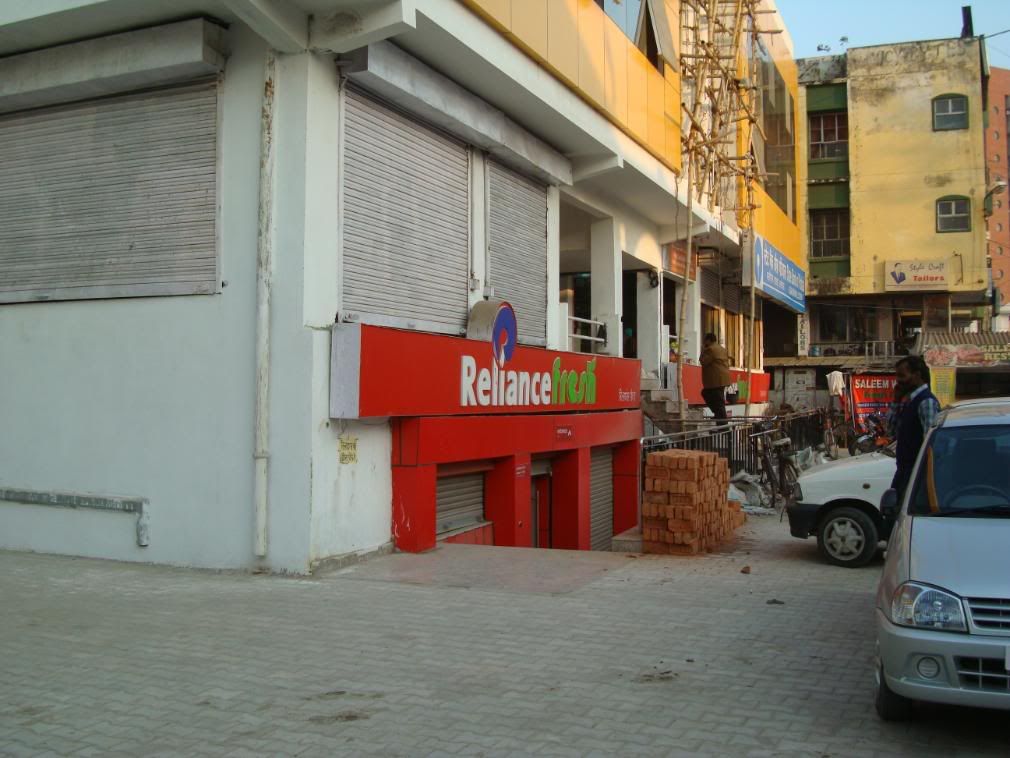
I have spoken before (and here) about the attempts of Reliance Fresh to set up a highly efficient set of retail stores in India and how a bunch of moronic politicians managed to kill off this initiative in certain parts of India. But recently I went to India and actually managed to take some photo's which show up this difference clearly.

The first set is from Lucknow where the lords of stupid rule, it is one of the heartlands where this special genus seems to spring forward with startling regularity. Given the fact that a huge amount of Indian intellectual thought actually emerged from this region makes is so interesting that idiots also come out from there who have, lets be polite, just a passing acquaintance with common sense and economics.

They have even formed suicide squads against Reliance Fresh in Orissa. Well, why not? if you can do suicide bombing for inner struggle objectives or secessionist objectives, why can you not do it for opposing Reliance Fresh Stores? (the mind boggles)

But let us move on.

Just next to my father in law's office, I spotted this door.

Moving closer, it looked a bit sad, with bricks piled up, and the shutters down.

Moving closer to the store, i went down the stairs and peeked through the glass door. Everything was pristine, new, but coated with dust. For some reason, I was feeling a bit like Howard Carter and Lord Carvanon.

The shelves were empty if stacked up, the glass was incredibly dirty and you can see yours truly the hulking fat git shadowed on the glass.

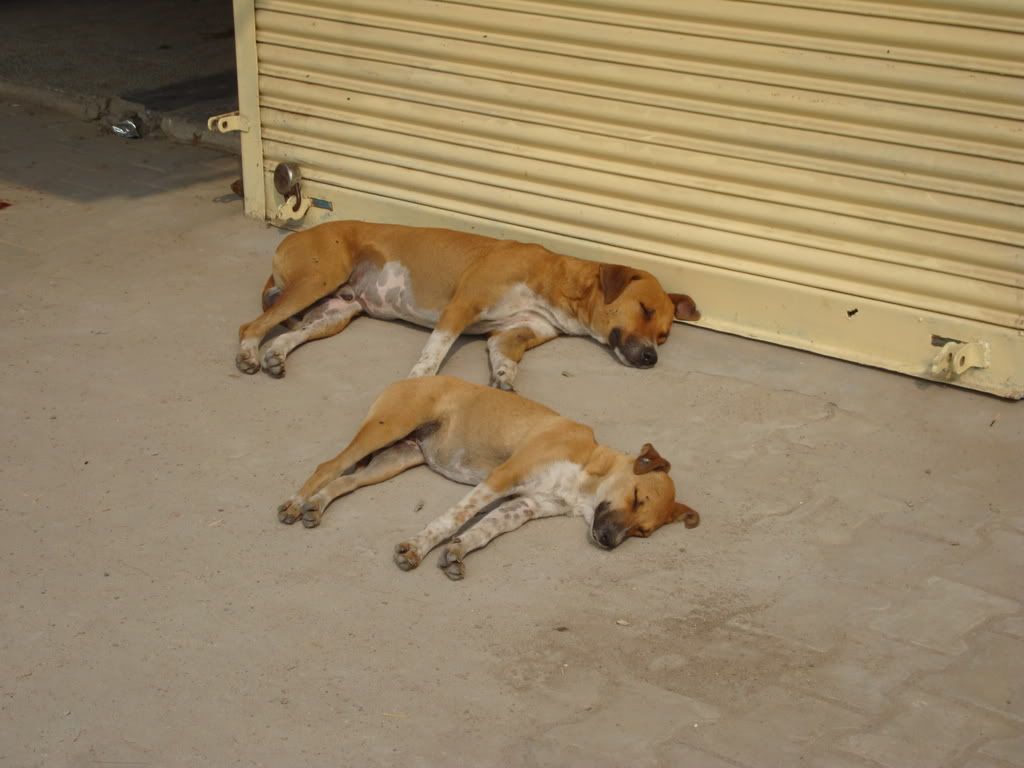
I looked around and even though it was the middle of the day in the middle of a commercial part of town, it was a nice dozy place, no jobs, no activity, no nothing. Even the bloody dogs were spooning!

And now compare it with this Reliance store in Indore. Unfortunately, I did not have a chance to get down and take some pictures as we were under severe time pressure (sod's law, we reached the school on time, but there was nobody there, I guess I have forgotten the chalta hai timekeeping system that I grew up with!). It was early morning, about 0845 hours. And you can see the store open, guards outside, well lighted store, all shelves piled high with goods, clean windows and shoppers already making a bee-line to shop.

Sad, very sad. One part of the country is flourishing and another part has dogs snoring. And the tragedy is that both cities are in states which are equally pushing each other aside in the bottom rankings of all Human Development Indicators of States in India. But one is doing something (very little but something!) while the other?

Monday, May 12

Like China in Africa, UAE is buying up Pakistan

I talked yesterday about how the Chinese are buying up land in Africa and other places. And as it turns out, UAE is now purchasing land in Pakistan for the very same reason. I quote:

One of the Middle East’s largest private equity companies has been quietly buying farmland in Pakistan as part of plans by the United Arab Emirates to increase food security and to damp inflation.

Dubai-based Abraaj Capital says it is working with the UAE government on the strategic agribusiness investments in Pakistan. The government in Abu Dhabi has been holding talks with Islamabad about a framework for investment in its agricultural sector as it seeks to secure cheaper long-term supplies of staples such as wheat and rice.

The Gulf state, which imports 85 per cent of its food needs, has already said it is to consider building a strategic reserve of staple food items, part of a broader strategy to tame inflation of more than 10 per cent, with sharp rises felt in food prices across the entire UAE population.

A senior Pakistani official told the Financial Times the government had agreed in principle to allow the sale of rural farmland to investors from the UAE, setting aside Pakistan’s own domestic concerns about increasing food prices and shortages of important commodities.

Be warned, this is not going to be an easy step for the common farmers in Pakistan, this will hurt them specially since there is no safety net and no good economy to back them up just now! And doing this without having land reform.....

Technorati Tags: ,,