Showing posts with label Denmark. Show all posts

Friday, September 7

The law of unintended circumstances–Danish Fat Tax

I quote

Denmark's recently introduced tax on food and drinks is driving shoppers to neighbouring Germany at an unprecedented level, according to a survey by the Danish Grocers’ Trade Organisation (DSK).

The survey shows that 60% of Danish households have bought beer or soft drinks in Germany within the past year. Only four years ago, 60% of the households said in the same survey that they “never” traded at the German border.

A large amount of the beer, which is bought in Germany, actually comes from Denmark. Last year Danish breweries exported 1.2 billion units to the German border shops. In 2011, Danish families on average bought 420 units of beer or soda in the German border shops, and the number is rising.

“This [the rise in the border trade] is due to the tax increases on specific consumer goods which where introduced by the Danish government at the start of the year. This is what we see the effects of now,” Claus Bøgelund Nielsen, vice president at DSK, told EurActiv.

On 1 January, the Danish government introduced higher taxes on beer, wine, chocolate, candy, sodas, ice, cream, coffee, tea and light bulbs. The government also raised the tax on tobacco starting in April.

Pretty much I TOLD YOU SO.

Wednesday, December 29

Smuggled Swede sweets eat away Danish tax take

Economics always wins out. Denmark has a high sugar tax rate so what’s going to happen? People are going to smuggle in Swedish candy.

An estimated 300 million kronor ($44.18 million) worth of illegally smuggled sweets and chocolate from Sweden are sold in Denmark every year, the Danish tax authority announced on Tuesday.

Skat, the Danish tax authority, revealed that every other kiosk that it has inspected sells smuggled candy from Sweden.
The reason behind the appetite for
illegal Swedish candy stems from a high sugar duty amounting to 17.75 Danish kroner ($3.15) per kilogramme, resulting in brisk illegal cross-border trade.
"Candy is our biggest challenge right now," Skat's Lars Klamer told Danmarks Radio (DR) on Monday.
According to the report, illegal candy
sales cost the Danish industry millions of kroner because it cannot compete on price. At the same time, they also cheat the state out of millions in taxes and duties.
Klamer added that the number of individuals and businesses simply crossing the Öresund between Copenhagen and Malmö to shop without paying taxes and surcharges has soared.
He acknowledged that the tax agency has made progress in stamping out smuggled beer and soft drink sales, but the Danish Chamber of Commerce singled out the job and business losses as a result of the illegal trade.
The chamber estimated that 15 percent of all candy trade in Denmark is illegal, the report said.

Saturday, May 31

The problem of conversion, can you be Danish and Muslim at the same time?

The fact that Immigrant Muslims and native Europeans are at loggerheads is not in doubt. Just look at the current huge hoo-haa around the Archbishop's silly statement. The Muslims are firmly noted as the "other" and this is across most of the countries in Europe. Specially in Denmark, where the feeling is much stronger than other countries (it has even elected clearly racist parliamentarians!). But what about the native Danes who covert to Islam? I got some very interesting clues from this paper.

Converts are seen as dangerous and possible traitors because (1) they have abandoned the Lutheran Protestantism and (2) they violate the unspoken rule of not showing their religion in public by wearing veils, praying at work, using different language, etc..

I would have thought that conversion would not show up that dramatically but apparently it does. The author talks about women changing clothing by wearing the veil, changing names, growing beards (for men that is), wearing different headgear, changing social locations such as pubs and churches to mosques etc. Estimates run from 2100-2800 Danes who have converted over the past 3 decades.

So why did they convert? Well, reasons range from a religious quest, search for the meaning of life, identification with the "other", rebellion against the common, and identification with the downtrodden/oppressed Muslims, identification with Islam as opposed to materialism, capitalism and modernity.

An interesting if unrelated joke point about this illness which converts seem to face called as convertitis and I quote, "which is at the same time an allusion to the generally assumed pathological nature of the conversion and a partial affirmation of this....The newly converted often exhibit a so-called fanaticism with their new religion, which is expressed in very ritualised behaviour such as only wearing Islamic dress and a preoccupation with the Islamic rules of what is haram ('forbidden') and halal ('allowed') - of doing things 'right'. This often leads to ironic situations where converts repudiate people who are born Muslims for not doing things in 'the right way' or not living up to what is defined as being 'Muslim'..

But all jokes have a kernel of truth. Converts who are going down the Islam route to find God usually end up in the Sufi or spiritualist camp. The other way is the literalist way and it shows itself with a pre-occupation with rules and regulations, it involves huge amounts of fixations and unquestioned beliefs and relates more to the Salafi or Hizb-ut-Tahrir type of fundamentalist school.

But when asked about their conversion and the path to/following conversion. Converts frequently talk about conversion as a love story which is very beautiful to hear personally. I quote,

This is especially reflected in the many cases that involve the relationship to a Muslim man or woman, where physical love conflates with metaphysical and spiritual love, both initiating identical processes of radicalism and transformation. It can also be seen in the various metaphors of love used to describe the conversion process, such as in the phrase 'Allah opened my heart to Islam', as well as other terms revolving around religiosity and conversion like 'submission', 'surrender', 'attraction', 'fascination', 'admiration', seduction', and 'willingness'.

But the converts are usually very hesitant to talk about their relationships with Muslims of immigrant background and would prefer to keep it secret. Why? I quote, "The avoidance of talking about one's often intimate interactions with people who belong to the immigrant minority population seems to be related to converts' reproduction of a public discourse that associates Islam with alienation, forming an enemy image that threatens Danish society"

Seems like there is serious psychological trauma involved, with converts being deeply defensive or offensive when asked about their conversions. Awkwardness and defiance is frequent on one end while on the other end, out and out rebellion is visible. Curiously, while some Dane converts have consciously and totally rejected Danish culture (as defined by pork eating, alcohol drinking sexual promiscuity...), others have not and say that they dont see any harm in being Danish and Muslim.

Family reaction seem to be a major factor in conversion, and there is unfortunately and sadly far too much family breakdown after conversion. But that just means that after conversion, the relationship to the original family breaks down and a new relationship with the "others" begins.

There is an amusing interlude about how a convert woman removed the legs of the sofa because her Muslim Husband did not like to sit on tall sofa's but then made it taller by padding it up by cushions and padding. But seems like converts then take on the racial overtones that is common, for example, referring (in a bad way) to "Arabs".

Religious observances such as Iftar during Ramadan being celebrated in the way they used to celebrate Danish Christmas (without, obviously with the church bits) with the same kind of food, discussions, drinks, etc. And in the end, integration proceeds quietly. Quite a sensitive and interesting paper, very well written without prejudice or discrimination on this small minority in steadily and increasingly Islamaphobic Denmark.

JO - Journal of Ethnic and Migration Studies, Routledge, Jensen, Tina Gudrun, To Be ‘Danish’, Becoming ‘Muslim’: Contestations of National Identity? 1369-183X, 2008, 34, 3, 389-409
AB - This article discusses the relationship between national, ethnic and religious identities as embodied by so-called ethnic Danes who convert to Islam. The point of departure is the constructed polarisation between Islam and the West. The article explores how converts experience their apparently contradictory identities as ‘Danish’ and ‘Muslim’. Identity is dealt with as processes of both difference and similarity, whereby the constructions of ‘self’ as ‘same’ and ‘other’ as ‘different’ are questioned. In exploring the space between ‘self’ and ‘other’ among Danish converts, it is argued that they negotiate their identities as both Danish and Muslims by engaging in an ideological struggle over otherwise commonsense meanings. This process opens a space for re-making identity by connecting relations between these identities, which are otherwise perceived as having nothing in common.


Saturday, February 23

The problem of conversion, can you be Danish and Muslim at the same time?

The fact that Immigrant Muslims and native Europeans are at loggerheads is not in doubt. Just look at the current huge hoo-haa around the Archbishop's silly statement. The Muslims are firmly noted as the "other" and this is across most of the countries in Europe. Specially in Denmark, where the feeling is much stronger than other countries (it has even elected clearly racist parliamentarians!). But what about the native Danes who covert to Islam? I got some very interesting clues from this paper.

Converts are seen as dangerous and possible traitors because (1) they have abandoned the Lutheran Protestantism and (2) they violate the unspoken rule of not showing their religion in public by wearing veils, praying at work, using different language, etc..

I would have thought that conversion would not show up that dramatically but apparently it does. The author talks about women changing clothing by wearing the veil, changing names, growing beards (for men that is), wearing different headgear, changing social locations such as pubs and churches to mosques etc. Estimates run from 2100-2800 Danes who have converted over the past 3 decades.

So why did they convert? Well, reasons range from a religious quest, search for the meaning of life, identification with the "other", rebellion against the common, and identification with the downtrodden/oppressed Muslims, identification with Islam as opposed to materialism, capitalism and modernity.

An interesting if unrelated joke point about this illness which converts seem to face called as convertitis and I quote, "which is at the same time an allusion to the generally assumed pathological nature of the conversion and a partial affirmation of this....The newly converted often exhibit a so-called fanaticism with their new religion, which is expressed in very ritualised behaviour such as only wearing Islamic dress and a preoccupation with the Islamic rules of what is haram ('forbidden') and halal ('allowed') - of doing things 'right'. This often leads to ironic situations where converts repudiate people who are born Muslims for not doing things in 'the right way' or not living up to what is defined as being 'Muslim'..

But all jokes have a kernel of truth. Converts who are going down the Islam route to find God usually end up in the Sufi or spiritualist camp. The other way is the literalist way and it shows itself with a pre-occupation with rules and regulations, it involves huge amounts of fixations and unquestioned beliefs and relates more to the Salafi or Hizb-ut-Tahrir type of fundamentalist school.

But when asked about their conversion and the path to/following conversion. Converts frequently talk about conversion as a love story which is very beautiful to hear personally. I quote,

This is especially reflected in the many cases that involve the relationship to a Muslim man or woman, where physical love conflates with metaphysical and spiritual love, both initiating identical processes of radicalism and transformation. It can also be seen in the various metaphors of love used to describe the conversion process, such as in the phrase 'Allah opened my heart to Islam', as well as other terms revolving around religiosity and conversion like 'submission', 'surrender', 'attraction', 'fascination', 'admiration', seduction', and 'willingness'.

But the converts are usually very hesitant to talk about their relationships with Muslims of immigrant background and would prefer to keep it secret. Why? I quote, "The avoidance of talking about one's often intimate interactions with people who belong to the immigrant minority population seems to be related to converts' reproduction of a public discourse that associates Islam with alienation, forming an enemy image that threatens Danish society"

Seems like there is serious psychological trauma involved, with converts being deeply defensive or offensive when asked about their conversions. Awkwardness and defiance is frequent on one end while on the other end, out and out rebellion is visible. Curiously, while some Dane converts have consciously and totally rejected Danish culture (as defined by pork eating, alcohol drinking sexual promiscuity...), others have not and say that they dont see any harm in being Danish and Muslim.

Family reaction seem to be a major factor in conversion, and there is unfortunately and sadly far too much family breakdown after conversion. But that just means that after conversion, the relationship to the original family breaks down and a new relationship with the "others" begins.

There is an amusing interlude about how a convert woman removed the legs of the sofa because her Muslim Husband did not like to sit on tall sofa's but then made it taller by padding it up by cushions and padding. But seems like converts then take on the racial overtones that is common, for example, referring (in a bad way) to "Arabs".

Religious observances such as Iftar during Ramadan being celebrated in the way they used to celebrate Danish Christmas (without, obviously with the church bits) with the same kind of food, discussions, drinks, etc. And in the end, integration proceeds quietly. Quite a sensitive and interesting paper, very well written without prejudice or discrimination on this small minority in steadily and increasingly Islamaphobic Denmark.

JO - Journal of Ethnic and Migration Studies, Routledge, Jensen, Tina Gudrun, To Be ‘Danish’, Becoming ‘Muslim’: Contestations of National Identity? 1369-183X, 2008, 34, 3, 389-409
AB - This article discusses the relationship between national, ethnic and religious identities as embodied by so-called ethnic Danes who convert to Islam. The point of departure is the constructed polarisation between Islam and the West. The article explores how converts experience their apparently contradictory identities as ‘Danish’ and ‘Muslim’. Identity is dealt with as processes of both difference and similarity, whereby the constructions of ‘self’ as ‘same’ and ‘other’ as ‘different’ are questioned. In exploring the space between ‘self’ and ‘other’ among Danish converts, it is argued that they negotiate their identities as both Danish and Muslims by engaging in an ideological struggle over otherwise commonsense meanings. This process opens a space for re-making identity by connecting relations between these identities, which are otherwise perceived as having nothing in common.


PS: Denmark is burning for the past many days and this has a direct bearing on the above. 

Saturday, October 20

Entrepreneurship Rates and Countries

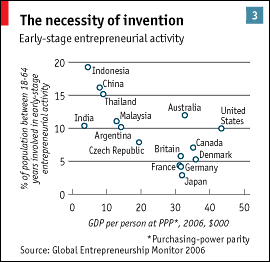
I read this very very interesting article in the Economist which made me go Hmm. The article was talking about Innovation and referred to this graph.

Photo Sharing and Video Hosting at Photobucket

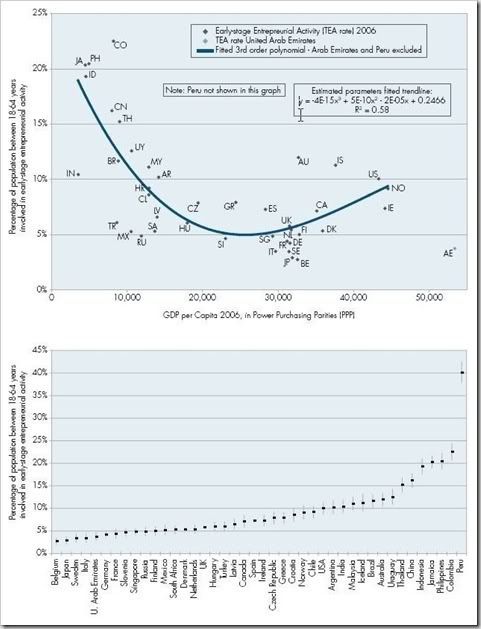
The Economist graph was simplified but the original graph shown below is much better as it provides more information.

Photo Sharing and Video Hosting at Photobucket

Based upon the curve fitting line, you will see that as countries grow and become richer, their rate of entrepreneurship reduces, and that too pretty steeply. Now why would this happen? I can hazard some guesses but no certainty. The first would be that as and how you get richer or the welfare safety net becomes better and better, the hunger for creating value progressively diminishes. The second would be that it would be easier to get jobs rather than worry about raising capital and push for a difficult enterprise. The third factor which I could think of is that as a country becomes richer, it makes it progressively difficult for entrepreneurs to be entrepreneurs, by making it more difficult to fire people, putting in more and more onerous conditions such as Health and Safety, etc. All these combine to make entrepreneurship a losing proposition.

Also, at a particular point in time, they seem to either get stuck or struggle with the next stage which seems to be more difficult. This seems to be the natural trough and despite quite a lot of efforts, the hunger is simply not there. Or it would take superhuman efforts to break through the thicket of regulations. I can well agree to this, while starting up a company is simple in European Countries, the other rules and regulations simply make it way too difficult for a person to embark on entrepreneurship.

But then there are some countries which do make a breakthrough, which is the curious aspect. To what do you ascribe the success of USA and Australia in pushing to develop entrepreneurs? Is it the national ethos? Or the innate hunger? Or their financial system? Or their education system? Why are they so much more risk taking? Or perhaps their time limited welfare system forces them to go about generating value themselves if they do not have a job?

Entrepreneurship is good, it is generating value, creating jobs and ensuring that assets are churned and made use of. Some percentage figures of population engaged in entrepreneurial activity: Indonesia has 19% of its population between 15 and 64 years as entrepreneurs, China 16% and Thailand 15%. India, Malaysia, Australia, USA, Argentina at 10-12% and then Czech, UK, Canada, Denmark, France, Germany, Japan at about 5% or below.

So Mr. Gordon Brown of the UK, what do you have to say about the fact that UK is only showing 5% of its population as entrepreneurs? What is stopping you from doing the same as Australia, USA, India (they are your ex-colonies, my friend - the child excelling over the father?)

As for Mr. Manmohan Singh of India, you need to think deeply, because you are below and behind the curve. You need to make it easier for people to start their own business. Others are leaving you to lag behind!