Kannu
Remember I offered to take you to Thailand for a week long trip and then you can learn scuba diving there? Here's an excellent article about a father son trip that you may want to read. Of course it's more oriented towards divers who already have a padi licence but we can discuss that. You and I can get a licence in London :) assuming your asthma gets fixed.
Scuba diving, son, is a wonderful exercise. One of the most amazing moments of my life was when I would scuba in the coral reefs. You saw the sea floor in Galapagos. It was nothing. Literally nothing. When you are down there, it's a magical location son.
Remember I have mentioned the burial ground of the sailors of the nautilus submarine for the 20,000 leagues under the sea? It's in a coral area. It is exquisite. So peaceful. The beauty of the scene with the sun dappled waters and fish and sea weed and and and is mind blowing. People faff around on beaches and I hate that. Knowing just few meters away you have a magical sea scape to wonder.
We will go there son :) it should be fun.
Love
Baba
http://www.nytimes.com/2016/02/21/travel/thailand-scuba-diving.html?smprod=nytcore-iphone&smid=nytcore-iphone-share
A father-son relationship deepens during a scuba trip exploring an exotic underworld off Thailand.
Showing posts with label Thailand. Show all posts
Showing posts with label Thailand. Show all posts
Thursday, February 18


Saturday, April 13
India has the largest labour market gender inequality
Sad statement, India, the country with the greatest physical labour requirements, exhibits the largest labour market gender inequality.
The author asks a good question.
Since WWII, women in the United States have greatly benefited from job requirements shifting away from physical attributes (“brain”) toward their comparative advantage in intellectual attributes (“brawn”) (seeRendall, 2010). While some of the shifting demand favoring women is related to job requirements changing intra-occupation, a large portion of the decrease in physical requirements is due to a structural shift toward services (Rendall, 2011). Hence, the last 60-years have seen an explosion in job opportunities for women in the United States, coupled with higher wages and relatively large returns to education. Can this structural transformation mechanism provide some insight into gender inequality in developing countries?
So how did they work out?
![1-s2.0-S0305750X12002495-gr1[1]](https://blogger.googleusercontent.com/img/b/R29vZ2xl/AVvXsEgUfEBuKNeLl13Z0T9Nw2pSY_b0GofJCzufWK5ZLgzBVTN5vPHHjUB_bw-LbTUavvHJIxop-ufnXK01aBx7dIz515T9-vpCcwk-xoqebupXLLqs-cy4BHTSDvBgE3kQgXlX1ol-ul5ARcU/s1600-h/1s2.0S0305750X12002495gr11.png "1-s2.0-S0305750X12002495-gr1[1]")
![1-s2.0-S0305750X12002495-gr2[1]](https://blogger.googleusercontent.com/img/b/R29vZ2xl/AVvXsEiy6Le6rY26_h2UywqiqwDjExKmlir3GdyaWSGrr_Hh4JBThF2J8DWqCZv2d5JDAkfZ9t0taTRJqlOxfedhrV7iPMgHdavgBg97vaHQt8yi7jvVbFGq0758TaZRHOy3CUE7ByoyeRb458E/s1600-h/1s2.0S0305750X12002495gr21.png "1-s2.0-S0305750X12002495-gr2[1]")
All the 4 countries, Brazil, Mexico, Thailand and India were ranked on their changes between brawn and brain. India, typically, didnt shift the brain demand upwards.
Given factor requirements,  , and estimates of “prices,”
  , the decomposition of individual traits and factor effects on wage changes is given by,
(2)

where ω is the average (natural) log of wages, and bars without time subscripts denote averages over time, e.g.,  .
.
Thus, the wage gap from period 0 to t is decomposed into four categories:
- 1.
-
Relative changes in standard male and standard female characteristics, given average returns across time.
- 2.
-
Relative price changes, given average male and female standard characteristics (including changes in general gender discrimination λ).
- 3.
-
Relative changes in skill endowments, given average skill prices.
- 4.
-
Relative skill price changes, given average male and female skills.
I am not sure about the usage of average returns across time, that can actually hide quite a lot of rather interesting movements. Perhaps median returns would have been more accurate. Same with the average skill prices. There have been quite a lot of fertility changes as well so that impact needs to be considered.
The policy implications are good enough to be quoted in full
The wage analysis of Section 4 strongly suggests that falling brawn requirements and rising brain requirements can have a large impact on women’s relative wages. Section 5 provides evidence for policies related to improving the labor supply of women.
More specifically, Brazil is a clear example of rising brain requirements and falling brawn requirements significantly closing the gender wage gap. In contrast, India is a striking counterexample, where women work primarily in the highly brawn dependent agricultural sector. Thailand is a good example of a country that experienced major structural transformation within the labor market. This has allowed Thai women greater labor market flexibility and better opportunities to match innate abilities with skill requirements. While some of the gains in Mexico were undone by the rise of maquiladoras (low-brain jobs) in the 1990s, it could be argued that, as countries move along the development path and become richer, gender equality should naturally follow. However, at the same time, policy makers should promote an open environment with respect to education and employment opportunities for both genders. In particular, improving the quality of education will likely help strengthen and develop women’s comparative advantage in brain endowments. This policy recommendation is supported by findings in Pitt et al. (2010) for Bangladesh and Klasen and Pieters (2012)for India.
Mexico also provides a cautionary tale, as suggested by Gonzalez (2001). Mexico pursued manufacturing sector growth in the 1990s. This lead to diminishing returns to brain endowments, and was considered counterproductive when accounting for the effects on female employment opportunities. Thus, if improving gender equality is a goal, policy makers should encourage the development of service sector employment. Specific policies aimed at attracting firms or FDI in the knowledge industry would seem most beneficial in generating greater gender equality in terms of wages. India has started moving along this path relatively recently with its information technology focus (see Winters & Yusuf, 2007), and the results of this paper suggest this is a good first-step.
Note however, that policies just aimed at increasing the knowledge industry might not be enough to persuade women to participate in the labor market. Section 5 provides clear evidence in this regard. Specifically, fostering a good environment for high-quality education is extremely important. However, as can be seen from the predicted gender employment ratios in all countries, higher brain demands still favor men. This means that equal access to education is imperative for the strengthening of female employment opportunities.
In conclusion, a policy aimed at attracting firms to create employment in the service sector (knowledge industries) with good access to education for both men and women should result in greater gender equality in terms of labor market outcomes
net net, educate women, more and more and more….and reduce their fertility impact..
Wednesday, October 10
"The Place to Disappear"
Kannu
This is an interesting story about a little street in Thailand. Full of young people enjoying themselves.
Some thoughts about travel. I've done my fair share of it now, both business and personal. We have been on holidays to various places. When you go with somebody you love, like we went to Corfu or Chicago or Cornwall (interesting how our holidays line-up) I loved it because you all were with me.
But till you have a regular girlfriend or a family, I would strongly advise you to think about going out on your own. Just a backpack and then you roam about on roads like this in Thailand or in Tibet or in Israel or panama or equador or USA. I haven't done that much but whenever I go on my trips, I sneak out of the hotel room and go for long walks around the cities. Just feel the city or place. Smell the food and trains and roads and people. Watch how they react. How the architecture has been built. Grab a slice of pizza at a local shop. Or a Philly cheesesteak at a kiosk. Or a burrito from a pavement seller.
I think wandering around alone will not only help you know more about the world but also about yourself son. We are but our experiences and its these experiences which will help make you into a smart intelligent and great man. Plus you will find some very interesting 'company' when you are out there :)
Love
Baba
"The Place to Disappear" by Susan Orlean [Send Me a Story]
On Bangkok’s Khao San Road.
The Place to Disappear
On Bangkok’s Khao San Road.
Susan Orlean | New Yorker | Jan 2000—
All languages are welcome on Bangkok’s Khao San Road, including Drunkard. “Hold my hand,” a man fluent in Singapore Slings commanded a Scottish hairdresser one night at Lucky Beer and Guest House—only in his dialect it came out soggy and rounded, more like Hole mah han. “Not right now,” the Scottish hairdresser said. She was a slender girl with the pinkish pallor of a milkmaid, blond hair, gray eyes, and a nose ring. She was on a six-week trip through Asia with two cute friends from Glasgow. They’d just arrived on a super-discount flight from Scotland and had checked into a seven-dollar-a-night room at one of the several hundred or so cheap guesthouses around Khao San Road-Happy Home Guest House or Nirvana Caf and Guest House or Sweety’s or Lek Mam’s or something; they actually couldn’t remember what it was called, but they knew how to find their way back. They also knew how to get from their guesthouse to the new branch of Boots, the English drugstore, which opened recently amid the T-shirt shops and travel agencies that line Khao San. Within their first few hours in Bangkok, the girls went to Boots and blew their travel budget on English soap and shampoo—same soap and shampoo they could get at home but somehow more exotic-seeming when bought in Thailand—and on snack packages of Oreos, which they worship and which are not easy to find in the United Kingdom. They thought Khao San was horrible because it was so crowded and loud and the room in the guesthouse was so dingy, but it was brilliant, too, because it was so inexpensive, and there were free movies playing at all the bars, and because they’d already run into two friends from home. On top of that, finding a branch of Boots right here was almost too good to be true. What’s more, Boots was super-air-conditioned, and that distinguished it from many of the other Khao San Road shops, which were open to the hot and heavy Bangkok air.
Friday, April 4
More problems with food prices
More and more worried about this situation. See these stories
1. World Bank warning about South Asian poor at severe risk of food shortages and inflation.
2. India pledging to crack down on hoarders. The Indian public distribution system is not fit for purpose and it is full of corruption... and this is deeply worrying for me.
3. Thailand is pledging supplies to importers. They need to be careful, apparently there are now reports of people stealing crops!
but who will pay for this rise in prices? inflation is the silent killer of the poor and Indians know about this. This is getting very very dangerous.
Saturday, October 20
Entrepreneurship Rates and Countries
I read this very very interesting article in the Economist which made me go Hmm. The article was talking about Innovation and referred to this graph.
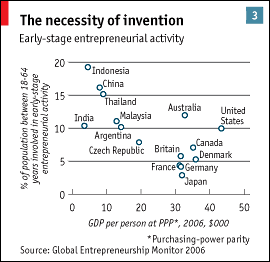
The Economist graph was simplified but the original graph shown below is much better as it provides more information.
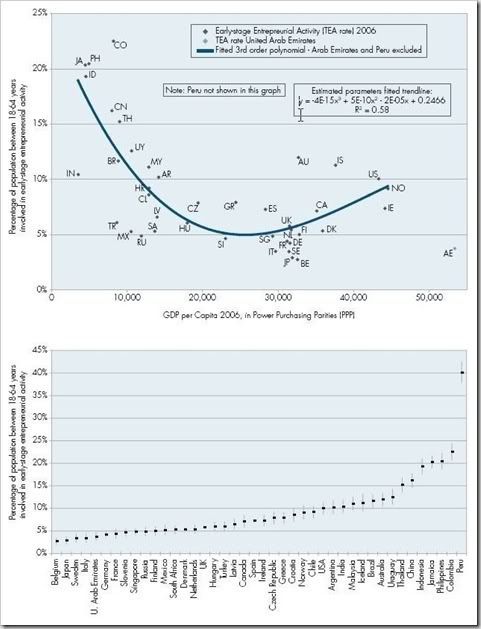
Based upon the curve fitting line, you will see that as countries grow and become richer, their rate of entrepreneurship reduces, and that too pretty steeply. Now why would this happen? I can hazard some guesses but no certainty. The first would be that as and how you get richer or the welfare safety net becomes better and better, the hunger for creating value progressively diminishes. The second would be that it would be easier to get jobs rather than worry about raising capital and push for a difficult enterprise. The third factor which I could think of is that as a country becomes richer, it makes it progressively difficult for entrepreneurs to be entrepreneurs, by making it more difficult to fire people, putting in more and more onerous conditions such as Health and Safety, etc. All these combine to make entrepreneurship a losing proposition.
Also, at a particular point in time, they seem to either get stuck or struggle with the next stage which seems to be more difficult. This seems to be the natural trough and despite quite a lot of efforts, the hunger is simply not there. Or it would take superhuman efforts to break through the thicket of regulations. I can well agree to this, while starting up a company is simple in European Countries, the other rules and regulations simply make it way too difficult for a person to embark on entrepreneurship.
But then there are some countries which do make a breakthrough, which is the curious aspect. To what do you ascribe the success of USA and Australia in pushing to develop entrepreneurs? Is it the national ethos? Or the innate hunger? Or their financial system? Or their education system? Why are they so much more risk taking? Or perhaps their time limited welfare system forces them to go about generating value themselves if they do not have a job?
Entrepreneurship is good, it is generating value, creating jobs and ensuring that assets are churned and made use of. Some percentage figures of population engaged in entrepreneurial activity: Indonesia has 19% of its population between 15 and 64 years as entrepreneurs, China 16% and Thailand 15%. India, Malaysia, Australia, USA, Argentina at 10-12% and then Czech, UK, Canada, Denmark, France, Germany, Japan at about 5% or below.
So Mr. Gordon Brown of the UK, what do you have to say about the fact that UK is only showing 5% of its population as entrepreneurs? What is stopping you from doing the same as Australia, USA, India (they are your ex-colonies, my friend - the child excelling over the father?)
As for Mr. Manmohan Singh of India, you need to think deeply, because you are below and behind the curve. You need to make it easier for people to start their own business. Others are leaving you to lag behind!
Subscribe to:
Posts (Atom)