Showing posts with label Indonesia. Show all posts

Monday, December 9

Exporting Christianity: Governance and doctrine in the globalization of US denominations

Modelling the spread of Christianity, fascinating study here.

In this paper we build a model of market competition among religious denominations, using a framework that involves incomplete contracts and the production of club goods. We treat denominations akin to multinational enterprises, which decide which countries to enter based on local market conditions and their own “productivity.” The model guides us in estimating how a denomination's religious doctrine and governance structure affect its ability to attract adherents. Using data on the foreign operations of US Protestant denominations in 2005 from the World Christian Database, we find that (1) denominations with stricter religious doctrine attract more adherents in countries in which the risk of natural disaster or disease outbreak is greater and in which government provision of health services is weaker, and (2) denominations with a decentralized governance structure attract more adherents in countries in which the pastor cost of connecting with congregants is lower. These findings illuminate factors shaping the composition of religion within countries, helping account for the rise of new Protestant groups. They also provide empirical evidence for the recent theoretical developments in organization and trade.

India is one of the countries where there is a pretty significant missionary push. Entire states have been proselytised out of their ancient Hindu/Animist background like Nagaland and as one has noted, that sometimes comes with a rather strong pushback. I quote from their conclusion:

The literature provides explanations for why strict religious groups have prospered in Israel (Berman, 2000) and Indonesia (Chen, 2010), based on Iannaccone's (1992) model of religious groups as clubs. Our contribution is to show theoretically and empirically how denominations compete for believers and how country characteristics affect the market value of a denomination's attributes, which is helpful for understanding the global expansion of Protestant Christianity. Strictness is more desirable in countries in which individuals are more exposed to shocks associated with natural disasters and disease outbreaks, and less desirable in countries with better health services. Weak governments and weak institutions may thus favor strict religious organizations. What may in part account for the recent globalization of Protestant Christianity is the lowering of state barriers to religion (Barro and Hwang, 2007), coupled with the slow expansion of state capacity in many developing countries, leaving individuals without adequate means to insulate themselves against risk.

So the pushback against missionary Christianity is not just in India but also in many other countries. Combine that with weak state power, bad infrastructure etc. etc. and then you wouldnt be surprised that the local populace reacts badly.

Wednesday, June 12

Resort Of Last Resort

Here's an example of where the bottom feeders live. People who are escaping Islam. Poverty. They are desperate to get away from the bastards who have ruined countries such as Pakistan Afghanistan and Iran. And more will come. The history of Islam tells us that Muslims kill more Muslims than any other religion. And this sad story has a long way to run. Till Muslims manage to box Islam into the civilised box rather than the shape fundamentalists have put it into. 

Ironically you see one of the sets of idiots, Saudis, who are responsible for this desecration of Islam coming to Indonesia to get their rocks off. The hypocrisy is breathtaking. The Saudis piss over their co religionists in India Bangladesh Pakistan Indonesia Egypt Lebanon and in return these guys fawn over the Saudis and lick their feet. Only place there where I faced in your face racism. Bah. 

But there you go. It's a sad view of one of the sad spots of the world. As an economist you need to consider why nations hate and love immigration. Freedom of capital is allowed generally but of labour? Nope. Think about why this is so son.

Love

Baba  

Resort Of Last Resort | The Global Mail
http://www.theglobalmail.org/feature/resort-of-last-resort/585/

Fear, corruption, boredom, smugglers, extortionists, Saudi sex tourists and temporary wives: such is life in the Indonesian resort town that has become limbo for asylum seekers.

Night is enveloping the hills of Cisarua, a resort town high outside Jakarta, and the area’s evening rituals are beginning. Rainwater thunders down from nearby mountaintops along hundreds of canals and rivulets that go whooshing on into the polluted sink that is Indonesia’s capital.

Across the bowl-shaped valley, dozens of mosques begin booming the call to prayer, all merging together into an asynchronous whine. In hillside villas, groups of men from Saudi Arabia — some in traditional white thawb robes, some in baggy track pants – load up on the evening’s stock of alcohol, which is banned in their home country. On motorbikes and in cars, pimps begin ferrying in the men’s other vice — Arabic-speaking Indonesian women.

(See the photos behind the story: Barat Ali Batoor’s series from Cisarua, In Between Persecution And Asylum.)

In other rented houses, hundreds of asylum seekers sit with little to do. Many have become near-nocturnal out of sheer boredom, and are just starting their day. Over the past decade, the town has become the unofficial haven for asylum seekers heading to Australia. For some, it is a brief stopover before they jump on a smuggler’s boat. For others, it is a limbo that can last for years.

Haider — not his real name — is sitting in a living room with half-a-dozen other men who, like him, are Hazaras from the Pakistani city of Quetta. All appear drawn and exhausted. One of the men, Ghulam Reza, sits with his foot extended because of an untreated, bloody gash.

Friday, July 8

Economic Incentives at play

Indonesia recently banned the recruitment of women from Indonesia to go to Saudi Arabia to work as maids. This was after an Indonesian maid killed her employer after he abused her thoroughly. Welcome to Saudi Justice. Anyway, so what happens after the ban? Read on MacDuff.

JEDDAH: Illegal housemaids in Jeddah have begun asking for huge salary increases following the decision to suspend recruitment of housemaids from Indonesia and the Philippines.

Many families are reporting that the maids have threatened to walk out if their demands are not met, especially that Ramadan is one month away when demand for extra domestic help spikes

Gosh, Saudi Society will collapse without maids, eh? So what do you do?

Following the decision to stop maids from Indonesia and the Philippines, recruitment from countries like Ethiopia or Kenya and other countries came as an alternative choice to fill the demand for domestic labor in Saudi Arabia. Spokesman of the Ministry of Labor Hattab Al-Anzi hinted that the Kingdom would start allowing recruitment for domestic workers, including maids, from different countries. Several recruitment offices have begun shifting their focus toward African countries. “However, I personally doubt whether one or two nations will be able to cover the gap in the domestic house labor market ruled by Indonesia for some time now,” he added.

Most domestic workers are recruited from Indonesia, the Philippines (which was recently barred due to a dispute over minimum wage) and Sri Lanka. Egypt doesn’t allow women to travel to the Kingdom to work as maids. Pakistani and Indian maids in Saudi Arabia are uncommon.

“In light of these new regulations, recruitment from other nations, such as Ethiopia and Kenya, could work,,” said Ahmad, an employee at a recruitment office.

Change the sources of maids. That’s interesting, eh? But here’s the interesting thing. The basic problem of Saudi’s mistreating their maids has not gone away. So very soon there will be another incident and then these other countries will also not allow their women to go to Saudi Arabia to do maid jobs. Egypt is out, Philippines is out, Pakistani and Indians don't do maid jobs (why???). So pick up people from Ethiopia and Kenya? Given that racism is so heavy in Saudi, I wont be surprised that these girls from Ethiopia and Kenya get it worse. For some reason I cannot generate any sympathy towards these muppets. In the meantime, be prepared to pay through the nose matey.

Their views on women are like Neanderthal as well. See this story about how they blame rape victims. It was shocking. Divorce rates in Saudi Arabia are one of the highest in the world. 62% of marriages in the western region in Saudi end in divorce. Overall, its about 60%. Ok, i wont go off into tangents, but basically economic incentives are showing their predictable response. Mistreat your women and the women react by either divorcing you or raising their prices.

Wednesday, October 20

Judge: Indonesia needs death penalty for graft

An interesting view. China regularly executes people found guilty of corruption. Now I do not like the idea of the death penalty, its a bit too final for me, but to actually treat white collar crime more seriously is something that i would support, across the world, there is an impression that white collar crime is victimless and doesn't really hurt anybody. But it does, it is a slow cancer and ruins the broader society and economy. I am not really sure how much of a deterrent this death penalty business is.

Friday, June 11

Saudi Arabia in trouble over housemaids

Yes, indeed, i can well see the solution to more and more expensive housemaids being Saudi men and women doing the work that the housemaids did. HAHAHAHAHAHAHAHAH!. I quote:

The upward spiral of housemaid costs will never stop. These costs will continue to increase as long as our society is totally dependent on foreign maids who have been allowed to become an integral part of our households.

They occupied homes, gained the sympathy of children and learned everything about our homes. For these reasons it is difficult, if not impossible, to get rid of the housemaid.

It is not an exaggeration to say that almost every home in the Kingdom, regardless of its financial situation, has a maid from Indonesia.

Local newspapers recently reported that the cost of recruiting maids from Indonesia has gone up by SR500 to SR10,000.

The charges imposed by recruitment offices have also increased to SR1,000 within two months. The offices have attributed this increase to the pressure exerted by the local recruitment offices in Indonesia, who also hiked their charges.

The time it takes to process paperwork for housemaids has likewise gone up from three to five months.

With the holy month of Ramadan near, the demand for housemaids is expected to surge and with it the costs of bringing them to the Kingdom.

The rise in demand for housemaids has also fueled a black market in cheap labor.

There are now millions of housemaids in our country, including 800,000 in Riyadh alone.

A number of maids tend to escape from their sponsors only a few days after their arrival, looking for more money.

In such cases, the sponsor will lose the money he spent on bringing her into the country and will also have to spend more time and cash recruiting a replacement.

The housemaids have also caused a number of negative habits to form within Saudi families. The children have become spoiled and housewives have neglected their primary duties because they  depend on maids to do everything in the house.

Aware of their growing importance, the housemaids have raised their salary demands and are imposing their own conditions, which the employing family is obliged to fulfill.

Our society is now torn between foreign manpower in the streets and housemaids in homes.

We are beginning to read about various crimes of theft and vengeance in addition to murder, child abuse, sorcery and others. Despite all this, the demand for housemaids is increasing.

I think it is time we curb the trend of recruiting maids and teach our society how to depend on itself.

Monday, May 31

Majorities Reject Banning Defamation of Religion: 20 Nation Poll

Good!. I quote:

As the UN General Assembly prepares to debate a proposal calling for nations to take action against the defamation of religion, majorities in 13 of 20 nations polled around the world support the right to criticize a religion.
On average, across all countries polled, 57% of respondents agree that "people should be allowed to publicly criticize a religion because people should have freedom of speech." However, an average of 34% of respondents agree that governments "should have the right to fine or imprison people who publicly criticize a religion because such criticism could defame the religion."
The issue of whether freedom of speech should extend to discussions of religion has stirred considerable controversy in recent months. The Organization of the Islamic Conference (OIC), a group of 56 Muslim nations, is championing a proposed U.N. resolution that calls on all nations of the world "to effectively combat defamation of all religions and incitement to religious hatred in general and against Islam and Muslims in particular."

And who were the dissenters? The typical idiot lot.

Of the seven nations where most people agree with that criticism of religion should be prohibited five have overwhelmingly Muslim populations -- Egypt (71%), Pakistan (62%), Iraq (57%), Indonesia (49%), and the Palestinian territories (51%). Another two -- India (59%) and Nigeria (54%)-- have historically been plagued by sectarian violence.

The United Nations passed one of the finest documents in human history, the Universal Declaration of Human Rights. That was its finest hour. If the United Nations now passes this defamation of religion crap, then it will show that idiots are now running the asylum. Freedom of speech is paramount. I can understand India and Nigeria objecting, they have a bunch of howling rage boys and most of the idiots who riot are basically barbarians who haven't evolved from pond life. But they still have hope. But religiously mandated defamation of religion? Good Lord (pun intended), get a grip you idiots.

Thursday, May 1

Yet another example of green versus green

Sighs. The road to hell is paved with good intentions.

All this to be taken with a grain of piquant salt!!!

Monday, April 28

Protesters burn Indonesian mosque

More fault lines and more to worry about rising fanaticism.

Hundreds of protesters in Indonesia have set fire to a mosque belonging to
the minority Muslim Ahmadiyya sect......We heard the attackers chanting 'burn,
burn' and 'kill, kill'," Zaki Firdaus, one of the sect's members, told the
Associated Press news agency. "It was horrifying."

Would we now get statements from the MCB that these do not speak in the name of Islam? Or that Inayat B actually supports the right of these Ahmadiya folks to practise their religion as they wish? Or perhaps they will consider how their own religion is being practised here in the UK? And if you say that what happens in Indonesia has nothing to do with a Brit Muslim, tell that to yourself the next time you moan about Palestine or Brit Muslims are found blowing up Jews.

I very much doubt it and this is the reason why all these leaders are looked upon with jaundiced eyes.

All this to be taken with a grain of piquant salt!!!

Thursday, November 1

Bali Bombers - their apologies

Further to my note about the Bali Bomb. Just see what the bombers are saying: Welcome to Islamism as a terrorist ideology. You will die, whether you are Muslim or Christian, Male or Female, Adult or Child. But the murderers will express regret if you are a Muslim victim.

JAKARTA: Two of the three Muslim militants on death row for involvement in
the 2002 Bali bombings have said they were sorry for killing fellow Muslims,
while insisting their deadly attack had gone according to plan.

In an interview at their remote island prison, taped secretly by national TV channel Lativi, Imam Samudra, 37, and Amrozi, 45, said it was regrettable Muslims were among the 202 killed on the resort island's nightclub attacks.

"Yes, I regret (the Muslim deaths)... I cried," Samudra said in the interview aired on Wednesday night. But he added that he had bowed "in grace" after the blasts were detonated.

Amrozi also admitted his regret but he repeated a joke made in bad taste while being tried in court, answering when asked whether he regretted the attacks that he was sorry "only 200" were killed.

"I am fasting for two months consecutively, it's to prove that I regret that Muslims
were killed. Please say I am sorry for the Muslim victims," said the convict, who has in the past apologised to the families of the Muslims killed.

The Islamic militant was dubbed "the laughing bomber" during his trial
for his apparent indifference to victims.

Nevertheless, he said the attacks "scenario was as planned." The trio are being held at Nusa Kambangan prison off the south coast of Java island, where they were moved from Bali for security reasons.

Two Lativi staff members posed as relatives of the convicts and accompanied their family members to gain access to the men. They were granted the visit at the end of the Muslim holy month of Ramadan in October as part of a normal programme allowing such visits then.

Indonesia's Supreme Court rejected an appeal by the three in August but
no date has so far been set for their executions. Their last chance of
avoiding a firing squad will be to appeal for clemency from the president, but
they have not done so yet and insisted they are willing to die.

The attack on two crowded nightclubs was carried out by the then al-Qaeda-linked Jemaah Islamiyah terror group to avenge perceived injustices to Muslims
worldwide. Most victims were foreign tourists, including 88 Australians

All this to be taken with a grain of piquant salt!!!

Sunday, October 28

The First Bali Bomb was justified

The biggest terrorist bomb after 9/11 was the Bali Bombing in Indonesia on 12 October 2002 killing 202 people and injuring 300 others. The mastermind behind this bomb was Imam Samudra and very luckily, we have a book written by him (in Indonesian unfortunately) so that we can check the thinking behind this ideologue.

Fortunately, this paper gives a good synopsis of the book, compares it with the Al-Queda ideology and proposes some counter terrorist recommendations. Besides some bad grammar, spelling and formatting of the paper, I am not that enamored of the conclusions, but the contents are what are very very interesting. (Compare this with the book written by Dhiren Barot - watch this blog for the forthcoming post, waiting for some bits!). But see the main sections here which I quote liberally:

To reach a concrete understanding on the Bali bombing I operation, Imam Samudra stresses the need to first understand the stages of jihad according to the understanding of the Salafush-Shalih (pious predecessors). In his elucidation of the subject, two reference books are specified, namely the Tarbiyah Jihadiyah by Sheikh Asy-Syahid Abdullah Azzam and Tafsir Ibnu Katsir,

Imam Samudra holds that the words fitnah and din are to mean one must "fight against them until there is no more polytheism and so that the excellent religion of God that is Islam prevails over other religion."

Imam Samudra accepts that armed jihad is one of many forms of dakwah (Islamic propagation). However, in the face of the Jews, Christians and other non-Muslims onslaught against Muslims and their lands such as in Afghanistan, Iraq, Palestine, Kashmir, and Chechnya, he despises those who choose the path of dakwah as a means to defend and uphold the teaching of Islam. He views those who choose the peaceful means as defeatists. They do not understand the comprehensiveness of Islam and have deviated from the path of the Salafus Soleh (the pious predecessors).

Jihad as Fardhu Ain

Imam Samudra argues that jihad today is not just obligatory but a fardhu ain (personal obligation) upon every single Muslim. This is because the classical Muslim scholars ruled that if an inch of a Muslim's land is seized then it become incumbent to all Muslims to liberate it through armed jihad. In today's context, Imam Samudra argues that there are plenty of Muslim lands that remain occupied by non-Muslims such as Palestine, Iraq, Afghanistan, Chechnya, Kashmir, and Mindanao. Because people of the respective lands are not able to repel the enemy by themselves, Muslims all over the world are to render their hands and participate in jihad against the occupying forces.

Because the main target of the Bali bombing is the United States and its allies who are guilty of attacking the helpless and innocent Muslims in Afghanistan in 2001, Imam Samudra argues that they deserved to be attacked. In his interpretation of the following verse:

hellipAnd fight against those who ascribe divinity to aught beside God, all together - just as they fight against you, [O believers,] all together - and know that God is with those who are conscious of Him. (The Quran: 9:36)

he equates the United States and its allies as those whom the Quran refers to as the musyrikeen (polytheists). In his opinion, war must be waged against them in retaliation for what they did. To him, the verses previously revealed on the musyrikeen are applicable to the United States and its allies. Therefore, Imam Samudra views that it is appropriate to use the verses as basis for Bali bombing.

Basic Rule: Killing or Attacking Civilians is Forbidden

Imam Samudra acknowledges that it is forbidden in Islam to kill women and children, destroy crops, as well as killing those who are old and those who devote their entire lives in worship.

However, he asserts the rule only applies when the enemies themselves do not transgress the rule. If the United States and its allies do not attack and kill Muslim civilians and observe this limit, the mujahidin will go to war in adherence to this basic rule

Civilian Targets

In the case of the Bali bombing, Imam Samudra argues that the concept of civilian immunity as prescribed by Islam does not apply to the victims because the targets are:

Military conscripts, whether in active or reserve duty. He mentions in particular civilians from the United States, Australia, Singapore, and Thailand;

Citizens of hostile countries who are guilty of voting and paying tax to the government, acts he considered as contributions to war against Islam and Muslims;

Unlikely to be civilians because they still travel to Bali despite various threats of attack. Those "civilians" are well aware of the situation in Indonesia as various warnings about terrorist attacks have been issued by their respective countries. He argues that such a hostile condition would frighten any ordinary civilian. What more, when there were already a few bombing cases reported? Would it then be logical for the "American civilians" and their allies to choose Indonesia for a visit? Defying such threat clearly demonstrates that they are in fact not civilian as claimed when the attack on 12 October 2002 took place.

Citizens of "colonial countries" who have caused the death of thousands of Muslim civilians in Iraq, Afghanistan, Kashmir, Chechnya, and many other places.

Attacking Civilians from among the Colonial Race is a Fair and Just Act

Imam Samudra points out that the precedent for targeting civilians had been set by the following incidents:

In 1991, the trade embargo on Iraq initiated by America through the UN brought about the death of 600,000 babies and subsequently the figure rose to 1.5 million (Jakarta Post, 4 December 2002).

Thousands of civilian deaths as a result of the American embargo on Afghanistan during the Taliban rule (1994-2001).

Israeli's attack on civilians with the America's military and financial support.

Post the World Trade Center and Pentagon attack, America demonstrated its military might beyond words how brutal and ruthless they can be, driven solely by vengeance and hostility.

200,000 civilians were killed during the U.S. attack on Afghanistan as reported by www.khurasan.com.

Then the author goes about refuting this ideology, but that's pretty much par for the course. So this is really horrifying and worrying that one can have this kind of ideology which cant really be fought against, is there? Dont forget that Imam Samudra was a very very intelligent chap, he had loads of academic prizes for his achievements, had a very prestigious family, and was well connected into the global Jihad network.

JO - Studies in Conflict & Terrorism, AU - Hassan, Muhammad Haniff Bin, TI - Imam Samudra's Justification for Bali Bombing
PY - 2007, VL - 30, IS - 12, SP - 1033, EP - 1056
AB - The primary objective of this article is to provide a map of Imam Samudra's thinking behind Bali bombing I as written in his book Aku Melawan Teroris to those who are not able to read the book in its original Indonesian language with an assumption that counterideological effort cannot be executed effectively without understanding the ideas held by terrorism perpetrators. To add value, the article also offers a comparative study between Samudra's thinking and Al Qaeda's ideology. It then points out and provides brief alternative viewpoints to Samudra's thinking. The article ends with some policy recommendations pertaining to counterideological work.

Saturday, October 20

Transfer Money via mobile phones back home

Mobile phones are about to become the simplest and quickest way to transfer money across borders, under a deal announced yesterday by Western Union and GSM Association, the main mobile phone operators’ body.

The agreement could have a big impact on global cross-border remittances, worth an estimated $300bn a year, and provide a springboard for mobile carriers and Western Union to offer other mobile banking services using “mobile wallet” technology.

Cross-border money transfers valued at up to $100 in countries such as India, the Philippines, Mexico and China – which have large volumes of remittances from migrant workers – will be an early priority of the deal.

Brilliant idea, see how it will work:

Under the scheme, mobile operators will connect to Western Union’s existing global money transfer system, which processed some 17 per cent of the world’s remittance volume in 2006.

Once connected to the Western Union service, mobile operators will be able to use their own “mobile wallet”’ software to enable person-to-person mobile money transfers over Western Union’s cross-border remittance network.

Very interesting news indeed!, I love it. But what do global banks do to cater for this? Between this and the hawala, they are missing out on the micro payments industry.

Mind you, this will have another very big impact on counter terrorism and will make it easier for the terrorists to transfer monies.

Entrepreneurship Rates and Countries

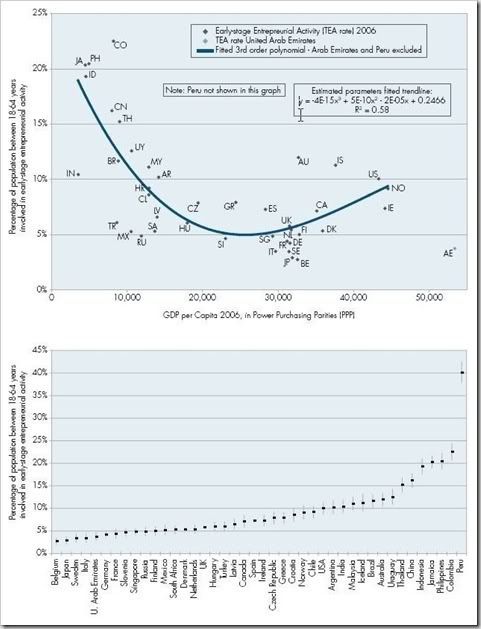
I read this very very interesting article in the Economist which made me go Hmm. The article was talking about Innovation and referred to this graph.

Photo Sharing and Video Hosting at Photobucket

The Economist graph was simplified but the original graph shown below is much better as it provides more information.

Photo Sharing and Video Hosting at Photobucket

Based upon the curve fitting line, you will see that as countries grow and become richer, their rate of entrepreneurship reduces, and that too pretty steeply. Now why would this happen? I can hazard some guesses but no certainty. The first would be that as and how you get richer or the welfare safety net becomes better and better, the hunger for creating value progressively diminishes. The second would be that it would be easier to get jobs rather than worry about raising capital and push for a difficult enterprise. The third factor which I could think of is that as a country becomes richer, it makes it progressively difficult for entrepreneurs to be entrepreneurs, by making it more difficult to fire people, putting in more and more onerous conditions such as Health and Safety, etc. All these combine to make entrepreneurship a losing proposition.

Also, at a particular point in time, they seem to either get stuck or struggle with the next stage which seems to be more difficult. This seems to be the natural trough and despite quite a lot of efforts, the hunger is simply not there. Or it would take superhuman efforts to break through the thicket of regulations. I can well agree to this, while starting up a company is simple in European Countries, the other rules and regulations simply make it way too difficult for a person to embark on entrepreneurship.

But then there are some countries which do make a breakthrough, which is the curious aspect. To what do you ascribe the success of USA and Australia in pushing to develop entrepreneurs? Is it the national ethos? Or the innate hunger? Or their financial system? Or their education system? Why are they so much more risk taking? Or perhaps their time limited welfare system forces them to go about generating value themselves if they do not have a job?

Entrepreneurship is good, it is generating value, creating jobs and ensuring that assets are churned and made use of. Some percentage figures of population engaged in entrepreneurial activity: Indonesia has 19% of its population between 15 and 64 years as entrepreneurs, China 16% and Thailand 15%. India, Malaysia, Australia, USA, Argentina at 10-12% and then Czech, UK, Canada, Denmark, France, Germany, Japan at about 5% or below.

So Mr. Gordon Brown of the UK, what do you have to say about the fact that UK is only showing 5% of its population as entrepreneurs? What is stopping you from doing the same as Australia, USA, India (they are your ex-colonies, my friend - the child excelling over the father?)

As for Mr. Manmohan Singh of India, you need to think deeply, because you are below and behind the curve. You need to make it easier for people to start their own business. Others are leaving you to lag behind!


Friday, October 12

Christian Terrorism in India, Uganda and Indonesia

We have heard quite a lot about Islamist Terrorism and there has been a pretty fair comment which has been floating about asking why other religions have not been similarly classified. Judaism is well represented with its Zionist angle, but the issue is confused because now we have a Jewish State and as I have frequently said, states cannot commit terrorism, they can sponsor it but they cannot commit it. Hindu terrorism is getting there, some of the activities of some of the groups such as Bajrang Dal and others are perilously getting close to where I would explicitly call them as terrorist organisations. Buddhist terrorism is already present in Sri Lanka although one can argue this is more Singhala (linguistic based ethno terrorism) terrorism rather than religion based terrorism.

Well, the main reason in the Christian matter, in my opinion, is because the number of terrorist campaigns being driven by ideology based upon Christianity is few and far between and secondly, they have not been as brutal or visible as the Islamist ones. That said Christian terrorism does exist. I have recently seen this paper which does a good job in covering the three main instances of Christian terrorism, namely in North East India, Northern Uganda and the island of Ambon in Indonesia.

In the Name of the Father? Christian Militantism in Tripura, Northern Uganda, and Ambon; Jeroen Adam; Bruno De Cordier; Kristof Titeca; Koen Vlassenroot, Conflict Research Group, Department of Third World Studies, Ghent University, Ghent, Belgium, Studies in Conflict & Terrorism, 30:963–983, 2007

Although armed groups and political violence referring to Islam have attracted increasing attention since the start of the global war against terror, one particular religion can hardly be described as the main source of inspiration of what is commonly referred to as “terrorist acts of
violence.” Faith-based violence occurs in different parts of the world and its perpetrators adhere to all major world faiths including Christianity. As such, this article treats three cases of non-state armed actors that explain their actions as being motivated by Christian beliefs and aimed at the creation of a new local society that is guided by religion: the National Liberation Front of Tripura, the Lord’s Resistance Army, and the Ambonese Christian militias. It
analyzes the way by which they instrumentalized religion against respective backgrounds of conflict rooted in social change, the erosion of traditional identities, imbalances of power, and widening communautarian faultlines.

Well, my first objection is why ask why call it militantism? Never heard of that word, but perhaps a better word would be terrorism. Each of these groups are non governmental, they are waging a low intensity war against a state, have secessionist or insurrectionist or at least a political objective and draw heavily on elements of Christian theology for their ideology. So call them as terrorists, stop faffing around. The authors draw 4 lessons from their study of these 3 campaigns and I quote their full conclusion as it is important to read their own words:

First, various forms of Christianity prove instrumental in filling the sociocultural vacuum left by the thorough social changes of local societies. They offer an alternative reading of the changing environment in the absence of structures that can offer prospects for development and security. In the case of Tripura, Christianity has become a true “exit-strategy,” as it is often associated with access to the “progress” that is associated with “the West.” In this sense, religion can give meaning to the context of deeper processes of socioeconomic crisis and marginalization and can therefore offer new tools to understand this context. In the three cases, the said processes of social change were caused by different factors, such as migration and land seizures (most obvious in Tripura, also Ambon), the loss of social-economic
status inherited from colonial times (the Acholi, the Ambonese Christians), and subsequent marginalization and exclusion to the advantage of dominant out-groups.

Even though the process of “christianization” and references to religion do not necessarily lead to religious radicalization, the different case-studies reveal that the potential for this radicalization is higher in situations where socioeconomic differences are also translated into
religious terms. In this context, social or economic shocks are often explained as being caused by other religious groups, which are considered as threats to the position of one’s own group. This explains why in Ambon and Tripura, Christian communities feel increasingly threatened by competing or numerically superior non-Christian groups.

Second, the cases also prove how Christianity also serves other strategic functions, apart from coping with processes of marginalization and change: it is a central mechanism in processes
of self-definition, informing both the in-group cohesion and the relationship with the “out-group.” Important in these processes are the use of collective symbols, rules, and rituals that in turn lead to a further polarization of the relation with the out-groups, that is, the Muslim population for the Ambonese Christian militias, the non-Acholi for the LRA, and the Bengali Hindus for the NLFT. The more the internal religious identity is being strenghtened, the more
the rift with the out-group deepens.

Third, in the cases discussed in this article, processes of religious radicalization have been hastened by so-called trigger events that have widened already existing communitarian rifts:
theAgartala riots in Tripura in 1979 and 1980; the failed “Acholi coup” and subsequent crackdown in Uganda in mid-1985; and the Christian–Muslim riots in Ambon and other Moluccan islands in 1999 and 2000. In all the case-studies, religion has become the main mobilization force, even though the content of the religious message differs. The same can be said about the impact of religious mobilization of local society. In the case of Ambon, processes of religious mobilization and violence have widened and almost physically institutionalised
religious-communitarian divisions, for example in the form of formerly mixed neighborhoods in Ambon city that are now either “purely” Christian or Muslim.

A similar situation exists in the town of Agartala in Tripura. However, in Tripura and Northern Uganda, Christian radicalism and unpopular methods such as forced conversions and kidnapping young recruits has also created internal splits in the in-group, for example between non-LRA Acholi and LRA members and between Christian and non-Christian tribals and NLFT members in Tripura.

And fourth, the question remains to what extent outside influence and manipulation have, ideologically as well as logistically, facilitated the rise of religious radicalism. If one talks of safe havens and arms supplies, then it is clear that the LRA could, at least temporarily,
benefit from facilities in and supply routes from southern Sudan; the same goes for the NLFT in Bangladesh and the neighboring state of Mizoram.

Ideologically, native Christian groups from Mizoram played a key role in the rise of Christianity among the tribals in Tripura. In Ambon, the arrival of the Islamist Lashkar Jihad group, the perceived Western support for Ambon’s Christians as references by some of them to their fight being “a crusade against Islamic terrorism”—and similar sloganeering by the Muslim side about “fighting stooges of the depraved and immoral West”—have strengthened
perceptions of a global civilizational frontline on the island. Because of the strong mobilizing capacity of religion, the increasing use of and reference to religious symbols and the integration of a local conflict as part of what is perceived to be a global struggle, the situation in Ambon is certainly more typical and instrumental for the new global context as it is since 2001 than that in Tripura and Northern Uganda.

What the authors did not consider and that’s a gaping hole, is the role played by external monies and funding (such as from evangelical bodies in the west) or from governmental support such as the reported links between the Pentagon and Evangelical groups. But all this is definitely fuelling the clash of civilisations, I am afraid. Another reason why I do not like proselytisation and religious evangelism aimed at conversions at all. It is such a bizarre concept anyway but that’s my personal opinion. What I hate about it is the propensity of such conversions (or even dawa in some bad examples!) to lead to violence, misunderstandings and overall bad atmosphere in this charged religious times.

All this to be taken with a grain of piquant salt!!!

Friday, September 28

The OECD wakes up in 2007

The OECD has an interesting history. Typical of the Anglo Saxon Western World just after the World War II, it was for the western economies and countries. So in 2007, the same institutional contradictions that you see in the United Nations, World Bank, IMF, etc. are also shown up in the OECD.

The OECD brings together the governments of countries committed to democracy and the market economy from around the world to:
• Support sustainable economic growth
• Boost employment
• Raise living standards
• Maintain financial stability
• Assist other countries' economic development
• Contribute to growth in world trade

All very fine and good but all this without the presence of the huge economically big and important countries of Chile, Baltic , Israel, Russia, Slovenia, Brazil, China, India, Indonesia and South Africa. See the current list and think about the contribution that these countries are making to global growth. Can you imagine excluding the BRIC countries?

So they finally decided to wake up in May 2007 and I quote:

16/05/2007 - OECD countries agreed to invite Chile, Estonia, Israel, Russia and Slovenia to open discussions for membership of the Organisation and offered enhanced engagement, with a view to possible membership, to Brazil, China, India, Indonesia and South Africa. Extract from the Council Resolution on Enlargement and Enhanced Engagement (adopted by Council at Ministerial level on 16 May 2007)

Well, I suppose better late than never but tut tut!

Technorati Tags: ,

Sunday, July 29

Muslim jurists to convene in Tehran

Press TV

Iranian TV is reporting that a Muslim Jurists (top judicial officials from Muslim countries) council is being convened in Tehran. But the important aspect is that they are trying to establish a "Permanent Judicial Assistance Council for Islamic countries". Given that Sunni and other non-Shia sects of Islam do not have a concept of a ruling theocracy such as the Shia, the responses and the future promise to be interesting. Mind you, almost every Muslim leader worth his salt has his/her pet Islamic jurisprudence council in almost every Muslim country such as in Egypt, Pakistan, Malaysia, Sudan, Saudi Arabia, Algeria, etc. (Interestingly enough, did not find anything so formal for Indonesia) These bodies provide the proverbial fig (or was it vine?) leaf for the assorted manky decisions that they take. Will this body then become the fig leaf for the OIC, perhaps upgrade the FIQH academy?

Update: 31 July 2007. Here's a rather bitter denunciation of all the mullah's by a Saudi. Pretty sad state of affairs, no?