Showing posts with label Sustainability. Show all posts

Thursday, September 6

The link between fish and climate change

HSBC released a report on climate change. I quote the summary

This past week, two publications highlighted the effect of carbon dioxide (CO2) and climate change on oceans and marine life. We believe the related consequences for Asian economies will serve to increase pressure on governments to reduce emissions.
CSIRO published its 2012 report card on Marine Climate Change in Australia and Nature Climate Change a paper which called on adaptation strategies for ocean conservation. Oceans absorb around one-quarter of all the CO2 that we emit resulting in rising surface acidity levels, which in turn affect marine life. Moreover, the consequences of CO2 also include warmer water (oxygen depletion) for certain fish, as well as changing currents, which drive fish towards cooler waters. We think the pressure on governments to curb emissions will only rise as the impact of CO2 on oceans becomes more recognised.
Globally, the production and consumption of fish and aquaculture have been rising (Chart 1) and this sector sustains the livelihoods of around 10% of the global population. Ocean acidification coupled with warming water - both consequences of CO2 emissions -disrupt marine life, impacting livelihoods and economies. Asian economies are most exposed to the fisheries and aquaculture sector, as Asia accounts for the top six producers of aquaculture (Chart 2) and 87% of all persons employed in the sector globally.
Fish provide 15-20% of animal protein for around half of the world's population. As marine life is disrupted by, amongst many factors, CO2 emissions, diets may turn to more meat for appropriate protein intake. Recent data from Japan shows that the consumption of meat and fish has been converging (Chart 3), suggesting that less fish means more meat. This switch has the potential to further exacerbate existing water scarcity problems in many Asian countries since meat requires more water to produce. In our view, the pressure on Asian governments to reduce emissions is only going to grow.

I guess the countries who have a well organised aqua culture and export industry will do something about it, but for countries where there is no organisation such as India, it wouldn't matter. Unlike pretty much most countries who have recognised the issue of climate change, need for sustainability and carbon capture, India is blissfully proceeding down the track of severe environmental degradation. And the fault directly lies with the citizenry second and the government first.

Monday, April 25

The unconsidered impacts of Jatropha biodiesel

Fairly typical situation here. People are getting all excited about biodiesel and thinking its the next thing to sliced bread. Let me quote the abstract.

Governments around the world see biofuels as a common solution to the multiple policy challenges posed by energy insecurity, climate change and falling farmer incomes. The Indian government has enthusiastically adopted a second-generation feedstock – the oilseed-bearing shrub, Jatropha curcas – for an ambitious national biodiesel program. Studies estimating the production capacity and potential land use implications of this program have typically assumed that the ‘waste land’ slated for Jatropha production has no economic value and that no activities of note will be displaced by plantation development. Here we examine the specific local impacts of rapid Jatropha plantation development on rural livelihoods and land use in Rajasthan, India. We find that in Jhadol Tehsil, Jatropha is planted on both government and private land, and has typically displaced grazing and forage collection. For those at the socioeconomic margins, these unconsidered impacts counteract the very benefits that the biofuel programs aim to create. The Rajasthan case demonstrates that local land-use impacts need to be integrated into decision-making for national targets and global biofuel promotion efforts.

So they have conveniently given some research highlights

► Hardy biofuel crops like Jatropha replace edible feedstocks that use arable land.

► In Rajasthan, Jatropha displaces grazing and forage on both public and private land.

► As Jatropha plantations mature, the loss of grass becomes more pronounced.

► Unconsidered impacts negate the benefits that the biodiesel program aims to create.

► Local land-use impacts need to be integrated into decision-making.

The authors further state

the science of Jatropha is seriously lacking. Although many university, government and industry researchers are working to refine planting materials and management techniques, the plant's five-year maturation period has so far impeded quick progress. The formal, peer-reviewed publication of scientific research has also been slow, which may result, in part, from concerns about intellectual property rights in an industry that has garnered substantial interest from investors. Without refined management techniques and planting materials, rapid plantation development may limit benefits for decades. Since the plants can live for 50 years, the impact of poor planting materials and early pruning mistakes will be magnified in the long term. Overall, it is unlikely that Jatropha will become a successful cash crop within the current scientific and policy climate, given the poor state of knowledge of the plant's agronomy and the disappointing seed yields in block plantations.

More work required before thinking this is a panacea for India and the world’s fuel issues.

Sunday, April 3

Challenges galore with funding

As you might know, I have recently joined Home Start as a trustee and was asked to help out temporarily as a treasurer as well. This organisation with its local chapters helps out families in trouble, whether drugs, lack of jobs, immigration problems, domestic violence, mental disability, you name it. So the charity trains volunteers to go to these families and speaks to them. Helps to put in a plan to remediate the issue, whether getting a job or to get medical assistance or simply escape domestic violence.

Anyway, the entire Home Start organisation is in trouble. This is pretty much almost fully funded by the government, the central government and local council. And the charities, with their fairly high fixed costs, is really susceptible to funding cuts or even delays.

Here’s a good article on a similar charity (SureStart) and how the funding changes are impacting this charity. Quoting large chunks of it.

Daycare Trust research suggests up to 86% of centres are facing budget cuts and that up to 250 may close in 2011. But ministers say there is enough money in the system to retain the centres. They want to refocus the centres to help more disadvantaged families with health visitors picking up some of their early intervention work.Sure Start Children's Centres are being cut in some places because the grant which funds them was cut by 11% in the emergency budget, and again in the comprehensive spending review by almost the same percentage.

Then the government removed the protection from the Sure Start budget. This has left them vulnerable as councils sought to make up losses to their central government grants overall. As local authorities have set out their plans to reduce budgets local campaigns have sprung up from parents anxious about losing the services and help they offer to them and their children.

One of the reasons why I have joined is that I am firmly of the belief that we can switch this idea of funding for families in our neighbourhood from sucking on the government’s tit to getting money from local businesses and other families. We need to make things more efficient and make this sustainable. I am going to speak to the ex treasurer of another charity which has gone bankrupt to find out why they did so. Well, we know why they went bust, they ran out of money from the government and were not able to replace it with private or alternative funding.

by the way, if you know of anybody who wishes to be a trustee and lives in and around Harrow, Ruislip, Hillingdon, and has experience of managing organisations or public sector units, happy to hear from them. In particular, very happy to hear from people who have HR experience of any sort.

===============

In other news:

1. Sustainability news, I am working to introduce a system of getting some actual revenue raising ideas on the table from our chaps. Sustainable cost savings is all right and good but the real challenge is to find something that raises revenues. Now THAT is a good challenge for me : )

2. On the IT4CH front, we are getting more properties across the country to store IT equipment and we are looking to find a deputy for Pat, we need some assistance on a part time basis. I spoke at couple of dinners to raise money for the charity. The first one was on cloud computing and the second was on asset management. Just shows that people are willing to pay me for the nothing that I know about and just regurgitate, lol.

3. We are moving ahead on the books for schools idea in India, still in the formative stage, but the bank has a relationship with a local school where we are contributing some stuff. So introduced couple of people together and seems like its working, we might have a bit of a movement on it.

4. On the academic front, am hoping to engage couple of MBA students and get them working on couple of projects, they get a business project and we get some high quality research out of them

5. Also meeting another university’s academic business coordinator to see what we can do to improve the liaison between the firm and the university.

6. Am hoping to join a corporate sustainability organisation, i need to understand more about this malarkey. Lets see.

7. I am going to go next week to the LSE SIFE unit’s presentations on the national competitions, I hope they win, they are my boys and girls :)

Thursday, March 17

For Every Green Job, Four Other are Lost (UK)

This report is quite interesting. I know quite a lot of politicians are very interested in riding the green stuff gravy train, but what’s the cost? As it so happens, and I quote:

A new study called “Worth The Candle?” by the consulting firm Verso Economics confirms the experience of Spain and other countries: The creation of “green” jobs destroys other jobs through the diversion of resources and the denial of abundant sources of fossil fuel energy. The Verso study finds that after the annual diversion of some 330 million British pounds from the rest of the U.K. economy, the result has been the destruction of 3.7 jobs for every “green” job created. The study concludes that the “policy to promote renewable energy in the U.K. has an opportunity cost of 10,000 direct jobs in 2009-10 and 1,200 jobs in Scotland.” “The Scottish renewable sector is very reliant on subsidies from the rest of the U.K.,” co-author Tom Miers adds. “Without the U.K.-wide framework, it would be very difficult to sustain the main policy tolls to promote this industry.”

Now this is a big question mark and has political implications as well. What is the cost? And my thoughts about subsidies are clear, we need to avoid subsidies as much as possible because subsidies are regressive by their very nature. Since they come out of general taxation, they end up penalising the poor much more. Anyway, besides this issue, what about the time when the Scots will have more economic independence? Then will the Scots subsidise this level of job creation which actually destroys more jobs than it creates? Much to think about.

Sunday, October 24

Shambling around doing stuff

It is slowly picking up speed on the charity front after the slow down over the summer. So what have I been up to?

1. Well, had a nice session with the SIFE LSE team who were formed for the first time this academic year. The financial trading game is going on fine, the interaction with TeachFirst is good and should pick up speed. Then we had a long chat about potential environmental projects and a shed load of projects popped up during the discussions, ranging from helping ex-convicts to homeless people to ex-soldiers who want to get back into civilian life and and and. Anyway, the chaps have decided to go away and check out the options. Spoke to one of our COO’s and he has kindly offered to sponsor a good sustainability project that has a clear business case (revenue, costs or both). So this promises to be good fun.

2. Help for Hero’s, we had a good quiz night and managed to raise more than £2000 for this charity. Good stuff, I think i will do a bit more for these fellows, lets see, I have some ideas which are brewing away.

3. Meeting somebody for the 100books projects next week which unfortunately sort of got paused because the main pusher of the project had to move jobs. But hopefully we can resurrect it and make something of this. Watch this space.

4. The team from Nottingham University SIFE team have met with Pat Ryan, who is our CEO of the IT4CH charity. They are apparently quite happy and excited to join into the charity and and and. Quite happy with this.

5. Talking about IT4CH, after pimping myself, managed to raise a £1000 cheque for the charity, that should help. We have also got a great volunteer who is speaking to various IT firms in London who could be potential donors of equipment.

6. An interesting project popped up at work during a sustainability meeting, and that’s a proposal to reduce the grammage of our printing paper from 80gsm to 75gsm. This could aim to reduce costs, save 15-12 tons of paper consumption daily. So am sponsoring this at my business unit to see if it works, if the client facing chaps don't object and the printing works. Quite a good idea, eh?

7. Didnt mention this before, but hosted a team from Essex University who were interested in knowing what we are doing with our sustainability piece within the bank. Quite an interesting talk, got two MD’s in as well to speak. This is one of our biggest selling points to graduates who love to join us because we live and breathe sustainability. Its indeed part of the DNA. Have you checked out our sustainability activities and report?? We walk the walk and talk the talk Smile

Thursday, May 1

Yet another example of green versus green

Sighs. The road to hell is paved with good intentions.

All this to be taken with a grain of piquant salt!!!

Thursday, April 24

Green versus Green

When public policy is done on the basis of pressure by single issue organisations, then the result is chaos. Take this example of a wind farm and see how the problem arises. Put up wind farms to generate non conventional renewal energy but then the turbines will smash birds. So who makes the choice? The public do. What did they decide? They decided that birds are more important, so making sure that electricity generation and carbon reduction isnt important. But that is not the issue, the issue is that there is no decision going to be taken while the world keeps on crying for one....


All this to be taken with a grain of piquant salt!!!

Thursday, April 10

The BBC and its much vaunted neutrality

Jennifer Marohasy: The BBC Changes News to Accommodate Activist

this was the most amazing thing I have ever read. A journalist doing something like this? Do they not know that the BBC is used, for example by my son, to learn things? And this is what their knowledge is based upon? Is this related to being this? So you could be liberal but you are definitely stupid and biased.

Criminal. What has been done about this?

All this to be taken with a grain of piquant salt!!!

Monday, March 17

Burials more carbon intensive than cremations

Now here's a counter-intuitive result but which makes perfect sense once I have thought about it. Burials are more carbon intensive once you factor in all the costs related to maintaining a grave! I quote:

The study found it was better for people to be cremated, compared with the long-term impact of burials, even though four times as much carbon dioxide was produced during the initial cremation process. "On the day that a cremation or burial takes place, the volume of carbon dioxide produced is higher for cremation than for burial," Centennial Park chief executive Bryan Elliott said.
"The report found that each cremation at Centennial Park generates approximately 160kg of carbon dioxide equivalent. "Each burial at Centennial Park generates approximately 39kg of Co2. "However, when the long-term environmental footprint is considered, burials at Centennial Park have a 10 per cent greater impact than cremations. "This is because we must look after the gravesite for a number of years by watering and mowing the surrounding lawn area and maintaining the concrete beam on which the headstone is placed. "Burial is a more labour and resource intensive process, consumes more fuels and produces larger quantities of waste than cremation."

Although you could quibble about what all you can include in the cost, but it does make sense. We can keep graves for 75 years here in the UK (I think), now think of the costs and that is not even including the indirect foregone opportunity costs (of using the land for something else such as a hospital or a business...)

All this to be taken with a grain of piquant salt!!!

Friday, February 29

Biofuels push up cost of farm goods

More on how this rampant rush to biofuels is mucking up the world's agricultural society. Has anybody thought about what will happen to the food prices if all the bloody farming land is switched to bio-fuel food grain production? I quote:

Agricultural commodities prices will remain high for the next few years, boosted by strong demand from the biofuels industry and robust consumption from emerging markets such as China and India....The price of soyabean, wheat and rice have surged this year to all-time highs and corn prices have jumped to a 12-year record. The costs of coffee, cocoa, sugar, meat, poultry and dairy products have also risen sharply.

Its the poor in the emerging markets who will suffer for this unmanaged environmental policy and the sad thing is, none of the environmentalists are saying anything about the fact that the poor are getting hungier and poorer. But then, saving the planet is more important, let the poor starve. Typical bloody bleeding middle class western liberalism. Hate it. Simply do not think through their silly ideas.

I just saw this news item today. What's the benefit? It will not improve sustainability that much and if airplanes start using biofuels as well, then the price of foodgrains will rise even more. Typical silly choice. Like not buy anything made by child labour but not worry about how the child will be educated or fed.

Tuesday, February 26

Another way to be sustainable

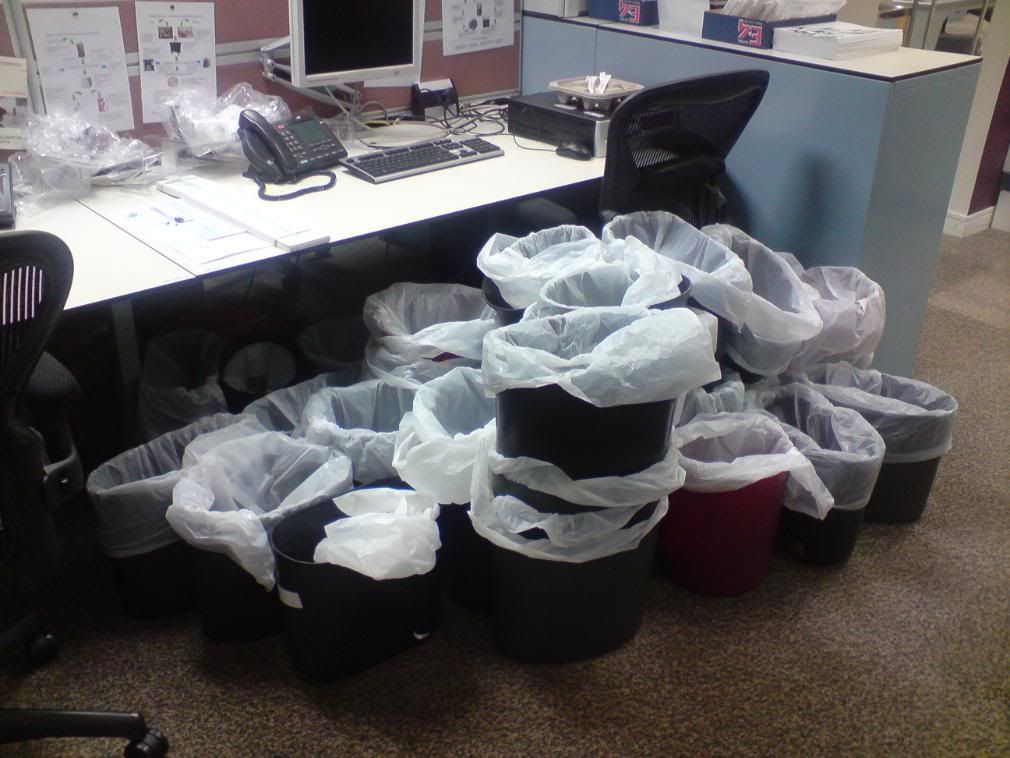
I walked into the office today and found this pile of garbage bins. A young lady who works for our sustainability initiatives had actually come into the office over the weekend, and then removed every garbage bin leaving aside one for every two people.

Of course, the individual offices still had one. I can see how the equation will work, if you have a smaller garbage bin, you will be forced to think about what and where you throw your stuff. Otherwise you will end up with a full bin by noon and then have banana skins piled up on your desk. Not good.


Click on the picture to get a bigger resolution.

Technorati Tags:

Wednesday, February 13

How should heavy-duty trucks be taxed?

ScienceDirect - Journal of Urban Economics : How should heavy-duty trucks be taxed�

This is an interesting paper. Heavy Duty Trucks have a special relationship to roads, pollution, transport, economics, taxation, and the like. In all cases, their impacts are way beyond what you would normally consider for a transport unit (as normally considered, such as a car!), so that is why you have differential taxation on trucks, mainly using road taxes. But this paper develops a framework for taxes on fuel. Quite an interesting one, but I am afraid the political courage to impose taxes on fuel would simply not be there.

This paper develops and implements an analytical framework for estimating optimal taxes on the fuel use and mileage of heavy-duty trucks in the United States, accounting for external costs from congestion, accidents, pavement damage, noise, energy security, and local and global pollution. The analysis allows for endogenous fuel economy, increased auto travel in response to reduced truck congestion, and distinguishes driving by truck type and region. We estimate the optimal (second-best) diesel fuel tax at $1.12 per gallon and implementing it increases welfare by $1.34 billion per annum. Optimizing over both fuel and mileage taxes, and differentiating mileage taxes by vehicle type and region, yields progressively higher welfare gains. The most efficient tax structure involves a diesel fuel tax of 69 cents per gallon and charges on trucks that vary between 7 and 33 cents per mile; implementing this tax structure yields estimated welfare gains of $2.06 billion.

All this to be taken with a grain of piquant salt!!!

Sea of Garbage

Watch and worry a

bout the planet!

sea-of-garbage-2.jpg


Tuesday, February 12

On a smoggy day, you cannot see China

This was gobsmacking! That's smog, that dirty greyish cloud over very large parts of china is smog!

Satellite image showing polluted air covering southeastern China

All this to be taken with a grain of piquant salt!!!

Monday, February 4

The Recycling Myth

An interesting view on re-cycling and something that I agree with. One has to consider the whole cost value chain, just like I talked about in terms of food miles here. Add up all the costs!!!. So when people talk about recycling, remember somebody has to pay, it will be the (past, current or future) shareholder, taxpayer etc. So in this case, it is at the expense of quality time that the government is hitting recycling targets.

Read and wonder!

All this to be taken with a grain of piquant salt!!!

Saturday, January 26

The British Sense of Humour on the backside of a truck


I was driving around in pouring rain in London when I got stuck behind this Waitrose truck.


So manoeuvred closer to the truck and noticed the writing on the bottom.

I noticed the writing on the bottom. It says, I'm a veggie van. I drink biodiesel


And on the other panel, it says, I dont like fast food so I am speed limited.

Brilliant, absolutely brilliant understated humour. Loved it.

Monday, December 3

Green IT - some very interesting things happening out there

Now I wouldnt dream of understanding 90% of what they are saying in here but seems like they are doing well with their Green IT business. Much more to be done! :)

Title: Turning Green
Feature:
Date: 1 November 2007

As banks make their IT more energy efficient, new opportunities emerge.
By Joe Morgan


Unless you have been living on another planet, you know that environmental issues have been thrust into the center of the political debate on both sides of the Atlantic. Banks and major corporations can no longer afford to pay lip service to the concerns of environmental activists. Former US vice president and environmental campaigner Al Gore's acclaimed book and documentary, An Inconvenient Truth, has made the dire consequences of global warming part of the mass consciousness.

The fact that green issues have become a hot political topic has not gone unnoticed on Wall Street. Lehman Brothers in March established an internal Global Council on Climate Change led by Theodore Roosevelt IV, great-grandson of the US president. JPMorgan Chase has built up a "renewable energy portfolio" which comprises about $1 billion of equity investments in 26 wind farms. Bank of America has pledged to not only cut back its own emissions by 7 percent but also to reduce greenhouse gas emissions from its client activity-specifically, from its investments and loans to energy and utility companies-by 7 percent.

Also turning to green, Citigroup, which plans a 10 percent reduction in its greenhouse gas emissions by 2011, earlier this year announced a $1 billion investment in the Clinton Climate Initiative (CCI), a foundation set up to tackle climate change.

Shareholder activism, campaigns by environmental groups and influential reports such as the UK government-commissioned Stern Review on the Economics of Climate Change are prompting banks to cut down on carbon emissions and implement eco-friendly policies.

GOING AFTER THE GREEN

Bob Giffords, an independent analyst and consultant for the European banking sector, says the tide of environmentalism sweeping across capital markets firms is not just motivated by a desire to save the planet. Green banking also presents profitable opportunities for financial institutions. "Where there is a problem to be faced, there is money to be made," says Giffords. "Politicians are finding that they are pushing on an open door when they pressure banks to do something [about environmental issues]. The banks are beginning to see good commercial reasons for wanting to pursue these policies."

Nowhere is this more apparent than in the push to make datacenters more energy-efficient, which plays a central part in banks' green IT strategies. Banks need little persuading to reduce power consumption in datacenters, already creaking under the strain of providing high levels of computational power. According to IBM, many major financial institutions in the City of London are experiencing "thermal issues"-which can result in servers breaking down as a result of overheating. New York City's power grid is also under increasing pressure to supply Wall Street firms with the power they need, say analysts at Massachusetts-based technology research firm Forrester.

Server energy use doubled between 2000 and 2005, says California-based microprocessor vendor Advanced Micro Devices (AMD). A survey published earlier this year found that in 2005, total datacenter electricity consumption in the US, including servers, cooling and auxiliary equipment, totaled about 45 billion kilowatt hours, resulting in utility bills of about $2.7 billion. Total datacenter power and electricity consumption for the world costs $7.2 billion annually, according to AMD.

"Besides being good citizens, banks actually need to optimize their carbon footprint. For example, in datacenters, as hardware capital costs go down, energy costs become significant. This is particularly the case with grid technology, which has serious power and cooling challenges," says Giffords. "A modest grid might have 1,000 or more CPUs/cores. Cram it all into a few racks and you get a lot of heat. The largest grids across multiple centers might now be from 10,000 to 20,000 nodes or greater, with forecasts rising to much higher levels. Inevitably, that will eat up power and generate heat."

COSTS ON THE RISE

Of every dollar spent on computer hardware, about 50 cents is spent on energy, according to analyst firm IDC. This is expected to increase to 71 cents over the next four years. And some of that is wasted. A report last year from Santa Fe-based IT consultancy Uptime Institute found that US datacenters were cooled nearly twice as much as necessary.

Banks and corporations are showing signs of moving toward more energy-efficient practices. A report from San Francisco-based datacenter manager Digital Reality Trust earlier this year found that many firms' "detailed" green datacenter strategies include using recycled materials, efficient power usage, purchases of renewable power such as wind and solar energy, high-voltage alternating current system enhancements, power generation on site using fuel cells and gas engines, and using carbon credits to offset the level of datacenter by-products.

"Green energy-efficient datacenter trends have been adopted more quickly and more deeply than previously believed. Even for people who have been tracking green IT trends closely, many of the report's metrics will be surprising," says Jim Smith, vice president of engineering for Digital Reality Trust.

DESIGN INNOVATIONS

Firms are taking their strategies beyond computers and servers-the primary focus of green initiatives in the past-and into the domain of facility design and operations. Some capital markets firms are even relocating their datacenters next to flowing water, since water is a better coolant than air.

"Our energy consumption is roughly a third heating, a third cooling and a third lighting," says Jon Williams, head of group sustainable development at HSBC. "We have a specific datacenter strategy aimed at designing the buildings in a way that makes them as energy efficient as possible."

The London-based global banking giant will invest $95 million in its global energy efficiency program over the next five years in a drive to reduce its energy consumption and make it more efficient. Vendors like IBM, Hewlett-Packard, and Sun Microsystems are eager to offer solutions that reduce power consumption in datacentrers. "The energy issue is a long-term problem," says Rich Lechner, vice president, IT optimization and system software at IBM. "But the idea of actively managing energy has just emerged over the past six months."

IBM's "Project Big Green" for datacenters was launched earlier this year. The initiative includes a new global "green team" of more than 850 "energy-efficiency" architects. IBM says it has received strong uptake from financial institutions, though vendor officials decline to name them.

"We help clients redesign their datacenters, either from scratch or in some cases customers are looking to upgrade their datacenter because it is eight years old and not able to handle the density of computing that we have today. Or they may just be looking at retrofitting certain elements," explains Lechner.

The project comprises five steps. First, IBM evaluates an organization's facilities and proposes an appropriate solution before building or updating an energy-efficient datacenter. Virtualization and special purpose processors are then installed across a firm's IT infrastructure along with power management software and liquid cooling solutions, both in and outside of the datacenter. IBM estimates that its clients can cut energy consumption by almost half on an average 25,000 square foot datacenter. This can be done by consolidating x86 servers for Windows and Linux, or Unix servers, to other platforms such as IBM servers with the vendor's Power processors.

To help achieve its aim of reducing corporations' energy consumption, IBM is tapping into cell processor technology used in computer game consoles such as Xbox 360 and PlayStation 3, which are more efficient at carrying out certain applications than conventional quad-core processors. "Special logic built into cell processors makes them ideal for certain classes of calculations. It can be 50 times more efficient than generic Intel processors. A customer can deploy applications on one-fifth the number of systems that would normally be required." IBM says capital markets firms in the US and Europe are using cell processor technology to more efficiently perform functions that require high amounts of computational power, such as Monte Carlo simulations for complex calculations for structured derivatives products.

SHIFTING THE LOAD

IBM uses virtualization technology-where servers host multiple operating systems and applications-to enable firms to identify "hot spots" within their datacenter network. Banks can then shift applications between datacenters to lightly used machines. "Organizations can move workloads among datacenters around the world in response to a power shortage or potentially to take advantage of low utility rates across time zones. As the sun sets, the utility rates will decline in one location. Work can then be moved from other financial centers to exploit this lower rate of usage," Lechner explains.

Capital markets firms are also turning to virtualization software offered by technology vendors like VMware and Virtual Iron to reduce datacenter use. Credit Suisse, which has begun evaluating IT managers according to how well they have helped reduce energy use, has implemented a far-reaching virtualization initiative using technology from vendors such as VMware to achieve an average 15-to-one compression ratio in server use.

David Reilly, head of technology infrastructure services at Credit Suisse in New York, says: "Utilization is up. Power consumption growth has been reduced. The need for ever more datacenter real estate is slowing and time to market for our application developers is improved because provisioning lead times are better with virtualization."

However, not all eco-friendly measures utilize cutting-edge technology. Using blocks of ice to provide air conditioning in buildings first emerged in Florida in the 1800s, when a physician blew air over ice to cool hospital rooms. The practice in vogue as firms attempt to reduce the emissions produced by conventional air conditioning systems.

COOL AS ICE

Credit Suisse this year installed an ice cooling system to cut down on emissions from its offices at the historic MetLife Building in New York City. The firm must cool 1.9 million square feet of office space in the tower. Three main cooling rooms, which house chilling machines and 64 tanks that hold 800 gallons of water each, are housed in the basement of the building. The system is equal to planting 1.9 million acres of trees to absorb carbon dioxide from electrical use for a year, according to the New York State Energy Research and Development Authority. Goldman Sachs and Morgan Stanley have installed similar ice cooling systems.

"If you take the time to look, you can find innovative ways to be energy efficient, be environmental and sustainable," says William Beck, the head of critical engineering systems at Credit Suisse in New York.

But the green banner can also be waved when implementing far less popular policies. For example, reducing air travel can be labeled as a green initiative when it may just be about optimizing costs. "There may also be serious operational risks in having many executives in the air all the time," says Giffords.

The global reach of major financial institutions undoubtedly swallows up a sizeable amount of energy consumption. Organizations such as HSBC-which consumes 2 billion kilowatt hours of energy a year, three-quarters of which stems from electricity usage along with fuel and air travel-are eager to highlight the steps they take to implement green policies. For example, HSBC has installed NightWatchman software in its offices, which reduces the power consumption of inactive PCs after 7 p.m. The escalators in the banking giant's London headquarters are also programmed to slow down during off-peak times. Even the logo at the top of the building is dimmed until evening falls.

HSBC is also using technology to cut down on air travel. The banking giant has installed Cisco TelePresence, video conferencing technology that simulates the environment of a real board room to such an extent that participants can see one another's eye color. HSBC held its first boardroom meeting this summer using the video conferencing technology, which saved executives from globetrotting to the bank's headquarters in London's docklands.

Deutsche Bank also uses video conferences and conference calls to reduce its carbon footprint. The German bank has also undertaken a series of environmentally friendly initiatives, including regularly improving technology to make energy use more efficient, campaigns to make staff aware of reducing energy consumption and purchasing "energy efficient" office equipment.

Hanns-Michael Hoelz, global head of sustainable development at Deutsche Bank in Frankfurt, says the bank has made efforts to promote environmentally friendly investing. DWS Investments, the fund management subsidiary of Deutsche Bank, offers private and institutional investors "sustainability orientated" investment opportunities, which include its DWS Klimawandel (Climate Change) fund. "Investors can thus decide whether they want to include both traditional investment criteria and ecological, social and sustainability-orientated aspects in their investment strategy," says Hoelz.

REPUTATIONAL RISK

Investing in eco-friendly projects is also gaining traction among capital markets firms. "We are now one of 54 banks covering over $50 billion of project lending a year. That is about 85 percent of the global project finance market. We lend directly to a project and our repayment comes from the cash flows of that project. So we could be financing a gas-powered power plant or a wind farm. You have a direct connection with the project, which means you can do environmental due diligence directly on the project quite specifically," explains Williams.

However, lending to environmentally friendly projects accounts for just 1 percent to 2 percent of HSBC's total loans and Williams says that the bank's environmentally friendly policies are influenced by the reputational risk of being associated with environmentally unfriendly practices. "It doesn't take much bad news around the brand for that brand's value to start eroding," he says.

The push toward environmentally friendly policies at capital markets firms is influenced by a host of dynamics, trying to save the planet being just one of them. Some scientists have predicted that many of the world's major cities could be flooded by the end of the century as a result of global warming. "Think of it this way: Climate change will absorb huge amounts of capital both to reduce the industry's environmental impact and eventually to rebuild flooded cities," says Giffords. "Mobilizing capital is what banks do best." And that means capital markets firms will play a central role in dealing with the new opportunities and threats that come with the risk of environmental catastrophes.


Source:

© Incisive Media Investments Ltd 2007


All this to be taken with a grain of piquant salt!!!

Thursday, November 22

Green IT - What are the investment banks doing?

A very good article on how Investment Banks are working on Green IT!. Usually the same culprits across the board.

  • Power consumption
  • Lghting
  • Cooling
  • Re-use and recycle of equipment
  • CO2 emissions
  • Electronic communications over physical travel
  • Charitable exercises

All this to be taken with a grain of piquant salt!!!