Showing posts with label Hinduism. Show all posts

Monday, August 29

An Ascetic on an Emaciated Nag

I came across this photograph of an Ascetic on an Emaciated Nag in a book in the British Library.

The artistic elements of the painting - well leave that aside for the moment, but this was so brilliantly executed that all I could do was to stare at it. Just look at it, the artist has managed to draw out the typical Hindu ascetic and that too riding a nag! absolutely amazing. 


Monday, June 20

Those who pray, those who work, those who fight - Medievalists.net

There's the Hindu caste system. Where everybody is divided into castes based upon what you do. And then a bewildering array of sub castes. It's all rubbish of course but still exists I'm afraid. I read about how Dalits, the untouchables and lowest caste people were sold off as slaves by upper classes to the Dutch in the 18th century in India. Tragic. 
But it was curious to read how this kind of work/profession based societal classification and how it was in the Middle Ages in England and France eh? It took a revolution to remove it in France. You still have it in England but hopefully the class based society will get removed soon without a revolution. 
Have a lovely day kids. 
Love 
Baba


Those who pray, those who work, those who fight - Medievalists.net
http://www.medievalists.net/2016/01/31/those-who-pray-those-who-work-those-who-fight/
(via Instapaper)

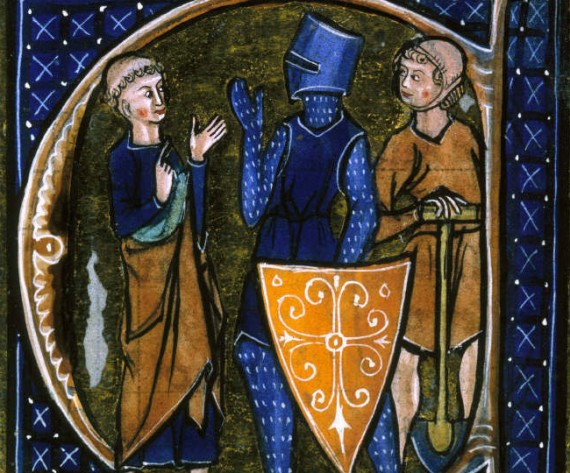
When people first start learning about the Middle Ages, one of the first concepts they are told was that medieval society was divided into three groups – those who pray, such as priests and monks; those who work, like farmers; and those who fight, the warrior class. How did this idea get started and what does it actually mean?

Cleric, Knight and Workman representing the three classes – from British Library Ms Sloane 2435, f.85 '
The concept of the three orders for society is not something you find in the Bible, or in classical sources. The closest thing that to it comes from the seventh-century encyclopedia writer Isidore of Seville, who makes a short reference to the Romans having divided themselves into three groups: senators, soldiers and plebeians.
It seems that our first reference to the idea of three orders comes from a curious source – an Old English translation of Boethius' The Consolation of Philosophy. This work was written by King Alfred the Great (probably with a team of scholars to help him) in the late-ninth century, and he often included his own commentary. It is here that you can find this statement:
I wished for tools and resources for the task that I was commanded to accomplish, which was that I should virtuously and worthily guide and direct the authority which was entrusted to me. You know of course that no-one can make known any skill, nor direct and guide any enterprise, without tools and resources; a man cannot work on any enterprise without resources. In the case of the king, the resources and tools with which to rule are that he have his land fully manned; he must have praying men, fighting men and working men. You know also that without these tools no king may make his ability known. Another aspect of his resources is that he must have the means of support for his tools, the three classes of men.
In his article, "The 'Three Orders' of society in Anglo-Saxon England" Timothy Powell explains some of the thinking behind this statement:
Alfred's formula is descriptive rather than prescriptive. He is not instructing the three orders in their duties, he is doing the reverse; he is meditating on his own duty to the effect that it is incumbent upon the king to ensure the three orders have the wherewithal they need to fulfil their functions. Alfred does not dwell on the theme; he mentions it as an aside. The point of the passage is not social commentary but a reflection on how he, King Alfred, should exercise his talents to ensure that his memory not be forgotten.

Saturday, April 30

Which is the strongest religion?

So to determine which religion is the strongest, subject the adherents to bench press experiments. I was laughing helplessly when i read this research paper. Only in India.


For the purpose of the study Two hundred ten (210) men from Buddhist monastery, Vaisanab and Tantrik(seventy from each group), age ranged from 30 to 35 years were selected randomly as the subject for the study from Uttar Pradesh, India. All the subjects belong to three different religion of India. The subjects were categorized into three groups, namely group (A) Himalayan Buddhist (B) Vaisanabs and (C) Tantriks. All the subjects chosen for the study had completed at least five years in their respective religious field. To measure Upper Body Muscular Strength YMCA Bench Press Test was used. To compare the significance difference in mean One-Way analysis of variance (ANOVA) with LSD Post Hoc test was employed at 0.05 level of significance and it was found significant for all the three groups. In Post Hoc compassion of bench press test Buddhist and Tantric, Buddhist and Vaisanab and also Tantric and Vaisanab have significance differs among each other’s.

Saturday, January 16

A Buddhist tale of Draupadi

Now this was a very curious retelling of a part of the Mahabharata. As you may recall son, draupadi is usually considered to be a wronged woman despite the polyandry aspects in the Hindu version of the Mahabharata, the longest poem in the world. And people get excited about the Iliad. Bah. 
But here's a fascinating alternative retelling of her tale from a Buddhist perspective. Now you've got to be careful. You see, these myths and legends and stories and Puranas also had a huge political overtone. If you were a Buddhist raja with Hindu subjects, then you want to shove out stories which tear down your idols and gods. So this kind of a story would be quite common. And vice Versa. There have been countless episodes of such literary looseness. 
But quite interesting to read though. If you get a chance son, do read the full Mahabharata. After all, that's the story where Karn is based. You should know it. Hope you've read mrityunjaya by now but the Mahabharata is the broader story. Absolutely fascinating :) will tell you why mamma and I named you after this amazing character. 
Love
Baba


A Buddhist tale of Draupadi
https://storyofstoryinsouthasia.wordpress.com/2015/08/28/a-buddhist-tale-of-draupadi/
(via Instapaper)

by Naomi
So, in actual fact Draupadī is not one of the shared characters that features in my research. (More on what is going in my project monograph shortly.) But while looking at some jātaka mentions of Kṛṣṇa, Rāma, et al, I came across the reference to Draupadī (there called Kaṇhā) in the Kuṇāla Jātaka. The verse, which is fairly well known, holds up Draupadī as an example of the wickedness of women, since despite having five husbands (listed with their names familiar from the epic) she still lusted after a sixth, a hunchback dwarf no less. What seems to be less known is that, hidden in the word commentary to the verses, and thus not included in the translation of Cowell et al, is a fuller prose narrative of Draupadī's misdemeanours. Although not strictly speaking of relevance to my current research, I couldn't resist bashing out a draft translation of this story, and share it with you here in case it is of interest, or entertainment value!
I translate the version as it appears in the CSCD edition on http://www.tipitaka.org.
Draupadi in the Kunāla Jātaka (536)
"I have seen, friend Puṇṇamukha, Kaṇhā of double-parentage and five husbands, set her mind on a sixth man, one who was barrel-like/headless (kabandha) and crippled."
And here too there is a further saying:
Kings A(tha)jjuna, Nakula, Bhīmasena, Yudhiṭṭhila and Sahadeva:
These were her five husbands. Yet the wife wished for more and got up to no good with a hunchbacked dwarf.
… [ some intervening verses ] …
[Commentary to the verses:] "I have seen" means: It is said that in the past Brahmadatta the king of Kāsi, with his army, seized the kingdom of Kosala and had the king of Kosala killed. He seized his chief wife, who was pregnant, and went to Vārāṇasī. There he took the chief wife as his own, and in due course she gave birth to a daughter. Now the king had no natural daughter or son, so he was pleased and said, "My dear, take a boon." She accepted it and set it aside.
Now that princess was given the name "Kaṇhā", and when she was of age her mother said to her, "My dear, your father gave me a boon, and I took it and set it aside. You should do as you please with it." She said to her mother, having no shame or remorse for her great lust, "Mama, there is nothing else lacking for me: hold a svayamvara ('self-choice') for the purpose of getting me a husband." She addressed the king. The king, having said, "She should take a husband according to her liking," had the svayamvara proclaimed. A great many men assembled in the royal courtyard, all adorned with ornaments. Kaṇhā took a basket of flowers and stood at the highest window, looking out, but she did not like anyone.
At that time Ajjuna of the family of King Paṇḍu, and Nakula, Bhīmasena, Yudhiṭḥila and Sahadeva, these five sons of King Paṇḍu, having learnt the crafts in the presence of a world-famous teacher in Takkasilā, were wandering around [thinking] "We will understand the conduct in the country." They entered Vārāṇasī and heard the hullabaloo inside the city. Enquiring, they found out what was happening. "We too will go there!" Looking like golden statues they went there and stood in a line. Seeing them, Kaṇhā became enamoured with all five of them, and having thrown garlands over all five of their heads she said, "Mama, I desire these five men." She again went to speak to the king. The king, though he was not pleased, because he had given the boon did not say "I will not have this!" He asked, "Of which family are you the sons?" and learning that they were the sons of King Paṇḍu he paid them honour and gave them their wife.
She, in a seven-storey palace, was filled by the power of lust. And she had one servant who was humpbacked and crippled. Having associated, because of her lust, with the five princes, after they had gone she seized the opportunity and, thoroughly inflamed, she sinned with the hunchback. Speaking with him she said, "There is nobody as dear to me as you. Having had the princes killed, I will have your feet annointed with the blood from their throats!" But to the others, when it was time for intercourse with the older brother she said, "You are dearer to me than these four. I would even abandon my life for you. I will have the kingdom given to you alone after my father's death." And when it was time for intercourse with the others it was the same plan. They were very pleased with her: "She is devoted to me, and the rulership is near."
One day she became ill, and they attended upon her, one sitting stroking her head, the others each taking a hand or foot, and the hunchback sat at her feet. While Prince Ajjuna, the oldest brother, was stroking her head, [in order to say]: "There is nobody dearer to me than you. While I live, I will live for you/as yours. When my father passes away I will have the kingdom given to you!" she favoured him by giving a sign with her head, while to the others she gave a sign with her hands or feet. And to the hunchback she gave a sign with her tongue: "You are so dear to me, I live for you!" And so they all understood the matter from her signs and what she had said to them before. The rest of them each understood only the sign given to himself, but Prince Ajjuna saw the movement in her hands, feet and tongue and thought, "Just as for me, she has given a sign to these others as well, and there is even intimacy between her and the hunchback." He took his brothers outside and asked, "Did you see the one with five husbands display a movement of the head for me?" "Yes, we saw." "Do you know the reason for this?" "No, we do not know." "This here is the reason. But do you understand the reason for the signs she gave to you with her hands and feet?" "Yes, we know that." "It is the same reason for me too. And do you understand the sign given with a movement of her tongue, to the hunchback?" "No, we do not understand that." Having explained this to them he said, "She has sinned with him." And though they did not trust him they summoned the hunchback and questioned him, and he explained the whole matter.
Having heard his words they had no more desire for her: "Oh women are evil and devoid of virtue! Having forsaken men like us, handsome and of good birth, she has done bad deeds with a hunchback of this bodily form and of contemptible family! What wise person would take pleasure in a woman, shameless and evil?" They reproached womenfolk in many ways, then, saying "Enough for us of the household life!" the five men entered the Himalayas, renounced, and set to work on kaṣina [meditations]. When their lives were over they went according to their kamma. And Kuṇāla, king of the birds, was at that time Prince Ajjuna.

Friday, December 25

Has the Kalki avatar already been born in the form of Prophet Mohammad or Mirza Ghulam Ahmad?

things that you find out while browsing the interwebs. So I was looking for some more information on Kalki Avatar after seeing this amazing illuminated manuscript in the British Library. It showed the 10 avatars of Vishnu. So I went looking for more information on Kalki. Quite an interesting story, but then my attention was diverted by a line at the bottom of the wikipedia page where it said that Mirza Ghulam Ahmad, the founder of the Ahmadi Sect of Islam claimed to be the Kalki Avatar. I quote,

"Mirza Ghulam Ahmad claims “Krishna... appeared as a Prophet in India... I am the Krishna whose advent the Aryas are awaiting in this age. I do not make this claim on my own, but God Almighty has repeatedly disclosed to me that I am the Krishna - King of the Aryas - who was to appear in the latter days...” (TEOI, V4, P83)

and then there was this entire debate about Prophet Mohammad, of all places, in Quora. 

Reminds of the time that I managed to wind up somebody on a mailing list when I said that given that the God that Jews, Christians and Muslims worship is the same (although some people quibble about it, see here and here), then Judaism, Christianity and Islam are all different sects. Not such a good idea. 

anyway, it was quite interesting to read the Islamic links to Kalki...

Wednesday, October 7

15 Most Amazing Predictions for Kali Yuga from the Bhagavata Purana

Kannu

I've been reading and blogging about the bhagwat Purana now for some years. Need to pick that up. It's the fattest single book in our library. That's the other claim to fame. Puranas are collection of stories about Hindu deities. Remember when I did the laxmi puja? And we acted out the laxmi story? I got that from the laxmi Purana. There are about 40 of these Puranas. Written from about 1500 down to the 18th century. These aren't single stories. They overlap. They don't have a coherent theme. Will be written by multiple authors. They will be written and overwritten over hundreds of years. Their character changes due to political changes. Changes in language. One scribe could have written one in bhrami which got translated into Tamil and back into Marathi or Sanskrit and and and. A veritable palmiset. 

But they are fascinating documents son. If you ever want to explore hinduism, start with the Puranas. Or even the Upanishads. In my experience, they are the most powerful and evocative philosophical tracts ever written compared to pretty much every other religion or ideology or philosophical school of thought. The ancient upanishad authors were grappling with esoteric concepts such as happiness, love, worship, life, universe much before the aristotles or socrates or platos of this world were even twinkles in their parental eyes. 

Still this article is interesting. The date of the bhagwat Purana given is rubbish. This was written around 1200 years back. And you can also quibble about the Sanskrit translation son. But it's good enough to think about. 

We are missing you :) 

Hope you're having a great time son. And tasting Spanish food and wine. Don't eat rotgut burgers and drink crappy beer. Drink the wine and taste the glorious food there :) search out the smaller hostelieries. Watch where the locals go to eat. Not the tourist traps. That's the key. Ask the waiter or concierge about which restaurant did he take his girlfriend or family to last month :) 

Love

Baba


15 Most Amazing Predictions for Kali Yuga from the Bhagavata Purana
http://www.indiadivine.org/news/articles-on-hinduism/15-most-amazing-predictions-for-kali-yuga-from-r711
(via Instapaper)


Please help spread hinduism by sharing these articles on facebook:

Posted Image

In the last canto of the Bhagavata Purana there is a list of predictions and prophecies about the dark times for the present age of Kali Yuga. The following 15 predictions, written 5,000 years ago by sage Vedavyasa, are amazing because they appear so accurate. Despite the negative tone of these prophecies, there is still one bright spot for all of us, which is mentioned at the end.

Prediction 1:

Religion, truthfulness, cleanliness, tolerance, mercy, duration of life, physical strength and memory will all diminish day by day because of the powerful influence of the age of Kali.

Thursday, December 4

The Criminalization of Abortion in the West

this was an interesting book review that I read today…

I quote

The argument of this book is that abortion, including miscarriage by assault and infanticide (p. 5), came to be treated as a “crime” in the modern sense — “wrongdoing requiring lawful retribution from the hands of publicly appointed officials” (p. 4) — in the period 1140–1250 (pp. 1–2). The introduction sets out this thesis and the crucial problematic: when do the sources for law and society in the West first conceptualise a clear distinction between crime on the one hand and wrongdoing that is not criminal, such as “tort” or sin, on the other? It is a debate that has long engaged scholars of medieval canon and English common law.

a fascinating argument. the author talks about abortion being criminalised in the mid 12th century with the rise in the emergence of universities and jurisprudence studies.

As for myself, i am firmly of the belief that its the choice of the mother whether or not to abort. And yes, whilst you can quibble over whether or not at which time period the baby becomes viable, the fact remains that the mother is responsible and accountable. So end of. But curious how this is all religiously mandated. For example, you wouldn't find any of these issues relating to non Judeo Christian backgrounds, at least not that I have read about it. If you believe in the cycle of life and rebirth, then when you die is merely a waystation…fascinating…

this book goes on my to be read pile :)

Wednesday, July 2

Do you meditate differently when you are a Hindu Vs a Buddhist?

Apparently you do! See this fascinating paper.

The most diffuse forms of meditation derive from Hinduism and Buddhism spiritual traditions. Different cognitive processes are set in place to reach these meditation states. According to an historical-philological hypothesis (Wynne, 2009) the two forms of meditation could be disentangled. While mindfulness is the focus of Buddhist meditation reached by focusing sustained attention on the body, on breathing and on the content of the thoughts, reaching an ineffable state of nothingness accompanied by a loss of sense of self and duality (Samadhi) is the main focus of Hinduism-inspired meditation. It is possible that these different practices activate separate brain networks. We tested this hypothesis by conducting an activation likelihood estimation (ALE) meta-analysis of functional magnetic resonance imaging (fMRI) studies. The network related to Buddhism-inspired meditation (16 experiments, 263 subjects, and 96 activation foci) included activations in some frontal lobe structures associated with executive attention, possibly confirming the fundamental role of mindfulness shared by many Buddhist meditations. By contrast, the network related to Hinduism-inspired meditation (8 experiments, 54 activation foci and 66 subjects) triggered a left lateralized network of areas including the postcentral gyrus, the superior parietal lobe, the hippocampus and the right middle cingulate cortex. The dissociation between anterior and posterior networks support the notion that different meditation styles and traditions are characterized by different patterns of neural activation.

Whilst I do meditate, I am not really sure if I know the difference between these two modes, do tend to work to the Hindu mode while starting in the Buddhist mode. Does that make sense?

but absolutely fascinating, we are different…

Tuesday, January 28

Religion, social class, and entrepreneurial choice

Fascinating

While considerable concern has emerged about the links between religion and economic growth, little is actually known about how religion and social class impact the decision making of individuals. Using institutional theory and social dominance theory, this paper examines the influence of religion and social class on individuals' occupational choices. Based on a large-scale database from India, this paper finds that while some religions are relatively conducive to self-employment, some others have a negative impact on self-employment choices. Furthermore, individuals belonging to social classes that are lower in the social hierarchy are less likely to be self-employed. The role of both religion and social class in influencing the likelihood of choosing self-employment suggests an important link between religion, social class, and occupational decision-making.

Highlights

• We examine the role of religion and social class on occupational choice.
• We find that religions like Islam and Jainism are more favorable for self-employment.
• We find that Hindus are less likely to be self-employed compared to others.
• Individuals belonging to social classes lower in the social hierarchy are least likely to be self-employed.

The following regression models are estimated to link occupational choice with religion and social class:

equation(1)

Y=α+β1*Religion+β2*Education+β3*Demographics+β4*Wealth+β5*Location+β6*Industry+ε1Y=α+β1*Religion+β2*Education+β3*Demographics+β4*Wealth+β5*Location+β6*Industry+ε1

equation(2)

Y=c+δ1*SocialClass+δ2*Education+δ3*Demographics+δ4*Wealth+δ5*Location+δ6*Industry+ε2

Let me quote the operative paragraph in here

While India is rich in diverse religions, some of them, such as Islam and Jainism, are more conducive to self-employment. The institutional profile associated with Islam strongly supports entrepreneurial activity. For example, Islamic banking models, based on the Koranic principles of risk sharing (Khan, 1996), may encourage even risk-averse Muslims to become self-employed. In Jainism, principles of self-reliance and benevolence to business (Caillat, 1987) give rise to an institutional profile that is conducive to self-employment. By contrast, Hinduism inhibits self-employment by shaping an institutional profile that is not conducive to self-employment choices. The normative pressures on Hindus to choose occupations based on the caste of their birth (Hutton, 1946), and the cognitive beliefs that do not support proactively changing thestatus quo ( Singer, 1966 and Tripathi, 1992) may discourage self-employment in Hinduism.

Although Christianity is associated with an institutional profile that is conducive to self-employment, it does not have a positive effect on self-employment in the Indian context. This result may be attributed to the large number of individuals from the Hindu backward classes converting to Christianity (Henderson, 2002). Thus, the estimated effect of the Christian religion in India shows the mixed effects of prior learning and new beliefs particularly with regard to the normative and cognitive dimensions of the two religions. The estimated effects of Buddhism and Sikhism show that the followers of these two religions are not different from Hindus when it comes to their self-employment choices. These results are attributable to the close relationship that Buddhism and Sikhism have with Hinduism. The founders of both the religions were Hindus and, Buddhism, in particular, shares many of the Hindu values and beliefs (

Maybe as public policy, the Indian government may want the Hindus to convert to Jainism. Or Islam. But as the example of Christianity shows, this will not work as despite conversions to another religion, they are still not being self employed.

Curious, eh?

Monday, October 14

Indian Nationalist Art History and the Writing and Exhibiting of Mughal Art, 1910–48

Art is usually the handmaiden of campaigns and ideologies. Think about all the songs, paintings, architecture, sculpture, poems by various great artists.

I just read this poem by Tyrtaeus of Sparta who after the First Messian War, encouraged his fellow male citizens to go forth and do battle.

Frontiers
You should reach the limits of virtue
before you cross the border of death.

Courage
For no man ever proves himself a good man in war
unless he can endure to face the blood and the slaughter,
go close against the enemy and fight with his hands.

Here is courage, mankind's finest possession, here is
the noblest prize that a young man can endeavor to win,
and it is a good thing his city and all the people share with him
when a man plants his feet and stands in the foremost spears
relentlessly, all thought of foul flight completely forgotten,
and has well trained his heart to be steadfast and to endure,
and with words encourages the man who is stationed beside him.

Here is a man who proves himself to be valiant in war.
With a sudden rush he turns to flight the rugged battalions
of the enemy, and sustains the beating waves of assault.
And he who so falls among the champions and loses his sweet life,
so blessing with honor his city, his father, and all his people,
with wounds in his chest, where the spear that he was facing has transfixed
that massive guard of his shield, and gone through his breastplate as well,
why, such a man is lamented alike by the young and the elders,
and all his city goes into mourning and grieves for his loss.
His tomb is pointed to with pride, and so are his children,
and his children's children, and afterward all the race that is his.

His shining glory is never forgotten, his name is remembered,
and he becomes an immortal, though he lies under the ground,
when one who was a brave man has been killed by the furious War God
standing his ground and fighting hard for his children and land.

But if he escapes the doom of death, the destroyer of bodies,
and wins his battle, and bright renown for the work of his spear,
all men give place to him like, the youth and the elders,
and much joy comes his way before he goes down to the dead.

Aging, he has reputation among his citizens. No one
tries to interfere with his honors or all he deserves;
all men withdraw before his presence, and yield their seats to him,
the youth, and the men his age, and even those older than he.

Thus a man should endeavor to reach this high place of courage
with all his heart, and, so trying, never be backward in war.

To the Soldiers; after a defeat
Now, since you are the seed of Heracles the invincible,
courage! Zeus has not yet turned away from us. Do not
fear the multitude of their men, nor run away from them.
Each man should bear his shield straight at the foremost ranks
and make his heart a thing full of hate, and hold the black flying
spirits of death as dear as he holds the flash of the sun.

You know what havoc is the work of the painful War God,
you have learned well how things go in exhausting war,
for you have been with those who ran and with the pursuers,
O young men, you have had as much of both as you want.

Those who, standing their ground and closing their ranks together,
endure the onset at close quarters and fight in the front,
they lose fewer men. They also protect the army behind them.
Once they flinch, the spirit of the whole army falls apart.
And no man could count over and tell all the number of evils,
all that can come to a man, once he gives way to disgrace.
For once a man reverses and runs in the terror of battle,
he offers his back, a tempting mark to spear from behind,
and it is a shameful sight when a dead man lies in the dust there,
driven through from behind by the stroke of an enemy spear.

No, no, let him take a wide stance and stand up strongly against them,
digging both heels in the ground, biting his lip with his teeth,
covering thighs and legs beneath, his chest and his shoulders
under the hollowed-out protection of his broad shield,
while in his right hand he brandishes the powerful war-spear,
and shakes terribly the crest high above his helm.
Our man should be disciplined in the work of the heavy fighter,
and not stand out from the missiles when he carries a shield,
but go right up and fight at close quarters and, with his long spear
or short sword, thrust home and strike his enemy down.
Let him fight toe to toe and shield against shield hard driven,
crest against crest and helmet on helmet, chest against chest;
let him close hard and fight it out with his opposite foeman,
holding tight to the hilt of his sword, or to his long spear.
And you, O light-armed fighters, from shield to shield of your fellows,
dodge for protection and keep steadily throwing great stones,
and keep on pelting the enemy with your javelins, only
remember always to stand near your own heavy-armed men.

Spartan Soldier
It is beautiful when a brave man of the front ranks,
falls and dies, battling for his homeland,
and ghastly when a man flees planted fields and city
and wanders begging with his dear mother,
aging father, little children and true wife.
He will be scorned in every new village,
reduced to want and loathsome poverty; and shame
will brand his family line, his noble
figure. Derision and disaster will hound him.
A turncoat gets no respect or pity;
so let us battle for our country and freely give
our lives to save our darling children.

Young men, fight shield to shield and never succumb
to panic or miserable flight,
but steel the heart in your chests with magnificence
and courage. Forget your own life
when you grapple with the enemy. Never run
and let an old soldier collapse
whose legs have lost their power. It is shocking when
an old man lies on the front line
before a youth: an old warrior whose head is white
and beard gray, exhaling his strong soul
into the dust, clutching his bloody genitals
into his hands: an abominable vision,
foul to see: his flesh naked. But in a young man
all is beautiful when he still
possesses the shining flower of lovely youth.
Alive he is adored by men,
desired by women, and finest to look upon
when he falls dead in the forward clash.

Let each man spread his legs, rooting them in the ground,
bite his teeth into his lips, and hold.

When you hear this in the Greek as you can feel the rhythm pounding into your feet and speeding up your blood before a battle.

When you come to India, it becomes heavily complicated. What do you do about Mughal Art when you are trying to remove colonialism? Is that Indian? Weren't the Mughals Imperial? they came from outside didn't they? but then they became Indian as the next man. Let me quote the initial paragraphs of the article to explain what happened early part of the last century when Indian Nationhood was being developed.

Writings on Indian modern art and art history have mainly concentrated on the developments that took place in Bengal in the late nineteenth and early twentieth centuries when art and nationalist politics came together under a new conception of Indian culture and civilization, mainly steeped in a refashioning of India's Hindu past.1 From the opening years of the twentieth century, Indian nationalist art history promoted a historical understanding of Indian art in defiance of colonial distortions.2 Ananda Kentish Coomaraswamy and Ernest Binfield Havell, the dominant voices of the new nationalist art history, sought to elevate Indian art by emphasizing its spiritual aspect, especially that of its Hindu legacy. Confronted with the dismissal of the symbolism and historical development of Indian art when judged against Western classical benchmarks, nationalist historians of Indian art aimed at inverting this pattern. But this often happened to the detriment of Mughal art and architecture that had been deemed worthy of praise by colonial officers and scholars, precisely because they perceived it as stemming from outside India.3 In doing so, Coomaraswamy's work drew connections with South East Asia and what was then known as ‘Greater India’, while Havell's effusive prose stressed the Hindu character of all aspects of Indian art.4

By contrast, accounting for the ‘Indianness’ of foreign-born Mughal art and architecture presented a major challenge for nationalist art historians. Mughal art had been incorporated into collections and exhibitions of Islamic art, but its position within Indian art history proved problematic. As Coomaraswamy explained:

Over against the metaphysical bases of Hindu art, the Mughals brought in a cult of personality and historical interests; Mughal painting is like Renaissance in curiosity about the individual, and in its historical preoccupations. … It is just these qualities which have made an appreciation of Mughal art, painting and architecture alike, easy for the modern European. This appreciation, however well justified in itself, nevertheless cannot be regarded as taking the student deep into the heart of Indian life or thought, from which the Mughal court life, except under Akbar, remained essentially aloof.5

The widespread exclusion of the Mughal legacy from major surveys of Indian art such as Coomaraswamy's History of Indian and Indonesian Art (1927) and from the work of foreign scholars such as that of Heinrich Zimmer attested to the influence of religious and philologist interpretations and ideologies. By relying on Sanskrit texts, rather than oral traditions of living Indian artisans or concerns with historical patronage, Coomaraswamy, but also Zimmer and later Stella Kramrisch, all participated in the construction of a Sanskrit canon that formed the basis of a newly conceived Hindu civilization.6 As several historians have commented, one of the achievements of Hindu cultural revivalism is that it succeeded in presenting ‘a civilisation incessantly talked about in terms of the spiritual and the metaphysical, … to be factual and realistic’.7 Crucial in this process were the ‘translations and interpretations of Western oriental scholars [that] were appropriated and fed into India's reconstructed past’.8 This imposed an interpretative framework for Indian art defined partly in exclusion of India's Islamic heritage, and often turned the latter into the very cause of the perceived decadence and corruption of Hindu civilization.9

It was fascinating to read this angle on Indian history and how the current events, like the riots in Muzzafarnagar as well as the nomination of that fellow from Gujarat plays out with reference to the struggle between secular India and the Hindutva India. The article also talks about how the nation moved away from excluding Mughal Art as the other and brought it into the syncretism loaded secular idea of India.

Monday, July 22

So how did the Catholics respond to evolution?

A fascinating article.

This article discusses Catholic responses to evolution between 1859, the year of publication of Charles Darwin's On the Origin of Species, and 2009, the year in which the scientific world celebrated its 150th anniversary. Firstly, I will discuss how the Vatican initially responded to evolution in the period between 1859 and 1907, the year in which Pope Pius X issued the encyclical Pascendi dominici gregis. Secondly, I will explore the responses of Catholic authorities and intellectuals and identify the local factors that influenced their responses. Also, I will demonstrate that, gradually, Catholics have shifted towards a more lenient position concerning evolution. Thirdly, I will demonstrate that, in the end, the Vatican has complied with this pattern. In general, this article shows that not only Protestants, but Catholics too have struggled to come to terms with evolution and evolutionary theory and that local factors had an impact on these negotiations.

One laughs at people who do not believe in Evolution. Seriously, no? they belong at the same level of people who believe the world is flat. But then, this is quite common. I mean, I heard somebody talk about how mountains had pegs inside them. No, seriously. Here’s the argument.

ch1-1-b-img2[1]

See those troughs? those are supposed to be pegs. Now I studied geography at the masters level while I was preparing for the IAS and my mum’s a professor of Geography. Do believe I have a nodding acquaintance with geography, plate tectonics and geomorphology. Here are few schematics which you may find more appropriate.

1-s2.0-S1365160907000202-gr1[1]

Gamburtsev_1_1711[1]

Ok so lets see some siesmological evidence on the Himalayas.

1-s2.0-S0040195109000742-gr6[1]

This is a seismic perspective of Yunnan South West China, the Eastern Himalayas. a depth of 17-56kms. Can you see pegs? If you are interested in mucking around with this topic, here’s a great overview. A step exists, but no pegs I am afraid.

himseis%20copy[1]

Here’s another cross section.

1-s2.0-S0024493706001241-gr1[1]

So what does the blessed people say? I quote from the Islamic site:

This is how the Quran has described mountains.  God has said in the Quran:

Have We not made the earth as a bed, and the mountains as pegs?  (Quran, 78:6-7)

Modern earth sciences have proven that mountains have deep roots under the surface of the ground (see figure 9) and that these roots can reach several times their elevations above the surface of the ground.2  So the most suitable word to describe mountains on the basis of this information is the word ‘peg,’ since most of a properly set peg is hidden under the surface of the ground.  The history of science tells us that the theory of mountains having deep roots was introduced only in the latter half of the nineteenth century.3

Mountains also play an important role in stabilizing the crust of the earth.4  They hinder the shaking of the earth.  God has said in the Quran:

And He has set firm mountains in the earth so that it would not shake with you... (Quran, 16:15)

Likewise, the modern theory of plate tectonics holds that mountains work as stabilizers for the earth.  This knowledge about the role of mountains as stabilizers for the earth has just begun to be understood in the framework of plate tectonics since the late 1960’s.5

Could anyone during the time of the Prophet Muhammad  have known of the true shape of mountains?  Could anyone imagine that the solid massive mountain which he sees before him actually extends deep into the earth and has a root, as scientists assert?  A large number of books of geology, when discussing mountains, only describe that part which is above the surface of the earth.  This is because these books were not written by specialists in geology.  However, modern geology has confirmed the truth of the Quranic verses.

heh. Anyway, that was funny, I was hiccupping with laughter when I finally managed to close my mouth. But then when people believe in this kind of stuff as a faith item, then one cannot say anything, you can believe that the moon is made of green cheese and that’s fine. But don't give me the bumph about it being scientific. But then the argument remains, remember people who believe in the infallibility of religion go about doing some pretty bad things. We have seen so many examples of how people committed genocide because of religion down the ages. One chap even got sentenced to life in prison for doing that in Bangladesh. These are the people who believe in crap like this.

So how did the Catholics end up reconciling evolution with religion? It took time. It took almost a century since the publication of the On the Origin of Species in 1859 till middle of the last century for the Vatican to reconcile itself with Evolution even though it has serious issues still with evolution of human morality and intelligence. Similarly Islam and other religions will also evolve. If not, people will write more books like this and people will foam at the mouth like here. read the reviews of the people who object to the book. Hilarious. Before you object, there are other books like this, like this one for christians, and this one and this one for Hindus. Here’s an interesting one about Buddhism.

Thursday, May 9

Voices of sanity in wilderness

Kannu

Here's a heartfelt letter of thanks from a Muslim man who thanks Hindus for helping his discriminated community. 

You can see the discrimination all over the world. But you personally should fight this. Have a gf. Or friend. So what if she he is a Muslim. Are they good? That's all you need to know and you don't need no stinking book or political party to tell you so. This is why I hate the Bjp. It's primarily filled by bigots. Hardly any of them exhibit any intelligence and their followers are usually idiotic as well. And the funny thing is that for a Hindu party, most don't know Sanskrit or have ever read any Hindu books. So they have no frikking idea what Hinduism is either. 

But as I said you don't need to read a religious book be a good person. 

Love

Baba

Voices of sanity in wilderness | TwoCircles.net
http://twocircles.net/2013apr14/voices_sanity_wilderness.html


Even as communalism grows in India, some of the fiercest voices raised in defence of Muslims happen to be those of Hindus

By Aijaz Zaka Syed,

Every time I despair of the land of the myriad hues and contradictions that is India, every time it’s many heroes give me fresh hope. And every time I stick out my neck to share the insecurities and concerns of my tribe and other dispossessed, I receive loads of fan mail most of which cannot be reproduced in these columns. Clearly, the Net is full of all sorts of fish. The comforting anonymity of cyberspace removes all inhibitions revealing our true colours.

But there are also those out there who never cease to amaze you with their generosity of spirit and ability to feel others’ pain. One such blessed soul is my friend Shashank Sharma, who heads a multinational IT giant. (I hope he will forgive this impudence to name him).

Monday, December 31

Is god male or female?

Firs the story

Just in time for Christmas, Germany's conservative Family Minister Kristina Schröder has sparked a contentious debate about the word most central to the Christian faith: God.

In an interview with the weekly newspaper Die Zeit in which she discussed gender roles in children's literature, Schröder also took on God's gender, and fellow members of her Christian Democratic Union and its Bavarian sister party, the Christian Social Union, are not impressed.

The German language has three definite articles for nouns to indicate their gender -- der (masculine), die (feminine) and das (neuter). The noun der Gott, or God, is masculine. But Schröder told Die Zeit that the article for God shouldn't matter. It could just as easily be the gender-neutral das Gott, she said, saying the article "doesn't mean anything."

Such a suggestion is an outrage, her colleagues say.

"This overly cerebral nonsense leaves me speechless," Bavarian Social Minister and CSU member Christine Haderthauer told the mass-circulation daily Bild on Friday. "I find it sad when our children, due to blatant insecurity and political correctness, have the strong images that are so important to their imaginations taken away."

Can god have a gender? Have X chromosomes, a penis? A desire for a female? If there can be a male god, where is the female god? Here’s an idea, convert to Hinduism, we have gods of all types, shapes, sizes, genders and and and.. Smile

Tuesday, May 8

Did the Jains cause casteism in Tamil Society?

I got this reference this week.

I quote:

Like any other human being, the average Tamil also functions at the intersection of many
overlapping identities. In spite of the persistence of a  linguistic identity over two
millennia, and a self-conscious Tamil nationalist political movement of the 20th century
which argued against caste differences among Tamils, for many Tamils of today, caste is
a significant, if not the primary, identity still.

One of the results of this caste identity is that many Tamils who are members of the Scheduled Castes or Dalits feel alienated from the interests of the Tamil Nationalist movement. Many Tamil nationalists like Pāvāṇar (1992: 169) held that the early Tamil society did not have a birth-based hierarchy. But Classical Tamil texts which are the earliest sources for information on the early Tamil society do employ words which are traditionally interpreted as ‘low caste person’ or
‘outcaste’. These words include ‘pulaiyaṉ’ (base or low-caste man’, ‘outcaste’), “pulaitti”
(the feminine form of ‘pulaiyaṉ’), ‘iḻiciṉaṉ’ (outcaste, low or  uncivilised person),
‘iḻipiṟappiṉōṉ’ (person of low birth, outcaste) and ‘iḻipiṟappāḷaṉ’ (synonym of
‘iḻipiṟappiṉōṉ’).
 
In these texts, ‘pulaiyaṉ’ is used to refer to a bard, a drummer, and a
funerary priest; ‘pulaitti’ is used to refer to a priestess, a washerwoman, and a basketmaker; ‘iḻipiṟappiṉōṉ’ is used to refer to a funerary priest; ‘iḻipiṟappāḷaṉ’ is used to refer
to a drummer; and ‘iḻiciṉaṉ’ is used to refer to a drummer and a cot-maker. These usages
seem to suggest that the above-mentioned professionals were considered to be outcastes
in the Classical Tamil society. The Tamil nationalists have not satisfactorily explained
how these usages could be reconciled with their idea of a casteless Tamil society.  On the
other hand, scholars such as K. K. Pillay (1969) and George Hart (1975a, 1975b, 1976,
and 1987) have suggested that the concept of untouchability and hence the notion of caste
were already present in the Classical Tamil society.

When the Classical Tamil texts are analyzed using information from the fields of
philology, linguistics, religion, anthropology, and epigraphy, however, we find that Tamil
social history is inextricably linked to Jainism. The notions of untouchability,
occupational pollution and caste were not indigenous to the Tamil society and the word
‘pulaiyaṉ’ which later came to mean ‘a polluted man’ originally meant ‘a man who
causes auspiciousness/prosperity’. It will be argued in this essay that, ironically, the nonviolence principle of Jainism was an inadvertent catalyst in the development of violenceridden untouchability among the speakers of Dravidian languages. 
Jains have made fundamental contributions to Tamil literature and grammar.
Zvelebil (1973: 137) considers Tolkāppiyaṉ, the author of the  core of the oldest extant
Tamil grammar, the Tolkāppiyam, to be a Jain who belonged to the pre-Christian era. 
Jains also authored major post-classical literary works such as the Cilappatikāram, and
the Cīvakacintāmaṇi as well as many didactic works. While the contributions of Jains to
Tamil literature and grammar are widely recognised, the influence of Jainism on early
Tamil society has not been understood well till now because the Classical Tamil texts
have not been studied from an inter-disciplinary perspective.

I did not know that Jainism had such a strong influence on Tamils. I always thought the influence of Jainism was more in the North of India and to learn that it extended down south was a new thing to me. One lives and learns. To the email, which I responded,

interesting research paper, although for an empirical positivist like me, the logic was lacking in some rigour. But I found it amusing that the Jain concept of 7 hells was used as a theological basis for casteism. But the author did not take the argument forward, if the concept of bad actions lead one to hell and that cycle of rebirth means you are born in a lower caste to expatiate the sins, then pretty much every other religion is the same, bad actions make you a bad man and hence a lower caste..

bit of a logical stretch there

Saturday, May 5

Why Hindu’s should give up terrorism

I lost a bet to a friend of mine after a discussion about Hindu terrorism. 2 years back, I said that there will be at least 2-5 cases of Hindu terrorism, but sadly, I lost the bet. Happy in a way because hopefully the bottle of single malt (the stakes) will be shared Smile

But then that led me to think about religious terrorism and violence and went back to check on the terrorism databases. Pretty much every religion is fairly heavy on minority violence and terrorism. Whether we are talking about Christianity (down the ages and say Northern Ireland), Buddhism (Sri Lanka and Thailand), Judaism (Palestine), Confucianism in China, Islam in a bewilderingly large number of countries, they have all shown an impressive grasp of the skills required to terrorise and act with extreme prejudice and violence on minorities. Heck, even godless communists were great at popping off people. Hindus, on the other hand, are pretty useless at this terrorism business. Seriously crap.

I know its all relative, but a small peep of an attack by the settlers in Palestine and 52 countries and countless rage boys boil over in anger and go about attacking cars and other assorted people. Now that’s an impressive reaction. What have the Hindu terrorists and rage boys managed to do? They popped off Mahatma Gandhi, bombed the Ajmer Dargah, a train ironically called as Samjhauta Express, Malegaon, the Staines murder and if we are talking about state directed violence, then Gujarat. I mean, look at the statistics of Gujarat from Wikipedia. I quote:

790 Muslims and 254 Hindus were ultimately killed and 223 more people were reported missing.[4][5] 523 places of worship were damaged: 298 dargahs, 205 mosques, 17 temples, and 3 churches. Muslim-owned businesses suffered the bulk of the damage. 61,000 Muslims and 10,000 Hindus fled their homes. Preventive arrests of 17,947 Hindus and 3,616 Muslims were made. In total 27,901 Hindus and 7,651 Muslims were arrested. Nearly 10,000 rounds of bullets were fired in police shootings that killed 93 Muslims and 77 Hindus

What is this? What kind of a stupid incompetent pogrom is this? The idea is to kill the others, not your own co-religionists to die.

Here’s another example of a stupid exercise.

Hyderabad, April 29: It was not ‘jihadis,' but four Hindu youths, instigated by two local leaders, who planted the legs of a cow and sprinkled green paint in a temple at Madanappet, sparking communal clashes in the old city three weeks ago, the police have said. The youths have been arrested, and the police have launched a hunt for Niranjan, a wine merchant, and Srinivas, a moneylender, accused of masterminding the desecration.

/facepalm. #wtf. legs of a cow? What on earth are you doing with a frikking legs of a cow? What’s wrong with the standard protocol of dropping the head of the animal? When Muslims do it to Hindu’s, then cow heads are used (see here and here). Heck, there is even a bloody wiki entry on Cow Head Protests. When others do it to Muslims, they use pig’s heads ( see here and here). See? heads. Use your head and use heads. But no, our worthy Hindu rage boys use the frikking legs. What the hell? Didn't you guys organise it? I quote

Investigators said the youths met in a wine shop and finalised their plan on April 7, allegedly at the behest of Niranjan and Srinivas.

Ah! ha!, wine shop, now the penny drops, so this was a drink fuelled planning session. chuckles, LEGS! and green paint! I am just imagining these two muppets walking around with two legs of a cow.

Even the terrorist events that I mentioned above like the Ajmer Dargah Blast, the Samjhauta Express Bombing, Malegaon Blasts and the Mecca Masjid events have a strong alternative explanation of the Pakistani ISI involvement or from Muslim Terrorist groups. I know wikipedia is suspect, but its good enough for this argument. /wtf? even the bloody terrorist incidents which are considered to be Hindu terrorist events couldn't be carried out without the help of Muslim terrorist groups or Pakistani Muslim secret agencies? What kind of stupid, incompetent morons are you?

So seriously, they should give up, just give up. Admit you are crap at this, and go back to worshipping your 300m gods and pumping out kids and doing the maya thing. Think about it, a billion Hindu’s and we cant even produce a decent terrorist campaign. Shameful. Even the tiny, peace loving, non violent Buddhists are better at this terrorism stuff than you. Useless morons

Tuesday, April 10

1/3rd of Germans are part Hindu

heh.

Over a third of Germans believe in life after death, a new survey revealed on Saturday.

Around 36 percent of Germans said that they believed life continued beyond the grave when asked earlier in April.
Considerably fewer were those who said that they definitely did not believe that they would live on. For those 28 percent of Germans, death was the end.
A further 22 percent said they would live on through their offspring and in the memories of their friends and family according to the survey, which was published in the Bild daily newspaper on Saturday.
The number of Catholics who said they believed in life after death was 10 percent higher than among members of the Protestant church. At 49 percent, nearly half of those asked who were Catholic were gearing up for eternal life, opposed to just 39 percent of Protestants.
Ironically, fewer Germans who aligned themselves with the ruling Christian Democratic Union (CDU) said they believed in the afterlife than those who voted for the Green Party or the Pirate Party.
Around 35 percent of CDU voters said they believed in life after death, in comparison to 40 of Green Party voters and 39 percent of Pirate Party voters.

Given that belief in rebirth is one crucial element of Hinduism, and Jainism and Buddhism, it was amusing to read this. Go figure. See? I told you we are all Hindus Smile with tongue out

Monday, April 2

Humility in Hinduism

Dear Kannu
I got this email, it was written by somebody around your age, so you might find it interesting to compare and contrast your views of Hinduism versus what this chap had to endure. You will like some of the perspectives that he brings.
You are still growing up and your relationship with religion and God will change, modify, evolve, die, decay, grow. It is normal, son. That's the beauty of Hinduism, its what you define it as. Once you get interested in Hinduism, you have a ton of books out there, but even if you don't know anything about it, you will still be a Hindu. That's the beauty and simplicity of it. You might as well as me what I think Hinduism is. Its a very complex answer but at the same time, son, its a very simple answer. Being a Hindu for me is to serve, be good to all and be happy. I do believe in God although I went through a phase not believing in God. But I was still a Hindu and Hinduism allows you to be an atheist even. Curious, no?
It changes. When you were born, my faith increased because I felt that I wasn't fully capable of being a good parent to you without help from God. Seriously. The complex answer is much more philosophical, son, and there is an immense amount of mythological, theological and religious work out there in Hinduism. It perhaps has the richest intellectual horsepower behind it compared to all other religions. Its also one of the oldest religions. So once you are comfortable with it, we can sit and work through some of the stuff that we have at home.
But, its good to explore. Whether you are a believer or not, whether you are religious or not, doesn't matter, son, as long as you have thought about it and have reasons for that belief.
Love
Baba
==================
HUMILITY IN HINDUISM
Posted: 03/24/2012 9:42 pm
By contributing writer Gautama Mehta, originally published at KidSpirit Online
Growing up in a Hindu family in New York, I've always been taught that I should try my best, but understand that after I've done what I personally can, I should leave the rest to God.
Well, not specifically God, but whatever factors there are beyond my control. There is, in my religion, the concept of dharma, or duty: each person has his or her own righteous path to follow, and at different times in your life, your dharma could be being a good student, or parent, or hard worker, and so on.
Hindus are taught to have humility. Ancient Hindu artists were never supposed to sign their names on their work, and temple artists, when creating statues of gods, are always supposed to leave a deliberate imperfection to show that they cannot really represent God.
It's a religion that decries affectation. It doesn't presume to be the one and only "true" faith: there is no conversion ceremony. All the Hinduism I have grown up with, has taught me to be free of misconceptions about my personal importance, my own status when viewed against all the other billions in the world. I don't know how "Hindu" this is, but my mother has always told me that the religion teaches only to do one's best, and not worry about the outcome. I don't know what it means for an idea like this to be "Hindu," as opposed to just a cultural notion that, in my limited experience, follows the faith wherever it goes. Hinduism is like that: Gandhi's ideals are considered just as Hindu as age-old scriptural doctrines.
In my family (and many others) when a baby turns one, we shave off its hair as a sacrifice to God for the beautiful baby, and also to protect against vanity or conceit. That's the beauty of traditions like these: we can interpret and re-interpret, internalize and re-internalize, to fit with our culture and ethics. The root, of course, is Hinduism, but Hinduism is evolving, is changing. It's an intensely personal religion. There is no Hindu Church or centralized authority. Hinduism can mean incredibly right-wing fundamentalists who use it as an excuse for violence, or it can mean my mother, a self-proclaimed atheist who is one of the most devout Hindus I know.
But there's a contradiction. Culturally, Hindus (or Indians in general) have a lot of pressure to do well, to succeed. Especially immigrant families like mine here in America, which are the ones I know best. In general, immigrant cultures tend to value achievement, because of how hard it is for them to make it in a foreign country where they are poor and discriminated against. Indians in America have done well, though. I see us in Ivy League schools and computer software, in spelling bees and politics. And we're still stereotyped as the culture that pressures its children into doing better than all the American kids, coaching the kids after school in trigonometry and computer science, and if a kid isn't valedictorian in every subject then he's beaten.
Obviously, this is an exaggeration, but the philosophy is still there -- the intense competition, the praise given for having one's name everywhere. In India, kids have an incredibly strict education system, learning everything at a much more advanced rate than I am here in New York, and students are strictly ranked in every aspect. There's a rigorous Hindu caste system only now falling apart, and still very much present in India's villages. My mother, a Brahmin (on the top of the ladder) talks about how growing up in India, she was told that she was superior to everyone else, and though she hates it, she still feels that inside her today. Harsh competition is encouraged from an early age in most Indians. So why the discrepancy between the religion and the culture?
Perhaps the discrimination Indians felt everywhere they went instilled in them the sense of having to be the best, and nurtured in them the insecurity that causes the egotism that is so warned against by Hinduism. My father's family, for example, has spent the last four generations moving across the globe in search of business, everywhere from a rural village in India to Kenya to Calcutta. When my dad was 14, he moved from Bombay to Queens, N.Y., and he describes the move as one of the most influential moments in his life. When he got here, he experienced flagrant racism at his local Catholic high school, in which he was the only minority student, and this has shaped the way he thinks and acts today. But in spite of all the hardships they've faced Indian immigrants like my father have kept religion with them, trusting it to guide them, preserving its traditions as best they can. For him, the Bhagavad Gita, probably the religion's most important text, is the one book he would want on a desert island. But he didn't discover it through his parents. He found it in an undergraduate course on Hinduism at NYU.
In this way, his Hinduism is like mine: Growing up, he knew the Hinduism that his grandparents told stories about, the Hinduism of gods and demons and many-headed animals. But the other side of Hinduism, its philosophy, is something too personal to tell kids on your lap stories about. I know Hindu mythology partly from my Ammamma (mother's mother) telling me stories as a kid, and partly from Amar Chitra Katha, a popular Indian comic book series illustrating myths and scripture. But to try and understand the reasons for the inconsistencies I've seen in my community, I decided I actually had to read the stuff.
I read through the Bhagavad Gita, expecting to find an archaic, illegible piece of scripture that would make no sense to me. But instead I found lines that illustrated perfectly ideals that still make perfect sense, many centuries later.
Let me give a bit of background on the Gita, as the book is commonly known. It's a chapter in the epic poem Mahabharata, which is about an ancient war between two sets of brothers. The Gita, Wikipedia tells me, was written between the 5th and 2nd centuries B.C. It's 700 verses long.
The story of the Gita is a conversation between Arjuna, a good-guy on one side of the war riding a chariot into battle, and Krishna, his charioteer who's also a god. Arjuna feels guilty about having to kill his cousins who are fighting on the other side, and he expresses these doubts to Krishna, sitting down in the chariot, letting his bow and arrow slip out of his hand. The result is an intense, beautiful dialogue about life, death and reincarnation. But the part that interested me most was when Krishna talked about ego, and "selfless service."
His initial answer to Arjuna's questions is that it is his dharma to kill his cousins. It wouldn't be immoral to kill them, because it is a part of the cycle of life and death that exists for everyone. "For a warrior, nothing is higher than a war against evil," Krishna counsels. And anyway, even when a body dies, he says, its soul, or Self, lives on, living forever in future and past, in an eternal cycle of karma and reincarnation until it is finally released from karma by defeating ego and materialism and sin. "You were never born; you will never die," he explains.
The ultimate object of this cycle is to become immortal and "be united with the Lord." The way to do this is to "renounce all selfish desires and break away from the ego-cage of 'I,' 'me,' and 'mine.'" In another place, he says, "Deluded by identification with the ego, a person thinks, 'I am the doer.'"
Another theme Krishna stresses is work. "You have the right to work, but never to the fruit of work... The ignorant work for their own profit, Arjuna; the wise work for the world." This, more than anything else, clashes for me with the stress my culture places on rewards and achievement.
When I read all this, I was fascinated by it. It resonated so truly with all the lessons I had been taught were Hinduism. All the principles I was taught came right out of its philosophy. The humility asked for by Krishna is simultaneously present and absent in his followers.
I don't think that the sense of pride only comes from immigrant cultures like mine. I think it's present in India too. There is constant religious violence between Hindus and Muslims, another example of the frenzied, insecure need to uphold whatever you have. India, as many Indians will readily brag, was once a huge world power, one of the most advanced cultures on the planet, the discoverer of zero, the creator of our numeral system, the inventor of chess. I have heard these facts so many times I know them and a million others by heart, all talking about "how __ India is," how India is "the most __ nation in the world."
But India was colonized by the British, and wherever its people went, they were put down. They were weaker, poorer and darker than everyone else, and that had to leave a mark on them. I don't know if I'm enough of a historian to attribute it to whatever they must have faced, but it's easy to imagine how all those factors could contribute to a collective need for self-esteem, that could have resulted in what I experience today.
When he wrote this, Gautama Mehta was 15 years old and on the KidSpirit Editorial Board. His article is reprinted with the permission of
KidSpirit Magazine and can be found here. Gautama Mehta lives in Brooklyn, NY, and is into writing, music, art, math and social justice.
Follow KidSpirit on Twitter:
www.twitter.com/kidspiritonline
---

Tuesday, February 14

Protest against the Shiv Sena #flashreads

The fact that the Shiv Sena is comprised of a bunch of uglyass muppets is not in question. Its truly filled with dunderheads who are lead by leaders who appeal to the baser instincts of their followers. Like sheep, they follow their leaders into violence and intimidation. Plus these morons managed to make Mumbai University complicit in their stupidity. Shame on you!

Do you remember these images? (and yes, I know about Godwin’s law). This is what is brewing in these people’s hearts and minds in Mumbai.


From Rohinton Mistry’s Such A Long Journey, removed from the Mumbai University syllabus after Shiv Sena members protested against and burned copies of the book:

Dinshawji: “What to do with such low-class people? No manners, no sense, no nothing. And you know who is responsible for this attitude—that bastard Shiv Sena leader who worships Hitler and Mussolini. He and his ‘Maharashtra for Maharashtrians’ nonsense. They won’t stop till they have complete Maratha Raj.”

Dinshawji’s narration had brought them to the main intersection of Flora Fountain, where the great traffic circle radiated five roads like pulsating giant tentacles. Cars were pulling out from inside the traffic island and recklessly leaping into the flow. … With the dead fountain at its still centre, the traffic circle lay like a great motionless wheel, while around it whirled the business of the city on its buzzing, humming, honking, complaining, screeching, rattling, banging, screaming, throbbing, rumbling, grumbling, sighing, never-ending journey through the metropolis.”

From Rohinton Mistry’s open letter about the targeting of Such A Long Journey:

In this sorry spectacle of book-burning and book-banning, the Shiv Sena has followed its depressingly familiar, tediously predictable scripts of threat and intimidation that Mumbai has endured since the organization’s founding in 1966. … A political party demanded an immediate change in the syllabus, and Mumbai University provided deluxe service via express delivery, making the book disappear the very next day.

As for the grandson of the Shiv Sena leader,  the young man who takes credit for the whole pathetic business, who admits to not having read the book, just the few lines that offend him and his bibliophobic brethren, he has now been inducted into the family enterprise of parochial politics, anointed leader of its newly minted “youth wing.”

What can -- what should -- one feel about him? Pity, disappointment, compassion? Twenty years old, in the final year of a B.A. in history, at my own Alma Mater, the beneficiary of a good education, he is about to embark down the Sena’s well-trodden path, to appeal, like those before him, to all that is worst in human nature.
Does he have to? No. He is clearly equipped to choose for himself. He could lead, instead of following, the old regime. He could say something radical -- that burning and banning books will not feed one hungry soul, will not house one homeless person nor will it provide gainful employment to anyone (unless one counts those hired to light bonfires), not in Mumbai, not in Maharashtra, not anywhere, not ever.
He can think independently, and he can choose. And since he is drawn to books, he might want to read, carefully this time, from cover to cover, a couple that would help him make a choice. Come to think of it, the Vice-Chancellor, too, may find them beneficial. First, Conrad’sHeart of Darkness, in order to consider the options: step back from the abyss, or go over the edge. Next the Nobel laureate Rabindranath Tagore’s Gitanjali. And I would like to urge particular to attention to this verse:
Where the mind is without fear and the head is held high
Where knowledge is free
Where the world has not been broken up into fragments
By narrow domestic walls
...Into that heaven of freedom, my Father, let my country awake.

Monday, February 13

300 Ramayanas #flashreads

Some muppets are desperate to turn Hinduism into a medieval obscurantist version of the Abrahamic religions. One way of doing that is to force wonderfully diverse sets of mythological literature like the Ramayana into one edition. Here is an overview of the issue. Protest against the Hindu fundo’s taking our lovely wonderful rich religion away from us, and turning it into a pallid, unidimensional crappy little version fit for their own tiny neuronically damaged brains. Bah!

So protest against this. Read the full version of the essay here. Here is an extract.

From AK Ramanujan’s Three Hundred Ramayanas, withdrawn from Delhi University’s syllabus after protests from Hindu rightwing groups:

How many Ramayanas ? Three hundred? Three thousand? At the end of some Ramayanas , a question is sometimes asked: How many Ramayanas have there been? And there are stories that answer the question. Here is one.

One day when Rama was sitting on his throne, his ring fell off. When it touched the earth, it made a hole in the ground and disappeared into it. It was gone. His trusty henchman, Hanuman, was at his feet. Rama said to Hanuman, "Look, my ring is lost. Find it for me."

Now Hanuman can enter any hole, no matter how tiny. He had the power to become the smallest of the small and larger than the largest thing. So he took on a tiny form and went down the hole.

He went and went and went and suddenly fell into the netherworld. There were women down there. "Look, a tiny monkey! It's fallen from above? Then they caught him and placed him on a platter (thali ). The King of Spirits (bhut ), who lives in the netherworld, likes to eat animals. So Hanuman was sent to him as part of his dinner, along with his vegetables. Hanuman sat on the platter, wondering what to do.

While this was going on in the netherworld, Rama sat on his throne on the earth above. The sage Vasistha and the god Brahma came to see him. They said to Rama, "We want to talk privately with you. We don't want anyone to hear what we say or interrupt it. Do we agree?"

"All right," said Rama, "we'll talk."

Then they said, "Lay down a rule. If anyone comes in as we are talking, his head should be cut off."

"It will be done," said Rama.

Who would be the most trustworthy person to guard the door? Hanuman had gone down to fetch the ring. Rama trusted no one more than Laksmana, so he asked Laksmana to stand by the door. "Don't allow anyone to enter," he ordered.

Laksmana was standing at the door when the sage Visvamitra appeared and said, "I need to see Rama at once. It's urgent. Tell me, where is Rama?"

Laksmana said, "Don't go in now. He is talking to some people. It's important."

"What is there that Rama would hide from me?" said Visvamitra. "I must go in, right now."

Laksmana said, "I'11 have to ask his permission before I can let you in."

"Go in and ask then."

"I can't go in till Rama comes out. You'll have to wait."

"If you don't go in and announce my presence, I'll burn the entire kingdom of Ayodhya with a curse," said Visvamitra.

Laksmana thought, "If I go in now, I'll die. But if I don't go, this hotheaded man will burn down the kingdom. All the subjects, all things living in it, will die. It's better that I alone should die."

So he went right in.

Rama asked him, "What's the matter?"

"Visvamitra is here."

"Send him in."

So Visvamitra went in. The private talk had already come to an end. Brahma and Vasistha had come to see Rama and say to him, "Your work in the world of human beings is over. Your incarnation as Rama must now he given up. Leave this body, come up, and rejoin the gods." That's all they wanted to say.

Laksmana said to Rama, "Brother, you should cut off my head."

Rama said, "Why? We had nothing more to say. Nothing was left. So why should I cut off your head?"

Laksmana said, "You can't do that. You can't let me off because I'm your brother. There'll be a blot on Rama's name. You didn't spare your wife. You sent her to the jungle. I must be punished. I will leave."

Laksmana was an avatar of Sesa, the serpent on whom Visnu sleeps. His time was up too. He went directly to the river Sarayu and disappeared in the flowing waters.

When Laksmana relinquished his body, Rama summoned all his followers, Vibhisana, Sugriva, and others, and arranged for the coronation of his twin sons, Lava and Kusa. Then Rama too entered the river Sarayu.

All this while, Hanuman was in the netherworld. When he was finally taken to the King of Spirits, he kept repeating the name of Rama. "Rama Rama Rama . . ."

Then the King of Spirits asked, "Who are you?"

"Hanuman."

"Hanuman? Why have you come here?"

"Rama's ring fell into a hole. I've come to fetch it."

The king looked around and showed him a platter. On it were thousands of rings. They were all Rama's rings. The king brought the platter to Hanuman, set it down, and said, "Pick out your Rama's ring and take it."

They were all exactly the same. "I don't know which one it is," said Hanuman, shaking his head.

The King of Spirits said, "There have been as many Ramas as there are rings on this platter. When you return to earth, you will not find Rama. This incarnation of Rama is now over. Whenever an incarnation of Rama is about to be over, his ring falls down. I collect them and keep them. Now you can go."

So Hanuman left.

This story is usually told to suggest that for every such Rama there is a Ramayana .[1] (end of excerpt)

Tuesday, January 24

Indians are incapable of History

While reading this research paper, I was constantly struck by the impact that colonialism has had on the historical development in the world. Whether we are talking about European Colonialism or Islamic Colonialism or American Colonialism or what have you, how you view history is dependent upon what colonisation you were faced with.

Some nations take up the colonisers ideology whole heartedly (look at the countries who have become Christian or Muslim due to the spread of that religion, or the Norman colonisation of UK, or the European colonisation of USA and and and) while some fight back.

Some sentences in the research paper made me think. I quote:

Ever since G.W.F. Hegel, Orientalist scholars had considered Indians to be incapable of history. India’s lack of historical consciousness,they reasoned, was a direct consequence of spiritual excesses. Indeed, the absence of historical consciousness could be directly attributed to the priestly caste’s need to control and to impose their religion on their naïve followers. As Theodore Goldstücker wrote in 1864, “When, by priestcraft and ignorance, a nation has lost itself so far as to look upon writings like these as divinely inspired, there is but one conclusion to be drawn: it has arrived at the turning-point of its destinies. Hinduism stands at this point…” (73). But all was not lost. “The causes of the gradual degeneracy of Hinduism,” Goldstücker reasoned, were no “different from those to which other religions are subject, when allowed to grow in the dark” (74). “In Europe, religious depravity received its check when the art of printing allowed the light of publicity to enter into the book whence her nations derive their faith” (74). So, too, “no other means” was capable of imposing a “check” on it “in India than the admission of the masses to that original book which is always on their lips, but which now is the monopoly of the infinitesimal fraction of the Brahminical caste able to understand its sense” (74).

As I said, perhaps its this excess of spirituality made India resist the colonisation of external parties, whether the religious kinds (Islam, Christianity) or the temporal kinds (British, French, Turkic)?

Besides this, the links between the silly Aryan Invasion theory and National Socialism hasn't really been explored in the public arena for the common man (Is this the reason behind the fascination Indians have for Mein Kampf?). There are some fascinating links between what Subash Chandra Bose did with the Nazi’s (he was a bit of a fascist himself), the linguistic arguments (Hindi, Urdu, Sanskrit etc. are considered to be part of the Indo European Linguistic family)

Other than that, the article was discussing the German Indological academic framework and history. Might be a bit esoteric for most, but then academic debates are like that. I end with a quote:

“ACADEMIC politics are so vicious precisely because the stakes are so small.” This observation is routinely attributed to former Harvard professor Henry Kissinger. Well before Kissinger got credit for that thought in the mid-1970s, however, Harvard political scientist Richard Neustadt told a reporter, “Academic politics is much more vicious than real politics. We think it’s because the stakes are so small.” Others believe this quip originated with political scientist Wallace Sayre, Neustadt’s onetime colleague at Columbia University. A 1973 book gave as “Sayre’s Law,” “In any dispute the intensity of feeling is inversely proportional to the value of the stakes at issue—that is why academic politics are so bitter.” Sayre’s colleague and coauthor Herbert Kaufman said his usual wording was “The politics of the university are so intense because the stakes are so low.” In his 1979 book Peter’s People, Laurence Peter wrote, “Competition in academia is so vicious because the stakes are so small.” He called this “Peter’s Theory of Entrepreneurial Aggressiveness in Higher Education.” Variations on that thought have also been attributed to scientist-author C. P. Snow, professor-politician Daniel Patrick Moynihan, and politician Jesse Unruh (among others). According to the onetime editor of Woodrow Wilson’s papers, however, long before any of them strode the academic-political scene, Wilson observed often that the intensity of academic squabbles he witnessed while president of Princeton University was a function of the “triviality” of the issues being considered.