Showing posts with label Unemployment. Show all posts

Wednesday, May 20

National Adjunct Walkout Day: Should We Feel Sorry for Adjuncts?

Having had taught in several universities in several countries, son, this is indeed an issue. Most professors don't like to teach. They prefer to research. The boring job of teaching is frequently pushed on to adjunct professors or doctoral or postdoctoral students. You yourself have been undergoing this phenomena.

Personally speaking I think academic staff need to do all three activities ideally, research teaching and administration. But what happens if that as usual specialisation happens. Some people do more in one area. And as economics will predict, their earnings will differ.

And yes people pile into doing a PhD without thinking through the implications. If you do a PhD from a good school and in a good area then you're good. But think about it. I'm embarking on a history PhD. If I'm lucky I'll get a job as a school teacher. Forget teaching in a university. Even on an adjunct basis. How many students want to study history eh? So sadly, this area is suffering. Finance. Mathematics. Economics computer science all top of the heap.

Anyway. We are but the choices we make son.

Love

Baba


National Adjunct Walkout Day: Should We Feel Sorry for Adjuncts?
http://bleedingheartlibertarians.com/2015/02/national-adjunct-walkout-day-should-we-feel-sorry-for-adjuncts/
(via Instapaper)


Thesis: Adjuncts are victims of their own bad choices.

Caveat: Universities are run badly. Brown was run like the Russian government, and Georgetown is run like the Catholic Church. Universities suffer from a wide range of public choice-type problems. I mean it. I’ve even given public lectures (e.g., at a SUNY school last month) elaborating on the what and why of their persistent wrongdoing and mismanagement. Everything below is written with that in mind.

Thursday, February 12

Food stamps put Rhode Island town on monthly boom-and-bust cycle

Kids


Yesterday I was chairing the finance committee at a charity. Which is an animal shelter. We help abandoned and abused animals, train vet surgeons etc etc. Very nice place.

But one of the things that we were talking about was how do we help our staff members. The basic problem is that people cannot survive in London on minimum wages. At about £15000 per year, after taxes, it's impossible to live. Their money runs out about the 22nd of every month. And then it becomes a nightmare. Like it's described here in the article.

Kids, being poor is very bad. Having had gone through this, it's soul destroying. Specially if you have children. Yes you may ask why have children when you're poor and cannot afford them but human nature and sex does that. Be that as it may, the human behaviour of people changes when they are poor. Very differently kids.
But we've got to help them kids. That's the mark of civilised people that we help others who are unfortunately in a worse situation than us.

London is more expensive than rest of the country so minimum wage doesn't work. So we are going to pay our staff at minimum wage an increase to what's called as a living wage. It will impact our delivery. It's a difficult decision as every pound we spend on staff has to be taken away from an animal. But it has to be done. We have to think holistically. Animals wouldn't be treated well if we have an underpaid hungry staff member. Yes. Hunger happens here in the uk kids. You've never experienced it and I promise you never will as long as I am alive but it's a very corrosive feeling.

Read this article kids. And think about how you can help the more unfortunate members in our society. And what can we do as citizens to make sure that we avoid this problem in the first place.

Love

Baba

http://m.washingtonpost.com/national/food-stamps-put-rhode-island-town-on-monthly-boom-and-bust-cycle/2013/03/16/08ace07c-8ce1-11e2-b63f-f53fb9f2fcb4_print.html

WOONSOCKET, R.I. – The economy of Woonsocket was about to stir to life. Delivery trucks were moving down river roads, and stores were extending their hours. The bus company was warning riders to anticipate “heavy traffic.” A community bank, soon to experience a surge in deposits, was rolling a message across its electronic marquee on the night of Feb. 28: “Happy shopping! Enjoy the 1st.”

In the heart of downtown, Miguel Pichardo, 53, watched three trucks jockey for position at the loading dock of his family-run International Meat Market. For most of the month, his business operated as a humble milk-and-eggs corner store, but now 3,000 pounds of product were scheduled for delivery in the next few hours. He wiped the front counter and smoothed the edges of a sign posted near his register. “Yes! We take Food Stamps, SNAP, EBT!”

“Today, we fill the store up with everything,” he said. “Tomorrow, we sell it all.”

At precisely one second after midnight, on March 1, Woonsocket would experience its monthly financial windfall — nearly $2 million from the Supplemental Nutrition Assistance Program (SNAP), formerly known as food stamps. Federal money would be electronically transferred to the broke residents of a nearly bankrupt town, where it would flow first into grocery stores and then on to food companies, employees and banks, beginning the monthly cycle that has helped Woonsocket survive.

Three years into an economic recovery, this is the lasting scar of collapse: a federal program that began as a last resort for a few million hungry people has grown into an economic lifeline for entire towns. Spending on SNAP has doubled in the past four years and tripled in the past decade, surpassing $78 billion last year. A record 47 million Americans receive the benefit — including 13,752 in Woonsocket, one-third of the town’s population, where the first of each month now reveals twin shortcomings of the U.S. economy:

So many people are forced to rely on government support.

The government is forced to support so many people.

Sunday, January 30

Benefit Conditionality

A good article on why tying welfare benefits to conditionality is good. But the argument that this cannot be done in a recession is wrong. The basic concept is that if you are offered a job, then you need to take it up or lose benefits. Fair point. But what’s that got to do with the recession? If and only if a job is offered, then you get into this issue. Even if ONE person out of the millions out of work gets work over benefits, then that is a good step, no? I understand the argument that the job has to pay more than the benefits otherwise this argument falls down but overall I dont understand why there is an issue? I quote:

"A lost generation”; “a wasted generation”; “a generation on the scrap heap” – those are some of the reactions to the news that youth unemployment has risen to nearly one million. And it is not hard to understand why. Unemployment at any time of life can be a disaster, but it can have particularly pernicious effects on the young, whose habits of work have not yet been formed: if a youngster spends a long time out of work and on benefits, he or she may never develop the discipline and determination necessary to seek and hold down a job.

Christine Snell runs Windmill Hill Fruit Growers, a soft fruit farm in Herefordshire. She has more than 300 people working on her farm in the summer, and she needs to employ at least 30 even during the winter months. The work is ideal for youngsters because experience is not necessary: all you need is a degree of physical fitness and the ability to turn up on time.

How many of her workers are English? Just one. She recruits almost the whole of her workforce abroad, mostly from Bulgaria and Romania.

“I desperately want to recruit locally,” she explains. “Every few months, I place ads in an attempt to attract local workers. The response to my most recent ad was typical. I got 17 replies. When I explained what was required – five days a week, eight hours a day, with wages of £6.50 an hour – only two of them were willing to work for me. The others dropped out either because they didn’t like the look of the work, or because I explained that I needed their National Insurance number in order to pay them. They wanted cash – they said if they weren’t paid in cash, they would lose their benefits, which they were eager to keep.” Mrs Snell told them she would not be complicit in an attempt to defraud taxpayers. That was enough to put those potential employees off.

“Of the two that agreed to start work,” she continues, “one didn’t turn up, and the other gave up after a week. The unemployment rate around here is high, and there are a lot of youngsters at the local job centre. But the truth is that none of them seem interested in taking the jobs that are on offer. I absolutely don’t like recruiting abroad, not least because it increases my costs: I have to get all the contracts and health and safety documents translated, and I have to find accommodation for all the foreign workers. But what else can I do? Believe me, if there were English youngsters around here willing to do the work, I would hire them like a shot!”

this was sad

But the one nationality you almost never find waiting on your table or tending the bar is someone from Britain. Owners of bars and restaurants say that the reason they don’t employ young Brits is straightforward: too many of them are unreliable, unwilling to work hard and to accept that you can’t be rude to customers.

And then this warning:

Whether it would actually ensure that they created more jobs is, of course, another matter. But even economists are agreed that when the job market picks up, the first section of the British population to benefit will be the young, because they are first in the queue for new jobs.

Providing, that is, that better qualified and more enthusiastic immigrants do not take them first.

Shocking waste. We don't have the gumption to deal with these things although after the economic disaster of the Labour government, I have slightly higher hopes for the coalition. And all this while, immigration grows to cater for this gap, thereby pissing off just this group of feckless feral youth who flock to the EDL and BNP. And the governments don't do anything about it.

update: Here is an updated article from the same newspaper.

Sunday, May 30

Further on #DianneAbbott concerns about employment in Hackney #ukpolitics

Dianne Abbott was on the Andrew Marr Show today with Ian Duncan Smith. While DA was quite complimentary towards IDS’s views on benefits, she said that we should be careful about cuts because if the public sector contracts, there will be no jobs in the private sector due to the recession. I was surprised at this, why is the public sector suddenly become responsible for providing people with employment? And if you do not find employment in Hackney, why cannot you move to a place where there IS employment? Surely nobody is sitting here saying that they HAVE to have a job at their doorstep? If we do not have freedom of labour inside our own country, what on earth is going on?

So I went looking for some evidence. This is a report which was produced couple of years back. Based upon the graph in page 7, the public sector was the highest employer in the area. A total of 35% were in the public sector. This is in 2003, and I have no reason to believe that this figure has fallen. There are many reasons why there is not much job growth in this area is the lack of suitable premises and very high rental levels. So what has Dianne Abbott done on this? Searching for “rental” on her website provided no hits. There are also no hits on “planning” on her website. Lots of hits on “rents”, but none that I could see related to her attempts to address premises or rents to increase jobs. For jobs there were quite a lot of hits but none that really showed me that she was actually sitting down and addressing the actual problem of entrepreneurs creating jobs. Peripheral stuff yes, transport, crime, poverty, education, Olympics, and and and, but the crucial problems that have been identified for job creation? Not much. She writes an article on Unemployment here.  But her speech doesnt seem to address the basic problems of entrepreneurs who want to set up businesses as identified by the above report. In any case, her figures and assertions were challenged in this post.

Here is some further detail on Hackney’s unemployment situation and it makes for absolute dire reading. For example, 42% of Hackney’s households are on housing benefit and this is rising. DA has been an MP for this area since 1987, its not like she is new in this area. Her wiki entry says that she is interested in race, black people, schools, civil liberties. All very good stuff, but nothing about the basics being done I am afraid. She has asked quite a lot of questions in parliament about Departments: Home Department, Health, International Development, Foreign and Commonwealth Affairs, Education and Skills and Subjects (based on headings added by Hansard): Haiti, Asylum Seekers, Mental Health, Haiti: Earthquakes, Hackney, but doesnt seem to be doing much on the employment front. How about her pushing to see what was done about the recommendations of this report published in 2006?

The council seem to be full of initiatives (here is another report) but not much result seems to be happening. The unemployment situation is dire and becoming worse. The reasons give are

- Low levels of qualifications

- Lack basic skills for life

- Lack of affordable and accessible childcare

- Sickness and disability

- Poor transport and access to labour market

- Engrained culture of worklessness

- Opportunities presented by the informal economy

13 years of Labour Government, she being there since 1987, and we are STILL seeing these issues? These are all supply side problems mainly, what about the demand side? Why arent they doing what the entrepreneurs and job creators want?

Guess what? Hackney think there are NO red issues. What the hell? How can you NOT have any red issues with unemployment in double figures and half of the damn council’s population on benefits? What will it take to go on the red register? the Black Death Plague? or an Asteroid Landing? So I am afraid I will have to conclude that Dianne Abbott has to do much more about some basic things on the jobs front. Here’s a suggestion, Dianne. Concentrate on speaking to and working with people who are going to give the jobs rather than looking for the public sector or the supply side. If you give people housing, if you give them benefits, and then wonder why unemployment is high, it doesnt work. Get them to move to where the jobs are if that is indeed the problem.

Wednesday, November 18

Unemployment by Age Group and Ethnicity

This image shows the latest unemployment figures for the USA for October 2009. Click on the image to show the full image.

I found the ethnicity unemployment rates rather interesting:

Black teens have a 41% unemployment rate, then you have white teens at 25%, black men at 17%, All Blacks at 16%, All Latinos at 13%, Black women at 12%, white men and all whites at 10% and white women at 7%.

Quite a startling result, no? Is this racism? or something to do with the black population themselves? I am not sure because other races in the USA like the Vietnamese, Indians, Chinese seem to do much better.

Here’s a great report on this issue.

Saturday, November 7

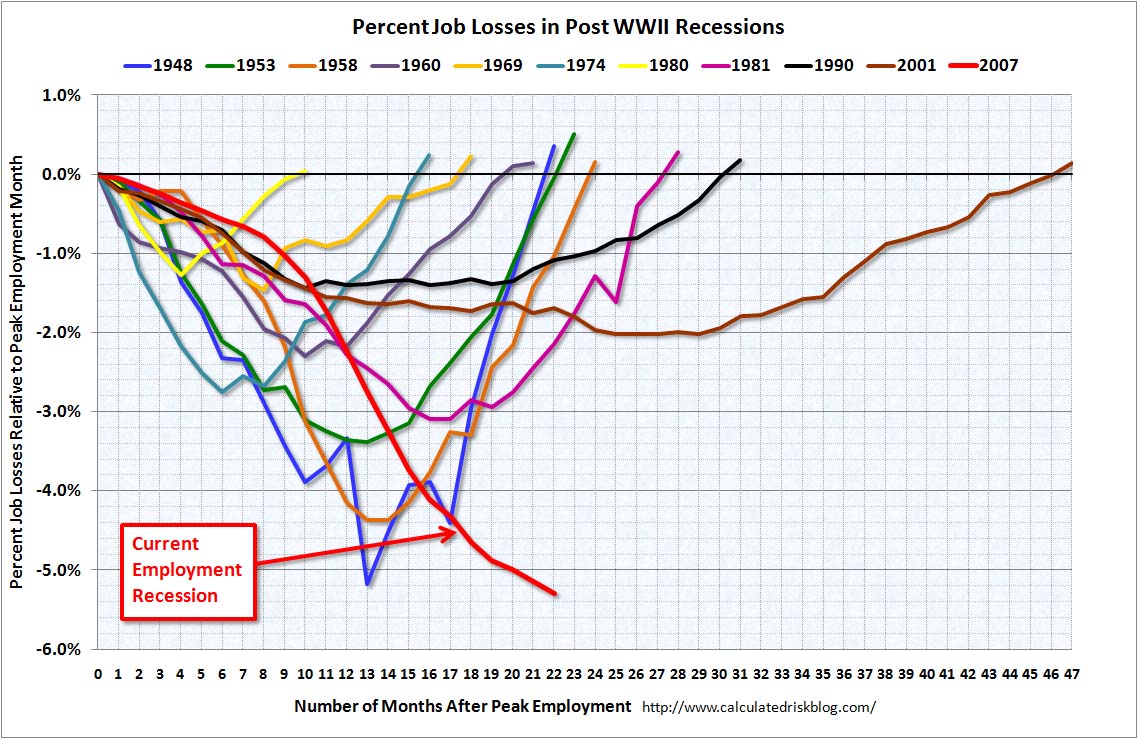
Job Losses in USA post recessions

You can click on the graph to show the full resolution. Its getting worse than previous recessions. One additional bit which you might notice is that by and large, as time goes on, the length of time it takes to get back to the previous top employment levels is stretching. In other words, this huge fall of unemployment which you are seeing can well take over another 2-3 years to recover. Can you imagine the repercussions? Think about the fact that the unemployment will still be lower and hurting when President Obama is going for re-election. I am going to hazard a guess that his re-election is not guaranteed, silver tongue orator notwithstanding. To get people to work in jobs, President Obama has to do something drastic but where is the fiscal firepower to actually fire a bigger gun? I suspect he will let the dollar depreciate, sod the status of reserve currency and let inflation help him out.

But whichever way you look at this, life is going to be fun.

Friday, August 28

1 in 6 households with nobody working in that household

Quite an interesting statistic, no? I quote:

The ONS also reported that the number of working-age people in so-called workless households jumped by 500,000 to 4.8 million in the year to June.

The workless household rate increased by 1.1 per cent to 16.9 per cent, the highest since 1999 and the biggest year-on-year increase since Labour came to power in 1997. The number of households with someone in work fell by 410,000 to 10.7 million, the figures revealed.

The workless household rate was highest for lone parents at 40.4 per cent, followed by one-person households at 30.1 per cent, with the worst figures recorded in the North East at 23.2 per cent. The lowest rate was in the East of England at 12.2 per cent. Figures showed that the biggest fall in the employment rate over the past year was for married fathers, down 2.1 per cent to 88.8 per cent.

Also see this. Two million people who can work have never ever worked in their life. Now imagine the drag on society with this kind of dead weight. I realise we are just coming out of one of the most difficult recessions in living memory, but bloody hell!

Monday, July 27

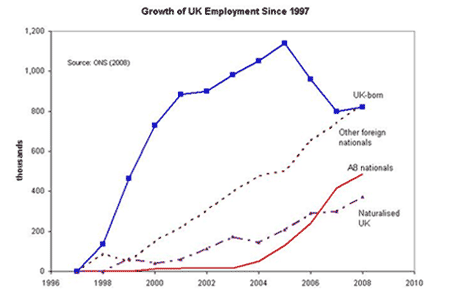
Why are migrants better than British workers?

Not only are foreign born workers getting more jobs than British born workers but they are better able to hold on to the jobs that they have in the first place.

Can you see the difference of UK born versus people from outside? I quote some worrying figures from here.

An analysis of official statistics shows that the number of British-born workers in employment fell by 451,000, or 1.8 per cent, in the first quarter of this year compared with a year ago.

Over the same period, the number of foreign-born workers with jobs rose by 129,000, or 3.5 per cent. In the first quarter of this year, British-born workers left employment at roughly four times the rate of foreign-born workers.

what do you do? what do people say?

Roughly the same proportion of British nationals and foreigners are unemployed – one in 12 – but joblessness among Britons rose by 600,000, or 43 per cent, in the past year compared with a rise of 16,000, or 15 per cent, among foreign workers. Part of the divergence may be explained by non-Britons leaving the country as jobs became harder to find.

Sir Andrew Green, the chairman of campaign group Migrationwatch UK, said: “It is increasingly clear that foreign-born workers are faring better than British-born ones as the recession bites. We must face up to this and take serious measures to tighten the points-based [immigration] system for the benefit of British workers.”

The government isn't doing much to deal with the issues relating to Britons, and this is allowing the BNP to step inside and claim for very emotive and problematical land such as British jobs for British people or go into the racist mode. And nowhere do we see what the Government is doing to help the local chaps out, the investment in the public sector goes into unproductive places such as welfare and other aspects rather than going much more into education, funding, and the like.

Forget about helping the poor working class students get better educated and get better jobs. The proportion of students who go to the top universities in the UK is falling rather than rising. This not only has an impact on the poor and unemployed, but its also causing severe decline in social mobility, a key feature in every good egalitarian society.

Tuesday, July 21

Fit to work, but can’t work

Now this is interesting, just because you are disabled or sick doesnt mean you cannot work. The government is trying to get people off the sickness rolls and into work. I quote:

More than two-thirds of applicants for sickness benefits are being rejected under a new testing regime, casting doubt on the validity of 2.6m existing claimants deemed unfit for work. According to data seen by several welfare industry figures, up to 90 per cent of applicants are being judged able to work in some regions and placed on unemployment rolls rather than long-term ill-health benefits. Every person returning to work would reduce the £12.5bn total bill of incapacity benefit and start to pay some income tax and national insurance.

I realise this is at a bad time because the recession is there and not so many jobs around, but the principle is fine and dandy. No reason to stop looking for jobs. What we need to do is to put in a time limit on welfare assistance, say 5 years. Surely that’s enough, no? See here for a good paper.


And then again, you have people like this:

Debi Wendes, 52, has resorted to standing in pearls and a smart navy shift dress in the middle of a busy shopping precinct, holding a sign asking for work.

The former accounts manager from Chelmsford, Essex, decided to take action after learning the temporary work which has kept her going is due to run out on Friday. She has had a sign made up with a cartoon picture of herself on the front, listing her CV. It reads: "I'm looking for work! Sales support, executive assistant, customer service, call centre, salary exp. £17k

Friday, March 20

Would the last man figure out the lights?

This was very amusing. You might have heard about the saying, “would the last man out please switch off the light?”, something that means that all hope is gone, and lets all make an orderly exit. Well, in this particular case, seems like the last man is out, but the lights are still burning. I quote:

Ilva, an upmarket Danish-owned furniture shop in Manchester, went into administration in September.

But the lights, which are computer-controlled, have remained switched on - running up a huge electricity bill.

A spokesman for Town Centre Securities Ltd, the property's landlord, said: "We are looking into the issue with a view to sorting it out, but the lights are controlled by a complex computer system.

"We need the lights to be able to show interested parties around. If they could have been turned off easily, we would have done it."

Environmental campaigners described the situation as "absurd and unacceptable".

Simon Ashley, leader of the Liberal Democrat group on Manchester council, added: "This takes 'computer says no' to a new level."

Spencer Fitzgibbon, spokesman for Manchester Green Party, said: "There is a good case for whichever energy company is concerned to simply pull the plug."

Technorati Tags: ,

Saturday, July 19

Even in USA, Food starvation

This is a serious problem facing developed economies as well, welfare cheque's are not really meant for permanent support, but as you can see, these people are getting hit by the counter-intuitive problem of being poor as well as obese because all they can afford are fattening and starchy food.

Read and wonder.

Technorati Tags: ,,

Tuesday, July 15

Jobless youth rate higher than in 1997

Now here's a surprise for you. I quote:

The proportion of 16- to 24-year-olds without a job is higher than when Labour came to power in spite of government efforts to reduce unemployment among the young.......blamed the rise on the failure to raise the skills of many youngsters. The New Deal scheme to reduce youth unemployment by providing training, subsidised employment and voluntary work had also failed to maintain its initial success.

What are the solutions? And this is where I disagree:

The OECD said policies such as raising the age to which youngsters must remain training to 18 needed “fine tuning”. It called for increased support for free nursery education; a three-month limit for 16- and 17-year-olds to find work with part-time learning, after which they must return to full-time education or training; more involvement for trade unions in development of apprenticeship schemes; and an expectation that youngsters working under New Deal stay in a job for at least 26 weeks.

See, this is an issue of taking a horse to water but cannot or being unable to make it drink. And here's the actual problem, and I further quote:

One in five youngsters who found work under New Deal held a job for less than 13 weeks, leading to “short employment spells with benefit dependency”.

What these gits do not understand is that for entry level jobs and basic jobs, the difference between the salary and benefits enjoyed is marginal, and in many cases, negative. So what's the point of me dressing up, going to work for a boss who treats me like a coprolite, doing soul destroying work and then ending up after working 10 hours with an amount which is lesser than what my friends earned by sitting at home smoking and drinking and bonking?

Benefit dependency is the issue, link the continued employment to the continued benefit and you will see that economic incentives do work. If you do not work, you do not get the money. And all the kings horses and men, like this whiney article, says, will not make humpty dumpty go back to work again.

Take a look at what Polly is celebrating. She is looking at an estate of 7300 people, and I quote: This vast estate, in much disrepair, had 7,300 residents but virtually no community life, voluntary or council-run. It did have crack houses, prostitution, rubbish tips and violent crime. It did have exceptional numbers of the old, the sick and single mothers.

This is the problem, it was the state's mistakes, the centralised planning, the benefit dependency, the bad public service delivery and the like which landed the estate of Clapham Park in this mess. So Polly is basically saying that the state mucked up, and then the state tried to fix it, and then it again failed. Erm. yes, obviously it will fail, you silly girl, because it was not done by the residents, but to and for the residents by people who never stayed in there. And she is asking for more public money to fix it, keep it going and worse of all, to extend it to other estates and counties where the state has spectacularly failed. Dont you think you should stand back and let the citizens do it themselves?

But here is the problem which goes back to the benefits issue. This state has made a vast swathe of the populace dependent upon benefits and is therefore unable to shift them off it. Take a look at this by-election coming up in Glasgow East. Trace the history of the constituency back and you will see that it has been managed by Labour going back to 1922. Ok? Now let me bring some interesting statistics to bear.

1. From the spectator:

Nick Clegg drew gasps at a reception in Westminster by observing that there are parts of Glasgow where life expectancy is the same as the Gaza Strip and North Korea. If only this were so. Glasgow City, as a whole, has a male life expectancy of 71 years which is actually lower than the 72 years of both Gaza and Pyongyang. But this includes its lush suburbs. Those in the welfare ghettoes of Glasgow East can only dream of such longevity. The life expectancy of its sink estates is worth recording here. A boy born in Camlachie is expected to live to 64.5 — the same as in Uzbekistan. In Parkhead it is 62, the same as Bangladesh. Just outside its boundaries lies Dalmarnock where the figure is 58 — lower than Sudan, Cambodia or Ghana. The lowest is Carlton, where the figure of 54 is lower than even Gambia’s equivalent.

2. BBC:

Figures for unemployment are also higher, with the rate for men over 25 about 10%, rising to 25% for women.

This year, NHS statistics showed that the east end of Glasgow had Scotland's highest rate of alcohol-related hospital admissions.

3. Blog:

Look beneath the lies, damned lies and statistics, and factor in the number of people on incapacity benefits, and we discover that around 50% of the adult 'working' population is unemployed.

4. Spectator again:

When you look at Scotland on any statistical dataset, it is one big horror story. Welfarism, health deprivation, drugs, drink – there are reams of data about what a socioeconomic nightmare the country is.

5. Financial Times:

Male life expectancy is 63, which is 14 years below the UK average. Unemployment runs at 25 per cent and about 40 per cent of the constituents live on benefits. About 40 per cent of the children live in workless households. Sadly, "household" is not always the most appropriate term. The teenage pregnancy rate is 40 per cent above the national average.

And this is from a city which, and I quote: Yet just a few generations ago Glasgow was the greatest industrial city of the British empire. At one time it produced half the world's ships and a third of its railway locomotives. It could be argued that many people in the UK enjoyed a prosperity that was in part built on the gargantuan efforts of industrial Glasgow.

6. The Times: male life expectancy is 14 years below the national average, 38% of constituents are welfare-dependent, 46% live in social housing, 60% of households have no access to a car, and deaths from heart disease among the under 75s are 83% above the national average.

Now yes, I agree that you cannot be up all the time, just look at Detroit, but hey, look at California, it reinvented it. And it did not do it by handing out benefits by the ton. The problem is that people are now accustomed to living by the state. So now why would you be surprised that the people will keep on voting Labour? As the quote goes, a government which promises to rob peter to pay Paul will always count on the support of Paul.

If you want to get people employed and productive members of the staff, you need to help them but just like pain killers, do not make them addicted to it, otherwise you will end up with estates like Clapham or Glasgow East. (Incidentally, the SNP and the Labour party are both the same, whosoever wins in this by election will do sweet sod all. Here's a prediction, 5 years time and the statistics will be worse! and I am very happy to be proven wrong).

Saturday, February 2

Another classic example of solutions in search of problems

This is a classic example of a solution looking for a problem. Specially government intervention. The problem? somebody noticed that non-white people have lower employment rates than white people in the UK. And this costs £8.6 billion an year to the UK economy.

Like women have lower employment rates than males. So they went and plonked huge amounts of my money down gigantic government programmes to get ethnic minorities back into work. I snorted when I read it in today's FT.

I quote: In spite of repeated government efforts to help to close the gap it would take 30 years to do so at the current rate of progress, the NAO said.......Between 2002 and 2006 the department put £40m into programmes aimed at ethnic minorities, which proved a qualified success, the NAO says, moving 15,500 into work at a cost of more than £2,000 a job.

So came back home and dug a bit deeper into this. Here's the full report if anybody is interested. And well, I am sure you can find out the simple reason why such large government programmes will fail.

You see, they assumed that anybody who is not white has a problem in getting a job. So you would expect that they have a very good analysis on exactly what problems they face? Yes? No. Their basis for sprinkling millions is based upon.

1. Human Capital: Apparently ALL ethnic minorities have problems with education (Figure 11). Oh, sorry, actually, Indians and Chinese are doing BETTER than the whites, so we will simply ignore them. So here's the first grand stupid moronic step. Let us just ignore 4 out of 10 ethnic minorities then, shall we? So pumping educational money to all minorities is a bit stupid, is it not?

2. Geography: Well, who lives in deprived areas with high unemployment? I quote from the report: Seventy per cent of ethnic minorities live in the 88 most deprived local authority districts, compared with 40 per cent of the general population. Notice they have not broken it down by the type of ethnic minorities but looking around anecdotally, there is a difference between the ghetto behaviour of many ethnic minorities as well as the desire / ability / willingness to move to another location where jobs are available. So instead of trying to find jobs where they are, ask the people to move to places where there are jobs.

3. Discrimination. Now I can well believe this despite lack of personal experience. But is it skin colour? or religion? or gender? or ethnic origin? In other words, is there a difference between

  • Brown, Hindu, Indian, Male....
  • Brown, Hindu, Bangladeshi, Female....
  • Brown, Muslim, Indian....
  • Black, Muslim, Caribbean
  • White, Muslim, Tonga...

So we need to determine what is the discrimination vector before you can determine what is the best way to address it. If nobody has a problem with Green Skinned Buddhists from Mars, then there isnt much point in targeting them, is there? If people have a problem with skin colour, then address that. But in this case, they are targeting everything and everybody. It is like ignoring the 200 piece tool kit and just using a hammer for everything.

4. And then there is a pathetically limp list of "other factors". I quote: There may also be cultural factors which discourage
ethnic minorities from participating in the labour market. Ethnic minorities can face multiple barriers to obtaining employment (Figure 13 on page 20). In addition to those above, they can include: lack of, or reluctance to take up, childcare provision; lack of job readiness; and low confidence or motivation. Many of these factors
are interrelated
. Many if not all these factors are not colour, religion, origin specific at all. Childcare provision applies to everybody.

So here we are, £40 million of taxpayer money, poured down some hole, minimal progress, will need 30 years (multiply this with 12 to get to 30 years, plus say a factor of 2 on top to cater for population growth rates plus say a factor of 2 to cater for the increased fertility of ethnic minorities), all based upon some very very stupid half baked reasoning.

We have not spoken about the fact that there is a very large self employment and improvement ethic in the Indian and Chinese communities and that manifests itself by showing up in higher earnings. They value education, they do not mind setting up their own businesses, they do not treat their women like brood mares (much!).

The NAO report addresses this point in 1.20 and I quote: One important result of lower employment for all ethnic minorities is poverty. Nineteen per cent of the white population live in low income households compared with 56 per cent for Pakistanis and Bangladeshis. Twenty three per cent of white children live in low income households compared with 60 per cent of Pakistani and Bangladeshi children. This in turn affects many areas of life including housing, health, education and childcare.

Even after identifying that their problem identification sucks big time, they proceed to shower my tax money down this hole and then wonder why it is not working as well as it should. Why do you not put in time limits on welfare payments for economically capable persons? And this itself was ignored in the study, for example see Table 23, USA section. So instead of asking, what makes the Indians and Chinese minorities work and replicating it, they will force weird public policy down the throat of everybody.

And the amusing thing is, the Table says that targets for affirmative action do not work based upon USA results but see this quote from the FT: Measurable targets for ethnic minority employment should become a condition of funding for local City Strategies, which were being developed to run welfare-to-work programmes. Sometimes I just get reduced to helpless giggling reading these.

Disclaimer: I am one of those ethnical minorities mentioned above.

Wednesday, January 30

Jobless challenges in Iran

You want to destroy an educated man's soul? keep him unemployed. There is nothing like destroying hope and specially his belief that he can be all he can be. And when I read this, I felt bad for the Iranian youth. I quote the dry statistic first:

A poll by Iran Economics, a leading business monthly, found the median forecast among 12 economists, some of them working in government, was 14.5 per cent. But the rate is even worse when the number of underemployed people is taken into account. Some economists suggest that as much as a quarter of Iran’s 21m-strong population eligible for work is either unemployed or underemployed.

but here's the human element:

“I’ve been looking for a job since graduation,” says the 25-year-old, who finished university two years ago. “I took tests to enter government banks but I didn’t succeed and I applied at the Tehran city council but they weren’t hiring.”“I want to have a job – I’d really like to work – so naturally it’s not very pleasant not to be able to find one,” she says.

.......

Mohammad bought a car so that his son, who has struggled to find a job since finishing school, could work as a taxi driver. He was still paying the instalments on that car when he realised, after retiring from his job in a government ministry, that he needed to drive too.

“My daughter is now 23 but I can’t afford the IR60m ($6,400, €4,300, £3,200) it will cost for her to get married,” he says, adding that his daughter cannot contribute because there are no suitable jobs for her either.

“There are not enough jobs out there for young ­people,” says Mohammad. “A young man can get a job if he has a wealthy father because his father can invest in a business for him. But otherwise there is nothing but being a taxi driver or day labourer.”

Perhaps President Ahmadinejad could concentrate on economics rather than fulminating very stupidly about Israel. But hey, his knowledge of economics is, well, rather along the lines of the Robert Mugabe School of Economics.

Technorati Tags: ,

Monday, November 19

Key to poverty alleviation is to give people a stake with assets!

Here is a fascinating overview of comparing rich Black Americans versus poor Black Americans, and this chap seems to point to having land as assets in the family as one good factor towards the upliftment of people from poverty! And this debate, during this time of sub-prime crisis, is to make sure that there is good financial instructure available for people to purchase their own homes!

Also look at Hernando de Soto's work. Very very interesting and controversial indeed.

Read and reflect!

Forty Acres and a Gap in Wealth
By HENRY LOUIS GATES Jr.
Cambridge, Mass.

LAST week, the Pew Research Center published the astonishing finding that 37 percent of African-Americans polled felt that “blacks today can no longer be thought of as a single race” because of a widening class divide. From Frederick Douglass to the Rev. Dr. Martin Luther King Jr., perhaps the most fundamental assumption in the history of the black community has been that Americans of African descent, the descendants of the slaves, either because of shared culture or shared oppression, constitute “a mighty race,” as Marcus Garvey often put it.

“By a ratio of 2 to 1,” the report says, “blacks say that the values of poor and middle-class blacks have grown more dissimilar over the past decade. In contrast, most blacks say that the values of blacks and whites have grown more alike.”

The message here is that it is time to examine the differences between black families on either side of the divide for clues about how to address an increasingly entrenched inequality. We can’t afford to wait any longer to address the causes of persistent poverty among most black families.

This class divide was predicted long ago, and nobody wanted to listen. At a conference marking the 40th anniversary of Daniel Patrick Moynihan’s infamous report on the problems of the black family, I asked the conservative scholar James Q. Wilson and the liberal scholar William Julius Wilson if ours was the generation presiding over an irreversible, self-perpetuating class divide within the African-American community.

“I have to believe that this is not the case,” the liberal Wilson responded with willed optimism. “Why go on with this work otherwise?” The conservative Wilson nodded. Yet, no one could imagine how to close the gap.

In 1965, when Moynihan published his report, suggesting that the out-of-wedlock birthrate and the number of families headed by single mothers, both about 24 percent, pointed to dissolution of the social fabric of the black community, black scholars and liberals dismissed it. They attacked its author as a right-wing bigot. Now we’d give just about anything to have those statistics back. Today, 69 percent of black babies are born out of wedlock, while 45 percent of black households with children are headed by women.

How did this happen? As many theories flourish as pundits — from slavery and segregation to the decline of factory jobs, crack cocaine, draconian drug laws and outsourcing. But nobody knows for sure.

I have been studying the family trees of 20 successful African-Americans, people in fields ranging from entertainment and sports (Oprah Winfrey, the track star Jackie Joyner-Kersee) to space travel and medicine (the astronaut Mae Jemison and Ben Carson, a pediatric neurosurgeon). And I’ve seen an astonishing pattern: 15 of the 20 descend from at least one line of former slaves who managed to obtain property by 1920 — a time when only 25 percent of all African-American families owned property.

Ten years after slavery ended, Constantine Winfrey, Oprah’s great-grandfather, bartered eight bales of cleaned cotton (4,000 pounds) that he picked on his own time for 80 acres of prime bottomland in Mississippi. (He also learned to read and write while picking all that cotton.)

Sometimes the government helped: Whoopi Goldberg’s great-great-grandparents received their land through the Southern Homestead Act. “So my family got its 40 acres and a mule,” she exclaimed when I showed her the deed, referring to the rumor that freed slaves would receive land that had been owned by their masters.

Well, perhaps not the mule, but 104 acres in Florida. If there is a meaningful correlation between the success of accomplished African-Americans today and their ancestors’ property ownership, we can only imagine how different black-white relations would be had “40 acres and a mule” really been official government policy in the Reconstruction South.

The historical basis for the gap between the black middle class and underclass shows that ending discrimination, by itself, would not eradicate black poverty and dysfunction. We also need intervention to promulgate a middle-class ethic of success among the poor, while expanding opportunities for economic betterment.

Perhaps Margaret Thatcher, of all people, suggested a program that might help. In the 1980s, she turned 1.5 million residents of public housing projects in Britain into homeowners. It was certainly the most liberal thing Mrs. Thatcher did, and perhaps progressives should borrow a leaf from her playbook.

The telltale fact is that the biggest gap in black prosperity isn’t in income, but in wealth. According to a study by the economist Edward N. Wolff, the median net worth of non-Hispanic black households in 2004 was only $11,800 — less than 10 percent that of non-Hispanic white households, $118,300. Perhaps a bold and innovative approach to the problem of black poverty — one floated during the Civil War but never fully put into practice — would be to look at ways to turn tenants into homeowners. Sadly, in the wake of the subprime mortgage debacle, an enormous number of houses are being repossessed. But for the black poor, real progress may come only once they have an ownership stake in American society.

People who own property feel a sense of ownership in their future and their society. They study, save, work, strive and vote. And people trapped in a culture of tenancy do not.

The sad truth is that the civil rights movement cannot be reborn until we identify the causes of black suffering, some of them self-inflicted. Why can’t black leaders organize rallies around responsible sexuality, birth within marriage, parents reading to their children and students staying in school and doing homework? Imagine Al Sharpton and Jesse Jackson distributing free copies of Virginia Hamilton’s collection of folktales “The People Could Fly” or Dr. Seuss, and demanding that black parents sign pledges to read to their children. What would it take to make inner-city schools havens of learning?

John Kenneth Galbraith once told me that the first step in reversing the economic inequalities that blacks face is greater voter participation, and I think he was right. Politicians will not put forth programs aimed at the problems of poor blacks while their turnout remains so low.

If the correlation between land ownership and success of African-Americans argues that the chasm between classes in the black community is partly the result of social forces set in motion by the dismal failure of 40 acres and a mule, then we must act decisively. If we do not, ours will be remembered as the generation that presided over a permanent class divide, a slow but inevitable process that began with the failure to give property to the people who had once been defined as property.

Henry Louis Gates Jr., a professor at Harvard, is the author of the forthcoming “In Search of Our Roots.”

All this to be taken with a grain of piquant salt!!!

The sun is rising in the west, the French protesting against the Unions???

I nearly fell off the planet when I read this. Sarko's fight against the unions is something that is good and I have mentioned this before. But when i read in the FT that French commuters are actually demostrating against the Unions, I felt good. This battle has to be fought if France can fight the 21st century economic war. I quote:

Frustrated commuters staged demonstrations in Paris yesterday to protest at the continuing transport strike as rail unions voted to extend their industrial action for another 24 hours.
Waving placards calling for an end to "the dictatorship of unions", a crowd of between 3,000 and 10,000 people braved freezing temperatures to denounce the spread of strikes that blocked public transport for five days.


And the fact that his popularity is dipping is ok, reality is always different from the promise. But he has a mandate from the French people, go Sarko go!

All this to be taken with a grain of piquant salt!!!

Saturday, September 29

Internet Cafe's as your home

What a fascinating story from the Guardian! Poor casual labourers who cannot afford their homes, work on casual labour work for the day, then head towards an Internet cafe, and for a comparatively miniscule payment (£8-9), get dinner, drinks, a wash, occupy a reclining chair, Internet access and a night's stay. Not bad, but interesting social evolution of the underclass. Long article but worthwhile reading.

Technorati Tags:

Thursday, September 27

Reliance cuts jobs in grocery chain in UP , India after idiot politicians protest

Here we go, typical moron behaviour which I have already alluded to. I would expect that the chief minister of one of the poorest states in India would want more jobs, more efficient farming and better economics all around? Oh! no, we do not want that. Besides the grotesquely stupid Uma Bharati protested, now it was the chance of the current Chief Minister, Mayawati, herself accused of serious corruption, who has closed 20 grocery chain stores.

So Reliance, the company which is busy generating jobs and money for farmers and people in other states said, ok, no worries, you can live with corrupt, moronic, idiot and stupid leaders, we are outies.

Pity the poor farmer and pity the poor unemployed youth who would have had a chance to break their poverty and unemployment status's.

Read and Weep!

Technorati Tags: , , ,