I just finished reading this book by Bruno Colson called as Napoleon: On War.. Quite an interesting book, son. It reviews prior work on Napoleon as a military commander and compares his work with Clausewitz. you may think this is a bit of a chimney thing which Baba does. :) I have included the review below.
But I see this as a different matter, son. Deals are like battles. winning large number of deals is like a war. And then you have an overarching grand strategy of the sector and overall business. So learning from war, for me, is vital. Yes, there are significant differences between war and banking but its not that much of a difference in so far as there are limited resources, there are competitors, there is a political and economic element, there are winners and losers, and so on and so forth. Let me quote a bit from the conclusion of the book
> In an army, unified command is essential. Supplies are an important task and local resources are there to contribute. If troops are not battle-hardened, it is better to entrust them with a defensive mission, which is accomplished better by men used to staying in the same sector, where they will have acquired habits. They must not be arranged in a cordon: that is equivalent to being strong absolutely nowhere. When you do not know where the enemy will attack, it is better for troops to be positioned in close echelons, so that they can be concentrated rapidly at the point under attack. If you attack, you will seek to outflank or envelop the enemy, but out of his view. It is always difficult to combine different forms of attack simultaneously. The simplest moves are the best. They are accompanied by concentrated fire. In moun- tainous terrain above all, you must not attack an enemy position head on. The enemy must be flushed out by making for his flank or rear. If you attack a town, it is better not to commit your infantrymen in the streets. An occu- pation is always difficult. In any event, forces must remain concentrated and be mobile. The main towns, where the important people whose collabor- ation is essential reside, must be held. Mobile columns will pursue insurgents, but without committing blunders. It is necessary to make examples, but also to issue pardons. Finally, all possibilities must be envisaged when one engages in war. It is necessary to reckon on the worst. Plans must be carefully prepared, but remain open to adaptation depending on circumstances. You must always ask yourself how the enemy will react. When it comes to the enemy, it is necessary to target the essentials—the main front—and direct your efforts there. If a breach is made, the secondary fronts will fall of their own accord. A conquest must always be accompanied by political gestures. Any military objective is subordinate to a political objective and every general must possess civil qualities. This does not preclude the supreme commander having to enjoy a certain freedom of action in the theatre where he is in charge. These observations can be applied to all wars, including those of the early twenty-first century.
>
If nothing else, you can see how these basic rules will help you to think about where to place your relationship managers, your capital, your attention, your pitching, and so on and so forth. each of these rules are golden rules for warfare and will be similar to business as well. Very interesting indeed. If you look at the business leaders, they are all having history or military history book.
But one thing you have to remember about Napoleon. He was tactically brilliant, won so many wars, was very focussed on the human element, but he was not a strategist and its that inability to bring in the political, economic, and other elements made him lose in the end. At end of the day, he left France smaller than what he took. So despite his great reputation, he lost in the end. You learn more from failures, son.
Best of luck with your presentation, I am very proud of you, that is good work, really good work on the presentation.
Your proud father.
Baba
=======
https://www.h-net.org/reviews/showrev.php?id=46865
In the more than two centuries since his rise to power during the French Revolution, the world at large has been fascinated with Napoleon Bonaparte, justly considering him as one of the great geniuses of all time. In particular, his military successes have led numerous authors, after his defeat and fall from power in 1815, to attempt to distill his writings into a series of maxims that could be studied and applied to current events. This concept has proven difficult. While exiled on Saint Helena, Napoleon himself considered writing about the art of war, but before his death in 1821 he ordered his efforts to be destroyed. Since the third decade of the nineteenth century, a number of scholars have sought to synthesize and recreate this material, with varying degrees of detail and accuracy, using the emperor's correspondence, official records, observations by his associates, and other sources.
Showing posts with label military. Show all posts
Showing posts with label military. Show all posts
Monday, August 22


Wednesday, January 27
The Gunpowder Age: China, Military Innovation, and the Rise of the West in World History
This book review made me blink and reconsider the dominant narrative that the west has always been smarter at weapons. Not so when you consider some of the times that China has been good.
Today I was reading the guardian son and found that the uk is selling huge quantities of arms and planes and ammo and advice to the Saudis who are using them to break the laws of war and expected human rights in Yemen. I'm just sad that we are now associated with that dreadful regime. All that brainpower and it's going into doing shitty things like killing people.
Sad. Very sad.
Hate war! Such a waste of talent people and money. And nobody remembers after a few years. Who remembers the dead in Iraq and Afghanistan? Nobody. Bah.
Love
Baba
The Gunpowder Age: China, Military Innovation, and the Rise of the West in World History
http://imperialglobalexeter.com/2016/01/27/the-gunpowder-age-china-military-innovation-and-the-rise-of-the-west-in-world-history/
(via Instapaper)
The Gunpowder Age: China, Military Innovation, and the Rise of the West in World History by Tonio Andrade (Princeton University Press, 2016).
Reviewed by Francis P. Sempa
Cross-posted from Asian Review of Books
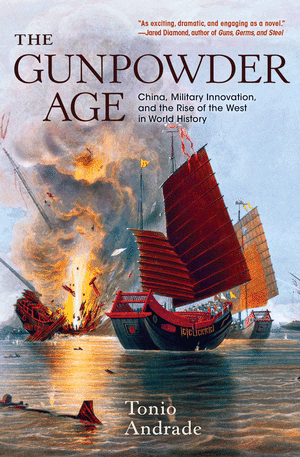 Tonio Andrade, a professor at Emory University, has written a well-researched, balanced, and comparative history of military innovation in Asia and the West in which he challenges the traditional notion—set forth most compellingly by Victor Davis Hanson in Carnage and Culture and Niall Ferguson in Civilization—that Western culture largely explains Western global predominance in the post-medieval world.
Saturday, January 16
Gen. Stanley McChrystal’s Lessons Learned
So here's an article which I strongly disagree with. And also another reason why the USA will lose in the Middle East again and again.
First of all, I absolutely hate this idea of national service and conscription. That's a clear violation of individual rights. So the general is talking out of his arse.
Second, his recommendation for teams of teams is rubbish. Clearly shows that he has no idea about running a business. You need to make organisational life sustainable. You need governance. You need processes. You need technology and data. Teams of teams. Rubbish. This will work in very limited circumstances and for a limited period of time.
And finally thinking that ISIS is a motorcycle gang just shows the man is a blithering idiot with no idea of history or Islam. For 1400 years, Islamic warriors and priests have constantly tried to impose their views by force. Constantly. On their own people or on others or both. There hasn't been a single year in recorded history that this fight hasn't happened. The dream and desire for a caliphate. An idealised Jerusalem if you will and if you don't mind the pun.
How did they get sorted? By giving them a right royal thumping. And then religiously thumping people who dare raise anything against secularism. All this education business is bollocks. Hasn't worked in 1400 years and will not work in the future.
His views about China exhibit a shocking level of ignorance. He says it will become bigger than USA and to fix it we need to educate Americans? What? So China rose because of education? Bloody hell. The man is a moron. But people pay tons of money to listen to him. You can fool some people some of the time eh?
Hope you're having fun son. I'm missing you :)
Love
Baba
Gen. Stanley McChrystal’s Lessons Learned
http://www.wsj.com/articles/gen-stanley-mcchrystals-lessons-learned-1431122717
(via Instapaper)
First of all, I absolutely hate this idea of national service and conscription. That's a clear violation of individual rights. So the general is talking out of his arse.
Second, his recommendation for teams of teams is rubbish. Clearly shows that he has no idea about running a business. You need to make organisational life sustainable. You need governance. You need processes. You need technology and data. Teams of teams. Rubbish. This will work in very limited circumstances and for a limited period of time.
And finally thinking that ISIS is a motorcycle gang just shows the man is a blithering idiot with no idea of history or Islam. For 1400 years, Islamic warriors and priests have constantly tried to impose their views by force. Constantly. On their own people or on others or both. There hasn't been a single year in recorded history that this fight hasn't happened. The dream and desire for a caliphate. An idealised Jerusalem if you will and if you don't mind the pun.
How did they get sorted? By giving them a right royal thumping. And then religiously thumping people who dare raise anything against secularism. All this education business is bollocks. Hasn't worked in 1400 years and will not work in the future.
His views about China exhibit a shocking level of ignorance. He says it will become bigger than USA and to fix it we need to educate Americans? What? So China rose because of education? Bloody hell. The man is a moron. But people pay tons of money to listen to him. You can fool some people some of the time eh?
Hope you're having fun son. I'm missing you :)
Love
Baba
Gen. Stanley McChrystal’s Lessons Learned
http://www.wsj.com/articles/gen-stanley-mcchrystals-lessons-learned-1431122717
(via Instapaper)
Tuesday, December 27
Stop poking foreigners. A view from Ron Paul
He says it as he see’s it. I love this idea that American troops should haul their hiney’s back home.
I do think that the UK should withdraw its troops from across the world and stick with trading. Its a waste of time, money and resources.
Where are British Troops stationed?

Ok, leave aside the UN deployments. Why the hell are we in the Balkans? In Germany? Gibraltar, Ascension Island, Diego Garcia, etc. etc? What a bloody waste of time and energy.
In comparison, look at what USA is doing.

Another view

This is unbelievable. And just out of interest, there are NO foreign military bases in the USA. Now there’s a classic case of imperial overstretch. Ron Paul talks about Rome, and that’s a very good point.
Incidentally, here’s a great article on how empires collapse. But we should know, we Brits have seen our empire collapse when we overstretched too much and we simply couldnt afford it.
STOP SPENDING MY MONEY.
Saturday, December 5
The Magnificient Pakistani Generals
An interesting review of a book review on one of the general’s books who commanded the Pakistani Army in 1971. Defeat has no fathers, it is an orphan and looking at the spate of books by the generals in charge then, looks like nobody was in charge, everybody was responsible and nobody was personally liable. One very interesting comment came back and this is what I have seen (as a very broad based generalisation), most of the third world country armies get more medals for killing their own people than the enemy. Pakistan’s army is no exception. In fact, for all the pious mumbling about Islamic armies, I would say that this Islamic Army of Pakistan has killed more Muslims than non-muslims. Post Independence, whether you think about Jordan, Kashmir, Kargil, Bangladesh, Afghanistan, Baluchistan, Sindh, you name it…
A.H Amin's Comments on Ahmad Faruqis Book Review of A.A.K Niazis Book on East Pakistan-2000While you can spend quite a lot of time reading both documents, this is what puzzles me ever since. Is it indeed possible to fool all people all the time? What explains the fascinating behaviour of the Pakistani Army? that it manages to screw up almost everything it touches but is still allowed to grab the resources of the Pakistani state and even rule it. We are getting to grips with the betrayal of East Pakistan but what about the betrayal of West Pakistan? When will that final chapter be written?
That said, tactically and militarily, the Pakistani Army seems to be getting better, Kargil was a great example, Swat and the South Waziristan campaigns are also good. What happens to these generals when they grow up? Also, the current C-in-C Kayani seems to be a canny smart chappie. But here’s the question, the lessons of the 1971 war (see the Hamdoor ur Rahman Report summary here) doesnt seem to be learnt. The same old same old, the involvement with politics and massive corruption is still there.
Lots to think about.
Sunday, August 9
British Defence Spending since 1830
Brilliant work.


Click on the graphs to show bigger resolution. What this tells you is how the British Government is trying to run its two recent big wars and a host of other military commitments on the cheap. And this is one of the reasons why we are seeing more and more English soldiers die…Last time we were at less than 2% of GDP, we were caught with our pants down just before WW2. And yet again, we are in trouble….
Read the full paper here.
Monday, April 28
India launches a rocket with a cluster of 10 satellites in it
Wednesday, November 7
The Pakistani Government has now lost control over a town!
As per this report, the Pakistani Government has lost control over large chunks over its territory, either to Islamist militants, terrorists, feudals or what have you. So if the Pakistani military cannot control its own territory, just what is it for? Welcome to Pakistan, the most dangerous country in the world.
The situation is unbelievable!
All this to be taken with a grain of piquant salt!!!
The situation is unbelievable!
All this to be taken with a grain of piquant salt!!!
Tuesday, September 25
Two types of British Hero's - one sung about, one quiet and unsung
We hear about brave British Squaddies who managed to rescue Italians from the grasp of the Taliban. I quote
Brave men. But here is another story of another British Hero. These are the sandwich generation who exhibit familial duty without a moan. Hero's? I think so.
A hat-tip to both!
All this to be taken with a grain of piquant salt!!!
Helicopter-borne British special forces yesterday rescued two Italian soldiers, killing their captors in a gunfight in western Afghanistan, defence sources said.
Troops from the Special Boat Service, the navy's equivalent of the SAS, were called in by Nato after intelligence reports that the Italians were about to be moved from a building east of the town of Farah. The SBS troopers were taken to the area by helicopter, and as Italian commandos stormed the building, the SBS attacked the two trucks in which the captors were about to drive the Italians away.
Brave men. But here is another story of another British Hero. These are the sandwich generation who exhibit familial duty without a moan. Hero's? I think so.
A hat-tip to both!
All this to be taken with a grain of piquant salt!!!
Sunday, September 16
Filipino Thieves falling out
Hmmm, so this is quite curious, Moro Islamic Liberation Front has suggested vacating some of its camps, so that the largely catholic Filipino army can go after the Abu Sayyaf and Jemaah Islamiyah groups.
Remember these two groups are suspected in a variety of terrorist offences, such as the Bali bombing of 2005, and the airline bombing of 1994. They also have deep links with Al Qaeda.
These groups are very amorphous, and members switch easily between the groups, so if I was the Philippines military and intelligence sources, I would agree totally in return for some intelligence on the other groups.
But why this offer? Are the thieves falling out? Did some personalities clash? Another alternative could be that the MILF is getting hammered so it wants to clear out, get protection for its own people and families and in return, get the army to knock the stuffing out of its enemies. Nothing like a spot of poking and prodding to get rid of these jihadi's.
Muslim separatists offer to vacate camps amid offensive
Posted September 16th, 2007 by Tarique Anwar
* Muslim World News
By DPA
Manila : The Philippines' largest Muslim separatist rebel group has offered to abandon some of its camps in the south to avoid hampering a military offensive against Al Qaeda-linked militants, a spokesman said Sunday.
Eid Kabalu, a spokesman for the Moro Islamic Liberation Front (MILF), said the rebel group's leadership has made the offer as a goodwill and confidence-building gesture ahead of the resumption of peace talks with the government.
He said MILF fighters were prepared to temporarily move out of their camps in Basilan province, 900 km south of Manila, to give way to the military's offensive against Abu Sayyaf rebels and Jemaah Islamiyah (JI) operatives.
"We are prepared to leave the area, on the consideration that the security and livelihood of the families of our fighters are taken care of," he said.
More than 50 soldiers have been killed in Basilan and nearby Jolo island -another stronghold of the Abu Sayyaf - since July.
While the military continues to have suspicion that some MILF members have ties with Abu Sayyaf or JI militants, the rebel group has denounced terrorism and has vowed to help the Philippine government's hunt down suspected terrorists.
Peace talks between the MILF and the Philippine government have been stalled since September 2006 over disagreements on what areas would be included in a proposed Muslim homeland.
All this to be taken with a grain of piquant salt!!!
Technorati Tags: Philippines , Islamic Terrorism , Moro Islamic Liberation Front , Abu Sayyaf , Jemaah Islamiyah , Al Queda
Burma, China and the Myth of Military Bases
Quite an interesting little report here. Burma (or Myanmar!) occupies a rather strategic place in a rather dicey corner of the world. So if one of the local regional powers starts taking a close look at Burma, others get a wee bit interested, specially India.
So India has been dancing with the generals and as we have noted before, has merrily ignored the Burma boycott pressures. All because of the worry that China has military bases in Burma and that can "encircle" India.
This report says that nope, there are no military bases.
Burma, China and the Myth of Military Bases
Author: Andrew Selth DOI: 10.1080/14799850701568929
Published in: journal Asian Security, Volume 3, Issue 3 September 2007 , pages 279 - 307
Abstract
Since the advent of a new, more outward-looking military government in 1988, Burma has come to occupy a position of considerable importance in the Asia-Pacific strategic environment. Burma's burgeoning relationship with China has attracted particular attention, not least because of the stream of reports in the news media and, to a lesser extent, academic literature, claiming that China has established several naval bases and intelligence collection stations in Burma. This apparent intrusion by China into the northeast Indian Ocean has strongly influenced the strategic perceptions and policies of Burma's regional neighbors, notably India. The reported facilities have also been cited as evidence that Burma has become a client state of China, and as proof of Beijing's expansionist designs in South and Southeast Asia. A close examination of the available evidence, however, suggests that there are no Chinese military bases on Burmese soil, a fact conceded by senior Indian officials in 2005. China still has a strong strategic interest in developing its bilateral relations with Burma but, based on this analysis, it would appear that China's presence in Burma, and its current influence over Burma's military regime, have been greatly exaggerated.
All this to be taken with a grain of piquant salt!
Friday, September 14
More war games planned in Asia showing that the centre of gravity is definitely shifting
After the recent success of the very large SCO war games, it was the turn of the five nation naval war games in the Bay of Bengal, Indian Ocean. Now India has announced that it will be holding multiple war games with other countries, ranging from China, South Africa to Russia. Quite a broad based effort and something which tells me that India is not putting all its eggs into one basket simply for ideological reasons but is much more pragmatic about this all.
I wonder if the good comrades in India would protest against this insult to the sovereignty of India? Clowns, I tell you, clowns indeed.
Also see this blog, very good analysis on counter terrorism, military, history, etc.
All this to be taken with a grain of piquant salt!!!
I wonder if the good comrades in India would protest against this insult to the sovereignty of India? Clowns, I tell you, clowns indeed.
Also see this blog, very good analysis on counter terrorism, military, history, etc.
All this to be taken with a grain of piquant salt!!!
Wednesday, August 15
Another Poke to my MP, G. Thomas, about the Iraqi Interpreters
I poked my MP again on this issue. Please take the liberty to write to your local MP (see details here on how to contact, some tips here, dont forget to sign the Downing Street Petition here) and ask them to support this issue
===========
Dear Mr. Thomas
I realise you are busy but I was directed to this website about other MP's who have signed up to this issue here.
They are
Conservatives (1):Anne Milton
Labour (11):Celia BarlowHugh BayleyWayne DavidFrank DobsonJim FitzpatrickPatricia HewittDavid LammyChris MoleAndrew SmithDr Rudi VisPaul Truswell (via Ian Clenshaw)
Lib Dems (3):John BarrettLynn FeatherstoneRobert Smith
I would appreciate knowing your views on this.
Sincerely
bd
Dr. Bhaskar Dasgupta
North Harrow.
- Hide quoted text -
On 08/08/07, Bhaskar Dasgupta <bdasgupta@gmail.com> wrote:
Hello there Mr. Thomas
I am one of your constituency members, living in 36 Hooking Green, North Harrow. I wanted to inquire whether you have pushed the prime minister to do something dramatic and quick about the Iraqi Interpreters? I have written about this on my blog for more details here: http://desicritics.org/2007/08/08/000700.php . I would like to hear if anything has been done on this issue by yourself.
Look forward to hearing from you.
Sincerely
bd
The Abandoned Iraqis - Shame on the UK
August 08, 2007Dr Bhaskar Dasgupta
Now this is a big blot on the British Government. A really bad situation. The British Government allows refugees to flood into the United Kingdom but where people have actually helped us in delivering our foreign policy objectives, we treat them horribly. Why? Why are we so ungrateful? And unthinking? Do the grand panjandrums in Whitehall have rocks in place of their brains? And is Prime Minister Gordon Brown thinking? We keep on doing this. These are interpreters for the British Army units in Basra. As you can imagine, they are putting themselves in harm's way.
And as you can further imagine, they will and are being targeted as traitors by the assorted militias and terrorists in Southern Iraq. So given the fact that they helped us and in return, are facing danger to their lives and for their families, dont you think we should give them asylum and a leg up to settle in the UK? For crying out loud, they can be our greatest asset in the fight against Arabic speaking terrorists. Bring them into our counter-terrorist intelligence operations in the UK! But no, we are going to be stupid at best and criminally negligent at worst.
We did it to the Cossacks after World War II by handing them over to the Russians who massacred them mercilessly. See here , and here. Shameful, utterly shameful. And we are not talking about 5 people here or there, we are talking about hundreds of thousands of people, where the British soldiers actively took these cossacks, their families, women and children, using British military transport, and handed them over to the murderous communist thugs of Stalin. And nothing, nothing since then in the British history books or media, it is as if it did not occur. And not one British Soldier or Politician has done or said anything to acknowledge this shameful crime.
But they were "others". Think about those brave little soldiers, the Gurkhas. Their courage and loyalty is unmatched and legendary. And they have bravely gone into battle for Crown and Country for decades and decades. How do we repay them? Badly. See here and here. You can give a Gurkha a Victoria Cross but you cant give him Citizenship? You pay him peanuts which is not even sufficient to live upon properly. While you are happy to spend money down the drain on silly things such as the bloody Millennium Dome. Why on earth did these brave British soldiers have to go to the courts to ask for decent behaviour? Are we now lacking in any form of gratitude? some form of common sense? a bit of faithfulness and loyalty? How absolutely bizarre and heartless of us!
And now these interpreters in Iraq. Criminal.
===========
Dear Mr. Thomas
I realise you are busy but I was directed to this website about other MP's who have signed up to this issue here.
They are
Conservatives (1):Anne Milton
Labour (11):Celia BarlowHugh BayleyWayne DavidFrank DobsonJim FitzpatrickPatricia HewittDavid LammyChris MoleAndrew SmithDr Rudi VisPaul Truswell (via Ian Clenshaw)
Lib Dems (3):John BarrettLynn FeatherstoneRobert Smith
I would appreciate knowing your views on this.
Sincerely
bd
Dr. Bhaskar Dasgupta
North Harrow.
- Hide quoted text -
On 08/08/07, Bhaskar Dasgupta <bdasgupta@gmail.com> wrote:
Hello there Mr. Thomas
I am one of your constituency members, living in 36 Hooking Green, North Harrow. I wanted to inquire whether you have pushed the prime minister to do something dramatic and quick about the Iraqi Interpreters? I have written about this on my blog for more details here: http://desicritics.org/2007/08/08/000700.php . I would like to hear if anything has been done on this issue by yourself.
Look forward to hearing from you.
Sincerely
bd
The Abandoned Iraqis - Shame on the UK
August 08, 2007Dr Bhaskar Dasgupta
Now this is a big blot on the British Government. A really bad situation. The British Government allows refugees to flood into the United Kingdom but where people have actually helped us in delivering our foreign policy objectives, we treat them horribly. Why? Why are we so ungrateful? And unthinking? Do the grand panjandrums in Whitehall have rocks in place of their brains? And is Prime Minister Gordon Brown thinking? We keep on doing this. These are interpreters for the British Army units in Basra. As you can imagine, they are putting themselves in harm's way.
And as you can further imagine, they will and are being targeted as traitors by the assorted militias and terrorists in Southern Iraq. So given the fact that they helped us and in return, are facing danger to their lives and for their families, dont you think we should give them asylum and a leg up to settle in the UK? For crying out loud, they can be our greatest asset in the fight against Arabic speaking terrorists. Bring them into our counter-terrorist intelligence operations in the UK! But no, we are going to be stupid at best and criminally negligent at worst.
We did it to the Cossacks after World War II by handing them over to the Russians who massacred them mercilessly. See here , and here. Shameful, utterly shameful. And we are not talking about 5 people here or there, we are talking about hundreds of thousands of people, where the British soldiers actively took these cossacks, their families, women and children, using British military transport, and handed them over to the murderous communist thugs of Stalin. And nothing, nothing since then in the British history books or media, it is as if it did not occur. And not one British Soldier or Politician has done or said anything to acknowledge this shameful crime.
But they were "others". Think about those brave little soldiers, the Gurkhas. Their courage and loyalty is unmatched and legendary. And they have bravely gone into battle for Crown and Country for decades and decades. How do we repay them? Badly. See here and here. You can give a Gurkha a Victoria Cross but you cant give him Citizenship? You pay him peanuts which is not even sufficient to live upon properly. While you are happy to spend money down the drain on silly things such as the bloody Millennium Dome. Why on earth did these brave British soldiers have to go to the courts to ask for decent behaviour? Are we now lacking in any form of gratitude? some form of common sense? a bit of faithfulness and loyalty? How absolutely bizarre and heartless of us!
And now these interpreters in Iraq. Criminal.
The Draft, good or daft idea?
In his recent blog entry, Steven Levitt, author of Freakonomics, says that the draft is a bad idea. He refers to Milton Friedman who opposed the draft and in my obituary of that great man, that's one of the things i disagreed with him. A draft is not much more than paying taxes as a human activity. Measured as an economic man, this is silly for him to do, but as a citizen of a state, this is one of the activities that one has to do. That's the compact a citizen makes with the state and that, I am afraid, does not square with economics.
What do you think?
All this to be taken with a grain of piquant salt!!!
Restore the Draft? What a Bad Idea
By Steven D. Levitt
A long report in Time magazine a few weeks back carries the headline: “Restoring the Draft: No Panacea.”
Milton Friedman must be turning over his grave at the mere suggestion of a draft. If the problem is that not enough young people are volunteering to fight in Iraq, there are two reasonable solutions: 1) take the troops out of Iraq; or 2) compensate soldiers well enough that they are willing to enlist.
The idea that a draft presents a reasonable solution is completely backwards. First, it puts the “wrong” people in the military — people who are either uninterested in a military life, not well equipped for one, or who put a very high value on doing something else. From an economic perspective, those are all decent reasons for not wanting to be in the military. (I understand that there are other perspectives — for example, a sense of debt or duty to one’s country — but if a person feels that way, it will be factored into his or her interest in military life.)
One thing markets are good at is allocating people to tasks. They accomplish this through wages. As such, we should pay U.S. soldiers a fair wage to compensate them for the risks they take! A draft is essentially a large, very concentrated tax on those who are drafted. Economic theory tells us that is an extremely inefficient way to accomplish our goal.
Critics might argue that sending less economically-advantaged kids to die in Iraq is inherently unfair. While I wouldn’t disagree that it’s unfair that some people are born rich and others poor, given that income disparity exists in this country, you’d have to possess a low opinion of the decision-making ability of military enlistees to say that a draft makes more sense than a volunteer army. Given the options they face, the men and women joining the military are choosing that option over the others available to them. A draft may make sense as an attempt to reduce inequality; but in a world filled with inequality, letting people choose their own paths is better than dictating one for them. As a perfect example of this, the Army is currently offering $20,000 “quick ship” bonuses to those who are willing to ship out to basic training within 30 days of signing up. (This bonus likely has something to do with the fact that the Army just hit its monthly recruiting goal for the first time in a while.)
It would be even better if the government was required to pay fair wages to soldiers during war time — i.e., if combat pay was market-determined and soldiers could opt to leave whenever they wanted, like most jobs. If that were the case, the cost to the government would skyrocket and more accurately reflect the true costs of war, leading to a truer assessment of whether the benefits of military action outweigh the costs.
Critics also argue that, if more affluent Caucasians were in the military, we wouldn’t be in Iraq. That is probably true, but it doesn’t automatically mean that a draft is a good idea. A draft would make fighting wars much less efficient, which should mean fewer wars. But it may be the case that, if you can fight a war efficiently, it is worth fighting — even if it’s not worth fighting inefficiently. Just to be clear, I am not saying this particular war is necessarily worth fighting — just that, in theory, this could be true.
As a side point, the current system of relying on reservists doesn’t seem like a good one, either. Essentially, it involves the government overpaying reservists when they aren’t needed, and underpaying them when they are needed. This setup shifts all the risk from the government to the reservists. From an economic perspective, such a result doesn’t make any sense, because individuals shouldn’t/don’t like risk. Ideally, you would want a system in which the payment to reservists is extremely low in peace time, and high enough in war time that they would be indifferent to being called up or not.
What do you think?
All this to be taken with a grain of piquant salt!!!
Restore the Draft? What a Bad Idea
By Steven D. Levitt
A long report in Time magazine a few weeks back carries the headline: “Restoring the Draft: No Panacea.”
Milton Friedman must be turning over his grave at the mere suggestion of a draft. If the problem is that not enough young people are volunteering to fight in Iraq, there are two reasonable solutions: 1) take the troops out of Iraq; or 2) compensate soldiers well enough that they are willing to enlist.
The idea that a draft presents a reasonable solution is completely backwards. First, it puts the “wrong” people in the military — people who are either uninterested in a military life, not well equipped for one, or who put a very high value on doing something else. From an economic perspective, those are all decent reasons for not wanting to be in the military. (I understand that there are other perspectives — for example, a sense of debt or duty to one’s country — but if a person feels that way, it will be factored into his or her interest in military life.)
One thing markets are good at is allocating people to tasks. They accomplish this through wages. As such, we should pay U.S. soldiers a fair wage to compensate them for the risks they take! A draft is essentially a large, very concentrated tax on those who are drafted. Economic theory tells us that is an extremely inefficient way to accomplish our goal.
Critics might argue that sending less economically-advantaged kids to die in Iraq is inherently unfair. While I wouldn’t disagree that it’s unfair that some people are born rich and others poor, given that income disparity exists in this country, you’d have to possess a low opinion of the decision-making ability of military enlistees to say that a draft makes more sense than a volunteer army. Given the options they face, the men and women joining the military are choosing that option over the others available to them. A draft may make sense as an attempt to reduce inequality; but in a world filled with inequality, letting people choose their own paths is better than dictating one for them. As a perfect example of this, the Army is currently offering $20,000 “quick ship” bonuses to those who are willing to ship out to basic training within 30 days of signing up. (This bonus likely has something to do with the fact that the Army just hit its monthly recruiting goal for the first time in a while.)
It would be even better if the government was required to pay fair wages to soldiers during war time — i.e., if combat pay was market-determined and soldiers could opt to leave whenever they wanted, like most jobs. If that were the case, the cost to the government would skyrocket and more accurately reflect the true costs of war, leading to a truer assessment of whether the benefits of military action outweigh the costs.
Critics also argue that, if more affluent Caucasians were in the military, we wouldn’t be in Iraq. That is probably true, but it doesn’t automatically mean that a draft is a good idea. A draft would make fighting wars much less efficient, which should mean fewer wars. But it may be the case that, if you can fight a war efficiently, it is worth fighting — even if it’s not worth fighting inefficiently. Just to be clear, I am not saying this particular war is necessarily worth fighting — just that, in theory, this could be true.
As a side point, the current system of relying on reservists doesn’t seem like a good one, either. Essentially, it involves the government overpaying reservists when they aren’t needed, and underpaying them when they are needed. This setup shifts all the risk from the government to the reservists. From an economic perspective, such a result doesn’t make any sense, because individuals shouldn’t/don’t like risk. Ideally, you would want a system in which the payment to reservists is extremely low in peace time, and high enough in war time that they would be indifferent to being called up or not.
Monday, August 6
China's Anti Satellite Test and what the world needs to think about it
China tested an Anti Satellite Kinetic Missile early part of this year. This was quite a serious step for many reasons. (1) It was the first time that there was an ASAT test, directly 1-2-1. Even the USA has problems in achieving this. In other words, the kinetic kill missile impacted directly on the target rather than exploding in the vicinity and hoping the shrapnel will riddle the target satellite. Witness the many failures of the Star Wars missile defence system. (2) It came as a total surprise to all the world and intelligence agencies. Furthermore, many of the Chinese diplomats and other government bodies did not know either. So this intelligence failure is at par with the Indian Nuclear Tests (both sets of them) and the collapse of the USSR.
You see, if this is quite possible (and we have no reason to believe that it is not), then the USA has suddenly lost its crucial satellite strategic reconnaissance ability. Given that the USA is still building up its HUMINT ability, it is crucially dependent upon ELINT. So in case of a conflict, the threat levels can rise very dramatically. See the current American satellite footprint and the potential Chinese responses here from a recent research paper that I came across.

This situation explains a bit as to why the Pentagon is in a bit of tizzy about the Chinese buildup. Oh!, by the way, the Chinese ASAT test singlehandedly increased the space pollution footprint by 10%. Read the intro of the article, it is very interesting
In the predawn darkness of 11 January 2007, a Chinese medium-range ballistic missile lifted off from a launch site at the Xichang space facility in Sichuan province. Fired from a mobile transporter-erector-launcher, the new two-stage, solid-fuelled missile - designated the SC-19 by the US intelligence community - carried a kinetic kill vehicle that slammed several minutes later into an ageing Chinese weather satellite deployed in low Earth orbit at an altitude of some 864 kilometres. Since the satellite, the Fengyun-1C (FY-1C), was heading south at the time of its intercept, and since the azimuth from the interceptor launch point to the target was approximately 346?, the attack involved a virtual head-on collision at extremely high velocity with thousands of blast fragments ejected at speeds of up to some 2,253km per hour into various orbits ranging from 3,800km to 200km in altitude.1 As of 30 May 2007, over 1,736 objects of trackable debris, each at least 10cm in diameter, had been catalogued and monitored. And NASA's Orbital Debris Program Office has estimated that the explosion produced more than 35,000 shards larger than 1cm, justifying the judgement that this test was undoubtedly the 'worst single debris event ever'2 since it instantaneously produced a 10% increase in the 50-year total of space artefacts capable of threatening spacecraft flying in low Earth orbits.
All this to be taken with a grain of piquant salt!!!
You see, if this is quite possible (and we have no reason to believe that it is not), then the USA has suddenly lost its crucial satellite strategic reconnaissance ability. Given that the USA is still building up its HUMINT ability, it is crucially dependent upon ELINT. So in case of a conflict, the threat levels can rise very dramatically. See the current American satellite footprint and the potential Chinese responses here from a recent research paper that I came across.
This situation explains a bit as to why the Pentagon is in a bit of tizzy about the Chinese buildup. Oh!, by the way, the Chinese ASAT test singlehandedly increased the space pollution footprint by 10%. Read the intro of the article, it is very interesting
In the predawn darkness of 11 January 2007, a Chinese medium-range ballistic missile lifted off from a launch site at the Xichang space facility in Sichuan province. Fired from a mobile transporter-erector-launcher, the new two-stage, solid-fuelled missile - designated the SC-19 by the US intelligence community - carried a kinetic kill vehicle that slammed several minutes later into an ageing Chinese weather satellite deployed in low Earth orbit at an altitude of some 864 kilometres. Since the satellite, the Fengyun-1C (FY-1C), was heading south at the time of its intercept, and since the azimuth from the interceptor launch point to the target was approximately 346?, the attack involved a virtual head-on collision at extremely high velocity with thousands of blast fragments ejected at speeds of up to some 2,253km per hour into various orbits ranging from 3,800km to 200km in altitude.1 As of 30 May 2007, over 1,736 objects of trackable debris, each at least 10cm in diameter, had been catalogued and monitored. And NASA's Orbital Debris Program Office has estimated that the explosion produced more than 35,000 shards larger than 1cm, justifying the judgement that this test was undoubtedly the 'worst single debris event ever'2 since it instantaneously produced a 10% increase in the 50-year total of space artefacts capable of threatening spacecraft flying in low Earth orbits.
All this to be taken with a grain of piquant salt!!!
Tuesday, July 31
What would an American Soldier read to be a better soldier?
Soldiers (airmen, sailors, marines, para military forces...) are interesting creatures. They are explicitly trained to kill other human beings. The side which is more efficient and effective usually wins. And in every moral system (atheist, christian, pagan....), killing is generally proscribed. Whether you like them or not, whether you are one yourself or not, understanding soldiers and how they continiously attempt to get better is very worthwhile. One way of trying to understand this is by looking at what they are reading.
And thanks to H-Net, I came across this list of lists of recommended reading. I am copying the first level information to show the variety of sources that this list of lists is drawn from. Absolutely fascinating. Needless to say, I am going to hit amazon.co.uk with the books on this list and my Amazon wishlist is going to groan and whimper! (I am not going to buy them just yet because my to-be-read pile in my library, toilet, bedroom, outside library, storage box is also whimpering - but if any of you were thinking about my birthday present....... (god I am so shallow, chuckles!!!))
3rd ACR - Brave Rifles Article Reading List for OIF
3rd ACR - Brave Rifles Book Reading List for OIF
Army War College Library's Suggested Reading Lists: 2006, 2005, 2004, 2003
Books for the Military Professional
CAC Commander's Counterinsurgency Reading List
CAC Commander's Cultural Awareness Reading List
CAC Commander's "Jihadism" / Militant Islam Reading List
CGSC Deputy Commandant's Deploying Officer Reading List
Chairman of the JCS Professional Military Reading List
Chief of Staff of the Air Force, Reading Program
Chief of Staff of the Army Professional Reading List
Congressman Ike Skelton's National Security Reading List
JFSC Commandant's Professional Reading List
Lean Sigma Six Initiative - Recommended Reading
Military Classics - by Dr. Robert H. Berlin
Military Deployment Reading List
Military Intelligence Officer's Basic Course Middle East Reading List
Military Survey Reading List
Navy Professional Reading Program
TRADOC Senior Leader Reading List
USMA Officer's Professional Reading Guide
USMA Suggested Historical Readings for OIF
USMC: Counterinsurgency Reading List for Marines deploying to Iraq and Afghanistan (All Ranks)
USMC: COIN (Supplemental List for MAJs and LTCs)
And thanks to H-Net, I came across this list of lists of recommended reading. I am copying the first level information to show the variety of sources that this list of lists is drawn from. Absolutely fascinating. Needless to say, I am going to hit amazon.co.uk with the books on this list and my Amazon wishlist is going to groan and whimper! (I am not going to buy them just yet because my to-be-read pile in my library, toilet, bedroom, outside library, storage box is also whimpering - but if any of you were thinking about my birthday present....... (god I am so shallow, chuckles!!!))
3rd ACR - Brave Rifles Article Reading List for OIF
3rd ACR - Brave Rifles Book Reading List for OIF
Army War College Library's Suggested Reading Lists: 2006, 2005, 2004, 2003
Books for the Military Professional
CAC Commander's Counterinsurgency Reading List
CAC Commander's Cultural Awareness Reading List
CAC Commander's "Jihadism" / Militant Islam Reading List
CGSC Deputy Commandant's Deploying Officer Reading List
Chairman of the JCS Professional Military Reading List
Chief of Staff of the Air Force, Reading Program
Chief of Staff of the Army Professional Reading List
Congressman Ike Skelton's National Security Reading List
JFSC Commandant's Professional Reading List
Lean Sigma Six Initiative - Recommended Reading
Military Classics - by Dr. Robert H. Berlin
Military Deployment Reading List
Military Intelligence Officer's Basic Course Middle East Reading List
Military Survey Reading List
Navy Professional Reading Program
TRADOC Senior Leader Reading List
USMA Officer's Professional Reading Guide
USMA Suggested Historical Readings for OIF
USMC: Counterinsurgency Reading List for Marines deploying to Iraq and Afghanistan (All Ranks)
USMC: COIN (Supplemental List for MAJs and LTCs)
Saturday, July 28
Our War on Terror - Books - Review - New York Times
Our War on Terror - Books - Review - New York Times
very nice review
some extracts are here
The book to begin with in looking for a revised 21st-century strategy is, unexpectedly, the landmark U.S. ARMY/MARINE CORPS COUNTERINSURGENCY FIELD MANUAL (University of Chicago, paper, $15). It was released as a government document in December 2006, but owing to its enormous popularity (1.5 million downloads in the first month alone), it has now been published by a university press, with a provocative, highly readable new foreword and introduction that testify to the manual’s "paradigm-shattering" content.
When the terrorists struck on 9/11, the United States military was singularly unprepared to deal with them. One reflection of the Pentagon’s mind-set at the time was the fact that the Army counterinsurgency manual had not been updated since 1986 and the Marine Corps guide had not been revised since 1980.
This lack of preparedness showed. In Afghanistan and Iraq, the armed forces did not have the appropriate intelligence, linguistic capabilities, weapons, equipment, force structures, civil affairs know-how or capacity to train security forces in other countries. "It is not unfair to say that in 2003 most Army officers knew more about the U.S. Civil War than they did about counterinsurgency," Lt. Col. John A. Nagl writes in the foreword to the University of Chicago edition. But while the Bush administration dug in, refusing to admit how ill-suited its premises were to the new century, American military officers revised their old doctrines on the fly.
The leading architect of the manual was David Petraeus, then a lieutenant general, who commanded the 101st Airborne Division in the initial invasion of Iraq in 2003 and took responsibility for governing Mosul, Iraq’s second-largest city, immediately thereafter. He is now the overall American commander in Iraq. Petraeus emphasized economic and political development and is said to have asked his soldiers, "What have you done for the people of Iraq today?" He worked with another military man who also saw that his job would have to be more than strictly military — Lt. Gen. James Mattis, who commanded the First Marine Division during the initial invasion and then in 2004 returned to help stabilize Anbar Province. His division motto was "No Better Friend, No Worse Enemy — First Do No Harm." In February 2006, while the new counterinsurgency doctrine was still being drafted, and while international criticism of American military excesses mounted, Petraeus invited journalists, human rights lawyers, academics and practitioners of counterinsurgency to Fort Levenworth to vet a draft, initiating what participants characterized as one of the most open and productive exchanges of ideas they had ever witnessed.
The fundamental premise of the manual is that the key to successful counterinsurgency is protecting civilians. The manual notes: "An operation that kills five insurgents is counterproductive if collateral damage leads to the recruitment of 50 more insurgents." It suggests that force size be calculated in relation not to the enemy, but to inhabitants (a minimum of 20 counterinsurgents per 1,000 residents). It emphasizes the necessity of coordination with beefed-up civilian agencies, which are needed to take on reconstruction and development tasks.
The most counterintuitive, as well as the most politically difficult, premise of the manual is that the American military must assume greater risk in order to gather much-needed intelligence and, in the end, achieve greater safety. The emphasis of the 1990s on force protection is overturned by the assertion of several breathtaking paradoxes: "Sometimes, the more you protect your force, the less secure you may be." "Sometimes, the more force is used, the less effective it is." "Sometimes doing nothing is the best reaction." Sarah Sewall, a former Pentagon official who teaches at the Kennedy School of Government at Harvard University (and a close colleague of mine), has contributed an introduction that should be required reading for anybody who wants to understand the huge demands effective counterinsurgency will place on the military and the voting public. "Those who fail to see the manual as radical probably don’t understand it," she writes, "or at least what it’s up against."
Sewall can say what the generals who devised the manual cannot. She addresses the concern that the manual is nothing more than a "marketing campaign for an inherently inhumane concept of war," arguing that if politicians continue to put young American men and women in harm’s way, military leaders have an obligation to enhance effectiveness, which in a globalized era cannot be disentangled from taking better care of civilians. Military actions that cause civilian deaths, she argues, are not simply morally questionable; they are self-defeating.
But Sewall explains that even if the military can overcome the substantial challenges of executing such a counterintuitive doctrine — and here the near-daily reports of large-scale civilian loss of life as a result of United States counterinsurgency operations in Afghanistan and Iraq are a reminder of the yawning gap between theory and practice — it will not succeed if it does not get the civilian leadership and support it needs. The military does not have the expertise to perform the range of economic and political tasks associated with nation-building, but in Iraq and Afghanistan, as civilian reconstruction teams went unstaffed, it was forced to pinch-hit. Sewall rightly calls for the "risks and costs of counterinsurgency" to be spread across the American government, but notes this is not an overnight job. "More people play in Army bands than serve in the U.S. foreign service," she writes.
The manual shows that the demands of counterinsurgency are greater than those the American public has yet been asked to bear. Sewall is skeptical that the public — now feeling burned by Iraq — will muster the will, even in Afghanistan, to "supply greater concentrations of forces, accept higher casualties, fund serious nation-building and stay many long years to conduct counterinsurgency by the book."
very nice review
some extracts are here
The book to begin with in looking for a revised 21st-century strategy is, unexpectedly, the landmark U.S. ARMY/MARINE CORPS COUNTERINSURGENCY FIELD MANUAL (University of Chicago, paper, $15). It was released as a government document in December 2006, but owing to its enormous popularity (1.5 million downloads in the first month alone), it has now been published by a university press, with a provocative, highly readable new foreword and introduction that testify to the manual’s "paradigm-shattering" content.
When the terrorists struck on 9/11, the United States military was singularly unprepared to deal with them. One reflection of the Pentagon’s mind-set at the time was the fact that the Army counterinsurgency manual had not been updated since 1986 and the Marine Corps guide had not been revised since 1980.
This lack of preparedness showed. In Afghanistan and Iraq, the armed forces did not have the appropriate intelligence, linguistic capabilities, weapons, equipment, force structures, civil affairs know-how or capacity to train security forces in other countries. "It is not unfair to say that in 2003 most Army officers knew more about the U.S. Civil War than they did about counterinsurgency," Lt. Col. John A. Nagl writes in the foreword to the University of Chicago edition. But while the Bush administration dug in, refusing to admit how ill-suited its premises were to the new century, American military officers revised their old doctrines on the fly.
The leading architect of the manual was David Petraeus, then a lieutenant general, who commanded the 101st Airborne Division in the initial invasion of Iraq in 2003 and took responsibility for governing Mosul, Iraq’s second-largest city, immediately thereafter. He is now the overall American commander in Iraq. Petraeus emphasized economic and political development and is said to have asked his soldiers, "What have you done for the people of Iraq today?" He worked with another military man who also saw that his job would have to be more than strictly military — Lt. Gen. James Mattis, who commanded the First Marine Division during the initial invasion and then in 2004 returned to help stabilize Anbar Province. His division motto was "No Better Friend, No Worse Enemy — First Do No Harm." In February 2006, while the new counterinsurgency doctrine was still being drafted, and while international criticism of American military excesses mounted, Petraeus invited journalists, human rights lawyers, academics and practitioners of counterinsurgency to Fort Levenworth to vet a draft, initiating what participants characterized as one of the most open and productive exchanges of ideas they had ever witnessed.
The fundamental premise of the manual is that the key to successful counterinsurgency is protecting civilians. The manual notes: "An operation that kills five insurgents is counterproductive if collateral damage leads to the recruitment of 50 more insurgents." It suggests that force size be calculated in relation not to the enemy, but to inhabitants (a minimum of 20 counterinsurgents per 1,000 residents). It emphasizes the necessity of coordination with beefed-up civilian agencies, which are needed to take on reconstruction and development tasks.
The most counterintuitive, as well as the most politically difficult, premise of the manual is that the American military must assume greater risk in order to gather much-needed intelligence and, in the end, achieve greater safety. The emphasis of the 1990s on force protection is overturned by the assertion of several breathtaking paradoxes: "Sometimes, the more you protect your force, the less secure you may be." "Sometimes, the more force is used, the less effective it is." "Sometimes doing nothing is the best reaction." Sarah Sewall, a former Pentagon official who teaches at the Kennedy School of Government at Harvard University (and a close colleague of mine), has contributed an introduction that should be required reading for anybody who wants to understand the huge demands effective counterinsurgency will place on the military and the voting public. "Those who fail to see the manual as radical probably don’t understand it," she writes, "or at least what it’s up against."
Sewall can say what the generals who devised the manual cannot. She addresses the concern that the manual is nothing more than a "marketing campaign for an inherently inhumane concept of war," arguing that if politicians continue to put young American men and women in harm’s way, military leaders have an obligation to enhance effectiveness, which in a globalized era cannot be disentangled from taking better care of civilians. Military actions that cause civilian deaths, she argues, are not simply morally questionable; they are self-defeating.
But Sewall explains that even if the military can overcome the substantial challenges of executing such a counterintuitive doctrine — and here the near-daily reports of large-scale civilian loss of life as a result of United States counterinsurgency operations in Afghanistan and Iraq are a reminder of the yawning gap between theory and practice — it will not succeed if it does not get the civilian leadership and support it needs. The military does not have the expertise to perform the range of economic and political tasks associated with nation-building, but in Iraq and Afghanistan, as civilian reconstruction teams went unstaffed, it was forced to pinch-hit. Sewall rightly calls for the "risks and costs of counterinsurgency" to be spread across the American government, but notes this is not an overnight job. "More people play in Army bands than serve in the U.S. foreign service," she writes.
The manual shows that the demands of counterinsurgency are greater than those the American public has yet been asked to bear. Sewall is skeptical that the public — now feeling burned by Iraq — will muster the will, even in Afghanistan, to "supply greater concentrations of forces, accept higher casualties, fund serious nation-building and stay many long years to conduct counterinsurgency by the book."
Thursday, July 26
Guantanamo Bay Detainees Assessment
Guantanamo Bay Detainees Assessment
This is a very interesting research which has been conducted by The Combating Terrorism Center (CTC) at West Point. While this obviously needs to be treated with care, I believe this is the first time we have such detailed statistical evidence of the detainees!
Happy Eeading!!
PS: the information was sent out by the US Department of State! as below:
Washington Foreign Press Center U.S. Department of State ======================================
The Combating Terrorism Center (CTC) at West Point, an independent, accredited academic institution, has just posted their study of the Guantanamo Bay detainees unclassified information on their website:
http://www.ctc.usma.edu/CTC-CSRT-Report-072407.pdf http://www.ctc.usma.edu/CTC-CSRT-ANNEX-A.pdf
Media contact info for West Point / CTC is here:
U.S. Military Academy at West Point, NY
(U.S. Army Military Academy, Combating Terrorism Center)http://www.usma.edu/
Mr. Frank DeMaro845-938-2006
francis.demaro@usma.edu
http://www.ctc.usma.edu/
Mr. Clint Watts845-938-8495
clinton.watts@usma.edu
West Point, NY is an hour's drive north of New York City. =======================================
Washington Foreign Press Center Suite 800,
National Press Building
529 14th Street,
NW Washington, D.C. 20045
Phone:(202) 504-6300
Fax:(202) 504-6334
This is a very interesting research which has been conducted by The Combating Terrorism Center (CTC) at West Point. While this obviously needs to be treated with care, I believe this is the first time we have such detailed statistical evidence of the detainees!
Happy Eeading!!
PS: the information was sent out by the US Department of State! as below:
Washington Foreign Press Center U.S. Department of State ======================================
The Combating Terrorism Center (CTC) at West Point, an independent, accredited academic institution, has just posted their study of the Guantanamo Bay detainees unclassified information on their website:
http://www.ctc.usma.edu/CTC-CSRT-Report-072407.pdf http://www.ctc.usma.edu/CTC-CSRT-ANNEX-A.pdf
Media contact info for West Point / CTC is here:
U.S. Military Academy at West Point, NY
(U.S. Army Military Academy, Combating Terrorism Center)http://www.usma.edu/
Mr. Frank DeMaro845-938-2006
francis.demaro@usma.edu
http://www.ctc.usma.edu/
Mr. Clint Watts845-938-8495
clinton.watts@usma.edu
West Point, NY is an hour's drive north of New York City. =======================================
Washington Foreign Press Center Suite 800,
National Press Building
529 14th Street,
NW Washington, D.C. 20045
Phone:(202) 504-6300
Fax:(202) 504-6334
Subscribe to:
Posts (Atom)