Showing posts with label Communist. Show all posts

Friday, March 13

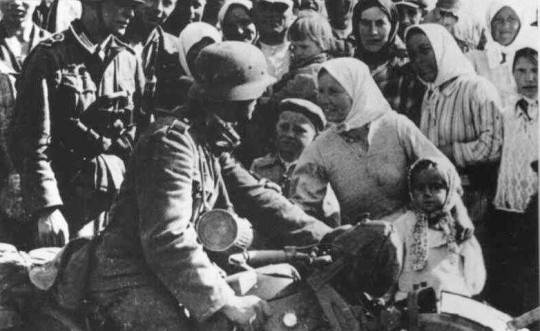
Ukraine and Foreign Soldiers

I quote

There is a ton of context and history behind this photo that should be known. I made this post yesterday, which should help explain why some Ukrainians were initially so welcoming of the Nazi invasion. Copy-pasting

This photo was taken in the city of Kharkov at the height of the Holodomor. The Holodomor refers to the 1932-33 famine that affected Soviet Ukraine, but during this time famines struck other parts of the USSR too. Most historians now believe that the Holodomor was a man-made famine that occurred due to Stalin's "collectivisation" and "dekulakization" policies. But there are still huge debates about the Holodomor's death toll, its status as a "genocide", and whether it was deliberately planned or mostly caused by Soviet incompetence. It comes up often as a point of contention between Russia and Ukraine. Denial of the Holodomor is still a thing just like Holocaust denial. Timothy Snyder (in my opinion) is one of the best researchers of the Holodomor; he believes that though the death toll is lower than most believe ("only" 3.3 million died), Stalin did deliberately starve Ukraine to target kulaks and Ukrainians.

Thus it is not surprising why Ukrainians, who suffered horrifically under Soviet rule, would welcome the Germans in 1941. Many hoped the Germans would grant them autonomy or even full independence. This was not what happened. Instead the Reichskommissariat Ukraine was set up to govern the area. The policies they enacted quickly drove much of the population into resistance. During the Nazi occupation millions of Ukrainians died. After the end of WW2, anti-Soviet resistance continued but was eventually crushed.”

How soon the Ukrainians forget, eh? Specially the Eastern ones…and also explains the antipathy of the Western Ukrainians to Russia.

Sunday, November 25

Letter to a letter to a letter

So first you had a pogrom. Then some rather bewildered and naive intellectuals looked very silly signing this horrible excuse of a letter almost excusing the pogrom. Then one signatory wrote another letter excusing herself from the letter. And then another letter came up which castigated the original letter writers.

Curious to see how this letter writing business pans out but I would hazard a guess that possibly Comrade Vijay Prashad (who seems to be the organiser of the original letter) will be thinking about what to do. Also, I would not be surprised to see more original letter signatories to drop out. In these days of internet communications, this spectacular own goal has to be very quickly disowned, otherwise you will be asked about these very awkward questions all through your career.

================

We read with growing dismay the statement signed by Noam Chomsky, Howard Zinn and others advising those opposing the CPI(M)’s pro-capitalist policies in West Bengal not to “split the Left” in the face of American imperialism. We believe that for some of the signatories, their distance from events in India has resulted in their falling prey to a CPI(M) public relations coup and that they may have signed the statement without fully realising the import of it and what it means here in India, not just in Bengal.

We cannot believe that many of the signatories whom we know personally, and whose work we respect, share the values of the CPI(M) - to “share similar values” with the party today is to stand for unbridled capitalist development, nuclear energy at the cost of both ecological concerns and mass displacement of people (the planned nuclear plant at Haripur, West Bengal), and the Stalinist arrogance that the party knows what “the people” need better than the people themselves. Moreover, the violence that has been perpetrated by CPI(M) cadres to browbeat the peasants into submission, including time-tested weapons like rape, demonstrate that this “Left” shares little with the Left ideals that we cherish.

Over the last decade, the policies of the Left Front government in West Bengal have become virtually indistinguishable from those of other parties committed to the neoliberal agenda. Indeed, “the important experiments undertaken in the State” – the land reforms referred to in the statement - are being rapidly reversed. According to figures provided by the West Bengal state secretary for land reforms, over the past five years there has been a massive increase of landless peasants in the state due to government acquisition of land cheaply for handing over to corporations and developing posh upper class neighbourhoods.

We urge our friends to take very seriously the fact that all over the country, democratic rights groups, activists and intellectuals of impeccable democratic credentials have come out in full support of the Nandigram struggle.

The statement reiterates the CPI(M)’s claim that “there will be no chemical hub” in Nandigram, but this assurance is itself deliberately misleading. This is the explanation repeatedly offered by CPI(M) for the first round of resistance in Nandigram – that people reacted to a baseless rumour that there would be land acquisitions in the area. In fact, as the Chief Minister himself conceded in the State Assembly, it was no rumour but a notification issued by the Haldia Development Authority on January 2, 2007 indicating the approximate size and location of the projected SEZ, which triggered the turmoil.

The major factor shaping popular reaction to the notification was Singur.

Singur was the chronicle of the fate foretold for Nandigram. There, land was acquired in most cases without the consent of peasant-owners and at gun-point (terrorizing people is one way of obtaining their consent), under the colonial Land Acquisition Act (1894). That land is now under the control of the industrial house of the Tatas, cordoned off and policed by the state police of West Bengal. The dispossessed villagers are lost to history. A fortunate few among them will become wage slaves of the Tatas on the land on which they were once owners.

While the CPM-led West Bengal government has announced that it will not go ahead with the chemical hub without the consent of the people of Nandigram, it has not announced any plans of withdrawing its commitment to the neo-liberal development model. It has not announced the shelving of plans to create Special Economic Zones. It has not withdrawn its invitation to Dow Chemicals (formerly known as Union Carbide, the corporation responsible for tens of thousands of deaths in Bhopal) to invest in West Bengal. In other words, there are many more Nandigrams waiting to happen.

In any case, the reason for the recently renewed violence in Nandigram has been widely established to have nothing to do with the rumour or otherwise of a chemical hub. Print and visual media, independent reports, the governor of West Bengal (Gopal Gandhi) and the State Home Secretary’s police intelligence all establish that this round of violence was initiated by the CPI(M) to re-establish its control in the area. We all have seen TV coverage of unarmed villagers barricaded behind walls of rubble, while policemen train their guns on them.

With the plans it has for the future, regaining control over Nandigram is vital for the CPI(M) to reassure its corporate partners that it is in complete control of the situation and that any kind of resistance will be comprehensively crushed. The euphemism for this in the free marketplace is ‘creating a good investment climate’.

The anti-Taslima Nasreen angle that has recently been linked to the Nandigram struggle against land acquisition is disturbing to all of us. However, we should remember that it is largely Muslim peasants who are being dispossessed by land acquisitions all over the state. There is a general crisis of confidence of the Muslim community vis-à-vis the Left Front government, inaugurated by the current Chief Minister’s aggressive campaign to “clean up” madarsas, followed by the revelation of the Sachar Committee that Muslim employment in government jobs in West Bengal is among the lowest in the country. While we condemn the attempts to utilize this discontent and channelize it in sectarian ways, we feel very strongly that it would be unfortunate if the entire anger of the community were to be mobilized by communal and sectarian tendencies within it. Such a situation would be inevitable if all Left forces were seen to be backing the CPI(M).

This is why at this critical juncture it is crucial to articulate a Left position that is simultaneously against forcible land acquisition in Nandigram and for the right of Tasleema Nasreen to live, write and speak freely in India.

History has shown us that internal dissent is invariably silenced by dominant forces claiming that a bigger enemy is at the gate. Iraq and Iran are not the only targets of that bigger enemy. The struggle against SEZ’s and corporate globalization is an intrinsic part of the struggle against US imperialism.

We urge our fellow travellers among the signatories to that statement, not to treat the “Left” as homogeneous, for there are many different tendencies which claim that mantle, as indeed you will recognize if you look at the names on your own statement.

Mahashweta Devi, Arundhati Roy, Sumit Sarkar, Uma Chakravarty, Tanika Sarkar, Moinak Biswas, Kaushik Ghosh, Saroj Giri, Sourin Bhattacharya, Nirmalangshu Mukherji, Sibaji Bandyopadhyay, Swapan Chakravorty, Rajarshi Dasgupta, Anand Chakravarty, Apoorvanand, Shuddhabrata Sengupta, Nivedita Menon, Aditya Nigam
Technorati Tags: , ,

The support further dribbles away from the pogroms in West Bengal

I talked about how these group of left leaders seem to be molly coddling the left's heinous pogrom in Nandigram in West Bengal, India. The letter was literally pathetic, and I am quite disappointed but I guess the cynical bit in me was not surprised.

More sad is that the original signatories to the letter are now seeming to drop off. Here's an email from one of them. I guess that's all right, everybody makes mistakes. So now what? Will she now fight for the peasants? and fight against the CPIM? or what exactly is the solidarity for? in what shape would that show up? Now that she has more information, what is she planning to do? Sign another petition? Or is this it? Pitiful.

From: "Susan George"<susangeorge@free.fr>
To: sanhatiindia@sanhati.com
Dear Friends, thank you for getting in touch. Please see my response and feel free to distribute if you like,

All good wishes, solidarity,

Susan George
> -----
To my friends in India:
Without wishing to place responsibility on anyone but myself, I want
to apologise for having signed the common letter concerning Nandigram and hereby withdraw my signature. I signed because the statement seemed reasonable, recognised that the signatories “could not say anything definitive”, seemed compatible with principles like left unity and non-violence which I try to uphold and, above all, had been previously signed by people I greatly admire and respect. Due to a certain urgency, I gave my name without consulting friends in India, particularly the two Indian Fellows of the Transnational Institute, Praful Bidwai and Achin Vanaik, as I ought normally to have done.

Now I have received further information from Indians who have
regretted my signature and, while exercising great comradely restraint towards me personally, have pointed to the recent tragic events in Nandigram as unequivocally the responsibility of the CPI[M]. All the communications sent to me blame the government, but having consulted other signatories, I learn that some of them have received thanks and letters of support, also from India.

While my instinct is quite naturally to side with those who have
written to me personally, particularly my TNI comrades, I regret above all that I was presumptuous enough to comment, however mildly, on a situation I was not, and am not, in any position to judge. I hope my Indian friends will forgive this presumption and accept my regrets for having signed a letter which has been used politically in India in ways I cannot condone and do not approve.

In solidarity,

Susan George

Technorati Tags: , ,

Thursday, November 22

Tariq Ali, Chomsky, Zinn and company - really praiseworthy letter! - NOT!

I bellowed against the pogroms taking place in West Bengal before. But then, you had the most amazing situation that a group of Left Leaders decided to write such a statement, given below:

Text of Statement
To Our Friends in Bengal.
News travels to us that events in West Bengal have overtaken the optimism that some of us have experienced during trips to the state. We are concerned about the rancor that has divided the public space, created what appear to be unbridgeable gaps between people who share similar values. It is this that distresses us. We hear from people on both sides of this chasm, and we are trying to make some sense of the events and the dynamics. Obviously, our distance prevents us from saying anything definitive. We continue to trust that the people of Bengal will not allow their differences on some issues to tear apart the important experiments undertaken in the state (land reforms, local self-government).
We send our fullest solidarity to the peasants who have been forcibly dispossessed. We understand that the government has promised not to build a chemical hub in the area around Nandigram. We understand that those who had been dispossessed by the violence are now being allowed back to their homes, without recrimination. We understand that there is now talk of reconciliation. This is what we favor.
The balance of forces in the world is such that it would be impetuous to split the left. We are faced with a world power that has demolished one state (Iraq) and is now threatening another (Iran). This is not the time for division when the basis of division no longer appears to exist.Noam Chomsky, author, Failed States: The Abuse of Power and the Assult on Democracy.
Tariq Ali, author, Pirates of the Caribbean: Axis of Hope and editor, New Left Review.
Howard Zinn, author, A Power Governments Cannot Suppress.
Susan George, author, Another World is Possible if, and Fellow, Transnational Institute.
Victoria Brittain, co-author, Enemy Combatant: A British Muslim’s Journey to Guantanamo and Back, former editor, Guardian.
Walden Bello, author, Dilemmas of Domination. The Unmaking of the American Empire, and Chair, Akbayan, the fastest growing party in the Philippines.
Mahmood Mamdani, author, Good Muslim, Bad Muslim: America, The Cold War and the Roots of Terror.
Akeel Bilgrami, author, Politics and the Moral Psychology of Identity.
Richard Falk, author, The Costs of War: International Law, the UN and World Order After Iraq.
Jean Bricmont, author, Humanitarian Imperialism: Using Human Rights to Sell War.
Michael Albert, author, Parecon: Life After Capitalism, and editor, ZNET.
Stephen Shalom, author, Imperial Alibis: Rationalizing US Intervention After the Cold War.
Charles Derber, author, People Before Profit. The New Globalization in an Age of Terror, Big Money and Economic Crisis.
Vijay Prashad, author, The Darker Nations: A People’s History of the Third World.


I found this letter absolutely amazing. The mealy mouthed hypocritical statement simply tells me that these leaders are basically intellectually bankrupt. More in tune with the party than the people they profess to support. To give you why I say so, just compare their statements on the BJP versus the CPI-M. There was fire and brimstone on the BJP while the statement above looks like a letter written by a kindergarten teacher to the parent of an unruly toddler. I suppose when the left does pogroms its ok for these giant intellectuals, they reserve their intelligence for the far right.

Here's another detailed rebuttal!

Esphoks.

, I am taking the liberty to copy the entire thing in full.

All this to be taken with a grain of piquant salt!!!

Tuesday, November 20

Genocide - Definitional discussions

I was having a chat with a colleague on my previous post about the fact that the Communist West Bengal, India government was conducting pogroms and part genocide against the Nandigrami's. On being asked why I said part-genocide, I pointed to the definition as given in the Article II of the United Nations Genocide Convention of 1948. I quote:

Article 2
In the present Convention, genocide means any of the following acts committed with intent to destroy, in whole or in part, a national, ethnical, racial or religious group, as such:
(a) Killing members of the group;
(b) Causing serious bodily or mental harm to members of the group;
(c) Deliberately inflicting on the group conditions of life calculated to bring about its physical destruction in whole or in part;
(d) Imposing measures intended to prevent births within the group;
(e) Forcibly transferring children of the group to another group.


Interestingly enough, somebody sent me a paper almost immediately afterwards on this issue. "Can there be genocide without the intent to commit genocide?" I quote the conclusion:

Intentionality is an important element in domestic law. The difference between homicide and murder, for example, turns on the degree of intent that is present in the act of taking life. The negligent killing of a pedestrian by a motorist is not the same as a deliberate assault that aims at the death of the victim. In the same way, I have argued in this essay, there is every reason not to ignore the role of intent in what is often called "the crime of crimes" - the destruction of an entire group of people or genocide. Proof of specific intent is necessary to find an individual guilty of genocide, and the role of intent is similarly crucial when the historian assesses an episode of mass death that occurred in the past. A large loss of life should be the point of departure for a searching investigation to determine responsibility, but in and by itself it should never be sufficient for a finding of genocide. The disregard of intentionality will create an incomplete or distorted picture and lead to false conclusions.
In the absence of a confession, the establishment of intent in mass deaths that occurred in the past is often difficult. Yet many times genocidal intent can be inferred from factors such as the scale of the atrocities committed or the deliberate targeting of victims on account of their membership in a particular group. "The emphasis on intent is important," Kurt Jonassohn has correctly noted, "because it removes from consideration not only natural disasters but also those man-made disasters that took place without explicit planning. Many of the epidemics of communicable diseases that reached genocidal proportions, for example, were caused by unwitting human actions."
61 To the victims it makes no difference whether they died because of a deadly epidemic or as a result of a planned programme of destruction. It does make a difference for the assignment of responsibility and guilt and, more importantly, for historical truth.

Now if this argument is valid, and there is sufficient logic and fact in it to say that it has validity, then it may well be that the Indian incidents of 1984 and 2002 do qualify as genocide. But the main quibble about 2007 would be the identification of Nandigrami's as a discreet unique group. Now there i have issues as the situation is extremely complicated by all news reports as to who all were there. One has heard reports about Maoists, normal villagers, opposition party members, etc. etc. being there. But to quote the other side, the communists actually claimed that all the people there were Maoists. So if the entire Nandigram operation was targeted at Maoists, then does it qualify fully as a genocide? Not sure.

JO - Journal of Genocide ResearchPB - RoutledgeAU - Lewy, GuenterTI - Can there be genocide without the intent to commit genocide?SN - 1462-3528PY - 2007VL - 9IS - 4SP - 661EP - 674

All this to be taken with a grain of piquant salt!!!

Wednesday, October 17

China's Sovereign Fund Head promises no political interference - HOW?

I dont have an issue with sovereign funds, after all, we do have public sector investments already. But this is the amusing bit.

The head of China’s new sovereign investment fund on Tuesday said the body would follow strictly “commercial goals” free of political motivation, in what appeared to be a move to counter western concerns about the potential influence of such funds.

China’s sovereign fund, which initially has $200bn (€141bn, £98bn) under management, was launched two weeks ago in an effort to squeeze greater returns from the country’s bulging foreign exchange reserves. It coincided with a push, notably in Europe, to demand greater transparency for sovereign funds amid fears they could mix investment goals with political agendas.

Given the fact that all in China is either directly or indirectly controlled by the Communist Party of China, just how will he guarantee that the shareholding or investments will be free of political motivation? Its just plain and simply silly to claim something like this. When they cant keep their own legal system free of political motivation, they are claiming that their foreign investments will?

All this to be taken with a grain of piquant salt!!!

Sunday, September 16

Communists beaten up for talking about nukes when farmers wanted to talk about food-grain shortages

I know, I know, I should not chuckle at these people's discomfort but so help me Immi, I cannot help it. Couldn't have happened to a better set of chaps! This happened in the Indian state of West Bengal which is currently governed by the Communist parties.

Read and Laugh!

The Telegraph

Bullets fly as villagers tell comrades: Give us grain, not nuclear nonsense OUR CORRESPONDENT

Durgapur, Sept. 16: Villagers faced with a food shortage today stormed a CPM nuclear-deal protest and beat up leaders, saying they wanted rice and not mumbo-jumbo on a subject they didn’t understand.

A mob of about 1,000 from the Bankura village — a CPM stronghold — then fought police with bombs and stones, prompting firing by the force that injured a schoolboy of 16 and a 23-year-old man.

The violence, coming at a time snap polls look a possibility, may confirm the Bengal CPM’s deepest fears. The state unit, which has to fight elections, favours caution while taking a decision on toppling the UPA government over the nuclear deal in contrast to the party’s central leaders, who have never contested polls.

A dozen villagers from Radhamohanpur, 250km from Calcutta, had come to the “anti-imperialism” meeting around 10am to complain to the CPM leaders against hoarding by ration-shop owners.

They erupted when panchayat chief Pabitra Mondal — who was on the dais trying to convince a crowd of 200 daily wagers about the dangers of the 123 Agreement — tried to shoo them away.

One man jumped on the dais, snatched the microphone and began abusing the assembled CPM leaders. “We’ll teach you a lesson. You can’t give us rice and wheat, instead you talk mumbo-jumbo. We don’t understand the nuclear deal, give us food,” he screamed. “Maar shalader maar (beat them up).”

The words will worry state CPM secretary Biman Bose, who has admitted that the anti-nuclear deal line lacks the force of bread-and-butter issues and will be difficult to sell to an electorate. This afternoon, he said he hadn’t heard about the incident but would find out what happened.

The news, however, spread fast across Bankura and violent protests against ration dealers were reported from elsewhere in the district, too.

In Radhamohanpur, news of the clash at the meeting drew men and women out of their homes, armed with sticks, knives, burning torches and even brooms. The dais, party banners and festoons were soon in flames.

“I had never seen a mob so angry. They dragged me from the dais and beat me. I ran to the panchayat office but they dragged me and four others out and beat us,”
Mondal said.

The police were driven out as soon as they arrived. A bigger team, together with the Rapid Action Force, later caned the mob and rescued the CPM leaders. The police said the villagers regrouped and hurled bombs and stones, injuring an officer and four others.

“We were forced to fire three rounds,” said Bishnupur subdivisional police officer Dyutiman Bhattacharjee.
The villagers claimed the police fired at least 20 rounds.

A bullet pierced the left hand of Sudhamoy Kandal and entered his stomach. Another hit schoolboy Tapas Pal.

Nine other villagers, injured in the baton-charge, are in hospital. Ten have been held.

Arjun Mondal, 30, a farmer, said: “We didn’t get rice or wheat from the ration shops for nearly a year. The dealers sell in the black market with CPM backing.”

Although Sonamukhi, the area in which Radhamohanpur falls, is a known CPM stronghold, local party officials blamed the Trinamul Congress, BJP and Maoists for the violence. Trinamul leaders denied the charge.

All this to be taken with a grain of piquant salt!!

Technorati Tags: , ,

Monday, August 6

The biggest danger to the state of India

The Naxalite terrorist problem within India is something which I have alluded to last year. As I mentioned in that essay, the challenge of such a terrorist campaign is that it hits the basic state framework from underneath, which makes it hugely difficult to address. Given a federal structure of the state, it is even more difficult to erradicate it. The Indian Government is using the Malaya method to address this terrorist campaign but not whole-heartedly. Corruption and bad politics is making the situation worse and the police are consequently getting hammered regularly. An year has passed since my essay and the situation hasnt changed much. Therein lies the answer to the author's question, because the Government and Politicians themselves are the problem.

Here's a research article on that issue.

All this to be taken with a grain of piquant salt!!!

TY - JOUR
JO - Democracy and Security
PB - Routledge
AU - Gupta, Dipak K.
TI - The Naxalites and the Maoist Movement in India: Birth, Demise, and Reincarnation
SN - 1741-9166
PY - 2007
VL - 3
IS - 2
SP - 157
EP - 188
AB - Far away from the glare of the achievements in the fields of information technology, a long festering Maoist insurgency is growing in the heart of India. The Maoists have found a strong base among the tribal people of India. By examining the history of Communist movements in India within a behavioral perspective, this article asks the question why in the past similar movements were relatively easy for the authorities to suppress, while the current Maoist insurgency is proving to be much harder to manage?


“The Naxalites occupy an ambiguous niche in history. Exemplary idealist to some, he indicates to others an expression of immature disaffection that has nothing constructive to offer. In either case, he embodies the reinstatement of man as a moral agent if only because Naxalites so radically challenge the premises of established morality.”

— Rabindra Ray (2002, p. 2–3).