Showing posts with label Canada. Show all posts

Tuesday, April 14

HMS Erebus

tumblr_nl0b9vKamx1qzix81o1_540[1] HMS ‘Erebus’ Passing Through the Chain of Bergs,1842 by Richard Brydges Beechey || Oil on canvas, 78.8 x 111.76 cm || Collection: National Maritime Museum

I have talked about this episode separately when I went to see the exhibition in the British Museum (haven't blogged the photos yet…) but when I saw this painting, it was truly earth shattering.

Here’s the story of HMS Erebus. What an extraordinary story of exploration and discovery and and the truly tragic end of the brave ship and its men.

Salutations.

Tuesday, October 15

The Effect of Education on Religion: Evidence from Compulsory Schooling Laws

Kannu

Religion has problems with modernity. Without fail. It has to happen. Religions pump out the idea that they have infallible truths which are immutable. If there is something that's immutable that is that nothing is immutable. 

But still we have morons who go about saying that their religion is the best and they are very happy to kill for it. Read a Ricky Gervais quote. Blasphemy is the idea that an all powerful god is upset because somebody said something bad about him. That's the level of thinking that religious people believe. 

So what do you do? This article gives an indication. Educate the populace and that will reduce the stranglehold of the priests and mullahs on the populace. Proof. 

Then again, a significant number of terrorists are highly educated. Counter factual there. And it's not necessary that higher education always leads to good civic behaviour. The ex president of Egypt has a doctorate. The ex president of Iran is an engineer. And both of them have religion coming out of their asses. 

Love

Baba

The Effect of Education on Religion: Evidence from Compulsory Schooling Laws
http://www.sciencedirect.com/science/article/pii/S0167268113002321


Cover image

Cover image

For over a century, social scientists have debated how educational attainment impacts religious belief. In this paper, I use Canadian compulsory schooling laws to identify the relationship between completed schooling and later religiosity. I find that higher levels of education lead to lower levels of religious affiliation later in life. An additional year of education leads to a 4-percentage-point decline in the likelihood that an individual identifies with any religious tradition. This is a reasonably large effect: extrapolating the results to the broader population would suggest that increases in schooling could explain most of the large rise in non-affiliation in Canada in recent decades.

Monday, June 3

Review of Rachel Duffett’s The Stomach for Fighting: Food and the Soldiers of the Great War

Kannu

Hope you liked the omelette of last night. Perhaps too many greens in there but have them son, it gives you a nice high protein diet with tons of vitamins and minerals. 

This is a great book review about food. Food for soldiers. Remember I told you the quote? Amateurs talk about tactics. Professionals talk about logistics. In whichever field of work son, you have to have a firm grasp of logistics. Most activities are won or lost due to logistics. In the business world as well. That's what is going to give you the reputation of competence. As and how you rise through the ranks, your job is to ensure that men materials and money are available in the right time at the right place at the right amounts. Alexander said, if I lose a battle I come back and kill my logistician. 

Details son details. That's the key. Think of the logistics of feeding a million soldiers in the middle of wartime. 

Love

Baba. 

Canadian Military History – Review of Rachel Duffett’s The Stomach for Fighting: Food and the Soldiers of the Great War by Matthew Walthert
http://www.canadianmilitaryhistory.ca/review-of-rachel-duffetts-the-stomach-for-fighting-food-and-the-soldiers-of-the-great-war-by-matthew-walthert/


Rachel Duffett, The Stomach for Fighting: Food and the Soldiers of the Great War (Manchester: Manchester University Press, 2012). 269 pages.

Reviewed by Matthew Walthert (Carleton University)

Anyone who has studied the First World War has read about the food. Complaints about bully beef, alternate uses for rock-hard biscuits, and generals fattening themselves behind the lines while the troops suffered from ration shortages at the front are common features of many Great War histories. Despite these oft-repeated stories, the enlisted man’s relationship with his food (official ration and otherwise) has not been the subject of a scholarly, book-length study, until now. Using the diaries and memoirs of the rank-and-file soldiers of the British Expeditionary Force (BEF), Rachel Duffett has put together a detailed review of ordinary soldiers’ experiences with food on the Western Front.

In The Stomach for Fighting, Duffett exposes truisms –  such as the enlisted men having better diets in the military than in pre-war, working-class England – which have crept out of sometimes self-congratulatory official statistics and histories, or overly-optimistic army ration scales. In The Last Great War, Adrian Gregory explored some of these clichés, particularly as they related to the British home front. Here, Duffett turns to the actual soldiers, whose caloric needs were being met, but were often less-than-thrilled with their food. Using a variety of published and unpublished letters, diaries and memoirs, she breaks new ground in looking not only at what (and how much) enlisted men ate, but also their reactions to their food.

Thursday, October 11

My Summer at an Indian Call Center

Son

This is an interesting read of how call centres work in India. I have personally have experience of setting these up in a variety of countries such as USA, Canada, uk, Poland, Egypt, Malaysia, India, Sri Lanka, Philippines etc etc. this behaviour that the author describes is quite common across the world. It's not just in India. 

The kids who get here and work are starting their careers. And they have an hunger, son, which is sort of humbling to see. The job is sort of thankless, to sort out your phone issues, to sell you insurance or time share holidays or or or. But these things keep on happening. 

With the increase in globalisation and connectivity, we don't see the man who is delivering our services and that is a bit of a shame as we lose touch with an important part of the value chain. But as a person interested in economics and management, remember that these people are the face of the companies to our customers. Never forget them and pay extra special attention to them, they are very very important. 

Love

Baba

My Summer at an Indian Call Center
http://m.motherjones.com/politics/2011/05/indian-call-center-americanization


Mother Jones

My Summer at an Indian Call Center

Lessons learned: Americans are hotheads, Australians are drunks—and never say where you’re calling from. Read the story everyone’s talking about.

By Andrew Marantz on Tue. July 5, 2011 2:00 AM PDT

“We were asked to hate everything Indian,” said 26-year-old Arnab (shown in his Delhi flat). Photographs: Sanjit Das/Panos

I stand flush against the window of a Toyota showroom, trying to stay in a shrinking sliver of shade. We’re on the cusp of midday, which, in Delhi in June, lasts most of the day and drives everyone into a languid torpor. I am waiting for a company cab, now an hour and a half late, to drive me across town to a call center, where an Indian “culture trainer” will teach me how to act Australian.

A uniformed guard next to me dozes on a stool, his rifle slumped in his lap. Behind the showroom window, which would be clear if two boys would stop rubbing it down with rags, a dozen red sedans glisten on a waxy white floor. On the dirt shoulder of the road, children hold hands as they walk to school.

Call centers don’t trust Indian infrastructure, as well they shouldn’t, so the company cab—typically a white Toyota Qualis—has become a standard industry perk. This morning a class of 24 new hires, myself included, will be ferried from all corners of the city to the offices of a small firm named Delhi Call Centre. For three weeks, a culture trainer will teach us conversational skills, Australian pop culture, and the terms of the mobile-phone contracts we’ll be peddling. Those of us who pass the training course will graduate to the calling floor. Our first job at DCC will be to interrupt Australians at dinner and ask them to switch phone providers. In the Delhi area alone, maybe 100,000 call-center agents make their living selling vitamins to Britons or helping Americans troubleshoot their printers. I am almost certainly the only one who acquired his conversational skills accidentally—by being born in the United States.

My phone vibrates. By the time I get it to my ear, a husky male voice is shouting in Hinglish, a rapid-fire blend of Hindi and English. “Meet at Toyota showroom!” I shout back.

“Fine sir, 20 minutes,” he replies.

I know “20 minutes” is a Hinglish phrase meaning “30 minutes,” so I call back after 40. A woman answers this time. “No problem, sir,” she says, “20 minutes only.” A sweat-and-sunblock solution drips down my forehead and stings my eyes. Behind me, the boys continue toweling the glass. The streaks they create blur into the streaks they wipe away.

Monday, June 15

Intraday value at risk (IVaR) using tick-by-tick data with application to the Toronto stock exchange

Its been a long time that I reviewed one of these papers before but reading about it made a frisson of excitement run down my spine. Ok ok, so call me sad!. Once upon a time in the dim and distant past, I used to muck around on the trading floor. One of the main problems that people on the trading side is that its tough to find out the amount of losses that you might occur. In other words, you make money when you exit a position, not when you enter a position. So you want to know when you can exit the position. So one of the biggest pieces of information that you can have is the potential level of losses that you can suffer given certain parameters such as the confidence intervals, time periods, etc.

So if somebody can sit, like Jimminy Cricket, on your shoulder, while you are trading, and keep on telling you the potential maximum loss you can suffer, then that provides you with an independent way of judging how much risk you can take. Putting it in another way, if you were a racing driver and you had a small voice in the back of your helmet constantly calculating the probability of doing a skid or ruining your tyres, then you know how much you can push your car.

Value At Risk or VaR for short, does this for you. It has faults and deficiencies, but by and large, its a good market risk management indicator. But the major problem from an operational perspective is that its a pigging pig to run and execute. It is highly data intensive and takes a bit of time to calculate, which means that you are lucky if you get it calculated on an overnight basis for large portfolio’s. So for intra-day traders, market makers and the like who operate on a tick by tick basis, its almost impossible to determine it. But this paper seems to present a good solution to this problem.

What I found interesting (and it makes perfect sense) is that there is informational content in the time distance between ticks. And its perfectly intuitive, more the difference, less is the depth and density of the market, liquidity risk has arisen (because you are missing one side or both sides of the spread) and therefore the price formation process is coasting a bit. Now how much it coasts is perhaps a discussion and research for another day. Microstructure buggering around is so much fun and just think about the sheer amount of data that you have to play around with. Nice paper, makes me go all nostalgic for the days of LISP programming and tick by tick terrabytes of data :)

Abstract:

Intradaynext term value at risk (IVaR) using tick-by-tick data with application to the previous termtorontonext term stock exchange

This paper investigates the use of tick-by-tick data for previous termintradaynext term market risk measurement. We propose a method to compute an previous termIntradaynext term Value at Risk based on irregularly spaced high-frequency data and an previous termintradaynext term Monte Carlo simulation. A log-ACD-ARMA-EGARCH model is used to specify the joint density of the marked point process of durations and high-frequency returns. We apply our methodology to transaction data for three stocks actively traded on the previous termTorontonext term Stock Exchange. Compared to traditional techniques applied to previous termintradaynext term data, our methodology has two main advantages. First, our risk measure has a higher informational content as it takes into account all observations. On the total risk measure, our method allows for distinguishing the effect of random trade durations from the effect of random returns, and for analyzing the interaction between these factors. Thus, we find that the information contained in the time between transactions is relevant to risk analysis, which is consistent with predictions from asymmetric-information models in the market microstructure literature. Second, once the model has been estimated, the IVaR can be computed by any trader for any time horizon based on the same information and with no need of sampling the data and estimating the model again when the horizon changes. Backtesting results show that our approach constitutes reliable means of measuring previous termintradaynext term risk for traders who are very active in the market.

Saturday, March 21

When even Canada bans you…

Canada is supposed to be uber liberal and when even it bans you, then you know you are really lowest of the low. Here is a roll call of the brave Canadian soldiers who have died in the line of duty and they are pretty brave chaps. So what has he been banned for? I quote from the Guardian:

A Canadian government spokesman said that the decision would not be overturned for a man regarded as an "infandous street-corner Cromwell". The description of the Respect MP may have led him to his dictionary the definition of infandous is "too odious to be expressed or mentioned".

Galloway has been deemed "inadmissible" to Canada under section 34(1) of the country's immigration act. Alykhan Velshi, a spokesman for the immigration minister, said the act was designed to protect Canadians from people who fund, support or engage in terrorism.

"We're going to uphold the law, [and] not give special treatment to this infandous street-corner Cromwell who actually brags about giving 'financial support' to Hamas, a terrorist organisation banned in Canada," said Velshi.

Even the Canadian Lebanese agreed with the banning. I dont, I think banning is wrong and freedom of speech is to be accepted in principle and in practise, but George Galloway always gets on my nerves with his shrillness and “indefagibility silly sod comment to Saddam Hussein” See here:

Wednesday, February 11

How do you like me?

So another survey seems to come out via the BBC about how countries are perceived (in terms of their influence). These chaps went out and talked to these countries:


Looks like the USA is still not on the list of countries which is on top of the likeability list. But see who are below it, Russia, Israel, North Korea, Pakistan and Iran. Hmmm, very curious, specially about the last one. I thought people would have liked Iran for showing 2 fingers to rest of the world, but the lesson I draw from the last 6 countries lack of likeability is that they really do not care about what others think of them. Which is the reason why others do not care about them.

What other bits were interesting? Well, UK was interesting, we seem to be liked much more than we are disliked????!!!!, i thought, as junior Satan, we would be equally hated around the world, but no, doing pretty well and not that much different from the first and second rates Germany and Canada. Quite chuffed about this. No?

Monday, April 14

Canadian Police are Pirates?

Heh, this was funny. The Canadian Police do not mind letting terrorists roam free on their land but let somebody protest against the killing of seals and all hell breaks loose.

On the other hand, given the fact that the Canadian police boarded the ship in international waters means that it was an act of Piracy. Now where are the French commando's?

Very amusing, I wonder what the Canadians would say to this now? lol. How funny. .

All this to be taken with a grain of piquant salt!!!

Open glorification of assasins and terrorists in Canada

The Canadian police are considered to be a bunch of muppets is well known. They mess up terrorist investigations, they cannot prosecute properly, etc. etc. In my discussions in a Canadian Muslim mailing list, nobody had a good word to say about their police and political parties. Very very few had anything good to say about Canada, their police, political parties, their foreign policy, you name it. In fact, when i circulated a note about how thankful the world is to Canada for providing peacekeeping soldiers, it landed like a lead baloon and somebody commented that it was bad, specially in Afghanistan. Well, I am not surprised reading about this.

Terrorists and Assasins are openly glorified in Canada? I wonder what Canada stands for in the first place and second, what on earth is Canada doing while letting these terrorists run rampant in its territory? Jihadi's, Tamil Tigers, Khalistani's, you name it, they are infesting that country. Guys, see the example of the UK, you let these buggers run loose and they turn on you, and the first people they cannibalise will be the minorities themselves.


All this to be taken with a grain of piquant salt!!!

Tuesday, March 25

When chocolate and counter-terrorism collide, chocolate loses

Such a sad story :(

I quote:

Except for crabby parents worried about their kids' dental bills, what could possibly come between children and chocolate?
Step forward the U.S. Bioterrorism Act of 2002.
Thanks to stringent food safety regulations imposed by the Act after the Sept. 11, 2001, terrorist attacks, "choc and awe" public visits to the famous factory operated by Rogers' Chocolates are no more.
The Act applies to Rogers because the venerable company, by now a Canadian institution with its century-old store in downtown Victoria an official National Heritage Site, has a thriving mail-order business shipping individual orders of big fat chocolates to salivating customers in the United States.

Companies that export food to the United States are required to ensure there is no risk that anyone can tamper with their products, and who knows what a 10-year-old high on sugar might do.
"Our factory had school buses full of kids pulling up all the time. Sometimes seniors, too," Rogers' president Steve Parkhill said yesterday.
"They'd all been going through without the appropriate level of security. We found it just too onerous to take the measures we would have needed in order to comply with the regulations. So we stopped. It is sad, I grant you."
The company's decision ended years of magical mystery tours that had entranced Vancouver Island kids with the up-close view of melting, dripping and pouring of chocolate, not to mention the sweet aroma and fresh samples at the end.


All this to be taken with a grain of piquant salt!!!

Wednesday, March 19

Unpalatable choices again for the USA

So here's the problem

1. To reduce greenhouse gases, dont purchase fuels which have a higher greenhouse gas content than conventional fuels. This will obviously drive down carbon emissions and greenhouse gases, or at least, not increase it over and above using normal fuels.

2. To reduce dependence on the horrible middle east and other assorted countries where oil is found, get oil from your next door neighbour who is a friend and colleague. This will reduce transport costs, you can control the output better, less risk of political instability and terrorism and so on and so forth.

Unfortunately, the oil that is produced in Canada violates the first problem. And here's where all that is wrong with American politics comes to the fore. Read and weep.


All this to be taken with a grain of piquant salt!!!

Tuesday, November 20

Minorities and Poverty - a comment

So if a first or second generation immigrant is poor, it is the host government's fault. And they have to go about doing silly things like affirmative action and equal opportunity. Oh!, and have minimum wage which is supposed to be decent. Who defines decent? As for minimum wages, there is a very hot debate going on about whether minimum wages depress employment or not. Even if it did not, the idea that a government agency will tell me how much to pay my workers is anathema to me as a libertarian!

But to go back to the article. They seem to be saying that it is to do with race. What utter rot, to put it politely. And this made me laugh, apparently there are people now called as visible minorities. I presume it refers to skin colour, social habits or such like. I would be curious to see what or who are visible majorities? or invisible majorities? But besides this frankly spectacularly stupid terminology, here is something to think about.

The mother country to Canada, United Kingdom which has a somewhat similar ethnic, immigration and minority background gives these figures for education:

Pupils achieveing 5 or more A* - C at GCSE by sex and ethnic group, 2004, England

Can you see the 2 lines which are beyond 70%? those belong to visible minorities - the Indians and Chinese, who significantly over take the visible majority (the whites, I guess). I wonder where Jews fit in? or how about Polish? But I presume they are too white to be minorities, yes?

Now look at economic activity here.

Percentage of people of working age who are economically active by ethnicity and gender, 2004

Can you see the second set of bar's? that's whites. Where are Indians? just a tiny bit below them. And so are Blacks.

How about employment (full time, part time, employment rate and unemployment rate?) see page 15 of this report. More Indian extraction women are in employment than white women. The % of full time employment is the same for Indian men and White men. Here's another interesting study on relative earnings by minority status.

For those who refer to the test of sending cv applications with different names, has anybody tried the reverse experiment? (I haven't seen it, so would love to hear about it). Send Christian and Hindu name cv's to say Hindu employers and see the results. I dare say that you will find group behaviour, that people prefer to work with people of their own kinds.

A very good overview of this entire issue of ethnicity and poverty in the UK is in this paper. See Table 4.1 and try to tell me that it is clear that just being visibly different causes differences. How is that that % differences are more than 100% across minorities? Or take a look at Table 4.4 where you will see that the hourly pay for Indians is greater than that of the white British population? Or that more Indians and Pakistani's get their income from self employment than whites as given in Table 4.6? Or in table 4.7, Indians and other ethnic groups take less benefits than whites?

Public policy should not be driven by blunt instruments such as skin colour. And why aren't people trying to push these people to setup their own businesses rather than look to the government to support them? I am totally not convinced that it is skin colour or religion that is the cause of poverty or be a significant explaining factor in government public policy. If say the government starts off doling out cash, then why on earth would they dole it out to say Indians who are earning more than Whites anyway? But then you have to start defining what a minority is, etc. etc. Wouldnt it simply be better to give cash and benefits to poor people? irrespective?

Monday, November 12

How to solve the Afghan Drug Problem?

Well, one idea is to target the economics of the trade as I have already mentioned before. But if that is thought to be too theoritical, see here for an example. But I talk about certain changes one might want to think about after some extracts:

For years, backpacks crammed with cash have slipped north into Canada, followed closely by hockey bags packed with premium marijuana skating south into Montana. A favorable exchange rate (not long ago, one American dollar bought one and a half Canadian dollars) made the smuggling profitable, and thus popular.

But last month, for the first time in more than 30 years, the two currencies were at par, matched in value, and Sunday a Canadian dollar bought $1.06 U.S. The financial tables have turned, and global economics have done what U.S. law enforcement could not: Capitalism has stopped the smugglers in their tracks.

Call it Marijuanomics 101. America borrows itself deep into the hole, ratchets up its trade deficits, buries itself beneath subprime mortgage debt, devalues its dollar with interest-rate cuts, and the currency plunges. Meanwhile, Canada’s economy booms on oil, foreign investors turn north for stability, and the “Loonie” — Canada’s dollar, named for the bird on the coin — hits a 50-year high.

Suddenly, it’s far more expensive to buy Canadian exports, legal or otherwise, and smuggling profits disappear. “It’s very simple,” said Stephen Easton, professor of economics at Simon Fraser University in Vancouver, B.C. “Canadian marijuana production costs are met in Canadian dollars, and those are worth more now.”

Previously, he said, pot growers could produce a pound of potent “B.C. bud” for about $2,000 Canadian and, with the exchange rate, smugglers buying with U.S. currency could sell it for a hefty profit south of the border. In those days, an American dollar in Canada was like a 50 percent discount card, and there’s nothing like a wholesale discount to bolster retail profits.

Production costs remain in the range of $2,000 Canadian, Easton said. But with the currencies at par, the profit margin is completely gone, unless Montanans are willing to pay 50 percent more for the prime northern bud. A smuggler’s risks and transport costs are no longer offset by profit.
“The upshot is that the Canadian marijuana is now less competitive against marijuana grown elsewhere,” Easton said. “This is a cost-driven business. With exports no longer viable, the British Columbia marijuana industry has certainly taken a hit, so to speak.”


Now of course, you wouldnt want to do the same thing with Afghanistan or Pakistan, they are far too pip-squeak a country to actually change the exchange rate. So what you do is to change the value of the drug and make it crash. Walk around with huge wads of cash in the interior of Afghanistan. And simply hand out cash and then take the drugs through to government sponsored drug distribution centres where you offer that for drug addicts at a subsidised price.

What you are doing is to remove the price differential. If the price on the London street is still high, then it negates the fun, but if the price crashes, as it would, then the Taliban will have no reason to use the drug money, they might as well as be trying to sell stones!. You could also grow large drug plants in the UK and distribute! :)

But there you go, just goes to prove that you cannot cheat the laws of economics.

All this to be taken with a grain of piquant salt!!!

Saturday, October 20

Entrepreneurship Rates and Countries

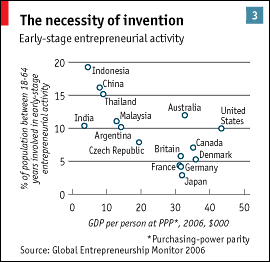
I read this very very interesting article in the Economist which made me go Hmm. The article was talking about Innovation and referred to this graph.

Photo Sharing and Video Hosting at Photobucket

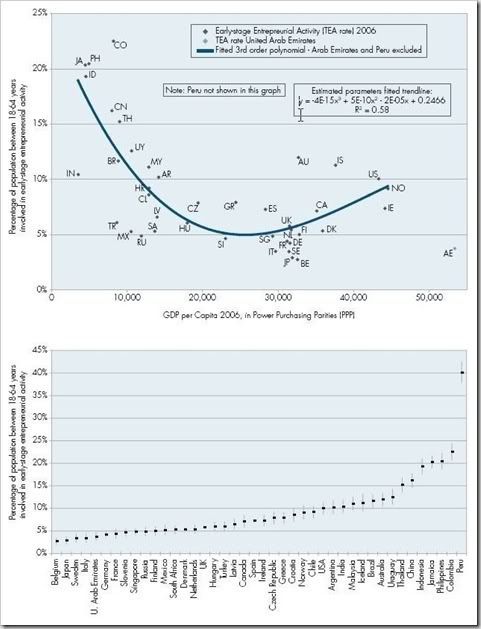
The Economist graph was simplified but the original graph shown below is much better as it provides more information.

Photo Sharing and Video Hosting at Photobucket

Based upon the curve fitting line, you will see that as countries grow and become richer, their rate of entrepreneurship reduces, and that too pretty steeply. Now why would this happen? I can hazard some guesses but no certainty. The first would be that as and how you get richer or the welfare safety net becomes better and better, the hunger for creating value progressively diminishes. The second would be that it would be easier to get jobs rather than worry about raising capital and push for a difficult enterprise. The third factor which I could think of is that as a country becomes richer, it makes it progressively difficult for entrepreneurs to be entrepreneurs, by making it more difficult to fire people, putting in more and more onerous conditions such as Health and Safety, etc. All these combine to make entrepreneurship a losing proposition.

Also, at a particular point in time, they seem to either get stuck or struggle with the next stage which seems to be more difficult. This seems to be the natural trough and despite quite a lot of efforts, the hunger is simply not there. Or it would take superhuman efforts to break through the thicket of regulations. I can well agree to this, while starting up a company is simple in European Countries, the other rules and regulations simply make it way too difficult for a person to embark on entrepreneurship.

But then there are some countries which do make a breakthrough, which is the curious aspect. To what do you ascribe the success of USA and Australia in pushing to develop entrepreneurs? Is it the national ethos? Or the innate hunger? Or their financial system? Or their education system? Why are they so much more risk taking? Or perhaps their time limited welfare system forces them to go about generating value themselves if they do not have a job?

Entrepreneurship is good, it is generating value, creating jobs and ensuring that assets are churned and made use of. Some percentage figures of population engaged in entrepreneurial activity: Indonesia has 19% of its population between 15 and 64 years as entrepreneurs, China 16% and Thailand 15%. India, Malaysia, Australia, USA, Argentina at 10-12% and then Czech, UK, Canada, Denmark, France, Germany, Japan at about 5% or below.

So Mr. Gordon Brown of the UK, what do you have to say about the fact that UK is only showing 5% of its population as entrepreneurs? What is stopping you from doing the same as Australia, USA, India (they are your ex-colonies, my friend - the child excelling over the father?)

As for Mr. Manmohan Singh of India, you need to think deeply, because you are below and behind the curve. You need to make it easier for people to start their own business. Others are leaving you to lag behind!


Monday, October 1

Some Canadian Hindus are now upset over a nude Ganesh!!!

Here we go again, ignorance compounded with stupidity and baked in a religious pie makes for a grotesque situation. Here is what I wrote to a colleague.

"People are just too sensitive indeed. I presume their objections were to the fact that a vulva and a breast were placed next to the statue. I received information about this over an email and what I replied back to them was that that they have managed to reduce Ganesh down to somebody who will be afraid of a breast and a vulva. This is a representation, just like the Shiv Linga for his Dad. I don't see them going about creating petitions for banning all statues of the Shiv Linga, do you? Truly, the feet of fanatics are firmly planted on clouds."

Each and every of those 800 people who ended up signing the petition has proven themselves to be either ignorant of Hindu representation, or capable of being swept up in passions which are not grounded in fact and plainly illiberal.

Here are some more pictures.

Technorati Tags: , ,

==========

The news story!

Ryan McCourt's sculpture The Reawakening of Ganesha, in front of the Shaw Conference Centre

Why are we so afraid to offend?

There's a big difference between respecting different cultures and caving in to illiberalism

MARGARET WENTE

September 29, 2007

Are you offended by the jolly little object you see reproduced on this page? Do you think it's sacrilegious? Or do you just wonder what it is? FYI, it's a sculpture of the Hindu elephant god Ganesha, as interpreted by Edmonton artist Ryan McCourt. Ganesha, patron of artists and writers, is among the most beloved of the Hindu deities. You can recognize him by his elephant head and the pot belly, which signifies prosperity.

Mr. McCourt has spent years studying traditional Indian art. Last November, four of his Ganesha sculptures were installed in front of the Shaw Conference Centre in Edmonton after he won a public competition. The figures are about the size of a baby. Some people - including Hindus - like them. But some more conservative Hindus think they're improper. For example, Ganesha is shown nude. One sculpture shows him with a trident (too warlike) and also depicts an abstract female breast and vagina.

Soon after the pieces were installed, says Mr. McCourt, "I started getting phone calls." Over coffee at Tim Hortons - "very Canadian neutral ground" - he met with a four-man delegation from the Hindu Society of Alberta. He pointed out that the history of Hindu iconography is extraordinarily rich and various, and that Ganesha is sometimes shown nude or with a trident, and that other Hindus, including a priest he knew, were not offended. Besides, the installation was temporary, and would soon be gone.

His critics weren't appeased. Earlier this month they got 700 people to sign a petition demanding that the exhibit be shut down. Edmonton's mayor, Stephen Mandel, caved without a whimper. "We're quite disappointed that the event happened and it insulted the Hindu community," he said. He ordered the offending objects removed immediately.

The mayor, of course, was quite wrong. Mr. McCourt's sculptures did not insult the Hindu community. They insulted a small but vocal conservative religious group that is about as representative of Hindus as Hassidic Jews are of Jews.

"I sense a slight whiff of racism when I read these headlines saying, Alberta Hindus Are Offended," says Mr. McCourt. "It's a kind of politically correct racism." He also wonders what would happen if 700 Christian fundamentalists petitioned the mayor to shut down the Gay Pride parade.

The answer is that people would be outraged - at the fundamentalists. But when the sensibilities of religious and ethnic minorities are involved, you can't be too careful. You may recall how everyone deplored the callous insensitivity of those cartoonists who made fun of Mohammed. So God forbid we should permit irreverence (even if it's unintended) toward a god with the head of an elephant.

In other circumstances, we're rightly proud of our secular society. We've spent the past 300 years, sometimes bloodily, separating church and state. Most of us don't think twice about mocking the more absurd extremes of Christianity. We are delighted to pour contempt and scorn all over the deluded idiots who think that dinosaurs strode the Earth with Man. Most of us roll our eyes at people who believe that every word in the Bible is the literal truth as revealed by God. But we're horrified of treading on the delicate sensibilities of people who worship elephant gods, to say nothing of people who believe the Koran was dictated by Allah to a seventh-century Arabian merchant.

Forgive me if I've been reading too much Christopher Hitchens. But there's a big difference between accommodating ethnic diversity and allowing the clamorous demands of conservative faith groups back into the public square. There's a big difference between respecting different cultures and caving in to illiberalism and superstition.

Yet that's usually our first impulse. Is a small group of Hassidic Jews offended by the sight of spandexed females sweating at the Y? Then put in frosted windows! Are some Muslims offended by images of pigs? Then ban storybooks about pigs from classrooms! (Don't laugh. It happened in Britain.) Do some Muslim students demand prayer rooms in universities? Then provide them!

This deference to the tender feelings of minorities (and minorities of minorities, at that) strikes me as a double standard of the most astonishing kind. And the idea that they have a right not to be offended strikes me as both dangerous and condescending. We treat them as if they're too fragile to endure the give and take of a robust democracy. The result is that, in the name of liberalism and tolerance, we give in to the forces of intolerance.

Then again, who wants to be called a racist? That's what happened to Bruce Allen, the Vancouver radio commentator who notoriously said, "If you choose to come to a place like Canada, then shut up and fit in." (He also said much else, which was widely misinterpreted because he said it badly.) How dare he threaten the sacred texts of diversity! The Sikhs (well, some of them, anyway) were outraged. So was somebody who claimed to represent the Jews, and somebody else who claimed to represent the Chinese. Several politicians demanded that Mr. Allen be fired from the Olympics committee he sits on, because he was a disgrace to Canada, and hundreds of people complained to the CRTC. They didn't like his opinion, so they thought he should lose his job.

Indo-Canadians Are Offended, said the headlines, more or less. But that was no more true than it was in the case of the sacrilegious elephant god. As it turns out, plenty of Indo-Canadians weren't at all offended. "We agree with not only the right to say it, but even with the substance of what he said," says Ron Bannerjee of the Hindu Conference of Canada. "I'm afraid I've inflamed many of the so-called members of the Indo-Canadian community by saying that."

All I can say is that if that's the case, then good for him. Maybe what we need right now is not less speech that might offend someone, but more of it.

mwente@globeandmail.com

http://www.theglobeandmail.com/servlet/story/LAC.20070929.COWENT29/TPStory/?query=wente

Sunday, September 23

The seabed land grab continues

Before we had many debates around the Northwestern Passage, then the Russians went in and claimed the Arctic Ocean sea bed as their own and planted a flag. (graphic from BBC)

Arctic map

Another area which has been under debate for a long time is the Caspian sea! See this map which shows the debates by the surrounding states. Its not just sturgeon but also oil which is the reason for the fights.

The image “http://www.wws.princeton.edu/wws401c/1998/caspiandivision.gif” cannot be displayed, because it contains errors.

This map shows the potential for disputes as the war for resources underwater heats up. See how many countries overlap!

http://www.oceansatlas.org/unatlas/-ATLAS-/IMAGES/HIGH/m302.jpg

The UN Commission on the Limits of the Continental Shelf has poked a hornet's nest by asking countries to submit their claims. The submissions can be done on the basis of nice quiet diplomatic debates and civilised agreements such as this one between France, Ireland, Spain and the United Kingdom of Great Britain and Northern Ireland, or otherwise.

Now the British are claiming thousands of square miles of the sea floor around the Falkland Islands, Ascension Island and Rockall. (Check out the picture of Rockall!, very amusing, its just a poxy rock, but that allows the UK to claim a big chunk of the sea floor!) That has immediately made the Argentinians go up in smoke, remember they have had a spat with the UK before over these islands.

The Argentinians call them as the Malvinas and there is a very long history of competing claims and control by various countries. And while before it was nationalism and a desire for some sheep farming land, now the fact that the sea areas can have resources - specially oil - means that the issue is more serious now!

Be prepared for big furballs. Watch this space, I will be tracking this.

Tuesday, July 24

DNA - World - Singhs and Kaurs are not welcome in Canada - Daily News & Analysis

DNA - World - Singhs and Kaurs are not welcome in Canada - Daily News & Analysis

I am constantly amazed at the propensity of governments to proclaim laws which go slam bang in the face of common sense. See the above example. Why would you have such a complicated law in the first place?Tangentially, it reminds me of the extreme sensitivity that Koreans have with their names and the most amazingly complex history behind personal names of Koreans. I made a big boo boo when I visted Seoul once, but that's besides the point. Here, read a bit of a background on this very interesting issue.