Showing posts with label economy. Show all posts

Tuesday, January 5

Was America’s Economic Prosperity Just a Historical Accident?

Now here's something that both you and I will face son. I've got about 50% of my life left. You have about 80-85% of your life left. You will most probably see in the next century. I'll be with you till about 2050 or so. 

What kind of society will we be living in? Where will be the jobs? Where is the money? Which country will be safe to work and raise your children? 

In particular son, two questions for you. What kind of job or work should you do? And what kind of financial security should you aim for? You are already saving and investing in blue chip companies so that's very good. One thing which you need to start thinking about is to be an entrepreneur and generate money. That is a good thing to do. You already have the skills and will be a good aspect to pick up. 

Jobs are plenty but high paying intellectual roles are going to be rarer and rarer. Competition higher and higher. Disruption more and more. 

I do agree that the growth rates are going to be depressed for many years if not at least 2 decades at least. Why? Because that's how long it will take to get the debt problem under control at a minimum. Our population productivity sucks. Supply of most inputs is constrained. The emerging markets and OECD countries have frankly bought as many fridges cars and smartphones. That's not going to move the dial that much. So growth will be constrained. 

So aim to get yourself where the driver is efficiency. Where you can make things at a lower cost. When revenues cannot grow then you go after productivity growth and cost reductions. 

Keep this in mind son. Take advantage of it. And keep an eye out on opportunities to make money and gain experience. Keep fighting son. 

Love

Baba 


Was America’s Economic Prosperity Just a Historical Accident?
http://nymag.com/news/features/economic-growth-2013-7/?mid=longreads


Illustration by Mario Hugo  

Picture this, arranged along a time line. 

For all of measurable human history up until the year 1750, nothing happened that mattered. This isn’t to say history was stagnant, or that life was only grim and blank, but the well-being of average people did not perceptibly improve. All of the wars, literature, love affairs, and religious schisms, the schemes for empire-making and ocean-crossing and simple profit and freedom, the entire human theater of ambition and deceit and redemption took place on a scale too small to register, too minor to much improve the lot of ordinary human beings. In England before the middle of the eighteenth century, where industrialization first began, the pace of progress was so slow that it took 350 years for a family to double its standard of living. In Sweden, during a similar 200-year period, there was essentially no improvement at all. By the middle of the eighteenth century, the state of technology and the luxury and quality of life afforded the average individual were little better than they had been two millennia earlier, in ancient Rome.

Then two things happened that did matter, and they were so grand that they dwarfed everything that had come before and encompassed most everything that has come since: the first industrial revolution, beginning in 1750 or so in the north of England, and the second industrial revolution, beginning around 1870 and created mostly in this country. That the second industrial revolution happened just as the first had begun to dissipate was an incredible stroke of good luck. It meant that during the whole modern era from 1750 onward—which contains, not coincidentally, the full life span of the United States—human well-being accelerated at a rate that could barely have been contemplated before. Instead of permanent stagnation, growth became so rapid and so seemingly automatic that by the fifties and sixties the average American would roughly double his or her parents’ standard of living. In the space of a single generation, for most everybody, life was getting twice as good.

At some point in the late sixties or early seventies, this great acceleration began to taper off. The shift was modest at first, and it was concealed in the hectic up-and-down of yearly data. But if you examine the growth data since the early seventies, and if you are mathematically astute enough to fit a curve to it, you can see a clear trend: The rate at which life is improving here, on the frontier of human well-being, has slowed.


Thursday, April 2

Why 'secular stagnation' matters

Kannu

A fascinating debate has been running over the past 3 days. Read this little article to get a summary. 

I've got another point here. People aren't including the impact of technology and automation. More technology and automation and more the economic activity goes outsides the purview of economic levers. 

Secondly, why isn't there any mention of productivity? After all, if you can improve productivity by doing more investments and education, then secular stagnation can be addressed. 

Anyway. Fascinating minds at work son. Hugely influential and amazing debate. Reminds me of the time I read the proceedings of the Bretton Woods agreement. Keynes was the guru then. 

Love

Baba

I saw this on the BBC News App and thought you should see it:
Why 'secular stagnation' matters

A debate between three major economists highlights a key macroeconomic issue.

Thursday, February 6

Do Elections Matter for Economic Performance?

Do they? do you feel lucky punk? go on, elect your leaders in a corrupt election, make my day

In mature democracies, elections discipline leaders to deliver good economic performance. Since the fall of the Soviet Union, most developing countries also hold elections, but these are often marred by illicit tactics. Using a new global data set, this article investigates whether these illicit tactics are merely blemishes or substantially undermine the economic efficacy of elections. We show that illicit tactics are widespread, and that they reduce the incentive for governments to deliver good economic performance. Our analysis also suggests that in societies with regular free and fair elections, leaders do not matter for economic growth.

that’s the key thing which so many people don't understand, they put their faith in single charismatic leaders and forget about institutions. While leaders do matter to some extent, but if you have regular free and fair elections where leaders are held to account, the leaders tend to focus on making their people better via economic growth. Look at India, the development story always helps. In the UK, the morons in the Labour govt starting with that blithering nincompoop Gordon Brown was thrown out when they screwed up the economy something bad.

good paper.

Thursday, August 23

Some reflections on the financial crisis

I was thrown into the wolves yesterday. In an academic conference full of economics, finance, politics, philosophy and journalist professors from across the world, this uglyass suited fat old git of a banker shambled in and decided to bollox up their lives. Apparently, for the past three years, they were debating how to fix the finance sector and then decided to invite me in to discuss the financial crisis, (i) what has gone wrong, (ii) what needs fixing, and (iii) how to put things right. Here are some thoughts.

  • Andrew Lo compared the search for reasons and fixes to the Financial Crisis to Rashomon, I would much rather talk about the Blind Men of Hindoostan. We are observing this from London, so the reasons are bit broader than what has been summarised nicely by Andrew Lo and others.
  • What's the problem and what's a symptom? Low interest rates? loose fiscal and monetary policy? housing bubble? subprime mortgage issues? liquidity and solvency issues? originate to distribute? fraud? reward and compensation policies in investment banking? repeal of Glass Stegal? Hubris? Too big to fail? regulatory failure? corporate governance? capital structure discussions - preference setting off debt against tax versus equity, regulatory capture and political contributions, inequalities? global capital imbalance and the dollar as reserve currency? govt push for housing - Freddie and Fannie mae, BSDs and Masters of Universe, risk transfer and risk management policies?
  • What needs fixing? All of the above
  • How to put things right? capital adequacy - Basel III, recapitalisation of banking system, the breakup of investment and retail banks - reintroduction of glass steagal, improved regulatory oversight, changes in comp policy, CoCo bonds, living wills, shrinking banks, etc. etc.

The above were my notes. So after the initial discussions, then questions came fast and furious. Im afraid I was very disruptive. Somebody asked me if the additional regulations were appropriate. I said, yes, the answer is yes. Is it going to avoid another crisis? No, its like saying passing laws against murder and theft will stop murder and theft. Plus all those regulations are actually increasing the possibility that there will be less money to go around.

A professor asked me, what should we teach our students? I said, I don't know about students as I am not a full fledged academic, but I look at my son and tell you the four things I taught him

  1. How to survive on his own, cooking, killing, hunting, growing vegetables, DIY, etc.
  2. Personal financial management, how to manage his own finances and how to be self sufficient, prudent with money, etc.
  3. I have taught him that he needs to have a technical skill, something that he can rely on somebody paying for that all through his life. That can be coding, that can be accounting, that can be engineering, that can be copywriting, something that somebody can and will pay for what you do. If nothing else, learn to dig ditches.
  4. Finally, learn how to sell. Everybody sells. Everybody. Some sell services, some sell ideas, some sell products, some sell themselves. Everybody needs to learn how to sell.

The last thing pisses me off, why don't business schools teach selling? eh? eh? There are about 150 business schools here in the UK. Do you know how many business schools teach sales? THREE. Warwick, Cranfield and Portsmouth. WTF? What do you think business is if its not revenue generating and selling? MORONS! I met with some people in Cranfield and I was pleasantly surprised to note their lovely sales programme. I am going to do something with them..

But the bottom line I told the conference. Remember that banking is an intermediary. And stop ascribing morality to economics. It takes money from people who have excess and gives it to who need it. If you want to reform it, then remove the need for banking.

When people were fulminating about derivatives, I asked a question, how many people here have insurance? Why are you taking insurance? Go home and stop taking insurance. If you cant, then dont fulminate against other people who are looking to protect their assets. But but, you cant slice and dice and and and. I said, you guys are confusing the underlying desire to protect with an instrument. Its like saying you need to ban ferraris because they drive too fast. That’s not going to change the underlying need to protect. People will find some other way to protect themselves.

Then I scared the crap out of them and said, you guys are all having academic pensions and think you are safe from the markets, eh? Let me wake you up, each and every one of you is going to have a poor retirement because there is no money in the pot. The deficits will be made up by the governments squishing your returns and asking you to pay more and work longer. That scared the crap out of them. heh.

My final point was, let the market be (I said I was a libertarian and that prompted some air whistling through the teeth and when I said that that was based on my religious principles – my Indian heritage tells me that I am responsible for my salvation through my deeds – that confused the heck out of these chaps, lol, they cant really complain about my religious beliefs while being against the tea party like / ayn ryandian individual rights business..hehehehehe). You complained about structured products, well, the crash made sure that pretty much a majority of people making and selling structured products have lost their jobs and the products arent there.

But bottom line is, we cannot live like this, spending too much, consuming too much. I said that we are heading for another crash as every sector of the economy, individual, household, corporate and government is trying to deleverage, so there is no demand. Don't assume that the business cycle is banished. So demand zero. ANy external shock like war or natural catastrophe is going to screw up our lives. Which I will welcome, I am hoping for a crash. Pretty much, I am happy to plonk down some money that in the next 5-7 years, we will have another crash/recession. And then hopefully people will wake up and reduce spending, reduce demands, reduce consumption, reduce materialism.

Here’s a great cartoon.

Sunday, June 17

If young Americans knew what was good for them, they would all be in the Tea Party.

This great lecture, at end of the day, will come and go, and the moron Politicians and the even more idiotic public will simply ignore it. People do not realise that they are spending money which belongs to our children and our grand children. Did you know that the current conservative government has taken on more debt in 4 years than the entire Labour government in the last time over 13 years? What the hell is happening?

Some extracts

The heart of the matter is the way public debt allows the current generation of voters to live at the expense of those as yet too young to vote or as yet unborn. These mind-boggling numbers represent nothing less than a vast claim by the generation currently retired or about to retire on their children and grandchildren, who are obligated by current law to find the money in the future, by submitting either to substantial increases in taxation or to drastic cuts in other forms of public expenditure.

If young Americans knew what was good for them, they would all be in the Tea Party.

The present system is, to put it bluntly, fraudulent. There are no regularly published and accurate official balance sheets. Huge liabilities are simply hidden from view.

Not even the current income and expenditure statements can be relied upon in some countries. No legitimate business could possible carry on in this fashion.

Western democracies are going to carry on in their current feckless fashion until, one after another, they follow Greece and the other Mediterranean economies into the fiscal death spiral that begins with a loss of credibility, continues with a rise in borrowing costs, and ends as governments are forced to impose spending cuts and higher taxes at the worst possible moment.

In this scenario, the endgame involves some combination of default and inflation. We all end up as Argentina.

Sunday, September 18

Pimp My Ride

Kannu


I forgot to say that I like your new haircut. But I still think I can give you a better haircut than those poxy hairdressers. One day you will realise the benefits of cutting your own hair, its liberating, it saves a heck of a lot of time, it saves money and best of all, it will manage to upset a whole bunch of women in your life and that's fun. But at this moment, when you are in teenagerhood, hair has a vastly bigger significance. The fate of the world depends upon the hair style. That is fine, that's what the teenaged girls are also looking for. But then when you realise that hair is nothing but a holdover artefact from our evolutionary times to keep us warm (its fur after all), the importance level reduces. What actually matters is what's below the hair rather than the hair itself. Thankfully, you are a smart fellow so I am also happy with that. Remember what I keep on saying, everything evens out, if you have less hair to comb, you have more face to wash.


But that's not the point of this missive, this is about libertarianism. This is the operating philosophy that I follow. There are literally thousands of philosophies out there, and you can judge them on several basis. Here is a very short survey you can do to find out what your operating philosophy is all about.
http://www.theadvocates.org/quiz


Here's what this website defines libertarianism as: Libertarians support maximum liberty in both personal and economic matters. They advocate a much smaller government; one that is limited to protecting individuals from coercion and violence. Libertarians tend to embrace individual responsibility, oppose government bureaucracy and taxes, promote private charity, tolerate diverse lifestyles, support the free market, and defend civil liberties.


I know you are still young, but I hope to raise you and Diya by those principles. We make you take responsibility over your own career and choices, there isnt much bureaucracy other than few things like having to water the garden and to empty the dishwasher, no taxes, you are trained on how to manage your own money and are doing well on your investments, not doing much on the charity side for some strange reason, but we will work on that, we are happy with what you want to do with your lifestyle - girls, whatever, you have had the choice to imbibe in alcoholic drinks (but not ciggies) etc. etc.


Anyway, here is a story about a presidential candidate in the USA and how he is a pure libertarian. Interesting views. Obviously he doesnt have a hope in hell's chance of becoming the president, but those views exist and hopefully the huge overhang of debt that we have will be removed.


Check out the austrian school of economics here, its an interesting read. http://en.wikipedia.org/wiki/Austrian_School
One thing which bothers me is the ability of running this giant ponzi scheme (http://en.wikipedia.org/wiki/Ponzi_scheme) of using debt to pay for today's spending while future generations pick up the bill. At this moment, the amount of debt being racked up by all the bloody governments means that YOU and DIYA will be paying for our mistakes for couple of generations. Learn from our mistakes, son. Never let governments become too big, they steal your money and they steal your liberty. Friedman said this, "If you put the federal government in charge of the Sahara Desert, in 5 years there'd be a shortage of sand.". Some more great quotes from him here. http://www.brainyquote.com/quotes/authors/m/milton_friedman.html

Happy reading son.


Love


baba


Pimp My Ride
http://www.tnr.com/print/article/representative-ron-paul-2008-republican-primary-president


The first thing I learned from driving around Nevada with Ron Paul for a couple of days: People really hate the Federal Reserve. This became clear midway through a speech Paul was giving to a group of Republicans at a community center in Pahrump, a dusty town about 60 miles west of Las Vegas. Pahrump is known for its legal brothels (Heidi Fleiss lives there), but most of the people in the audience looked more like ranchers than swingers. They stood five deep at the back of the room and listened politely as the candidate spoke.

Until Paul got to the part about the Fed. “We need a much better monetary system,” he said, a system based on “sound money, money that’s backed by something.” Paul, who is small and delicate and has a high voice, spoke in a near monotone, making no effort to excite the audience. They cheered anyway. Then he said this: “The Constitution gives no authority for a central bank.” The crowd went wild, or as wild as a group of sober Republicans can on a Monday night. They hooted and yelled and stomped their feet. Paul stopped speaking for a moment, his words drowned out. Then he continued on about monetary policy.

Wow, I thought. The constitutionality of a central bank is not an issue you see on many lists of voter concerns. (How many pollsters would think to ask about it? How many voters would understand the question?) Yet a room full of non-economists had just responded feverishly when Paul brought it up. Hoping for some context, I went outside and found a Paul staffer. He didn’t sound surprised when I told him about the speech. “It’s our biggest applause line,” he said.

Our biggest applause line? There are two ways to interpret a fact like that: Either the Ron Paul movement is more sophisticated than most journalists understand, or a lot of Paul supporters are eccentric bordering on bonkers.

One thing you can say for certain: The crowds at Ron Paul rallies aren’t coming to be entertained. Stylistically, a Paul speech is about as colorful as a tax return. He is the only politician I’ve ever seen who doesn’t draw energy from the audience; his tone is as flat at the conclusion as it was at the beginning. There are no jokes. There’s no warm-up, no shout-out to local luminaries in the room, no inspiring vignettes about ordinary Americans doing their best in the face of this or that bad thing. In fact, there are virtually none of the usual political clichés in a Paul speech. Children may be our future, but Ron Paul isn’t admitting it in public.

Paul is no demagogue, and probably couldn’t be if he tried. He’s too libertarian. He can’t stand to tell other people what to do, even people who’ve shown up looking for instructions. On board the campaign’s tiny chartered jet one night (the plane was so small my legs were intertwined with the candidate’s for the entire flight), Paul and his staff engaged in an unintentionally hilarious exchange about the cabin lights. The staff wanted to know whether Paul preferred the lights on or off. Not wanting to be bossy, Paul wouldn’t say. Ultimately, the staff had to guess. It was a long three minutes.

Being at the center of attention clearly bothers Paul. “I like to be unnoticed,” he says, a claim not typically made by presidential candidates. “That’s my personality. I see all the excitement and sometimes I say to myself, ‘Why do they do that?’ I don’t see myself as a big deal.” Ordinarily you’d have to dismiss a line like that out of hand—if he’s so humble, why is he running for president?—but, in Paul’s case, it might be true. In fact, it might be the key to his relative success. His fans don’t read his awkwardness as a social phobia, but as a sign of authenticity. Paul never outshines his message, which is unchanging: Let adults make their own choices; liberty works. For a unified theory of everything, it’s pretty simple. And Paul sincerely believes it.

Most Republicans, of course, profess to believe it too. But only Paul has introduced a bill to legalize unpasteurized milk. Give yourself five minutes and see if you can think of a more countercultural idea than that. Most people assume that the whole reason we have a government is to make sure the milk gets pasteurized. It takes some stones to argue otherwise, especially if nobody’s paying you to do it. (The raw-milk lobby basically consists of about eight goat-cheese enthusiasts in Manhattan, and possibly the Amish.) Paul is pro-choice on pasteurization entirely for reasons of principle. “I support the right of people to drink whatever they want,” he says. He mocks the idea that “only government can make sure we’re safe, so we need the government to protect us. I don’t think we’d all die of unsafe food if we didn’t have the FDA. Someone else would do it.” If you know Ron Paul primarily from watching the Republican debates, you probably assume he spends most of his time ranting about September 11 and the Iraq invasion. In fact, his real passion is Austrian economics. More even than the war, Paul despises paper currency, which he considers a hoax, “fiat money.” He can become emotional talking about it. Caught in traffic in downtown Vegas on the way to an event, Paul looked out the window at the casinos and mused aloud: “Can you imagine when all those slot machines used real silver dollars? All that silver … ” His words trailed off, as in a pleasant daydream.

Paul trusts coins, and he has bought them all his life, first as a childhood collector, then as an investor. During the 1980s, as he ran unsuccessfully for the Senate and the White House, he became involved in a coin business, Ron Paul Coins. Numismatics, he says, is a labor of love. “You only make five or ten dollars a coin. You’ve got to sell a lot of coins to get rich. I was just promoting something I believe in.” It’s a rare person who admits something like this. Everybody knows the gold standard is for cranks. It’s complicated, unwieldy, and basically incompatible with the modern world. Worse, it’s boring. Paul doesn’t care. “It’s been over one hundred years since that issue has been talked about in a presidential election,” he told me with apparent pride.

Over dinner at the coffee shop in the Saddle West Hotel, Casino, and RV Resort, Paul and his staff talked about little else. There were eight or nine of us at the table, with the 72-year-old obstetrician-congressman at the head in a gray suit, working over a chicken platter and discussing hard money. It had the feel of a familiar conversation, a dialogue that doesn’t really end but that never diminishes in intensity. At one point, Paul’s assistant checked his BlackBerry for the latest gold and silver prices and read them aloud to the table.

For Paul, the original sin in monetary policy took place in 1933, when FDR uncoupled the currency from gold. This removed limits from federal spending, allowing Congress an endless supply of money it could print at will, while leaving citizens vulnerable to the inflation that inevitably resulted. But, worst of all from Paul’s point of view, it was compulsory. Private currencies are forbidden, so Americans had no choice but to participate. The whole system is a mandatory Ponzi scheme, built on faith in the government. Except that, now that the bottom has dropped out of the dollar, it’s clear there’s no reason to have faith in the government or its money.

That’s Paul’s essential argument. His solution: allow competing currencies.

If individuals want to circulate gold or silver coins (or scrip backed by metal reserves), let them. Give citizens the chance to decide which money they trust.

The owners of NORFED, an Indiana coin company, gave it a shot. The company minted and sold thousands of silver Ron Paul dollars, complete with the candidate’s face in profile, before federal agents showed up in November and confiscated their entire remaining inventory. In its affidavit for a search warrant, the FBI accused NORFED of trying to “undermine the United States government’s financial systems by the issuance of a non-governmental competing currency for the purpose of repealing the Federal Reserve and Internal Revenue Code.” That may be a crime, but it’s also pretty close to Ron Paul’s stump speech.

It’s hard to think of a presidential candidate who’s ever drawn a coalition as broad as Ron Paul’s. At any Paul event, you’re likely to run into self-described anarcho-capitalists, 9/11-deniers, antiwar lefties, objectivists, paleocons, hemp activists, and geeky high school kids, along with tax resisters, conspiracy nuts, and acolytes of Murray Rothbard. And those are just the ones it’s possible to categorize. It’s hard to say what they all have in common, except that every one is an ideological minority—or, as one of them put it to me, “open-minded people.” To these supporters, Paul is a folk hero, the one person in national politics who doesn’t judge them, who understands what it’s like to be considered a freak by straight society.

Which is odd, because, in person, Paul doesn’t seem like a freak. He seems like someone’s grandfather. I first met up with Paul after a rally at University of Nevada, Las Vegas. He apparently hadn’t known I was coming but accepted my arrival with Zen-like calm, welcoming me into the seat next to him in the minivan and offering me baked goods from a plate on his lap. We were both finishing our brownies when he mentioned they’d been baked by a supporter. I stopped chewing. Where I work, this is a major taboo (Rule One: Never eat food sent by viewers), and my concern must have shown. Paul grinned. “Maybe they’re spiked with marijuana,” he said.

If so, it would have been his first experience with illegal drugs. Though Paul argues passionately for liberalizing marijuana laws and is beloved by potheads (Timothy Leary once held a fund-raiser for him), he has never smoked pot himself. He sounded shocked when I asked him. “I have never seen anyone smoke marijuana,” he said. “I don’t think I’d be open to using it.” For some people, libertarianism is the philosophical justification for a zany personal life. Paul, by contrast, describes his hobbies as gardening (roses and organic tomatoes) and “riding my bicycle.” He has never had a cigarette. He doesn’t swear. He limits his drinking to an occasional glass of wine and goes to church regularly. He has been married to the same woman for 50 years. Three of their five children are physicians.

Ron Paul is deeply square, and every bit as deeply committed to your right not to be. “I don’t gamble, but I’m the gambler’s best friend,” he says, boasting of his support for online casinos. He is a Second Amendment absolutist who doesn’t own a gun. “I’ve only fired one a couple of times in my life. I’ve never gotten around to killing anything.” It’s an impressively, charmingly principled world view, though sometimes you’ve got to wonder how much Paul has in common with many of the people who support him.

Before we left the speech in Pahrump and headed across the state, I’d called a friend of mine in Carson City named Dennis Hof. Dennis owns the Moonlite BunnyRanch, probably the most famous legal brothel in the country and the setting for an HBO series called “Cathouse.” Dennis isn’t very political, but he’s smart, and I suspected he might lean libertarian. I told him Ron Paul was speaking the next morning in Reno. He said he’d drive down to see it.

I wasn’t planning on showing up at Paul’s press conference with a bordello owner and two hookers, but unexpected things happen on the road.

I’d arrived with the campaign at the Best Western Airport Plaza Hotel in Reno at two in the morning the night before, and, at some point while I was sleeping, the power in the hotel went out, disabling my alarm. By the time I woke up, Paul and his staff had left. So I called Dennis for a ride. He was there in ten minutes, in an enormous stretch limo with a BunnyRanch logo on the side. He’d brought two of his girls, Brooke and Air Force Amy, as well as his driver, a middle-aged man in a cowboy hat and Western wear. It was a conspicuous group.

Probably because they didn’t fully understand who I was coming with, the Paul people waved the limo through a roadblock outside the auditorium and brought us in through the loading dock. A Paul aide informed us that press conferences are for press only. That’s us, said the girls, and we walked right in.

The other, actual journalists looked confused. Dennis is built like a linebacker and was dressed entirely in black. Brooke and Air Force Amy looked like hookers because they are. All three slapped on Ron Paul stickers (“we could use these as pasties,” Air Force Amy said, giggling) and sat near the front. Pretty soon, Paul showed up and did his 15 minutes on liberty and Austrian economics. If he noticed there were prostitutes present, he didn’t show it.

The first time I heard Paul talk about monetary policy, I’d felt like a hostage, the only person in the room who didn’t buy into the program. Then, slowly, like so many hostages, I started to open my mind and listen. By the time we got to Reno, unfamiliar thoughts were beginning to occur: Why shouldn’t we worry about the soundness of the currency? What exactly is the dollar backed by anyway? And, if the gold standard is crazy, is it really any crazier than hedge funds? I’d become Patty Hearst, ready to take up arms for the cause, or at least call my accountant and tell him to buy Krugerrands. I looked over at Dennis and the girls. They looked like they might be having the same thoughts.

Once the press conference ended, Paul left to do interviews with local TV reporters. Dennis and the girls stood at the podium and had their pictures taken under the Ron Paul sign. Air Force Amy hammed it up. What I really want more than anything, she told me, is to get my picture taken with Dr. Paul. She meant it.

I considered trying to explain to her that I was not actually affiliated with Ron Paul, merely writing about him for a political magazine back in Washington. But I didn’t. Instead, I led all three of them into the back room where Paul was doing his interviews.

Paul was talking on camera and never saw us. But his staff was on high alert. They looked more uncomfortable than I have ever seen a campaign staff look. Air Force Amy didn’t appear to notice. Dressed in red, her Dolly Parton hairdo and 36DDs at full attention, she sidled up to Lew Moore, Paul’s campaign manager, and made her pitch. “Hi,” she said. “I’m Air Force Amy, and I’d like a picture with Ron Paul.” I knew right away it wasn’t going to happen. “I’ve got a concern, I’ve got to be honest,” Moore said, tense but trying to be nice. “If that picture surfaces, it could be very damaging to him politically.” Dennis stepped in to take up Air Force Amy’s cause, but Moore wasn’t budging. “The mainstream in the early primary states is not moving in that direction,” he said.

I really thought Air Force Amy was going to cry. She looked crushed. Like a child of alcoholic parents, she immediately started to rationalize away the pain. “It wasn’t Ron’s decision,” she told Moore. “It was yours. So I can’t take it personally.” But it was obvious that she did. It was awful. There wasn’t much left to say, so Dennis and the girls and I left and went downtown to a casino for pancakes. There were no hard feelings. They wore their Ron Paul stickers all through breakfast. If I’d had one, I would have worn it too.

Tucker Carlson is an anchor on MSNBC.

This article originally ran in the December 31, 2007 issue of the magazine.

Tuesday, May 3

Invisible Businesses: The Characteristics of Home-based Businesses in the United Kingdom #ukpolitics

I never thought of these. The researchers come up with some very interesting arguments. I quote their abstract:

Home-based businesses comprise a significant proportion of the small business sector. But because they are invisible, their economic significance is assumed to be minor. This paper challenges this view. The majority are full-time businesses. One in ten has achieved significant scale. They create jobs for more than just the owner(s). They are concentrated in computer-related, business, and professional service sectors. They also have a distinctive geography. Rural areas and non-metropolitan parts of Southern England have the highest proportion of home-based businesses. Urban-industrial regions have the lowest proportion. This suggests a need to reconsider the role of home-based businesses in local economic development.

More to be pushed I daresay. I think local councils are missing a trick here by not pushing this faster, further, etc. etc. This would be good for the country, the council and and and.

Tuesday, March 1

Mishraism gets a slam

My ferociously erudite and diabolically brilliant friend, Salil Tripathi knocks the socks off a rather strange whiney article on India and China’s progress written by that strange character, Pankaj Mishra. I have to admit, I have yet to understand why he is rated that well, I mean, d’oh. Anyway, Salil writes back to the Mishra article. I quote this:

To put Indian growth in perspective: when it grew at 7.5% last year, India's income rose by an amount higher than the total income of Portugal ($194 billion), Norway ($183 billion), or Denmark ($178 billion) that year. It was the equivalent of adding a rich country's economy to a very poor one. More important, India has reduced the number of people living in abject poverty, even though its population has increased significantly. Once again, facts: In 1991, 36% of India's 846 million people, or a little over 304 million people, lived on less than one dollar a day, the measure economists at the World Bank use to define absolute poverty. That number - of 304 million people - represented possibly the highest-ever agglomeration of poor people in the world in one country at any time. Ten years later, the proportion of India's poorest dropped to 26% - a decline not only of 10 percentage points, but also in absolute terms. By 2006, India's population had risen to 1.02 billion people. If the proportion of poor is still at 26%, it means 267 million people now lived in absolute poverty. What it also means is that even though India added 156 million more people to its population during that decade - a figure combining the total populations of Britain, France and Spain put together - during that period, the number of poor people in India actually fell by 37 million, or the size of Poland. Had the poverty level remained the same, there would have been 361 million poor in India. Instead, the Indian economy had lifted 94 million people out of absolute poverty during that period - that's 12 million more people than the entire population of Germany, the most populous state in the European Union. Such growth would simply have not happened if India had not put in place macroeconomic changes in 1991.

People who moan about inequality need to understand that there is no crime or problem in people being rich. its when the poor remain or are kept poor is where the problem starts. Here are some of my responses about inequality here, here.

Then Mishra responds to Salil’s note here. Now besides the economic fallacies he exhibited in his first post, he now adds historical incoherence to his post, which Salil takes apart in the rejoinder to the rejoinder here. If nothing else, Mishraji, try to simplify your language. See these 2 statements:

1. Old assumptions of moral and civilizational superiority shape the neo-liberal view of Chinese and Indian history, in which the Indians and Chinese appear as deluded socialists and famine-struck peasants, who could only have been saved by western-style neo-liberalism.

2. I can only mention one here: the challenge of postcolonial reconstruction in countries devastated by war and colonialism, in a harsh geopolitical situation which forced ruling classes everywhere to choose sides in the cold war

Say what?

bah!, and seems like Mishraji gets slammed in other areas as well. Here’s another book review kerfuffle that he got involved in and the book’s author poked him

Sunday, February 6

Egypt’s economic apartheid

Why Egypt revolted. Extract:

The key question to be asked is why most Egyptians choose to remain outside the legal economy? The answer is that, as in most developing countries, Egypt’s legal institutions fail the majority of the people. Due to burdensome, discriminatory and just plain bad laws, it is impossible for most people to legalize their property and businesses, no matter how well intentioned they might be.

The examples are legion. To open a small bakery, our investigators found, would take more than 500 days. To get legal title to a vacant piece of land would take more than 10 years of dealing with red tape. To do business in Egypt, an aspiring poor entrepreneur would have to deal with 56 government agencies and repetitive government inspections.

All this helps explain who so many ordinary Egyptians have been “smoldering” for decades. Despite hard work and savings, they can do little to improve their lives.

and here

• Egypt's underground economy was the nation's biggest employer. The legal private sector employed 6.8 million people and the public sector employed 5.9 million, while 9.6 million people worked in the extralegal sector.

• As far as real estate is concerned, 92% of Egyptians hold their property without normal legal title.

• We estimated the value of all these extralegal businesses and property, rural as well as urban, to be $248 billion—30 times greater than the market value of the companies registered on the Cairo Stock Exchange and 55 times greater than the value of foreign direct investment in Egypt since Napoleon invaded—including the financing of the Suez Canal and the Aswan Dam. (Those same extralegal assets would be worth more than $400 billion in today's dollars.)

I was reminded about this when I lectured on the topic of doing business in India. Egypt ranks 94th out of 183 countries. Not really that bad is it? And the graph on page 6 in the World Bank Survey says that Egypt made huge strides in improving conditions in doing business.  It cut or simplified post registration procedures relating to tax registration, social security registration and licencing. It recently launched a system to establish companies electronically. I quote:

Egypt introduced a one-stop shop in 2005. Further reforms included incorporating more agencies in the one-stop shop, introducing a flat fee structure and reducing and then abolishing the paid-in minimum capital requirement. The time and cost of incorporation were reduced in both 2005 and 2006, and by 2007 the number of registered companies had increased by more than 60%. Reductions of the minimum capital requirement in 2007 and 2008 led to an increase of more than 30% in the number of limited liability companies.

I am not convinced that this economic deprivation is indeed just the reason for the revolution. If this was indeed the case, you will be having revolutions across most of the globe outside the OECD countries. How about India? Its on 134th rank, even sunny old Nepal is above India. Take a look at this document. States run by the communists were horrible for wealth and employment creation. Generally, the canker of corruption and the dead hand of the state stops India from achieving its true potential (besides some other bits) but that explains why India doesnt have revolutions of this ilk. It is a democracy. Egypt revolted because it didn't have democracy and there was no outlet.

Monday, June 7

Show me the money and who owns it

Over the past couple of years, there has been a steadily rising crescendo of voices, initiatives, conferences and papers, all concentrating on enhancing and improving the regulatory framework around the banks so as to avoid another banking crisis. By and large, all of the initiatives and suggestions concentrate on the risk element of the bank’s portfolios. Whether they related to the portfolio being too big (too big to fail), having badly designed instruments (toxic debt and credit instruments), bad remuneration policies (the hoo haa over bonuses), separation of prop trading from deposit making (the Volker plan aka Glass Steagal v 2.0), to globally coordinated regulation to improved liquidity standards and the like. What has not been considered, at least the little bits that I have read, is the factor of bank corporate governance. Thankfully, a recent paper sheds some light on this issue.

The authors find that bank risk taking varies positively with the comparative power of shareholders within the corporate governance structure of each bank. Their sample has 279 publicly listed banks across 48 countries, so it’s pretty much a global study of the top banking firms in the world. In other words, you can pretty much take these outcomes to the bank (if you excuse the rather laboured pun) and generalise the results. The bank corporate governance is defined as relating to control rights and cash flow rights usually expressed in terms of one large shareholder having more than 10% of voting rights. If there is no single shareholder with more than 10% of voting rights, then it’s considered to be widely held. So what they find is that banks with a single large shareholder have a statistically significant greater bank risk and this is, surprisingly so, holding for all the 48 countries in the sample. No outliers at all. Policy implications are simple, regulators should also aim to get banks to diversify their shareholding, so that there is no single shareholder who manages to have banks hold greater risk than usual.

But then, there is a different angle to this. If the regulations are too onerous, then the utility value of holding a bank reduces because of increased capital requirements, and therefore existing owners can be tempted to increase risk to show greater returns. And the authors find that this behaviour is exacerbated when there is a single large shareholder in the bank. In other words, just increasing the requirement to hold more capital may not make the banking sector less risky if there are banks with large single shareholders. By how much you ask? The regression figures show that for widely held banks, for every 1 standard deviation increase in capital stringency, bank risk falls by 0.3 standard deviations, but increases by 0.1 standard deviations if the bank has a single large shareholder.

More worryingly, the authors find that capital requirements no longer have a robust direct link with banking stability and posit that this is due to the lack of attention paid to bank governance elements. Putting it in another way, it is crucial for regulators to factor in the bank governance elements in their analysis of the efficacy of proposed bank regulations. If they do not, then their attempts to reduce bank risk will be compromised at best and be ineffectual or even negative at worst.

Quite an interesting paper.

(Laeven Luc and Levine Ross, 2009, Bank Governance, regulation and risk taking, Journal of Financial Economics, 93, pp 259-275.

Sunday, March 7

IT Outsourcing actually increases a firm’s IT Spend

I have learnt the hard way that trying to outsource on the basis of “manage my mess for less” is a sure fire way of crashing and burning at worst and being more expensive at best. Anything that is crucial to your firm’s success, you do not outsource. In other words, only outsource which is a commodity and it is easy to switch suppliers such as perhaps storage management, electricity supplies, sewage, catering, cleaning, etc.

Lo and Behold, here’s a paper which provides some more data to back up the idea that outsourcing actually pushes up your costs. The data used is crucial and I quote:

ITOS and IT spending data were obtained from InformationWeek magazine, a weekly print magazine aimed at business technology professionals. Since 1991, InformationWeek has conducted annual surveys to gather current year IT budgets from a variety of the largest US public and private firms and government entities that use IT. It has supplemented this with firms demonstrating innovative use of IT. In 1999, InformationWeek began asking firms what percentage of their IT spending is outsourced. InformationWeek recently provided the additional firm-level data for the 1998 to 2005 time period for this study with strict disclosure restrictions on the authors precluding the sharing of specific firm responses. Data are used from respondents who provided both IT spending and ITOS information for one or more years between 1999 and 2005. Observations for non-public firms were eliminated and merged with corresponding Compustat financial data to calculate the various control variables shown to affect IT budget levels in Kobelsky et al. (2008b). This reduced the overall sample to 1959 firm-year observations for 647 firms in the period 1999 to 2005

The model comprises of variables:

• itb/sls = firm IT budget for each year per InformationWeek data divided by sales for that year (Compustat data12);

• itos dummy = 1 if IT outsourcing percentage per InformationWeek data is positive in Current Year, 0 if not;

• size = log of Current Year sales;

• ind_conc_ratio = four-firm concentration ratio for four-digit SIC;

• uncertainty = standard deviation of earnings before extraordinary items for previous 5 years scaled by sales;

• rel_divers = related diversification (within 2 digit SICs);

• unrel_divers = unrelated diversification (across 2 digit SICs);

• op_ros = operating return on sales, before depreciation (compustat data13/data12);

• debt_ratio = debt ratio (Compustat data9/data6);

• ave_sales_growth = average sales growth for last two years;

• automate = 1 for firms in automate industries, 0 otherwise;

• transform = 1 for firms in transform industries, 0 otherwise;

• hi_tech = 1 if high-tech firm, 0 otherwise;

• lo_tech = 1 if low-tech firm, 0 otherwise.

    • year = 1 for each year 2000-2005, 0 otherwise.

90% of the sample companies partake of outsourcing some or all of their IT activities. The authors find that while on a project level, they might see a reduction in the IT costs and spend, on an aggregate firm level, the IT spend actually goes up. Note that they do control for scope and volume changes by looking at the sales growth. Within two years of outsourcing, the IT cost level of firms who have outsourced is correspondingly higher than firms which have not outsourced. While the authors suggest that this is because of capabilities are enhanced, I have my doubts. One cannot improve IT capabilities in 2 years, it is simply not possible to evolve the business and IT side so quickly that a statistically significant improvement in productivity and quality can be observed. It is, in my opinion, clearly aimed at the fact that the business case is frankly wrongly specified and outsourcing doesnt really help as far as cost control is concerned.

Business cases are rarely expressed in terms of ratio’s, in other words, you will very rarely find that the managers concerned or the IT outsourcing firm are quoting you IT costs as a ratio to say the sales revenue or operating costs or profits of the firm. This is why I am very nervous whenever I hear that outsourcing is happening which is going to drive down costs.

There is a good argument to outsource to improve efficiencies, drive a centre of excellence, to improve productivity, but for cost purposes, the figures do not bear out the benefits.

Thursday, March 4

Beware of Greeks bearing change?

Having had the pleasure of working in Greece for many months at a bank, I have an attachment to that lovely country. It is a great country, great food, great people, great architecture, wonderful history and just tickety boo in all respects. In fact, I was thinking at that time of retiring there but then I came to know and love Italy, but that is for another post. Therefore, when I read about Green suffering macro-economic challenges, it is obviously of interest to me.

Greece, as you might have read, is facing severe financial deficits. I do not want to go into the details of the history behind how Greece got into trouble but suffice to say that it told a few porkies to get into the Euro and then it has gone downhill ever since. Here is a good overview of the crisis. The deficit is out of control, the public finances are a disaster, growth is anemic, corruption rife and its competitiveness is very weak. Combine this with a rather dysfunctional political maturity and what you have is a full-blown national crisis.

So what do you do? Well, depends upon which side of the economic rail tracks you are, some believe that you need a bit more assistance from the other Euro zone countries or from the IMF. Cut public spending, improve statistical data collection and publication / governance, improve competitiveness, etc. etc. The new government has promised to cut the deficit and improve growth. But here is the problem which interests me. The markets simply do not believe that the government can do this.

One of my teachers once told me this. “We judge ourselves by what we think we are capable of doing while others judge us by what we have done”. This applies to us as individuals and as well way up to national governments. What about for those who are deep in the weeds doing projects? I sometimes think that we are no different from the old style prophets who through a combination of doom and gloom sticks plus a heavy dose of eternal salvation carrots come up with a project plan (10 commandments, Quranic rules, etc.) to get there.

But just like what happened to Greece, how do we make sure that people believe in the fact that we are going to get there? Everybody has different ways of doing this, but I prefer to have a good agreed scope / benefits / objectives document, clear transparent project plan, a good governance around it, clear links between the actions and the resources (responsible, accountable, informed, communicated), solid risk and issue management and the financial bits. While nobody knows the future accurately, to engender belief, one has to show that we have put in place these measures and are open and transparent on our progress, problems and issues.

I have seen projects which do not have identified risks and issues and that fill me with dread. After ruling out the presence of divinity (as only heavenly creatures do not commit mistakes, have issues and risks), one has to regretfully conclude that the project will face significant problems because risks and issues are not being identified.

Look what happened when the Greek PM announced its plans. Immediately the market said, sorry, mate, do not believe you. The cost of insuring against Greek debt is now the highest ever. In my opinion, this is because the government is not transparent with the economic data, the plans to achieve the objectives are seriously flaky, the issues and risks not laid out nor are the management actions to deal with them. Over here in the UK, Nick Clegg, the leader of the Liberal Democratic Party says that we have to do the same thing for the UK as well. Unfortunately, the political calendar dictates that transparency is a fond hope and rigorous macro-economic planning and execution has to wait. In the meantime, the market is judging us by what we have done.

Monday, July 27

Spending a cool £0.5 billion on politicians

Coolness personified. We are ending up spending half a billion pounds on about 29,000 people on top of the political tree. I quote:

The number of politicians and their advisers on the UK public payroll now tops 29,000, The figure includes councillors, MPs, peers, MEPs, members of the Scottish Parliament and Welsh and Northern Ireland assemblies and their staff. Their total cost is estimated at more than £499m for the year 2007/8.

Please bear in mind that this figure doesnt include the MEP travel or expenses which could bump it up a wee bit. But why are we surprised, take a look a the growth of public sector in the country over the last 100 years.

 image

So what' the share of the economy this year?

Almost 43% is being generated off the back of the 56% generated by us. Now that’s not a parasite, that’s a cannibal. How long and how much would these blood sucking buggers suck our lives out? Compared to that kind of spend, 1/2 a billion is measly change, no?

image

Wednesday, March 11

The Bailout Mascot

image

Seems really quite accurate to me…

Technorati Tags: ,,


Quote of the day:
The truth is rarely pure and never simple. - Oscar Wilde
Quote of the Day:
There should be no yelling in the home unless there is a fire.
--David Oman McKay

Friday, February 6

US car sales fall below China's for first time

Now this is interesting. I quote:

Annualised US car sales slipped below 10m last month in spite of steep discounts offered by carmakers and government efforts to ease lending. GM said it estimated the overall annualised selling rate for cars at 9.8m in the US in January, compared with 10.3m in December, and less than China’s estimated selling rate of 10.7m last month.

”This is the first time in history that China has surpassed the US,” said Michael DiGiovanni, GM’s head of global sales and industry analysis. However, auto market analysts in China said the figures were not comparable because the Chinese figure included all vehicles produced in China - including heavy commercial vehicles and buses - while the US figure did not. Chinese passenger car production last year was 5.8m.

Still, a headline figure has significantly changed the balance of impressions at least. A small milestone on the path of shifting economic powers.

Technorati Tags: ,,

Wednesday, March 26

for those who were thinking the worst is over, read on...

h/t: fintag.


GOLDMAN SEES CREDIT LOSSES TOTALING $1.2 TRILLION
Goldman Sachs forecasts global credit losses stemming from the current market turmoil will reach $1.2 trillion, with Wall Street accounting for nearly 40 percent of the losses.
U.S. leveraged institutions, which include banks, brokers-dealers, hedge funds and government-sponsored enterprises, will suffer roughly $460 billion in credit losses after loan loss provisions, Goldman Sachs economists wrote in a research note released late on Monday.
Losses from this group of players are crucial because they have led to a dramatic pullback in credit availability as they have pared lending to shore up their capital and preserve their capital requirements, they said.


Much more to come!!!! current write off by banks? about 100 odd billion. Where's the rest of the 360 billion going to come from? To put this into perspective, this amount is more than the TOTAL foreign exchange reserves of India or about 70% of that of the entire Eurozone or three times the size of the German foreign reserves.
If you want to put in another way, to fix this entire 1.2 trillion problem, you will have to liquidate UK Plc's 20% of total assets.


All this to be taken with a grain of piquant salt!!!

Sunday, January 27

A nation's economic growth does improve children's health

An interesting paper here. Opening up the economy and helping people get richer is good for the kids.


Over a five-year period in the 1990s Vietnam experienced annual economic growth of more than 8% and a 15 point decrease in the proportion of children chronically malnourished (stunted). We estimate the extent to which changes in the distribution of
child nutritional status can be explained by changes in the level and distribution of income, and of other covariates. This is done using data from the

1993 and 1998 Vietnam Living Standards Surveys and a flexible decomposition technique based on quantile regression that explains change throughout the complete distribution of child
height. One-half of the decrease in the proportion of children stunted is explained by changes in the distributions of covariates and 35% is explained by change in the distribution of income. Covariates, including income, explain less of the decrease in
very severe malnutrition, which is largely attributable to change in the conditional distribution of child height.

Owen O'Donnell, Angel Lopez Nicolas and Eddy Van Doorslaer, Growing richer and taller: Explaining change in the distribution of child nutritional status during Vietnam's economic boom, Journal of Development Economics In Press, Accepted Manuscript, , Available online 26 January 2008.

Wednesday, November 7

The Indian Rupee is squeaking a bit

The Lex reports that because of the fall in the USD, the Indian Rupee is heaving itself upwards and slowly the market equalisation bill is rising for India. Lex suggests 3 options:

Assuming further big-scale currency appreciation is off the agenda, India’s
policymakers have three options. They can continue hiking bank’s reserve
requirements, which has the added advantage of curbing credit growth. Second,
interest rates could be cut to lower the cost of sterilisation – but that would
risk stoking an already hot economy. Last, policymakers could follow their
neighbours and revert to old-fashioned capital controls. India has already
dallied with this, imposing curbs on external commercial borrowing and
participatory notes, but could extend these to real estate or local banks’
foreign currency operations. In Asia, the least palatable option can never be
ruled out.
Well, perhaps Lex didnt notice but India just did the first one, second one and it has a fair bit of third one already. And one didnt see the fourth option, and that is to push for Indian firms to invest outside, so to take the damn rupees out of the country rather than the familiar giant sucking sound so beloved of the Indian banks and corporates (and individuals, but they are pipsqueaks compared to the big chaps).

It promises tobe quite interesting to see how the Reserve Bank of India handles this situation! :)


All this to be taken with a grain of piquant salt!!!

Friday, November 2

India keeps on making the same mistakes

You know what the definition of insanity is? It is to keep on doing the same thing over and over again yet expecting a different result each time. That's where the Indian Government is now.

I talked earlier about what happened to the 25,000 people, who were marching to Delhi. What happened to that peaceful protest by the 25,000 people who wanted to go see their representatives? Nothing. Police herded them away into a compound, refused to let them meet Dr. Manmohan Singh, the Prime Minister of India and then it all just dribbled away. Remember what they wanted? All they wanted was their legitimate rights. The rights to the land they owned and which was taken away forcibly and criminally. Land which was common land at first, but has become private land, and that land was promised to them, but nothing has been delivered.

While discussing this with some people, one comment was, "they should form a political party and fight for their rights". Well, they did, or rather they tried and nothing happened. But for long term political movements, what you need are full bellies. When your children are having a distended belly in front of you, then you are more inclined to riot and destroy for food. And I am afraid that is what is already happening. The current government coalition as well as the opposition coalition comprises of a bunch of frankly consumerist blind corrupt politicians who frankly do not give a toss about the populace. This brings me to the most threatening factor to India, the Naxalites.

So if nobody listens when people talk to you peacefully, you might listen when the talk becomes violent. Speaking to an intelligence chap at the Indian Embassy here in London, he talked about 200 districts, which are now impacted by Naxalites. Many districts in a vast swathe of the country are now being ruled by Naxalites. Yes! Ruled! There is NO INDIAN GOVERNMENT there whatsoever. No mandi tax, no octroi, no district administration, no public health centres, no electricity, no irrigation officials and certainly no forestry people.

For those who think this does not matter, remember what happened to POSCO? the biggest FDI in India, 12 Billion. This was announced 4 years ago, and nothing has happened. Here is my prediction: nothing will happen and very soon, a full fledged insurrection will break out targeted at the South Koreans. In 2 years maximum, you will see Korean or Posco employee fatalities. And there is a better than even chance that this investment will be withdrawn.

Remember these Naxalites are Maoists, and one of the central tenets of Maoism is control over the countryside. So while we are having fun and orgasms over the Sensex reaching 20,000, the base of our country is being sucked dry by these maggots and termites. Between the venality of the politicians and the ideological maneuvering of the Maoists, the poor are getting poorer and stay ignored. Once the rural countryside is in their hands, the urban areas become useless and thrash around like fish out of water.

More importantly, for those of you who are living in the cities and towns in and around these districts in MP, UP, Bihar, Orrisa, AP, WB, etc., you will notice that the cost of foodgrains, vegetables and beedis is steadily going up. Have you also asked around to find where the tax take is coming from? No, the onions which you eat are now coming from further away from the towns and they are being shipping in from further as local produce is not happening. Have you noticed that the freight insurance costs are going up by much more than the rate of inflation? Now this is still not feeding into national inflation as it is not happening in the big population centres (our inflation measurement is highly urbanised), but this will happen soon and we will have fun! And these stupid politicians keep on making the same mistake over and over again! So many governments have fallen because they did not deal with rising prices (remember the onion crisis which screwed the BJP in 1998? The Janta Dal in 1980?)

25,000 of our fellow countrymen came in and went away saddened, all they wanted was "do bigha jamin". The intelligence fellow said that the estimated strength of the jihadis in India is about 200 hardcore. There are 200,000 naxalites, with more than 120 million sympathisers. Do you see where I am going?

All this to be taken with a grain of piquant salt!

Saturday, October 20

Entrepreneurship Rates and Countries

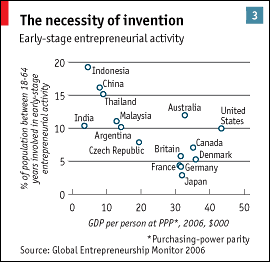
I read this very very interesting article in the Economist which made me go Hmm. The article was talking about Innovation and referred to this graph.

Photo Sharing and Video Hosting at Photobucket

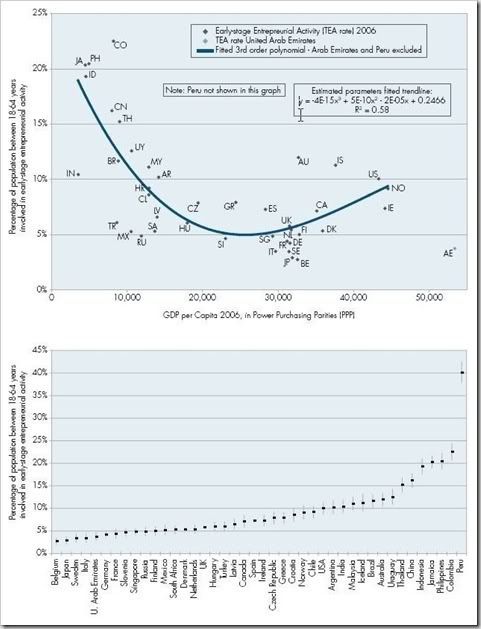
The Economist graph was simplified but the original graph shown below is much better as it provides more information.

Photo Sharing and Video Hosting at Photobucket

Based upon the curve fitting line, you will see that as countries grow and become richer, their rate of entrepreneurship reduces, and that too pretty steeply. Now why would this happen? I can hazard some guesses but no certainty. The first would be that as and how you get richer or the welfare safety net becomes better and better, the hunger for creating value progressively diminishes. The second would be that it would be easier to get jobs rather than worry about raising capital and push for a difficult enterprise. The third factor which I could think of is that as a country becomes richer, it makes it progressively difficult for entrepreneurs to be entrepreneurs, by making it more difficult to fire people, putting in more and more onerous conditions such as Health and Safety, etc. All these combine to make entrepreneurship a losing proposition.

Also, at a particular point in time, they seem to either get stuck or struggle with the next stage which seems to be more difficult. This seems to be the natural trough and despite quite a lot of efforts, the hunger is simply not there. Or it would take superhuman efforts to break through the thicket of regulations. I can well agree to this, while starting up a company is simple in European Countries, the other rules and regulations simply make it way too difficult for a person to embark on entrepreneurship.

But then there are some countries which do make a breakthrough, which is the curious aspect. To what do you ascribe the success of USA and Australia in pushing to develop entrepreneurs? Is it the national ethos? Or the innate hunger? Or their financial system? Or their education system? Why are they so much more risk taking? Or perhaps their time limited welfare system forces them to go about generating value themselves if they do not have a job?

Entrepreneurship is good, it is generating value, creating jobs and ensuring that assets are churned and made use of. Some percentage figures of population engaged in entrepreneurial activity: Indonesia has 19% of its population between 15 and 64 years as entrepreneurs, China 16% and Thailand 15%. India, Malaysia, Australia, USA, Argentina at 10-12% and then Czech, UK, Canada, Denmark, France, Germany, Japan at about 5% or below.

So Mr. Gordon Brown of the UK, what do you have to say about the fact that UK is only showing 5% of its population as entrepreneurs? What is stopping you from doing the same as Australia, USA, India (they are your ex-colonies, my friend - the child excelling over the father?)

As for Mr. Manmohan Singh of India, you need to think deeply, because you are below and behind the curve. You need to make it easier for people to start their own business. Others are leaving you to lag behind!