Showing posts with label mathematics. Show all posts

Sunday, September 4

On two conjectures that shaped the historiography of indeterminate analysis: Strachey and Chasles on Sanskrit sources ☆

This paper is part of a research project on the historiography of mathematical proof in ancient traditions. Its purpose is to shed light on the various ways in which nineteenth-century European scholars attempted to make sense of Sanskrit mathematical sources dealing with indeterminate analysis. Attention will be paid to the historical processes by which these different strands interwove into a cumulative historiography of the field. The focus is on two interpretive conjectures that shaped alternative readings of an evolving corpus of texts, with significantly different emphases and viewpoints.
The British scholar and East India Company servant Edward Strachey first identified a consistent algebraic theory in Bhāskara's Bīja-gaṇita, which he translated from a seventeenth-century Persian manuscript. While reading his sources through the lens of the Euler–Lagrange theory of periodic continued fraction expansions for quadratic irrationals, he offered an insightful interpretation of the so-called cakravāla  , or “cyclic method”. Two decades later, in the context of his investigations on the historiography of geometry, the French geometer Michel Chasles delved into Henry Thomas Colebrooke's translations of Bhāskara and Brahmagupta, from the Sanskrit original, which had become authoritative all over Europe in the meantime. While working out an overall interpretation of Brahmagupta's theory of quadrilaterals, Chasles incidentally spotted a geometrical construction which opened the way to a geometrical solution of the indeterminate equation Cx2±A=y2. He conjectured that this geometrical way may have been the Sanskrit path to indeterminate analysis. Furthermore, on the basis of textual reconstruction, he supplemented his rigorous interpretive conjecture with a more sweeping historical assumption about a possible transmission of this geometrical approach to algebra, from Sanskrit to European mathematics, through the Arabs and Fibonacci. Owing to further scholarship by Baldassare Boncompagni, Franz Woepcke and others, the wheat would be sorted out from the chaff.

http://www.sciencedirect.com/science/article/pii/S0315086016300015

Saturday, September 3

Parents' math skills 'rub off' on their children

now this is a very interesting result.

I quote

Parents who excel at math produce children who excel at math. This is according to a recent study that shows a distinct transfer of math skills from parent to child. The study specifically explored intergenerational transmission -- the concept of parental influence on an offspring's behavior or psychology -- in mathematic capabilities.

there's a genetic transfer...

so if they are rubbish at maths, blame their parents? and then their parents? and and and? 

Friday, September 2

Getting kids to do more maths

As you may know, I am a STEM ambassador and once every month or so, pop into a London school to speak to children about them doing more STEM and talk about how I use Maths in my day to day work. So it was with interest that I read this article

I quote


The math myth is the myth that the future of the American economy is dependent upon the masses having higher mathematics skills. This myth goes back to at least Sputnik, when the Russians were going to surpass us because they were better in math and science. It returned in the late 80's when the Germans and Japanese were going to surpass us because they were better in math and science. It's occurring again now because the Indians and Chinese are better than us in math and science.   I find it difficult to find anyone who uses more than Excel and eighth grade level mathematics (=arithmetic, and a little bit of algebra, statistics and programming). In the summer of 2007 I taught an advanced geometry course and had two students in the class who had been engineers and one who had been an actuary. They claimed never to have used anything beyond Excel and eighth grade level mathematics; never a trig function or even a log or exponential function! There is in fact a deskilling going on in our economy, where even the ability to make change is about to disappear as an important skill.  Vivek Wadhwa has described how there's no shortage of scientists and engineers. I've been concerned with what skills those who are working as scientists and engineers actually use. I find that the vast majority of scientists, engineers and actuaries only use Excel and eighth grade level mathematics. This suggests that most jobs that currently require advanced technical degrees are using that requirement simply as a filter. In particular, I'm working on documenting the following:   Math Myth Conjecture: If one restricts one's attention to the hardest cases, namely, graduates of top engineering schools such as MIT,  RPI,  Cal. Tech., Georgia Tech., etc., then the percent of such individuals holding engineering as opposed to management, financial or other positions, and using more than Excel and eighth grade level mathematics (arithmetic, a little bit of algebra, a little bit of statistics, and a little bit of programming) is less than 25% and possibly less than 10%.
   
Now there's obviously a difference in outlook here. I work in banking and we DO use mathematics. We use statistics, we use calculus, we use matrix algebra and we can get some really funky stuff. We use operational research and optimisation techniques. Dont forget we also use quite a lot of physics (money behaves like a fluid?) and stuff like that. In many of my banking jobs, i hired PhD's in physics, chemistry, astronomy, comp science, etc. But no trigonometry :) or geometry. 

But i can see why people want to use it as a filter. Doing Maths gives signals that you are structured, you are able to handle abstractions, you care good with numbers, you can review and analyse numbers, so on and so forth. It also gives signals that you are a good analyst (not that sure about this one). I would also posit that people with maths are maybe a bit more financial literate? although I dont have any evidence for this

So interesting view. 

Saturday, April 16

A 3,800-year journey from classroom to classroom

http://news.yale.edu/2016/04/11/3800-year-journey-classroom-classroom

what a fascinating piece of news, for a man who is looking for his first clay tablet to somebody who loves history and mathematics and teaching, this is amazing news.

and this weekend I am going to go see the film on Ramanujam :)


Thirty-eight hundred years ago, on the hot river plains of what is now southern Iraq, a Babylonian student did a bit of schoolwork that changed our understanding of ancient mathematics. The student scooped up a palm-sized clump of wet clay, formed a disc about the size and shape of a hamburger, and let it dry down a bit in the sun. On the surface of the moist clay the student drew a diagram that showed the people of the Old Babylonian Period (1,900–1,700 B.C.E.) fully understood the principles of the “Pythagorean Theorem”1300 years before Greek geometer Pythagoras was born, and were also capable of calculating the square root of two to six decimal places.
Today, thanks to the Internet and new digital scanning methods being employed at Yale, this ancient geometry lesson continues to be used in modern classrooms around the world.
“This geometry tablet is one of the most-reproduced cultural objects that Yale owns — it’s published in mathematics textbooks the world over,” says Professor Benjamin Foster, curator of the Babylonian Collection, which includes the tablet. It’s also a popular teaching tool in Yale classes. “At the Babylonian Collection we have a very active teaching and learning function, and we regard education as one of the core parts of our mission,” says Foster. “We have graduate and undergraduate groups in our collection classroom every week.”
The tablet, formally known as YBC 7289, “Old Babylonian Period Mathematical Text,” came to Yale in 1909 as part of a much larger collection of cuneiform tablets assembled by J. Pierpont Morgan and donated to Yale. In the ancient Mideast cuneiform writing was created by using a sharp stylus pressed into the surface of a soft clay tablet to produce wedge-like impressions representing pictographic words and numbers. Morgan’s donation of tablets and other artifacts formed the nucleus of the Yale Babylonian Collection, which now incorporates 45,000 items from the ancient Mesopotamian kingdoms.

Discoverying the tablet's mathematical significance

The importance of the geometry tablet was first recognized by science historians Otto Neugebauer and Abraham Sachs in their 1945 book “Mathematical Cuneiform Texts.”
“Ironically, mathematicians today are much more fascinated with the Babylonians’ ability to accurately calculate irrational numbers like the square root of two than they are with the geometry demonstrations,” notes associate Babylonian Collection curator Agnete Lassen.

Tuesday, November 17

Ramanujan surprises again

This was another pleasant surprise kids. Did I tell you that I went looking for his house in chennai last year? And found it? It was just a normal house. Perhaps I was reading too much into it. Or was hoping to see some plaques or something but nothing. Maybe that's the right metaphor. India has these brilliant people but they aren't recognised at all. The man was brilliant and his work is still being recognised in amazing ways. That's one of my regrets. That I'm not able to spend more time doing mathematics. So much to learn and so little time. It's so much fun doing maths. Specially when you're trying to derive things. Pure mathematics was beyond me though. This was more applied maths that I liked. I couldn't get my head around the pure abstract thinking that pure mathematics requires. But I'm happy both of you like mathematics. It's fun and games. 

Anyway read and admire kids :) 


Ramanujan surprises again | plus.maths.org
https://plus.maths.org/content/ramanujan
(via Instapaper)


Ramanujan's manuscript
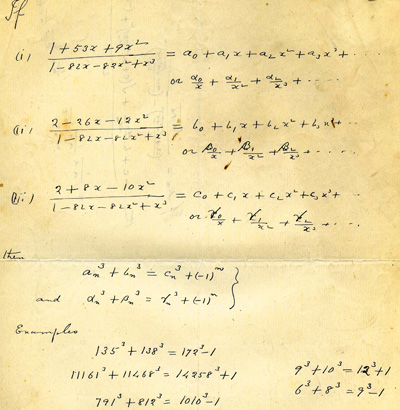
Ramanujan's manuscript. The representations of 1729 as the sum of two cubes appear in the bottom right corner. The equation expressing the near counter examples to Fermat's last theorem appears further up: α3 + β3 = γ3 + (-1)n. Image courtesy Trinity College library. Click here to see a larger image.

A box of manuscripts and three notebooks. That's all that's left of the work of Srinivasa Ramanujan, an Indian mathematician who lived his remarkable but short life around the beginning of the twentieth century. Yet, that small stash of mathematical legacy still yields surprises. Two mathematicians of Emory University, Ken Ono and Sarah Trebat-Leder, have recently made a fascinating discovery within its yellowed pages. It shows that Ramanujan was further ahead of his time than anyone had expected, and provides a beautiful link between several milestones in the history of mathematics. And it all goes back to the innocuous-looking number 1729.

Ramanujan's story is as inspiring as it is tragic. Born in 1887 in a small village around 400 km from Madras (now Chennai), Ramanujan developed a passion for mathematics at a young age, but had to pursue it mostly alone and in poverty. Until, in 1913, he decided to write a letter to the famous Cambridge number theorist G.H. Hardy

Thursday, July 3

Rites of Love and Math

How extraordinary…

Rites of Love and Math - the Official Trailer from Edward Frenkel on Vimeo.


I quote

In any case, the evening began with Frenkel comparing the lack of appreciation for mathematics in society at large to a fictitious scenario in which painting is studied without any reference to the great masters such as van Gogh and Picasso. As one can imagine, the subject of painting in such a world would be devoid of lineage and it may very well be reduced to the art of repetitive brush strokes. This, unfortunately, quite accurately describes how mathematics is commonly taught in schools, where rules and formulas are introduced rather mechanically and without reference to their origins.

From this starting point, Frenkel goes on to argue how mathematics and art contain many elements in common. One of these is the central role that abstraction plays. To illustrate, Frenkel described the concurrent introduction of higher dimensions into mathematics and physics as well as art in the early twentieth century. In the former scenario, we have figures such as Poincaré and Einstein who developed the mathematics of special and general relativity, and in doing so, revolutionized our conception of the universe in which we live. Indeed, whereas Euclidean geometry had been the model for reality for over two millennia, and its absoluteness was even regarded in Kant’s philosophy as being fundamental to our ability to perceive the world, the new vista of a curved spacetime was now provided solely by the powerful abstraction of mathematics. In the world of art, we have in the same period, the workNude Descending a Staircase, No. 2 by Marchel Duchamp in 1912, in which Duchamp departs from traditional painting and attempts to incorporate the dimension of time into a static, two-dimensional canvas. Frenkel, via this example and others, suggests that it is through such novel and powerful ways of introducing abstraction that we soar to higher levels in mathematics and art.

Frenkel goes on to explain briefly the relationship between love and math. Despite tattooing a mathematical formula on his lover in his film Rite of Love and Death (a formula discovered by Frenkel by the way), Frenkel explains that it is not that the case that he thinks there is a formula for love (thankfully). But rather, he believes (if I understood him correctly) that math and love can share aspects in common, namely, its ability to infuse passion and desire. On this point however, I do not recall if Frenkel explained what is unique about mathematics’s intersection with love (in contrast to any other creative pursuit), something I personally would have liked to be clarified…..

absolutely fascinating. I am always reminded of the quote from Bertrand Russell in his magnum opus, A History of Western Philosophy, on this matter

“Mathematics, rightly viewed, possesses not only truth, but supreme beauty—a beauty cold and austere, like that of sculpture, without appeal to any part of our weaker nature, without the gorgeous trappings of painting or music, yet sublimely pure, and capable of a stern perfection such as only the greatest art can show.”

Sunday, February 17

Lilavati

I saw a copy of this book by Bhaskara II which Emperor Akhbar had asked to be commissioned in Farsi at the Mughal Exhibition in the British Library in London. It was beautiful. But the story resonated with me and I quote from the wiki site

His book on arithmetic is the source of interesting legends that assert that it was written for his daughter, Lilavati. A Persian translation of the Lilavati was commissioned in 1587 by Emperor Akbar and it was executed by Faizi. According to Faizi, Lilavati was Bhaskara II’s daughter. Bhaskara II studied Lilavati's horoscope and predicted that she would remain both childless and unmarried. To avoid this fate, he ascertained an auspicious moment for his daughter's wedding and to alert his daughter at the correct time, he placed a cup with a small hole at the bottom of a vessel filled with water, arranged so that the cup would sink at the beginning of the propitious hour. He put the device in a room with a warning to Lilavati to not go near it. In her curiosity though, she went to look at the device and a pearl from her bridal dress accidentally dropped into it, thus upsetting it. The auspicious moment for the wedding thus passed unnoticed leaving a devastated Bhaskara II. It is then that he promised his daughter to write a book in her name, one that would remain till the end of time as a good name is akin to a second life

now that’s a dad for you…

and while researching this, came across this place in Rajasthan..what a shame its falling to pieces..

Tuesday, March 27

One of my heroines–Hypatia

Is Hypatia of Alexandria. An amazing lady who was a Greek Philosopher in Roman Egypt, one of the first guruines in Mathematics, she also was amazing in philosophy and astronomy. A contemporary Christian described her as

There was a woman at Alexandria named Hypatia, daughter of the philosopher Theon, who made such attainments in literature and science, as to far surpass all the philosophers of her own time. Having succeeded to the school of Plato and Plotinus, she explained the principles of philosophy to her auditors, many of whom came from a distance to receive her instructions. On account of the self-possession and ease of manner which she had acquired in consequence of the cultivation of her mind, she not infrequently appeared in public in the presence of the magistrates. Neither did she feel abashed in going to an assembly of men. For all men on account of her extraordinary dignity and virtue admired her the more

Can you fall in love with a woman from history? Yes, I can. What a woman. Here is a painting of her by Charles William Mitchell. Before you think it was prurient, remember this is showing her state after  a rabid Christian mob tore off her clothes and just few moments before tore her to pieces.

And guess who killed her? a howling mob of Christians who said that she was a blasphemer, she corrupted young ones and and and.

Yet even she fell a victim to the political jealousy which at that time prevailed. For as she had frequent interviews with Orestes, it was calumniously reported among the Christian populace, that it was she who prevented Orestes from being reconciled to the bishop. Some of them therefore, hurried away by a fierce and bigoted zeal, whose ringleader was a reader named Peter, waylaid her returning home, and dragging her from her carriage, they took her to the church called Caesareum, where they completely stripped her, and then murdered her with tiles. After tearing her body in pieces, they took her mangled limbs to a place called Cinaron, and there burnt them.

I saw this recent article on her and was prompted to blog about this amazing woman. I quote: This is what she was faced with

In Politics, Aristotle tells us, “silence is a woman‟s glory.”  St. Paul wrote, “women should keep silent . . . they have no permission to talk, but should keep their place as the law directs” (1 Corinthians 33-34).  In 1 Timothy (2:12) St. Paul stated he did not “permit women to teach or dictate to the men”  In Moralia Plutarch states the Roman position on women clearly, “the two great duties of a virtuous woman . . . are to keep at home and be silent. For she is only to speak to her husband, as by her husband.  Nor is she to take amiss the uttering of her mind . . .”  By adopting Platonic/Aristotelian ideologies of women we have, in many ways, reconstructed the universal woman and the universal woman‟s condition in the ancient world as unvaried and universally oppressed.

One good point that the author says is worthy of reiteration:

 It is true that many women were probably prohibited from leading lives similar to Hypatia, however, there have been times and places like Alexandria that were less restricted and may have served to empower women.  Nor do misogynistic ideologies alleviate the responsibility of contemporary feminist scholars to contest the historical canon of ancient rhetoric.  Since traditional history has avoided or suppressed women in history, the trick for feminist scholars is to search for women everywhere, and to recreate historical periods and women‟s lifetimes as fully as possible.  With attention to race, class, orientation in addition to gender, we may be able to uncover likely pockets of women‟s empowerment and subsequent  activity.  I assure you, women like Hypatia of Alexandria were active in a variety of ways in the ancient world, of that there is little doubt.  It seems likely that then, as now, they performed work to serve their families, to earn wages, or to serve other interests and, in some places and times like ancient Greece and Alexandria, they participated in scholarly and public life. 

If one looks around, the situation is much much better (although its really shameful that the number of women in banking, technology, mathematics, physics and and and are so few and far between compared to men). But we still have problems, the state and men still decide your reproductive rights, women are still told that their virtue is based upon them hiding away behind a ghunghat or a veil, they are still aborted much more than boys. Women should fight, its not a fight that will end soon, remember Hypatia lived between 350-415AD, she faced these problems and she was a brave wonderful girl. Anybody who wears a ghunghat or a veil to me is betraying women down the ages and frankly is a bit of a muppet. Stand up, fight, be a woman, your face, body and mind are yours. And don't give me the answer that its your choice. Its your choice to be hidden away based upon what a man told you? bah.

But on to better things, she has been well documented in video as well.

Here is her death in a film, Agora 2009

A trailer from this film.

And the first of five segments on Hypatia.

I have not been to Alexandria yet, but one day I will go there to say hello to one of my mental goddess (as opposed to my domestic goddess, heh).

What a woman.

Wednesday, March 14

The challenge with mathematics

I do dabble a wee bit with mathematics. For a long time in my career, I had to muck about with mathematics, some very serious hair hurting stuff. Anyway, thankfully, I am now too old and boring to muck about with the old cutting edge stuff in mathematics, these days, its most statistics, time series stuff and stuff related to multi variate analysis.

Kannu is taking maths and advanced maths in his 6th form. Which is good. I was also very chuffed when Diya’s teacher told me that she is good in maths. I reviewed her maths workbook and she is quite good actually. And then to top it, she says that as she is so good in Maths, she will become a banker rather than a doctor (for more prosaic reasons, she doesn't want to spend that long in hospitals which doctors do, I didn't want to tell her that unfortunately some kinds of bankers will end up spending an equal if not more time at work).

Anyway, here’s an interesting column on why mathematics matters.

If one manages to graduate from high school without the rudiments of algebra, geometry and trigonometry, there are certain relatively high-paying careers probably off-limits for life -- such as careers in architecture, chemistry, computer programming, engineering, medicine and certain technical fields. For example, one might meet all of the physical requirements to be a fighter pilot, but he's grounded if he doesn't have enough math to understand physics, aerodynamics and navigation. Mathematical ability helps provide the disciplined structure that helps people to think, speak and write more clearly. In general, mathematics is an excellent foundation and prerequisite for study in all areas of science and engineering. So where do U.S. youngsters stand in math?

Drs. Eric Hanushek and Paul Peterson, senior fellows at the Hoover Institution, looked at the performance of our youngsters compared with their counterparts in other nations, in their Newsweek article, "Why Can't American Students Compete?" (Aug. 28, 2011), reprinted under the title "Math Matters" in the Hoover Digest (2012). In the latest international tests administered by the Organisation for Economic Co-operation and Development, only 32 percent of U.S. students ranked proficient in math -- coming in between Portugal and Italy but far behind South Korea, Finland, Canada and the Netherlands. U.S. students couldn't hold a finger to the 75 percent of Shanghai students who tested proficient.

What about our brightest? It turns out that only 7 percent of U.S. students perform at the advanced level in math. Forty-five percent of the students in Shanghai are advanced in math, compared with 20 percent in South Korea and Switzerland and 15 percent of students in Japan, Belgium, Finland, the Netherlands, New Zealand and Canada.

Hanushek and Peterson find one bright spot among our young people. That's Asian-American students, 52 percent of whom perform at the proficient level or higher. Among white students, only 42 percent perform math at a proficient level. The math performance of black and Hispanic students is a disaster, with only 11 and 15 percent, respectively, performing math at the proficient level or higher.

The National Center for Education Statistics revealed some of the results of American innumeracy. Among advanced degrees in engineering awarded at U.S. universities during the 2007-08 academic year, 28 percent went to whites; 2 percent went to blacks; 2 percent went to Hispanics; and 61 percent went to foreigners. Of the advanced degrees in mathematics, 40 percent went to whites; 2 percent went to blacks; 5 percent went to Hispanics; and 50 percent went to foreigners. For advanced degrees in education, 65 percent went to whites; 17 percent went to blacks; 5 percent went to Hispanics; and 8 percent went to foreigners. The pattern is apparent. The more rigorous a subject area the higher the percentage of foreigners -- and the lower the percentage of Americans -- earning advanced degrees. In subject areas such as education, which have little or no rigor, Americans are likelier -- and foreigners are less likely -- to earn advanced degrees.

In a New York Times article -- "Do We Need Foreign Technology Workers?" (April 8, 2009) -- Dr. Vivek Wadhwa of the Pratt School of Engineering at Duke University said "that 47 percent of all U.S. science and engineering workers with doctorates are immigrants as were 67 percent of the additions to the U.S. science and engineering work force between 1995 to 2006. And roughly 60 percent of engineering Ph.D. students and 40 percent of master's students are foreign nationals."

American mathematic proficiency levels leave a lot to be desired if we're to maintain competitiveness. For blacks and Hispanics, it's a tragedy with little prospect for change, but the solution is not rocket science. During my tenure as a member of Temple University's faculty in the 1970s, I tutored black students in math. When they complained that math was too difficult, I told them that if they spent as much time practicing math as they did practicing jump shots, they'd be just as good at math as they were at basketball. The same message of hard work and discipline applies to all students, but someone must demand it.

And here is another story, makes one weep, I tell you, this soft bigotry of low expectations is killing our kids. Go read that story about a NY School from the perspective of a black girl. I quote:

Her mother, Annmarie Miller, a nursing assistant at a hospital in the Bronx, recalled a cousin’s reaction when she mentioned Rudi’s pick: “You have to be Chinese or Indian to get in there.” A co-worker, also black, “said the exam is built to exclude blacks because it’s heavy on math, and black people can’t do math,” Mrs. Miller said.

Why isn't there any discussion about family? I demand high performance from my team and my family. My parents did the same. Why is this idea that blacks cannot do math? What a bloody fool of an idea. I quote from a comment:

At one time people used to complain that there was too high a percentage of Jewish students in these schools and now they complain of too many Asians.
When I arrived in NYC in 1959 the complaint was also about the percentage of Jewish students and graduates at City College.
Can the answer be that the parents of both these groups inculcated in the children an academic drive and work ethic that helped them to succeed and still does.
Apparently this young black woman has a family that does that for her, helped by her own nature. We have to look into the family culture and values and also that of peer pressure.

Thursday, February 2

The scope-severity paradox

Dear Son

Here is something that you will find interesting. What this experiment shows is that people dont really take large numbers on board. In other words, a large number, more than 30 or even more, just becomes a statistic in people's minds. Stalin said something very interesting, A Single Death is a Tragedy; a Million Deaths is a Statistic. There is also an old old joke, the subject keeps on changing:


The President and his Vice President are sitting in a bar.
A guy walks in, sees them and asks the barman, "Isn't that the President and the Vice President sitting over there?"
The bartender says, "Yep, that's them."
So the guy walks over and says, "Wow, this is a real honour! What are you guys doing in here?"
Bush says, "We're planning World War Three."
And the guy says, "Really? What's going to happen?"
Bush says, "Well, we're going to kill 140 million guys and one blonde with big hair."
The guy exclaimed, "A blonde with big hair? Why would you kill a blonde with big hair?"
The President turns to the VP and says, "See, I told you no one would care about 140 million guys".

People are very nervous about large numbers, so you have to recognise this factor and use it to your advantage. For example, you are going to do Maths and Further Mathematics in your A levels. Have you noticed the reactions of people when you say that? They are impressed, they go, wow. Why? because these people cannot comprehend somebody actually understanding large numbers. If you want to become a banker or a diplomat or whatever, use this to your advantage, be very comfortable with large numbers and realise how people react negatively to this.

A related item to this is to always talk in terms of bullet points, if somebody asks you to explain something to them, say ONE and then one factor, say  TWO and then the next factor, dont just run along and mix them all. If you bullet them, and then tick them off using your fingers, you come across as a person with an impregnable explanation. Also, people cannot keep more than 3-4 separate items in their head, so always push more than 3-4 factors.

Its very interesting reading anyway, Son.

The scope-severity paradox
http://www.cognitionandculture.net/home/blog/72-anikos-blog/2308-aniko-sebesteny


poissons
The scope-severity paradox
Details
Anikó Sebestény
Sunday, 30 October 2011
Blog, Anikó’s blog

Do criminals deserve a less severe punishment if they harmed more people ?

Most people would almost certainly answer “no”. Of course: punishment should be sensitive to the severity of the crime. That’s what we usually think.

Yet in a compelling paper published in Social Psychological and Personality Science in August 2010, Loran F. Nordgren and Mary-Hunter Morris McDonnell found that increasing the number of people victimized by a crime actually decreases the perceived severity of that crime and leads people to recommend less punishment.

The scope-severity paradox presented in the article is indeed astonishing. The paper is also exemplary in how beautifully it combines lab experiments and analysis of real-world data.

The authors conducted experiments to test the effect. 60 participants were asked about the severity of a crime. A financial advisor has betrayed his clients, how severe is his crime, how many years of jail should he get? The astonishing (and robust) result is that the crime is seen as significantly less serious when there are 30 victims rather than 3. When asked about how participants imagine one of the victims, participants gave an average of 3 traits less in the case of 30 victims than in the case of 3 victims, showing that their representation is much more vivid in the case of less victims. According to the authors, this difference in the vividness of how the victim is represented accounts for the paradox.

The authors then turned to archival data to demonstrate that the scope-severity paradox is a robust, real-world effect. They collected archival data of actual jury verdicts concerning 136 cases of poisoning in the U.S. spanning over a 10-year period from 2000 to 2009. They found that juries required defendants to pay higher punitive damages when their negligent behavior harmed fewer people.

The authors then returned to the lab and tried to find a way to reduce the effect. It appears that by making victims more individually identifiable, the effect is reduced. Having identifiable victims makes people not give less punishment to the criminals harming more people. And yet, they still don’t give more punishment to the criminals harming more people: they just give the same punishment, regardless of the number of victims.

I suggest that there may be a strong connection with Susan Carey’s work on learning mathematics: there is a bootstrapping process going on when children learn to deal with 3, then with 4, then with 5. It may well be that the bootstrapping process is never entirely complete, and we don’t have, even as adults, a very clear concept of 30, or at least it is far less clear than our concept of 3. Imagining 100 tables appears much more difficult to me than imagining 5. Imagining 100 real people probably goes beyond my cognitive capacities.

Can this effect at least partially explain why the world, or at least the media pay so much more attention to single criminals than to institutions who fraud and harm hundreds or thousands of people?

Wednesday, November 2

Widespread panic: Why math anxiety continues to multiply - Schools


Dear Son

Here's an interesting article on why math anxiety keeps on happening. I know you also said that you aren't that interested in Mathematics. I was like you, didn't really like mathematics so much till I started doing applied mathematics. In fact, Neela Didi tried to beat mathematics into my head when I was younger than you in the famous Jabalpur Sahakar Nagar house but she failed, lol, nothing to do with her, it was me who was the dunderhead. I used to be religiously carted over to Jabalpur every summer to learn Mathematics and I ended up learning more about Readers Digest, Fiction, dictionary, use of english and other bits that my Jethamoshai taught me. And how to ride a bike, climb mountains, kiss girls and and and, everything other than mathematics.

At this moment, what you are learning are the techniques and methodologies, the calculus, algebra, geometry and trigonometry. But once you get into the applied side, that's when the fun starts, when you have to apply numbers to figure out how much you have earned or the height of a potential tower to support a space elevator or see if you can calculate from first principles on when the next eclipse will happen or how fast does a potential influenza infection spread etc. etc.

For some reason, people get upset with numbers, much more than with prose. But there's your advantage son, people who like mathematics actually end up ruling over people who dont. Seriously. Take finance or economics or what have you. When you know the numbers, your arguments are better. You are able to make better judgements. The vast majority of people will basically duck out of these discussions and debates. So you, being a smart boy, will be able to explain and discuss how the numbers work.

I am proud of you for going for maths and further maths and economics, good solid subjects and they will stand you in good stead in your future. But dont give up hope, mathematics is fun and its beautiful. I had this quote written on top of my desk when I was your age. “Mathematics, rightly viewed, posses not only truth, but supreme beauty; a beauty cold and austere, like that of sculpture” by Bertrand Russell quotes. It is a beautiful thing, theorems and applications, its a demanding area, it demands dedication and love, it requires passion and intelligence. it requires hard work but it gives back hugely. Unfortunately, its not easy to communicate this beauty, you have to learn to appreciate it. You might want to see the A Beautiful Mind, its an extraordinary combination of mathematics, economics and how to pick up girls. And of course, the famous Good Will Hunting is a good movie as well. Incidentally, son, if you know mathematics and are known as a mathematician, and if you are cool (like you are), girls seem to like it :)


So when your friends moan about mathematics, just smile at them and think back on the quote, too bad they will never appreciate the beauty of mathematics.
Love
Baba


Widespread panic: Why math anxiety continues to multiply - Schools - MiamiHerald.com
http://www.miamiherald.com/2011/08/17/2362802/widespread-panic-why-math-anxiety.html


What’s new
Widespread panic: Why math anxiety continues to multiply

Tips for fighting math anxiety

• Bring math into everyday life. Have your kids figure out math problems while cooking, for instance.

• Encourage your child to speak up and ask questions if he or she doesn’t understand math principles.

• Have discussions about math. Don’t focus on “the answer;” discuss concepts as you would a good book.

• Hold your tongue when it comes to “negative” math talk. Kids will pick up on your own anxiety.

• Advise children to first find a problem they know they can solve to gain confidence, then go back to the others.

• Don’t let your kids save math homework as the last thing they do. Do it first before fatigue sets in.

• Remember: Math is not an aptitude you’re born with; it’s an acquired skill.

By Vanessa Garcia
Special to The Miami Herald

One look at math word problems and many students cringe.

Even worse, many elementary school teachers seem to have the same reaction.

Math anxiety, a fear that first gained recognition as a feminist issue in the 1970s, remains a big problem that psychologists, educators, and parents are trying to crack.

A negative emotional reaction to math or even the prospect of solving a problem that has to do with mathematics, math anxiety is now the topic of many books, research papers and seminars.

Sheila Tobias, author of Overcoming Math Anxiety (W.W. Norton & Co., $16.95), started studying the phenomenon three decades ago when she noticed girls were doing poorly in math in school and not seeking out math-influenced careers, such as engineering. She now notes a tremendous modern shift in more girls pursuing math-related fields, although females as a group still report more math anxiety than males.

Some studies show that the one of the causes may be teachers themselves.

Last year, the Proceedings of the National Academy of Sciences published an article called “Female teachers’ math anxiety affects girls’ math achievement,” co-written by Sian Beilock, a University of Chicago associate professor of psychology. The paper cited research that shows female math teachers carry a good deal of math anxiety into their classrooms, affecting the behavior of their female students.

“Children are more likely to emulate the behavior and attitudes of the same gender vs. opposite-gender adults,” Beilock wrote.

And because most elementary teachers in the United States are women (more than 90 percent), girls are more likely than boys to be influenced by this problem.

Some experts suggest that one solution is to raise the bar on minimal mathematics requirements for elementary school teachers.

Teachers have to deal with their own anxiety first, agreed Walter Secada, a professor and senior associate dean at the University of Miami’s School of Education and a former math professor.

“Before you drill, make sure you know the skill,” Secada said.

The stakes are much higher than a failing grade on a report card, and the problem isn’t entirely associated with gender.

“Educators who fail to recognize the signs of math anxiety [hinder] further development,” said Carol Warner, an associate professor of mathematics and academic coordinator of math for Barry University’s School of Adult and Continuing Education. “The U.S. economy depends on students with a strong mathematical background. If the great technical advances in energy, the environment, medicine, and information are elsewhere, so will be the jobs in the future.”

Beilock, the Chicago researcher, agrees the problem is not just limited to women, and that there’s a need for more studies on math anxiety within other communities, such as blacks and new immigrants.

Tobias, the author, points to studies on math anxiety among minorities by such researchers as the University of Texas’ Philip Uri Treisman.

“What we learn from those studies,” she said, “is that Asian Americans do better not because they are better at math, but because they create study groups or study gangs, whereas an African American student is more likely to deal with and struggle through problems alone.”

While such support systems help, the real solution is prevention, Tobias said.

“Don’t make kids anxious to begin with,” Secada at UM agreed.

That’s often a struggle with today’s test-centric teaching. The emphasis on standardized testing “reduces innovative instruction by forcing teachers to ‘teach to the test,’ ” Barry’s Warner said. “Students feel the anxiety introduced into the classroom surrounding these tests, which often perpetuates a further downward spiral for those who are already math anxious.”

Beilock suggests having students write for 10 minutes about their anxiety before a high-stakes test. Writing about what worries you can help curb negative thoughts and free-up your thinking to do what it needs to do, she said.

UM’s Secada advises going back to the basics.

“Even if you think you’re too old for them, try to ‘understand’ concepts behind math first and foremost,” he said.

Friday, September 9

Can Math Beat Financial Markets?: Scientific American

Dear son

Quite an interesting if an old argument. People have been using math to explain the world and predict the future for centuries now. Whether it's the movement of the planets or the weather or the height of Nile water or prices of goods, mathematics is a cool intellectually beautiful way of describing real or imaginary worlds.

Mathematics can help explain the markets but it's not easy and it's not consistent as you would have found out. But it's good to know that you ate comfortable with maths.

Once you have started your calculus studies, I will teach you how to use stochastic calculus to model prices and use time series analysis to model well time series. Also perhaps a spot of non linear analysis, that should be fun.

Can Math Beat Financial Markets?: Scientific American
http://www.scientificamerican.com/article.cfm?id=can-math-beat-financial-markets&print=true


Wall Street’s wild swings last week helped skew both retirement portfolios and mathematical models of the financial markets. After all, a standard Gaussian function—a bell curve—would predict that such extreme dips and rises would be exceedingly rare and not prone to following one after the other on succeeding days.

Gaussian functions might be able to describe the distribution of grades in a big college class, with most students getting, say, B–/C+, and enable you to predict how many students will get A’s or fail. But evidently, they do a poor job at explaining steep fluctuations in stock prices, although some economists and modelers think they are the best tool available to describe financial markets.

So can any math accurately describe market behavior and enable you to beat it? To find out, Scientific American spoke with statistical physicist H. Eugene Stanley of Boston University, a proponent of applying the approaches and concepts of physics to economics.

[An edited transcript of the interview follows.]

Can mathematical models beat markets?
They haven’t yet. Science is about empirical fact. There is no question that optimistic people think they can beat the market, but they don’t do it consistently with mathematical models. No model can consistently predict the future. It can’t possibly be.

So what can math predict?
What you can do is
predict the risk of a given event. The risk just means the chance that something bad will happen, for example. That you can do with increasing accuracy because we have more and more data. It’s like insurance companies: they cannot tell you when you are going to die, but they can predict the risk that you will die given the right information. You can do the same thing with stocks. If you lose less, you get ahead of those who lose more.

Why do economists and “quants”—those who use quantitative analysis to make financial trades—have such faith in their mathematical models then?
If they’re just to reduce risk, then they’re very valuable. If you’re worried, for example, about the segment of the Chinese economy that deals with steel, you make a model of what that whole market is all about and then you see if we did this what would likely happen. They’re right some of the time. It’s better than nothing.

But when they have excessive faith in these models, it’s not justified. Math starts with assumptions; the real world does not work that way. Economics, which calls itself a science, too often doesn’t start with looking at empirical facts in any great detail. Fifteen years ago even the idea of looking at huge amounts of data did not exist. With a limited amount of data, the chance of a rare event is very low, which gave some economists a false sense of security that long-tail events did not exist.

Why do you argue that financial markets are ruled not by Gaussian functions but by power laws—relations in which the frequency of one event varies as a power of some attribute of that event and are generally more L-shape than bell shape?
For anything that is random and fluctuating, like a financial market, a Gaussian function is a wonderful way to make a histogram of the outcome. If the things that fluctuate are not correlated at all with one another, then it’s demonstrable that a Gaussian function is the correct histogram.

The catch is: in a financial market, everything is correlated. The proof of that is that if the stock market were Gaussian, then you’d never have a flash crash. A Gaussian crash would be an event that goes out to maybe five standard deviations [that is, a rarity on par with one part in two million]. In markets, this is simply not true. There are events that are 100 standard deviations. Every economist knows for sure that these rare events occur and cannot be described by a Gaussian function. The question is: What are you going to do about it?

Power laws are simply way more accurate. If you don’t know the risk, you are not going to make the right decision, and the economy is at risk from these big fluctuations. It’s no surprise when they come. The only reason you have to wait awhile is because they are rare. Knowing that they will happen forces anyone prudent to have a plan for what to do if it happens.

The idea that it would be a power law that describes all the events, the tails and the middle is really a major contribution. It allows one to quantify risk. You can read off a plot of the law the numerical chance for a downturn of any given size. It’s very small for something that is 100 standard deviations out but not so small for something that is 10 standard deviations out. In fact, the S&P 500 fluctuations—which if they were Gaussian, would pretty much be constrained to plus or minus five standard deviations—you find, in a 10-year period, the number of events that exceed five standard deviations is not just one, it’s 64. And the number that exceeds 10 standard deviations is eight, and there was one event that exceeded 20 standard deviations. It looks like a power law, and that’s what it is demonstrated to be when every trade of every stock is analyzed.

There are an awful lot of rare events and they’re all ignored. This is not the best way I want my retirement funds invested.

Are algorithm-based trading programs causing these fluctuations, like in the “flash crash” in 2010, when the Dow Jones Industrial Index momentarily dropped roughly 1,000 points in minutes?
There is no question that a huge percentage of trades are done electronically by algorithms. Of course, the flash crash was triggered by that. But we had problems before [algorithm-based trading programs]. We’ve had lots of crashes.

The speed of a flash crash is vastly greater than the speed of crashes before. Things move fast because everybody knows everything all the time. In that sense, it’s not the algorithm-based trading that moves the markets, it’s that the information is so instantaneous.

Does this understanding of financial markets suggest anything about how to invest, like when to buy or sell?
It can’t predict the future. The key thing is that it tells you not to listen to those who tell you now is the time to buy or sell if their advice is based on something wrong, as it sometimes is.

Is this all a result of the interlinked global financial system?
I believe so. The finances of every country are interlinked to the finances of every other country and, because they are
interlinked, if one key players goes down then the other players know things aren’t going to be as good. A useful analogy is coupled networks, which are far more susceptible to a cascade of failures than uncoupled networks.

Is there a remedy for preventing markets from affecting one another?
It would be nice if there were, but the system is going to be more fragile because it is so interlinked. Maybe something like a circuit breaker, something that slows trading down? There are two answers to that: one is that [a circuit breaker] is good and allows people to cool off, to realize the economy is still there. The opposite view is that we just pick up where we left off.

For something like the flash crash, you might try it out. If you lose five to 10 percent in the space of an hour, then you stop the market. Of course, stopping the market at a low point could do the opposite and convince everyone something bad is happening.

Can anything predict the market?
Let me tell you a story: two to the power of 10 is 1,024. One way to predict the market is to call up 1,024 trading places and tell half of them by week’s end the market will be up and the other half that the market will be down. At the end of the week, forget about the half that knows you were wrong. Keep doing that for 10 weeks and, at the end, you will have called the market correctly for one person who will think you are a genius.

The economy is a very complex system—like the weather—that we understand bits of. You sure as heck can’t decide on a Monday whether the weather will be nice on the coming weekend. No one can predict where the market will be at the end of the week.

Sunday, September 4

Rationally Speaking: Why we should use odds, all the time

This is something that I live doing, give my responses in the form of probability. It makes your judgement much more accurate son.

Plus I frequently ask questions like this during my interviews. Such as, what do you think will happen to the ft100 index on Monday? I am interested to learn about their thinking process and what all inputs they include when making a decision. You will be surprised how many people reply back by saying, dunno, or how long is a piece of string. Needless to say, I do not hire them because if they cannot make a simple economic decision, how can they work in my team and take decisions every 2 minutes?

Stuff to think about.

Rationally Speaking: Why we should use odds, all the time
http://rationallyspeaking.blogspot.com/2011/08/why-we-should-use-odds-all-time.html


by Ian Pollock  thefertilityblogs.com It is extremely important to quantify epistemic states — specifically, levels of certainty — if you wish to think clearly. The reason why was summed up rather nicely by one of my special historical heroes, James Clerk Maxwell:

The actual science of logic is conversant at present only with things either certain, impossible, or entirely doubtful, none of which (fortunately) we have to reason on. Therefore the true logic for this world is the calculus of Probabilities, which takes account of the magnitude of the probability which is, or ought to be, in a reasonable man’s mind.

In other words, even if everybody reasoned using classical logic without committing logical fallacies (fat chance), practical reasoning would still be impossible, because questions in real life just never deal in certainties.*

One of the more beautiful things to discover in this world is that there are objective rules for the manipulation of subjective certainties and uncertainties. Bayesian statisticians call these levels of uncertainty “probabilities.” (Frequentists… get confused at this point, on which I hope to write much more in the future).**

One of the most unexpected beneficial side-effects of thinking probabilistically as a habit, is that it makes you realize just how much you actually know. (This is probably the one skeptical conclusion that doesn’t deflate one’s ego.)

For example, suppose that I ask you a weird question like “What did Peter Singer (the philosopher) eat for breakfast on October 12, 2007?”

The standard answer to such questions, which in my experience is elevated almost to the level of a Kantian imperative among some traditional skeptics, is “I don’t know.” Whereof one cannot speak, thereof one must be silent.

The problem with this is that you usually do know quite a lot. To illustrate, let’s consider my “Breakfast of Utilitarians” example.

To begin with, you know with near-certainty that Peter Singer didn’t eat anything that doesn’t actually exist — unicorn cheese, for example. Okay, but that’s trivial.

You also know with decent confidence that he didn’t eat anything actively poisonous — for example, fly agaricus mushrooms. But that’s pretty obvious too.

Fine, now we’ve narrowed it down to non-poisonous foods that actually exist. You also may know that he is a champion of animal welfare, and a utilitarian vegan, so all or most animal products are out of the running. Now we’re getting somewhere.

Further, the man is Australian, and of European ancestry, which ceteris paribus makes various other world cuisines (e.g., Mexican, Finnish) somewhat less likely than not.

On the other hand, you might want to revise this last consideration if you’ve read “A Vegetarian Philosophy,” at the end of which he gives a recipe for Dal, an Indian dish. This suggests, if weakly, that he might have more international tastes.

Lastly (or is it?), the meal in question is breakfast, and people typically confine certain foods to specific meals. For this reason, tofu sausages are a fairly good bet relative to others, while onion soup is a fairly bad one. We could go on, if we wished…

The point is that if you cared enough, you could probably narrow Singer’s breakfast that day down to a sizeable, but not endless, list of possibilities, each weighted by its own likelihood. A probability density distribution over Platonic breakfast-space, if you will. You may not be able to pick one specific food and say “He ate this!”, but you are far from wholly ignorant — you’ll know the best candidates. And this generalizes to almost all sensible propositions. Try it — it’s actually a rather fun exercise!

Of course, it’s still reasonable to say “I don’t know” as a quick gloss of the actual truth: “I have no special information on this question that you do not.” However, the problem with thinking “I don’t know” in the sense of full ignorance, is that it allows you — intentionally or not — to sweep all your background knowledge under the rug and pretend to yourself that some question is perfectly uncertain. Background knowledge should always be the first thing to come to your mind when considering a truth question. This helps avoid mistakes like the base rate fallacy (and more generally, fallacies wherein you ignore your own priors), and allows for good decision-making under uncertainty.

However, if humans wish to think like this as a habit, it is often much more useful to forget about probabilities per se, and use the mathematically equivalent concept of odds.

Let’s have a quick refresher on what “odds” are. We all know what a probability is (or at least, we’re familiar with the term!). Odds can be seen as ratios of probabilities. Just as we use P(A) for the “probability of A,” we may talk about O(A), the “odds of A” (where A is some apparently sensible proposition).

In terms of probabilities, O(A) = P(A)/P(~A). So for example, if there is a 66% probability of rain tomorrow, then O(rain) = 0.66/(1-0.66), or more easily 66:33, which finally reduces to 2:1 (usually read “two to one in favour”). The “:” is basically just a division sign, so O(rain) can be stated as “2 to 1” or as simply “2.” Although odds can be expressed as ratios of probabilities, they are best understood on their own terms altogether. In this case, “odds of 2 to 1 in favour of rain tomorrow” means something like “days like this are followed by twice as many rainy days as non-rainy days, to the best of my knowledge.”

Odds are even more familiar from the racetrack, where a bookie might give “10 to 1 on Longshot, to win.” What this means is that if the bookie is selling stakes for $5 each, then a single $5 stake will get you (10+1)*$5 = $55 if you win (i.e., a gain of $50 plus your $5 stake back), while a loss will simply lose you your $5 stake. (Of course, in order to make money, the bookie must think that the real odds on Longshot are even longer than 10 to 1.)

I advocate using odds rather than probabilities to quantify your epistemic states on all sensible propositions, for two main reasons:

(1) Odds have the appropriate mental associations.

Odds are associated in our minds with betting, which is an earthy activity in which irrationality might actually lose you your shirt; whereas probabilities are abstract and academic, probably associated with mathematics and statistics courses, and with Spock from Star Trek. The latter being the case, either you don’t get statistics at all (and the word “probability” just brings up memories of Spock being cold and emotionless), or you learned about probability in the context of wildly overspecified textbook problems, in which you had way more information handed to you than humans typically have in real-world situations.

By contrast, thinking in terms of odds and the racetrack forces you to let belief constrain anticipation — if you say you are 98% sure that Obama will win in 2012, that sounds to me suspiciously like “I really really hope he’ll win,” whereas “5 to 1 in favour” leads to the obvious question: “Care to make it interesting?” Suddenly your wishful thinking needs to take a back seat to whether you can afford to lose this bet. (I think the advantages of this mode of thinking at least partly carry over, even if you don’t actually bet any money.)

Moreover, probabilities sound too precise, as though they have to be calculated rigorously or not at all. Stating a 95% probability makes me ask myself (and others ask me) “Why not 96% or 94%?” By contrast, “5 to 1” seems more acceptable as a tentative verbalization of a level of certainty, the arguments for which might not be readily quantifiable.

(2) Odds map epistemic states to numbers in a way that makes sense.

Alice the juror believes that Casey Anthony is guilty, with probability 90%. Bob the juror also believes she is guilty, with probability 99%. They seem to pretty much agree with each other, and yet…

If we switch over to odds, we find that Alice gives odds of 9:1 in favour of guilt, while Bob gives 99:1. This is more than an order-of-magnitude difference! Actually, Alice is substantially less convinced than Bob; they should still be arguing! Alice still entertains reasonable doubt — at this point, she should probably vote to acquit.

And tellingly, when Eve mentions that she is 100% certain of the defendant’s guilt, a quick conversion shows that she gives odds of 100:0, aka “infinity.” This means, if taken literally (which we should not actually do), that Eve should be willing to take a bet in which being proven right earns her a penny, while being proven wrong earns her unending torture. The fact that odds explode as mathematical objects when they try to map absolute certainty is a nice feature probabilities don’t have.***

In summary:

- Quantifying uncertainty about all sensible questions is a crucial cognitive tool, both for eliminating all-or-nothing thinking and for reminding us to always use our substantial background knowledge.

- Odds are more useful than probabilities for this purpose, because they have: more appropriate mental associations for most humans; good mathematical properties showing the folly of extreme cases (perfect certainty); and an intuitive relation to frequency that humans readily understand. Also, talking in odds will make you sound badass.

________

* “But what about questions like 1+1=2?” you ask? Remember, probability has to reference the fact that it is calculated in a fallible human mind. Maybe “1+1=2” is 100% correct as mathematics (I think it is), but there is still a chance that I can mistakenly think 1+1=2 (epistemology) — for example, because aliens are messing with my brain. So I have to assign a probability slightly less than 100% to it.

** Also, it is often a point of contention as to what sorts of propositions “probability” can be meaningfully applied. For example, does it make sense to speak of probabilities where straightforward empirical evidence is lacking (e.g., “the probability that immaterial souls exist”)? Without wishing to get into this issue too deeply, I hold that this use of the word does make sense (provided any discourse about the existence or nonexistence of souls makes sense), since if we can discuss how likely souls are at all, we should be able to quantify our uncertainty in the same manner as for other questions.

*** If you use logarithms, you can get even nicer mathematical properties, but you lose all the intuitiveness.


Friday, April 22

Just what is a 25 Standard Deviation Move?

I had mentioned this level of movement last year at several lectures. Mr. Viniar who was the CFO of Goldman Sachs said in 2007, we are seeing things that were 25 standard deviation moves, several days in a row.

What does a 25 Standard Deviation mean? Does it really mean anything? These chaps actually tried to put some context around this 25 SD move. I am going to quote some extracts:

a 5-sigma event corresponds to an expected occurrence of less than just one day in the entire period since the end of the last Ice Age; a 6-sigma event corresponds to an expected occurrence of less than one day in the entire period since our species, Homo Sapiens, evolved from earlier primates; and a 7-sigma event corresponds to an expected occurrence of just once in a period approximately five times the length of time that has elapsed since multicellular life first evolved on this planet

So we are at 7 sigma and we are already way back into the mists of time on this planet. “ok ok, so get on with it”

These numbers are on truly cosmological scales, and a natural comparison is with the number of particles in the Universe, which is believed to be between 1.0e+73 and 1.0e+85 (Clair, 2001). Thus, a 20-event corresponds to an expected occurrence period measured in years that is 10 times larger than the higher of the estimates of the number of particles in the Universe. For its part, a 25-sigma event corresponds to an expected occurrence period that is equal to the higher of these estimates but with the decimal point moved 52 places to the left! 

They explain this in a different way.

UK  National Lottery is currently was offering a prize of £2.5m for a ticket costing £1. Assuming it to be a fair bet, the probability of winning the lottery on any given attempt is therefore 0.0000004. The probability of winning the lottery  n times in a row is therefore 0.0000004 n , and the probability of a 25 sigma event is comparable to the probability of winning the lottery 21 or 22 times in a row.  
And we should not forget Goldman’s losing streak – Goldman did not just experience a single 25-sigma event, but experienced several in a row – or forget that other institutions also experienced 25-sigma events. If the probability of a single 25-sigma event is low, the odds of two or more such events are truly infinitesimal. For example, the odds of two 25-sigma events on consecutive days are equal to 3.057e-136 squared, which is 9.3450e-272. This is as likely as winning the lottery about 42 times in a row. The corresponding expected occurrence period is the square of 1.309e+135 years – that is, 1.713e+270 years – a number so vast that it dwarves even cosmological figures. As Oscar Wild might have put it: to experience a single 25-sigma event might be regarded as a misfortune, but to experience more than one does look like carelessness

So before you decide to beat up the banks, have a think about what they were faced with. But then again, one can question, just what kind of a business are you running where extremes of this kind are present? How do design contingencies of this nature? Or put in scenario’s of this kind? Scenario Analysis is one of the most common ways of trying to analyse how things might happen in the future, but if you had to have some scenario’s of wildly cosmologically oriented events like this will need several universe sized computers to analyse.

The mind boggles.

Wednesday, January 26

Show me the money teach

This was quite interesting. Not bad, eh? for a first time teacher, the salaries are not bad at all.

h/t Alice Cook

So I mapped this to the PISA results. Unfortunately I didnt have a full set of figures from the above table. Anyhooo,

image

Quite an interesting comparison, eh? Luxembourg is way down in the middle of the table. Germany is 1/4th down the table, Spain is also in the middle of the table. Doesn't seem to have a big correlation between teacher salaries and actual performance, eh? Food for thought, teach.

Tuesday, September 29

What factors drive Mathematics Achievement of students?

Quite an interesting paper, this one. The chaps analysed more than 100000 15 year old students and what did they find? Well, quite interestingly, they found that your scores in mathematics are better when:

  • richer or more egalitarian countries;
  • when living with two parents,
  • without grandparents,
  • with fewer siblings (especially fewer older siblings);
  • with higher family SES,
  • more books,
  • cultural possessions,
  • or cultural communication;
  • or when they had greater interest in mathematics,
  • more effort and perseverance,
  • and higher self-efficacy or self-concept

Quite an interesting medley of factors, eh? Some surprises were there obviously. What on earth is the connection with grandparents? And nothing direct on teachers?

Friday, February 6

Statistically Significant Other?

This was just brilliant, if a bit of a nerdy mathematics/statistics joke from The Monkey Cage.


image


Technorati Tags: ,

Sunday, January 18

UK maths failures 'cost £2.4bn'

Despite the fact that the UK is doing very well in math education, there are still a bunch of students who are not really that clued up in mathematics. I see this all the time, so many people are out there who do not look after their bank accounts, their savings, their pensions and are unnecessarily poor. And this is avoidable, we are talking about people who, due to a fear of mathematics, are unable to claim benefits or even move up the jobs ladder.

Here's an interesting story. I quote:

Accountants KPMG tracked children with poor numeracy and found they were more likely to be unemployed, claim more benefits and pay less tax. The report by KPMG estimates that the long-term costs of children leaving schools unable to do maths could be as high as £44,000 per individual up to the age of 37.

I am assisting in a small but global charitable enterprise called as SIFE. And one of the things that I do is to try to get hold of undergraduate students who have just entered into university. Research has proven that if you inculcate the right habits into the students at that point, then they are much more inclined to look after their financial health. Over the past few years, I have seen a good rise in the number of undergraduate students who are worrying about their financial future and put aside some money for investments (pension, stock market, etc.). But mind you, these are mostly business and economics students, which means that I have the self selection bias.

Few months ago, teaching at Swansea, there were about 400 students in 2 lecture theatres. One was video conferenced in, so I could not interact with them, but the one which I was, they were quite interested, and several claimed to have investment accounts. But most of the students were not interested in it for now. I can understand, neither did I when I was their age, but after the lecture, I asked around about the reason. The main reason as it turned out, was because they were scared of the whole numbers thing. They are boring, they make you have to think and financial future? who cares.

But these numbers give you an indication of the scale of the problem. When you are talking about a small country like UK, with a very good mathematics education system, and you still end up 2.4 billion pounds poorer because some are not mathematically aligned. Just imagine what it would be for other countries who are much below the scale on mathematics achievements? Lack of this knowledge costs society dearly.

So what explains this behaviour? I went to the person who knows more than me on everything, my teenage son. He likes mathematics and has shown an interest in mathematics since the beginning. Does all right in that subject. (a function off the old block? if you excuse the rather sad pun?) and helps others as well. Furthermore, he has businesses running (he buys sweets in packs and sells them individually to the students in his school, runs a garage sale during the summer, and he runs a business selling artifacts/user id's from World of Warcraft, he is also good at the stock market, although currently his positions are roughly 12% down - pretty good going, if I might say so. Mind you, he did invest £50 in Woolworths, so lets not get too excited). So both theory and practical is fine.

So what does he think of the tendency to do poorly in mathematics? His answer was curious. He said that he thinks his friends who did poorly were so because of their parents. I was very much taken aback with this statement but on reflection and his further explanation, it sort of made sense. He said, "Baba, I can come and ask you about mathematics, but quite a lot of parents hate it so they groan, roll their eyes, make excuses and many times swear at the kids/teachers for asking them about mathematics. So they come ask me". Now, this is interesting. Does this mean that if a student is weak at mathematics, and he is being given remedial education, we should make sure that the parents enroll as well? Makes sense, if you keep on tearing down maths, abuse and look down on people who do and like mathematics, they will not be very good at it, no?

Mind you, it is not that bad, Kumon Mathematics is quite popular this corner of the world. You have hordes of parents carting their kids around the neighbourhoods of UK getting them trained up in Mathematics, but there is still an element of the populace which is not doing good, and that has some pretty big impacts on society. Perhaps it would be good to reflect on what Russell said about Mathematics, "Mathematics, rightly viewed, possesses not only truth, but supreme beauty - a beauty cold and austere, like that of sculpture." Then again, how many people appreciate sculpture but unlike sculpture, if you hate or dont "do" mathematics, it will cost you.