Showing posts with label Leadership. Show all posts

Tuesday, January 24

Decoding leadership: What really matters

Kannu
Hope you had a great time at your spring ball. We are anxiously waiting to see your photographs in your tuxedo all dressed up. I made chicken stir fry yesterday and I was missing feeding you. Lol. That sounds like I'm an emperor penguin feeding his chick while his mate is off foraging for her meals. But you did cuddle into my lap like a penguin chick does :) 
Anyway. Talking about leadership. Difficult decision son. And I've seen more papers and advice about leadership than I've seen leaders. I've had great leaders. I've had crap leaders. I've been an ok leader and have had serious leadership issues myself as well. It's a tough one. You have to have different leadership skills at different times with different people for different tasks. 
Besides the below, I would say that the first thing is that you shouldn't be an asshole. In so many banks, I've seen leaders become assholes. Just because they have the power. Be nice to start with son. And then other elements come in. 
Another thing is to talk. Leaders talk. And communicate. And communicate. Written. Spoken. All the time. Keep banging on about it. 
Anyway. Looking forward to the photos son. 
Love you

Baba


Telling CEOs these days that leadership drives performance is a bit like saying that oxygen is necessary to breathe. Over 90 percent of CEOs are already planning to increase investment in leadership development because they see it as the single most important human-capital issue their organizations face.1 And they’re right to do so: earlier McKinsey research has consistently shown that good leadership is a critical part of organizational health, which is an important driver of shareholder returns.2
A big, unresolved issue is what sort of leadership behavior organizations should encourage. Is leadership so contextual that it defies standard definitions or development approaches?3 Should companies now concentrate their efforts on priorities such as role modeling, making decisions quickly, defining visions, and shaping leaders who are good at adapting? Should they stress the virtues of enthusiastic communication? In the absence of any academic or practitioner consensus on the answers, leadership-development programs address an extraordinary range of issues, which may help explain why only 43 percent of CEOs are confident that their training investments will bear fruit.
Our most recent research, however, suggests that a small subset of leadership skills closely correlates with leadership success, particularly among frontline leaders. Using our own practical experience and searching the relevant academic literature, we came up with a comprehensive list of 20 distinct leadership traits. Next, we surveyed 189,000 people in 81 diverse organizations4 around the world to assess how frequently certain kinds of leadership behavior are applied within their organizations. Finally, we divided the sample into organizations whose leadership performance was strong (the top quartile of leadership effectiveness as measured by McKinsey’s Organizational Health Index) and those that were weak (bottom quartile).

Saturday, December 13

Cleon

Here's one of the men who as the leaders of Athens drove it to defeat in the Peloponnesian war. 

This kind of leader is quite common son. Populist leaders are very very dangerous. They appeal to the base instincts. And thus seem popular in polls and there are short term gains but the country suffers in the long term. One extreme example is Chavez of Venezuela. Another is ex president Ahmadinejad of Iran. Same with bibi Netanyahu of Israel. And our own David milliband with his stupid idea of price controls on energy bills. 

Be wary of people who are like this son. Look at them with the deepest suspicion. Even though David milliband's proposals will help me right now by reducing the electricity bill for 2 years, you and Diya then run the high risk of having no electricity or load shedding. Short term gain for long term pain. Not fun. 

Love

Baba

Cleon - Wikipedia, the free encyclopedia
http://en.wikipedia.org/wiki/Cleon


Cleon (English pronunciation: /ˈklən/; Greek: Κλέων, Ancient Greek: [kléɔːn], Kleon) (died 422 BCE) was an Athenian statesman and a strategos during thePeloponnesian War. He was the first prominent representative of the commercial class in Athenian politics, although he was an aristocrat himself. Contemporaries Thucydides and Aristophanes represented him as a warmonger and a demagogue.

Contents

Public service

Opposition to Pericles

Cleon first came to notice as an opponent of Pericles in the late 430s through his opposition to Pericles' strategy of refusing battle against the Peloponnesian League invaders in 431 BC. As a result, he found himself acting in concert with the Athenian aristocratic parties, who also had no liking for Pericles. During 430 BC, after the unsuccessful expedition by Pericles to the Peloponnesus, and when the city was devastated by the plague, Cleon headed the opposition to Pericles' rule. At this time, Pericles was accused by Cleon of maladministration of public money, with the result that Pericles was found guilty and removed from office (see Grote's History of Greece, abridged ed., 1907, p. 406, note 1). However, Pericles' setback was temporary and he was soon reinstated.

Rise in popularity

The death of Pericles from the plague in 429 BC left the field clear for new leadership in Athens. Hitherto Cleon had only been a vigorous opposition speaker, a trenchant critic and accuser of state officials, but he now came forward as the professed champion and leader of the democracy and, as a result, dominated Athenian politics. Although rough and unpolished, he was charismatic, being gifted with natural eloquence and a powerful voice, and he knew how to work upon the emotions of the Athenian populace. He strengthened his support amongst the poorer citizens of Athens by increasing the pay of the jurymen, which provided many of the poorer Athenians with a means of livelihood.

The fondness of the Athenians for litigation increased his power; and the practice of "sycophancy" (raking up material for false charges), enabled him to remove those who were likely to endanger his ascendancy. In 426 BC, Cleon brought an unsuccessful prosecution against Laches based on his generalshipin the unsuccessful first Sicilian expedition. This is one of the very few times that an Athenian general escaped civil punishment for a defeat. Having no further use for his former aristocratic associates, he broke off all connection with them, and thus felt at liberty to attack the secret combinations for political purposes, the oligarchical clubs to which they mostly belonged. Whether he also introduced a property-tax for military purposes, and even held a high position in connection with the treasury, is uncertain.

War against Sparta, subsequent death

Thursday, September 25

Ferguson’s Formula

One of my Hero's son. The man is a legend and here's his success in his own words. Fascinating. Small things but these are difficult to make sure they are done. 

Planning. Foresight. Thinking about what might happen and then ensuring that you put in mitigating actions to avoid. Think about it. He put in a 4 year plan to win a trophy. It's a long time to plan son. And requires awesome dedication to keep on the path for 4 years! 

Good stuff to read and learn. Don't think it's worthwhile to put this in your personal statement but the sentiments are valid. 

Love

Baba

Ferguson’s Formula
http://hbr.org/2013/10/fergusons-formula/ar/1


image

Photography: Sean Pollack

Some call him the greatest coach in history. Before retiring in May 2013, Sir Alex Ferguson spent 26 seasons as the manager of Manchester United, the English football (soccer) club that ranks among the most successful and valuable franchises in sports. During that time the club won 13 English league titles along with 25 other domestic and international trophies—giving him an overall haul nearly double that of the next-most-successful English club manager. And Ferguson was far more than a coach. He played a central role in the United organization, managing not just the first team but the entire club. “Steve Jobs was Apple; Sir Alex Ferguson is Manchester United,” says the club’s former chief executive David Gill.

In 2012 Harvard Business School professor Anita Elberse had a unique opportunity to examine Ferguson’s management approach and developed anHBS case study around it. Now she and Ferguson have collaborated on an analysis of his enormously successful methods.

Anita Elberse: Success and staying power like Sir Alex Ferguson’s demand study—and not just by football fans. How did he do it? Can one identify habits that enabled his success and principles that guided it? During what turned out to be his final season in charge, my former student Tom Dye and I conducted a series of in-depth interviews with Ferguson about his leadership methods and watched him in action at United’s training ground and at its famed stadium, Old Trafford, where a nine-foot bronze statue of the former manager now looms outside. We spoke with many of the people Ferguson worked with, from David Gill to the club’s assistant coaches, kit manager, and players. And we observed Ferguson during numerous short meetings and conversations with players and staff members in the hallways, in the cafeteria, on the training pitch, and wherever else the opportunity arose. Ferguson later came to HBS to see the ensuing case study taught, provide his views, and answer students’ questions, resulting in standing-room-only conditions in my classroom and a highly captivating exchange.

Wednesday, May 21

Developing leaders in a business

Kannu

There are many articles and books like this out there. Talking about how to become a good leader. Fairly non contentious advise here son. 

But I would add 2 points. Be flexible with your leadership style. At one point you may need an autocratic style while another time you may need a democratic style. Or a consensual style. Or a communicative style. No one model is right for all situations son. So be flexible. The key here is to recognise that different situations exist. And then you use a different tool. It's like people just having a hammer in their tool box. And then everything looks like a nail. Smart people have several tools in their tool box and use them appropriately. 

Second point, don't be an arsehole. Seriously. Don't. Be nice. It goes a very long way. Nobody wants to work for an arsehole. It's surprising how many leadership books fail to mention this and it's not surprising how many arseholes become leaders. Very weird. 

And never have low expectations son. Expect high. Light a fire. Stand on a burning platform. Sense of urgency. Conquer the world!

Love 

Baba

Developing leaders in a business
http://www.mckinsey.com/insights/leading_in_the_21st_century/developing_leaders_in_a_business


The shortcomings of command-and-control management are becoming ever more apparent. The hierarchy of bosses organized into ranks, with each superior exercising authority over subordinates who do exactly what their boss wants, has long been the dominant form of corporate organization. But recognizing that they are handicapped by their current systems, many companies are now questioning the way they manage themselves. They are striving for greater effectiveness and flexibility to cope with and capitalize on the fast-moving, ever-changing competitive conditions they see just ahead.

I believe that the old command system must be replaced. Fixing it is not good enough. My view is that authority should be replaced by leadership. By that, I don’t mean that a business should be run by a single leader, but that it should be run by a network of leaders positioned right through the organization. Leaders and leadership teams working together will, I suggest, run a business more effectively than a hierarchical, command-and-control structure.

What makes a leader?

Leadership scholars define a leader as a person who sets attractive goals and has the ability to attract followers, or constituents, who share those goals. Above all, a leader must be trusted and respected. Trust between a leader and constituents opens up two-way communication, making it possible for them to realize their common goals.

Anyone who aspires to lead must develop certain qualities and attributes. By “qualities,” I mean elements of character or personal makeup that are typically difficult (but not impossible) to learn. People usually bring their qualities with them when they join a company. “Attributes,” on the other hand, are more like skills and hence easier to learn. Fortunately, the attributes needed for leadership far outnumber the qualities.

Saturday, March 9

Warrior Petraeus

Remember this man Son. He will be remembered as one of the great thinkers of the current age, a warrior monk, who thinks fights negotiates and wins. Notice also how politicians actually create more problems and do not allow problems to be resolved. The sections around the negotiations with Petraeus and Obama just show how the  destiny of nations is dependent upon some idiot sitting in the White House. One of the reasons why I hate the uk getting into foreign entanglements. Not because its needed but because I know we will screw it up, leave hundreds killed and thousands injured, cost money and really not solve the problem. And we don't learn. The uk has been getting entangled in these wars for the past 1000 years. And what did we get for those wars in every continent since the centuries ? Look around you. We are the same old same old with millions of Brits lying dead and mouldering in thousands of cemeteries around the world. Just read about how the British graves in Lucknow dating back to 1857 which mum wrote about are going to be demolished for a train line. 

150 years afterwards, what will people say about bush or Obama's wars in Afghanistan and Iraq? When more soldiers died outside combat than in it? Such a fruitless exercise. 

But wars will happen as long as men have penis's and need to wave it around to show who is the bigger man. 

So back to Petraeus. Learn from how he fights the insurgents and terrorists. Profit from the stupid decisions taken by politicians who lead countries to war. Just because they are stupid doesn't mean that you have to be stupid as well. Don't ever buy defence stocks. Stocks which rely on stupidity of people don't work out very well son. 

It would be interesting to see how Petraeus career pans out. I'm wondering if the republicans will pick him? 

Love

Baba

Warrior Petraeus by Thomas Powers | The New York Review of Books
http://www.nybooks.com/articles/archives/2013/mar/07/warrior-petraeus/?pagination=false


David Petraeus; drawing by James Ferguson

Former General David Petraeus, now retired from the United States Army and unemployed, had been a professional soldier for thirty years before he commanded troops in combat. The year was 2003, the place southern Iraq. The war to overthrow Saddam Hussein was only a few days old when Petraeus concluded that the scrambling retreat of the Iraqi army was not going to be the whole of the story.

“Tell me how this ends,” he remarked to a reporter embedded with Petraeus’s 101st Airborne Division, heading for Baghdad. “Eight years and eight divisions?”

Army folklore says “eight years and eight divisions” was General Matthew B. Ridgway’s answer when asked what it would take to rescue the French from defeat in Indochina in 1954. No president who was thinking straight—certainly not Dwight David Eisenhower—would ever commit so large a force for so long a time to anything less than a matter of the first importance. Survival of the French colonial regime did not come close. What Petraeus was saying was, now we’re in for it.

Open-ended wars—getting over them, staying out of them, stumbling into them—were the constant theme of Petraeus’s life as a solider. He had been a high school teenager in the mid-1960s when General William Westmoreland was playing tennis two or three times a week in Saigon, where his formal title was Commander of the United States Military Assistance Command Vietnam, or COMUSMACV. His preferred courts were at Le Cercle Sportif, a private sports club near the Saigon River, built by the French colonial regime in the 1890s. It was there in March 1966, while the army under Westmoreland’s command was climbing toward its ultimate peak of 540,000 men, that the general suffered his only wound during four years of war—a fractured wrist suffered when he fell on the court.

Wednesday, February 6

Solitude and Leadership

Kannu

Here's an interesting lecture. Focus. Discipline. Some of the interesting aspects that we miss out on. I'm guilty of the same. Too much multi tasking. 

But solitude is important and I'm happy you are self confident enough to be comfortable with being alone. People rush about wanting to be social but if one is comfortable, has books, they have all the company they need. 

Love

Baba

"Solitude and Leadership" by William Deresiewicz [Send Me a Story]


A speech on the value of being alone with your thoughts, delivered to the plebe class at West Point.

Solitude and Leadership
On the enduring value of being alone with your thoughts.
William Deresiewicz | The American Scholar | Apr 2010

The lecture below was delivered to the plebe class at the United States Military Academy at West Point in October 2009.

My title must seem like a contradiction. What can solitude have to do with leadership? Solitude means being alone, and leadership necessitates the presence of others—the people you’re leading. When we think about leadership in American history we are likely to think of Washington, at the head of an army, or Lincoln, at the head of a nation, or King, at the head of a movement—people with multitudes behind them, looking to them for direction. And when we think of solitude, we are apt to think of Thoreau, a man alone in the woods, keeping a journal and communing with nature in silence.

Leadership is what you are here to learn—the qualities of character and mind that will make you fit to command a platoon, and beyond that, perhaps, a company, a battalion, or, if you leave the military, a corporation, a foundation, a department of government. Solitude is what you have the least of here, especially as plebes. You don’t even have privacy, the opportunity simply to be physically alone, never mind solitude, the ability to be alone with your thoughts. And yet I submit to you that solitude is one of the most important necessities of true leadership. This lecture will be an attempt to explain why.

We need to begin by talking about what leadership really means. I just spent 10 years teaching at another institution that, like West Point, liked to talk a lot about leadership, Yale University. A school that some of you might have gone to had you not come here, that some of your friends might be going to. And if not Yale, then Harvard, Stanford, MIT, and so forth. These institutions, like West Point, also see their role as the training of leaders, constantly encourage their students, like West Point, to regard themselves as leaders among their peers and future leaders of society. Indeed, when we look around at the American elite, the people in charge of government, business, academia, and all our other major institutions—senators, judges, CEOs, college presidents, and so forth—we find that they come overwhelmingly either from the Ivy League and its peer institutions or from the service academies, especially West Point.

Thursday, October 25

Saturday, July 4

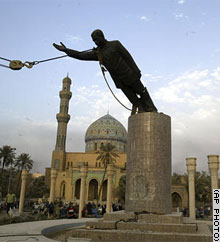
Raising Statues – the stupid option

Now we have Mayawati, a Dalit (lower class) woman in one of the poorest states of India, who is busy going around raising statues to herself and her allies. This is the lady concerned.


My in-laws stay in the capital of that state and her statues are an eyesore. Not only personally corrupt up the ying yang, she is useless as an administrator and she she got her backside handed to her in a sling in the recent elections. And typically, she doesnt help out her own caste, forget about the rest of the state. But she goes about raising her stature by putting up statues.

No self respect anyway, but then you wouldn't expect a corrupt person to worry about finer aspects of life like that. I do hope that this lawsuit goes and pokes her. I would like to show two historical statue related stories and a partial poem to her. First is this one:

If you are not content with this, remember what happened at Easter Island who went about raising Moai (statues) to their leaders. After cutting all those trees to use for quarrying and transportation, the culture basically went through severe ecological damage and died out.

Finally, you would know this poem as well.

I met a traveller from an antique land
Who said: Two vast and trunkless legs of stone
Stand in the desert. Near them on the sand,
Half sunk, a shatter'd visage lies, whose frown
And wrinkled lip and sneer of cold command
Tell that its sculptor well those passions read
Which yet survive, stamp'd on these lifeless things,
The hand that mock'd them and the heart that fed.
And on the pedestal these words appear:
"My name is Ozymandias, king of kings:
Look on my works, ye Mighty, and despair!"
Nothing beside remains. Round the decay
Of that colossal wreck, boundless and bare,
The lone and level sands stretch far away.

Friday, November 30

The Curious CEO: Four Keys to Becoming a Great Leader

This states some very basic truths. And I am so in agreement, rarely I see people read and be curious. They prefer to sit in their tiny little wells, mucking around with purely money and boasting about the great car they have got, the great house they got, the great bonus they got. Curious they arent, maybe they are, but no, havent seen them being so. But then, i suppose that's why most MD's remain MD's and very few rise to the top.

Read and Remember!

  1. Reading Outside Their Industry. It’s easy to immerse yourself in one vertical area of business knowledge. But the best CEOs read books and magazines outside their narrow business focus. They’re trying to find trends that are going to hit their company in coming years. And they’re looking to adjacent fields to find tips on how other industries are coping with a particular problem.
  2. Exposure to Networking Groups. The best CEOs expose themselves to other corporate leaders in non-profit settings or organizations like the Young Presidents Organization. And in those environments, they are constantly hungry for best practices.
  3. They Don’t Wall Themselves Off. The most curious and therefore best CEOs make sure that they have exposure to people in their private and social lives who can speak the truth to them, even if it’s uncomfortable. They don’t fall into the CEO Trap where the only things you hear are the things that people beneath you want you to hear.
  4. Avoiding the Arrogance Trap. A corollary is never becoming arrogant, never assuming that he or she knows everything. When a whole organization knows that a CEO is curious and is open to learning, that shapes the culure of the whole company. But when a CEO projects arrogance, the whole company shuts down and stops learning. The personality and behavior of the CEO is so crucial–it cascades throughout the organization.

All this to be taken with a grain of piquant salt!!!