Showing posts with label Casteism. Show all posts

Monday, June 20

Those who pray, those who work, those who fight - Medievalists.net

There's the Hindu caste system. Where everybody is divided into castes based upon what you do. And then a bewildering array of sub castes. It's all rubbish of course but still exists I'm afraid. I read about how Dalits, the untouchables and lowest caste people were sold off as slaves by upper classes to the Dutch in the 18th century in India. Tragic. 
But it was curious to read how this kind of work/profession based societal classification and how it was in the Middle Ages in England and France eh? It took a revolution to remove it in France. You still have it in England but hopefully the class based society will get removed soon without a revolution. 
Have a lovely day kids. 
Love 
Baba


Those who pray, those who work, those who fight - Medievalists.net
http://www.medievalists.net/2016/01/31/those-who-pray-those-who-work-those-who-fight/
(via Instapaper)

When people first start learning about the Middle Ages, one of the first concepts they are told was that medieval society was divided into three groups – those who pray, such as priests and monks; those who work, like farmers; and those who fight, the warrior class. How did this idea get started and what does it actually mean?
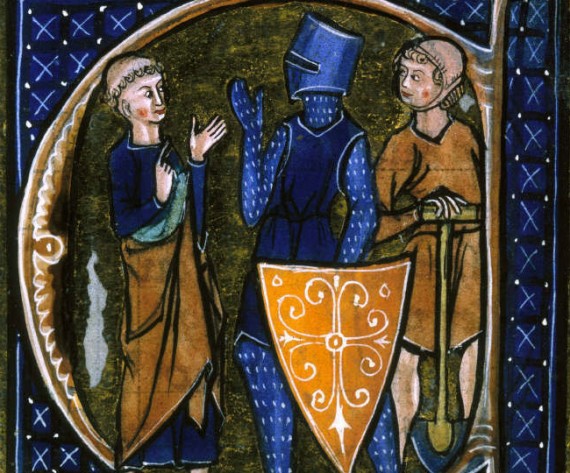
Cleric, Knight and Workman representing the three classes – from British Library Ms Sloane 2435, f.85 '
The concept of the three orders for society is not something you find in the Bible, or in classical sources. The closest thing that to it comes from the seventh-century encyclopedia writer Isidore of Seville, who makes a short reference to the Romans having divided themselves into three groups: senators, soldiers and plebeians.
It seems that our first reference to the idea of three orders comes from a curious source – an Old English translation of Boethius' The Consolation of Philosophy. This work was written by King Alfred the Great (probably with a team of scholars to help him) in the late-ninth century, and he often included his own commentary. It is here that you can find this statement:
I wished for tools and resources for the task that I was commanded to accomplish, which was that I should virtuously and worthily guide and direct the authority which was entrusted to me. You know of course that no-one can make known any skill, nor direct and guide any enterprise, without tools and resources; a man cannot work on any enterprise without resources. In the case of the king, the resources and tools with which to rule are that he have his land fully manned; he must have praying men, fighting men and working men. You know also that without these tools no king may make his ability known. Another aspect of his resources is that he must have the means of support for his tools, the three classes of men.
In his article, "The 'Three Orders' of society in Anglo-Saxon England" Timothy Powell explains some of the thinking behind this statement:
Alfred's formula is descriptive rather than prescriptive. He is not instructing the three orders in their duties, he is doing the reverse; he is meditating on his own duty to the effect that it is incumbent upon the king to ensure the three orders have the wherewithal they need to fulfil their functions. Alfred does not dwell on the theme; he mentions it as an aside. The point of the passage is not social commentary but a reflection on how he, King Alfred, should exercise his talents to ensure that his memory not be forgotten.

Tuesday, January 28

Religion, social class, and entrepreneurial choice

Fascinating

While considerable concern has emerged about the links between religion and economic growth, little is actually known about how religion and social class impact the decision making of individuals. Using institutional theory and social dominance theory, this paper examines the influence of religion and social class on individuals' occupational choices. Based on a large-scale database from India, this paper finds that while some religions are relatively conducive to self-employment, some others have a negative impact on self-employment choices. Furthermore, individuals belonging to social classes that are lower in the social hierarchy are less likely to be self-employed. The role of both religion and social class in influencing the likelihood of choosing self-employment suggests an important link between religion, social class, and occupational decision-making.

Highlights

• We examine the role of religion and social class on occupational choice.
• We find that religions like Islam and Jainism are more favorable for self-employment.
• We find that Hindus are less likely to be self-employed compared to others.
• Individuals belonging to social classes lower in the social hierarchy are least likely to be self-employed.

The following regression models are estimated to link occupational choice with religion and social class:

equation(1)

Y=α+β1*Religion+β2*Education+β3*Demographics+β4*Wealth+β5*Location+β6*Industry+ε1Y=α+β1*Religion+β2*Education+β3*Demographics+β4*Wealth+β5*Location+β6*Industry+ε1

equation(2)

Y=c+δ1*SocialClass+δ2*Education+δ3*Demographics+δ4*Wealth+δ5*Location+δ6*Industry+ε2

Let me quote the operative paragraph in here

While India is rich in diverse religions, some of them, such as Islam and Jainism, are more conducive to self-employment. The institutional profile associated with Islam strongly supports entrepreneurial activity. For example, Islamic banking models, based on the Koranic principles of risk sharing (Khan, 1996), may encourage even risk-averse Muslims to become self-employed. In Jainism, principles of self-reliance and benevolence to business (Caillat, 1987) give rise to an institutional profile that is conducive to self-employment. By contrast, Hinduism inhibits self-employment by shaping an institutional profile that is not conducive to self-employment choices. The normative pressures on Hindus to choose occupations based on the caste of their birth (Hutton, 1946), and the cognitive beliefs that do not support proactively changing thestatus quo ( Singer, 1966 and Tripathi, 1992) may discourage self-employment in Hinduism.

Although Christianity is associated with an institutional profile that is conducive to self-employment, it does not have a positive effect on self-employment in the Indian context. This result may be attributed to the large number of individuals from the Hindu backward classes converting to Christianity (Henderson, 2002). Thus, the estimated effect of the Christian religion in India shows the mixed effects of prior learning and new beliefs particularly with regard to the normative and cognitive dimensions of the two religions. The estimated effects of Buddhism and Sikhism show that the followers of these two religions are not different from Hindus when it comes to their self-employment choices. These results are attributable to the close relationship that Buddhism and Sikhism have with Hinduism. The founders of both the religions were Hindus and, Buddhism, in particular, shares many of the Hindu values and beliefs (

Maybe as public policy, the Indian government may want the Hindus to convert to Jainism. Or Islam. But as the example of Christianity shows, this will not work as despite conversions to another religion, they are still not being self employed.

Curious, eh?

Friday, August 17

Caste and Buddhism

For a very long time, I always thought that Buddhism was totally against caste. In so many references, the Buddha has explicitly said that what you are is defined by your deeds not birth such as sutta nipata verse 136 or majjhima nikaya 2-147ff.

So it was quite surprising that I read in the digha nikaya 3.80 ff about how the caste system came about and how this was the natural order!!!!

Mind you, the epistle does say that it's not what the shudhra or Brahman's birth condition that determines the future post death state or trajectory but the deeds.

Still to read that caste is the natural order is surprising. But then the association is also described based upon what they do. Or deeds. If you make war then you are a Kshatriyas. Period.

Interesting.

Monday, April 16

Where can you find a Christian Leader being casteist?

Actually, I shouldn't be surprised. For all of Jesus’s preaching about everybody being equal and stuff (with some limitations, mind you), Church leaders have been busy down the centuries deciding who is a Christian or who is not. Sectarian hatred is amazing within Christianity.

But one would have agreed that once you are inside the particular sect of Christianity that you belong to, you wont do any more divisions, would you? Nope. Check out what Dr. John Dayal, who is a member of various august bodies in India has said. I quote:

Dr. John Dayal

Member, National Integration Council

Government of India

Member, National Monitoring Committee for Minority Education,

Government of India

Secretary General, All India Christian Council

Imm. Past National President, All India Catholic Union

505 Link Apartments, 18 IP Extn. Delhi 1100092 INDIA

Mobile +91 9811021072 Land +91 11 22722262

Email: john.dayal@gmail.com;

15th April 2012

Dr Manmohan Singh

Prime Minister of India

South Block, Central Secretariat

New Delhi 110001

Re: Serious flaws in enumeration of Caste census will impact on Dalit, OBC and MBC Christians

Dear Prime Minister

Easter Greetings

I am writing to you as a Member of the National Integration and on behalf of the All India Christian Council to draw you urgent attention to serious deficiencies in the enumeration process in the national Census on Caste which is now underway. Unless corrected, the enumeration will lead to falsification of the data and will seriously impact on the interests of the Christian community in general and on the rights of those of the community people who trace their origins to India’s Dalit and OBC groups.

This is from my own personal experience and the experiences of other Christians in various parts of the country.

Two enumerators, a lady and a gentleman, came to my house and interviewed me as the head of the household. They asked me my name and personal details. Thereafter they asked me my religion. I told them. They then sought to leave. I asked them if they would not ask me my caste. They had no answer. I told them they had to ask, even if I thereafter said I had no caste, or declared any other caste. They again had no answer. I must also mention that they did not ask us about the religion of every individual member of the family, possibly presuming that everyone shared the same faith. This may or may not be always true. In many urban families, there may be spouses, sons or daughters in law who are Tribals, OBCs or of Dalit origin. The Enumerating Staff have patently not been properly instructed and trained.

This failure to ask about the caste of those declaring Christianity as their religion is a major procedural lapse that introduces an avoidable error in the data and will skew the statistical computations. The Registrar General of India will not be able to determine the caste diversity in the Christian community with any exactitude.

Article 341 (iii) of the Constitution or its predecessor the Presidential Order of 1950, which the community has challenged through Public Interest Litigation in the Supreme Court of India, cannot be used as an excuse, as the RGI’s office seem to be doing, as this is a mere enumeration exercise and does not pre-suppose any consequential benefits at this stage. Even otherwise, OBC and MBC Christians, including the Latin Rite of Kerala have acceptance in official records of several States.

The Dalit Christians have, of course, for more than half a century repeatedly urged the government to grant them Schedule Caste status, a demand supported by various national Commissions, a large number of State governments and national and regional political parties. The CPI-M, for instance, renewed this demand at their recent meeting. We have consistently urged the Government of India to give a positive response to the Public Interest Litigation in the Supreme Court on this issue.

The Government of India should immediately direct the Census Commissioner and Registrar General of India to ensure that in the on-going exercise, Christians should be enumerated for their caste origins. For many, this is an assertion of their Identity. Individuals can, should they so want, will continue to have the right to say they do not want their caste to be recorded. The enumeration staff should be appropriately instructed and trained in this matter.

Thank you

God bless India, and God bless you

Yours sincerely

John Dayal

Now I will leave you with some questions

1. Why is a Christian Leader trying to propagate caste? Doesn't make sense does it? Surely he should be campaigning for social equality rather than entrench it?

2. For a person from minorities, why are they trying to split a minority even further? Doesn't make sense.

3. Why would they want to have Dalit non Christians and Non Dalit Christians as separate groups? If he was indeed interested in Dalits, then he would make common cause with other Dalits such as Andhra Dalits, Hindu Dalits, Buddhist Dalits, Muslim Dalits, etc. Why split?

4. So is he speaking on behalf of Dalits or Christians?

5. So there is no reason due to the reservations? (no? really?)

this chap is very strange, frankly. Very dodgy. His press releases come across as somebody who is very dodgy, but I couldn't find out anything about about his doctorate. He is a journalist by profession. Couldn't find out on his linked in profile or elsewhere.

Thursday, March 8

India is broken by narrow walls

I got this emailed petition. It says:

The Communal Award was announced by the British Prime Minister Ramsay Macdonald on 4 August 1932 to grant separate electorates to minority communities in India, including Muslims, Sikhs, and Dalit (then known as the Depressed Classes or Untouchables) in India.

In August 1932, the then Prime Minister of Britain, Ramsay Macdonald gave his 'award' known as the Communal Award. According to it, separate representation was to be provided for the Muslims, Sikhs, Indian Christians, Anglo-Indians, Europeans, etc. The depressed classes were assigned a number of seats to be filled by election from special constituencies in which voters belonging to the depressed classes only could vote.

https://secure.wikimedia.org/wikipedia/en/wiki/Communal_Award

This came on a day when I read that the US Supreme Court is going to review the issue of race in university admissions. I agree totally. Respecting race in this manner is stupid. If you do have to discriminate, then discriminate in favour of poor people. Irrespective. That’s the way you see that citizens are non racial and there is an intellectually rigorous argument for making choices.

Needless to say, this idea is totally stupid and idiotic. We shouldn't divide up our communities like this. Why is the assumption that another person of the same religion will be better able to look after you than another person of the same gender? or same height? Or same earnings? This is an extraordinarily stupid initiative and people should grow up, seriously.

bah!

Tuesday, July 26

Evidence on Caste-Based Discrimination

The author carried out a survey which is quite common in the UK and USA to test for situations like discrimination and racism. Basically what you do is to take the same cv, duplicate it, change the name to say something that is "white race" sounding and something that is black race sounding or asian sounding, send to employers, see what the response is, and then try to show that the difference in the reaction to those applications is because of that variable (race, sex, region, location, etc.) being different. So this lady did this to Chennai based entry level white collar jobs and on websites between march and dec 2006. She found that a high caste applicant had to send out 6.2 cv's versus 7.4 for a low caste applicant, a difference of 20%. Male recruiters, Hindu recruiters and large firms showed the biggest difference on these 523 applications. But only 2 resumes were sent out, which is interesting, why didnt they send out 4 to correspond with the 4 categories? (other castes, Other backward castes, SC and ST)? in this study, because of this, the results are interesting but hardly surprising.

Now the difference between these is given by these stats: 2004-05 median per capita consumer expenditure bracket (in Rupees), within urban areas of India, was [580,675] for the SC, [675,790] for the ST, [675,790] for the OBC and [1100,1380] for the Other category. Interesting or what? Given the wide variety, it would have been interesting to see the response rate. Anyway. Some interesting bits. Lower caste Women get lower callbacks. And also for both customer services and front office/administration jobs. Now this is the interesting bit, they saw the recruiter bit from the name given in the advertisement. I am not really sure that the contact person in the advertisement is the actual manager. So this has to be taken with a grain of salt. For all you know, the contact name on the advertisement is the name of the junior most person whose responsibility is to handle advertisements in the HR department. But even without that, makes sense that male and Hindu recruiters would show this discrimination.


Firms without multiple domestic offices and foreign offices favour high caste applicants. makes sense, they are parochial firms but firms with multiple domestic and foreign offices prefer low caste applicants. I am not sure if the reverse explanation works. Bigger firms are, by definition, more amorphous and more bureaucratic. Thus they will end up hiring more low caste employees simply because of the probability distribution rather than any explicit liberal positive discrimination. The author suggests its due to political pressures in Tamil Nadu, the state where Chennai is based. Not clear, sorry. Other researchers seems to have found that there is no difference between high or low caste workers in IT but do find in call centre work. But all these points show up fascinating points on how caste is still in place but one positive thing that i take away from here is that i think this gap is reducing as more urbanisation happens and more firms become big and more education happens etc. etc. Would be good to confirm this with a repeated experiment in say 10 years time.


Here's the abstract.


Caste-based quotas in hiring have existed in the public sector in India for decades. Recently there has been debate about introducing similar quotas in private sector jobs. This paper uses a correspondence study to determine the extent of caste-based discrimination in the Indian private sector. On average low-caste applicants need to send 20 percent more resumes than high-caste applicants to get the same callback. Differences in callback which favor high-caste applicants are particularly large when hiring is done by male recruiters or by Hindu recruiters. This finding provides evidence that differences in callback between high and low-caste applicants are not entirely due to statistical discrimination. High-caste applicants are also differentially favored by firms with a smaller scale of operations, while low-caste applicants are favored by firms with a larger scale of operations. This finding is consistent with taste-based theories of discrimination and with commitments made by large firms to hire actively from among low-caste groups

Saturday, September 18

Caste amongst Muslims and Christians in India

I had a good discussion with some friends on a mailing list. Quite a lot of people were very surprised and wouldn't believe that Muslims and Christians in India have a caste system. So I am taking the liberty (and with permission from some) to put in some points which I and others wrote which confirms the existence of caste in the Indian Muslim and Christian population. It is only when we identify and agree that this happens that we can think about eradication. This is not just Hindu specific, this has become an India wide, cross all religions. We see this situation in Hindus, Muslims, Jains, Buddhists, Christians, Sikhs, you name it.

  1. I dont know about keralites, but among tamil christians, at least 20 years ago, caste was very important in marriage. We have nadar christians, thevar christians, vellalar christians etc. Also a telugu christian lady once told me that she was a brahmin-chrstain and would not intermarry with other 'non-brahmin' christians. One of her relatives had married the tamil actor Nagesh, and she was saying how the family was alright with it since Nagesh was a brahmin although a hindu. I have a Oriya christain friend who says he is kshatriya/Rajput, and in his family they will be willing to marry a brahmin-christian at the most outside his own caste.
    BTW, a muslim friend from Hyderabad, while referring to another muslim caste (I dont remember the name of the caste) told me how they looked down on those muslims and would not intermarry with them. I have heard how in Bengal at one time hindus and muslims married among themselves on caste lines, when they refused to marry from a different caste even if of the same religion.
    Times have changed. I see a lot of intermarriage among urban hindus, especially the IT types, I am sure such changes are happening among christians and muslims also. Intermarriage alone is the solution.
  2. For a genuine student of Kerala Christianity, I can give the names of the following castes in Kerala Christianity:- 1) Anglo Indians ( approved by Government of Kerala os an OBC) 2) Latin Catholics ---( OBC as per GOK) - unofficially they belongs to 3 castes - group of 500s, Groups of 700s & Former Syrains. 3)Nadar Christians ( approved by GOK as an OBC) 4) Scheduled Caste Coverts to Christianity ( approved by GOK as an OBC) -- unofficially they belong to many castes like Pulaya, Parya, Sambvar etc. 5) Mala Aryan Christians ( Approved by GOK/GOI as ST) The Pre-portugese Christians or the Ancient Malabar  Christians now commonly referred as Syrian Christians are classified into two, a) Northists -- who claim they were Christianised by Apostle Thomas b) Southists --- who claim they are the descendants of those Christians who have migrated to Kerala in 4th & 9th Centuries from Syria. Of course  there is no observance of hierachy and ritual purity amoung these castes, the differences mainy exist "in the mind" & in matters of marriage.
  3. I just realised that you might not have access to the journal articles. I only have the second one electronically, the other two are paper, but here are some extracts which you might find of use: In India, Muslim castes generally fall into two categories: higher castes of Syed, Sheikh, Pathan, and Mughal, and lower, service castes. The high castes claim foreign origin from Saudi Arabia, Iran, Afghanistan, or Central Asia, while the members of the low castes are low-caste Hindu converts. Many high castes however are also Hindu converts. For example, manyPathans are publicly known as high-caste Hindu converts. The large number of Sheikhs, as seen in census data on Muslim caste throughout India, makes it probable that many if not most of the Sheikhs are Hindu converts (see Ahmad, 1978a, for a study of a converted Hindu caste that regards itself as a Sheikh subcaste). This is likely a result of what Goodfriend (1983:123) calls the “Sheikh factor” (or Sanskritization in Srinivas’s terminology) , that is, of lower ranking Muslim caste groups attempting to raise their status over time by claiming that they are Sheikhs. These four Muslim high castes are categories, and often (though by no means always) there will be corporate subgroups formed from these categories. In Hyderabad, in addition to the four higher caste categories, the most well-known lower caste groups are the Qureshi (or Qassab, butchers) and  Ladaf (cotton beaters). Other castes that are important in the local hierarchy are Baid Pathan (who have a near-monopoly on the local wholesale betel nut trade) and Chawsh (descendents of Yemeni Arabs who migrated to serve in the Nizam’s forces; see Khalidi, 1997).We should note that being high caste does not necessarily mean that the caste is high status; that is, caste does not fully determine a group’s status. For example, Chawsh, while Arab, are of distinctly lower status than Syeds, Sheikhs, and Mughals in Hyderabad, since their main employment was as military personnel, and others regard them as rough and uncivil. They are not as low as service castes, such as weavers and butchers. However, because of their military background, they are considered lower than “genteel” castes of Syeds, Sheikhs, and Mughals, yet they are still high because of their Arab descent.12 He then talks about the qureshi's and Medhavi Pathans and so on and so forth.  The architect we had was a Qureshi and as you can appreciate over the construction of the house, we discussed various things, caste and history being one of them.
  4. That's true. Christians in Kerala were identified with the upper castes till the westerners came. But please go back to history beofre that and you will find in all books of history that it is the 9th century that Christians came to be accepted as a caste just below the Brahmins. Go back to the social history of Kerala and you will find that the caste system became an integral part of Kerala in this century that is known as the dark of Kerala. That was a little over a century after the Parasuram myth entered Kerala marking the birth of Brahminism. (It had entered Karnataka about a century before that. By saying that caste entered the Kerala Churches only with the westerners you are doing what Hindu fundamentalists are doing by saying that caste is an introduction of colonialism. What happened with the western missionary is that persons from different castes entered the church and they remained as different castes. That is what one means by saying that caste is practised among Christians. By speaking of caste system one does not refer only to its extreme form of caste-based oppression.
  5. It differs from place to place. In Goa and Mangalore, there are four or five castes but occupation makes a difference. In Kerala there are two castes (Nordist and Sudhist) among the Syrian Christians. Latin Christians keep pretty much the system as in their surroundings. Obviously there are many nuances which can be understood from historical factors. For example, there are "Latin Christians" who joined the "Latin Church" considered the authentic church at the "Coonan Cross "Revolt" of 1653 (?). They keep their caste and many intermarry with the Syrian Christians. In TN and AP, there is very little difference between the Hindu and Christian castes. This of course is a simplified versions. It has many nuances. But the basic fact is that caste continues to exist among Christians. For example, some groups like the Nadars who were "untouchable" toddy tappers have moved upwards by using the church structure and have become a "backward" caste. One can mention other nuances. But the basic fact is that caste exists in different ways among Christians though many of its external expressions have changed during the last century. Though Muslims may not recognise it, in practice it exists also among them in different ways. It is important to recognise it and fight against the injustice it does to the subaltern castes.
  6. check these out: *       Ahmad, Imtiaz (1978). Caste and social stratification among Muslims in India. New Delhi: Manohar. OCLC; *       Ali, Syed (December 2002). "Collective and Elective Ethnicity: Caste Among Urban Muslims in India". Sociological Forum 17 (4): 593–620. ; *       Ahmad, S. Shamim; A. K. Chakravarti (January 1981). "Some regional characteristics of Muslim caste systems in India". GeoJournal 5 (1): 55–60.
  7. belonging to a caste itself is not illegal. Not least because there is no agreed legal structure behind what a caste can be. The current way of defining castes is such a hodge podge that castes are identified based upon gazetted notifications. Go figure. Finally, no, I have not come across any well argued historiographically accurate explanation of how the ved or purana or upanishad descriptions of godhead into humans into professions have morphed into the 600 odd castes which are currently gazetted as per the following list. http://lawmin.nic.in/ld/subord/rule3a.htm so as you can see, actually belonging to a caste or following the caste system as a means of identification is not illegal.
  8. The government of India stopped collecting data on non-Untouchable (or Dalit) castes after independence. Therefore we do not know how many people of each caste there are. The last census to consider caste for Hyderabad state was in 1921. In this census, in the state of Hyderabad, there were 1,298,277 Muslims counted, with 906,363 returned as Sheikh, 187,679 as Syed, 131,828 Pathans, and 50,048 Mughals. Only 22,359 other caste members were counted (Census of India, 1921:228–236). Although it would be foolish to extrapolate these numbers to today, my observations and conversations with scholars and others indicate that, as in 1921, there are relatively few people of low castes in Hyderabad, while the bulk of Muslims in the city are high caste, mostly Sheikhs. The collection of ethnographic data is valuable here precisely because caste groups are not identifiable through enumeration.
  9. The idea may seem strange that in an egalitarian religion like Islam, there would be ranked, hierarchical divisions among Muslims. Many scholars have debated this point, whether or not caste exists among Muslims in India. It has been clearly established that in some parts of India, and for certain Muslims, caste considerations are strong (e.g., Ahmad, 1976, 1978b, 1981, 1983; Ansari, 1960; Jamous, 1997; Madan, 1995), while for others they are less important (e.g., Fanselow, 1997; Mines, 1978; Vatuk, 1997).
  10. Blood purity is an important concern for Qureshis; they only give and take marriage partners amongst themselves. Qadeer, a 25-year-old butcher, said that if he were to marry out, it would be a major problem. The butchers are very keen on this. There is a distinct sense of honor among them, which is manifest mainly through the maintenance of endogamy (they do not give or take girls from “just anyone”), and the type of work they do—they slaughter only goats. They do not slaughter large animals such as buffalo and cattle, so they feel superior to the buffalo butchers. They also do not slaughter chickens, which is not the province of any particular caste.While the Qureshi are endogamous as a matter of honor, others who are higher caste do not want to associate downward with them. One doctor (a
    Syed) looking for a wife for her son (a Pathan) told me in a firm manner, “No Qureshis. Their culture is completely different.” Aijaz, a marriage lawyer, said that there is biraderi endogamy among groups like butchers because others do not want to marry them, since they always have knives in their hands, and they are a little jahil, rough and uncivil. “But what if they are not practicing butchers?” I asked. He reflected and said, “Yes, I know of one doctor who is of the Qureshi biraderi in Mallepally neighborhood, and his wife is not a butcher.” So, he said, people are only considering money and education now.
  11. The literature on Hindu caste is vast, and beyond the scope of this paper (e.g., Dirks, 1987; Dumont, 1980; Raheja, 1988). Marriott (1976, 1989; see also Marriott and Inden, 1977) argues for interpreting Indian culture through indigenous sociological categories, while Milner (1994) employs aWeberian analysis to examine caste as the most extreme form of status stratification.
    Unlike Marriott, Milner sees caste as comparable to status systems elsewhere.While there are arguments over how best to understand the caste system, another question has been over just how rigid this system historically has been. Cohn (1987) argues that the caste system(s) were quite fluid and that hierarchies of caste were contingent upon local conditions of rule. This changed under the British, who established thorough and relatively stable control, directly and indirectly, over all of India. Also, through the British-administered census, caste was enumerated for the first time, and codified according to a Brahmanical view. Thus, in many places where caste was contested, a hierarchy of castes with Brahmins as superior was imposed by the British (Dirks, 1987). For the most thorough discussion of caste, see Bayly (1999), who gives an excellent account of the development and changes in caste throughout India from the ancient Vedic period to the present.
  12. three of my cousins have married Christians, so I have a reasonably good view of 3 case studies of how caste is pretty solidly entrenched in there. Whether we are talking about who gets invited, the churches which are certain castes, inter marriage between castes and the like are all indicators to the fact that it does exist. And before we start, yes, discrimination is present in both religions, just not on the basis of caste, so if its discrimination that we are looking for, we have that in spades. But to go back to your question, caste as a measure of association is perfectly legal. No illegality in that. It is when you discriminate on that basis, remove opportunities on that basis, etc., that's illegal.

The existence of caste in Muslim and Christian communities that I have observed in Allahabad, Lucknow, Hyderabad, Bhopal and other places pretty much shows that it part and parcel of Indian community life. Calling it localised is irrelevant since its pretty much prevalent wherever there are concentrations of Muslims and Christians. Just like Hindu's try to explain away caste, others also try to explain away caste in their communities. As I said, I dont really have a problem with people wanting to stick with their own biraderi or caste. And as I said, its not illegal either and its a fundamental right. Its when it becomes discriminatory, that's where the problem lies.

Arguing that the caste system exists in India because of Hinduism might be fair. We do need to go after the Hindu guru’s and the Shankaracharya’s to get them to come out clearly against this heinous situation because it is only after we clearly state that despite it being mentioned in some of the Hindu tracts, it does not meant that we think of people in an upper or lower caste basis.

While I am at it, I also disagree with the idea of counting and measuring castes, we are trying to get away from all this caste business and all this measurement, enumeration, will simply perpetuate this and keep huge problems growing. Look at the people who are asking for it and pretty much all of them are asking for this so that they can demand more resources from the government. Nobody thinks about India as a whole. If you do want to help, then help the poor irrespective of their castes. Surely we are all Indians and that’s more important?

Saturday, February 27

Hindu Nationalism in UK and the VHP

This was a very curious paper that I read. It was even more curious, because just a day before I got this paper, I read this note which was published in Outlook. I have to admit that I am in some sympathy with the views of Roover, but how it is taught in the west is something that I find a bit strange. At the very least, I would have expected some reasonable facsimile and similarity in the ways it is taught compared to Judaism, Christianity, etc., but this is specially in the USA, much less in the UK. I have personally had several experiences of this. Anybody saying anything good about Hinduism or its philosophy or any thing like that is almost automatically considered to be a raving Hindutva casteist rage boy. I have seen this happen far too many times. I strongly suggest you read that article and here’s a quote:

In one sense, then, the picture for students of India is even grimmer than the one Tripathi sketches. In another sense, there is hope, because times of turbulence also hold the potential for intellectual change. As students of India, we will have to take seriously the growing discontent among Hindus about the ways in which their traditions have been depicted. Some of this is inspired by an attempt to sanitise the Hindu traditions according to the model of Islam and Christianity and the prudishness of middle-class morality. However, other strands express a deep sense of grievance towards the secularist hegemony and the academic allergy to Hinduism. As long as reasonable and well-educated minds do not address these grievances, Hindu nationalism will be able to tap into the growing anger among Hindus and manipulate this to its own benefit. To address such problems, one needs to work towards a climate of intellectual freedom that has too long been absent from the study of India.

So while I am quite interested to read about the scholarship that is done about Hinduism and India, I am not 100% sure about the academy. Do not get me wrong, I think the Hindutva chaps are a bunch of goons themselves and they come up with serious stinkers. In any case, they and their bunch of merry men are most certainly against academic freedom (witness the cases against the beef book, etc. etc., read my friend’s book on this issue. I can't say much more than this, as I think I am biased in favour of Salil’s book.

Usually my net scraper for the “Hinduism” keyword throws up very few scholarly alerts but this article piqued my interest. The author is assessing the role of Hindu nationalism in the development of Hindu identity in Britain. And to do that, he delves into the VHP UK organisation. After some 10-15 pages, I am not very sure where he ends up. This is the abstract:

This paper assesses the role of Hindu nationalism in the development of Hindu identity in Britain. Some accounts argue that the authoritarian network of Hindu nationalist organisations apparent in India is reproduced in Diaspora contexts, especially in the west. The paper argues that this degree of organisational intentionality is not always borne out by evidence in the UK. Although Hindu nationalist organisations have achieved some success in establishing their presence, in national arenas they frequently give way to umbrella organisations such as the Hindu Forum of Britain (HFB) and the Hindu Council UK (HCUK). The paper argues that Hindu nationalist organisations nevertheless operate vigorously in multilocal contexts, fuelling a 'Hindutva effect' which has a broader ideological influence. The paper examines some of the positions taken by the HFB and HCUK to demonstrate how this influence is played out in national arenas, before reflecting more broadly on the implications of these dynamics for the development of diaspora identities.

There was one event that the VHP organised 20 years ago, but since then, it has been remarkably quiescent. Their website is basic, its members aren't represented in the organisations which deal with civil society, etc. So he talks about all this and then says that the VHP is a serious organisation spreading a nebulous underground version of Hindutva. He called the VHP arranged sammelan as a tamasha. That was a cheap shot frankly, not worthy.

Then the chap starts talking about conversion. And I am seriously surprised that the author does not understand the importance of conversion to a Hindu. I mean, isn't this obvious? We are talking about a religious identity, and a factor which goes directly against this identity and reduces it will be considered to be a threat. So when the Hindu elders in the UK were raising their concerns about Muslim gangs converting Hindu (and Sikh) girls, the British Police considered that as a legitimate problem. But the author thinks that this objection to conversion is an expression of Hindu Nationalistic thought. Erm, no!

Then furthermore, he goes forward and says that this is a subterranean inflection towards Hindutva. I totally disagree. This is going to the core of a Hindu’s identity and it has no political leanings at all. So I am not sure where he is getting the subterranean bit from or where he is seeing Hindutva. It's like seeing a commie under every bed.

The next result that he finds is that to protect against the threat of conversion, one has to “wake up” Hindu Unity. This apparently demonstrates the presence of Hindu nationalist ideology. Again, this is a massive over reading into the word “wake up”. If I say that we need to do jagran, then it is the same. It is making visible, bringing up, to awaken, to rise up. Obviously he doesn't link this to Swami Vivekananda who said, “Arise, Awake! And stop not until the goal is reached”. Or how about his poem? I quote:

The Song of the Sannyasin


Wake up the note! the song that had its birth
Far off, where worldly taint could never reach
In mountain caves and glades of forest deep,
Whose calm no sigh for lust or wealth or fame
Could ever dare to break; where rolled the stream
Of knowledge, truth, and bliss that follows both.
Sing high that note, Sannyasin bold! Say –
    ‘Om tat sat, Om!’
Strike off thy fetters! Bonds that bind thee down,
Of shining gold or darker, baser ore;
Love, hate; good, bad; and all the dual throng,
Know, slave is slave, caressed or whipped, not free
For fetters, though of gold, are not less strong to bind;
Then off with them, Sannyasin bold! Say –
    ‘Om tat sat, Om!’
Let darkness go! the will-o’-the-wisp that leads
With blinking light to pile more gloom on gloom.
This thirst for life, for ever quench; it drags
From birth to death, and death to birth, the soul
He conquers all who conquers self. Know this
And never yield, Sannyasin bold! Say –
    ‘Om tat sat, Om!’
‘Who sows must reap,’ they say, ‘and cause must bring
The sure effect; good, good; bad, bad; and none
Escape the law. But whoso wears a form
Must wear the chain.’ Too true; but far beyond
Both name and form is Atman, ever free.
Know thou art That, Sannyasin bold! Say –
    ‘Om tat sat, Om!’
They know not truth who dream such vacant dreams
As father, mother, children, wife and friend.
The sexless Self! whose father He? whose child?
Whose friend, whose foe is He who is but One?
The Self is all in all, none else exists;
And thou art That, Sannyasin bold! Say –
    ‘Om tat sat, Om!’
There is but One – The Free, The Knower – Self!
Without a name, without a form or stain.
In him is Maya, dreaming all this dream.
The Witness, He appears as nature, soul.
Know thou art That, Sannyasin bold! Say –
    ‘Om tat sat, Om!’
Where seekest thou? That freedom, friend, this world
Nor that can give. In books and temples vain
Thy search. Thine only is that hand that holds
The rope that drags thee on. Then cease lament,
Let go thy hold, Sannyasin bold! Say –
    ‘Om tat sat, Om!’
Say, ‘Peace to all: From me no danger be
To aught that lives. In those that dwell on high,
In those that lowly creep, I am the Self in all.
All life both here and there, do I renounce,
All heavens and earths and hells, all hopes and fears.’
Thus cut thy bonds, Sannyasin bold! Say –
    ‘Om tat sat, Om!’
Heed then no more how body lives or goes,
Its task is done. Let Karma float it down;
Let one put garlands on, another kick
This frame; say naught. No praise or blame can be
Where praiser praised, and blamer blamed are one.
Thus be thou calm, Sannyasin bold! Say –
    ‘Om tat sat, Om!’
Truth never comes where lust and fame and greed
Of gain reside. No man who thinks of woman
As his wife can ever perfect be;
Nor he who owns the least of things, nor he
Whom anger chains, can ever pass thro’ Maya’s gates.
So give these up, Sannyasin bold! Say –
    ‘Om tat sat, Om!’
Have thou no home. What home can hold thee, friend?
The sky thy roof, the grass thy bed; and food
What chance may bring, well cooked or ill, judge not.
No food or drink can taint that noble Self
Which knows itself. Like rolling river free
Thou ever be, Sannyasin bold! Say –
    ‘Om tat sat, Om!’
Few only know the truth. The rest will hate
And laugh at thee, great one; but pay no heed.
Go thou, the free, from place to place, and help
Them out of darkness, Maya’s veil. Without
The fear of pain or search for pleasure, go
Beyond them both, Sannyasin bold! Say –
    ‘Om tat sat, Om!’
Thus, day by day, till Karma’s powers spent,
Release the soul for ever. No more is birth,
Nor I, nor thou, nor God, nor man. The ‘I’
Has All become, the All is ‘I’ and Bliss.
Know thou art That, Sannyasin bold! Say –
    ‘Om tat sat, Om!’
— Swami Vivekananda

Composed at Thousand Island Park, New York, July 1895.

I mean, if just the term “waking up” got him so excited, I wonder what he will do with the song of the Sanyasin? Will he consider Swamiji as a raving Hindutva militant revolutionary? He also says that the 1993 Global Vision 2000 conference in Washington DC was “ostensibly” a centenary celebration of Vivekananda’s visit to the USA, but he thinks this was a key moment in the development of the US Hindu nationalist movement. But he does that without any follow-up explanation, and we are supposed to swallow it.

In other words, the author simply does not prove that Hindu identity is nationalism at all and even lesser are the links to the VHP. There might well be Hindutva effects, but he does not consider the other factor which in many ways is more powerful than the Hindu identity factor. This is the linguistic/cultural factor. Hindus in the UK are more defined by their Asian Gujerati or Punjabi background or their Indian background, rather than something that is a broad based tent. For example, there is a shed load of professional (doctors, accountants, nurses, technology professionals, etc.) Indians who have come over directly from India who do not belong to any of these groupings of Punjabi or Gujerati chaps.

So no, I am not impressed with the forced identification by the author. There is no such thing as an overarching British Hindu identity. The Hindu organisations in the UK are primarily religious and cultural, and very rarely do they step into the political area and for the author to try to attribute Hindutva to this society is simply not borne out by the facts that he quotes. The people on the left and in the academy must realise that they really cannot go about publishing pap like this. Like the climate science academic research imbroglio brewing, their reputation is suffering significantly.

Sunday, January 31

1818, the first shots in a casteist war?

I received the following email on new year’s day:

ON 1ST JANUARY 1818, MERE 500 BAHUJAN SOLDIERS COURAGEOUSLY FOUGHT AGAINST 50,000 TYRANNICAL FORCES OF MANUWADI PESHWAS AND GAVE THEIR LIVES TO END THE OPPRESSIVE MANUWADI REGIME

EMPIRICAL RULE OF BRITISHERS IN RECOGNITION OF THE GREAT BRAVERY OF BAHUJAN SOLDIERS UNDER THE CAPTAINCY OF SIDNAK MAHAR, ERECTED A MONUMENT AT KOREGAON-BHIMA, PUNE ON THE BANK OF RIVER BHIMA.

DR. B. R. AMBEDKAR, THE BODHISATTVA WHO FOUGHT THROUGHOUT HIS LIFE AGAINST THE AGE OLD MANUWADI OPERATIONS, INVARIABLY USED TO VISIT AND SALUTE THE "VIJAY STAMBHA"- MEMORIAL OF BAHUJAN WARRIORS

LET BAHUJANS NOT FORGET THEIR MARTYRDOM AND OFFER THEIR SALUTATIONS TO THE GREAT MEMORIES OF THOSE GREAT BAHUHAN SOLDIERS WHO RELENTLESSLY FOUGHT TO BREAK THE SHACKLES OF OUR AGE OLD SLAVERY.

LET'S NARRATE THE HISTORY TO FUTURE GENERATIONS SO AS TO MAKE THEM STRONG ENOUGH TO WITHSTAND MANUWAD.

Very impressive. I had never heard of this before, so went looking for more information. Here’s another site where there is more background. Hmmm, fascinating stuff. So if I understood the essence, it was a group of 500 Dalit soldiers who fought approximately 25000 Brahmins. And why is this important? I quote:

First, the British army fought this battle with a minuscule army expecting the worst, especially after their experience of the Pune Regency. Secondly, the battle of Koregaon was one of the most important events which helped tear down the Peshwa Empire and subsequently the Peshwa had to abdicate. Thirdly and most importantly, it was an attempt by the untouchables of Maharashtra to break the shackles of the age-old caste order.

That sort of didnt really jibe with what I had read about the Maratha Wars. So I went to do a bit of poking around.

1. The Maratha Wars:

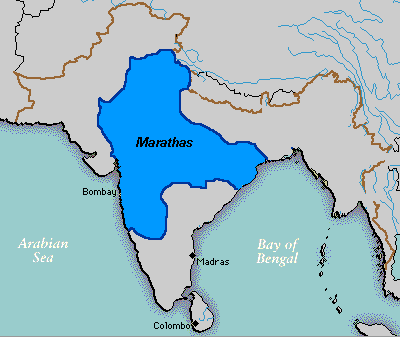
While I can understand the desire of Dalits to home into that skirmish and claim that to be the be all and end all of all, skirmishes like this have to be grounded in the greater framework. The Maratha Empire brought to life by Shivaji attained its greatest strength by 1760 as shown in the image below.

And I should point out that Shivaji was not a Brahmin. While they claimed Kshyatriya status later on, there are some arguments that he was originally a Dalit, a Shudra to be precise. See here for an overview of this argument. Finally, Shivaji’s army was largely composed of people like him, so it was a Dalit Army anyway which got promoted, so to say. Then comes the first Anglo Maratha War 1777-1783 where first the Maratha’s won and then the British won. In both cases, native soldiers were far too frequently Dalits. Anyway, more land was captured by the Brits and the power of the Maratha’s was further reduced. Peshwa Baji Rao II and his father basically got up to no good. In 1802, BajiRao went and sucked up to the British after being defeated by Holkars in the Battle of Poona. This pissed off the other Maratha warlords and they got into a bit of a fight with the British which ended with more loss of territory for the Marathas. Then comes the crucial 3rd War which our Dalit friends might now appreciate.

This relates to the 3rd Anglo Maratha War 1817-1818 or the Pindari War. The Pindari’s were highly mobile cavalry units which were not on the payroll of any ruler but associated with rulers in return for protection and permission to plunder. Guess what? These Pindari’s were low caste, Ladul and also had quite a lot of Muslims (mainly Afghans and Pusthun). Anyway, all this plundering was not good for the British and a really very big army of 120,000 men and 300 artillery pieces was put into gear by Lord Hastings to exterminate these Pindari’s. The attacks happened from the east in Bengal, from the South in the Deccan and from the west from Gujarat and Bombay. Look at the map above and see who is the nut in this 3-way nutcracker? The Marathas.

2. The immediate predecessor to the 1st Jan 1818 Battle of Koregaon.

Once the British invaded Maratha territory to go after the Pindari’s, there were skirmishes between the Peshwa’s forces and the British forces such as the sack of the British Residency in Pune, and then the British routed another Peshwa force at Khirki. Then the main battle was fought in the Battle of Khadki on November 5, 1817 where the Peshwa Baji Rao was routed pretty much comprehensively and then the British took over the Peshwa’s seat at Shaniwarwada by November 17, 1817. The Peshwa, by this time, was running ragged. There was another battle between the Nagpur forces and the British at Sitabalsi on November 27 1817. The next battle to be fought was the Battle of Mahidpur on 20th December where the Holkar’s fought and lost to the British, after being betrayed by one of the Pindari (who killed Tulsibai).

3. The Battle of Koregaon:

A good description of the battle can be found here. This is a book by WC Taylor, A Popular History of British India published in 1847. See page 268-269 for details of the battle. Sounds like a pretty good bash. Taylor says that the Peshwa’s forces numbered about 25,000 although it should be noted that counting was pretty vague at that time. Still, it wasnt 50,000. But here’s the crucial thing, the Peshwa’s forces then retreated not because they were defeated by Captain Francis Staunton’s forces, but because they got to hear that British reinforcements were coming over. The British forces lost 200 soldiers out of 500, and 6 out of 7 British officers. Good defensive battle without food or water at this village. You can see the layout of the land here although there are no records extant of how the battle actually went, the defences and the lay of the land.

4. The soldiers.

The soldiers who did most of the dying were Mahars. And again ironically, they got their start in being soldiers by no other than Shivaji to become scouts and fortress guards. They were highly mobile light infantry, which is the reason why they were in the 2nd Battalion, 1st regiment of ‘Bombay Native Light Infantry’ as part of the Maratha Light Infantry. The Peshwa’s soldiers were also by and large lower caste soldiers including Mahars, in any case, not Brahmins. So the fighting basically was between lower castes, only the people who were ordering them around were the British and the Peshwas. This Mahar Regiment still exists and has provided two of the most brilliant Indian Army Chiefs: Gen (Retd) K V Krishna Rao and Gen (Retd) K Sunderji. Also, there is no caste element to the regiment from 1963 onwards and it is now a fully mixed regiment.

5. The aftermath of the Battle of Koregaon:

There was another fight between the fleeing Peshwa’s forces and the British at Ashti on February 20th 1818 and he remained under pressure till he surrendered to Sir John Malcolm on June 3, 1818 and was given the pension of an annual payment of 8 lakhs rupees. The Battle of Koregaon was celebrated by raising of an Obelix which commemorated this.

So all in all, I am afraid what my research threw up was in sharp variance with the mythology is being provided. It was frankly a small battle / skirmish in a much bigger war, the Peshwa’s forces were not defeated in this skirmish, the British Army did not fight this battle expecting the worst because they had been winning every battle in this war, this battle of Koregaon was not really that important as fighting kept on happening for months after this battle and I am afraid there is absolutely no evidence that any kind of caste based ideology was involved in the fight.

So all in all, good myth but a rather more calm reading of the historical record tells differently. I can also see why the Dalit hotheads want to use this battle to burnish their credentials. After all, all revolutions need their battles. Google for “Battle of Koregaon” to see how this myth is being built up, but I am afraid the reading is slightly different. If they do want to celebrate the success of lower caste soldiers, they should celebrate Shivaji, the Indian Soldier, the bravery that these soldiers showed to whoever paid them. See here for the campaigns that the Maratha Light Infantry got involved in. But to bring this casteism into the Indian Army? Not really cricket, old chaps. But I am very happy to be corrected if I have not referred to any other source or documentation. Happy to learn more.

Friday, December 11

21st Century Discourse on Dalits

I received the email below and this is what I responded. The sad part is that he and those other dolts are doing exactly to those poor benighted dalits what others have done to them. They are the useful idiots. If they were smart and they are getting smarter (otherwise the shrillness coefficient from these idiots will not have gone up), they would realise that their economic well being is more tied to being Indians rather than Dalits. Plus economic development and urbanisation will put paid to these people. Still, sometimes its cringe inducing….

Have people actually read the drivel that Kancha produces in the name of scholarship? Its political ideology rather than history, historiography, sociology, anthropology or even political geography. It is not sociology, it sure as heck isn't spiritual and by no means it is scientific. As for discourse, that shrill outpouring of bile and drivel is as conducive to debate and discourse as a sewer.

And looking at the book launch, it has unfortunately proven the point, none (except Professor Rodriguez who I don’t know) are purely there for either political or commercial purposes. I am also not sure what's the connection with Nagaland, or even Burma as she seems to be heading up some Burmese research centre.

Citing American civil war as an example is frankly bewildering and again shows a very large lack of understanding of the background & reasons of that war. For one people (integrationists) to go to war over somebody totally unrelated (the black population) with their own people (secessionists) has never happened in the history of humankind. Never. And spiritual democracy? And yet again, no religion actually claims that, every religion (if Hinduism can indeed be called as such) has discrimination actively built into it. Every one.

So it is not surprising that given the intellectual vacuity of his argument, one would immediately suspect that this was nothing to do with religion but everything to do with politics.

Curioser and curioser.


>
> Dalit Freedom NetworkP. O. Box 2174  Secunderabad, Andhra
> Pradesh – 500003, India www.dalitnetwork.org Email 
dfndelhi@gmail.com Dr. Joseph D’souza - International > President For Press ReleasePost Hindu India by Kancha Ilaiah
> Released21st Century Discourse on Dalit Bahujan,
> Socio-Spiritual and Scientific Revolution in India New Delhi, 
November 26, 2009 In a historic gathering of campaigners for > Dalit Bahujan (India’s “untouchables” and lower castes) human
> rights, Dr. Alana Golmei, a Rongmei Naga tribal woman from 
North East India released Dr. Kancha Ilaiah’s book last evening > at Gulmohar, India Habitat Centre, New Delhi. Following a
> short press conference, a panel discussion featured leading
> Dalit-Bahujan thinkers interacting on the themes of the
> book.While congratulating the author, Dr. Alana said, “I am
> delighted to release such profound and revolutionary book,
> which predicts the future of my people and Dalit  Bahujans at
> large, who have been classified as outcastes and untouchable
> by Brahminical hierarchies and kept under socio-political,
> socio-economic, socio-religion and socio-educational
> oppression for last 3000 years. Kancha’s ideology will create
> a welcome debate and discussion in the coming decade on these
> important issues of true freedom for Dalit Bahujans.” 
> Research scholars, students, civil society members, social
> workers, politicians, Dalit activists, and journalists --
> both national and international -- attended the book launch
> and joined the two hour panel discussion. Mr. Yogendra
> Makwana, Former Home Minister of Gujarat state, chaired the
> discussion. Panelists included: Prof. Gail Omvedt, an
> American-born scholar, sociologist, and human rights activist 
who is an Indian citizen; Dr. Joseph D’souza, International > President of the Dalit Freedom Network; Dr. Udit Raj,
> National Chairman of the All India Confederation of SC/ST 
> Organisations; Prof. Valerian Rodrigues, School of Social
> Sciences, Jawaharlal Nehru University, Delhi; and Mr. Vivek
> Mehra, Managing Director of Sage Publications. Dr. Joseph
> D’souza, in his panel discussion remarks, said, “Kancha’s
> book, “Post-Hindu India” is the greatest 21st century
> challenge to the Brahminical portion of Hindu society. It
> rationally questions and respectfully reveals the caste
> apartheid facing untouchables, outcastes and the oppressed
> majority of India.” In his remarks, Professor Kancha Ilaiah 
said, “Any religion that says all human beings, men and women > are created by God equally is a spiritual democracy. Hinduism
> says all human beings -- men and women -- are not equally
> created. They were born unequal, live unequal, and die
> unequal. I call this spiritual fascism.” Professor Dr. Kancha
> Ilaiah teaches in the Department of Political Science, 
Osmania University, Hyderabad. He won the prestigious London  > Institute of South Asia (LISA) Award for 2008 for his book
> “Why I am Not a Hindu” and has provided expert testimony to
> commissions in India and abroad about the Dalit Bahujan
> struggle. “The oppressive system of spiritual fascism is
> detrimental to the future of religion and the flourishing of
> our great nation. The idea of spiritual justice or
> varnadharma, used to justify the caste system, as rooted in
> spiritual inequality is the main factor that will affect the
> future of Hinduism,” said Prof. Kancha. As Dalit Bahujans
> continue to struggle against spiritual fascism and search for
> equality and liberation, the nation seems to be heading
> toward a civil war, predicted Prof. Kancha. He cited American
> civil war history, “Racism of black and white in America came
> to end but only at the end of civil war. I hope we can avoid
> this.” The event was organised by Dalit Freedom Network in
> partnership with Sage Publications. Dr. Kancha  Ilaiah serves
> on the Advisory Board of the Dalit Freedom Network. The Dalit
> Freedom Network (www.dalitnetwork.org), is a non-partisan,
> non-government human rights organization founded in 2002 to
> support the Dalit Bahujan quest for religious freedom, social
> justice, and human dignity through projects in education,
> health care, economic advancement, and social justice
> advocacy and intervention. Sage Publications is an
> independent, international publisher of books, journals, and
> electronic media with offices in India, London, and the 
> United States. Known for a commitment to quality and
> innovation, Sage is a world leader in scholarly, educational,
> and professional markets. See excerpt below about the book. 
Released by  Madhu. ChandraMedia In-chargeDFN - Delhi9716004939>  About the Book “Post-Hindu India” by Kancha IlaiahFrom: 
http://www.sagepub.in/browse/book.asp?bookid=1422&mode=1 Kancha > Ilaiah, the author of the best selling  book Why I am Not a
> Hindu, pens a thought-provoking critique of Brahmanism and
> the caste system in India, while anticipating the death of
> Hinduism as a direct consequence of, what he says is, its
> anti-scientific and anti-nationalistic stand. This work
> challenges Hinduism`s interpretation of history, with a
> virulent attack on caste politics, and also takes a
> refreshing look at the necessity of encouraging indigenous
> scientific thought for the sake of national progress. It
> establishes Hinduism as a `backward` religion that suppresses
> the latent scientific and productive potential of the
> Dalit–Bahujan communities. The author says this oppressive
> system of spiritual fascism is detrimental to both the future
> of religion and the nation-state. He thus criticizes the idea
> of spiritual justice or varnadharma, used to justify the
> caste system, as rooted in spiritual inequality. On a
> micro-analytical level, it is based on a thorough study of
> the productive knowledge systems of the Dalit? Bahujan
> communities of Andhra Pradesh, and provides a detailed
> day-to-day analysis of the scientific technological processes
> and events at work in the life of a member of these
> communities. On a macro level, it shows how Hinduism fails to
> negotiate between faith and reason, unlike other major
> religions of the world. Kancha Ilaiah critiques the
> intellectual imagination of the dominant communities and
> inspires the marginalized. In the process of doing so he
> crafts a work of immense socio-political interest which
> appeals to academics, and also to all those who are concerned
> about contemporary India`s polity and social fabric.
>

Sunday, November 22

Asian caste discrimination rife in UK

Casteism is a canker on society, it hollows it out. The fact that it exists in India is not in doubt, but the fact that it has followed the Indian immigrants here to the UK is disgusting. More economic development or more education doesnt seem to have made a difference. One of the countries where liberalism was born has this horrible thing in its society.

See this. I quote:

Caste discrimination is rife in the UK, with more than half of those from traditionally lower-status Asian backgrounds finding themselves victims of prejudice and abuse, according to a report published today.

The study, co-ordinated by the Anti Caste Discrimination Alliance (Acda), suggests that the caste system is still widespread and affects tens of thousands of people in the workplace, the classroom and even the doctor's surgery.

Fifty-eight percent of the 300 people surveyed said they had been discriminated against because of their caste, while 79% said they did not think the police would understand if they tried to report a caste-related "hate crime".

Almost half of the respondents (45%) said they had either been treated negatively by co-workers or had comments made about their caste. Nine per cent felt they had been passed over for promotion, and 10% said they had been paid less because of their caste. A further 5% said they had experienced threatening behaviour because of their caste.

One woman said she had been demoted from her job at a radio station after her manager discovered her caste background, while one bus company decided to reorganise shifts so that a "higher caste" inspector would not have to work alongside a "lower caste" bus driver.

The classroom also appears to be subject to caste divides: 7% of those surveyed said they had been the victims of threatening behaviour while aged under 12 at school, with another 16% suffering verbal caste abuse. According to the study, 10% of those responsible for caste discrimination against under-12s were teachers, and 42% fellow pupils.

One of the most commonly reported forms of discrimination is caste-related name-calling. Almost three quarters (71%) of those questioned in the survey identified themselves as members of the Dalit community. Dalits, who were formerly known as Untouchables because of their low caste status, are sometimes referred to abusively as chuhra and chamar

What are the Hindu, Sikh and Gujurati community associations doing about it? Sweet sod all, if you ask me. This should be taken up post haste, but I have a bit of a doubt. The reason I dont get involved with these groups is that they are actually the problem. A very narrow parochial view permeates them, the discussions in Indian origin groups is frankly horrifying, its racist, its casteist, its anti white and usually has overtones of us and them. Of course I am generalising but I dont like to be in groups where this kind of behaviour is common. Its small beer but still, sod off.

Thursday, September 17

Christianity and Untouchability

I was sent this email by this All India Christian Council (dont ask, strange are the ways of mailing lists).

All India Christian  Council

Dalit News Update

A coalition birthed in 1998 to protect and serve the Christian Community, Minorities, and the Oppressed Castes

Vol. II, Issue No. 19, 14 September 2009

Dear Friend of AICC,

Greeting to you from All India Christian Council ,

We are glad to give you the information on the stories of Dalit Issues time to time, We hope to recieve your feed-backs and suggestions on the different Issues in regard to Dalit plight. Thanks again for your involvement in helping the down trodden specially the dalits in our country and hope to bring freedom and dignity to the Dalits of India.

We are sending the five most recent articles on our website, we want to keep you informed, and hope you will visit our website:- www.christiancouncil.in regularly or subscribe to a feed in order to get the latest information. We appreciate your partnership and interest in down trodden in India.


With Best Wishes,

Administrator

"Caste-based discrimination eclipses democracy"

Correspondent
Unsociability is result of State’s failure to provide equality to Dalits: Brinda  
CPI (M) Polit Bureau member Brinda Karat addressing a meeting on `Unsociability and Implementation of Legal Provisions,’ held in Madurai on Friday.
Read more...

SC/ST Act brings little relief to victims, say Dalit activists

Correspondent
JAIPUR: Dalit activists attending a State-level dialogue on the Scheduled Castes and Scheduled Tribes (Prevention of Atrocities) Act, 1989, here on Wednesday suggested several amendments to the Rules of 1995 framed under the legislation to ensure a prompt and fair probe into crimes against Dalits and render speedy justice to the victims of persecution.
Speakers at the dialogue, organised by the National Campaign for Dalit Human Rights and other Dalit groups, expressed concern over the abysmally low conviction rate under the SC/ST Act and noted that no change in the condition of Dalits had been witnessed during the past 20 years of the statute being in force primarily due to its “weak implementation”.
Read more...

So I wrote back to them (I desisted from pointing out spelling mistakes on their email anyway, lol):

why are you guys sending news of Dalit's? Curious that you want to speak about Hindu Dalilts...Or do you mention Christian Dalits? and if the later, how can they be Christian Dalits? Christianity doesnt believe in untouchability.

Pretty confusing of these Christians, no? Either they aren't Christians or they are not dalits or if they are, then they are Hindu Dalits. While there is no problem at all with a Christian organisation standing up for anybody, but why call them as Christian Dalits? I am not clear about this organisation at all, very shady. Lets see what they respond back…

Friday, April 25

'Untouchable' woman dies after Indian medics refuse treatment

Each and every doctor in the hospital who did not provide treatment to the woman should be

  1. stripped of their degree
  2. their heads shaved
  3. tar poured over them
  4. feathers stuck on them
  5. tied to posts on the way to the garbage chute
  6. people invited to throw their organic waste on them
  7. and they would not get medical treatment, ever.

Sod non-violence, these animals (with due apologies to animals, they are better than humans anyway) do not need any human consideration, and yes, I know I am descending to their level, but an example needs to be made. May their souls rot in hell.

Compare this to the doctor's I have written about before here and here. But these doctors are scum.

Technorati Tags: ,,

Tuesday, March 11

You can convert but discrimination remains

This is why I am very jaundiced towards conversions and proselytisation even though it is a right and its perfectly fine. But if you think conversion is a route to social policy, then think again as this proves:

Upper caste and Dalit Catholics clash
http://ultracurrents.blogspot.com/
Nirmala Carvalho - 3/10/08
Asia News

New Delhi (AsiaNews) – Two Christians died and many more were wounded shot by police who intervened yesterday to stop clashes between Dalit Catholics and upper caste Catholics in the diocese of Pondicherry-Cuddalore (Tamil Nadu).

Troubles started on 7 March when a group of Dalit Christians from the Villupuram district began a hunger strike to protest discrimination in a local parish by the Vanniyar.

Three months ago Dalits from St Jabamalais Annai Church in Earyur built another church dedicated to Saghaya Madha (Our Lady of perpetual Help) and sought to have it erected as a separate parish with its own priest.

They were backed in their demands by two political groups, the Viduthalai Chiruthaigal Katchi (Vck) and Ambedkar Makkal Iyakkam (AMI). The VCK even put up posters calling for the closure of St Jabamalai and the recognition of the new parish church.

In response some 500 upper caste Christians went on a rampage on Sunday, attacking Dalits and torching over 30 huts.

Police said that when they moved in to stop the protest they were pelted with stones and were thus “forced” to open fire on the aggressors. M Periy Nayagam, 40, and A. Magimai, 24, were killed and 40 more people were wounded.

Fr G Cosmon Arokiaraj, secretary to the Commission for Scheduled Castes and Scheduled Tribes of the Catholic Bishops’ Conference of India, told AsiaNews that the “confrontation in the area between Dalit and Vanniyar Catholics goes back quite some time, but the Church does not want to split a parish along caste line,” but is working towards “gradually removing discrimination against the Dalits and uprooting all forms of discrimination.”

These tragic incidents show that it is urgent to ban many forms of discrimination against Dalit Christians both within the Christian community and especially society at large.

In fact “since the Christian community is perceived as a single entity,” he explained, “the government does not recognise to Dalit Christians the same rights as other Dalits.”

In the Indian caste system, states have granted specific benefits and quotas in schools and public service for Dalits to compensate for their secular low social standing.

“For years Dalits have been discriminated within the Church itself,” he said. “They cannot sit with upper caste members in the same church; they are buried in separate cemeteries; they cannot use the same roads as upper caste people. When the mother of a Dalit priest died in the 1990s the upper caste did not allow the funeral procession to use the main road; even the bishop failed to bring about a compromise.”

“In India more than 65 per cent of all Christians are Dalit, but Christians represent only 2.3 per cent of a population of 1.1 billion people.”

Sunday, January 20

Women Priests

More good news from India. Read and applaud! I quote:


The family purohit, the medium of communication with the Almighty for most Hindus, conforms to a stereotyped image—dhoti-clad, sacred thread across the chest, a smear of turmeric/sandalwood paste/ash on the forehead, and a tongue that unleashes an avalanche of shlokas and mantras. He is also usually defined by two crucial words: Brahmin; Male.
But those stereotypes are now crumbling in Andhra Pradesh. A group of women has not only stormed this traditional male bastion by turning professional purohits but have managed to prise open the once impenetrable caste barrier as well. Today, there are 20 practising women purohits in the state, most of them based in Hyderabad. Astound-ingly, about 90 per cent of them are OBCs. Most of these women have studied the Vedas, know Sanskrit and are degree holders from colleges certified by the Maharishi Dayanand University, Rohtak.

Technorati Tags: ,,

Wednesday, December 5

Educating Girls makes casteism go away

May this scrouge of casteism disappear! Educate the girls, get them creating wealth and setting up their own businesses, make them mobile and work all over India and the world and all this rotten groupism and casteism will go.

I am very happy with these results.

But of more concern is the issue with the language schools. Perhaps one should considere multi-lingualism as the standard rather than starting from a one language presumption!! In other words, start with say 3 languages from childhood schooling.


Read and Applaud and hope more girls are educated!


A study suggests that girls are proving to be quicker learners than
boys

NEW DELHI: As the processes of globalisation strikes deeper roots in
India, girls are proving to be quicker learners than boys. And,
these are not girls who have benefited from a privileged upbringing,
but those from more modest, urban working-class homes where
traditional caste identities are still quite strong.

These young girls, authoritative studies reveal, have been breaking
several social retardants and surging ahead in education and,
empowered by their skills, are making job and marriage choices which
are helping shake off their dependence on caste rules and the weight
of family tradition.

An extensive study published in The American Economic Review ,
conducted by economists Kaivan Munshi of Brown University and his
Yale University counterpart Mark Rosenzweig, shows that a
traditional institution like caste (jati) has been impacted by
schooling, career and marriage choices of boys and girls in
the "new" economy.

Its study areas are the dynamic urban context of Mumbai's Dadar for
1980-2001, and families of the metro's 'labour market'. These form
its fairly large sample size of 4,945, with upper-castes accounting
for 17.5%. The response to the inquiries reveals that the premium on
an English language education has gone up steeply. For boys it went
up from 15% in 1980-90 to 24% in 1990-2000. But it really shot up
for girls from near zero to 27% in the same period.

The study also found that English schooling contributed to increase
in inter-caste marriages as 31.6% of such respondents married
outside jati, several of whom were girls, as against only 9.7% of
those who studied in the Marathi medium. Among siblings, who were
subject of the study and who are currently employed, 13.9% of those
educated in English work outside Maharashtra. For those who studied
in Marathi, the percentage is just 2.1.

With marriage outside jati and out-migration seen to weaken caste
ties and networks, an exposure to the modern economy can produce
uneven results. Those with English education get better jobs and
this can result in differences between boys and girls of the same
jati and also challenge social networks. As the economists
conclude, "The forces of modernisation could ultimately lead to the
disintegration of a system that has remained firmly in place for
thousands of years."

The findings reveal that whether families put their children in
English or Marathi-medium schools may well be a deciding factor in
the trends uncovered by the study. These could form the basis of
similar inquiries in larger Indian cities. English school passouts
are placed well for the expanding white-collar job market, while
those from Marathi schools are more likely to be headed for the blue-
collar labour market.

The study showed that while a majority of boys from working-class
families still attend Marathi schools, more and more girls from the
same background are headed for English schools, increasingly making
a difference in their attitudes to social and personal matters.

The reason is not far to seek. Historically, women did not form part
of Mumbai's labour market — the mills, factories, dockyards or
construction sites. "Historical occupation patterns kept in place by
caste-based networks continue to shape occupational choice, and
hence schooling choice, for boys in the new economy," says the
study. "In contrast, lower-caste girls, who historically kept away
from labour market and so, have no network ties to constrain them,
take full advantage of opportunities that become available in the
new economy."

According to the study, growing disparities in school choices within
the traditional jatis not only point to a new gender equation in
boys and girls availing of emerging economic opportunities, but also
threatens the stability of the caste system, based on marriages
within the same sub-castes. Significantly, the change in favour of
girls took place despite English school fees being significantly
higher than those in Marathi schools (Rs 480 versus Rs 200 at 1980
prices) and other expenses at Rs 1,100 versus Rs 710, respectively.
This also suggests that parents of these girls were prepared to pay
more for their education. The area, moreover, had only 10 English
schools, performing better in terms of pass percentages, against 18
of the Marathi medium.

All this to be taken with a grain of piquant salt!!!

Thursday, September 27

Some pointed questions at the purveyors of silly politics in India

The Indian Supreme Court has asked some pointed questions to the Government:

Does the inclusion of a larger number of castes in the backward class list by the National Commission for Backward Classes (NCBC) indicate deterioration of their social status? Does a caste which gets designated as backward and becomes eligible for quota benefits ever sheds the tag? Referring to the swelling number of castes in the backward list, the Bench said, "This means for 60 years, people who were disadvantaged continue to be backward. If this is so, then what is the meaning of the arrangements for social advancement of backward community for all these years?"

As I have said before, when a government robs Peter to pay Paul, it can always count on the support of Paul. Similarly, these affirmative action mechanisms are against equality and perpetuate these discriminatory policies.

Attaboy!

Technorati Tags: , , ,