Showing posts with label corporate governance. Show all posts

Monday, June 30

Dirty medicine - Fortune Features

Kannu

This is one of the reasons why I wasn't a success in India. Not so much anyway. The amount of corruption and decay present is just breathtaking. Even in the university sector where I spent so much time, I was gobsmacked at how professors and administrators would steal. Left right and centre son. It was crazy. 

Having integrity is vital Kannu. You have to have the ability to sleep peacefully. It could be moral or religious but never compromise with your integrity or honour son. You, your colleagues and your company, rise and fall by this factor. I've been in several situations where the company fell down and it's been punished badly. But not badly enough son as you could have noted from the press articles. What really makes me upset is that because nobody was punished, everybody is punished. So by default I'm guilty of something that somebody else did in a country far away. It's no good telling me that we won't do it again. You can bloody well believe that we won't do it again. But there is a very good case to fire and ban people who did do fraud. Like in this company. 

Keep your head up son, no hanky panky at work and nose clean. Honourable with high integrity. 

I'm proud of you son

Love

Baba 

Dirty medicine - Fortune Features
http://features.blogs.fortune.cnn.com/2013/05/15/ranbaxy-fraud-lipitor/


By Katherine Eban

1. The assignment

FORTUNE — On the morning of Aug. 18, 2004, Dinesh Thakur hurried to a hastily arranged meeting with his boss at the gleaming offices of Ranbaxy Laboratories in Gurgaon, India, 20 miles south of New Delhi. It was so early that he passed gardeners watering impeccable shrubs and cleaners still polishing the lobby’s tile floors. As always, Thakur was punctual and organized. He had a round face and low-key demeanor, with deep-set eyes that gave him a doleful appearance.

His boss, Dr. Rajinder Kumar, Ranbaxy’s head of research and development, had joined the generic-drug company just two months earlier from GlaxoSmithKline, where he had served as global head of psychiatry for clinical research and development. Tall and handsome with elegant manners, Kumar, known as Raj, had a reputation for integrity. Thakur liked and respected him.

Like Kumar, Thakur had left a brand-name pharmaceutical company for Ranbaxy. Thakur, then 35, an American-trained engineer and a naturalized U.S. citizen, had worked at Bristol-Myers Squibb (BMY) in New Jersey for 10 years. In 2002 a former mentor recruited him to Ranbaxy by appealing to his native patriotism. So he had moved his wife and baby son to Gurgaon to join India’s largest drugmaker and its first multinational pharmaceutical company.

Wednesday, August 22

The Tata View

Kids

Mamma grew up in Noamundi which is described here and Nana worked for TISCO. So we are connected to this company. 

Happy reading. But I'm afraid it's not pleasant reading. Still there are no other choices for global companies. 

Love

Baba

===========

An extract relating to Noamundi

A
T FIRST SIGHT, the quaint mining town of Noamundi, nestled against the Orissa border at the southern edge of Jharkhand, looks like it’s been sprinkled with fairy dust: particles of iron oxide tint the sky red, floating onto trees, roads, the rooftops of pastel-coloured huts and even the skin, hair, clothes, fields, food and water of those who live here.

The iron mines in Noamundi were first discovered by Tata Steel in 1917, and are estimated to contain some 200 million tonnes of iron ore, all of it a convenient three-hour train ride from the company’s steel plant in Jamshedpur. Legend has it that Tata Steel’s prospectors stumbled on Noamundi’s iron deposits almost by accident. Amazed to come across people with iron pickaxes, they inquired where they found the metal and were pointed in the direction of “Neya Mundi”, meaning “that hill” in the local Ho tribal language.

Today the iron ore business is booming in Noamundi, where convoys of open trucks ferry iron from mines of varying legality. But for decades, the fate of Noamundi was linked solely and inextricably with Tata Steel, starting with the first consignment of iron ore dispatched to Jamshedpur in 1925. Until the late 1960s, local men and women, mostly Ho, manually mined ore with “chisels and hammers” for Tata Steel, as a company brochure puts it. In 1967, the mines were fully mechanised, and by the following year Noamundi was supplying more than 90 percent of the 2.7 million tonnes of iron ore used at Jamshedpur.
A certain sense of lawlessness is palpable in Noamundi as soon as you step outside the small provincial train station. On the drive into town, I passed what appeared to be an endless line of trucks, parked back-to-back at the side of the red and dusty road; it’s been estimated that some 5,000 ply the roads every night, loaded with iron. We soon ran into a massive traffic jam; earlier that day, I learned, a truck driver speeding through town in spite of daytime “no entry” rules had run over a young tribal boy at a market, and angry locals had blocked the road to demand action against the driver. The boy was in critical condition, I was told, but local authorities still hadn’t arrived at the scene several hours later.
According to local police records, two or three people are killed each month by vehicles on Noamundi’s main road. Crime has also spiked in recent years: in 2010 there were 15 cases of murder. In 2008, an officer in the district government testified in front of a state task force that almost 170 iron ore crusher units in the area were processing thousands of tonnes of iron ore from illegal mines every week. By 2010, with air pollution worsening and attention to illegal mining increasing, the state government temporarily shut down the crushers and announced it wouldn’t renew licences. “There was a breathing problem,” said Shailash Sharma, a local police inspector. “Life was getting affected. Some illegal ones still operate.”

It would be all too simple to lay the unflattering legacy of a century of mining in Noamundi at the feet of Tata Steel, given the explosive and largely unregulated (and in many cases, outright illegal) expansion of mining activity in the past few decades.
But the red-tinted town is an excellent place to consider the consequences of the shifting corporate culture at Tata Steel, and the company’s uneasy position as a private firm whose earlier status and reputation was as something far more than a private firm. The ethical precepts of Jamsetji and JRD Tata, as we have already seen, were not always perfect in practice. But their notions of “trusteeship” eased the tension between Tata Steel’s dual identities: the state gave the company land and rights, but it strived to do something in return for the affected populations.
The land allotted to Tata Steel in Noamundi and Jamshedpur under the British Raj consisted mostly of tribal villages; since many of the tribals did not have land titles, they were displaced when the goverment handed over the property to Tata Steel for mining. For decades, the tribals found employment with Tata: until the early 1990s, the company’s mining operations in Noamundi and nearby Joda employed approximately 30,000 people. But the permanent workforce has been reduced to under 1,000, with an additional 1,500 or so contract labourers. When the downsizing began, tribal people were often among the first to go, because of their low literacy and skill levels. “The company said they will only keep technical, not unskilled people,” said Nizam Laghury, a straight-talking former president of Tata Steel’s Noamundi Worker’s Union, in his raspy voice. “But if they don’t have capability and you have not invested in their training, how will they compete with people from the outside?”
“When TISCO first arrived in Noamundi, the local people didn’t want to work for them,” said Ambika Das, a chirpy 28-year-old girl whose grandparents spent their lives manually mining iron for Tata Steel. Originally from a scheduled caste family, intermarriage and coexistence with the Ho people have made her manners, habits and way of life almost indistinguishable from theirs. “There were a lot of Kusum trees at that time, which used to have a lot of lac,” said Das, who grew up listening to stories about Tata Steel passed down the generations in her family. “It would sell for good money and goods in the market. TISCO would go door to door and nobody would come. Then, they started cutting Kusum trees and people were forced to come out and work.”
A Ho tribal, Laghury joined Tata Steel in 1977 as a labourer, picking up iron for 195 per month. When we met one evening at his compact two-bedroom quarters in the “TISCO camp”, he walked in looking like he had stepped straight out of a furnace. Traces of red iron dust had settled on his receding, white hairline. Large, black-rimmed glasses framed his swarthy, beaten face. Tall and medium-framed, he sank into a low sofa, pulled out a white handkerchief from his trouser pocket and wiped the sweat off his face. Hanging on the wall across from him was a framed photo of JN Tata with a quote inscribed below, which read: “In a free enterprise, the community is not just another stakeholder, but is in fact the very purpose of its existence.”
“I remember a time when even if it was belt cleaning, people had a permanent job,” Laghury told me. “The general repairs of houses and drains of the workers, the company used to do all this. It was all outsourced in 1998. Maybe the company was thinking a hundred years ahead, but it should not have outsourced jobs of a permanent nature.”
“TISCO didn’t do right by the tribal people,” Laghury continued. “They gave us jobs at one time in exchange for our lands. But most of the next generation was left high and dry. But today, Tata Steel is still standing strong and taking production from the same plant made on our land.”
“It used to be a better company,” Laghury concluded. “But now it is working with carte blanche.”
Before leaving, I asked Laghury about the photo of Jamsetji Tata hanging on his wall. “I still believe in JN Tata,” he said. “And JRD never gave any direction to make the local community unhappy.”
As the story of cutting the Kusum trees illustrates, it would be naive to presume that the happiness of the local community was the absolute highest priority for Tata Steel in Noamundi. But in a series of interviews with former employees who served in the town, it became clear that there had been significant efforts in an earlier era to offset the impact of mining on the environment and local communities—and that these endeavours had been sharply curtailed in recent years.
Sudhir Sinha was the head of Tata Steel’s affiliated NGO, the Tata Steel Rural Development Society (TSRDS), in Noamundi in the late 1990s. Originally from Bihar, Sinha had grown up playing with friends in the underground mica mines of Jhumri Telaiya, now in Jharkhand. “This is where I had my first brush with tribal people and saw the ‘nudity of poverty’ to the extent I’ve never seen,” Sinha told me during our first meeting at his office in Delhi. “Can you believe that people in this world can live just eating leaves? They would boil them, put some salt and eat them.”
Dressed in a navy blazer, burgundy shirt and blue jeans, Sinha has a calm and steady demeanour; he exudes a certain small-town humility and sincerity. After attending the Xavier Institute of Social Science in Ranchi—where he hid from his family the fact that he studied rural development rather than personnel management—he joined Tata Steel in 1984 because he was impressed with the community work he had seen in a block near Jamshedpur where his cousin worked. Within three months of joining, Sinha asked to be transferred to Hatibari, in Orissa, to get his hands dirty—and got more than he had bargained for. “I didn’t have any means of transport and so we would ride bicycles into villages and travel five to ten kilometres everyday.”
Sinha first helped build a road and then tried to get tribal women involved in planting nurseries. “Nowhere were they involved in the development process,” he said. A year later, after meeting the Chipko movement leader Sundarlal Bahuguna at a conference, Sinha began to mobilise the local population for a “save forest” campaign. In three years, he told me, an area of about 200 acres that had been deforested was re-greened.
“It took me fifteen years to understand why mining companies should do this,” said Sinha. “It’s not our idea. These [tribal] people are already close to nature but they just have to figure out how to strike the balance between their needs from nature and how to preserve it. Their livelihoods were dependent on forests but they were themselves concerned that the forest cover was depleting. They had rules in place, the concern and knowledge was there but they weren’t united. So, we tried to act as a catalyst.”
Many of the initiatives that Sinha started in Hatibari were eventually brought to Noamundi, where TSRDS launched a similar “save forest” campaign. According to another former Tata Steel officer, who spent a decade working in Noamundi from 1988 to 1998 and asked to remain anonymous, the tribal people were not always so disenchanted with Tata Steel. Until the early 1990s, he said, Noamundi was an inviting hill retreat with lush green sylvan beauty, nestled as it was in the dense Saranda Forest, filled with sal, jamun, mahua and mango trees. “In the early nineties, it was a how green is my valley sort of place,” the officer said. “If you took a satellite image, you would have found more greenery in an eight-mile radius around the Tata Steel plant than outside that area. The local population was not hostile. There was some balance achieved, some positive equilibrium between mining and the local community. The company was living in its small oasis of good practice even if it did not play its stewardship role—I would not say that the company was even then doing a lot of work for the rural people.” Asked about the present situation in Noamundi, he said that “whether they continue to remain an oasis of good practice is an open question.”
The former officer said that he had gone to work for Tata Steel precisely because he admired its positive image. “I was aware of the high ethical standards, and it was my job to work with the communities—no strings attached,” he said. “When an intelligence official once came and asked me for a bribe,” the former officer continued, “I told him that some companies do not pay bribes. This courage I did not get only from within or from my upbringing. It also came from the company.”
“During the time I was working there,” the former officer said, “definitely people had a lot of respect [for Tata Steel]; there was a good relationship, without hostility or animosity. For decades the company followed its principles, and you’ll see there was no hostility as such.”
While TSRDS remains the company’s main vehicle for community and rural development, particularly in its mining areas, the registered NGO has earned the ire and suspicion of many tribals in Noamundi, who over time have come to regard its initiatives as a sop to blunt their discontent—or, even worse, as a front to manipulate the community so that Tata Steel can obtain the necessary local clearances required to expand production capacity, renew leases, or give environmental certification to new projects.
“One well, one school there, one road here,” said 61-year-old Ladura Balmuchu, a Ho tribal who worked with Tata Steel in Noamundi for 40 years. “They haven’t done much else. It’s not very meaningful development. Inside the TISCO camp, there are hardly many tribal people.”
“Until even ten years ago, people were happier with TSRDS, but slowly they got disappointed,” said Geetu Reddy, the president of the Tata Steel Workers Union in Noamundi. “Now they get angry if its name even comes up.”

Sunday, June 6

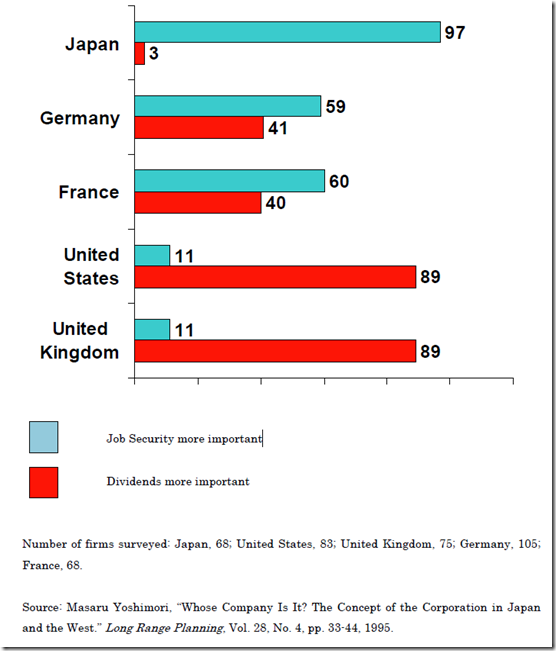
Difference between Jobs and Dividends

from here. While the survey was too small, it is the difference between Japan, Germany/France and the UK/USA which is so shocking. Now imagine you are in a business which is operating in these countries. Try to manage this kind of expectation framework. And how will the financial markets react to such a framework? Fun time!

Saturday, May 24

Women make gains in Arab boardrooms

Excellent news and very shameful for Japan and Italy. I quote:

Public companies listed in Oman and Kuwait have more women on their boards than in Italy and Japan, highlighting rare gains made by businesswomen in one of the most restrictive parts of the world.

Overall, the numbers arent that good,

The representation on boards in the two Gulf countries masks a bleaker overall picture: across the region women represent only 1.5 per cent of board seats, compared with 13.6 per cent in the US and 22 per cent in Norway.

But its a start at improving women's lives.

Friday, May 23

Corruption is hidden under national security rug

Its curious how people start hiding behind national security when corruption, monopolistic policies, bad governance, etc. etc. is in play. We saw that when we had the situation with BAe and UK and now we are seeing the situation with J Power in Japan.

See here.

The move came as the auditors of J-Power launched an internal investigation into the utility’s business practices, following a request by TCI, its largest shareholder with a 9.9 per cent stake.

yes? the auditors would be the protection of Mr. and Mrs. Yamamoto who have invested their life savings in this company, no?

No. Why?

TCI, which wants to improve returns from its 9.9 per cent stake in electric power wholesaler J-Power, is asking the company’s statutory auditors to investigate whether directors have breached their duty by failing to stop practices that have led to profit declines. But their relationship with J-Power offers small hope the auditors will uncover anything improper. Of the five auditors, one is a former J-Power director with 30 years of company service behind him. Two others hail from the Ministry of Finance – one of the government organs charged with determining whether TCI should be allowed to increase its stake in J-Power. The practice, called “descending from heaven”, raises questions as to whether some of the auditors may be constrained from acting independently of management.

Welcome to Japanese management..

Thursday, May 1

Your tax details on the web

Now this is quite interesting. Would you mind exposing your tax and income details on a public website? I am slightly ambivalent over it. While on one side, I can well understand the problems of privacy, none-of-your-business, danger, etc. etc. but on the other hand, just the tax paid by individuals and companies is public income, and one could argue, that if you anonymise the individual, then we should be able to get much granularity down to a level which provides good information while saving individual privacy. Obviously, this does not apply to firms.

All this to be taken with a grain of piquant salt!!!

Wednesday, March 12

Board Member performance in India

If you have board members who are board members in too many companies, then the
busyness hypothesis says that the directors will be over committed and cannot monitor
the firms properly. But this paper seems to suggest otherwise.


Jayati Sarkar and Subrata Sarkar, Multiple board appointments and firm performance in emerging economies: Evidence from India, Pacific-Basin Finance JournalIn Press, Accepted Manuscript, , Available online 4 March 2008.


Abstract


This paper extends the literature on multiple directorships, busy directors and firm performance by providing evidence from an emerging economy, India, where the incidence of multiple directorships is high. Using a sample of 500 large firms and a measure of “busyness” that is more general in its applicability, we find multiple directorships by independent directors to correlate positively with firm value. Independent directors with multiple positions are also found to attend more board meetings and are more likely to be present in a company’s annual general meeting. These findings are largely in contrast to the existing evidence from the US studies and lend support to the “quality hypothesis” that busy outside directors are likely to be better directors, and the “resource dependency hypothesis” that multiple directors may be better networked thereby helping the company to establish more linkages with its external environment. Multiple directorships by inside directors are, however, negatively related to firm performance. Our results suggest that the institutional specificities of emerging economies like India could work in favor of sustaining high levels of multiple directorships for independent directors without necessarily impairing the quality of corporate governance.


Technorati Tags: ,

Wednesday, December 5

Corporate Governance by the open-toed sandal brigade

Now this was very amusing. The Chairman of Guardian Group and Land Securities and , and ex chairman of Marks and Spencer and Gartmore (some doughty members of the British Corporate World) is moaning about the fact that the open-toed sandal brigade is thinking purely on board structure and pay while fund managers dont really care.

I quote:

Mr Myners said portfolio managers who make investment decisions often seemed at odds with corporate governance specialists. “I frequently find when I talk to institutional investors that the portfolio manager, who I regard as the owner of the shares of the company on whose board I sit, is very content with what we are doing, but there’s somebody in the basement who is responsible for governance who has got an issue, and there’s a dislocation between the two.”

His criticisms echo those made this year by company directors, notably Terry Smith, chairman of Collins Stewart, and comments made in April by Sir Christopher Hogg, chairman of the Financial Reporting Council, which monitors the combined code. Sir Christopher admitted to concerns that fund managers regarded the job of monitoring governance as a “costly, distracting and irrelevant chore”.


I personally think this is wrong. Whether or not you are a fund manager, it does not matter. You are a shareholder or a shareholder representative. And you have to take your stance on corporate governance. And for you to say that its, "costly, distracting and irrelevant chore" simply means that you are abdicating your responsibility to make sure that you as the owner makes sure that the management are delivering value. But if you simply pick and choose, leap from one firm to another, then you arent really a shareholder, are you? You are simply a locust. And I use the word with due reason.

This is why I hate the word "activist investors". So looking after my money is not being active? What kind of stupidity is that? passive investors have another name, they are called as "idiot investors" or "investors who are looking to get fleeced".

So I disagree with Mr. Myners on one small aspect but the fact that there is a disconnect is a worry.

Read and Think


All this to be taken with a grain of piquant salt!!!

Tuesday, November 13

How much capital should a bank keep?

I have been thinking about corporate performance, capital and corporate governance for some time now. These three are very tightly linked together. In almost every case of a bank getting into difficulties, it was because the firm had bad capital controls and bad capital management. And thus it leads to bad performance and the balance sheet looks like Swiss cheese.

More importantly, if you control the amount of capital you can have very tightly based upon the risk factor, then counter-intuitively, in times of market turmoil, you make the problem worse. For example, say based upon their internal risk measures, you have determined that the capital I need to keep aside is 10 quid. So far so good. But say the markets have dived like a dingo down its hole. Now the risk measures would be saying that I have to either get rid of positions or I have to increase my capital. In the case of the former, I will be exacerbating the market problem by increasing the selling pressure. In case of the latter, you will end up with no take-up of your capital increase (either by a rights issue or bond issue or what have you) (who wants to purchase in a selling market?).

Furthermore, as we have seen in the case of the Northern Rock (btw, did you know that we have spent more on this stupid incompetent fiasco of Northern Rock than the entire military budget of this year? our squaddies are dying because they do not have equipment and our taxpounds are going to save the collective patooties of the government, FSA and the central bank - makes me furious, I tell you!), corporate governance problems kicks in, who wants to purchase it? Hedge Funds? Private Equity? Other banks? What? So what do you do?

Well, here’s one answer: In other words, it is not sufficient to just meet Basel II requirements, but also to go ahead and have a buffer over and above it! But more importantly, certain economies which have a preponderance of bank lending compared to market lending (such as Germany or countries with less developed capital markets such as China and India) will be hit harder despite having buffer capital!. I quote the full conclusion as it is worthwhile reading it.

The problem of cyclicality of the Basel II minimum capital requirements is currently the subject of an intense discussion in the financial and supervisory community. This paper provides two important contributions to the debate. First, whereas previous research has largely focused on fluctuations in capital charges only, it finds that the behavior of capital buffers is crucial to assess the impact of capital requirements on bank lending. Second, it provides an analysis of macroeconomic consequences emphasizing the conceptual difference between the cyclicality of regulatory capital ratios and lending and their pro-cyclical effect on the real economy.

With regard to the cyclicality of lending I find that the capital buffers are likely to mitigate the impact of changes in capital charges. I find that by ignoring this effect one might substantially overestimate any potential lending volatility. At the same time, the capital buffer will only partially absorb the fluctuations in minimum capital (roughly by 50%). It is worth noting that the cyclical effects of regulatory capital on lending are not unique to Basel II, but that they are also present in the old framework with time invariant risk weights.

While pro-cyclical effects occur or are to be expected under the old and the new framework, the capital buffer is found to differ completely. Under the old framework this paper predicts an increase in the capital buffer during an economic downturn due to a reduction in lending (which is in line with previous empirical research). Under Basel II, however, the capital buffer will actually decrease, because the rise in the average risk weights will usually overcompensate the reduction in lending. I think that this finding has important implications for further empirical research on Basel II. In my view, it would be wrong to look at the movements of capital buffers under the old framework and assume a similar pattern under Basel II, as some previous papers seem to suggest.

As to macroeconomic fluctuations, the impact of Basel II on aggregate demand can be significant – even if banks hold significant capital buffers – in particular for economies where bank lending plays an important role in the firms’ investment decisions. However, the pro-cyclical effects on macroeconomic fluctuations will vary among countries. In general, bank-based economies will most probably experience the biggest effects, while the effects in financial markets-based economies will be smaller. The magnitude of any such pro-cyclical effect will depend on various factors, which are not specifically modelled in this paper, such as the firms’ access to outside capital for instance. Among other things, the average size of firms, the sectoral specialization of a particular economy, its accounting framework and the competitive condition in the banking industry play an important role in this regard.16

Finally, I need to mention some other qualifications of the model presented above. First, it assumes that the riskless interest rate remains constant over the business cycle. This assumption was made to separate the pro-cyclical effects of Basel from any potential counter-cyclical measures of the central bank. In the present context this means that the central bank needs to accommodate any income-induced changes in money demand in order to keep the interest rate fixed, and this has an additional effect on real demand. Further research is necessary to assess the interdependence of the prudential regulation of banks and monetary policy. Secondly, the model is not explicitly dynamic but makes interpretations that are dynamic in nature. However, augmenting the model with a dynamic specification is unlikely to change the basic results in principle unless one assumes very high portfolio adjustment costs on behalf of the bank.17 Deviating from the assumption of full flexibility in the portfolio adjustment – for example if assets are illiquid – it suffices to assume that a sufficiently large fraction of loans expires every year.


Frank Heid, The cyclical effects of the Basel II capital requirements, Journal of Banking & Finance, Volume 31, Issue 12, , December 2007, Pages 3885-3900.
Abstract:
Capital requirements play a key role in the supervision and regulation of banks. The Basel Committee on Banking Supervision is in the process of changing the current framework by introducing risk sensitive capital charges. Some fear that this will unduly increase the volatility of regulatory capital. Furthermore, by limiting the banks' ability to lend, capital requirements may exacerbate an economic downturn. The paper examines the problem of capital-induced lending cycles and their pro-cyclical effect on the macroeconomy in greater detail. It finds that the capital buffer that banks hold on top of the required minimum capital plays a crucial role in mitigating the impact of the volatility of capital requirements.


All this to be taken with a grain of piquant salt!!!

Sunday, November 11

Why FAS 157 strikes dread into bankers

We have been hearing about FAS157 for a long time now, and for some reason, people tend to think that that is bad. Well, not really. One has to remember that the chances of a bank really running short of all capital to handle tier 3 asset write-downs is very small indeed. And if a large bank has really gone short of capital to hit those, then my friends, bend over and kiss the patootie goodbye because by that time, you will be in far deeper trouble than expected.

But that said, here's one opinion!

We have heard about sub-prime mortgages; we have heard about collateralised debt obligations (CDOs); we have heard about banks writing down their assets; we have heard about global bankers resigning; we have heard about Northern Rock and the first run on a British bank in 140 years.

The risk of a worldwide banking crisis – one that is particularly damaging to mortgages, private equity, hedge funds and the banks themselves – is higher than it was a month ago, and the storm is rising.

This is still an emerging story. It was not until last Wednesday that The Financial Times led on the legal provision that CDOs can be liquidated by the senior holders when they go into default. That could lead to a fire sale of CDOs and still larger defaults.

Yet this, as important as it could be, is not the biggest threat. Few non-bankers have heard of FAS 157 and 159, yet these are the regulations that will set the terms on which the banks will value their assets. The trouble with FAS 157 and 159 is that they are perfectly reasonable regulations in themselves which could have disastrous, though unintended, consequences.

What are FAS 157 and 159? They are the new United States (Federal) accounting standards that have been introduced to regulate the valuation of bank assets. These valuations are of crucial importance because they are the basis of all bank lending: no assets, no lending; no lending, no bank. According to an informative article in The Financial Times, the new standards will apply fully from Thursday. Many US banks have adopted them already. All US quoted banks will have to publish asset figures in conformity with FAS 157 by next spring.

The new rules divide bank assets into three “levels”, according to the freedom with with which they can be bought or sold. Level-one assets, which are easy to value or trade, have to have quoted prices in active markets such as US government bonds or gold bullion. Level two is an intermediate stage; these assets are not as fully marketable as level one, but still sufficiently tradeable to have a definite value.

Level-three assets – usually artificial financial instruments – are the problem. They do not have quoted prices in active markets. They have to be valued by reference to the bank’s own models. According to the analyst Martin Hutchinson, who had analysed some of the US banks, the holdings of level-three assets are substantial. Lehman has $22 billion; Bear Stearns $20 billion; JP Morgan Chase $60 billion. Even these figures may be understated, since the banks have themselves decided whether assets belong to level three or the more acceptable level two, and they have an interest in placing as little in level three and as much in level two as they reasonably can.

Martin Hutchinson has also analysed the assets of Goldman Sachs. The bank has disclosed $72 billion of level-three assets, out of total assets of $900 billion. That seems reasonable enough, but it compares with Goldman Sachs’s capital of $36 billion. Any substantial write off of level-three assets would impact on Goldman Sachs net asset value.

One cannot say that FAS 157 is only an American regulation and the banks of other countries would not therefore be affected. Most global banks already have a listing in the United States that would therefore be subject to US accounting standards. Those that do not will be judged by FAS 157 as the international standard. From now on all major banks will have to declare their assets in the FAS 157 form with its division into different levels by marketability.

No doubt this is the reform that should have been introduced years ago; that would have saved a great deal of agony and some abuse. But FAS 157 is coming into effect at a most inconvenient time. The sub-prime mortgage defaults have already undermined confidence in mortgage banked securities. These form a significant part – perhaps about a quarter – of all level-three assets. Level three also includes higher-quality mortgages and leveraged bridged loans for buyouts.

The global banking system now faces the risk of a general flight towards cash and liquid level one assets on a scale that has not been seen since the early 1930s. Already British banks are showing signs of near panic. I hear of London banks going back on recently agreed loans to parties of good credit, presumably on orders from head office.

There have also been cancellations of offers of credit cards that had already been approved. One need have little sympathy for the US investment banks; they found it profitable to make speculative loans, and now they are paying the price.

Even if ordinary mortgages do continue to be offered – and they are bound to be restricted – sub-prime mortgages will no longer be available for first-time buyers. Yet the housing market depends on people being able to sell their first houses when they trade up to their second. If all banks are anxious to protect their cash reserves, and to reduce their level-three assets, that will make ordinary borrowing difficult and level-three borrowing impossible. Probably the downturn will spread into stock markets, even though it did not originate in stock market speculation.

It is far too late to cancel FAS 157 and 159, even if that were desirable. The concept of different levels for bank assets has been introduced to the banking system and the defaults on sub-prime mortgages have lowered the acceptability of all level-three assets. No one knows what they are worth and hardly anyone wants them.

Commercial banking, with its large customer base, is in better shape than investment banking, but will also be affected. FAS 157 may prove an historic regulatory blunder.

Tuesday, November 6

Board of Directors - confirmed ignorance

I did a big whine and whinge about how the board of directors are not taking care of the firms. And now today a report comes out which talks about the fact that Almost a third of non-executive directors at UK public companies targeted by buyout firms have insufficient understanding of their duties

More than half were uncomfortable with their knowledge of regulations
and the impact of the new Companies Act, parts of which came into force last
month, on a public to private deal.The survey also found 56% of directors felt
they did not receive enough timely and accurate information during the course of
a deal. Half of the respondents said they felt constrained by the threat of
potential litigation or shareholder action. External pressure from market
observers such as the media and analysts was cited by 49% of respondents as
being another major constraint, while 43% also blamed scrutiny from regulators
and stock market obligations. The survey showed 38% of directors felt restricted
by potential conflicts of interest with those sponsoring, advising and / or
financing deals, while 30% said conflicts of interest with other board members
were a significant problem.

Regarding special committees, 61% of NEDs surveyed said they had sat on
one before, while 68% felt they contributed to good corporate governance and 61%
said they provided a "clear record of independence".Just over two thirds of NEDs
said external lawyers were more important than in-house counsel, while 59% said
external independent financial advisers were very important, compared to
in-house teams.

Now if these are the numbers, then are you surprised that we have such severe losses at public firms?


All this to be taken with a grain of piquant salt!!!

Monday, November 5

The supine Board of Directors!

One thing which I find so strange, even after so many years in the financial markets, is how frankly supine the board of directors usually is. Not that its just there, another target of amazement are the pension trustees but that moan is for another day. We now have lost quite a lot of senior management across the global financial sector. Ok, so everybody makes mistakes and why should CEO's be immune from being human?

But what gets my goat is how bad performance is rewarded by gigantic lump sums of cash and pension benefits being doled out to these guys. What is the downside for these guys? that they are chucked out of their corner offices? God, with multi-million dollar payoffs, i can do with some more chucking out. And yes, pun intended. Some of these chaps have got hundreds of millions of dollars of payoff for driving their stock prices into the ground and raising risk levels several fold!.

And dont give me the guff that they managed to raise the stock price before, they were compensated for that in the previous years. And furthermore, I do not blame the CEO's, they are acting perfectly normally and economically by limiting their downsides and pushing for the maximum possible personal returns. The fault squarely lies on the Board of Directors.

Unfortunately, we keep on seeing that the Board of the big firms are usually supine. Why take action AFTER the event, you dopey's, your job is to make sure you keep an eye out on risk and the firm and take care before problems hide. Ok, so I further excuse that but what is your excuse for giving such a large payoff to the departing CEO? If the excuse was that you didnt want to leave open the option of legal action, then again that reflects badly on you as you did not design a cast iron contract!

Espokhs.

All this to be taken with a grain of piquant salt!!!

Wednesday, October 24

Do big banks need more capital?

See this article from Risk Centre. I quote:

With all due respect to the Nout Wellink and the other members of the BCBS, we do not believe that the implementation of the Basel II proposal or anything that looks remotely like it would have alleviated the ongoing collapse of the market for complex structured assets. When an entire asset class literally dies in a matter of weeks, the risk is infinite. To us, measuring the liquidity or market risk of a Structured Investment Vehicle ("SIV"), with or without the Basel II framework, makes about as much sense as using statistics to predict corporate credit defaults.

Remember too that most of Basel II is based upon the very quantitative models and rating agency methods which caused the subprime crisis, thus offers of assistance from Basel II's creators within the BCBS should be viewed with caution. Basel II merely mimics the business processes of the Sell Side investment houses, systems which are intended first to enable new financial transactions and, as a secondary matter, manage the risk.

Without going into too much detail, I agree with the above sentiments. You see, I have a slightly different perspective on this. Based upon my previous research on extreme events, I am firmly of the belief that the relationships between various factors in these extreme events becomes dramatically non-linear in nature.

So a structure such as Basel II which relies on linear modeling to provide an indication of risk capital is ok for stable, linearly correlated markets but fails miserably when it moves into the fat tails. If you just look at the investment banks, they are taking billions of dollars in losses. My question, if you still are quibbling about it, why did the risk management models not pick up this problem?

Now the fact that the risk management models did not pick up the sub-prime mess leads me to wonder whether it makes sense to provide estimates of capital adequacy based upon these very same risk management models? No Sir.

The answer is that the banks need MORE capital, not less capital. More capital has the downside of implied opportunity cost, less capital has the downside of shaking the entire financial system through systemic risk. If I was a central banker, I would take a hard close look at Basel II.

Tuesday, October 23

A blow FOR European Minority Shareholders

Now this is indeed a good step, the European Court of Justice has overturned a law which protected Volkswagen from hostile takeovers. While this is not going to make an immediate difference, but this is still an important step in the annals of European Corporate Governance.

This idea of national champions is frankly silly. If its not car making in Germany, its bloody yogurt manufacturing in France.

Minority shareholders are massively overlooked and I do think that the 1 share 1 vote principle should be pushed a bit more.

Wednesday, October 17

Will the audit landscape change in the UK?

The Financial Reporting Council (UK's independent regulator responsible for promoting confidence in corporate reporting and governance) has now presented 15 recommendations to remove the concentration risk that only 4 top audit firms cater for 246 of the top 250 firms in the UK. If one of them goes bust, then the entire economy of the country will be dangerously impacted in terms of confidence. We have seen something like this before when Arthur Andersen blew up. That had a major impact.

So the FRC came up with these following recommendations.

  1. The FRC should promote wider understanding of the possible effects on audit choice of changes to audit firm ownership rules, subject to there being sufficient safeguards to protect auditor independence and audit quality.
  2. Audit firms should disclose the financial results of their work on statutory audits and directly related services on a comparable basis.
  3. In developing and implementing policy on auditor liability arrangements, regulators and legislators should seek to promote audit choice, subject to the overriding need to protect audit quality.
  4. Regulatory organisations should encourage participation on standard setting bodies and committees by appropriate individuals from different sizes of audit firms.
  5. The FRC should continue its efforts to promote understanding of audit quality and the firms and the FRC should promote greater transparency of the capabilities of individual firms.
  6. The accounting profession should establish mechanisms to improve access by the incoming auditor to information relevant to the audit held by the outgoing auditor.
  7. The FRC should provide independent guidance for audit committees and other market participants on considerations relevant to the use of firms from more than one audit network.
  8. The FRC should amend the section of the Smith Guidance dealing with communications with shareholders to include a requirement for the provision of information relevant to the auditor selection decision.
  9. When explaining auditor selection decisions, Boards should disclose any contractual obligations to appoint certain types of audit firms.
  10. Investor groups, corporate representatives, auditors and the FRC should promote good practices for shareholder engagement on auditor appointments and re-appointments.
  11. Authorities with responsibility for ethical standards for auditors should consider whether any rules could have a disproportionately adverse impact on auditor choice when compared to the benefits to auditor objectivity and independence.
  12. The FRC should review the Independence section of the Smith Guidance to ensure that it is consistent with the relevant ethical standards for auditors.
  13. Regulators should develop protocols for a more consistent response to audit firm issues based on their seriousness.
  14. Every firm that audits public interest entities should comply with the provisions of a Combined Code-style best practice corporate governance guide or give a considered explanation.
  15. Major public interest entities should consider the need to include the risk of the withdrawal of their auditor from the market in their risk evaluation and planning.
All very fine and good. But when in the name of all that's holy will this happen? Is there space in the legislative diary? It will take 5-6 years for this entire project to finish, so the Government should take its finger out and get moving quickly!

All this to be taken with a grain of piquant salt!!!

Further to the comment on Sovereign funds...

A great op-ed by Martin Wolf, a very impressive columnist in the FT on sovereign wealth funds, further to my previous comment. Some quotes:

Globalisation was supposed to mean the worldwide triumph of the market
economy. Yet some of the most influential players are turning out to be states,
not private actors. States play a dominant role in ownership and production of
raw materials, notably oil and gas. Now states are also emerging as owners of
wealth. This is creating widespread concern. Does that narrow focus make sense?
The broad answer is No.
Fevered attention is currently focused on so-called "sovereign wealth funds". As Standard Chartered shows in an intriguing analysis, carried out with input from Oxford Analytica*, these are not a new phenomenon: the oldest dates back to 1953. But today there are more funds, with far more money at their disposal than before. In all, they control some $2,200bn, with
$2,100bn in the top 20 funds. The seven biggest belong (in order of estimated
size) to Abu Dhabi ($625bn), Norway ($322bn), Singapore - GIC ($215bn), Kuwait
($213bn), China ($200bn), Russia ($128bn) and Singapore - Temasek
($108bn).

How large are these funds? They account for approximately 1.3 per cent
of the world's stock of financial assets (stocks, bonds and bank deposits). But
the total of $2,200bn is, notes the Standard Chartered report, bigger than the
sums invested in hedge funds (at $1,000bn-$1,500bn) and private equity funds (at
$700bn$1,100bn). Nevertheless, it is dwarfed by the $53,000bn controlled by
mature institutional investors.

How is the money used? Here the report distinguishes funds by their
transparency and by the active, or strategic, nature of their approach to
investment (see chart). Norway's fund is conventionally invested (with widely
distributed ownership) and transparent. Singapore's funds are defined as
transparent, but look for large ownership positions. Qatar's fund is defined as
non-transparent and strategic, as is China's. But Lou Jiwei, chairman of the
China Investment Corporation, insists that the new fund will operate on
commercial lines.

Is there any reason, then, to be concerned about the emergence and
likely growth of such funds? As a general proposition, the answer is No. If a
government operates a fund transparently and on normal commercial lines, with a
wide range of investments and no dominant positions, as does Norway, one can
only welcome its emergence as an investor. Questions should be raised only if a
fund sought a controlling interest in a strategic company. Then two issues would
arise, neither of them specific to sovereign funds: the first is whether the
fund is a "fit and proper person" to control a company; the second is whether
ownership might threaten a public interest.

My broad recommendation, then, is to consider the emergence of these
funds as part of the integration of countries that accept a bigger role of the
state in markets than western countries do today. So be it. It is better for
such countries to prosper inside the market system than glower outside it. It is
absurd to take a country's exports of oil and refuse to allow it to buy assets,
in return.


All this to be taken with a grain of piquant salt!!!

Monday, October 8

Rejection of the 1 Share - 1 Vote principle will hurt European Markets

The Financial News has a nice editorial on this issue today. Remember I talked about this over the weekend and said that personally speaking, I dont like it. I quote:

But the decision is a setback for the development of European capital markets and European prosperity. It follows publication of a study this summer that found the proportionality principle was widely ignored in several European markets. Of 464 European companies surveyed, 44% deviated from the principle by using devices such as multiple voting rights, priority shares with special voting rights, pyramid structures, voting ceilings and golden shares. Institutional investors surveyed expressed an aversion to these practices, stating the increased risk led them to expect a substantial discount when buying the affected shares.

This raises the cost of capital, fragments the European capital market and impedes a properly functioning market for corporate control.The lack of common understanding on proportionality bedevilled discussions around the European Union’s takeover directive and made the result ineffective.

The European Corporate Governance Forum, which advises the EC, identified reasons why proportionality matters. Without it, boards and management can become entrenched, companies can be harder to take over and minority shareholders can lose out because controlling shareholders are in a stronger position to take benefits for themselves. Also, the principle of comply-or-explain, which is a valuable tool of corporate governance, works less well when companies entrench their ownership structure in this way.

The forum therefore suggested an enhanced transparency regime whereby companies that deviate from the proportionality principle should explain their reasoning and the value their structure brings. This would promote debate and enable the market to decide. The extra information would also inspire further academic debate, which has been narrow and sometimes based on unreal premises.

Shareholders would go further and suggest there could be a vote on the explanations provided by companies. This would boost the pressure for change when companies are unable to provide a satisfactory explanation for their capital structure.

All this to be taken with a grain of piquant salt!!!

Saturday, October 6

One share one vote proposal dropped by the European Commission

Personally speaking, I find this situation curious. One observes democratic principles applied selectively. AGM resolutions are voted on the basis of majority democracy, but not in terms of actual capital structure. The core principle should be, voting rights in proportion to shareholder capital. But in many parts of the world, you have voting shares and non-voting shares. In other words, you are providing capital but if you have non-voting shares, you do not have a say in how the company is running. Think about many European (Scandanavian, Swiss, etc.) who adopt this form of Corporate Governance. Some deep background reading here, here and here.

So the EU does not think it is worthwhile to have a EU wide rule. I applaud this, knowing when a law is not required is very important; Lord only knows that we have enough. Also, a company is not a political animal, it doesn't behave democratically!! On the other hand, if the shareholder composition does not matter to the efficiency of capital deployed or profitability, then I suppose corporate governance ideas need to be re thought out!

All this to be taken with a grain of piquant salt!!!

Friday, September 28

Transparency is good for both Sovereign Wealth Funds AND for European Governments

Joaquín Almunia, the EU’s commissioner for economic and monetary affairs, said that, “We have good reasons to ask these funds to declare what kind of assets they want to invest in, what criteria they apply to decide their investments, and what the distribution of their investments is”.

I agree, very good thing to ask for transparency indeed.


erm, why? since when were government investments in industry clear and transparent? Let me see, if you take a small sample of the large countries, say Germany, France, UK and Italy, they have large investments (many time controlling interests) in so many private firms.

How transparent is that? Look at the how Germany and France squabbled over EADS and nearly drove the company into a tailspin (pun intended). And they dont have any problems in having an Indian on the board (specially ironic when almost the entire European intelligensia got upset about an Indian purchasing an European crown jewel!!!). Also remember that France considers a Yogurt manufacturer (Danone) to be strategic!

People who live in glass houses shouldn't throw stones, my dear Sir. When people say, "do as I say" and "forget what I do", they become objects of derision. Let us start inside the EU first, there is no harm in sovereign wealth fund investments. And I am all for transparency but when asking for transparency, public sector investments should be included as well.

You could start with making the ancient company law regimes a bit more modern!

All this to be taken with a grain of piquant salt!!!

Tuesday, September 25

Corporate Governance in Asia - still a very long way to go!

Mahatir Mohammad, an ex Malaysia Prime Minister was a very interesting character. He wittered on about how asian values are different from western values so told the western countries to stop moaning about human rights. It was correct, Mahatir Mohammad doesnt treat Asians as humans. In other words, all that wittering on about Asian Values is simply a fig leaf for being a tyrant, discriminatory, autocratic and dictatorial. Esphoks!

But to get to the point, all these asian values lead to is bad corporate governance and a strong feeling that small shareholders are to be ignored. See here for a better report on it. I quote:

ACGA marks down Singapore for limited disclosure of director remuneration, a lack of legal remedies for investors and continuing use of discounted stock options.

However, even top-ranked Hong Kong lags way behind rival markets in the US and Europe in terms of corporate governance. Hong Kong is criticised for allowing reporting deadlines to remain well below international best practice, for inadequate continuous disclosure of price sensitive information and an “artificially designed” and weak definition of independent directors.

Long way to go!


All this to be taken with a grain of piquant salt!!!