Showing posts with label Malaysia. Show all posts

Saturday, January 16

How Intermarriage Created One of the World's Most Delicious Foods

It's fascinating how things come together son. One of my favourite foods since I started working in Singapore is Laksa. It is a totally delicious concoction of noodles tofu chicken prawns beans spices and and and. Add and subtract according to taste and location. Bloody heavy but oh good Lord so bloody delicious. 
By the way the best laksa you can get in London is a tiny Malaysian / Singaporean restaurant off Euston. It's a very basic place. Hardly 20 feet by 8 feet. And they've stuffed few rickety tables and chairs in there. They cook the food in the side of the restaurant and it's so bloody popular that people queue up for hours to get in. Cheap and cheerful. I'll take you there son. 
But this story of laksa is also connected to the spice trade. I'll let you read this story and the map. The author talks about how Indians came to south east Asia and it was fascinating to read how a Malaysian dish in Penang got called as Assam Laksa. 
The last piece is what really got my attention. I've talked about the peranakan culture - the amazing mix of Chinese and south East Indian Malay and Indian cultures. There's a museum in Singapore relating to this culture and it's quite an emotional museum. You can see people from mainland China coming over and then marrying locally. You can see their food. Their clothes. Furniture. The pain and bloodshed during the wars. Absolutely fascinating. And spices ran through it all. 
Hope your first week back at Oxford is working out well son
Love
Baba


How Intermarriage Created One of the World's Most Delicious Foods
http://www.atlasobscura.com/articles/how-intermarriage-created-one-of-the-worlds-most-delicious-foods
(via Instapaper)
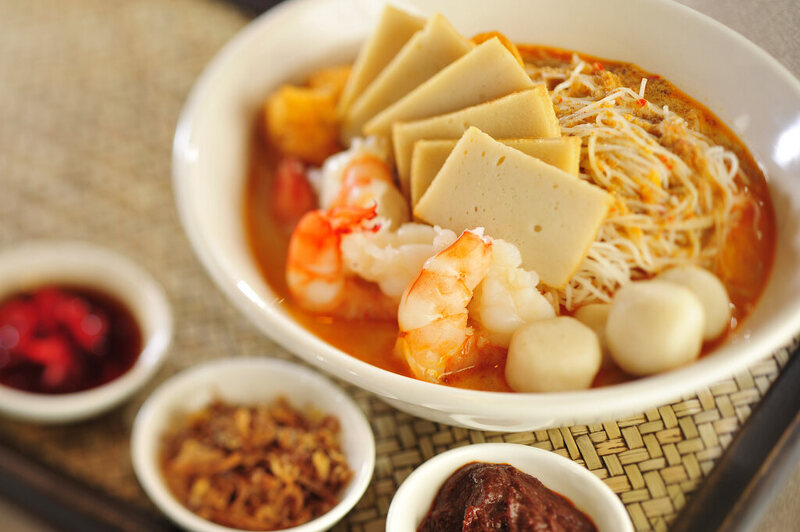

Laksa is said to get its name from the Sanskrit word "lakh," which means 100,000. (Photo: InterContinental Hong Kong/Flickr)
A few things are definitive of an afternoon on the coasts of Southeast Asia: inescapable heat, the smell of the sea, and a steaming bowl of laksa. If you haven't been fortunate enough to sample laksa before, picture an addictively spicy noodle soup brimming with chillies, coconut milk, tamarind and fresh seafood. If you need additional convincing, laksa was ranked seventh on CNN's list of the World's 50 best foods in 2011.
There is nothing quite like laksa, and no two laksas are the same. The soup can be found in different iterations in four Southeast Asian countries, from the coasts of Thailand and Malaysia down to Singapore and Indonesia, but its origins are more elusive. Where did laksa really come from, and how did it spread through all the regions that now claim it as their own?
To begin tracing the laksa trail back through time, we need to plot its three modern variations—curry, Siamese, and Assam—on the map.
Curry laksa is spicy and likewise includes coconut milk. It is found in Malaysia's Malacca and Johor states, and pops up in Singapore as Katong laksa, and in Indonesia as Bogor, Cibinong and Betawi laksa, to name a few. Each region has added its own unique ingredients to the mix, such as kaffir lime leaves, shredded chicken, or even snakehead fish.
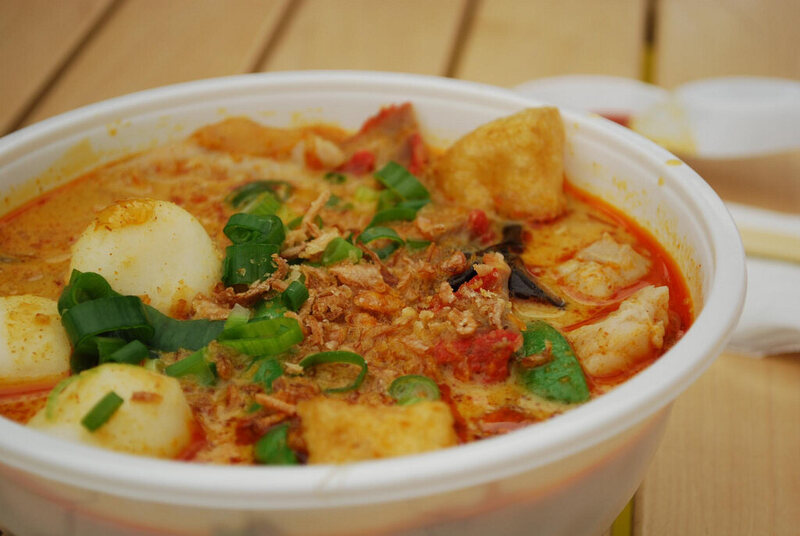
Curry laksa. (Photo: Alpha/Flickr)
Siamese laksa, found in Thailand, contains coconut milk and is informed by traditional Thai flavors such as red curry paste, while Assam laksa (which has tamarind but no coconut milk) is found in the Penang state of Malaysia.
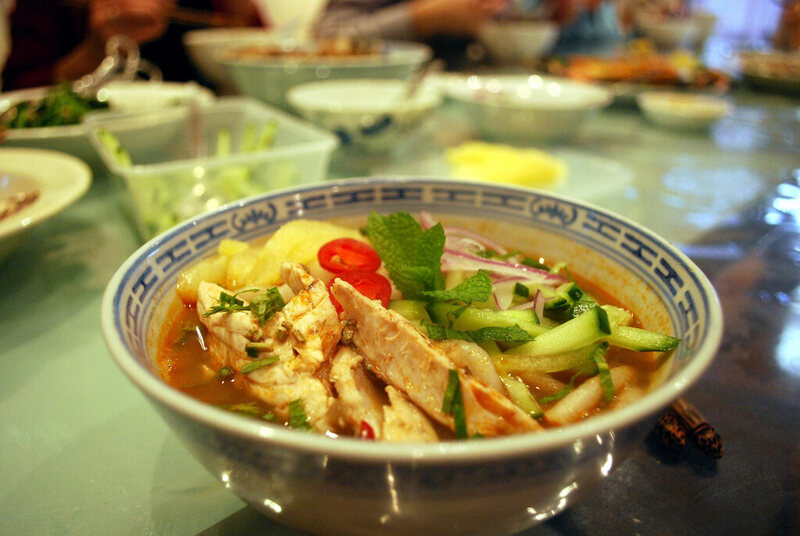
Assam laksa. (Photo: Alpha/Flickr)
Because of all the different varieties, it's difficult to say whether laksa had a specific point of origin. The history of Southeast Asia has been one of trade, with the port cities of Singapore, Malacca and Penang being major stops along the spice route. As a result, laksa began popping up in multiple regions as the marriage of different cuisines brought over by traders.
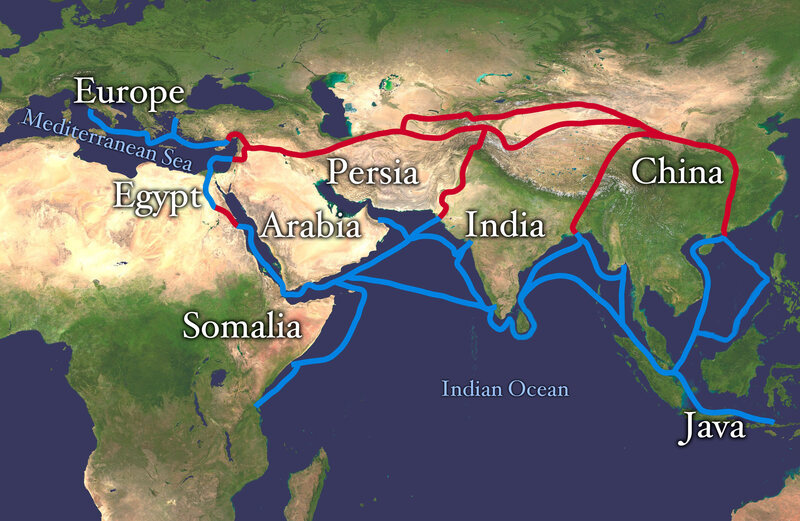
A map showing the Silk Road in red and the spice trade routes in blue. On the right, the routes stretch from India down through the Strait of Malacca, past Singapore and Indonesia and up to China. (Photo: Public Domain/Wikipedia Commons)
Southeast Asia had an early period of intense interaction with China and India, which largely influenced the culture of the region, and therefore its cuisine. According to Professor Penny Van Esterik in Food Culture in Southeast Asia, Indian traders arrived in Southeast Asia as early as 200 BC, while the Chinese had settlements in Indonesia by the 16th century.
The descendants of these Chinese traders were called the Peranakans, and the tradition of laksa was born out of the Peranakan desire to marry Chinese food with existing Southeast Asian flavors like coconut milk, and those brought over by South Asian traders, like chillies. Often, the desire to marry cuisines resulted from literal marriages between Peranakans and locals. In Indonesia, for example, the origin story of laksa traces back to the Chinese coastal settlements. Chinese sailors set out to find local wives, and these women began incorporating chilli peppers and coconut milk into Chinese noodle soup. Similarly, the arrival of laksa in Malaysia can be traced back to marriages of Chinese traders to local women in Malacca in the early 19th century.
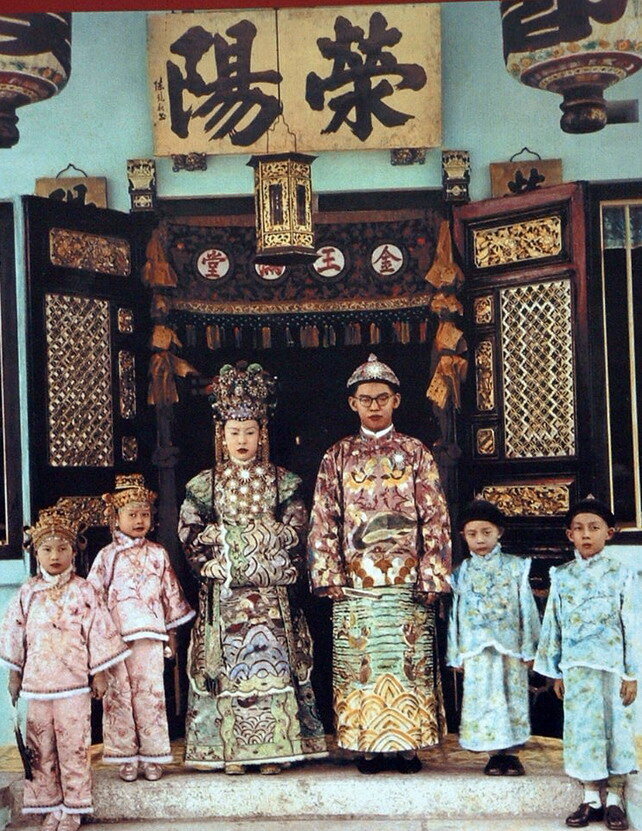
A Peranakan wedding takes place in Penang, Malaysia in May 1941. (Photo: Public Domain/Wikipedia Commons)
In Singapore, laksa arrived in the town of Katong when the Peranakans travelled down to the island from the Malaysian peninsula. Southeast Asian food expert Dr. Jean Duruz followed a laksa trail in Singapore to uncover that Peranakan laksa evolved with interaction with local Singaporeans. This happened via "[t]raditions of working for, or 'marrying into,' Peranakan families" as well as "rituals of exchange of festive foods and recipes between neighbors," writes Duruz in The Taste of Retro: Nostalgia, Sensory Landscapes and Cosmopolitanism in Singapore.
Of all the food that the Peranakans brought with them, it was laksa that spread most rapidly and extensively through trade channels in Southeast Asia. Why? Laksa's wide popularity is largely due to its adaptability, which makes it an appealing meal across many cultures and contexts. Even the name itself metaphorically empowers laksa's cultural flexibility. The word "laksa" originates from the Sanskrit word for one hundred thousand, and refers to the large variety of ingredients used in making the dish. Local women were able to manipulate the noodle soup brought over by their Chinese trader husbands to include their own plethora of existing ingredients. Because laksa was so easily adaptable into new varieties, it was able to serve as a bridge between cultures when traders and locals began intermarrying.
"The successful story of Laksa challenges the idea that people always like to eat familiar food," writes Veronica Mak Sau Wa in Southeast Asian Chinese Food in Hong Kong. There is nothing quite like laksa, and no two laksas are the same. Its unique adaptability is why it was able to build bridges between traders and locals on the Southeast Asian spice routes and continues to cross new borders today.

Thursday, December 10

When death rained from the skies

Warning. Very distressing photographs ahead. Do not read if you're of a sensitive disposition. 

These photographs are from the ground in Ukraine where the MH17 plane's bits and bobs landed. Some bobs landed as well. You don't see these photographs usually on tv or newspapers. 

The sheer banality of the man still strapped inside his seat and has fallen to his death. Wheat fields giving birth to the dead. Just when I couldn't be more shocked, the other photographs managed to shock me even more. A body crashed through this man's bedroom. You can see the hole in the roof. And is lying next to the bed. All the clothes have been blown off the body. Can't make out if it's a man or woman. The dead have no dignity. 

And then the photo of the man with his head held low in the red shirt leaning on the windowsill is Igor. He owns this place. He was in the bedroom when the body came crashing through. 

I was trying to imagine the man's feelings. And trying to put myself in his shoes. And failed miserably. I don't know if they had family. But that bedroom would be associated with violent undignified death. 

What a tragic set of photographs. Makes me hate war even more but worse was to come. 


Tuesday, November 12

Contested Nationalisms and Propaganda: Birth Pangs of a Malaysian Nation, 1957-1969

one of my recurrent little moans is the lack of good history books on Malaysia. Whenever I have been to Malaysian bookstores, you never get a good solid feel of the history of the country. So many other countries have absolutely tomes of books on the formation of the country, the background, etc. etc. I mean, its not like Malaysia is unique in terms of the colonial history, the emergence from WW2, the multi ethnic nature of the population, etc. etc. , there are tons of books on Pakistan, India, Bangladesh etc. etc.

So it was interesting to read this dissertation review. I quote

In the first twelve years of Malaya/Malaysia’s independence, there was a fundamental disagreement among the country’s populace about national identity. On the one hand, the Malay majority, basically supported by the structures of government, conceived of a special role for the ethnically Malay population, the Malay language, and Malay culture (including Islam and other cultural trappings). On the other hand, non-indigenous groups, particularly the large Chinese population, imagined a nation wherein all ethnic groups, as well as their languages and cultural practices, would be celebrated and on equal footing. Cheong Soon Gan has chosen the vantage point of propaganda to probe not just the ideological incompatibility of these two visions but even more the practical, daily, lived contradictions in the government.

the reviewer notes that Malaysian history is more about Great man of History like talking about Tunku Abdul Rahman and Lee Kuan Yew, etc. But here its more about Indian barbers, letters to newspapers and reports by Malaysian civil servants, a perspective which will be closer to the ground..fascinating.

Wednesday, February 20

Splashing around in KL’s Monsoon

As soon as I got free in KL, I left to go take some photographs..and then there was torrential monsoon rains. I got royally wet and I loved it. You ask me, how did I feel? Well, this photo describes my feeling…

Happiest Photos Taken This Year

Monday, January 7

Splashing around in KL’s Monsoon

As soon as I got free in KL, I left to go take some photographs..and then there was torrential monsoon rains. I got royally wet and I loved it. You ask me, how did I feel? Well, this photo describes my feeling…

Happiest Photos Taken This Year

Thursday, October 11

My Summer at an Indian Call Center

Son

This is an interesting read of how call centres work in India. I have personally have experience of setting these up in a variety of countries such as USA, Canada, uk, Poland, Egypt, Malaysia, India, Sri Lanka, Philippines etc etc. this behaviour that the author describes is quite common across the world. It's not just in India. 

The kids who get here and work are starting their careers. And they have an hunger, son, which is sort of humbling to see. The job is sort of thankless, to sort out your phone issues, to sell you insurance or time share holidays or or or. But these things keep on happening. 

With the increase in globalisation and connectivity, we don't see the man who is delivering our services and that is a bit of a shame as we lose touch with an important part of the value chain. But as a person interested in economics and management, remember that these people are the face of the companies to our customers. Never forget them and pay extra special attention to them, they are very very important. 

Love

Baba

My Summer at an Indian Call Center
http://m.motherjones.com/politics/2011/05/indian-call-center-americanization


Mother Jones

My Summer at an Indian Call Center

Lessons learned: Americans are hotheads, Australians are drunks—and never say where you’re calling from. Read the story everyone’s talking about.

By Andrew Marantz on Tue. July 5, 2011 2:00 AM PDT

“We were asked to hate everything Indian,” said 26-year-old Arnab (shown in his Delhi flat). Photographs: Sanjit Das/Panos

I stand flush against the window of a Toyota showroom, trying to stay in a shrinking sliver of shade. We’re on the cusp of midday, which, in Delhi in June, lasts most of the day and drives everyone into a languid torpor. I am waiting for a company cab, now an hour and a half late, to drive me across town to a call center, where an Indian “culture trainer” will teach me how to act Australian.

A uniformed guard next to me dozes on a stool, his rifle slumped in his lap. Behind the showroom window, which would be clear if two boys would stop rubbing it down with rags, a dozen red sedans glisten on a waxy white floor. On the dirt shoulder of the road, children hold hands as they walk to school.

Call centers don’t trust Indian infrastructure, as well they shouldn’t, so the company cab—typically a white Toyota Qualis—has become a standard industry perk. This morning a class of 24 new hires, myself included, will be ferried from all corners of the city to the offices of a small firm named Delhi Call Centre. For three weeks, a culture trainer will teach us conversational skills, Australian pop culture, and the terms of the mobile-phone contracts we’ll be peddling. Those of us who pass the training course will graduate to the calling floor. Our first job at DCC will be to interrupt Australians at dinner and ask them to switch phone providers. In the Delhi area alone, maybe 100,000 call-center agents make their living selling vitamins to Britons or helping Americans troubleshoot their printers. I am almost certainly the only one who acquired his conversational skills accidentally—by being born in the United States.

My phone vibrates. By the time I get it to my ear, a husky male voice is shouting in Hinglish, a rapid-fire blend of Hindi and English. “Meet at Toyota showroom!” I shout back.

“Fine sir, 20 minutes,” he replies.

I know “20 minutes” is a Hinglish phrase meaning “30 minutes,” so I call back after 40. A woman answers this time. “No problem, sir,” she says, “20 minutes only.” A sweat-and-sunblock solution drips down my forehead and stings my eyes. Behind me, the boys continue toweling the glass. The streaks they create blur into the streaks they wipe away.

Friday, May 11

What do you expect out of marriage?

Amusing study here.

I quote the abstract

This study examines whether communication and culturally embedded concepts influence cross-cultural similarities and differences in marital role conceptions. Young adults from the US, China, South Korea, Japan, India and Malaysia responded to a series of open-ended questions about marriage and marital roles. Analytic induction methods produced categories across six topics (good wife/bad wife, good husband/bad husband, good marriage/bad marriage). Results showed even greater variation in marital role conceptions than hypothesized. Only East Asians nominated a family home focus more and only Chinese and Koreans considered respectfulness and gentleness more for the good wife role than did US participants. Loving/caring nominations did not differ across the cultural groups except for greater nominations by US participants for the good marriage and good wife role conceptions, and proportions of controlling/abusive behaviors did not differ except for the Indian group's higher nominations for the bad wife role. Communication expectations for marital roles showed some cross cultural similarity, as both US and Asian participants rated communication characteristics as more important than attractiveness/ability characteristics, but only for the good wife/husband roles.

its a bit of a d’oh question, but would help raise a chuckle at the entrenchment of national stereotypes. Indian groups seem to be highly interested in the bad wife role, lol

Wednesday, February 15

Belonging to a religion doesn't make you a race

It was amusing, in an online debate about Mahatir Mohammad, who is an out and out anti Semite and discriminatory chap, somebody said I was an anti Muslim racist because I said a Muslim was an Anti Semite. Leaving aside the bizarre logical argument, I queried the notion that Muslims are a race. Then some other worthy piped up and said that Muslims can be a race. And threw in an anthropological angle to it. No references at all.

Well, here’s the currently understood meaning of race and racism. I am afraid none of the references quote anything to do with race or racism having anything to do with religion. I am not quoting academic references because they are usually not available publicly, but happy to get other references and be corrected.

So what happened to the debate? Somebody said that they dont care about Mahatir’s anti semitic and discriminatory comments because he developed Malaysia. When I pointed out that that is exactly what Modi is also trying to say in Gujarat and India, come to me for development – forget about the riots and murders, that sort of went up their noses. Heh. This is what happens when one doesn't draw the right conclusions.

After some spluttering about anti Muslim bigot and vague accusations here and there about annoying comments, it went to a grinding and silent halt. Nothing more annoying than arguing with a man who knows what he is arguing about, eh? :P

Very amusing interlude.

Saturday, September 17

More progress at SIFE

The chaps at LSE SIFE are quite ambitious, I love that. This trading game project is really catching fire. They went and sold it to a Malaysian University SIFE unit and they are spreading the word there. More about that later as my hopes to help them in Malaysia needs a bit of digging first.

Second, am going to go speak to the new SIFE recruits and get them all excited motivated. Plus if things work out, I will run investment classes for the volunteers. Teach these undergraduate students how to invest. I wonder if I can replicate what I did with Kannu with them?

Third, there seems to be very good progress with the Transformation Trust and extending the trading game to other schools in London. Watch this space.

The lady who introduced me to the Transformation Trust, Annie Natarajan, has managed to rope me into another initiative. lol, as a member of their advisory board. That’s also quite exciting, to help schools across the world to share best practises. I just got involved briefly in the initial proposals and Annie tells me that we have already got the first donation. Well done. The pilot will be touching some schools in India, Kenya and Brazil. Cant wait to get motoring on that.

Fourth, SIFE Nottingham is working on a pilot project with IT4CH with Pat. They are also pretty aggressive, they are trying to work to getting more donations of computers into our storage offices which we can then sell to get funds to purchase equipment for hospital schools and poor sick children at home.

Fifth, SIFE Nottingham has decided to do a project in Sri Lanka. Here’s the blurb on the email that they sent:

A group of 13 SIFE Nottingham students returned from Sri Lanka 4 weeks ago. To summarise our project, Future for Jaffna is a charitable organisation established under a trust deed. We aim to empower widows of the civil war in North Sri Lanka to create their own businesses, ranging from food processing to sewing and tailoring businesses. The ultimate aim is to establish a community and entrepreneurial/business centre in Jaffna, where the widows can sell their products, and where people can receive help in setting up their own business. Finally, we are looking into an environmental sub-project, mobilising rural communities through the production of biofuels.
We are partnering with a local charity, CORD Sri Lanka who monitor livelihood projects with widows. Their widows receive funding via a rigid scheme from the Bank of Ceylon; we do have more specific details on this scheme.
We require funding for the business start-ups for Future for Jaffna to be successful. This may be via a local bank, offering an independent finance scheme, or through raising funds through sponsorship and donations, and setting up a microfinance scheme. A key objective for us is to raise £5,000, at which point we will meet the £5,000 income requirement for registration by the Charity Commission, opening the floodgates to funding opportunities.

So I have got them hooked up with some of my colleagues in Sri Lanka. I think this should be a good thing to help push forward. Still under discussion on how exactly the firm can help them but broadly, i think we could provide advisory services to these poor ladies. I didn't know we were the only international firm operating there. Good stuff, makes me proud to work for such a nice firm.

I love September, after the hiatus of the Summer, its good to get back in track.

Thursday, April 28

Support for Suicide Terrorism

So what is the relationship between the support for terrorism in public opinion and the relationship with terrorist attacks? Guess what these researchers found?

We find that justification in public opinion for suicide terrorism increases terror attacks on people in countries that are unfavorably regarded. There is a robust positive relationship between the share of the population in a country that at the same time justifies suicide bombings and has an unfavorable opinion of another country, and terrorism originating from the former country.

In other words, there is statistically significant evidence that public opinion does encourage terrorism. In a way, this is a d’oh statement. Terrorism thrives on the oxygen of publicity and then there are various assorted morons and idiots who will support terror as a way to punish other countries. What they do not understand (well, not surprising because its usually religious nutters and other ideologically screwed up people who do this) is that terrorism usually devours them.

So what do people from s Bangladesh, Egypt, Ethiopia, Kuwait, Malaysia, Morocco, Senegal, Tanzania, Mali, Jordan, Lebanon, Indonesia, Turkey, Pakistan, Palestine and Nigeria respond to the PEW survey question?

Some people think that suicide bombing and other forms of violence against civilian targets
are justified in order to defend Islam from its enemies. Other people believe that, no matter
what the reason, this kind of violence is never justified. Do you personally feel that this kind
of violence is often justified to defend Islam, sometimes justified, rarely justified, or never
justified?

On average 23% justified suicide terrorism, with a minimum of 8% support and an astonishingly high 70% maximum support. Highest was in Palestine, Nigeria and Mali, Lowest up was in Egypt, Pakistan and Indonesia. Surprising eh? Palestine I can understand, but Nigeria, Mali, Egypt, Pakistan and Indonesia? The last 3 countries are like factories for terrorists. Some other facets, Nigerian Women were showing more support for suicide bombing compared to men. Here’s the graph

image

There was another question which was asked, about which countries are most unfavourable to the respondents. Some of the results for the most unfavourable and least unfavourable are amazing and bewildering.

image

So Bangladesh actually has the lowest unfavourable opinion towards India! and highest towards USA. And what on earth is happening in Ethiopia with least Japan and high Iran? USA seems to be the most hated country across these muslim nations. Extraordinary but what is worrying is the extraordinarily high level of support for suicide bombing and terrorism in all these countries. The next time somebody says that terrorist support in Muslim countries relate only to a very small minority, do ask about the definition of a very small minority because a minority which ranges from 8-70% with an average of 23% aint such a small minority by any stretch of imagination.

Saturday, February 20

Egypt: Female Judges Barred from Council Positions

Very nice, the world is moving forward while Egypt is moving backwards. I think of the advertisements for Egypt which say that its the cradle of civilisation and looking at this, I think its also moving back to that time. People keep on asking why Muslim countries do not have the wherewithal to go and rejoin the golden age of Islam? Well, why do you think? If you keep on shoving your women into veils and bar them from everything other than pregnancy, teaching and shopping, what do you think your country will be? Its like having a one legged man running with two legged men in a race. Here, read this.

I quote:

Dozens of Egyptian women and human rights activists have staged a protest in Cairo against a recent decision that bars women from holding judicial positions.

Thursday's protest came after the Council of State's association voted on Monday by an overwhelming majority against the appointment of women as judges in the council, an influential court which advises Egypt's government. "Three-hundred and eighty judges took part in the general assembly and voted, with 334 rejecting the appointment of females to judicial posts and 42 agreeing, with four abstentions," the Egyptian MENA news agency reported on Tuesday.The country's supreme judicial council, which has jurisdiction over criminal and civil courts, selected 31 women in 2007, who were later appointed by presidential decree.

But the decision angered conservatives who said women were not suited for the role.

Up until 2007, Egypt had only one woman serving as a judge who was appointed by Hosni Mubarak, the president, to the constitutional court.


And then I read that the Malaysian women who were caned for extramarital sex said that they deserved it. Good grief.

Friday, January 22

If US Could Create 'Avatar', It Could Fake 9/11 Attacks: Mahathir

You cant make this up. I quote:


Malaysia’s former premier Mahathir Mohamad said on Wednesday there was “strong evidence” the US faked the September 11 terror attacks as an excuse to go to war against Muslims.
“There is strong evidence that the attacks were staged. If they can make Avatar, they can make anything,’ Mahathir told the Conference for the Support of Al-Quds (Jerusalem), as quoted by local media.
The former premier also blamed Jews for hindering progress in US foreign policy. Voicing his disappointment that Barack Obama had not yet ended the war in Afghanistan or closed the US terror detention center at Guantanamo, he explained that “there are forces in the United States which prevent the president from doing some things. One of the forces is the Jewish lobby.”
Jews “had always been a problem in European countries. They had to be confined to ghettoes and periodically massacred. But still they remained, they thrived and they held whole governments to ransom," Mahathir said.
"Even after their massacre by the Nazis of Germany, they survived to continue to be a source of even greater problems for the world."

Thursday, November 12

International Conference to Criminalise War

Very laudable conference I thought but then when I read the list of people who were attending and what they all said, I was gobsmacked. Why do these buggers invite these loons? When will they learn that to hear that kind of drivel makes one feel sympathy for inhabiting the shallow end of the global human gene pool? Sad, very sad. Here are some examples:


He said that he followed the opinion of George Galloway, Member of Parliament of Britain, that we should distinguish between good Jews and bad Jews, and I agree entirely, I have many Jewish friends. But it should also not be allowed to call all Muslims terrorists, there are good Muslims and good Muslim terrorists, he joked to laughter of the audience.

Eh????

Here’s another pearl of wisdom:

He also spoke about the military, as a Malaysian retired General yesterday had addressed the possible good uses of the military, and he explained that the military is like a sharp knife that can make beautiful carvings, but can also kill.

No shit sherlock.

Here’s another one.

Tan Sri Sanusi Junid, former President of the International Islamic University, summed up saying that although he had not been to war, he is very much against war. He said that the army arrested his uncle and nephew and raped his auntie, then chopped off his uncles head, then tied his nephew and chopped of his auntie's head. His uncles head was then sent to a grandmother. He said he does not blame the "soldier" who did this but he blames those who give the orders to go to war. He revealed that he asked a former CIA director "you hate Dr Mahathir so much, why don't you kill him" to which he received the reply "we don't want to make him a martyr" and that they felt he would be an "over" case within a few years, but he has kept on living and living, he said to the cheers of the almost 1,000 strong audience at the Merdeka Hall in the PWTC Conference Centre.

Good heavens. So a CIA Director was in conversation with a President of International Islamic University and he said to him that they have considered bumping off Dr. Mahathir? Say what?

Ok, one more and no more:

Al Qaidah and its relevant organisations are a construct of the CIA and he confirmed that the CIA knows this, we know it, and that the CIA does not deny it. The process of demonisation of Muslims and Arabs is continuing, and there must be a process to find and prosecute those behind the crimes of September 11th.
Dr Mahathir said that the odd thing about 9/11 was that all 3 buildings collapsed rapidly straight down, as if they had explosives already inserted in certain places, and not from the effect of the aircraft hitting them, but due to a demolition method. He wondered why the 3rd building collapsed in the same way (WTC7) although it was not hit by any aircraft. The collapse of this building had been admitted by its jewish owner, as a controlled demolition when he said "we pulled it."

heh. How amusing. I think we need to appoint these people to become professors and leaders of educational institutions so that they can teach more legions of students to believe in this wonderful self evident truths. Oh! I am sorry, they already are.

Wednesday, July 1

Kudos to the Malaysian PM to knock the bhumiputra policy

The concept of sons-of-the-soil or Bhumiputra in Malaysia is something that i have written about before. Its a classic case of discrimination to push forward one part of the population compared to others. Obviously, when this is done on a race, religion or ethnicity, it causes major angst on part of the people who are not part of this equation. For example, in the USA, they decided to help out the black population by doing affirmative action, but this meant that the white, brown and Hispanic population complain that they have been unfairly targeted and discriminated against. You cannot win, can you? In this case in Malaysia, they discriminated for the Malays against the economically dominant Chinese, but in return, the ethnic Indians were really put upon. Result? Race riots, corruption and the like. Anyway, seems like there are signs of hope. I quote:

When he assumed power as Malaysian prime minister in April, Najib Razak was dismissed as a defender of the status quo. He was seen as a staunch supporter of the interests of the United Malays National Organisation, which has led the country’s coalition government since independence from Britain in 1957.

He was expected to continue the legacy of his father, who as prime minister in the late 1970s introduced the divisive policy of giving preferential treatment to the ethnic Malay majority in business and government jobs under what was known as the New Economic Policy.

The prime minister on Tuesday took a big step towards dismantling the pro-Malay economic policy by ending a long-standing rule that ethnic Malays must hold a 30 per cent stake in companies in most industries. The equity quota will be reduced to 12.5 per cent and new rules for additional rights issues will dilute it further.

Good step, it will make Malaysia a much fairer and just society. I have to congratulate the courage of the PM to take on the entrenched interests in the interests of all Malaysians. He has started to break the narrow domestic walls, which you can still see in so many different countries.

Sunday, June 7

What’s in a name? Quite a lot if you are God

My Dad used to tell this joke. A Sikh was on the bus and he finds that his 10p coin has slipped out of his pocket and into a deep crack in the side panel. So he starts praying, “Ya Allah, please help me get the 10p out, please please please”. A Mullah was sitting next to him and after some time of hearing his prayers, gets a bit irritated and then pokes the Sardar. “Oiy, Sardar, you are a Sikh, why are you taking the name of Allah?” Pat comes the answer, “Do you think i am going to send Guru Gobind Singh into that crack for just 10p?”

But I was reminded of that joke when I read this:

the Roman Catholic Church has been banned by a Malaysian court from using the word "Allah", the word commonly used for God in the Malay language. A court upheld a government ban that has become a symbol of religious tensions in the Muslim-majority country. Christians in Malaysia are banned from using "Allah" in their literature, because the government says it would confuse Muslims.Christian groups say the ban is unconstitutional, arguing the word "Allah" predates Islam.

I am amused because I grew up respecting all religions. My grandma had a picture of the Kaaba inside her temple room. Here’s a song that I grew up listening.

It just means, Allah is your name, God is your name, you give sustenance to all.

Curious, no? how people are stupid enough to fight over a name for the God? And how patronising, Muslims will get confused because a Christian organisation calls God as Allah? And it also says that the court knows sweet sod all about theology because the God in Judaism, Christianity and Islam is considered to be the same. And I am sure God is looking down and digging his elbow into his friend’s ribs, pointing to that silly court and laughing their heads off. Clowns.

Saturday, April 4

Prices for girls…

Now I dont have any idea about the provenance of this image but looks like its a Chinese place. Now presuming that it is true, the rates are quite extraordinary and tells you about the demand and supply of various nationalities of girls and their relative costs. Now why on earth would a Malay girl be less than a Philippine girl, a china girl is the same as a HK girl and bloody hell, what’s going on with the Russian girls?


image

Saturday, February 7

Nations turn to barter deals to secure food

A curious situation is emanating in the world of international intra-governmental trade. I quote:

Countries struggling to secure credit have resorted to barter and secretive government-to-government deals to buy food, with some contracts worth hundreds of millions of dollars. In a striking example of how the global financial crisis and high food prices have strained the finances of poor and middle-income nations, countries including Russia, Malaysia, Vietnam and Morocco say they have signed or are discussing inter-government and barter deals to import commodities from rice to vegetable oil. The revival of these trade practices, used rarely in the last 20 years and usually by nations subject to international embargoes and the old communist bloc, is a result of the countries’ failure to secure trade financing as bank lending has dried up.

But before you think that this is too strange, it is not, this is quite common. Take a look at this deal. In return for up to 600k barrels of oil per day to the UK, the UK promised to provide a ton of aircraft and other defence benefits to the Saudi Arabian Government.

Here is another example. The Venezuelan government promised to give oil to London (to use in running its buses), in return for London providing free consultancy and advice on policing, tourism, transport, housing and waste disposal. But you have to remember this, when barter deals are not denominated in currencies, the chances of getting a corrupt hand in the till is massively increased because you simply cannot compare (or mark to market if you will) with international prices. In this particular case, the people who lost out were the people of Venezuela who were not able to get the money that they could have earned in return for some dubious advice on those aspects. In the interests of transparency, its best to sell the oil and buy services clearly and transparently. But then, politics trumped and a bad deal signed.

Same thing happened with the Al Yamamah deal, it is absolutely a stinker for corruption and something that I have complained bitterly about before. Deals like that have corrupted this country and have made us a laughing stock. Why barter? Just lay the costs out in public, its not like anybody else will complain, would they?

Another example of corrupt, trade distorting and silly deals were the oil for sugar deals signed between Russia and Cuba. Here is a great overview of this spectacular failure. I quote:

The fall of the Berlin Wall in November 1989 and the breakup of the Soviet Union in December 1991 became the precursors for the collapse of the Cuban economy, central to which were the Soviet oil-for- sugar swaps over the preceding three decades. At its
zenith, this barter arrangement provided the financial basis for Cuba to sustain the agricultural inputs necessary to produce sufficiently large annual harvests to permit significant sugar export levels and oil re-ex-port revenues. At its nadir, the systemic failure in the oil-for-sugar arrangement created shortages through- out the Cuban economy including fuel, fertilizers, herbicides, and spare parts for farming equipment
and sugar mills. Over the past decade, this is marked by the simultaneous downward spiral of Cuba's oil imports along with its sugar exports. Cuba's historic energy dependence and limited oil resources coupled with the sudden disruption of the oil-for-sugar barter arrangement severely impacted the Cuban economy
from which it has yet to fully recover.

Here is another example of an African Country, Uganda, starting to face issues with its barter deals. Here is a good overview of the Barter Trade and how it is changing. While private firms are better suited at doing barter trade, I am certainly not in favour of having barter trade done by Governments. Also, these barter trades crystallise the generally bad subsidy scheme. You pay tons of money to your farmers to grow stuff that nobody wants to buy, so you then do a barter trade with a country who does need that stuff, and you underprice your agricultural stuff. Which means that the international trade in that agricultural commodity is distorted as one market has its price driven down. See here for an example of what India is trying to do with Russia relating to its wheat crop. Here’s another example of the domestic sugar lobby moaning about its bad economics and trying to resolve it using another bad economic barter deal. See how much they demand subsidies and help and all that? All classic signs of people who cannot compete in the open market and thus want to suck on the taxpayer’s tit.

The costs relating to corruption, lack of transparency, lack of built in productivity agreements, and so on and so forth means that these agreements are generally bad in the long run. Going for bartering further lets the governments off from taking necessary decisions. For example, the fact that governments are not getting sufficient financing is neither here nor there, there are international funding agencies (government owned, such as IMF, or Import Export Banks etc.) who can provide funding, but because going to these agencies would mean exposing their bad economic policies, they tend to hide their faults by pitching barter as a way of doing trade. Bad, bad bad.

Saturday, January 17

Business Holy War???? Say what?

this totally bewildered me. There is this Islamic Economic Congress which was held recently in Malaysia, it passed 29 resolutions, but one of the resolutions sort of got me gibbering. I quote:

The congress also passed a resolution to pursue the "business holy war" for Muslim traders to strengthen their socio-economic status by promoting entrepreneurial skills.

hehehe, didnt find any more details, but just that statement made me giggle away like crazy. Really, some people...

Technorati Tags: ,,

Wednesday, November 12

Obama’s historic win – can a Chinese, Indian, Kadazan or Iban become Prime Minister?

Hmmm, interesting question. I had email exchanges with an Indian Muslim who was moaning about a similar thing. His point was that India can never see an Indian Muslim as a Prime Minister, to which I took exception. There is a minority currently in power as a prime minister, he is a Sikh. We have Presidents who have been from minorities, we have people leading the national cricket teams who have been minorities and the like. So India has been quite good in having minorities capable of rising to the top. But obviously, if you ask some of these benighted Indian chappies, they would want to moan. To another chap who was saying the same, I told him, i will support you if you support the election of an Indian Muslim woman. Needless to say, he did not reply. Pretty clear, no?

But here's an interesting post I read from a Malaysian Chinese politicians who was moaning about their minorities becoming a Prime Minister of Malaysia. He apparently asked in their own parliament and rather shamefully I thought, there were many answers which were "no". I quote:

However, Obama’s historic breakthrough make many Malaysians ask whether it is possible for a Chinese, Indian, Kadazan to become the Prime Minister of Malaysia although the Constitution is very clear that any Malaysian citizen, regardless of race or religion can become Prime Minister.

If such a question is asked 50 years ago, the nation’s founders like Tunku Abdul Rahman, Tun Razak, Tun Dr. Ismail, Tun Hussein Onn, Tun Tan Cheng Lock, Tun Tan Siew Sin and Tun V.T. Sambanthan would unhesitatingly answered in the positive as there is no constitutional bar - separate from the question of whether it was likely to happen.

But if the same question is asked now, there will be strong voices (as heard in Parliament today when this question was posed) who would rise up to say no.

Who is going against the Merdeka Constitution and the social contract reached by the forefathers of the major communities to achieve national independence half a century ago?

Why is Malaysian race relations and nation-building going backwards in the past 50 years as compared to the historic breakthrough in race relations in the United States with Obama’s historic victory in the US presidential elections?

Long way to go before these narrow domestic walls come tumbling down...

Technorati Tags: ,,

Friday, November 7

Malaysia blogger to be released

Another win for freedom of speech!, good work folks!


A Malaysian judge has ordered the release of a prominent critic of the government, Raja Petra Kamaruddin.

Raja Petra, 58, editor of the website Malaysia Today, was being held under the Internal Security Act (ISA).

But the judge said the government had acted outside its jurisdiction when it issued a two-year detention order.

The government alleged that Raja Petra was a threat to national security having published articles that it said created racial tension.

He is due in court later in the day, and will then be freed, the state news agency Bernama reported.

His lawyer, Malik Imtiaz, described Friday's ruling as "historic" and said it was "definitely a wonderful step in terms of civil liberties in Malaysia".

Raja Petra has increasingly angered the Malaysian authorities with his Malaysia Today website, the country's best-known political blog.

He still faces charges of sedition for an article he published which linked Deputy Prime Minister Najib Razak to the 2006 murder of a Mongolian woman, Altantuya Shaariibuu.

Mr Najib, who has consistently denied any involvement, is widely expected to take over as prime minister when incumbent Abdullah Badawi agrees on a transition date.

Raja Petra was arrested on 12 September under the ISA as part of a government clampdown on opposition voices.

Technorati Tags: ,