Showing posts with label Labour. Show all posts

Monday, September 30

Red Ed – read this

When I read about Ed Milliband doing a Khrushchev by promising price controls, I winced. The economic illiteracy of these people is shocking. More importantly, the entire great unwashed herd of morons who applauded it are also part of this shock. It is true that you can fool some people all the time.

Here’s a fascinating dissertation review which I read recently. I quote:

Berg captures an episode in postwar agrarian politics that is little known to non-specialists: the 1950-51 collective farm amalgamation campaign in which the number of soviet collective farms shrank from 252,146 to 99,400 farms. The significance of this campaign to the central administration of collective farms was immeasurable. While until 1950 the vast majority of collective farms were organic village communities, which Sheila Fitzpatrick calls “collectivized villages” (Stalin’s Peasants: Resistance and Survival in the Russian Village after Collectivization [New York: Oxford University Press, 1994], pp. 10-16, 103-127), most post-amalgamation farms (87.4%) consisted of two to four former farms and some combined as many as ten farms. The new amalgamated collective farm stretched for kilometers on end, often with swamps, forests and rivers separating communities within the same farm. Berg writes of collective farms stretching for four hundred kilometers (p. 165), chairmen who complained that the terrain of their newly constructed farms was impassable in spring and fall and they could not acquire information about the other villages, let alone visit them (p. 194). Needless to say these new collective farms could no longer hold general meetings, discuss and make decisions as one community. Farm chairmen governed populations they did not know and field brigade leaders acquired responsibility over workers working in distant fields.

What brought about this strangely destructive policy? Berg uses James Scott’s concept of authoritarian high modernism to explain the drive to amalgamate collective farms. According to Scott modern states simplify the complexity of the real world in order to make societies governable. Indeed, Berg shows that as early as 1935 district officials complained that the enormous number of collective farms per district made governance impossible. Some were attempting to administer as many as four hundred collective farms (pp. 40-41). Berg shows that until 1950 provinces lacked coherent maps of the districts’ agricultural lands and regional leaders did not know the number of cattle of each farm. Planners designed the amalgamation campaign to render the countryside more “legible” by correcting boundaries between farms, reducing the number of farms and thus the amount of paperwork, and making surveillance of collective farm administration easier. Moreover, a modernist vision propelled the Bolsheviks since the early 1920s to push for larger farm. After all, larger farms were thought to be more prosperous for they used agricultural machinery more efficiently, the state could provide services such as schools, postal deliveries, electricity and radio cheaper. Of course, a smaller number of farms also allowed the state to send “reliable leaders” from the center rather than relying on local chairmen which collective farmers preferred. Berg shows, however, that a combination of political intrigue, lack of resources and collective farmers’ resistance made the amalgamation campaign less than successful.

Having voted Labour 4 times, I very regretfully and holding my nose voted for the Tories last time. And if this moron Red Ed keeps on making such stupid pronouncements and having a policy that has come out of the proverbial backside of an equine, then next time as well the Tories will get my vote.

Bah!

Friday, January 6

Services offshoring increases wage inequality

First the paper:

The effects of offshoring on wages remain a hotly debated issue. This column explores the case of UK firms between 1992 and 2004, recognising that offshoring in one particular industry may also affect labour demand in other industries. It suggests that services and materials offshoring increase the wages of high-skilled workers and decreases the wages of low- and medium-skilled workers, thus contributing to a rising wage inequality.

But this is such a d’oh research. You don't even want to think about offshoring, the idea of competitive advantage will immediately impact every industrial or service value chain. zillions of years back, when we started getting services (whether it be religious services or legal services or journalism etc. etc.) from elsewhere even within the country, this phenomena was noted. At end of the day, services are value adding aspects. Offshoring, outsourcing will obviously drive down the overall cost of services. This will mean that the cost stack will change shape and since the majority of the resource cost is at the bottom in terms of FTE, they will try to reduce that.

But, well, I suppose its good hear this.

Monday, August 1

Swedes slam centrally negotiated wages

For an avowedly centralised socialised model, this is surprising. I quote:

A majority of Swedes, 60 percent, want to arrange their own salary raises through individual negotiations with their boss, shows a survey published Friday by employer organisation Almega.

Less than one in ten would prefer to see wages set through centrally run union negotiations.
"It's also interesting to see that 6 out of 10 think it's more fair that those individuals who perform best and put in the most effort should receive a raise, compared to the 3 out of 10 who said it would be more fair if everyone was always guaranteed a raise, regardless of performance and effort," said Almega's CEO Jonas Milton in a statement.
50 percent of survey participants were also unsatisfied with their union's definition of a fair salary.

It definitely makes sense. For example, I was reading the economist and read that the unionised UPS in the USA which is run by the teamster union has 27% higher wage cost per employee compared to the other logistics firms. Does anybody realise what kind of economic challenge that is? For people who complain that this is unfair, let me point out the situation with GM and Ford who ended up having thousands of $’s of every car’s cost being due to healthcare costs. And we both know what happened to them. And when the crash happened, they had to retrieve those costs. Not good.

Wednesday, April 13

When religiosity is compulsory, skiving will happen

Well, fairly typical. What did you expect? You treat human beings like children and then they will behave like it, or rebel. When you force people to pray, do you think they will be praying ? or as it seems in this story, outside smoking or running errands. Bah! I quote:

Some private company employees use the prayer time as an excuse to avoid work. Some companies allow 10 minutes for each prayer, while others allocate 15 minutes.

Employees use more than their allocated time to skive off work. In some government departments, employees simply leave work and go home when the call for Dhuhr prayer starts without bothering to come back after the prayer break to complete the remaining hours.

Employees are often accused of wasting too much time chatting outside their offices during prayer time. Others gather outdoors to smoke. Some employees try to use this time to go out and finish personal errands.

Thursday, January 6

Yearly leave of 3 months in the EU

Now this is very nice indeed. I quote:

Despite being paid six figure salaries, 1,962 of EU's most senior civil servants have been allowed to join a "flexitime" scheme, originally meant for lower paid secretarial staff, that gives an extra 24 days off work every year for those that put in an extra 45 minutes a day in the office.

The perk comes on top of annual holidays of 24 days as well as seven days off for public holidays, and in 2010, 11 "non-working" days out of the office when the Brussels institutions are closed in summer and at Christmas.

The allowances mean that last year many EU staff were entitle to 66 days or 13 weeks or a quarter of the year off work.

I found it further amusing that Inge Grassler thinks that leadership roles with 6 figure salaries in industry work 37.5 hours. Which industry would that be, Inge? Leadership roles at that level frequently put in 50 hour average weeks. bah!

This is indeed bloody strange and what a rip off.

Wednesday, December 22

Economic Activity amongst Black people in UK during 18th Century

While the United Kingdom abolished slavery legally in 1833 and actually banned trading in Slaves back in 1807, there were still slaves during the 18th century. In addition, you end up with many Black slaves who are now freemen (so to say) and their children who are now based in the UK. Which I never considered. As it so happens, the estimates of these ex-slaves is approximately 10,000 in the 18th century. So how did they survive now that their economic activity was no longer driven by the slave owner?

Seems like the researcher found that these black citizens were mostly employed as domestic servants. Post domestic service, they would either go into business of their own or move household. Service of their own was of various kinds, such as teaching sword fighting, buying and selling food items, coal merchants, etc. They could also do apprenticeships. If the black chaps did not do domestic service, then they would usually go into the Navy. Other jobs that the historical record (which is admittedly patchy) relate to being shop assistants, druggists, musicians, ministers of religion, constables and in one case, a lawyer. These were all men and their situation was much better than the Black women whose lives were much more difficult post manumission. Domestic service was obviously high up in the list of occupations, but prostitution seems to be unfortunately high up on the list as well.

So what happened to the second generation? They seem to have moved into a wider set of occupations compared to their parents. Hair dressers, ministers, gardeners, lace makers, cabinet makers, sea captains, engine fitters, and so on and so forth. Seems like this was fairly typical economic behaviour and not so much different from what other poor white folks in the United Kingdom would also see. But what wasn't clear was how did they find the jobs? Besides word of mouth, it would be quite interesting to find out how prospective employers and employees linked up.

And that’s where this second paper comes in handy. I quote one classified advertisement on page five on Tuesday 7 November 1876 edition of the Liverpool
Mercury.

A Coloured Man (from Canada) desires a Situation as SERVANT in
gentleman’s family. Accustomed to horses. Age 50. Miss Cane, 130
Duke-street.

More examples and I quote:

On Monday 18 December 1876 a ‘respectable, well-educated Young Coloured Man’ who had recently arrived in England (although he does not say from where) advertised his availability for work in the Liverpool Mercury. He was specifically looking for a position in a Mercantile Office to start immediately or in the beginning of January 1877. He advertised himself as having a sound knowledge of bookkeeping and a ‘fair legible hand’. He assured future employers that he could produce ‘excellent certificates’ as to sobriety and honesty. His advert was repeated on Saturday 23 December 1876. The Liverpool Mercury also carried two adverts for a ‘Coloured Young Man’ on Tuesday 18 and Saturday 22 November 1879. He was looking to ‘make himself useful’ in a situation in a hotel, billiard room or as a messenger for offices or shops. On 10 November 1900 a ‘Coloured Young Lady’ advertised her desire to find work in a Bazaar or Playhouse as an attendant in The Era. The advertisement was also carried on 17 November 1900.

So looks like that despite the cost involved in placing this classified advertisement, the black men and women would actually place advertisements and would presumably get jobs.

Employers on the other hand would hire black / coloured folks via advertisements for specific purposes. For example, there were quite a lot of advertisements which actually relied on the colour of their skin for the job. This is like becoming an attraction in a bar, on the stage, barmaids, entertainers at hotels, musicians, animal trainers in a circus. Here is one example from The Era 19 October 1889.

WANTED a Steady Man as Animal Keeper. One that will enter the
Lion’s Den and give a performance if required. A Coloured Man
Preferred

other advertising entries show coloured and black folks applying for jobs as a travelling servant, valet or butler, nurse or maid but these were in the minority. Looks like the job opportunities were quite oriented towards the colour of skin itself. As it so happens, having a black or coloured servant was considered to be high class and were sought after. One has to remember that we are talking about a comparatively small number of black and coloured people in the UK which would not have threatened the general public. It was more during the second world war where there was a step change in the number of black people in common society. What also did not help was that 130,000 Black GI’s came over from the USA as part of the Invasion Force. That really changed the dynamic of how white indigenous white people saw the growth of Black communities in the UK. The post world war period with the wholesale importation of workers from commonwealth countries such as Jamaica, India, Pakistan, Bangladesh, Kenya, Uganda, etc. then again changed the dynamic even further.

Quite an interesting view on a long lost part of British life.

Friday, June 11

Saudi Arabia in trouble over housemaids

Yes, indeed, i can well see the solution to more and more expensive housemaids being Saudi men and women doing the work that the housemaids did. HAHAHAHAHAHAHAHAH!. I quote:

The upward spiral of housemaid costs will never stop. These costs will continue to increase as long as our society is totally dependent on foreign maids who have been allowed to become an integral part of our households.

They occupied homes, gained the sympathy of children and learned everything about our homes. For these reasons it is difficult, if not impossible, to get rid of the housemaid.

It is not an exaggeration to say that almost every home in the Kingdom, regardless of its financial situation, has a maid from Indonesia.

Local newspapers recently reported that the cost of recruiting maids from Indonesia has gone up by SR500 to SR10,000.

The charges imposed by recruitment offices have also increased to SR1,000 within two months. The offices have attributed this increase to the pressure exerted by the local recruitment offices in Indonesia, who also hiked their charges.

The time it takes to process paperwork for housemaids has likewise gone up from three to five months.

With the holy month of Ramadan near, the demand for housemaids is expected to surge and with it the costs of bringing them to the Kingdom.

The rise in demand for housemaids has also fueled a black market in cheap labor.

There are now millions of housemaids in our country, including 800,000 in Riyadh alone.

A number of maids tend to escape from their sponsors only a few days after their arrival, looking for more money.

In such cases, the sponsor will lose the money he spent on bringing her into the country and will also have to spend more time and cash recruiting a replacement.

The housemaids have also caused a number of negative habits to form within Saudi families. The children have become spoiled and housewives have neglected their primary duties because they  depend on maids to do everything in the house.

Aware of their growing importance, the housemaids have raised their salary demands and are imposing their own conditions, which the employing family is obliged to fulfill.

Our society is now torn between foreign manpower in the streets and housemaids in homes.

We are beginning to read about various crimes of theft and vengeance in addition to murder, child abuse, sorcery and others. Despite all this, the demand for housemaids is increasing.

I think it is time we curb the trend of recruiting maids and teach our society how to depend on itself.

Sunday, May 30

Further on #DianneAbbott concerns about employment in Hackney #ukpolitics

Dianne Abbott was on the Andrew Marr Show today with Ian Duncan Smith. While DA was quite complimentary towards IDS’s views on benefits, she said that we should be careful about cuts because if the public sector contracts, there will be no jobs in the private sector due to the recession. I was surprised at this, why is the public sector suddenly become responsible for providing people with employment? And if you do not find employment in Hackney, why cannot you move to a place where there IS employment? Surely nobody is sitting here saying that they HAVE to have a job at their doorstep? If we do not have freedom of labour inside our own country, what on earth is going on?

So I went looking for some evidence. This is a report which was produced couple of years back. Based upon the graph in page 7, the public sector was the highest employer in the area. A total of 35% were in the public sector. This is in 2003, and I have no reason to believe that this figure has fallen. There are many reasons why there is not much job growth in this area is the lack of suitable premises and very high rental levels. So what has Dianne Abbott done on this? Searching for “rental” on her website provided no hits. There are also no hits on “planning” on her website. Lots of hits on “rents”, but none that I could see related to her attempts to address premises or rents to increase jobs. For jobs there were quite a lot of hits but none that really showed me that she was actually sitting down and addressing the actual problem of entrepreneurs creating jobs. Peripheral stuff yes, transport, crime, poverty, education, Olympics, and and and, but the crucial problems that have been identified for job creation? Not much. She writes an article on Unemployment here.  But her speech doesnt seem to address the basic problems of entrepreneurs who want to set up businesses as identified by the above report. In any case, her figures and assertions were challenged in this post.

Here is some further detail on Hackney’s unemployment situation and it makes for absolute dire reading. For example, 42% of Hackney’s households are on housing benefit and this is rising. DA has been an MP for this area since 1987, its not like she is new in this area. Her wiki entry says that she is interested in race, black people, schools, civil liberties. All very good stuff, but nothing about the basics being done I am afraid. She has asked quite a lot of questions in parliament about Departments: Home Department, Health, International Development, Foreign and Commonwealth Affairs, Education and Skills and Subjects (based on headings added by Hansard): Haiti, Asylum Seekers, Mental Health, Haiti: Earthquakes, Hackney, but doesnt seem to be doing much on the employment front. How about her pushing to see what was done about the recommendations of this report published in 2006?

The council seem to be full of initiatives (here is another report) but not much result seems to be happening. The unemployment situation is dire and becoming worse. The reasons give are

- Low levels of qualifications

- Lack basic skills for life

- Lack of affordable and accessible childcare

- Sickness and disability

- Poor transport and access to labour market

- Engrained culture of worklessness

- Opportunities presented by the informal economy

13 years of Labour Government, she being there since 1987, and we are STILL seeing these issues? These are all supply side problems mainly, what about the demand side? Why arent they doing what the entrepreneurs and job creators want?

Guess what? Hackney think there are NO red issues. What the hell? How can you NOT have any red issues with unemployment in double figures and half of the damn council’s population on benefits? What will it take to go on the red register? the Black Death Plague? or an Asteroid Landing? So I am afraid I will have to conclude that Dianne Abbott has to do much more about some basic things on the jobs front. Here’s a suggestion, Dianne. Concentrate on speaking to and working with people who are going to give the jobs rather than looking for the public sector or the supply side. If you give people housing, if you give them benefits, and then wonder why unemployment is high, it doesnt work. Get them to move to where the jobs are if that is indeed the problem.

Sunday, August 16

Go work in the laundry room to earn high amounts

I am going to suggest that my son forget about his ideas about becoming a software entrepreneur or a stock broker and go become a laundry operator. Seems like being one helps you to reach the top of the earnings league. (h/t: Lahar). I quote:

Guess who is the highest paid employee at the Taj Hotel, Colaba? It is not its corporate chef Hemant Oberoi. It is not the executive director (finance) Anil Goel. It is not even the general manager and 26/11 hero Karambir Singh Kang. Ok, now, hold your breath. That employee is P P Saher, a senior operator at its laundry division. Saher draws Rs 1.5 crore per annum. That is Rs 12,50,000 a month. That is Rs 41,666 a day. That is Rs 5,208 an hour, per eight-hour shift.

This is the hotel which was attacked by the Pakistani terrorists and has been on the news.


He is obviously a cleaning god as he is the top fourth earning man in the company. So you have the Managing Director, the COO, the CIO and then the laundry man. Very good. Very nice. How interesting now?

btw: the laundry man is also the general secretary of the Indian Hotels Company Employees’ Union. Not that that has anything to do with it. Of course not, the very idea. Its his ability to turn a sheet inside the drier or to iron the shirt which has everything to do with his salary :)

Wednesday, December 10

Classic example of Homo Econominius

Man is an economic animal, by and large, their behaviour is a matter of economic incentives. For example, a ton of french men and women have flooded into London to work because London offers them a better place to work, much more money, less taxes and more enjoyment. But now that they are getting made redundant, they are going back to Paris because the amount of redundancy money they get from the state is much better. See here. I quote:

As anyone who has lost their job and been forced to turn to the British government for help will know, you can’t buy much with £60.50 a week.

In France, however, the state is considerably more generous. It pays benefits equivalent to 57.4% of base pay, up to a maximum of €6,366 (£5,506) per month for nearly two years.

Given that some senior French traders, quants, structurers and salespeople who’ve lost their jobs in London were on salaries of £115k, they are now eligible for the maximum level of benefits in France.

According to French news sources, they are going back home to claim it. To be eligible, French bankers who’ve worked in the UK need to have toiled for between one day and four weeks in France, but many are said to be getting a ‘Mc Job’ for 24 hours to overcome this hurdle.

Do check out the comments, some of them are brilliant.

Saturday, May 31

FDI causes child labour, yes? Wrong!

It is almost a truism in the modern day and age that FDI is bad, and one ways that it shows up is that it causes child labour. What nobody see's is the impact on the child itself (see here for an interesting email discussion that I partook in). Blame the foreigner for making our children work, while we are quite happy to have children work as servants or not to provide any other economic way to allow the children to actually study. But its better to kick out the foreign investor, no?

But here's a study which checks what is the impact of FDI on child labour. The authors find that FDI is negatively correlated with child labour and even after controlling for per capita income, the effect totally disappears. Nothing, no impact, zilch, zero, nada.

Another very interesting conclusion that the authors come to is and I quote, "A key policy implication of this finding is that policies that increase the income effects of FDI may be especially useful in combating child labour. Such policies include payroll tax reductions that encourage multinationals to increase employment and wages. Thus, rather than interpreting these findings as an indication that FDI has no effect on child labour, we believe that our results point towards the need for nuanced policy that exploits these indirect effects."

This was a very curious conclusion to draw. I can understand concluding that dont swear at FDI, guys, if nothing, there is no relationship to child labour at all. But why talk about income effects? How will reducing payroll taxes actually help improve child labour? Well, the fact remains that child labour exists because of a variety of factors, not least because their parents are not gainfully employed. Get their parents into employment and you will lop off a very large number of children having to work. Which parent would want to see their children work when they could be playing and studying? But, all those payroll taxes do is to make it difficult to increase employment.

Ronald B. Davies and Annie Voy, The Effect of FDI on Child Labor, Journal of Development Economics In Press. 


The role of gender and beauty in economics

We know that being beautiful helps in the workplace, yes? Or rather, if you are ugly (like me), then you face problems. Also, if you are a male (also like me, but that gets washed out because of the ugliness, see above), you benefit. So appearances do matter. But has anybody delved deeper into this? This paper has.

What they did was to create an experiment where they controlled various variables around the contribution by each member, gender, relative attractiveness, and that of the group. They found, when performance is not known to the respondents, they tended to reward beauty and females. So as long as you are in a group, then the eyes will normally fall to the beautiful females. On the other hand, when performance is known (even when it is the same) the female premium vanishes. The author's point to 3 factors behind this result.

  1. relative beauty is rewarded. So if you are attractive compared to others, then you will get more money. As as simple as that. If you are butt ugly, then you will get peanuts. 12% is the premium, and that's a huge amount! And this seems to be because you expect beautiful people to be more cooperative. But if you then let the respondents know about their individual contributions, the weight of defeated expectations actually works against the attractive people. So the lesson is, get dressed well and put on make up, but dont let anybody know about your salary.
  2. Second, women earn 7% more than men when individual contributions are not known. Simply because we think that women are more helpful! This is also because attractiveness seems to play a bigger part in the case of women compared to men!
  3. But this disappears when contributions are known, and the payoff for men is a startling 15%.

I quote a line from their conclusion: The most striking result from this research is that, on average, men and women did not behave very differently, and attractive people did not behave appreciably differently than unattractive people. Nonetheless, beauty and gender had significant effects on earnings. This happened because beauty and gender affect the way people were treated by others.

It is quite interesting how people behave to stereotypes. Now if you are a manager, you need to think about how to manage these bias's inside yourself, while if you are an employee (male or female), you need to make sure that you look attractive. And if you are female, enhance your visible contributions if in an open group. If you are male, stop ogling those attractive women!.

Saturday, April 19

FDI causes child labour, yes? Wrong!

It is almost a truism in the modern day and age that FDI is bad, and one ways that it shows up is that it causes child labour. What nobody see's is the impact on the child itself (see here for an interesting email discussion that I partook in). Blame the foreigner for making our children work, while we are quite happy to have children work as servants or not to provide any other economic way to allow the children to actually study. But its better to kick out the foreign investor, no?

But here's a study which checks what is the impact of FDI on child labour. The authors find that FDI is negatively correlated with child labour and even after controlling for per capita income, the effect totally disappears. Nothing, no impact, zilch, zero, nada.

Another very interesting conclusion that the authors come to is and I quote, "A key policy implication of this finding is that policies that increase the income effects of FDI may be especially useful in combating child labour. Such policies include payroll tax reductions that encourage multinationals to increase employment and wages. Thus, rather than interpreting these findings as an indication that FDI has no effect on child labour, we believe that our results point towards the need for nuanced policy that exploits these indirect effects."

This was a very curious conclusion to draw. I can understand concluding that dont swear at FDI, guys, if nothing, there is no relationship to child labour at all. But why talk about income effects? How will reducing payroll taxes actually help improve child labour? Well, the fact remains that child labour exists because of a variety of factors, not least because their parents are not gainfully employed. Get their parents into employment and you will lop off a very large number of children having to work. Which parent would want to see their children work when they could be playing and studying? But, all those payroll taxes do is to make it difficult to increase employment.

Ronald B. Davies and Annie Voy, The Effect of FDI on Child Labor, Journal of Development Economics In Press. 


Monday, April 14

Work or Starve - the option facing child workers

I keep on talking about this issue. You cannot talk about child labour without looking at family earnings. If you remove the employment from the family, where are they going to get the money from to put food on the ground (there IS no table)? So if your shirt is made by child labour, then that is indeed good in many circumstances or its not bad in all circumstances as that money is helping feed himself and in many cases, their families. If you stop purchasing those shirts or cancel that purchasing contract from that Bangladeshi vendor, then remember that you have immediately made several families utterly destitute. Who is now going to feed them?

Read and ponder.

I quote:

Basudeb Maitra Basu, from the Organisation for Disadvantaged Children, a nongovernmental organisation, said: "No parents want to send their children to work, especially in hazardous conditions."
The UK's department for international development says more than 82 per cent of Bangldeshis live below $2 per day.
As a consequence, Basu says, families are "helpless" but to send their children to work.
"They send them to the factories to save their families. They know this is harmful to their kids but they don't have an alternative."


All this to be taken with a grain of piquant salt!!!

Friday, March 7

The role of gender and beauty in economics

We know that being beautiful helps in the workplace, yes? Or rather, if you are ugly (like me), then you face problems. Also, if you are a male (also like me, but that gets washed out because of the ugliness, see above), you benefit. So appearances do matter. But has anybody delved deeper into this? This paper has.

What they did was to create an experiment where they controlled various variables around the contribution by each member, gender, relative attractiveness, and that of the group. They found, when performance is not known to the respondents, they tended to reward beauty and females. So as long as you are in a group, then the eyes will normally fall to the beautiful females. On the other hand, when performance is known (even when it is the same) the female premium vanishes. The author's point to 3 factors behind this result.

  1. relative beauty is rewarded. So if you are attractive compared to others, then you will get more money. As as simple as that. If you are an ugly pugly, then you will get peanuts. 12% is the premium, and that's a huge amount! And this seems to be because you expect beautiful people to be more cooperative. But if you then let the respondents know about their individual contributions, the weight of defeated expectations actually works against the attractive people. So the lesson is, get dressed well and put on make up, but dont let anybody know about your salary.
  2. Second, women earn 7% more than men when individual contributions are not known. Simply because we think that women are more helpful! This is also because attractiveness seems to play a bigger part in the case of women compared to men!
  3. But this disappears when contributions are known, and the payoff for men is a startling 15%.

I quote a line from their conclusion: The most striking result from this research is that, on average, men and women did not behave very differently, and attractive people did not behave appreciably differently than unattractive people. Nonetheless, beauty and gender had significant effects on earnings. This happened because beauty and gender affect the way people were treated by others.

It is quite interesting how people behave to stereotypes. Now if you are a manager, you need to think about how to manage these bias's inside yourself, while if you are an employee (male or female), you need to make sure that you look attractive. And if you are female, enhance your visible contributions if in an open group. If you are male, stop ogling those attractive women!.

Wednesday, February 20

Bringing Foreign Experts into the country helps in knowledge transfers!

Sounds like a good thing to me. But this will need to be looked in conjuction with the freedom of labour to move across boundaries. If an expert can move from USA to Bangladesh to talk about food rotation and offer his abilities, then can a farm labourer move from Bangladesh to USA to offer his food rotation abilities?


Gains from productivity and knowledge transmission arising from the presence of foreign firms have received a good deal of empirical attention, but theoretical micro-foundations for this mechanism are limited. Here we develop a model in which foreign experts may train domestic workers who work with them. Hypotheses are generated under the assumptions that workers learn from experts (the effect of using an expert is not strictly temporary) and that this learning is embodied in the workers rather than in the firm. We use fixed effects and nearest neighbour matching estimators on a panel of plant-level data for Colombia that identifies the use of foreign experts, to show that these experts have substantial and persistent positive effects (though not always immediate) on the wages of domestic workers and on the value added per worker.

All this to be taken with a grain of piquant salt!!!

Tuesday, January 29

Gulf Arabs are lazy and will get drowned in the Asian Tsunami

A great post here. Read it fully. Mind you, something that the author has not considered is the fact that the fertility rates across the Arab lands is dropping dramatically, with certain countries such as Tunisia now approaching European levels. In other words, the fertility is below replacement rate and other things being equal, the Arabs will disappear in due course of time (to be replaced by??). So keep the women in ignorance and have a high birth rate. Educate them and watch the generations squish down.

I quote:

Al-Jamri suggests that foreign labour we customarily have and as their visas suggest, should not be classified as temporary due to their semi-permanence in our communities. He contends that what we really have is full-scale emigration. And this, denotes the possibility of them soon demanding their human and political rights. Whether we like it or not, international conventions give them those rights. After all, quite a lot of them have already surpassed the requirements to gain the citizenship in the country they chose to work in even by using local constitutions and laws. […] As Al-Jamri suggests, it is not too far fetched to have India exerting its major power in our countries by proxy. It will apply inordinate political and cultural influence by virtue of the millions of its citizens gaining citizenships, or even just continuing to live and work in our countries without any measure of control and without investing in the local population’s education and rehabilitation. Al-Jamri suggests that India’s political influence might well develop into making our countries a part of a “Commonwealth of India” soon, as its former citizens will gain positions of responsibility in both private and public sectors, even rising to ministerial positions within the Cabinet.

All this to be taken with a grain of piquant salt!!!

Monday, January 28

Plumber or Degree?

There is much to say about vocational versus degree education, and then technical degrees versus liberal arts degrees. Here's one view and also see my previous post on this.

All this to be taken with a grain of piquant salt!!!

Sunday, January 27

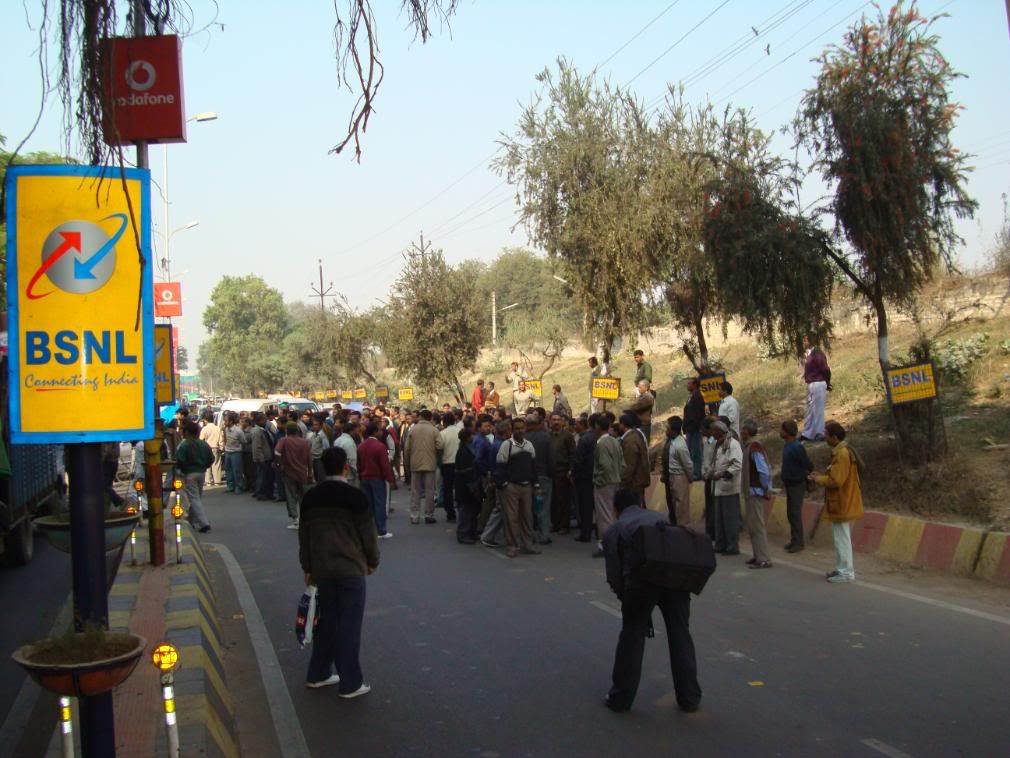
Photo Essay: Demonstration in Lucknow

On the way to the Imambara, we were stopped in front of the UP Road Transport Corporation Offices because of some demonstration.

The driver stopped the car and I hopped out on the road divider to see the people coming out of the offices.

then many more came piling out of the offices. I couldnt see where they were coming from so moved out in front and peeked

Those are the offices.

Then they started shouting slogans and moved off clearing the road and we moved off as well. This is the same road where you have the High Court Bench and just a few days ago, it was shaken apart by some bloody terrorists. So people were very nervous, looking around nervously. Our driver was nearly having kittens at the thought of me being highlighted on the divider and actually being outside the car!

Technorati Tags: ,,

Leaving your job as an IT Worker to become a plumber? read this

Before you decide to switch, read this. I quote


Burney said the resurgence of interest in plumbing stems from the 'considerable myth' that tradesmen can earn up to £80,000. 'That is only true if you work very long hours, manage a company or are doing the Channel tunnel,' he said. 'The more realistic figures are below £20,000 for a newly qualified plumber, and then £30,000 with experience or £35,000 if you are supervising people. It may be a little higher in the south east.'

Technorati Tags: ,