So I went to this quiz yesterday. The team came second. I was invited by Salil my friend who has just written a book on Bangladesh and in particular the killing of sheikh mujibur in 1974. So the quiz was for raising money so that this team can help make a documentary on the birangonas. An estimated 200000-400000 women were raped by the razakars and Pakistani army during the operation searchlight and then the war of independence in 1971.
These poor women were damaged twice. First by the Pakistani soldiers and razakars first. And then second by their Bangladeshi men and society who shunned them, abandoned them, murdered them. About 50000 women were forcibly impregnated. I met with an old Australian doctor who carried out late term abortions on these women. If they had given birth to children of their rapists, then the child would have been killed along with the mother or would've gone through pain.
The women suffer silently. They don't have a channel to express their grief. Nor does the society care. For them they are a reminder of their fragility and weakness and honour. And now, 44 years later, they are dying off. Without their stories being told.
So what these 4 women are doing is to make a documentary on them to show off their stories and try to change society. An extraordinary mission
Just 4 women. Came together and decided to do something. That's what I like. People who DO. Not just talk about it. Or press the like button on Facebook. Oh and sheikh mujibur named them birangonas. War women. Aptly named.
So I've offered my help with fundraising or photography or historical research but looks like they are well covered in that area. So let's see how I can help. But it was an amazing evening son. Seriously affected me.
There was one photograph in particular about a birangona. She was holding a rifle in one hand, a baby in her arms and a small child was holding on to her Aanchal. She was silhouetted against the sky. A black and white photo. Looking off into the direction of where the soldiers had gone. And that was a punch in the gut. She was woman. Who fought to protect her kids. And got raped. And would be abandoned by her husband. But if you want to think of raw courage that's it son. For her to keep loving her kids, living in abject poverty, but in silence. Now there is courage for you.
Anyway. I came out and went for a walk along the 10pm night time next to the Thames. The tide was in and the lights of the O2 and other areas were glimmering on the wind swept surface of the river. Curious son curious. Events of nearly 50 years back and echoing across all those years and so many kilometres.
Made many new friends and a new avenue to explore and learn.
Love
Baba
Monday, June 29
Birangonas


Friday, April 10
The British and their pen
Some maps which show the very long term implications of the British and their blasted pens.

The Durand Line

The Sykes Picot Treaty line.

The McMahon Line in East India. There are debates about loads of little pockets between India and Bangladesh.
Tuesday, March 31
Birth of a country
Kannu
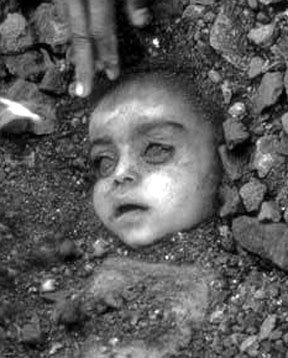
You missed a great afternoon, when Salil uncle read from his book, the Colonel who would not repent. About the death of Bangabondhu, Mujibur Rahman, the President of Bangladesh, and the history of this great but truly god-forsaken country. He mentioned about this book of photographs, by Kishor Parekh, which I am enclosing. Don’t read it if you have a bit of a sensitive tummy because there are very distressing photographs in here. But it’s not a big book, hardly 40 odd pages, but very powerful photographs, son. Sometimes photographs can be truly heart wrenching. Two of which I have written about before.
1. Bhopal: http://piquancy.blogspot.co.uk/2004/07/for-every-glance-behind-us-we-have-to.html. Here is the photograph in question.

2. Vietnam: http://piquancy.blogspot.co.uk/2004/02/chemical-warfare-is-not-all-hot-air-my.html. Here is the photograph
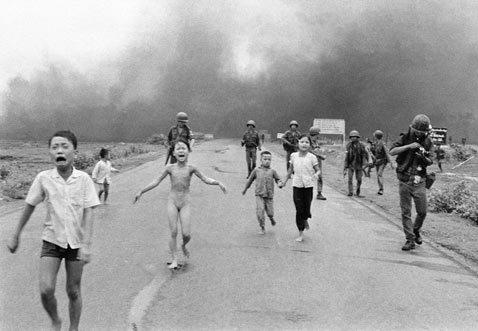
I have mentioned to you about my memories of this refugee issue, son. I was in Calcutta when this happened, hardly 4 years or so old, but I can still remember the cries of “phan de go” “please give me phan” echoing in the nights in the roads of Tollygunj which is a Calcutta neighbourhood…Phan is the water which remains after you decant the rice after cooking. People were so poor that they wanted that rice water. There were 10 million people who got into India in a matter of months, you cannot have an organisation which can handle this load of refugees so they were all in huge trouble despite all the help that the Indian government and civil society gave. Plus the second memory I have is of these refugees fighting over the garbage bins where people had thrown their left over food, fighting with dogs. Truly barbarian situation. Bangladesh is where our ancestors came from, son, so they are our people in a way. You are a Bengali and despite you not knowing Bengali, there are roots here. So you need to know because people who forget their history do not have a future. Remember what I told you about the Russian Georgian Girl? She said that you Indian/English people are lucky, you have a history to remember and be proud of.
So some of the photographs are really wrenching. People do not see this level of destruction, son. Why do you think I hate war? That’s why when people go all gung ho about war, I hate it. Absolutely hate it. Just saw a great cartoon, 2500 people died in 9/11 and 2.5million people died in wars which were launched because of 9/11. See? everybody has a reason to fight and kill, but when will it stop? We thought after the cold war, peace will break out but no, more and more wars have happened, and that’s why we need to stop people from fighting, starting with our own country, United Kingdom. Its stupid, its expensive and it creates havoc far beyond and for much longer than the people who did it will remember.
So read and weep for our compatriots, son. And think about not letting this happen again, as much as possible.
Love
Baba
PS: Here are some of the photographs which were totally brilliant


Friday, June 20
Appropriating Wives’ Income: New Form of Dowry
Dear son
Here's something that you will find of interest. How men steal the earnings of their wives. Despite the fact that it's religiously not mandated. There are two philosophical questions here.
One, how can you ensure proper division of rights? Between man and woman, husband and wife. And what needs to be done from a legal perspective. Is that law from the sharia law? Or shall you do this from the perspective of universal law like the convention of rights of women or United Nations universal declaration of human rights.
Second is what is religion? What has been written down or what is practised? Take this example in this situation. Islam in the majority version clearly says they the monies due to the wife are her's. But the way Islam is practised in Bangladesh is different. Then the question is, who determines who is right? Acres and tomes have been written on pretty much every topic under the sun and there's no consistency.
For both questions, it's vital to remove religion from the public sphere. Absolutely vital son. Because most if not all religions are a way of controlling the populace and more importantly are skewed towards male patriarchy. It's one when you kick out morons of the religious orders that true civilisation exists.
But it will be a long haul. Specially with these abhrahamic religions. Christianity has been controlled by and large. Judaism is still having challenges in Israel and well you know what's happening with Islam across the world. Both your and my generation will struggle with this religious genie son. It has to be forced into the bottle and capped hard. Long fight.
Love
Baba
Appropriating Wives’ Income: New Form of Dowry - Dissertation Reviews
http://dissertationreviews.org/archives/7942
A review of Appropriation of Wives’ Income: a New Form of Dowry in Bangladesh, by Farah Deeba Chowdhury.
Farah Deeba Chowdhury’s dissertation investigates the interrelationship between law, culture, patriarchy, and Islam in the context of contemporary Bangladesh. The dissertation has nine chapters.
Chowdhury has concentrated on the situation of Muslim married women in her dissertation. In the introduction, she argues that many practices in Bangladeshi society are based on misinterpretation of Islam and the main purpose of such manipulation is to seek control over wives’ income, financial resources and other assets. The author characterizes such practice as “appropriation of wives’ income as a new form of dowry” (p. 1). As the dowry system has been legally banned in Bangladesh, the income of working women is now considered as a source of earning for their husbands. The author argues that the root of such practice lies in the norms of patriarchal society. Women are deprived as the patriarchal society never conveys their role to the broader society. Instead, the dominant fallacy is women are only obliged to perform duties towards their in-law’s family.
Monday, February 3
Language, literature, education and community: The Bengali Muslim woman in the early twentieth century
This was a fascinating article even if it left me a bit befuddled. What was the hypothesis and how did they manage to come to their conclusions? I quote the synopsis.
The issue of women's empowerment has a long history. This article intends to trace the issue of women's empowerment in the area that now forms contemporary Bangladesh. In this regard, we have delved into the early part of the twentieth century to look into women's writing in numerous journals that were beginning to be published in that era. Looking into Muslim-edited journals, we look into how issues of women's education, writing and the place of women in society were being debated. In this process, we have laid special emphasis on women's writing, using the examples that we have cited as part of a new form of women's voices. What we discover about women's empowerment in this process is that it is a fraught issue, and there is no clear-cut or direct path that can be easily delineated. Early twentieth-century anti-colonial nation-making processes were indeed complex, and in the Bengal region, veered between emphasizing a Bengali as well as a Muslim identity. It is interesting to see how issues of language and the position of women coalesce to form a very exciting arena for researchers.Concentrating on literary writings by women in the early part of the twentieth century, this research is an effort to look into the construction of the modern Bengali Muslim woman, and the connections that can be drawn between the formation of this identity and the emergence of a notion of a Bengali nation. In broad outline, we will be debating the main contours of this nation — based as it is on religious, community and linguistic affiliations. Identity — both at the individual, or community/national level, remained, and remains fluid, as its various dimensions are foregrounded at different times. The nation is also being envisaged as an appendage to modernity, hence the lines that defined modernity at this point are also shifting, and the grounds that the envisaged modern nation occupies are continuously reformed and reconstituted.
foregrounded? eh?
But very interesting to learn about Bengali women writers at the beginning of the last century. Fascinating flowering of their own identity. The authors also navigate and bring out fascinating differences between the urban and rural, muslim and hindu, urdu and bengali speaking and the mixtures thereof.
An interesting paper but curiously left me unsatisfied. I would have liked the authors to have delved deeper into the mix and seen how the Bengali woman emerged, comparing the Hindu and Muslim woman, rather than taking a uni-dimensional perspective because I do believe that there would be a firmer and broader identity with the Bengali bit rather than the religious bit. Still some good references…
Monday, May 13
War and Famine in Late Colonial Bengal
This was a raw read. A snippet: ]
A review of Hungry Bengal: War, Famine, Riots, and the End of Empire 1939-1946, by Janam Mukherjee.
Janam Mukherjee’s dissertation is a thorough study of late colonial Bengal in the context of war, famine, and riots leading up to the eventual dissolution of empire. The central argument of the dissertation is built on the claim that famine was the “most profound factor influencing the structural, political, social, economic and communal fabric of Bengal” during this period (p. 5). The author provides a vivid illustration of the famine’s “awesome magnitude” in terms of its impact on the socio-political landscape of Bengal (p. 7). Before proceeding to the core content of the work, the author makes three important revisions to our understandings of the famine: first, he complicates the chronology of the famine, which is otherwise more commonly referred to as the Bengal Famine of 1943. Secondly, he shows that the war efforts and business interests, both centered in Calcutta, were responsible in equal measure for the devastation that ravaged rural Bengal, thus leading to the famine. And by looking beyond the actual famine victims and drawing a more explicit link between rural and urban Bengal, this work also demonstrates that the Bengal Famine was indeed “man-made.” Finally, contrary to the claim that the famine victims “died without a murmur” (Sugata Bose,Agrarian Bengal: Economy, Social Structure, and Politics, 1919-1947. Cambridge: Cambridge University Press, 1986) the author argues that by broadening the chronology of the famine the active resistance of the victims becomes evident.
I have spoken before about witnessing the raw hunger and pain in Calcutta when I was a teeny weeny chappie, around the war of independence in 1971. Seeing people fighting over scraps of food in the rubbish bins with dogs and others was a horrible sight. But to see that the British actually had direct responsibility over the death of millions of Bengali’s is a big big issue.
Sad.
Here is the wiki entryhttp://en.wikipedia.org/wiki/Bengal_famine_of_1943 for the Bengal Famine.
Sunday, December 30
Turkish President asks genocide to be forgotten
I saw this news item.
Turkish President stepped in to halt planned execution of Bangladesh Islamic leader and 100 others.
President Abdullah Gul sent Bangladesh President a letter on the leaders under trial, Turkish Daily Yeni Şafak said.
Some reports say Bangladesh plan to execute former leader of Jamaat-e-Islami, Ghulam Azam, will be executed in 26 March 2013.
The three-judge International Crimes Tribunal-1, set up to deal with crimes against humanity during the 1971 War of Independence, has indicted 91-year old leader for five charges including incitement, conspiracy and abetment. Gul's letter comes after Foreign Minister Ahmet Davutoglu assigned envoy to Dhaka to follow the issue.
Bangladesh’s largest Islamic party staged rallies against trials with police reportedly using live ammunition against the protesters. At least one person has been killed and scores injured and detained by police
Well, you know where this is coming from, no? Turkey, being responsible for the Armenian Genocide, is trying to stop other genocide’s being recognised. Typical muppets…they are happy to have popped off millions of their people but let somebody else kill their citizens (Syria, Greece, Israel, etc. etc.) and they go up in flames. Bloody hypocrites.
Here’s a draft letter (written from the perspective of a Bangladeshi citizen, but one can amend suitably) which one can use to send protests to your local Turkish Embassy.
Mr. Abdullah Gül
The President of the Republic of Turkey
Ankara
The Republic of Turkey
This is the shocking news that we have received on 27th December 2012. You have written a letter to the President of the People’s Republic of Bangladesh. Your Excellency, you asked in your letter not to punish the leader of 1971 genocide in Bangladesh. Shame on you Mr. President. To establish the role of law we must punish the war criminals. How could you ask to free a war criminal?
Mr. President, You have requested President of Bangladesh Mr. Zillur Rahman to give "clemency" to the accused under trial in the International Crimes Tribunals for the "sake of peace in the society".
Mr. President, Your request not to sentence Ghulam Azam, former ameer of Jamaat-e Islami, for committing the crimes against humanity is not only against the diplomatic norms and interference with the internal affairs of Bangladesh, but also a blow to its independence and sovereignty. Shame on You Mr. President.
Your Excellency, The judicial system of every country is independent and sovereign and no country can make any comment on the judicial system of other. Mr. President as the head of a nation you should be aware of this.
Mr. President should remember that the Armenian Genocide was carried out by the "Young Turk" government of the Ottoman Empire in 1915-1916 (with subsidiaries to 1922-23). One and a half million Armenians were killed, but no trial was held for the killings. Turkey had committed the first genocide in the world in the last century. The Turkish government never apologized for the crime. Turkey is still killing Kurdish people without any trial.
The other genocide of the 20th Century was in Bangladesh and committed by the Pakistani government. Three millions of Bangalees were killed and 400 000 of women were raped by the brutal Pakistani army and its alies led by Golam Azam. The Pakistan government did not ask any apology like the Turkish government.
The Turkish government supported the Pakistani military regime during the great liberation war of Bangladesh in 1971. Now after 40 years we have started the war crime tribunal in Bangladesh. This is the demand of 3 millions of martyrs and 400 000 raped women of Bangladesh.
Your Excellency, Mr. President, under the soil of Bangladesh we still have the 3 millions martyrs. You have dishonoured the whole Bangalee nation. I therefore demand an apology from you.
It is bad enough that you have dishonored the history and it is the shameless and shameful attempt to interfere with Bangladesh’s internal affair. This is an undertaking, the greatest of follies. Shame on You Mr. President.
I strongly protest if any country like Turkey makes any statement against the independent judicial system of Bangladesh or its sovereignty and dignity.
Mr. President, your request is a shameless expression of a conspiracy.
Your Excellency, Mr. President Please try to listen to your conscience and be truthful.
Thanking you.
With kind regards
(your name)
Wednesday, November 23
Divorce at marriage ceremony
BRAVO BRAVO.
Excellent news, this woman needs to be congratulated. These morons and idiots who demand dowry, these people who are genitally challenged should be forced to sleep with flea infested camels and then a bucket of warm spit poured over them while being kicked with hob nailed boots will only realise when they are publicly mocked. Bastards. May he never be able to sustain an erection. So there. And for his aunt, may your hair fall out in clumps and warts grow on your nose. So there even. Detest these bastards and witches. Bah, but what a great woman, now that’s courage for you. Attagirl.
I quote:
A bride has divorced the bridegroom for demanding dowry on the very day of marriage.
The bride, Farjana Yasmin, is the daughter of Khalilur Rahman of Kalipura village under Kukua union council of Amtali upazila of the district. She recently completed her Masters in Social Welfare from Dhaka's Eden College, securing first class.
The bridegroom, Shawkat Ali Khan alias Hiran, is headmaster of a government primary school at Kalapara upazila in Patuakhali district. He is the son of Shah Alam Khan of Madrasah Road area in Kalapara municipality.
Farjana told bdnews24.com that she was married to Shawkat on Friday morning.
"As they were about to leave our house along with me, his (Shawkat) aunt Tahmina Begum demanded a TV set, refrigerator, motorbike and some other things as dowry in presence of the guests," she said.
As Shawkat also supported his aunt's demand, Farjana divorced him then and there.
"He who demands dowry can never be my life partner. I'm divorcing him in your presence," she told the guests.
The relatives of the bridegroom tried to solve the row until 9:45pm, but Farjana stuck to her guns.
The relatives of the bridegroom left the ceremony humiliated.
Farjana told bdnews24.com, "In my student life, I was an anti-dowry activist and generated awareness against it among the people. But now I have myself become its victim."
"I think women should stand against dowry."
Contacted, Shawkat's mobile phone set was found switched off.
Tahmina is the headmistress of a government primary school of Kalapara Sadar upazila.
Saturday, September 17
Throwing acid on women
This pisses me off. Seriously and totally pisses me off and makes me want to go medieval on them. This is why I actually applauded the attempts by the Iranian woman who wanted to punish her attacker by asking acid to put out his eyes. Before you call me barbaric and thinking about an eye for an eye, this is what she was left with.
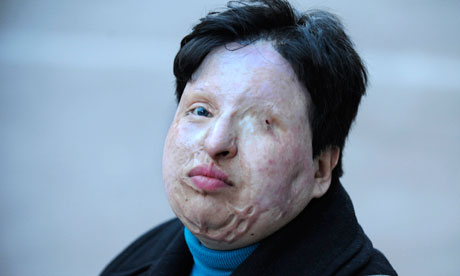
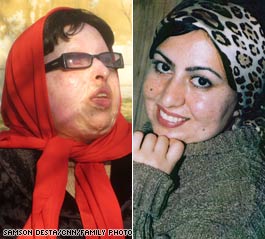
Yes, eye for an eye is good. Same with rapists whose penis’s should be hacked off with a blunt shovel and paedophiles should be physically tortured till their gonads pop out of their eyes. Bastards. As it so happens, this brave woman actually forgave her attacker at the last moment. That’s the level of her humanity, you bastard, may you rot here on earth, forget about hell.
And then I read two stories today. First where in Bangladesh, men were sentenced for life terms for an acid attack. Excellent news, these bastards need to be locked away for life. Good for you, Bangladesh.
Dhaka, Sep 10: Four Bangladeshi men have been sentenced to life in prison for throwing acid on a girl who rejected their advances, a media report said.
The incident had taken place in 2006 in northeastern Habiganj district along the border with India, the Daily Star reported.
The four men were identified as Abdul Quaiyum, Haris Miah, Auli Miah and Alkas Uddin.
They were convicted and sentenced in absentia by the district and sessions court in Habiganj of breaking into the house of Abdur Rahman and hurling acid on his 18-year-old daughter Mayarunnesa in February 2006.
Only Haris Miah was arrested, while the others are still at large.
And then in that lovely country, Pakistan, it was doubly heinous.
QUETTA: Four female school teachers received burn injuries on their faces after they were attacked by unidentified men in Quetta on Saturday.
Police informed that the teachers were on their way home in a van when the attackers riding a motorbike threw concentrated acid on their faces, and then fled.
You bastards have ruined 4 women and also stopped students from learning from them.

This is what you left her with. And knowing about Pakistan, I very much doubt that it will be doing anything to these bastards as compared to what Bangladesh did. And before you think I am taking off on Pakistan, this bloody behaviour is horrid and perhaps even worse in India where bride burning and dowries and acid throwing is far more given that its a bigger country. More women are devastated in India. May the lot of them burn themselves. May the acid sprinkling fleas of 1000 camels infest their groin. Bastards.
Sunday, August 14
Fatalism leads to more accidents in Bangladesh
From here.
This study was conducted to see whether fatalism is an important factor in explaining occupational accidents among medical waste operatives in Dhaka, Bangladesh. Data were collected using a variety of qualitative techniques and included observation, formal and informal dialogue. Sampling strategies included formal representative sampling, purposive and authoritative sampling. Employers did not supply PPE or offer training to their staff. Most workers (73%) did not wear PPE regularly, and a further 18% wore only insufficient PPE. Consequently, most waste workers (95%) reported that they had experienced occupational accidents, mostly (75%) from used needles and other sharps. These observations were associated with fatalistic beliefs among the participants, both managers and employees, who attributed these events to “fate” reflecting their perceived lack of control over such accidents. This study reveals many examples of a lack of organisational awareness that can occur within a culture of fatalism.
Quite a sad state of affairs, eh? Even if they had proper equipment, they dont wear it thinking that if it has to happen, it will happen. Inshallah. Bhagwan ki Daya Hai. I hate this bloody philosophy. God has nothing to do with it, you muppets. You are responsible for your own life, actions and rewards. And this causes problems in business clearly. There is simply no drive. Where are the unreasonable men and women who drive the productivity, quality, customer service to excellence and beyond? Not many will come up with a feeling of inshallah I am afraid. Bah!
Thursday, April 28
Support for Suicide Terrorism
So what is the relationship between the support for terrorism in public opinion and the relationship with terrorist attacks? Guess what these researchers found?
We find that justification in public opinion for suicide terrorism increases terror attacks on people in countries that are unfavorably regarded. There is a robust positive relationship between the share of the population in a country that at the same time justifies suicide bombings and has an unfavorable opinion of another country, and terrorism originating from the former country.
In other words, there is statistically significant evidence that public opinion does encourage terrorism. In a way, this is a d’oh statement. Terrorism thrives on the oxygen of publicity and then there are various assorted morons and idiots who will support terror as a way to punish other countries. What they do not understand (well, not surprising because its usually religious nutters and other ideologically screwed up people who do this) is that terrorism usually devours them.
So what do people from s Bangladesh, Egypt, Ethiopia, Kuwait, Malaysia, Morocco, Senegal, Tanzania, Mali, Jordan, Lebanon, Indonesia, Turkey, Pakistan, Palestine and Nigeria respond to the PEW survey question?
Some people think that suicide bombing and other forms of violence against civilian targets
are justified in order to defend Islam from its enemies. Other people believe that, no matter
what the reason, this kind of violence is never justified. Do you personally feel that this kind
of violence is often justified to defend Islam, sometimes justified, rarely justified, or never
justified?
On average 23% justified suicide terrorism, with a minimum of 8% support and an astonishingly high 70% maximum support. Highest was in Palestine, Nigeria and Mali, Lowest up was in Egypt, Pakistan and Indonesia. Surprising eh? Palestine I can understand, but Nigeria, Mali, Egypt, Pakistan and Indonesia? The last 3 countries are like factories for terrorists. Some other facets, Nigerian Women were showing more support for suicide bombing compared to men. Here’s the graph

There was another question which was asked, about which countries are most unfavourable to the respondents. Some of the results for the most unfavourable and least unfavourable are amazing and bewildering.

So Bangladesh actually has the lowest unfavourable opinion towards India! and highest towards USA. And what on earth is happening in Ethiopia with least Japan and high Iran? USA seems to be the most hated country across these muslim nations. Extraordinary but what is worrying is the extraordinarily high level of support for suicide bombing and terrorism in all these countries. The next time somebody says that terrorist support in Muslim countries relate only to a very small minority, do ask about the definition of a very small minority because a minority which ranges from 8-70% with an average of 23% aint such a small minority by any stretch of imagination.
Thursday, January 20
One of the most brutal genocides and nobody guilty
I saw this photograph on a blog which posts old Indian photographs. Ripped my heart out.

This relates the Bangladeshi Genocide carried out by those stalwarts of Islam, the Pakistani Army and their assorted quislings, the Bangladeshi Religious establishment who popped off 3 million people. Well, it doesn't matter, does it? when Muslims kill Muslims? its only when non Muslims kill Muslims do the howling mob come out. And in any case, they were Hindu’s or ex-Hindus or Bangla speaking. Bah. But look at the face, hopeless eyes, tired from walking for miles, a dying child. Nothing to call her own other than a thin bangle, a single tattered piece of cloth, cradling her child, who is most probably cholera inflicted.
I was very young at that time, about 4 years of age, but as I keep on saying, one of my earliest memories are people like this squabbling like feral dogs over food thrown into the garbage bin after the wedding feast. We were in Calcutta at that time. I also remember people like this wandering the streets during the afternoon begging for “maarh”, the rice water which is left after washing rice. Watch and weep. And since 1971, the Pakistani Army has gone on to do better and bigger things. Still doing it.
Tuesday, March 30
Bangla hospital bans burqas for female staff to prevent theft
Another reason to ban the burqa, lol.
A leading state-run health facility in Dhaka banned burqas for its female staff on Monday and enforced strict uniform regulations to prevent growing incidents of theft of mobiles and wallets at the hospital wards.
"We have just enforced the regulation asking women staff to wear the prescribed hospital uniform and carry ID cards while they are on duty inside the patients wards," Abdul Majid Bhuiyan, administrative director of Bangabandhu Sheikh Mujib Medical University, the largest hospital of Bangladesh, told PTI.
He said the order was issued for the female staff only against the backdrop of growing incidents of theft of wallets or mobile phones particularly from female and children wards. In most of the cases, the outsider women identifying them as hospital staff, were found to be involved in the thefts.
"This part of the disciplinary measures also to ensure hygienic standards of the facility...The female staffs are allowed to use the burqas outside the (hospital) wards," he said.
Bhuiyan, however, added that the visitors or patients were "in no way" come under the purview of the order.
So only the doctors and staff in burqa’s can be the thieves and not the people who come in from outside? nice way to show trust.
Thursday, December 31
Religious Restrictions in the 25 Most Populous Countries

Bloody shameful, if you ask me. What on earth are these countries doing? Think about India, not only does it have high government restrictions but the people themselves are actively hostile to other religions. Disgusting.
For that matter, the UK correspondingly has room for improvement as well. It has to reduce the amount of government restrictions and also further educate its population on being more liberal to other religions. Not good.
Wednesday, December 9
Difference between Madrassah and Secular School Students
So its pretty well established that generally the madrassah is considered to be not really very good in raising modern students and citizens. The common argument is that they teach medieval stuff at best and obscurantist stuff at worst. So what’s the real truth? Well, here’s one answer from Bangladesh. So what did the researchers do? But before we go there, some points.
In the early 1980’s, the Bangladeshi government made sure that the madrassah’s teach English, Bengali, Science and Mathematics along with the religious subjects in return for government funding for teachers and official registration. This is, of course, in stark contrast with the majority of madrassah’s elsewhere in the Muslim countries where teaching of modern subjects is a tad lacking. God (rather Allah) only knows what their output is but that’s not the point.
So the researchers went and asked questions on attitudes toward working mothers, desired fertility, higher education for boys vis-à-vis girls, and a number of political regimes such as military rule, democracy, and Islamic rule. Interviewing 1280 teachers over 94 madrassahs and 231 public secular schools with each school providing a rough 20 students sample size.
Teacher Responses:
On the question of desired fertility, teacher responses differ significantly: madrasa teachers either favor larger families or are more likely to rely on ‘destiny’ to decide on the desired number of children. Compared to their secular school colleagues, they significantly favor boys over girls for higher education and men over women for political leadership. They are also significantly sympathetic to religious leadership in political affairs. For instance, relative to secular school teachers, they significantly prefer Islamic rule, are at greater ease should religious leaders influence people’s voting choice, like to see more religious people in public offices, and are more likely to support religious leader’s interference in government affairs.
Graduate Responses:
Even after controlling for earlier religious education (maktab schooling), madrasa graduates are 31% more likely to prefer an unspecified number of children.
Female graduates in our sample were interviewed on whether they agreed with the following questions:
- 1. “Compared to housewives, working mothers are more cordial with children”
2. “A married working woman and a married housewife are equal”
3. “Both, the husband and the wife should contribute towards family income”
On the question of whether housewives, instead of working women, are better mothers, there is no madrasa effect. A negative association with religious school attendance prevails in the other two outcomes. Madrasa graduates do not agree that both husband and wife should contribute to family income
Even after controlling for educational histories (maktab attendance, class rank in grade 6 and grade completed), parental background, and socio-economic conditions, madrasa graduates are 21% more likely to conclude that higher education is a preserve for boys.
Lastly, females in our sample were asked three questions related to the desirability of various regimes for governing the country:
- 1. Military rule as a political regime for ruling the country is good
2. Democratic rule as a political regime for ruling the country is good
3. Islamic rule as a political regime for ruling the country is good
A large and significant madrasa effect prevails in all three cases: madrasa students are significantly opposed to military rule, support democracy and favor Islamic rule
In sum, the analysis of graduate responses reveals that madrasa attendance is not associated with perverse attitudes toward working women and military rule. They are more likely to support democracy although they have a preference for religious political representation. At the same time, these female madrasa students have a perverse attitude toward higher education for girls and larger family size. Also, our female madrasa respondents are more likely to delegate the choice of desired number of children to destiny.
Well, as you can see, a much more complex and richer set of results are emerging. For one, they are against the military rule which is a great step but then they desire islamic rule which is frankly like jumping from the frying pan into a fire. Surprising coming from females where an islamic state actively drops them in the order of priority on almost every aspect.
Then you have the other problem of fertility. Bangladesh and other Muslim countries are facing a massive problem in feeding, educating and raising their young. As it turns out, the problem is not going to get better but going to become worse if they all leave it up to God. God unfortunately doesnt have anything to do with contraception. All these kids will ruin the women’s lives. And they want this to continue. Bloody strange. But one very positive thing comes out, more female teachers the lower is the madrassah influence. Unfortunately, it conflicts with the other finding that its boys who deserve education more.
Sighs, more complexity….
Saturday, December 5
The Magnificient Pakistani Generals
An interesting review of a book review on one of the general’s books who commanded the Pakistani Army in 1971. Defeat has no fathers, it is an orphan and looking at the spate of books by the generals in charge then, looks like nobody was in charge, everybody was responsible and nobody was personally liable. One very interesting comment came back and this is what I have seen (as a very broad based generalisation), most of the third world country armies get more medals for killing their own people than the enemy. Pakistan’s army is no exception. In fact, for all the pious mumbling about Islamic armies, I would say that this Islamic Army of Pakistan has killed more Muslims than non-muslims. Post Independence, whether you think about Jordan, Kashmir, Kargil, Bangladesh, Afghanistan, Baluchistan, Sindh, you name it…
A.H Amin's Comments on Ahmad Faruqis Book Review of A.A.K Niazis Book on East Pakistan-2000While you can spend quite a lot of time reading both documents, this is what puzzles me ever since. Is it indeed possible to fool all people all the time? What explains the fascinating behaviour of the Pakistani Army? that it manages to screw up almost everything it touches but is still allowed to grab the resources of the Pakistani state and even rule it. We are getting to grips with the betrayal of East Pakistan but what about the betrayal of West Pakistan? When will that final chapter be written?
That said, tactically and militarily, the Pakistani Army seems to be getting better, Kargil was a great example, Swat and the South Waziristan campaigns are also good. What happens to these generals when they grow up? Also, the current C-in-C Kayani seems to be a canny smart chappie. But here’s the question, the lessons of the 1971 war (see the Hamdoor ur Rahman Report summary here) doesnt seem to be learnt. The same old same old, the involvement with politics and massive corruption is still there.
Lots to think about.
Friday, November 20
Bangladeshis rush to learn English by mobile
Quite an interesting development here. I quote:
The project, which costs users less than the price of a cup of tea for each three-minute lesson, is being run by the BBC World Service Trust, the international charity arm of the broadcaster. Part of a UK government initiative to help develop English skills in Bangladesh, it marks the first time that mobile phones have been used as an educational tool on this scale.
Through its Janala service, the BBC offers 250 audio and SMS lessons at different levels. Each lesson is a three-minute phone call, costing about 3 taka (2.6p).
One basic lesson involves listening to and repeating simple dialogue like: “What do you do?” “I work in IT, what about you?” “I’m a student.” “That’s nice.” Another is devoted to differentiating vowel sounds like those in ship and sheep or leaf and live.
All six mobile phone operators in Bangladesh have agreed to cut the cost of calls to the service by 50 per cent to make it more affordable. Ms Chamberlain said the project team was in talks with the mobile phone companies to increase capacity to cope with the unexpectedly high demand.
The language lessons are mainly targeting 18 to 24-year-olds, who typically had five or more years of formal education, but whose training in English had been weak. The target market is people living on less than 10,000 taka ($145, €97, £87) a month, who would struggle to pay for formal English lessons.
Education by mobile phones. This can be used to drive other educational programmes as well. I was discussing with a friend of mine about how to use Google Wave in educational institutions after the idea was sparked by a discussion online. I think I am going to try to see if any of my professor friends around the country would be interested to see if we can roll this out for a class somewhere. The idea being that we can have twitter, sms, email, online conversations, documents all mixed up when we are evaluating a proposal or something like that, all inside a class.
But this is indeed very interesting. Worth watching out for.
Saturday, February 21
Pakistani Envoy demurs on Bangladesh Genocide Trials
Well, he would, wouldn't he? I quote:
People who collaborated with the Pakistan government during the freedom movement are called "war criminals" in Bangladesh.
During a heated discussion in Jatiya Sangsad (parliament), Pakistan President Asif Ali Zardari's special envoy Mirza Zia Ispahani was asked to "apologise for his audacious remark", New Age newspaper said Thursday. Ispahani is here on a five-day goodwill visit that is the first high level contact by Pakistan after the Hasina Government took office last month. Dhaka should not expect any cooperation from Islamabad "at this stage", Ispahani said Tuesday while responding to a media query on the proposed war crime trials.
War crimes is a prickly issue in Bangladesh-Pakistan relations as all the accused were either Pakistani nationals or armed bands propped up by the erstwhile East Pakistan regime to terrorise the civilian population. Many of the accused escaped to Pakistan after Bangladesh became free. Bangladesh says over two million people, mostly unarmed civilians, were killed during the nine month conflict. Ten years back, Dhaka had expelled a senior Pakistani diplomat posted at the high commission after he made disparaging remarks about the freedom struggle
Sunday, February 15
Bangladeshi War Criminals arrested
Bangladesh has pleasantly surprised me, it has actually arrested two people on war crime charges. I have written about this before and frankly, did not expect this to happen. Bangladesh faced one of the biggest genocide events in our history but typically, nobody was prosecuted till now. Forget about the Pakistani’s, they will obviously not do so, but for Bangladesh itself not to look at the war criminals still working and living amongst their own midst, was criminal. But, very impressively (and perhaps Pakistan would learn, doubtful…), they have arrested two of the war criminals. Good for them, these Islamist scum should know that they cannot escape the long hand of the law.
Sunday, February 8
Fascinating animation of the Mogul Empire
Fascinating stuff, while I have read about the Mogul Empire, the animation makes it so real and a bit sad as well…