
Showing posts with label freedom of speech. Show all posts
Showing posts with label freedom of speech. Show all posts
Friday, January 29


Friday, November 15
Orality, Writing and the Image in the Maqamat: Arabic Illustrated Books in Context
This was one of the most interesting articles about an antiquarian book that I have read. This is about a book called as Maqamat of al Hariri, going back to the 13th century, by which time Islam had well established for 2 centuries and Islamic traditions were moving from the violence to the cultured. So this book had elements of art, rhetoric, Islamic jurisprudence, dramatics, legal disputes, charity, painting, politics, etc. etc. It was popular across the world, at least the Islamic World. The book has a series of chapters, each chapter about how a man preaches amazingly on a particular topic and then gets quite a lot of alms and charity and then is exposed as a charlatan. I quote
The pattern established in the first story remains relatively unchanged throughout the text: each new episode is narrated by al-Harith, who witnesses a masterpiece of eloquence by an old or a young man, a woman, a poet, a storyteller, an orator, a person able to read the stars, to resolve grammatical problems, to pronounce authoritatively on legal issues, and so on.5 All of them turn out to be one and the same Abu Zayd, whose performance earns him a generous reward, after which al-Harith discovers the subterfuge; in most cases, he goes on to confront Abu Zayd before both characters part.
![AHIS_881_fu1[1]](https://blogger.googleusercontent.com/img/b/R29vZ2xl/AVvXsEhIZbn5utpXHhIUWLaDDat_uKLbnl2tDwLXqAo4BW39skMNsfqtcsDOJzyCISV4Sf5kQOfSOHXa4Farbx1QEjyIAW4QtfDsrJkGOOjjp72O_gcRCWMOVc11YfjP5UI8iJChsI9KpbjA5ig/s1600-h/AHIS_881_fu113.jpg "AHIS_881_fu1[1]")
What I found amusing was this part.
Besides a solid educational background, the owners of illustrated versions of the work must have boasted some degree of material wealth and deemed pictorial representation acceptable, at least in private, like many people in society appear to have done. In this era, figural art was being deployed on an unprecedented scale in manuscripts, ceramics, textiles, metalwork, statues and figurines, particularly in Iran, Iraq and Syria.30 This phenomenon was, needless to say, not to the liking of all. ‘The angels will not enter a house in which there is a dog or an image’, a well-known religious saying asserted.31 An equally widespread hadith warned that ‘on the Day of Judgement, those who make images (al-musawwirun) will be punished most severely by God’, with some versions adding that they ‘will be called upon to breathe life into what they have created, but they will not succeed’.32
the recent arguments about the Mohammad Cartoons is evidence that so many people still have their heads up the backside of some fundo view of the world. As can be seen, rebellion against this senseless stricture was pretty much widespread across the world and since the beginning. And this is also why accusations of hypocrisy is widespread. I again quote
Such vehement proscriptions did not reverse the societal trends which they implicitly denounced, but one consequence may have been that figural art was generally reserved for private consumption. There is little direct evidence to support this idea, apart from fact that the objects bearing such images were of a private rather than public nature. But it seems likely on the basis of context. The enclosed space of urban homes and their inner courtyards were sheltered from outside interferences by Islamic law. This applied even to houses in which the owners gave themselves over to such unlawful activities as music and drinking, so long as the sound or odour did not blatantly reach outside their walls.35 Theological injunctions against images and legal protection from zealous intrusion thus appear as two sides of the same coin, reflecting a reality in which the norms of religious orthodoxy were plainly ignored by many.
Bah!
but thankfully as the author says, these wonderfully illustrated books came down history for us to see and admire.
![AHIS_881_f7[1]](https://blogger.googleusercontent.com/img/b/R29vZ2xl/AVvXsEgkPhMxTJ1qeDzTYoMpAvPx_-dn3bz4LFy3mginBxY2I-n4QERCoN_HyTplH3OAhksDnfwixei5zgGAOBYKuQZ7_18rM0DSzJguQ7SkM6RMKZPfJOGDLHUbBEqRhxcWmnr6-lNiMZWjeWs/s1600-h/AHIS_881_f714.jpg "AHIS_881_f7[1]")
![AHIS_881_f10[1]](https://blogger.googleusercontent.com/img/b/R29vZ2xl/AVvXsEjcbh0RTnJ7UGquSovCRrr_oSUhL9nvH3tjQPPqERw0tp6pKjamVOigViTgccEIvzEdCkSbiWvzgJpe7cLhsg1XH47Wf70dQAfK3oujsJL6DgEGb1SEOOCnyXbt7mYSeX1IIe82PjbcJME/s1600-h/AHIS_881_f1013.jpg "AHIS_881_f10[1]")
and what’s this???are they kissing? :P
![AHIS_881_f14[1]](https://blogger.googleusercontent.com/img/b/R29vZ2xl/AVvXsEindiEy44XpWXbKsvjnwUhKZWV3p7VHfOfvjq9_VN_rnyyRhdWsg6TcgXcOHGW1S-hYJUp8ept9U9U69vjkEKH3HOIzoJz7BUSlo-UK1M-jT3hJD3KrJ_X8h1QpjWWQajwfwjsQQBNR0jc/s1600-h/AHIS_881_f1413.jpg "AHIS_881_f14[1]")
![AHIS_881_f15b[1]](https://blogger.googleusercontent.com/img/b/R29vZ2xl/AVvXsEgnzjd02LuHREPFqjkMMTMn1UqZLvc4Dcpd-MiA33bzmv7lZiw1i9V5SUeIWytBpuiOAQ5NwRA4Ocv8Om7M0xYXtm21m9fICscTRFm1di5AWGbElsfz6a5IPCxHlRFeetD_c6NbEgl7_Oo/s1600-h/AHIS_881_f15b13.jpg "AHIS_881_f15b[1]")
Wednesday, November 13
How the British and American Missionaries converted Nagaland
this dissertation is a good overview of how Nagaland moved from a tribal animist society to a Christian society, how the rules of nationhood entwined closely with religions aspects and the prospects thereof.
I quote
John Thomas’ dissertation, Missionaries, Church and the Formation of Naga Political Identity, 1918-1997, historicizes the formation of Naga political identity. It examines the intersection of religious and national identity in the formation of the Naga self by critically evaluating missionary, colonial, and nationalist representations of Naga political identity. Thomas is critical of a particular theological perspective, produced by American and Naga Baptist missionaries that mediated this identity formation. This theological perspective is based on a particular interpretation of Christianity based on a fundamentalist variety of Evangelical Christianity that emphasizes “ahistorical and fundamentalist reading of the Bible; solely interested in questions of personal sin, morality and salvation; aggressively exclusive in relating with secular ideologies and other religious faiths; and yet supportive of preserving the existing status quo” (p. 10). This kind of fundamentalist, evangelica understanding imposes a particular religious identity on national identity “wherein being an evangelical Christian increasingly becomes a pre-requisite towards being a Naga” (p. 10). Therefore, this theology is limited by a narrow focus on individual salvation, which reiterates a colonial logic of “saving the savage,” thereby taming the understanding of the Naga self. As such, it is inadequate to understand the complexities of the social, political and cultural specificity of the Naga situation, Thomas argues.
More crap is being pumped in across the country further fanning flames in AP, Orissa, etc. etc. But then again, they should be allowed to preach. Freedom of speech is absolute. Still you wonder if this is really helpful when such a complex tribal animist persona is now being subsumed into being seen solely via a fundamentalist christian worldview. Sad
Thursday, June 27
To learn who rules over you, simply find out who you are not allowed to criticize – Voltaire
Not much to say beyond saying that this is a great quote, cuts straight to the core of human behaviour and society. As a libertarian and freedom of speech absolutist, this is clearly very important.
Two US bloggers were banned from entering UK. This is clearly a failure of the Sharansky test. The book is very good, and the test is simple:
If a person cannot walk into the middle of the town square and express his or her views without fear of arrest, imprisonment, or physical harm, then that person is living in a fear society, not a free society. We cannot rest until every person living in a "fear society" has finally won their freedom.
I saw so many people wittering on along two lines, “i support freedom of speech but…” that but means you are not a freedom of speech supporter.
Second was, what kind of a society are we producing if we allow people like these guys in? Well, as the Sharansky test says, we are living in a fear society. USA is happy to have freedom of speech, but here in the UK?
ESPHOKS on the Home Office Minister, bah
Thursday, January 3
We have a definition of an Expert on Islam
There are so many people who purport to speak for Islam. So how do you determine who is an expert and who isn't? Well, now we have a definition. You are supposed to have a formal academic qualification from an accredited institution of Higher education in the West or an institution of higher education in a Muslim Majority Country that ranks amongst the world’s top 500 universities.
heh. that basically counts out pretty much everybody, eh? Most of the sheikhs, all the mullah’s, all the chaps will be disqualified. Heck, did you know that Al Azhar isnt on the list of 500 universities either? King Saud, King Abdulaziz and King Fahd Universities are there. And we know what’s coming out of there.
Why do people do this? its like stupid…instead of engaging with the substantive parts of Islamophobia (which does exist), they go for these ad hominem attacks. Idiots. There is a very good reason why the Prophet did not allow or put into operation or Islam allows a priestly class. Every person is allowed his own relationship with God and speak of that.
Thursday, October 18
Freedom of Speech is not absolute, even in Universities
I didn't realise this. I quote
Gallaudet University’s “chief diversity officer,” Angela McCaskill, was suspended (with pay) for signing a petition that sought a referendum vote on whether to undo Maryland’s new same-sex marriage law. Is it legal for a private employer to suspend or fire an employee for signing a referendum or initiative petition?
Really? I didn't realise that private political activity is proscribed. But looks like it is
It depends on the state. As I’ve discussed in a good deal of detail in a recent article, Private Employees’ Speech and Political Activity: Statutory Protection Against Employer Retaliation, about half the states impose some restrictions on private employers’ ability to retaliate against employees for the employees’ speech or political activity. Some state laws cover a large range of speech and political activity, while some cover only a small range. (Some, which I didn’t discuss in the article, only ban discrimination based on how an employee voted.) But nearly all the states that do impose such restrictions — beyond a mere ban on discrimination based on voting — would apply to referendum or initiative signatures.
Its interesting, conceivably a firm can even go forward and tell me where and how to vote? How amazing. I never thought that a university would do this. Second, that my personal political activity (as long as it doesn't violate support for clearly illegal actions such as terrorism – although that is also debatable) can be ground for me being fired!!!!
Sunday, September 30
Another victim of freedom of speech
And we find another example of the idiocy of the Egyptians. I quote:
In a rare exercise of its anti-blasphemy laws, an Egyptian court has decided to put on trial a radical Muslim blogger who tore pages of the New Testament Bible while attending protests at the U.S. Embassy in Cairo two weeks ago.
Ahmed Mohammed Abdullah, known as Abu Islam, was shown in two videos posted online desecrating the Christian Bible. In one video, Abdullah stood before a large crowd and ripped up the holy book. In the second video, he told the camera, "Next time I will urinate on it."
Abdullah, who is part owner of the ultra-conservative Islamic television channel Al Uma, told The Associated Press that he was not practicing "contempt for religion" when tearing up the Bible.
________________________
I will wait with bated breath for the hordes of Christian Rage Boys who will riot and create havoc and sodomise the Egyptian Ambassador and kill Egyptian Embassy personnel and burn the Egyptian flag and and and.
Talking about Rage Boys…
Wednesday, May 9
What did Mark Twain say about censorship?
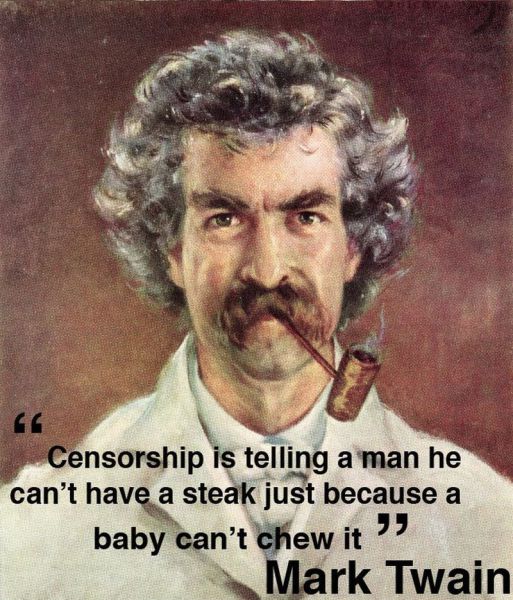
Chuckles, the man is a genius. Every time I see anybody saying something has to be banned, I feel like asking them to go back to school and demanding their school fees back for turning them into blithering idiots and imbeciles.
Monday, May 7
A troubling case of freedom of speech
The fact that this chap was posting inflammatory material on the web is not in doubt. But that doesn't mean that it was wrong. Completely disagree with the sentencing of this man in the USA. If the courts can imprison you for saying that you believe in, then where is the first amendment? I am not happy at all, this isn't good.
See this summary first. I quote:
Civil liberties advocates say the case represents a slippery slope. In the 2010 case Holder v. Humanitarian Law Project, which decided whether or not providing nonviolent aid (such as legal advice) to terrorist groups constitutes material support for terrorism, the Supreme Court ruled that even protected speech can be a criminal act if it occurs at the direction of a terrorist organization. Based on that ruling, you could be convicted of materially supporting terrorism merely for translating a document or putting an extremist video online, depending on your intentions.
"If he's doing it on behalf of a designated group, he's providing a service, and that's the crime," says Georgetown University law professor David Cole, who argued against the government in Humanitarian Law Project. "It doesn't matter if the speech is itself violent or nonviolent." The question is whether Mehanna's actions were done at the direction of a terrorist group or whether his actions constituted "independent advocacy."
Convicting Mehanna on conspiracy charges stemming from his alleged attempt to seek terrorist training or lying to investigators is one thing. Convicting him based on his alleged pro-jihadist internet advocacy could establish a legal path to stamping out extremist propaganda on the web. At the same time, in the view of some civil libertarians, the case could narrow the right to free speech by allowing the government to successfully prosecute the expression of radical or unpopular views as a crime. The verdict could come as soon as next week.
Mehanna's defense team has argued that his views have been misrepresented and that he doesn't share Al Qaeda's extremist worldview. Holding radical or abhorrent beliefs, however, is still protected by the Constitution. The basic legal standard for when speech becomes criminal is referred to as the "Brandenburg test." Stemming from a 1969 Supreme Court case, the rule essentially stipulates that speech can't be criminalized unless it is deliberately meant to incite "imminent lawless action" and there's a reasonable belief that action could take place.
After all, if the government can kill someone for posting extremist sermons on the internet, why can't it put someone in prison for doing the same thing?
"That's a very hard standard to meet," Cole says. "The court saw from experience that prosecutions for advocacy of illegal conduct often became politically motivated prosecution of dissenters where there was no actual nexus to crime."
But, as Cole points out, the decision in Holder v. Humanitarian Law Project created a key terrorism-related exception making even nonviolent, nonmonetary aid to a terrorist organization a crime.
The government has tried to argue that Mehanna's speech isn't protected for two reasons. One, that his actions reflect Al Qaeda's call for its followers to preach its twisted gospel to Westerners. The second is that Mehanna posted extremist propaganda and responded to requests to translate materials from individuals associated with terror groups.
Scholars of Islamic extremism, however, frequently translate and post jihadist material on the internet for the purpose of study—something Mehanna's attorneys have noted in their defense.
"The Supreme Court says the law makes a distinction between independent advocacy and advocacy at the direction and control of a group," Cole says. Prosecuting someone for obeying a "general call" for extremists to spread Al Qaeda's message, Cole says, seems like a reach.
He was convicted and this is what he said.
TAREK’S SENTENCING STATEMENT
APRIL 12, 2012Read to Judge O’Toole during his sentencing, April 12th 2012.
In the name of God the most gracious the most merciful Exactly four years ago this month I was finishing my work shift at a
local hospital. As I was walking to my car I was approached by two federal agents. They said that I had a choice to make: I could do things the easy way, or I could do them the hard way. The “easy ” way, as they explained, was that I would become an informant for the government, and if I did so I would never see the inside of a courtroom or a prison cell. As for the hard way, this is it. Here I
am, having spent the majority of the four years since then in a solitary cell the size of a small closet, in which I am locked down
for 23 hours each day. The FBI and these prosecutors worked very hard-and the government spent millions of tax dollars – to put me in that cell, keep me there, put me on trial, and finally to have me stand here before you today to be sentenced to even more time in a cell.
In the weeks leading up to this moment, many people have offered suggestions as to what I should say to you. Some said I should plead for mercy in hopes of a light sentence, while others suggested I would be hit hard either way. But what I want to do is just talk about myself for a few minutes.
When I refused to become an informant, the government responded by charging me with the “crime” of supporting the mujahideen fighting the occupation of Muslim countries around the world. Or as they like to call them, “terrorists.” I wasn’t born in a Muslim country, though. I was born and raised right here in America and this angers many people: how is it that I can be an American and believe the things I believe, take the positions I take? Everything a man is exposed to in his environment becomes an ingredient that shapes his outlook, and I’m no different. So, in more ways than one, it’s because of America that I am who I am.
When I was six, I began putting together a massive collection of comic books. Batman implanted a concept in my mind, introduced me to a paradigm as to how the world is set up: that there are oppressors, there are the oppressed, and there are those who step up to defend the oppressed. This resonated with me so much that throughout the rest of my childhood, I gravitated towards any book that reflected that paradigm – Uncle Tom’s Cabin, The Autobiography of Malcolm X, and I even saw an ehical dimension to The Catcher in the Rye.
By the time I began high school and took a real history class, I was learning just how real that paradigm is in the world. I learned about the Native Americans and what befell them at the hands of European settlers. I learned about how the descendents of those European settlers were in turn oppressed under the tyranny of King George III.
I read about Paul Revere, Tom Paine, and how Americans began an armed insurgency against British forces – an insurgency we now celebrate as the American revolutionary war. As a kid I even went on school field trips just blocks away from where we sit now. I learned about Harriet Tubman, Nat Turner, John Brown, and the fight against slavery in this country. I learned about Emma Goldman, Eugene Debs, and the struggles of the labor unions, working class, and poor. I learned about Anne Frank, the Nazis, and how they persecuted minorities and imprisoned dissidents. I learned about Rosa Parks, Malcolm X, Martin Luther King,
and the civil rights struggle.I learned about Ho Chi Minh, and how the Vietnamese fought for decades to liberate themselves from one invader after another. I learned about Nelson Mandela and the fight against apartheid in South Africa. Everything I learned in those years confirmed what I was beginning to learn when I was six: that throughout history, there has been a constant struggle between the oppressed and their oppressors. With each struggle I learned about, I found myself consistently siding with the oppressed, and consistently respecting those who stepped up to defend them -regardless of nationality, regardless of religion. And I never threw my class notes away. As I stand here speaking, they are in a neat pile in my bedroom closet at home.
From all the historical figures I learned about, one stood out above the rest. I was impressed be many things about Malcolm X, but above all, I was fascinated by the idea of transformation, his transformation. I don’t know if you’ve seen the movie “X” by Spike Lee, it’s over three and a half hours long, and the Malcolm at the beginning is different from the Malcolm at the end. He starts off as an illiterate criminal, but ends up a husband, a father, a protective and eloquent leader for his people, a disciplined Muslim performing the Hajj in Makkah, and finally, a martyr. Malcolm’s life taught me that Islam is not something inherited; it’s not a culture or ethnicity. It’s a way of life, a state of mind anyone can choose no matter where they come from or how they were raised.
This led me to look deeper into Islam, and I was hooked. I was just a teenager, but Islam answered the question that the greatest scientific minds were clueless about, the question that drives the rich & famous to depression and suicide from being unable to answer: what is the purpose of life? Why do we exist in this Universe? But it also answered the question of how we’re supposed to exist. And since there’s no hierarchy or priesthood, I could directly and immediately begin digging into the texts of the Qur’an and the teachings of Prophet Muhammad, to begin the journey of understanding what this was all about, the implications of Islam for me as a human being, as an individual, for the people around me, for the world; and the more I learned, the more I valued Islam like a piece of gold. This was when I was a teen, but even today, despite the pressures of the last few years, I stand here before you, and everyone else in this courtroom, as a very proud Muslim.
With that, my attention turned to what was happening to other Muslims in different parts of the world. And everywhere I looked, I saw the powers that be trying to destroy what I loved. I learned what the Soviets had done to the Muslims of Afghanistan. I learned what the Serbs had done to the Muslims of Bosnia. I learned what the Russians were doing to the Muslims of Chechnya. I learned what Israel had done in Lebanon – and what it continues to do in Palestine – with the full backing of the United States. And I learned what America itself was doing to Muslims. I learned about the Gulf War, and the depleted uranium bombs that killed thousands and caused cancer rates to skyrocket across Iraq.
I learned about the American-led sanctions that prevented food, medicine, and medical equipment from entering Iraq, and how – according to the United Nations – over half a million children perished as a result. I remember a clip from a ’60 Minutes‘ interview of Madeline Albright where she expressed her view that these dead children were “worth it.” I watched on September 11th as a group of people felt driven to hijack airplanes and fly them into buildings from their outrage at the deaths of these children. I watched as America then attacked and invaded Iraq directly. I saw the effects of ’Shock & Awe’ in the opening day of the invasion – the children in hospital wards with shrapnel from American missiles sticking but of their foreheads (of course, none of this was shown on CNN).
I learned about the town of Haditha, where 24 Muslims – including a 76-year old man in a wheelchair, women, and even toddlers – were shot up and blown up in their bedclothes as the slept by US Marines. I learned about Abeer al-Janabi, a fourteen-year old Iraqi girl gang-raped by five American soldiers, who then shot her and her family in the head, then set fire to their corpses. I just want to point out, as you can see, Muslim women don’t even show their hair to unrelated men. So try to imagine this young girl from a conservative village with her dress torn off, being sexually assaulted by not one, not two, not three, not four, but five soldiers. Even today, as I sit in my jail cell, I read about the drone strikes which continue to kill Muslims daily in places like Pakistan, Somalia, and Yemen. Just last month, we all heard about the seventeen Afghan Muslims – mostly mothers and their kids – shot to death by an American soldier, who also set fire to their corpses.
These are just the stories that make it to the headlines, but one of the first concepts I learned in Islam is that of loyalty, of
brotherhood – that each Muslim woman is my sister, each man is my brother, and together, we are one large body who must protect each other. In other words, I couldn’t see these things beings done to my brothers & sisters – including by America – and remain neutral. My sympathy for the oppressed continued, but was now more personal, as was my respect for those defending them.
I mentioned Paul Revere – when he went on his midnight ride, it was for the purpose of warning the people that the British were marching to Lexington to arrest Sam Adams and John Hancock, then on to Concord to confiscate the weapons stored there by the Minuteman. By the time they got to Concord, they found the Minuteman waiting for them, weapons in hand. They fired at the British, fought them, and beat them. From that battle came the American Revolution. There’s an Arabic word to describe what those Minutemen did that day. That word is: JIHAD, and this is what my trial was about.
All those videos and translations and childish bickering over ‘Oh, he translated this paragraph’ and ‘Oh, he edited that sentence,’ and all those exhibits revolved around a single issue: Muslims who were defending themselves against American soldiers doing to them exactly what the British did to America. It was made crystal clear at trial that I never, ever plotted to “kill Americans” at shopping malls or whatever the story was. The government’s own witnesses contradicted this claim, and we put expert after expert up on that stand, who spent hours dissecting my every written word, who explained my beliefs. Further, when I was free, the government sent an undercover agent to prod me into one of their little “terror plots,” but I refused to participate. Mysteriously, however, the jury never heard this.
So, this trial was not about my position on Muslims killing American civilians. It was about my position on Americans killing Muslim civilians, which is that Muslims should defend their lands from foreign invaders – Soviets, Americans, or Martians. This is what I believe. It’s what I’ve always believed, and what I will always believe. This is not terrorism, and it’s not extremism. It’s what the arrows on that seal above your head represent: defense of the homeland. So, I disagree with my lawyers when they say that you don’t have to agree with my beliefs – no. Anyone with commonsense and humanity has no choice but to agree with me. If someone breaks into your home to rob you and harm your family, logic dictates that you do whatever it takes to expel that invader from your home.
But when that home is a Muslim land, and that invader is the US military, for some reason the standards suddenly change. Common sense is renamed ”terrorism” and the people defending themselves against those who come to kill them from across the ocean become “the terrorists” who are ”killing Americans.” The mentality that America was victimized with when British soldiers walked these streets 2 ½ centuries ago is the same mentality Muslims are victimized by as American soldiers walk their streets today. It’s the mentality of colonialism.
When Sgt. Bales shot those Afghans to death last month, all of the focus in the media was on him-his life, his stress, his PTSD, the mortgage on his home-as if he was the victim. Very little sympathy was expressed for the people he actually killed, as if they’re not real, they’re not humans. Unfortunately, this mentality trickles down to everyone in society, whether or not they realize it. Even with my lawyers, it took nearly two years of discussing, explaining, and clarifying before they were finally able to think outside the box and at least ostensibly accept the logic in what I was saying. Two years! If it took that long for people so intelligent, whose job it is to defend me, to de-program themselves, then to throw me in front of a randomly selected jury under the premise that they’re my “impartial peers,” I mean, come on. I wasn’t tried before a jury of my peers because with the mentality gripping America today, I have no peers. Counting on this fact, the government prosecuted me – not because they needed to, but simply because they could.
I learned one more thing in history class: America has historically supported the most unjust policies against its minorities – practices that were even protected by the law – only to look back later and ask: ’what were we thinking?’ Slavery, Jim Crow, the internment of the Japanese during World War II – each was widely accepted by American society, each was defended by the Supreme Court. But as time passed and America changed, both people and courts looked back and asked ’What were we thinking?’ Nelson Mandela was considered a terrorist by the South African government, and given a life sentence. But time passed, the world changed, they realized how oppressive their policies were, that it was not he who was the terrorist, and they released him from prison. He even became president. So, everything is subjective - even this whole business of “terrorism” and who is a “terrorist.” It all depends on the time and place and who the superpower happens to be at the moment.
In your eyes, I’m a terrorist, and it’s perfectly reasonable that I be standing here in an orange jumpsuit. But one day, America will change and people will recognize this day for what it is. They will look at how hundreds of thousands of Muslims were killed and maimed by the US military in foreign countries, yet somehow I’m the one going to prison for “conspiring to kill and maim” in those countries – because I support the Mujahidin defending those people. They will look back on how the government spent millions of dollars to imprison me as a ”terrorist,” yet if we were to somehow bring Abeer al-Janabi back to life in the moment she was being gang-raped by your soldiers, to put her on that witness stand and ask her who the “terrorists” are, she sure wouldn’t be pointing at me.
The government says that I was obsessed with violence, obsessed with ”killing Americans.” But, as a Muslim living in these times, I can think of a lie no more ironic.
-Tarek Mehanna
4/12/12
This wasnt right, I think the American courts fell down on the job, but then again, my faith in American justice is not that high anyway, specially when it continues to hold people without charging for years and years. And kills American citizens without due process.
Sunday, March 4
A tale of two gay hate circumstances
Two incidents caught my eye, both on the same day.
Christian street preacher who allegedly told gay couple they would 'burn in hell' in High Street rant is cleared of wrongdoing. Religious Michael Overd, 47, pictured, was accused of using threatening or abusive language against Craig Manning and Craig Nichol in Taunton, Somerset.
Muslim fanatics who called for execution of gays and wanted to set up a 'medieval state' under Sharia law in Derby are jailed for up to two years
Ihjaz Ali, Kabir Ahmed and Razwan Javed handed out the pamphlet, called The Death Penalty?, which showed an image of a mannequin hanging from a noose and quoted Islamic texts.
Hmmm, see the differences? Or see the commonalities? or both?
First of all, they shouldn't be arrested for their opinions. Voltaire will be spinning in his grave.
But here is the condemnation which is fine, because my opinion is that between these Abrahamic religion fundo’s, life is tough. The only silver lining is that they are slowly becoming extinct. Morons
Sunday, February 26
Maldives lose their Buddhist History
First the story.
Islamists stormed the the Madives’ National Museum and destroyed the entire collection of 12th Century Buddhist relics. At the Maldives’ National Museum, smashed Buddhist statues are testament to the rise of Islamic extremism and Taliban-style intolerance in a country famous as a laid-back holiday destination.
“They have effectively erased all evidence of our Buddhist past,” a senior museum official told AFP at the now shuttered building in the capital Male, asking not to be named out of fear for his own safety.
“We lost all our 12th century statues. They were made of coral stone and limestone. They are very brittle and there is no way we can restore them,” he explained.
“I wept when I heard that the entire display had gone. We are good Muslims and we treated these statues only as part of our heritage. It is not against Islam to display these exhibits,” he said.
People who forget the past are condemned to repeat it. But then, welcome to Salafi Islam. This is what these obscurantists have done to a wonderful religion. They have reduced it to an image of violent barbaric behaviour. Good for them. Very soon, their lives will be reduced to a black and white, unemotional barren desert. The Prophet would be weeping at the thought of what these barbarians have wrought on the message he delivered to the world.
Also, just like Greece, Maldives lives for tourism. So its good to hear that mindless violence like this is going to really make tourists visit this country as well. bah
I didn't even know that Maldives had a Buddhist past, but I guess it wont be allowed to be even spoken about now. Tragic. I am just waiting for the pyramids and other pre Islamic art in Egypt to be destroyed..
Friday, February 17
Vikram Seth’s speech #flashreads
Vikram Seth, speech at the Kolkata Book Fair on Kolkata, Kobi, Constitution and Kolom:
I will now go to the fourth ‘ko’ or Kolom. I have touched upon the word in law and literature. But especially when one thinks of Tagore, one also thinks of the word as a graphic form, a form of art. I am very happy that Sunil Gangopadhyay and I—as part of this inauguration—were asked to write the word ‘kolom’ in black paint on those white boards there. As you can see, Sunil Da has written it in Bengali and I have written it in English and Urdu. It is interesting that three of the world’s great civilisations, the Hindu, the Islamic and the Judaeo-Christian, are thus incorporated on those boards, just as they are part of our common discourse. This is the richness of our country; we cannot allow it to be filtered and thinned. This is the strength of our country; we cannot allow it to be contorted or distorted.
Let me end with the two opening lines of a poem by Tagore that I have known—in his own English translation—since I was eleven years old. It was one of our school prayers and it expresses his aspirations for India.‘Where the mind is without fear and the head is held high; Where knowledge is free.’
Let me repeat that: ‘Where knowledge is free.’
Those who try to cloud our minds with fear are the enemies of both knowledge and freedom.
We cannot let our republic, our beloved republic, our constitutional republic, our free and free-speaking republic, be hijacked by fear. It happened once in the Emergency. It must never happen again.
We cannot let them close our mouths and eyes and ears.
We cannot let them break the pen or ration the ink.Kolome kali jeno na shokaye.
May the kolom flourish.
POEM, RABINDRANATH TAGORE:
Where the mind is without fear and the head is held high
Where knowledge is free
Where the world has not been broken up into fragments
By narrow domestic walls
Where words come out from the depth of truth
Where tireless striving stretches its arms towards perfection
Where the clear stream of reason has not lost its way
Into the dreary desert sand of dead habit
Where the mind is led forward by thee
Into ever-widening thought and action
Into that heaven of freedom, my Father, let my country awake.
~ Rabindranath Tagore
Thursday, February 16
Ismat Chugtai and obscenity #flashreads
This is a classic. And a great example of how these paragons of morals and virtue get exposed to be morons, idiots, lacking any kind of intellectual coherency or ability and then are laughed at. That is the best thing to do with these people, laugh at them. Laugh at their stupidities. Laugh at their tiny minded views. Laugh at them saying nay to love. Bah.
From Ismat Chughtai’s account of the obscenity trial for Lihaf:
We now waited impatiently for our second appearance in court. We no longer cared if we were to be hanged. If we were hanged in Lahore we would attain the status of martyrs and the Lahorewallahs would take out our funeral processions with great pomp and show.
The second appearance was scheduled for the pleasant month of November, in 1946, that is. Shahid was busy with his film. Seema’s ayah had become very efficient and Seema was now very healthy and robust, so I left her in Bombay and flew by plane to Delhi, continuing on to Lahore by train, accompanied by Shahid Ahmad Dehlavi and his calligrapher. I felt very embarrassed before the calligrapher. The poor man had been dragged into all this for no reason at all. He was always very quiet, sat with his eyes lowered, a weary expression on his face. Every time I looked at him I’d be overwhelmed afresh by a feeling of guilt.
“What do you think?”
I asked him, “Will we lose the case?
I can’t say, I haven’t read the story.”
“But Katib Sahib, you calligraphed it.”
“I see the words separately and write them, I don’t pay attention to the meanings.”
Amazing! And you don’t even read it after it has been printed?”
“I do. But only to catch printing errors.”
“Each word separately?”
“Yes.” He lowered his head in contrition. After a short pause he said,
“You won’t mind if I say something?”
“No.”
“You make a lot of spelling mistakes
May God bless calligraphers, they will keep my honor intact, I thought.”
***
There was a big crowd in the court. Several people had advised us to offer our apologies to the judge, even offering to pay the fines on our behalf. The proceedings had lost some of their verve, the witnesses who were called in to prove that “Lihaf” was obscene were beginning to lose their nerve in the face of our lawyer’s cross-examination. No word capable of inviting condemnation could be found. After a great deal of searching a gentleman said, “The sentence ‘she was collecting ‘ashiqs ’ (lovers) is obscene.”
“Which word is obscene,” the lawyer asked. “‘Collecting,’ or ‘‘ashiqs’?”
“The word ‘‘ashiqs,’” the witness replied, somewhat hesitantly.
“My Lord, the word ‘‘ashiqs’ has been used by the greatest poets and has also been used in na‘ts. This This word has been given a sacred place by the devout.”
“But it is highly improper for girls to collect ‘ashiqs,’” the witness proclaimed.
“Why?”
“Because … because … this is improper for respectable girls.”
“But not improper for girls who are not respectable?”
“Uh … uh … no.”
“My client has mentioned girls who are perhaps not respectable. And as you say, sir, non-respectable girls may collect ‘ashiqs."
“Yes. It’s not obscene to mention them, but for an educated woman from a respectable family to write about these girls merits condemnation!”
The witness thundered.
“So go right ahead and condemn as much as you like, but does it merit legal action?”
The case crumbled.”
Wednesday, February 15
On freedom and free speech #flashreads
Mahatma Gandhi on the sedition laws:
“Affection cannot be manufactured or regulated by law. If one has an affection for a person or system, one should be free to give the fullest expression to his disaffection, so long as he does not contemplate, promote or incite to violence. But the section under which Mr.Banker [a colleague in non-violence] and I are charged is one under which mere promotion of disaffection is a crime. I have studied some of the cases tried under it, and I know that some of the most loved of India’s patriots have been convicted under it.”
Sedition, by Prasun Mukhopadhyay
“To serve the Muse is sedition
Sedition is assemblage
To think about the country is sedition
Sedition is to speak about hunger
To continue living in this country is sedition’.
From Luka and The Fire of Life, Salman Rushdie:
“The nerve!” squeaked the Border Rat. “That you say you are offended, insults me mortally. And if you offend one rat mortally, you offend all Rats gravely. And a grave offence to all Rats is a funeral crime, a crime punishable by--.”
RULES FOR CITIZENS
A poem by Jeet Thayil
Let us govern those who undertake the telling of stories.
Censorship is good governance. Self-censorship is an attribute of the highest civilization.
If an actor speaks of God, he will be chastised. He will be refused an encore. If he repeats the speech, he will have his license revoked.
Let us govern those who undertake praise of the next world, since what they say is neither true nor useful to us.
Our best recourse is to be warlike.
We do not deny that storytellers are good at their job and give people what they like to hear. But the better they are, the less we wish our children and men to hear them.
We shall refute their attempts to be wise. We shall scoff when they repeat their vile allegation, Whereof one cannot speak, thereof one must remain silent.
We will do away with the dirges of famous men and leave them for women, and not the best among women either.
Let us abolish those fearful and terrific names, Cocytos, the River of Lamentations, Styx, the River of Fear, Ganga, the River of Death in Life, Lethe, the River of Bliss, Tigris, the River of Affliction.
We shall disallow travel and the mingling of songs.
Tuesday, February 14
Protest against the Shiv Sena #flashreads
The fact that the Shiv Sena is comprised of a bunch of uglyass muppets is not in question. Its truly filled with dunderheads who are lead by leaders who appeal to the baser instincts of their followers. Like sheep, they follow their leaders into violence and intimidation. Plus these morons managed to make Mumbai University complicit in their stupidity. Shame on you!
Do you remember these images? (and yes, I know about Godwin’s law). This is what is brewing in these people’s hearts and minds in Mumbai.

From Rohinton Mistry’s Such A Long Journey, removed from the Mumbai University syllabus after Shiv Sena members protested against and burned copies of the book:
Dinshawji: “What to do with such low-class people? No manners, no sense, no nothing. And you know who is responsible for this attitude—that bastard Shiv Sena leader who worships Hitler and Mussolini. He and his ‘Maharashtra for Maharashtrians’ nonsense. They won’t stop till they have complete Maratha Raj.”
Dinshawji’s narration had brought them to the main intersection of Flora Fountain, where the great traffic circle radiated five roads like pulsating giant tentacles. Cars were pulling out from inside the traffic island and recklessly leaping into the flow. … With the dead fountain at its still centre, the traffic circle lay like a great motionless wheel, while around it whirled the business of the city on its buzzing, humming, honking, complaining, screeching, rattling, banging, screaming, throbbing, rumbling, grumbling, sighing, never-ending journey through the metropolis.”
From Rohinton Mistry’s open letter about the targeting of Such A Long Journey:
In this sorry spectacle of book-burning and book-banning, the Shiv Sena has followed its depressingly familiar, tediously predictable scripts of threat and intimidation that Mumbai has endured since the organization’s founding in 1966. … A political party demanded an immediate change in the syllabus, and Mumbai University provided deluxe service via express delivery, making the book disappear the very next day.
As for the grandson of the Shiv Sena leader, the young man who takes credit for the whole pathetic business, who admits to not having read the book, just the few lines that offend him and his bibliophobic brethren, he has now been inducted into the family enterprise of parochial politics, anointed leader of its newly minted “youth wing.”
What can -- what should -- one feel about him? Pity, disappointment, compassion? Twenty years old, in the final year of a B.A. in history, at my own Alma Mater, the beneficiary of a good education, he is about to embark down the Sena’s well-trodden path, to appeal, like those before him, to all that is worst in human nature.
Does he have to? No. He is clearly equipped to choose for himself. He could lead, instead of following, the old regime. He could say something radical -- that burning and banning books will not feed one hungry soul, will not house one homeless person nor will it provide gainful employment to anyone (unless one counts those hired to light bonfires), not in Mumbai, not in Maharashtra, not anywhere, not ever.
He can think independently, and he can choose. And since he is drawn to books, he might want to read, carefully this time, from cover to cover, a couple that would help him make a choice. Come to think of it, the Vice-Chancellor, too, may find them beneficial. First, Conrad’sHeart of Darkness, in order to consider the options: step back from the abyss, or go over the edge. Next the Nobel laureate Rabindranath Tagore’s Gitanjali. And I would like to urge particular to attention to this verse:
Where the mind is without fear and the head is held high
Where knowledge is free
Where the world has not been broken up into fragments
By narrow domestic walls
...Into that heaven of freedom, my Father, let my country awake.
Monday, February 13
300 Ramayanas #flashreads
Some muppets are desperate to turn Hinduism into a medieval obscurantist version of the Abrahamic religions. One way of doing that is to force wonderfully diverse sets of mythological literature like the Ramayana into one edition. Here is an overview of the issue. Protest against the Hindu fundo’s taking our lovely wonderful rich religion away from us, and turning it into a pallid, unidimensional crappy little version fit for their own tiny neuronically damaged brains. Bah!
So protest against this. Read the full version of the essay here. Here is an extract.
From AK Ramanujan’s Three Hundred Ramayanas, withdrawn from Delhi University’s syllabus after protests from Hindu rightwing groups:
How many Ramayanas ? Three hundred? Three thousand? At the end of some Ramayanas , a question is sometimes asked: How many Ramayanas have there been? And there are stories that answer the question. Here is one.
One day when Rama was sitting on his throne, his ring fell off. When it touched the earth, it made a hole in the ground and disappeared into it. It was gone. His trusty henchman, Hanuman, was at his feet. Rama said to Hanuman, "Look, my ring is lost. Find it for me."
Now Hanuman can enter any hole, no matter how tiny. He had the power to become the smallest of the small and larger than the largest thing. So he took on a tiny form and went down the hole.
He went and went and went and suddenly fell into the netherworld. There were women down there. "Look, a tiny monkey! It's fallen from above? Then they caught him and placed him on a platter (thali ). The King of Spirits (bhut ), who lives in the netherworld, likes to eat animals. So Hanuman was sent to him as part of his dinner, along with his vegetables. Hanuman sat on the platter, wondering what to do.
While this was going on in the netherworld, Rama sat on his throne on the earth above. The sage Vasistha and the god Brahma came to see him. They said to Rama, "We want to talk privately with you. We don't want anyone to hear what we say or interrupt it. Do we agree?"
"All right," said Rama, "we'll talk."
Then they said, "Lay down a rule. If anyone comes in as we are talking, his head should be cut off."
"It will be done," said Rama.
Who would be the most trustworthy person to guard the door? Hanuman had gone down to fetch the ring. Rama trusted no one more than Laksmana, so he asked Laksmana to stand by the door. "Don't allow anyone to enter," he ordered.
Laksmana was standing at the door when the sage Visvamitra appeared and said, "I need to see Rama at once. It's urgent. Tell me, where is Rama?"
Laksmana said, "Don't go in now. He is talking to some people. It's important."
"What is there that Rama would hide from me?" said Visvamitra. "I must go in, right now."
Laksmana said, "I'11 have to ask his permission before I can let you in."
"Go in and ask then."
"I can't go in till Rama comes out. You'll have to wait."
"If you don't go in and announce my presence, I'll burn the entire kingdom of Ayodhya with a curse," said Visvamitra.
Laksmana thought, "If I go in now, I'll die. But if I don't go, this hotheaded man will burn down the kingdom. All the subjects, all things living in it, will die. It's better that I alone should die."
So he went right in.
Rama asked him, "What's the matter?"
"Visvamitra is here."
"Send him in."
So Visvamitra went in. The private talk had already come to an end. Brahma and Vasistha had come to see Rama and say to him, "Your work in the world of human beings is over. Your incarnation as Rama must now he given up. Leave this body, come up, and rejoin the gods." That's all they wanted to say.
Laksmana said to Rama, "Brother, you should cut off my head."
Rama said, "Why? We had nothing more to say. Nothing was left. So why should I cut off your head?"
Laksmana said, "You can't do that. You can't let me off because I'm your brother. There'll be a blot on Rama's name. You didn't spare your wife. You sent her to the jungle. I must be punished. I will leave."
Laksmana was an avatar of Sesa, the serpent on whom Visnu sleeps. His time was up too. He went directly to the river Sarayu and disappeared in the flowing waters.
When Laksmana relinquished his body, Rama summoned all his followers, Vibhisana, Sugriva, and others, and arranged for the coronation of his twin sons, Lava and Kusa. Then Rama too entered the river Sarayu.
All this while, Hanuman was in the netherworld. When he was finally taken to the King of Spirits, he kept repeating the name of Rama. "Rama Rama Rama . . ."
Then the King of Spirits asked, "Who are you?"
"Hanuman."
"Hanuman? Why have you come here?"
"Rama's ring fell into a hole. I've come to fetch it."
The king looked around and showed him a platter. On it were thousands of rings. They were all Rama's rings. The king brought the platter to Hanuman, set it down, and said, "Pick out your Rama's ring and take it."
They were all exactly the same. "I don't know which one it is," said Hanuman, shaking his head.
The King of Spirits said, "There have been as many Ramas as there are rings on this platter. When you return to earth, you will not find Rama. This incarnation of Rama is now over. Whenever an incarnation of Rama is about to be over, his ring falls down. I collect them and keep them. Now you can go."
So Hanuman left.
This story is usually told to suggest that for every such Rama there is a Ramayana .[1] (end of excerpt)
Sunday, February 12
Rushdie’s trial by Ayatollah Khomeini #flashreads
Text of the fatwa against Salman Rushdie issued by Ayatollah Khomeini on February 14:
"We are from God and to God we shall return." (Quranic verse). I am informing all brave Muslims of the world that the author of The Satanic Verses, a text written, edited, and published against Islam, the Prophet of Islam, and the Koran, along with all the editors and publishers aware of its contents, are condemned to death. I call on all valiant Muslims wherever they may be in the world to kill them without delay, so that no one will dare insult the sacred beliefs of Muslims henceforth. And whoever is killed in this cause will be a martyr, God Willing. Meanwhile if someone has access to the author of the book but is incapable of carrying out the execution, he should inform the people so that [Rushdie] is punished for his actions.... Rouhollah al-Mousavi al-Khomeini."
From Salman Rushdie’s The Satanic Verses:
“What kind of idea are you? Are you the kind that compromises, does deals, accomodates itself to society, aims to find a niche, to survive; or are you the cussed, bloody-minded, ramrod-backed type of damnfool notion that would rather break than sway with the breeze? – The kind that will almost certainly, ninety-nine times out of hundred, be smashed to bits; but, the hundredth time, will change the world.”
Rushdie’s book was the torch paper which lit the flame of revolt against these medieval purveyors of obscurantism. Or much simply, Neanderthal idiots. Here, read the full story if you haven't. I find it bizarre. At one time, Muslims were the most enlightened group of people in the world while rest of the world was stuck in barbarism. These days, some parts in the OIC are regressing back to those benighted times. And I include parts of the UK as well.
Saturday, February 11
Free speech & love on valentine’s day #flashreads
One of my friends, Nilanjana Roy, has come up with this brilliant idea. To read something that is banned somewhere in the world, to strike a blow for freedom of speech. I have been debating this for some time now. Some points about some people.
- People are happy for freedom of speech as long as it doesnt offend somebody
- People are happy for freedom of speech as long as it doesnt offend their guru / prophet / God / neighbour / job / language. You are free to offend somebody else’s guru / prophet / God / neighbour / job / language
- People think freedom of speech means people are impolite
- People think that freedom of speech leads to slander
- Minorities particularly have a love hate relationship. Christians in Indian love to stick up with Muslims when Rushdie is mentioned but fall silent when Hussein is mentioned. Muslims generally are silent anyway. Hindu’s are all excited when Hussein is mentioned or they talk about Christians propagating their faith but get upset with other Hindu’s who are saying bad things about say casteism. Even the secularists and communists get excited about Hindu supremacist articles but would not say a peep about say Muslims getting excited about Rushdie…
And so on and so forth. I used to get upset at first when these debates used to happen, the sheer stupidity of their thought processes, the breathtaking illogical thought and the shocking hypocrisy is guaranteed to raise your temperature. But no longer, it is now amusing to watch them wriggle when you say specially to the religious nutters. If you want to ban hate speech, then presumably you are happy to ban the quran and bible as well? Then you watch them squirm and squirm. Anyway, laughing at them is a good technique, that seems to wind them up even more. heh.
But we need to protest more. So what’s the idea? I quote:
THE IDEA: To celebrate free speech and to protest book bans, censorship in the arts and curbs on free expression
WHY FEBRUARY 14TH? For two reasons. In 1989, the Ayatollah Khomeini issued a fatwa ordering the death of Salman Rushdie for writing the Satanic Verses. In GB Shaw’’s words: “Assassination is the extreme form of censorship.”
February 14th or Valentine’s Day has also become a flashpoint in India, a day when protests against “Western culture” by the Shiv Sena have become an annual feature. In Chandigarh, 51 Sena activists were arrested by the police after V-day protests turned violent in 2011. Our hope is to take back the day, and observe it as a day dedicated to the free flow of ideas, speech and expression.
#flashreads is a simple way of registering your protest against the rising intolerance that has spread across India in the last few decades. At any time on February 14th—we suggest 3 pm, but pick a time of your convenience—go out with a friend or a group of friends and do a quick reading. We’ve made some suggestions (below) but feel free to pick your favourite passage on free speech, or passages from a challenged book or the works of any writer who has faced sedition charges, a book ban or other forms of censorship.
Feel free to make up your own protest.
Places where you might do public readings: subway and Metro stations, public parks, coffee shops, open areas in malls. If you’re talking about Flashreads on Twitter, please use the #flashreads hashtag.
If you have a blog, a tumblr or a website, an easy way to join in is to post Tagore’s poem, “Where the mind is without fear” (see below) on your site for a day, or choose any of the excerpts below.
(If you choose to read from books that are currently banned, be aware of the possible legal risks. Readings from the Satanic Verses were conducted by Rajeev Dhawan, Swami Agnivesh and others in 1988-1989 when the book was banned in India and attracted no legal penalty at the time since the novel was banned under a Customs rule that prevents importation of the book, but not readings from excerpts. However, the four authors—Hari Kunzru, Amitava Kumar, Ruchir Joshi and Jeet Thayil who read from the book at the Jaipur Literature Festival may face legal action—please feel free to read from any of their works on February 14th as well.)
I'm not in India so I wont be able to participate but I can help electronically 
Here’s the first one
“What kind of idea are you? Are you the kind that compromises, does deals, accommodates itself to society, aims to find a niche, to survive; or are you the cussed, bloody-minded, ramrod-backed type of damnfool notion that would rather break than sway with the breeze? – The kind that will almost certainly, ninety-nine times out of hundred, be smashed to bits; but, the hundredth time, will change the world.” ~ Salman Rushdie
How many Ramayanas ? Three hundred? Three thousand? At the end of some Ramayanas , a question is sometimes asked: How many Ramayanas have there been? ~ AK Ramanujan
He could say something radical -- that burning and banning books will not feed one hungry soul, will not house one homeless person nor will it provide gainful employment to anyone (unless one counts those hired to light bonfires), not in Mumbai, not in Maharashtra, not anywhere, not ever. ~ Rohinton Mistry
“Affection cannot be manufactured or regulated by law. If one has an affection for a person or system, one should be free to give the fullest expression to his disaffection, so long as he does not contemplate, promote or incite to violence. ” ~ Mahatma Gandhi, on the sedition laws
We cannot let our republic, our beloved republic, our constitutional republic, our free and free-speaking republic, be hijacked by fear. It happened once in the Emergency. It must never happen again.
We cannot let them close our mouths and eyes and ears.
We cannot let them break the pen or ration the ink. ~ Vikram Seth, speech at the Kolkata Book Fair.Where the mind is without fear and the head is held high
Where knowledge is free
Where the world has not been broken up into fragments
By narrow domestic walls
Where words come out from the depth of truth…
Where the mind is led forward by thee
Into ever-widening thought and action
Into that heaven of freedom, my Father, let my country awake. ~ Rabindranath Tagore
Monday, October 3
Muslims convicted of disrupting Israeli envoy's speech
First the story, Son.
Ten Muslim students have been convicted of unlawfully disrupting a speech last year by Israel's ambassador to the US.
They shouted prepared statements at Michael Oren in February 2010, defying calls for order from officials at the University of California, Irvine.
The students' lawyers say they had a right to protest, but prosecutors said it curbed Mr Oren's right to be heard.
The 10 could face up to six months in jail, in a case that has sparked a heated debate about free speech.
The students stood up one by one, shouting slogans such as: "It's a shame this university has sponsored a mass murderer like yourself."
Their supporters say the case has unfairly criminalised student protest.
About 150 people attended Friday's hearing at Orange County Superior Court.
Some of them were visibly upset when the verdict was delivered, reports the Associated Press news agency.
Erwin Chemerinsky, the dean of the law school at the university, believed the conviction was heavy-handed.
Shakeel Syed, of the Islamic Shura Council of Southern California, said it was "yet another reaffirmation that Islamophobia is intensely and extensively alive and thriving in Orange County".
As you know, I am firmly in favour of free speech. An absolutist as a matter of fact. Freedom of speech has to be sacrosanct till it impinges on some other rights or somebody else’s rights. And the default should be to allow freedom of speech, as much as it offends and bothers people. So what do you do in this case? The Muslim students are claiming that they have freedom of speech to curtail somebody else’s freedom of speech. As you can appreciate, this logic does not work. You cannot use your freedom of speech to curtail somebody else’s freedom of speech. One can quibble over the sentence but generally, this is what i firmly believe, you cannot stop anybody else from speaking.
As for Shakeel Syed, he is talking out of his backside, he is confusing freedom of speech and liberal thought with islamophobia but usually you will find that Islamists institutions absolutely hate freedom of speech, after all, their entire philosophy rests on just their interpretation of life, world, truth and religion. So the best things to do is to ignore these idiots.
But I was reminded of the joke, a man kills his parents and then begs for mercy claiming to be an orphan. Interesting dilemma, eh?
Incidentally, check out this news story about freedom of speech.
The pains taken by the education secretary Michael Gove to conceal email exchanges from his civil servants, and from discovery under the Freedom of Information (FoI) Act, illuminates a cross-party consensus among senior politicians that the law is asinine. Tony Blair, the former prime minister, famously berates himself in his memoirs for being a “naïve, foolish, irresponsible nincompoop” in bringing in the Act:. In a Guardian interview, he argued, less vividly, that “if you are trying to take a difficult decision and you’re weighing up the pros and cons, you have frank conversations ... And if those conversations then are put out in a published form that afterwards are liable to be highlighted in particular ways, you are going to be very cautious. That’s why it’s not a sensible thing.”
Mr. Gove and his advisers agreed: one of these advisers, Dominic Cummings, wrote that he would no longer answer messages through his official departmental account, but only from Gmail accounts held by people known to him – for reasons, he writes, “I can explain in person”. The reason is no mystery: once discovered through FoI requests, or leaked, thinking of the blue-sky kind can, as Mr.Blair writes, “be highlighted in particular ways”.
In this past year (or so) of living transparently, that which has been esteemed by journalists, campaigners and many academics as a good – greater openness of government, corporations and institutions – seems to have reached some kind of limit. One has been the limit of the law: the News of the World’s efforts to discover ever-more intimate secrets of their journalistic subjects have led to a civil and a police inquiry into how pervasive the practice was – with testimony that it was far more common than a few “rotten apples” at the Sunday tabloid.
A second has been the limits of government secrecy, dramatised by last year’s release by the WikiLeaks website of hundreds of thousands of US files relating to Iraq and Afghanistan, and drawn from the confidential cables of US diplomats. This has seen discussion on how to make such material at once more secure and less extensive: the scholar and former Department of Defense assistant secretary Joe Nye wrote in the FT in March that “we should learn from more advanced approaches, in banks and other companies, to develop systems that classify less and protect data better. Better procedures should also be developed for dealing with things that are likely to be leaked, and how in turn this relates to our laws and to principles we are trying to establish for the internet…”
More recently, the fear many had of WikiLeaks’s actions – that diplomatic sources, speaking in what they thought to be secure confidence, would be at risk – has been realised. WikiLeaks founder Julian Assange released the entire trove of cables earlier this month: already, arrests of suspected sources in authoritarian states are reported. The newspapers that published redacted cables culled from the WikiLeaks store last year – The Guardian, Le Monde, the New York Times, El País and Der Spiegel – issued a statement saying they could not defend “the needless publication” of the complete data and were “united in condemning it”.
Now, the workings of FoI are at issue: and while the damage of phone hacking and WikiLeaks are easy to see and condemn, this one is harder – depending as it does on the public’s right to know, and the concept of the public interest – both at the heart of the democratic mission of good journalism.
Probably the first to properly articulate the right of citizens to see the documents of their state was the 18th century Finnish/Swedish polymath, Peter Forsskål, whose Thoughts on Civil Liberty (1759) claimed that it was “an important right in a free society to be freely allowed to contribute to society’s well being. However, if that is to occur, it must be possible for society’s state of affairs to become known to everyone, and it must be possible for everyone to speak his mind freely about it. Where this is lacking, liberty is not worth its name”. This became ingrained into Swedish law and practice, and in recent decades, its spirit became a general one in the democratic world. Indeed, it was Mr Blair’s view when leader of the opposition: he once spoke in Forsskål’s vein, arguing that “The very fact of its (FoI’s) introduction will signal a new relationship between government and people: a relationship which sees the public as legitimate stakeholders in the running of the country...”
He – and Mr Gove, a former journalist – learned the limits, from a cabinet room acutely conscious of the unwelcome transparency of its words and deeds. Yet government passed the law, and must live with it: to flout it, as may have occurred in the Department of Education, is to render law nugatory when inconvenient.
There is much evidence – including from Sweden – that governments cope with laws on transparency by circumventing them, keeping frank discussion off paper or the screen, and recording only that scrubbed of potential embarrassment. If this is so, and the law deprives citizens of efficient government, then it must be confronted, argued through and a consensus gained for change. Until then, the burden of proof is with those who deplore it – to show that, in Forsskål’s phrase, liberty is worth its name if a defined set of inner government conversations remain for their eyes only.
Wednesday, April 13
Freedom of Speech means freedom to offend
I am so bloody pissed off with these idiots. You blithering idiots, freedom of speech means exactly that, you are free to offend anything and anybody. And this is the United Nations. What imbecility and idiocy. You are dragging the world back into the days of blasphemy and throat slitting. But then, you would now be comfortable, eh? with the similar medieval punishment of throat slitting carried out.I quote their moronic statements:
See what this fellow, Staffan de Mistura says:
Earlier, the head of the UN Assistance Mission in Afghanistan (Unama), Staffan de Mistura, said during a visit to Mazar-e Sharif that the only person who could be blamed for the violence was the American pastor.
"I don't think we should be blaming any Afghan. We should be blaming the person who produced the news - the one who burned the Koran. Freedom of speech does not mean freedom from offending culture, religion, traditions."
I know you are a slimeball hypocrite but for crying out loud, you moron, stand up for basic universal rights of freedom of speech. Yes, you need to be blaming the Afghans who did this. Who appointed this blithering moron? No wonder they spit on the UN.
Bah!
Subscribe to:
Posts (Atom)