Showing posts with label Women in Islam. Show all posts

Wednesday, January 7

Book Review: Sexual Life in Ottoman Society

IMG_9553

An interesting book. Looks like it's translated from the Turkish but not that well. Has some thematic chapters arranged loosely around sultans, the structure of the harem,prostitution, slavery, homosexual behaviour, affairs of the heart, sexual humour and sexual poetry.

It's got copious amounts of illustrations, paintings and drawings by local and international artists and painters.

The author has obviously relied on primary research for her(?) book but the translation is poorly done. The boom jumps around very badly and therefore the editing is also done very badly.

For those who are of an academic bent, will find some of the references useful. For those who are expecting a detailed exposition, will be left wanting as there is very little contextual information given.

A particularly fascinating insight on the sexual descriptions of various nationalities of both sexes by Enderunlu Fazil Bey  in his book Hubanname is particular amusing and interesting. Here’s what he says about British Roses (the men).

“They are the silent but very much desired beauties who confuse your mind. They live on a quiet island. These guys who are beardless by birth are of medium height, and are as white as the whitest lily on a stream. Most of these fishlike men are sailors and they have a good sexual apparatus; nevertheless, I can not say that they give much satisfaction.

he was gay, so he didn't know much about women, but that didn't stop him from opining on the various nationalities.

“Eastern Indians: Their face, eyes, and skin are dark. They look like framed pictures on a wall. You wouldn't feel like having sex with them because they are frigid”

Jews: All of them sleep with us. Jewish women and homosexual boys are abundant. The women have plain faces with a dull skin which is as tasteless as snow.

British Women: When their lips move, you hear the nightingale. They are good natured and have lovely faces. They are very keen on finery and they wear sumptuous clothes

Performing_Kocek[1]


Still looking at the mildly Islamist trajectory that Turkey is taking, it's a bit of a surprise to see publications like this coming out in this decade.

Friday, June 20

Appropriating Wives’ Income: New Form of Dowry

Dear son

Here's something that you will find of interest. How men steal the earnings of their wives. Despite the fact that it's religiously not mandated. There are two philosophical questions here. 

One, how can you ensure proper division of rights? Between man and woman, husband and wife. And what needs to be done from a legal perspective. Is that law from the sharia law? Or shall you do this from the perspective of universal law like the convention of rights of women or United Nations universal declaration of human rights. 

Second is what is religion? What has been written down or what is practised? Take this example in this situation. Islam in the majority version clearly says they the monies due to the wife are her's. But the way Islam is practised in Bangladesh is different. Then the question is, who determines who is right? Acres and tomes have been written on pretty much every topic under the sun and there's no consistency. 

For both questions, it's vital to remove religion from the public sphere. Absolutely vital son. Because most if not all religions are a way of controlling the populace and more importantly are skewed towards male patriarchy. It's one when you kick out morons of the religious orders that true civilisation exists. 

But it will be a long haul. Specially with these abhrahamic religions. Christianity has been controlled by and large. Judaism is still having challenges in Israel and well you know what's happening with Islam across the world. Both your and my generation will struggle with this religious genie son. It has to be forced into the bottle and capped hard. Long fight. 

Love

Baba

Appropriating Wives’ Income: New Form of Dowry - Dissertation Reviews
http://dissertationreviews.org/archives/7942


A review of  Appropriation of Wives’ Income: a New Form of Dowry in Bangladesh, by Farah Deeba Chowdhury.

Farah Deeba Chowdhury’s dissertation investigates the interrelationship between law, culture, patriarchy, and Islam in the context of contemporary Bangladesh.  The dissertation has nine chapters.

Chowdhury has concentrated on the situation of Muslim married women in her dissertation. In the introduction, she argues that many practices in Bangladeshi society are based on misinterpretation of Islam and the main purpose of such manipulation is to seek control over wives’ income, financial resources and other assets. The author characterizes such practice as “appropriation of wives’ income as a new form of dowry” (p. 1). As the dowry system has been legally banned in Bangladesh, the income of working women is now considered as a source of earning for their husbands.  The author argues that the root of such practice lies in the norms of patriarchal society. Women are deprived as the patriarchal society never conveys their role to the broader society. Instead, the dominant fallacy is women are only obliged to perform duties towards their in-law’s family.

Monday, February 3

Language, literature, education and community: The Bengali Muslim woman in the early twentieth century

This was a fascinating article even if it left me a bit befuddled. What was the hypothesis and how did they manage to come to their conclusions? I quote the synopsis.

 The issue of women's empowerment has a long history. This article intends to trace the issue of women's empowerment in the area that now forms contemporary Bangladesh. In this regard, we have delved into the early part of the twentieth century to look into women's writing in numerous journals that were beginning to be published in that era. Looking into Muslim-edited journals, we look into how issues of women's education, writing and the place of women in society were being debated. In this process, we have laid special emphasis on women's writing, using the examples that we have cited as part of a new form of women's voices. What we discover about women's empowerment in this process is that it is a fraught issue, and there is no clear-cut or direct path that can be easily delineated. Early twentieth-century anti-colonial nation-making processes were indeed complex, and in the Bengal region, veered between emphasizing a Bengali as well as a Muslim identity. It is interesting to see how issues of language and the position of women coalesce to form a very exciting arena for researchers.Concentrating on literary writings by women in the early part of the twentieth century, this research is an effort to look into the construction of the modern Bengali Muslim woman, and the connections that can be drawn between the formation of this identity and the emergence of a notion of a Bengali nation. In broad outline, we will be debating the main contours of this nation — based as it is on religious, community and linguistic affiliations. Identity — both at the individual, or community/national level, remained, and remains fluid, as its various dimensions are foregrounded at different times. The nation is also being envisaged as an appendage to modernity, hence the lines that defined modernity at this point are also shifting, and the grounds that the envisaged modern nation occupies are continuously reformed and reconstituted.

foregrounded? eh?

But very interesting to learn about Bengali women writers at the beginning of the last century. Fascinating flowering of their own identity. The authors also navigate and bring out fascinating differences between the urban and rural, muslim and hindu, urdu and bengali speaking and the mixtures thereof.

An interesting paper but curiously left me unsatisfied. I would have liked the authors to have delved deeper into the mix and seen how the Bengali woman emerged, comparing the Hindu and Muslim woman, rather than taking a uni-dimensional perspective because I do believe that there would be a firmer and broader identity with the Bengali bit rather than the religious bit. Still some good references…

Monday, January 6

Women Around the World Are Being Stoned to Death. Do You Know the Facts?

the world's law codes are full of stupidities and idiocies. Mostly arising from the religious underpinning of most modern law systems. But thankfully most modern law systems have removed crap like this. But when people say laws are religiously mandated is when all kinds of alarm bells go off. 

Morons. 

Women Around the World Are Being Stoned to Death. Do You Know the Facts?
http://www.policymic.com/articles/68431/women-around-the-world-are-being-stoned-to-death-do-you-know-the-facts


Stoning still happens today. There are 15 countries in which stoning is either practiced or authorized by law, even if it has never been practiced. In Iran, Mauritania, Nigeria (in one-third of the country's states), Pakistan, Qatar, Saudi Arabia, Somalia, Sudan, the United Arab Emirates, and Yemen, stoning is a legal punishment. However, out of these countries, only in Iran, Pakistan and Somalia have stonings actually occurred, and all instances in Pakistan have occurred outside the legal system.

By comparison, three of the remaining five countries (Afghanistan, Iraq, and Mali) do not condone stoning in national legislation, but sentences and executions have been carried out by non-state actors. In the Aceh region of Indonesia and Malaysia, stoning is sanctioned regionally but banned nationally.

Wednesday, December 11

Why would you want to repair your hymen 5 times?

This news story is just erm bordering on the off the wtfness scale so many times like its a demented bottle fly banging its head against a window.

artificialhymenadvert[1]

I quote the last bit which also completely bewildered me.

Possibly the most interesting thing about both of these websites is that they feature bundle offers—at hymenshop.com, you can get five artificial hymens for $114.95; athymenshop.net, you can get five of them for $103. I’m honestly trying to envision the situation that would call for five artificial hymens—I haven’t had any success yet. It could be a good device in a grim yet devastatingly entertaining farce by Pedro Almodóvar.

Tuesday, June 19

An economist looks at veiling

I suppose it had to happen, lol. I quote

Veiling among Muslim women is modeled as a commitment mechanism that limits temptation to deviate from religious norms of behavior. Our analysis suggests that veiling is a strategy for integration, enabling women to take up outside economic opportunities while preserving their reputation within the community. This accounts for puzzling features of the new veiling movement
since the 1970s. Veiling also has surprising effects on the intergenerational transmission of values. Compulsory veiling laws can lead to a decline in religiosity. Bans on veiling can inhibit social integration and increase religiosity

Veiling has been on the increase pretty much over the past few years. But the authors actually draw up an econometric model, very interesting and amusing. But here’s an interesting paragraph

In recent work, Meyersson (2010) uses a regression discontinuity design, to compare the economic outcomes of elections where an Islamic party won or lost municipal mayor seats by a narrow margin.
He finds that rule by an Islamic party leads to higher female (secular) education, particularly in poorer and more religious areas. Islamic rule also leads to greater female labor
24force participation and shifts in female employment from agriculture to services. Meyersson provides evidence that ruling Islamic parties increased provision of religious “add
ons” such as Qur’anic study centers, prayer rooms and dormitories where the headscarf
could be worn, creating a more religious educational environment that induced conservative Muslims to send their daughters to state schools, where the headscarf is banned.
This suggests that one’s choice of veiling and one’s general environment are substitutes.

This will send the people who think about women’s rights into a bit of a conniption. Can you imagine the dilemma? Veiling allows women to get more educated?

Sunday, November 20

Saudi moral committee threatens to cover “tempting” women’s eyes

First the story:

Women with sexy eyes in Saudi Arabia may be forced to cover them up, according to the spokesperson of the Committee for the Promotion of Virtue and the Prevention of Vice (CPVPV) in the conservative Gulf kingdom.

Spokesman of the Ha’eal district, Sheikh Motlab al-Nabet said the committee has the right to stop a women whose eyes seem “tempting” and order her to cover them immediately.

Saudi women are already forced to wear a loose black dress and to cover their hair and in some areas, their face, while in public or face fines or sometimes worse, including public lashings.

The announcement came days after the Saudi newspaper al-Watan reported that a Saudi man was admitted to a hospital after a fight with a member of the committee when he ordered his wife to cover her eyes. The husband was then stabbed twice in the hand.

/facepalm

While in Israel, this is what’s being pushed around.

That Orthodox Judaism forbids a man from hearing a woman sing. These soldiers adhere to the strict interpretation of the expression “Kol B’Isha Erva.” This might translate as, “the voice of a woman is like nakedness.” Or as, “the voice of a woman is like her vagina.”

And these are men? MEN? They are barbarians, molluscs would hesitate to associate with them, the morons. Truly frightening idiocy of the first order, that they read something in some medieval book, park their brains in the basement, and go forth to do this kind of Neanderthal crap.

No wonder all the prophets had to be born in the middle east, look what they had to work with, God has had to work overtime on these muppets.

Tuesday, October 4

ALGERIA: PROTESTS IN FRANCE FOR WOMEN IN HASSI MESSAOUD

Its sad what these purveyors of religion are reduced to. I quote:

(ANSAmed) - PARIS, MAY 4 - Protests in France against the daily aggression against women working in Hassi Messaoud, the oil city in the heart of Algeria, continue. These women are considered to be prostitutes by fundamentalist imams, only because they live on their own. The imams set people against them in fiery sermons, which are always followed by punitive expeditions in which the women are robbed, beaten, tortured and raped. Today Francés Grand Lodge for women in a statement denounced "the silence that reigns on this extreme violence, aggression, the rapes and even murders" and deplores "the indifference of the media regarding these dramatic and barbaric events". The violence has also been denounced by other French associations, particularly that tragic night in 2001 when around a hundred women ended up in hospital after an expedition of men armed with clubs, steel bars, knives. The story was recently told in a book by Algerian writer Nadia Kaci, unveiling the drama to France. But the drama still continues according to articles in Algerian dailies in the oil city, which denounced the impunity of the aggressors, the silence of the institutions and local authorities, the laxity of the community regarding the general condition of women in Algeria.

These parasitical misogynistic patriarchal imams should be removed, they are ruining the religion. Good way to develop your image and treat womankind, chaps. I spotted this quote on a fb page:

"i stopped wearing skirts, for their eyes would haunt me/ salwar kurta could not keep their hands away from me/ hair opened or tied, they did not stop hounding me/ legs, arms and face covered, my existence was dead/ but they were flourishing all around me/ their hands could reach me even in the dark/ i screamed, my eyes searched for help/ but they looked on, laughed for i was an entertainment for them.  "

Poor girls

Tuesday, August 23

U.S. Muslim Women and Body Image: Links Among Objectification Theory Constructs and the Hijab

First the godawfully written abstract.

This study tested tenets of objectification theory and explored the role of the hijab in body image and
eating disorder symptoms with a sample of 118 Muslim women in the United States. Results from a path
analysis indicated that individual differences in wearing the hijab were related negatively with reported
sexual objectification experiences. Sexual objectification experiences, in turn, had significant positive
indirect relations with body surveillance, body shame, and eating disorder symptoms, primarily through
the mediating role of internalization. Internalization of cultural standards of beauty also had a significant
positive direct relation with body shame and significant positive direct and indirect relations with eating
disorder symptoms. By contrast, the direct and indirect relations of body surveillance were significant
only when the role of internalization was constrained to 0 (i.e., eliminated), suggesting that internalization
of cultural standards of beauty subsumed the hypothesized role of body surveillance in the model.
Taken together, these results support some of the tenets of objectification theory with a sample of U.S.
Muslim women, point to the importance of internalization of dominant cultural standards of beauty
within that framework, and suggest the utility of considering individual differences in wearing the hijab
among U.S. Muslim women.

I had to read it thrice to make sure I understood it and i am still not sure if I got it. If I understood it, it says that based upon a sample of 118 Muslim women, they found that there was a relationship between a woman wearing a hijab and sexual objectification experience. So if they had a bad experience of being treated as a sex object, then they were more inclined to wear a hijab. ok. So far so good. But seems like having a bad experience of treated as a sex object is also connected to body shame and eating disorders. Does this mean to say that wearing hijab is connected to these disorders? And the survey also says that wearing a Hijab lead to lesser number of sexual objectification experiences. Complicated stuff.

Friday, July 8

Economic Incentives at play

Indonesia recently banned the recruitment of women from Indonesia to go to Saudi Arabia to work as maids. This was after an Indonesian maid killed her employer after he abused her thoroughly. Welcome to Saudi Justice. Anyway, so what happens after the ban? Read on MacDuff.

JEDDAH: Illegal housemaids in Jeddah have begun asking for huge salary increases following the decision to suspend recruitment of housemaids from Indonesia and the Philippines.

Many families are reporting that the maids have threatened to walk out if their demands are not met, especially that Ramadan is one month away when demand for extra domestic help spikes

Gosh, Saudi Society will collapse without maids, eh? So what do you do?

Following the decision to stop maids from Indonesia and the Philippines, recruitment from countries like Ethiopia or Kenya and other countries came as an alternative choice to fill the demand for domestic labor in Saudi Arabia. Spokesman of the Ministry of Labor Hattab Al-Anzi hinted that the Kingdom would start allowing recruitment for domestic workers, including maids, from different countries. Several recruitment offices have begun shifting their focus toward African countries. “However, I personally doubt whether one or two nations will be able to cover the gap in the domestic house labor market ruled by Indonesia for some time now,” he added.

Most domestic workers are recruited from Indonesia, the Philippines (which was recently barred due to a dispute over minimum wage) and Sri Lanka. Egypt doesn’t allow women to travel to the Kingdom to work as maids. Pakistani and Indian maids in Saudi Arabia are uncommon.

“In light of these new regulations, recruitment from other nations, such as Ethiopia and Kenya, could work,,” said Ahmad, an employee at a recruitment office.

Change the sources of maids. That’s interesting, eh? But here’s the interesting thing. The basic problem of Saudi’s mistreating their maids has not gone away. So very soon there will be another incident and then these other countries will also not allow their women to go to Saudi Arabia to do maid jobs. Egypt is out, Philippines is out, Pakistani and Indians don't do maid jobs (why???). So pick up people from Ethiopia and Kenya? Given that racism is so heavy in Saudi, I wont be surprised that these girls from Ethiopia and Kenya get it worse. For some reason I cannot generate any sympathy towards these muppets. In the meantime, be prepared to pay through the nose matey.

Their views on women are like Neanderthal as well. See this story about how they blame rape victims. It was shocking. Divorce rates in Saudi Arabia are one of the highest in the world. 62% of marriages in the western region in Saudi end in divorce. Overall, its about 60%. Ok, i wont go off into tangents, but basically economic incentives are showing their predictable response. Mistreat your women and the women react by either divorcing you or raising their prices.

Wednesday, April 20

Medieval Arab Lesbians and Lesbian-Like Women

Fascinating article. Here’s the abstract if you dont want to read the full paper.

If the absence of a specific terminology to denote lesbianism in medieval Europe seems to have compromised the production of scholarship about same-sex love and desire among women, the existence of the label sahq and sihaqa, musahaqat al-nisa’, or sahiqa(Arabic words for “lesbianism” and “lesbian,” respectively) in medieval Arabic writings did not result in a richer critical production. In fact, if relatively little research has been conducted on female same-sex desire in medieval Europe, even less has been produced on homosexuality in the medieval Arabic literary or Islamicate tradition, and almost no research at all has been done on medieval Arab Islamicate lesbianism. This state of scholarship into alternative sexual practices in the Arab Islamicate world is especially astonishing considering the survival of a noteworthy body of primary texts dealing precisely with this topic. Furthermore, if one broadens the category of medieval Arab lesbian to include women who were “lesbian-like,” as Judith Bennett has invited us to do in our construction of the history of Western female homosexuality, we uncover additional expressions of medieval Arab lesbian presence. For indeed, the cultural and social life of some women in certain medieval Arab courts, including their work and lifestyle, may well unveil unsuspected spaces in which same-sex activities might have occurred. If it is not always clear that these practices could be dubbed lesbian, they may well be considered lesbian-like.

But one should read this paper (its free to access), it talks about much that the current crop of mullah’s and morons say absolutely drivel about like the punishment for homosexuality etc. I quote:

Because the Qur’an did not prescribe a specific punishment for homosexuals, and despite general agreement among Islamic jurisprudents that homosexuality was one of the major sins (kaba’ir), there existed no onsensus regarding its punishment, which varied according to the traditional schools of Islamic legal thought (madhahib).
The Maliki school (which was the strictest one in this regard and followed especially in North Africa during the medieval era) considered liwat to be more serious than zina and thus deserving the harshest of hadd penalties (those defined in the Qur’an and the Sunnah and not left to the judge’s discretion), namely, stoning to death for both partners. This school is said, however, to have permitted homosexual practices between a man and his male slaves. The Shafi`i school (followed especially in Egypt and Syria) assimilated zina and liwat and thus
distinguished between married and unmarried homosexuals and between active and passive partners. It condemned partners accordingly to be stoned to death (if married) or lashed (if unmarried). The most “liberal” school, the Hanafi (the school associated with Iraq and with the Persian- and Turkishspeaking regions of the Islamic world), prescribed a ta`zir punishment, that is, a discretionary penalty aimed to punish, reform, and deter others and that amounted to no more than ten lashes and a term of imprisonment. It must be noted that all these punishments addressed liwat understood only as anal penetration by a man. Kissing, caressing, tafkhidh (intercrural intercourse), and the like, while considered reprehensible, were technically not liwat and
thus were not subject to these penalties. Though also considered a sin, sahq was generally deemed to be a less serious offense than liwat and the least serious form of zina, since it did not involve penetration by a man. It was hence given a lesser punishment than either liwat or zina, although its sentence varied also among different jurisprudents. While some theologians prescribed one hundred lashes, the eleventh-century
theologian from Córdoba, ibn Hazm, prescribed the ta`zir punishment (ten lashes, and it remains unclear whether a prison term was also required or not), and others did not penalize it at all. In most legal compendia of fiqh (Islamic jurisprudence) sahq is not even regularly addressed.

While reading this, an irreverent thought popped into my head, i wished that i could send this article to all the assorted mullahs and made them read it, i betcha several of the woollier sort will spontaneously self combust, heh.

Wednesday, March 2

Conditions of nationality

This bewildered me. I quote:

They need to have iqamas (residence permits) and obtain exit-reentry visas every time they want to leave the country.

Under the citizenship rules and regulations, children born to Saudi women with foreign husbands are not automatically entitled to Saudi passports at birth.

Boys can, however, apply to obtain the nationality when they are 18, while girls can only get it if they marry Saudi men.

The boys should be born in the Kingdom and lived here until they are 16 years of age. Saudi men married to foreign women do not face such a problem. Their children are automatically entitled to citizenship at birth.

Children born to Saudi women and foreign fathers need sponsorship.

Al-Sharif said many Saudi mothers register their sons and daughters under their sponsorship as drivers and housemaids regardless of their education in order to save them from deportation.

“These particular job titles will prevent their sons and daughters from getting proper jobs and prevent the mother from recruiting a driver or a housemaid from outside,” he added.

“These children feel humiliated in their motherland, the very place they were born in.”

Al-Sharif said that if the mother was able to register her children as companions to her, they would not be granted work permits regardless of their financial needs.

Al-Sharif said the husband would not have declared in his iqama that he is married to a Saudi, while the wife will not have made the same declaration in her civil records. “They have to have their marriage contract with them always to prove that they are husband and wife,” he said.

He also noted that daughters from such marriages are given cards when they are 18 years old stating that they should be treated like Saudi citizens, but added this would not allow them to work.

He also noted that foreign husbands would not be given any preferential treatment when they apply for Saudi nationality, no matter how long he remains married.

Al-Sharif said Saudi men who marry foreign women without permission from the authorities concerned have a different kind of problem. “They find great difficulties in documenting their marriage contracts or getting their wives and children into the Kingdom,” he said.

Al-Sahrif said children born to Saudi mothers and foreign fathers also have problems in obtaining free medical treatment in government hospitals.

He said the society has come across cases in which children from such marriages were not allowed to obtain their mothers’ pensions or social security assistance.

He claimed that children born to Saudi women and Palestinian men are not even allowed to apply for Saudi citizenship.

Simply bewildering why this kind of gender based discrimination would occur at this day and age. At one point, the UK also treated women differently from men but thankfully this has been resolved now. For example, if a British woman married a foreign man, her British citizenship would be lost but not so if you were a British Man marrying a foreign woman. There are still gender based differences, see here for example.

Thursday, February 3

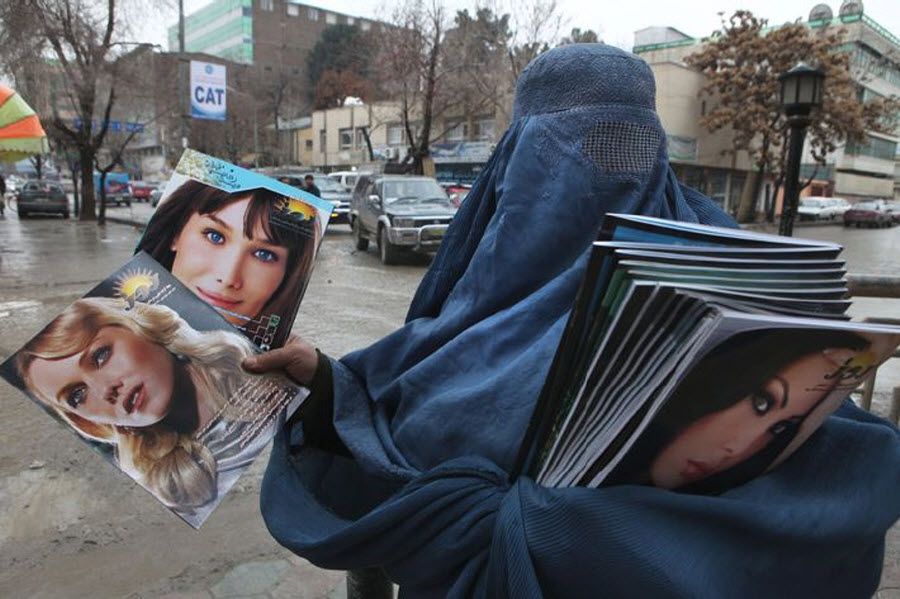
Selling Magazines

A photo which says a million words. Welcome to Afghanistan, look what the Afghan traditions and their interpretation of Islam has done to them. Mind you, all religions are interpretations anyway, but here you are. What irony

Shame.

Saturday, August 14

What is the reason behind high & increasing rates of suicide for Muslim Middle Eastern Women?

Now this is a rather sad if interesting result. Well, not so surprising if one thinks deeply about this. There is an increase in tensions in the middle east, globalisation is happening, media intrusion is happening, religiosity is increasing. So changes in suicide rate, in hindsight, should happen as well. But this paper does a review of the PubMed database and extracts a shed load of papers relating to this phenomena.

The author finds clear evidence that the rate of suicide or even attempted suicide has shot up. What are the reasons? Well, the reasons that the researcher proposes are psychiatric disorders, marriage and the role of the man / patriarchal perspectives. The author closes by saying, and I quote:

Higher suicide rates among young Middle Eastern Muslim females must be considered an important issue, and their root causes should be dealt with properly and without delay.

Out of the three main root causes that the researcher identified, the first one seems to be easiest to address. Psychiatric disorders: improve health care systems, train more doctors and psychiatric analysts, provide help and assistance, teach the family to be more receptive of these disorders and understand the problems, help and support the women. But this is not easy. As long as women in the Middle East are (and I am exaggerating here), meant not even to be seen forget about being heard, the second and third factors are not going to be fixed that easily.

The author talks about Muslim women only and given the patriarchal perspectives in Muslim worlds (there is a current blow up in India about this), how on earth are you going to remove it? This has religious sanction and we all know how tough it is to apply equal rights to woman in the face of religious facts (here is a list of jaundiced points which purport to shed light on how women are seen).

Very long way to go on this fight, and in the meantime, more suicides will keep on happening.

Thursday, June 10

Woman Muslim MP in the UK. Welcome to Neanderthal times

Rushanara Ali is a new MP in the new British Parliament. Check out the reaction to her election. Welcome to the 7th century. Here’s another post on this.

Thursday, June 3

Veiling doesnt seem to stop harassment

One of the most frequent reasons given by Muslim women who are veiled or want to veil is that it allows them to affirm their faith, follow the strictures of Islam and basically stop themselves being looked as objects of lust. Dress modestly so to say, dont allow your hair to be seen and and and. So when I read this, I was a bit bewildered. I quote:

The Egyptian media reported that about 300 cases of sexual harassment against women occurred over the recent Adha holiday. The cases, which the Interior Ministry would not confirm or deny, varied from verbal taunts to assaults. Al Destour newspaper said the number of incidents was higher than what was reported during the Fitr feast in September.

Sexual harassment in Egyptian cities has become an disturbing phenomenon of late. It recently became associated with feast holidays, where thousands enjoy spending their free time outdoors. Younger generations face less-strict scrutiny from their parents, who tend to allow their daughters to go out without parental supervision during feasts. Police security is usually softer than it is throughout the rest of the year.

The biggest incident came during last year's Fitr, when 150 men and boys were arrested for going on a harassing spree in the streets of Mohandeseen in Cairo. A few of the defendants, who assaulted girls and cut their clothes, were taken to court and one was sentenced to a year in jail.

The number of harassment cases during the feasts echoes a study carried out by the Egyptian Center for Women's Rights (ECWR) last July, showing that 83% of Egyptian women and 98% of foreign females residing in the country reported being harassed.

Egypt's penal code sets imprisonment punishments for anyone who sexually assaults minors, but many assaulted women have seen their cases blocked as judges and prosecutors blamed similar incidents on the "provocative" way some girls are dressed. But the ECWR's study refutes such allegations, saying that 71.5% of women who reported sexual harassment were wearing veils (head scarves) and non-revealing clothes, and 19.6% of them were even wearing niqabs (face veils).

I am not really sure that veiling is really helping out here. And as usual, the problem is with the men. Without veils, you are accused of dressing provocatively and acting whorishly. Seriously, so many debates that i have followed in mailing lists or newspapers or elsewhere, the women who are veiled (and the men who support them) talk about bikini clad women, scantily clad women and how that doesnt give rise to dignity of the women. But seems like if you veil, you are in bigger danger of being groped and harassed. When I spoke to somebody who was Egyptian, their response was that the men think that veiled women are easy, they would not complain, they will simply take the harassment and walk on. Once a woman finds that her body is shameful and has to be hidden away, well, there you go, if you cover the meat, you will get handled, if you uncover the meat, you will be called as uncovered meat.

The problem is not going to be resolved by wearing burqa’s or the veil, the problem is that men are defining what women are and aren't. Look at what happened in New York. I quote:

Scantily clad hipster cyclists attracted to the Brooklyn neighborhood made it difficult, the Hasids said, to obey religious laws forbidding them from staring at members of the opposite sex in various states of undress. These riders also were disobeying the traffic laws, they complained

See? the men are the weak lot, they cannot control their lust and emotions. While I am fully in favour of what you wear and what not to wear, these internal contradictions need to be thought through a bit more. Given that Europe is moving towards banning the veil, does this mean that women’s harassment in Europe will be lessened?

Tuesday, March 30

Bangla hospital bans burqas for female staff to prevent theft

Another reason to ban the burqa, lol.

A leading state-run health facility in Dhaka banned burqas for its female staff on Monday and enforced strict uniform regulations to prevent growing incidents of theft of mobiles and wallets at the hospital wards.

"We have just enforced the regulation asking women staff to wear the prescribed hospital uniform and carry ID cards while they are on duty inside the patients wards," Abdul Majid Bhuiyan, administrative director of Bangabandhu Sheikh Mujib Medical University, the largest hospital of Bangladesh, told PTI.

He said the order was issued for the female staff only against the backdrop of growing incidents of theft of wallets or mobile phones particularly from female and children wards. In most of the cases, the outsider women identifying them as hospital staff, were found to be involved in the thefts.

"This part of the disciplinary measures also to ensure hygienic standards of the facility...The female staffs are allowed to use the burqas outside the (hospital) wards," he said.

Bhuiyan, however, added that the visitors or patients were "in no way" come under the purview of the order.

So only the doctors and staff in burqa’s can be the thieves and not the people who come in from outside? nice way to show trust.

Saturday, February 20

Egypt: Female Judges Barred from Council Positions

Very nice, the world is moving forward while Egypt is moving backwards. I think of the advertisements for Egypt which say that its the cradle of civilisation and looking at this, I think its also moving back to that time. People keep on asking why Muslim countries do not have the wherewithal to go and rejoin the golden age of Islam? Well, why do you think? If you keep on shoving your women into veils and bar them from everything other than pregnancy, teaching and shopping, what do you think your country will be? Its like having a one legged man running with two legged men in a race. Here, read this.

I quote:

Dozens of Egyptian women and human rights activists have staged a protest in Cairo against a recent decision that bars women from holding judicial positions.

Thursday's protest came after the Council of State's association voted on Monday by an overwhelming majority against the appointment of women as judges in the council, an influential court which advises Egypt's government. "Three-hundred and eighty judges took part in the general assembly and voted, with 334 rejecting the appointment of females to judicial posts and 42 agreeing, with four abstentions," the Egyptian MENA news agency reported on Tuesday.The country's supreme judicial council, which has jurisdiction over criminal and civil courts, selected 31 women in 2007, who were later appointed by presidential decree.

But the decision angered conservatives who said women were not suited for the role.

Up until 2007, Egypt had only one woman serving as a judge who was appointed by Hosni Mubarak, the president, to the constitutional court.


And then I read that the Malaysian women who were caned for extramarital sex said that they deserved it. Good grief.