Showing posts with label War. Show all posts

Monday, August 22

Napoleon

I just finished reading this book by Bruno Colson called as Napoleon: On War.. Quite an interesting book, son. It reviews prior work on Napoleon as a military commander and compares his work with Clausewitz. you may think this is a bit of a chimney thing which Baba does. :) I have included the review below.

But I see this as a different matter, son. Deals are like battles. winning large number of deals is like a war. And then you have an overarching grand strategy of the sector and overall business. So learning from war, for me, is vital. Yes, there are significant differences between war and banking but its not that much of a difference in so far as there are limited resources, there are competitors, there is a political and economic element, there are winners and losers, and so on and so forth. Let me quote a bit from the conclusion of the book

> In an army, unified command is essential. Supplies are an important task and local resources are there to contribute. If troops are not battle-hardened, it is better to entrust them with a defensive mission, which is accomplished better by men used to staying in the same sector, where they will have acquired habits. They must not be arranged in a cordon: that is equivalent to being strong absolutely nowhere. When you do not know where the enemy will attack, it is better for troops to be positioned in close echelons, so that they can be concentrated rapidly at the point under attack. If you attack, you will seek to outflank or envelop the enemy, but out of his view. It is always difficult to combine different forms of attack simultaneously. The simplest moves are the best. They are accompanied by concentrated fire. In moun- tainous terrain above all, you must not attack an enemy position head on. The enemy must be flushed out by making for his flank or rear. If you attack a town, it is better not to commit your infantrymen in the streets. An occu- pation is always difficult. In any event, forces must remain concentrated and be mobile. The main towns, where the important people whose collabor- ation is essential reside, must be held. Mobile columns will pursue insurgents, but without committing blunders. It is necessary to make examples, but also to issue pardons. Finally, all possibilities must be envisaged when one engages in war. It is necessary to reckon on the worst. Plans must be carefully prepared, but remain open to adaptation depending on circumstances. You must always ask yourself how the enemy will react. When it comes to the enemy, it is necessary to target the essentials—the main front—and direct your efforts there. If a breach is made, the secondary fronts will fall of their own accord. A conquest must always be accompanied by political gestures. Any military objective is subordinate to a political objective and every general must possess civil qualities. This does not preclude the supreme commander having to enjoy a certain freedom of action in the theatre where he is in charge. These observations can be applied to all wars, including those of the early twenty-first century.
>

If nothing else, you can see how these basic rules will help you to think about where to place your relationship managers, your capital, your attention, your pitching, and so on and so forth. each of these rules are golden rules for warfare and will be similar to business as well. Very interesting indeed. If you look at the business leaders, they are all having history or military history book.

But one thing you have to remember about Napoleon. He was tactically brilliant, won so many wars, was very focussed on the human element, but he was not a strategist and its that inability to bring in the political, economic, and other elements made him lose in the end. At end of the day, he left France smaller than what he took. So despite his great reputation, he lost in the end. You learn more from failures, son.

Best of luck with your presentation, I am very proud of you, that is good work, really good work on the presentation.

Your proud father.

Baba

=======

https://www.h-net.org/reviews/showrev.php?id=46865

In the more than two centuries since his rise to power during the French Revolution, the world at large has been fascinated with Napoleon Bonaparte, justly considering him as one of the great geniuses of all time. In particular, his military successes have led numerous authors, after his defeat and fall from power in 1815, to attempt to distill his writings into a series of maxims that could be studied and applied to current events. This concept has proven difficult. While exiled on Saint Helena, Napoleon himself considered writing about the art of war, but before his death in 1821 he ordered his efforts to be destroyed. Since the third decade of the nineteenth century, a number of scholars have sought to synthesize and recreate this material, with varying degrees of detail and accuracy, using the emperor's correspondence, official records, observations by his associates, and other sources.

Thursday, August 4

The U.S. President Has a Blank Check for Waging War

Kids

As I've said so many times before, I hate wars. It's the most spectacular waste of energy and lives. And pretty much war mongers are literally bastards who are intellectually dishonest. But they are murderers. We launch wars, get thousands and millions killed and then the people who actually ordered the wars go on to become rich. Look at the prime ministers and presidents. 

Surely they should obey laws? Read this article to see why you have to constantly be on the guard against people exceeding their powers including democratic mandates. I asked my member of Parliament what his vote did after the Syrian war and he has no answer. Such are our leaders. 

Bah

Love

Baba 


The U.S. President Has a Blank Check for Waging War
http://warisboring.com/articles/the-u-s-president-has-a-blank-check-for-waging-war/
(via Instapaper)


Let's face it — in times of war, the Constitution tends to take a beating. With the safety or survival of the nation said to be at risk, the basic law of the land — otherwise considered sacrosanct — becomes nonbinding, subject to being waived at the whim of government authorities who are impatient, scared, panicky or just plain pissed off.

The examples are legion. During the Civil War, Pres. Abraham Lincoln arbitrarily suspended the writ of habeas corpus and ignored court orders that took issue with his authority to do so. After U.S. entry into World War I, the administration of Woodrow Wilson mounted a comprehensive effort to crush dissent, shutting down anti-war publications in complete disregard of the First Amendment.

Amid the hysteria triggered by Pearl Harbor, Pres. Franklin Roosevelt issued an executive order consigning to concentration camps more than 100,000 Japanese-Americans, many of them native-born citizens. Asked in 1944 to review this gross violation of due process, the Supreme Court endorsed the government's action by a six-to-three vote.

Tuesday, July 26

Marie von Clausewitz: The Woman behind the Making of On War.

Kannu
I've told you many times that one of the key things a good leader knows about are logistics. And of course strategy. Both are refined to a giant extent in the war studies arena. And my Phd at the department of war studies at King's college helped me tremendously. The book by Clausewitz, On War, is a seminal book on this subject. In a few years, do try to read it son. It would be useful for you to learn from the master of war on how to wage war, the strategy and logistics. Amazing book. 
And then this book review talks about a different aspect, his wife. As you read the review, you can see how she manages to work with him, set fire to his ideas, encourage and challenge him, kick him when required, cuddle him when needed. 
You don't have to have a wife like that although if you are lucky, you will get somebody like that, somebody who is ferociously intelligent, somebody who is challenging you, kicks you when you need it, cuddles you when you need it. You know the tests to know if you've found her? Does she challenge you? Does she make you think? Does she make you laugh? And have you cried in her arms? It could be your wife, your sister, your mother, your girlfriend, your friend, doesn't matter and can be a combination even but be on the lookout for girls like that. They are rarer than gold. Of course you have to do the same thing to her. Challenge her. Encourage her. Make her feel like a queen. Make her laugh. Cuddle and kiss her. If you can do that, brilliant. You have a problem son, you are very intelligent and you are also sensitive and emotional. And ambitious.  Rare combination. You need a rare girl to be with you.  
If that meshes, great. I'm sure you will find her. Keep on the lookout son. 
But I'm so proud of you. I see you heading off to work. Working so hard. Asking questions. Very impressed son. 
Love you
Baba


H-Net Reviews
https://www.h-net.org/reviews/showrev.php?id=45568
(via Instapaper)

Vanya Eftimova Bellinger. Marie von Clausewitz: The Woman behind the Making of On War. Oxford: Oxford University Press, 2016. 312 pp. $29.95 (cloth), ISBN 978-0-19-022543-8.
Reviewed by Jill S. Russell (King's College London)
Published on H-War (March, 2016)
Commissioned by Margaret Sankey

On Marie
Opening new vistas to military and strategic history's most famous man, in The Woman behind the Making of On War, Vanya Eftimova Bellinger uses Marie von Clausewitz's letters and her marital relationship to demonstrate Marie's material role in Carl von Clausewitz's thinking and writing of his foundational work in strategy. As a biography based around the writings of the subject, Bellinger's work compares favorably to Clair Tomalin's Samuel Pepys: The Unequalled Self (2002), as the latter imbued the story of the man with substance by way of his own words. In this book, the narrative sustains Bellinger's essential argument of Marie's critical place in this most famous piece of writing on strategy specifically. Along the way, deeper points regarding military and historical scholarship, strategy, and polities emerge. Although many will make On War the focus of this biography, that work of strategy figures only as the denouement of the Clausewitzes' lives. Given the biography's importance on two important levels, this review will address Marie's story both on its own written terms and in its comment on and place within military history as well as the practice and scholarship on strategy that have been built on it.
Consider first the text itself. Without intending to minimize it, the aim of this work is simple: to judge the influence of the "mundane" on a historic volume. In this case, for a woman like Marie, who commanded the respect of generals, the mundane became transformative, as her biography in total demonstrates her clear place in On War. And it is such attention to the quotidian that both I and Earl Wavell appreciate as a focus of study. Who was Marie? Bellinger sums her up as "a restless spirit and a politically active woman who often challenged societal conventions, spoke her mind, and lived an industrious life often independent of her husband's," even as she was until very recently still thought of as nothing particularly more than his wife (p. 5). The rich narrative that Bellinger crafts from the new correspondence and other contemporary sources sustains this characterization and our recognition of her achievements.

Wednesday, April 6

The strange case of a Nazi who became an Israeli hitman

This made me gape. Such an amazing story. While I read commando comics when I was a boy about world war 2 special forces soldiers, Otto was a real life special forces man. And I knew about his exploits in that theatre. 
But his exploits after the war not so much. And when I read this article I was gobsmacked. What a fascinating man. Totally walking beyond  where normal soldiers walk. So amazing. And also the related story is about how Mossad protected Israel. You need the 007's. Wet work is required. Some acts are done by the state which can be plausibly denied. 
Fascinating story kids. 
Love
Baba


The strange case of a Nazi who became an Israeli hitman - Israel News
http://www.haaretz.com/israel-news/1.711115
(via Instapaper)


On September 11, 1962, a German scientist vanished. The basic facts were simple: Heinz Krug had been at his office, and he never came home.
The only other salient detail known to police in Munich was that Krug commuted to Cairo frequently. He was one of dozens of Nazi rocket experts who had been hired by Egypt to develop advanced weapons for that country.
HaBoker, a now defunct Israeli newspaper, surprisingly claimed to have the explanation: The Egyptians kidnapped Krug to prevent him from doing business with Israel.
But that somewhat clumsy leak was an attempt by Israel to divert investigators from digging too deeply into the case — not that they ever would have found the 49-year-old scientist.
We can now report — based on interviews with former Mossad officers and with Israelis who have access to the Mossad's archived secrets from half a century ago — that Krug was murdered as part of an Israeli espionage plot to intimidate the German scientists working for Egypt.
Moreover, the most astounding revelation is the Mossad agent who fired the fatal gunshots: Otto Skorzeny, one of the Israeli spy agency's most valuable assets, was a former lieutenant colonel in Nazi Germany's Waffen-SS and one of Adolf Hitler's personal favorites among the party's commando leaders. The Führer, in fact, awarded Skorzeny the army's most prestigious medal, the Knight's Cross of the Iron Cross, for leading the rescue operation that plucked his friend Benito Mussolini out from the hands of his captors.


But that was then. By 1962, according to our sources — who spoke only on the promise that they not be identified — Skorzeny had a different employer. The story of how that came to be is one of the most important untold tales in the archives of the Mossad, the agency whose full name, translated from Hebrew, is "The Institute for Intelligence and Special Missions."
Otto Skorzeny with the liberated Mussolini – 12 September 1943.Wikimedia Commons /Toni Schneiders

Thursday, February 18

Young Saudis See Cushy Jobs Vanish Along With Nation’s Oil Wealth

I'm not impressed by Saudi Arabia son. Besides the absolutely rampant racism and religious fundamentalism, the terrorism problem is big here. Then again what do you expect? I have seen the university syllabus and have interviewed Saudis and worked with them. The syllabus of most of the Saudi universities is shit. Teachers are shite. Atrocious. For a rich country to have such shitty university is a travesty. 

With some honourable exceptions, they are spectacularly unsuited for modern life. Professional middle class jobs or vocational jobs are simply out of the question. Entrepreneurship is minuscule. So what can you do with quarter of a million Saudis who enter the job market? Some wrenching changes are in train. And unfortunately you and I will see a large proportion of these young Saudis swelling the ranks of the jehadis. 
This will cause us problems. And the steps the Saudis are taking by embarking on two wars is very bad. A giant country like USA finds it difficult to wage war properly. Saudi Arabia will pay very heavily for its Yemeni and Syrian mistakes. And us as well.

Not good

Love

Baba


Young Saudis See Cushy Jobs Vanish Along With Nation's Oil Wealth
http://www.nytimes.com/2016/02/17/world/middleeast/young-saudis-see-cushy-jobs-vanish-along-with-nations-oil-wealth.html
(via Instapaper)


Saudi men leaving a mosque in Riyadh last year. For decades, the royal family has used the kingdom's immense oil wealth to lavish benefits on its people, including free education and medical care, generous energy subsidies and well-paid government jobs. Tomas Munita for The New York Times

RIYADH, Saudi Arabia — In pressed white robes and clutching crisp résumés, young Saudi men packed a massive hall at a university in the capital city this month to wait in long lines to pitch themselves to employers.
It was one of three job fairs in Riyadh in two weeks, and the high attendance was fueled in part by fear among the younger generation of what a future of cheap oil will mean in a country where oil is everything.
For decades, the royal family has used the kingdom's immense oil wealth to lavish benefits on its people, including free education and medical care, generous energy subsidies and well-paid (and often undemanding) government jobs. No one paid taxes, and if political rights were not part of the equation, that was fine with most people.
But the drop in oil prices to below $30 a barrel from more than $100 a barrel in June 2014 means that the old math no longer works. Low oil prices have knocked a chunk out of the government budget and now pose a threat to the unwritten social contract that has long underpinned life in the kingdom, the Arab world's largest economy and a key American ally.

Wednesday, February 17

Putin is learning what Churchill knew

Kannu 

This was a great quote 

read what Winston Churchill had to say about going to war in My Early Life: “Let us learn our lessons. Never, never, never believe any war will be smooth and easy, or that anyone who embarks on that strange voyage can measure the tides and hurricanes he will encounter. The statesman who yields to war fever must realise that once the signal is given, he is no longer the master of policy but the slave of unforeseeable and uncontrollable events. 

“Antiquated War Offices, weak, incompetent or arrogant commanders, untrustworthy allies, hostile neutrals, malignant fortune, ugly surprises, awful miscalculations – all take their seats at the Council Board on the morrow of a declaration of war. Always remember, however sure you are that you can easily win, that there would not be a war if the other man did not think he also had a chance.”
As they say, wars never survive contact with the enemy. 

This is the problem, people simply dont understand the issues that you will face after going to war. Every time, without fail, the costs of going to war are much higher than what you expected or anticipated or even planned for. Even now, every of the little wars or big wars have unexpected and unanticipated costs all over the place. Jaw Jaw is better than war war as the other quote goes. 

And to a much lesser extent, son, same thing happens in business as well. Your resources may not be the best ever. Your support may not be good. Your competitor may do something else. Your customers may not buy into your proposition. The trick is to be flexible and be willing to move smoothly and react to unforeseen circumstances :) 

Love 

baba 


I saw this article when using the Financial Times app and thought you might be interested:

Financial Times,
Putin is learning what Churchill knew
--
From Mr Charles Lucas. Sir, Vladimir Putin should read what Winston Churchill had to say about going to war in My Early Life

Read the full article at: 
http://on.ft.com/1txdWix 

Saturday, January 16

Targeting Child Soldiers

This is a difficult moral and ethical question son. And made me think. When you read the two examples quoted, leaving aside the legal points, I'm afraid I would have pulled the trigger in both cases. Just because a child is at rest doesn't mean the gun on his side will not be picked up. 
A boy was recently killed in USA. He was playing with a toy pistol which looks exactly like a real one. And somebody called the police. Who came in and almost immediately shot the boy. You can say the police are trigger happy. Or racist (the boy was black). But the question arises, where do you draw the line. 
Think about another problem with age. You were able to join the army by 16. But you aren't allowed to vote. So you can kill for your country but you can't vote for your leaders. Bit inconsistent eh? So the Tories are bothered by not wanting the voting age for the brexit referendum to be reduced. Why? Stupid excuses. 
Something to think about. 
Love
Baba


Targeting Child Soldiers
http://www.ejiltalk.org/targeting-child-soldiers/
(via Instapaper)

Despite the numerous volume on child soldiers in legal literature over the last few decades, very little has been said on targeting child soldiers. It seems to be something international lawyers would rather not talk about. The fact that legal literature doesn't say much about targeting child soldiers doesn't mean that no such practice exists, or that soldiers haven't discuss the matter. In 2002, the US Marine Corps Warfighting Laboratory organised a 'Cultural Intelligence Seminar' on the implication of child soldiering for US forces. One trigger for that discussion was the fact that the very first US soldier killed in Afghanistan reportedly was a Special Forces Sergeant shot by a 14-year-old boy. The year before, in Sierra Leone, a squad from the Royal Irish Regiment was taken prisoner by a group consisting mostly of armed children called the West Side Boys, as the British soldiers were hesitant to open fire. After they had been held hostage for two weeks, an assault was launched by an SAS unit supported by suppression fire from helicopters, leading to between 25 to 150 dead among the West Side Boys. Finally, during the civil war in Sri Lanka, a Government aircraft bombed what was deemed an LTTE training camp, killing a reported 61 minors, mostly girls. Although the LTTE was widely known to use child soldiers, and the specific facts were contested, the Sri Lanka Government was adamant that if a child took up arms, then he or she could be targeted and killed.
The phenomenon of child soldiers remains widespread, and their activities does include direct participation in hostilities. It is imperative that international humanitarian law provide guidance as to what opposing forces can do if they are confronted with that reality. In this piece, I suggest that there are elements in international humanitarian law that support adapting a child-specific approach to targeting. Under this approach, the fact that a potential target is a child should prima facie raise a doubt as to whether he or she is targetable. Although the doubt may be dissipated in light of available facts, overcoming the presumption of civilian status might require more than would be the case for an adult. In addition, even if a child is deemed targetable, the allowable means and methods must nevertheless reflect the protected status of children in international law.
Direct participation in hostilities for kids
The issue of targeting child soldiers raises two distinct legal questions: first, whether child soldiers are combatants like any other combatants and, second, if so whether the means used to target then follow the same rules as for adult combatants.
In order to discuss this, it is useful to consider two scenarios as ideal-type situations that give rise to the legal regulation of the targeting of child soldiers: a first scenario corresponds to a minor enrolled in the FARC rebels in Colombia, wearing a uniform, spotted by a government drone while having a nap against a tree, his gun lying next to him. A second scenario is one of a child wearing civilian clothes running towards government troops firing an AK 47 in the context of the civil war in Uganda. . In one case as in the other, can the government forces targets the child as if he or she were an adult?
Are these two child soldiers to be considered combatants under accepted principles of international humanitarian law? The starting points are articles 4(A) of the 1949 Third Geneva Convention and article 43 of the 1977 Additional Protocol I, which provides for the definitional elements of what a combatant is under international humanitarian law, albeit overtly in the context of an international armed conflict. If a child is enrolled in the armed forces of a party to an international armed conflict, there seems to be no apparent basis in current international humanitarian law to characterize that child as anything other than as a combatant. For a non-international armed conflict, which would correspond to the situations in Uganda and Colombia that I provided as my two ideal-type scenarios, the legal concept of the combatant is contested. Article 1 of Protocol I defines the scope of application of the protocol as covering only conflicts between the states armed forces and "dissident armed forces or other organized armed groups", which implies that there is a legal concept of insurgent armed forces. Seeing this, it is possible that a child may be fully incorporated into the insurgent armed forces and, as such, be a 'regular' fighter on a footing prima facie equal to other armed participants in a non-international armed conflict. According to the ICRC Interpretive Guidance on Direct Participation in Hostilities, individuals who can be said to have a "continuous combat function" are not civilians in non-international armed conflict, and can therefore be targeted. There is nothing in the Interpretive Guidance that suggests that children cannot have a continuing combat function and, as a result, be combatants. In a short post, Frédéric Mégret suggests that children should be considered as non-combatant members of the armed forces and not targeted unless they are directly participating in hostilities, implying that there would be no continuous function possibility for children. The underlying assumption seems to be that, because of their age, children can never become combatant in the full sense of the concept. Somehow, that does not appear to square with the reality in the field in many armed conflicts in which, as with the West Side Boys unit in Liberia, children can become ruthless fighters on a strategic footing equal to adults. There may be space in international humanitarian law to reflect an imperative to treat child soldiers differently than adult ones, as I will suggest shortly, but not in the impossibility that a child may have a continuous combat function or, for that matter, be a member of the armed forces.
A somewhat different approach can be taken by inquiring whether a child is directly participating in hostilities. The standard is expressed as regards international armed conflicts in article 51(3) of Protocol I, and for non-international armed conflicts in Common Article 3 of the 1949 Geneva Conventions and Article 13 of Protocol II. According to the approach adopted by the ICRC in its Interpretive Guidance, individuals who do not have a continuous combat function are therefore to be seen as civilians that may temporarily lose their entitlement to protection against targeting. For individuals in this class, direct participation refers to a specific act that meets three distinct criteria: a threshold of harm, linked to the likely effect of the act on the enemy; direct causation, linking the civilian act to that harm; and a belligerent nexus, intentionally linking the act and harm to the conflict. According to this approach, an individual who is not a member of the armed forces or a fighter in an armed group remains a civilian entitled to protection against targeting, except for the time that this individual engages in acts that meet the three elements of direct participation as defined by the Interpretive Guidance. This 'revolving door' approach has been challenged by some as not flowing from accepted treaty and customary humanitarian law. Be that as it may, there is nothing in any of these elements that connects in a particular manner with children. This aligns with the 2015 US Law of War Manual which states that "whether a civilian is considered to be taking a direct part in hostilities does not depend on that person's age" (§4.20.5.3). Decisions of the International Criminal Court and Special Court for Sierra Leone on the crime of recruiting and using child soldiers have confirmed, in that context, that children can directly participate in hostilities, and indeed have adopted a broad approach to participation. Although these courts did not articulate any ensuing consequences as regard the targeting of such children, they would seem to logically follow. Indeed, the ICRC explicitly confirms this in the commentary to the Interpretive Guidance, finding that "Children below the recruitment age may lose protection against direct attack" (page 60).
It bears noting that the recruitment age cut-off referred to in the Interpretive Guidance is 15 years old, as provided in article 77(2) of Protocol I, article 4(3)(c) of Protocol II, and Rule 137 of the ICRC study on customary law. Indeed, the structure of article 77 of Protocol I mirrors the general approach to the targeting of child soldiers under international humanitarian law: a first paragraph proclaims a duty to respect and protect children in armed conflicts; a second paragraph declares a duty of the belligerents not to enroll or involve children in hostilities; and three further paragraphs specify special protection for children that have been detained after taking direct part in hostilities. Perhaps as a lingering remnants of the distinction between Hague and Geneva law, international humanitarian law elides entirely the middle phase in which the child is taking active part in hostilities.
It was suggested by the author of one volume on child soldiers that children are 'civilian by nature'. There seems to be no basis for such a view. Upon closer consideration of applicable law, it appears that children can be combatants in largely the same way that an adult can. I offer this qualified statement to suggest that despite the analysis offered up to now, there are elements in international humanitarian law that support adapting a child-specific approach to targeting. Article 50(1) of Protocol I provides that "[i]n case of doubt whether a person is a civilian, that person shall be considered to be a civilian." It is not unreasonable to offer that, as regards the application of both the continuous combat function and 'revolving door' principles, the fact that the individual in question is a child should prima facie raise a doubt as to whether he or she is targetable. That doubt may be dissipated in light of facts available to those making a determination of the targetability of the child in question, but it requires that a presumption of civilian status be overcome, in a manner that would not obtain for an adult. For the three elements listed in the Interpretive Guidance as constituting direct participation, this presumption would imply that the threshold of harm, the direct causation, and the nexus to the conflict are not met unless the facts are sufficiently clear to overcome the presumption that a child is not directly participating. Likewise, a presumption in favour of the civilian character of children would structure the understanding of what is required for a child combatant to unambiguously opt out or withdraw from direct participation in hostilities, lowering the evidentiary threshold that corresponds to a conclusion that a child has regained a civilian status. For example, an adult fighter in uniform running away from battle may not be considered as unambiguously opting out of hostilities, as this could be a mere strategic fallback, but that same behaviour by a child fighter would meet a lower threshold.
In conclusion on this point, direct participation in hostilities for kids does not exclude the possibility that a child may be a combatant, either continuously or periodically, but the test is comparatively more restrictive than for adults as a reflection of the presumption that children are civilians.
Means and ends
The fact that a child soldier can be a combatant or a civilian taking direct part in hostilities implies that this child soldier can be directly targeted. The conclusion that it is lawful to directly target child soldiers does not necessarily entail that it is lawful to target them as if they were adult soldiers. Here again, the moral intuition that children remain children even if they take direct part in hostilities has an impact on applicable legal standards.
The starting point is the principle that, even in war, a belligerent's right to injure its enemy is not unlimited. More specifically, treaty and customary international law proscribe superfluous injury and unnecessary suffering (Art. 35, Protocol I). In a general manner, this is taken as a statement that the injury and suffering that is lawful under international humanitarian law is limited by what is necessary to achieve a military objective. As a foundational statement of the laws of war, this principle has acted as the basis for the specific prohibition of a number of weapons over the last century and a half, including the prohibition of dum-dum bullets, poison, blinding lasers, anti-personnel landmines, etc. But the principle is offered in Protocol I as a broad rule that is meant to have an effect on the lawfulness of means and methods of war generally, and not merely as a basis for a decision by states to regulate specific weapons by way of subsequent agreement. At its broadest, the norm against superfluous injury and unnecessary suffering calls for an appreciation of the necessary use of any means or methods of war in every case, to balance the military advantage against the injury and suffering caused in the operation. Authors likes Dinstein and Meyrowitz have challenged the suitability of a balancing approach in this context, arguing that the principle does not call to import here a balancing that is required only in relation to the impact of an attack on civilians. Still, this suggests that if available means and methods of warfare can achieve the same military advantage while causing a lesser degree of injury or suffering, then international humanitarian law requires that they be used. For example, if a military radar station must be disabled in order to prevent detection of a military operation, and this can be achieved either by kinetic means (bombing the station) or cyberwarfare (a virus attack to disable the computers running the radar), then the latter option must be selected. This finds some support in Art 52(2) of Protocol I which restricts military objectives to those the destruction of which brings a definite military advantage. What could be termed the 'most favoured weapons' doctrine can be extended even further, to suggest that if it is possible to wound instead of killing, or to capture instead of wounding (or killing), then that must be done. Whether international humanitarian law really confers upon belligerent a licence to kill enemy combatants, and whether the rules are different in international and non-international armed conflicts, has generated an intense debate (on 'capture or kill', see eg the contributions of Melzer, Hays Parks, Schmitt, Goodman, Kretzmer).
What I want to suggest is that, regardless of the validity of a general duty to use the least injurious means or method of warfare in any category of armed conflict, such a duty ought to obtain when directing an attack against child soldiers who qualify as combatants or as taking direct part in hostilities. It speaks to the moral intuition that, even in the context of war, the intentional targeting of children is a calamity. In law, it reflects the multiple norms in international humanitarian law and international human rights that demand special protection for children against harm. A duty to use the least injurious means or method of warfare against a child soldier can find some support in the French version of the prohibition of superfluous injury and unnecessary suffering, which speaks of maux superflus. As noted by several authors, the French is actually the original, taken from the 1868 St-Petersburg Declaration and later reproduced in the 1899 and 1907 Hague Regulations. The notion of maux superflus appears broader than its English translation, in that maux can be taken to refer not only to injury or suffering, but also to an evil; indeed, the idea of a mal superflu necessarily evokes its pendant, the mal nécessaire. In other words, war may be a necessary evil, but evils unnecessary for the pursuit of the legitimate aims of war (also defined in the St-Petersburg Declaration) are illegitimate. Returning to child soldiers, direct targeting can be considered permissible only to the extent that it is a necessary evil, meaning that no viable option can be identified and that there is a tangible military necessity for this attack, otherwise it violates the treaty and customary prohibition of superfluous injury and unnecessary suffering.
To go back to the two scenarios I sketched at the start, it seems quite clear that a child fighter with the LRA running towards government troops while firing an AK47 can be directly targeted using lethal force. It seems unlikely that there is another way to stop the attack that involves merely wounding or capturing a child soldier in this context. The second scenario of a drone spotting a FARC child soldier in uniform taking a nap, on the other hand, demands that the specific military advantage of targeting this child be clearly demonstrated and, if that can be done, that there is no available alternative that would be less harmful to this child while maintaining the military advantage.
The aim of this approach is to avoid the pitfalls of moralising idealism and ruthless instrumentalism, to reflect both the reality that child soldiers can sometimes present a direct and significant threat and the moral impulse to try to shield children from war as much as possible.

Tuesday, January 5

How War in Syria Turned These Ordinary Engineers Into Deadly Weapons Inventors

This was an interesting story son. Of how ordinary men become agents of war and destruction. We will keep on having wars. And for wars to keep in happening, we will keep on having moron leaders and useful idiots like these. 

Let me give you two examples. The uk has been embroiled in some wars somewhere pretty much constantly across the world for the past several hundred years. Yes. And you wonder why. What did we get out of it? Look at the USA. Constantly warring. Stupidity. As a way to achieve your aim of keeping your populace happy and wealthy, war is the most stupid way. So from a purely functional basis it's incompetence. 

Love

Baba


How War in Syria Turned These Ordinary Engineers Into Deadly Weapons Inventors | Threat Level | Wired.com
http://www.wired.com/threatlevel/2013/07/diy-arms-syria/


image

Makers
of War

The arms manufacturers of Aleppo used to be ordinary men—network administrators, housepainters, professors. Then came the bloody Syrian crisis. Now they must use all their desperate creativity to supply their fellow rebels with the machinery of death.

By Matthieu Aikins

Photographs and audio interviews by
Moises Saman

Audio recording by
Sam Tarling and
Alexander Fedyushkin

In Aleppo, Syria, a rebel builds Molotov-cocktail-like incendiary bombs in an abandoned school.

Abu Yassin pulls open the heavy iron gate of the school and steps back. “Peace be upon you,” he says in Arabic, grinning and extending a hand, his arm stained to the elbow with aluminum powder. “Welcome, welcome.” He turns and waves for me to follow. We walk along a short pathway toward the front door, past an assortment of ordnance laid out on the concrete, bombs that fell from the sky but failed to explode: an ovoid 88-millimeter mortar shell, a big 500-pounder with twisted tail fins, a neat row of pale-gray Russian cluster bomblets, their nose fuses removed. “Later! I will open them later!” he says, eyebrows waggling with anticipation.

Monday, November 23

The French Way of War

This made me blink. Kannu. My image of the French forces wasn't good. The dien bein phu disaster, the Algerian mess. The Vichy regime and the performance in the two world wars. Etc etc all combined to make me doubt the efficacy of the French forces. This article may be tending a bit too on the other side. But the last line was good. If they decide to hurt somebody, they will. Now that's power. Reminds me of the clint Eastwood quote, if you want to shoot - shoot. Don't talk. And then the Eisenhower quote, speak softly but carry a big stick. And hit when required. That's where power comes in. You have to use it. British fail many times in this matter. 

Still this promises to be a fascinating study of military tactics. Politically a mess, the military charge  will be fun to observe. 

Hope you get better soon son. I felt like cuddling You to me :) but you're a bit too big now :) 

Love 

Baba


The French Way of War
http://www.politico.com/magazine/story/2015/11/the-french-way-of-war-213372
(via Instapaper)


France's military may suffer from a poor reputation in American popular imagination, dating from historical events like the rapid fall to Nazi Germany in World War II and the colonial-era defeat at Dien Bien Phu. This is a mistake: The French airstrikes on Islamic State positions in Syria are only the beginning of the counterattack against ISIS, as French officials themselves are promising. And as anyone familiar with France's military capabilities can attest, when it comes to war the French are among the very best.

Moreover, whatever France does probably will not look like anything the U.S. would do. There is a French way of warfare that reflects the French military's lack of resources and its modest sense of what it can achieve. They specialize in carefully apportioned and usually small but lethal operations, often behind the scenes; they can go bigger if they have help from the U.S. and other allies—which they will probably have in any case and know how to put to good use.


Tuesday, November 17

America dumbs down: a rising tide of anti-intellectual thinking

Kannu

Here's an example of how people lose their arguments. A laudable objective. Stop war. I concur with that. I hate war as well. But the author forgets few things. That a state has to first and foremost keep its citizens safe and there are competing ideologies and missions which stop them from doing so. Think about the police. Why do you need them? 

Second is to make silly comparisons. Don't make an aircraft carrier and instead use the money to build water systems. Good. Whose going to pay for that? Running costs for the next 30 years? The American taxpayer will pay for the world's water system? There's that little matter of democracy to worry about. 

When people make arguments like this,, they cause more damage to their own cause. Just noise. 

Love

Baba


America dumbs down: a rising tide of anti-intellectual thinking
http://www.macleans.ca/politics/america-dumbs-down/
(via Instapaper)


Bill Pugliano/Getty Images

Furthermore: This US Memorial Day Remember War Is Murder

BY GLEN BARRY · MAY 25, 2014, Ecological Internet: We must stop glorifying war murders and their perpetrators, and demobilize globally in order to address the far greater threat of abrupt climate change and ecosystem collapse. Murder has not, nor will it ever, make us free.

Wednesday, April 15

When we were bombed

IMG_2871

Can you see the depression? the regular rectangular depression on the green? this is the green in front of our house. And this depression shows that there was an air raid shelter during World War 2 times here. Why you ask its needed? well, London was pretty much heavily bombed during the blitz.

image

So got this amazing graphic from this site.

image

This is Harrow…pretty hairy, eh? you can make out the patterns of the bombs..as the German bombers would drop their bombs in a stick, so they will form a line pattern. Fascinating, eh?

image

And further zooming in, saw that a bomb had fallen just outside the green, on the house behind the house I can see in front of my house. A high explosive bomb fell here sometime between Oct 7 1940 and June 6 1941, no more precise dating. But I found out from this link that the first bombs in the war actually fell in Harrow.

Records have always shown that at 0330hrs on the morning of August 22nd 1940, the first bombs to be dropped on London were at Harrow…..I do recall seeing an item in the past that the Luftwaffe used a guiding point in Harrow which was a sewerage works ( large round cleaning pond) next to the large Kodak works.

Did you know, we also were hit by a V2 Rocket? This hit less than 300 meters from my home and just behind Diya and Kannu’s School.

Harrow Cemetery

Information from Malcolm Hutton:
The V2 rocket map doesn’t show the location of the V2 which fell in North Harrow. It came down next to the cemetery gates. We were living about a mile away and I well remember sitting in our dining room with my mother and father. (at Durley Avenue). It was very eerie at first. Our heavy velvet curtains suddenly billowed out and rose to the ceiling and then came the explosion followed by a fading sound of the rocket. It cracked one of our windows, but that was the only damage we suffered.
Corroborated here:
http://www.bbc.co.uk/history/ww2peopleswar/stories/33/a7999933.shtml

image

So how was it to live through a bombing in Harrow? We have this story.

The raids started. The siren wailing up and down made my tummy turn over. Nearby we had Northolt Aerodrome, so the noise of planes taking off became commonplace. We used to count them going out, and count them returning, always hoping it would be the same number…. We had an Anderson shelter in the garden. The lady next door with small children had a Morrison shelter indoors, which was like a big reinforced rabbit hutch. They used the top as a table. Every night after I was in my pyjamas I would be sent down the garden to the shelter, and when no-one was looking, I would get up and go down the back alley to play with my friends. Raids were frequent at this time. Every day the children would go out looking for shrapnel, and the competition was quite keen to find the biggest bit..
My father was working in London on something that he was not allowed to discuss with us. We later found out it was to do with the construction of the amphibious craft used in the invasion. As he was a well-qualified St. John first aider, he was also required to help with rescue work. He was always so tired.
While on his rescue duties, he would sometimes find an unexploded shell, or incendiary bomb, which had to be thrown in the water tanks on the streets. I have an unexploded shell, which he made into a table lighter, having made it safe!
I remember the bomb disposal crews on their lorry having completed a job. Sometimes they would actually sit on the land mine or bomb that they had disarmed. They always received a cheer. - Just, as aircrew would not be charged for admission into our local cinema. Everyone felt they had done more than enough for us. During daytime raids we could often watch the dogfights above us as our planes intercepted the Germans. We could always tell the difference between our aircraft and the German’s even at night. Our planes had a steady hum and the German planes made a pulsating noise.
Our house remained intact, but a nearby house had a landmine suspended inside it. The parachute had caught on the roof, and it was hanging suspended a couple of inches off the floor! We had to evacuate our house while the brave disposal team came and made it safe. They drove off with it on the back of the lorry. I was told the German bombers would take Harrow-on-the Hill church as a landmark
And drop a stick of bombs, hoping to hit Northolt Aerodrome. This meant they passed close to us.

The raids became intense. Our Anderson shelter had flooded, and we had to go to the nearest communal shelter. During the day if the siren sounded on our way to school, we were told to run home if we were nearest to home, or carry on to school if that was the nearest. We had a large underground shelter built on the playing fields at school, and we spent a lot of time sitting on the hard benches around the walls. At home we had decided we were tired of running to air raid shelters at night, so we decided that if the bomb had our name on it, we would get it! We stayed in our own beds.

Tuesday, March 31

Birth of a country

Kannu

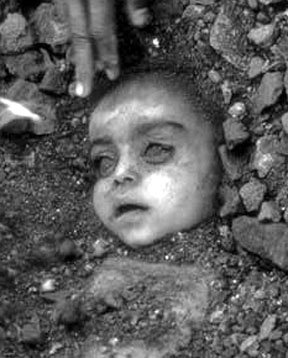
You missed a great afternoon, when Salil uncle read from his book, the Colonel who would not repent. About the death of Bangabondhu, Mujibur Rahman, the President of Bangladesh, and the history of this great but truly god-forsaken country. He mentioned about this book of photographs, by Kishor Parekh, which I am enclosing. Don’t read it if you have a bit of a sensitive tummy because there are very distressing photographs in here. But it’s not a big book, hardly 40 odd pages, but very powerful photographs, son. Sometimes photographs can be truly heart wrenching. Two of which I have written about before.

1. Bhopal: http://piquancy.blogspot.co.uk/2004/07/for-every-glance-behind-us-we-have-to.html. Here is the photograph in question.

 bhopal.jpeg[1]

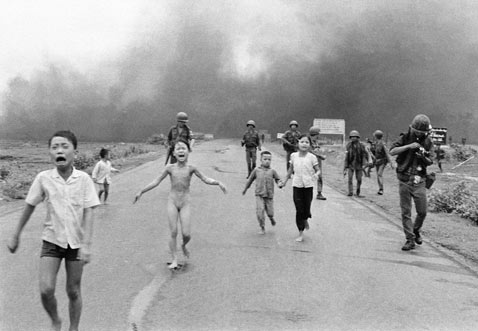
2. Vietnam: http://piquancy.blogspot.co.uk/2004/02/chemical-warfare-is-not-all-hot-air-my.html. Here is the photograph

Vietnam Napalm 1972

I have mentioned to you about my memories of this refugee issue, son. I was in Calcutta when this happened, hardly 4 years or so old, but I can still remember the cries of “phan de go” “please give me phan” echoing in the nights in the roads of Tollygunj which is a Calcutta neighbourhood…Phan is the water which remains after you decant the rice after cooking. People were so poor that they wanted that rice water. There were 10 million people who got into India in a matter of months, you cannot have an organisation which can handle this load of refugees so they were all in huge trouble despite all the help that the Indian government and civil society gave. Plus the second memory I have is of these refugees fighting over the garbage bins where people had thrown their left over food, fighting with dogs. Truly barbarian situation. Bangladesh is where our ancestors came from, son, so they are our people in a way. You are a Bengali and despite you not knowing Bengali, there are roots here. So you need to know because people who forget their history do not have a future. Remember what I told you about the Russian Georgian Girl? She said that you Indian/English people are lucky, you have a history to remember and be proud of.

So some of the photographs are really wrenching. People do not see this level of destruction, son. Why do you think I hate war? That’s why when people go all gung ho about war, I hate it. Absolutely hate it. Just saw a great cartoon, 2500 people died in 9/11 and 2.5million people died in wars which were launched because of 9/11. See? everybody has a reason to fight and kill, but when will it stop? We thought after the cold war, peace will break out but no, more and more wars have happened, and that’s why we need to stop people from fighting, starting with our own country, United Kingdom. Its stupid, its expensive and it creates havoc far beyond and for much longer than the people who did it will remember.

So read and weep for our compatriots, son. And think about not letting this happen again, as much as possible.

Love

Baba

PS: Here are some of the photographs which were totally brilliant

image image image image

Saturday, January 24

The Battle for China: Essays on the Military History of the Sino-Japanese War of 1937-1945.

Kannu

Wars have the unsettling ability to make countries lose their equilibrium. And normal trajectory. One of the reasons why I hate wars. They end up wasting resources on a colossal magnitude. If the uk had not got involved in the Iraq and afghan wars, all that material and money and men could have helped the country recover from recession better. Our leaders got distracted. And this will keep on rumbling on for a long time. 

Second, history is very west centric at least what's taught here in the uk. But for you son, china will be important. Just like USA was/is for me. So you need to know and learn where they are coming from. The rivalry between Japan and china is important. China has had geopolitical disputes with pretty much every neighbour. It's a strange country. Spend much time learning about it. 

Love

Baba

H-Net Reviews
https://www.h-net.org/reviews/showrev.php?id=35560


Mark R. Peattie, Edward J. Drea, Hans J. van de Ven, eds. The Battle for China: Essays on the Military History of the Sino-Japanese War of 1937-1945.Stanford: Stanford University Press, 2010. Illustrations, maps. 664 pp. $65.00 (cloth), ISBN 978-0-8047-6206-9.

Reviewed by Roger H. Brown (Saitama University)
Published on H-War (December, 2012)
Commissioned by Margaret Sankey

The Sino-Japanese War of 1937-45 was immense both in its scale and consequences. Nevertheless, Western military histories of World War II have focused overwhelmingly on the campaigns of the European and Pacific theaters, and those specialized studies of the conflict that do exist deal primarily with such matters as diplomacy; politics; mass mobilization; and, in more recent years, Japanese atrocities and public memory. Indeed, as the editors of the volume under review attest, “a general history of the military operations during the war based on Japanese, Chinese, and Western sources does not exist in English” (p. xix). In 2004, Japanese, Chinese, and Western scholars gathered to remedy this situation and in the belief that such a close study of the operations and strategy of the Sino-Japanese War would “illustrate that, in this period, warfare drove much of what happened in the political, economic, social, and cultural spheres in China and Japan.” They further recognized that because “much of the best scholarship on WWII in East Asia is naturally produced in China and Japan,” there was a need to “bring the fruits of Chinese and Japanese work to the attention of a wider public” (p. xx). Granting that the resulting volume is not exhaustive, the editors seek to bridge the inevitable gaps with “a general overview of the military campaigns, an accompanying chronology, and introductions to the several sections into which the chapters are grouped” (p. xxi). With that caveat behind them, coeditors Mark R. Peattie, Edward J. Drea, and Hans J. van de Ven declare that the contributors have provided “an authoritative introduction to the military course of one of the greatest conflicts of the twentieth century” (p. xx). Their confidence is not misplaced, for The Battle of China beautifully fulfills the objectives they have laid out for it and will be gratefully utilized by readers interested in the history of the Sino-Japanese War, World War II, and modern warfare in general.

Friday, January 16

Book review The Spanish Armada

I have to admit kids that I didn't know the details of this episode. Of course I knew the basics, Philip of Spain wanted to attack England and Elizabeth with Drake managed to fight him off. Big seminal moment in British history. Take that, you poxy papists.
But managed to go deeper this time on this book. It's a bit of an old book so I'm sure there will be more recent research based books which provide more information via library and newly discovered archives and books. But this 55 year old book was good enough to talk to me about the leaders. The ships. The cannons and culverins. The food and water - or rather the lack of it. On both sides.
Two lessons I took away. First is that I'm still very convinced that logistics are the crucial part of any strategy. England at times had only 1 day worth of food and water in their ships. They were fighting while hungry. They couldn't fight many times because they didn't have any ammunition. Round shot and powder was terribly in short supply.
Second, it's about luck. And luck comes to the brave and people who jump at more opportunities than the next one.
Curiously the actual number of ships destroyed in actual battle were minuscule. Most ships were lost to the storms and when they had accidents while getting lost. Huge number of sailors died due to disease and sickness rather than battle. Hardly any damage was actually done to the ships.
It's curious. One of the greatest triumphs of England and the reason for that was luck and that the Spaniards were badly led. Truly history is written by the victors.
Love
Baba


Displaying IMG_9863.JPG

Friday, December 19

Algerian War

Son

You know that I hate wars. It's a spectacular waste of intelligence and human resources. The uk has invaded more than 180 countries and what do we have to show for it? Mouldering graves in all those countries of young men and their families? 

Wars have very long memories son. They don't end when the peace treaty is signed. And have seriously bad repercussions for decades and centuries afterwards. Think about Thermopylae. It still excites emotions. How about the battles of panipat? Or of Vienna? Or the Golden Horde and Moscow? Or or or. 

This is another example of how imperialism has cast a very long shadow over so many people and generations. France has suffered hugely because of its imperialism, the fourth republic fell because of this, civil wars happened. 

Tocqueville praised how Algeria was taken over. This man praised the quality of American democracy and wasn't able to look at Algeria in the Same way. We got you his book for your 18th birthday son. Read it. 

Then the fight between Algeria and Egypt. It boils over every now and then, over football recently. But look at the history, Egypt helped Algeria regain it's independence and paid for it by having France invade it. Again! Poor Egypt keeps getting its teeth kicked in. 

But Algeria is still suffering from what the French did. 

And the Berber Arab fight in the Maghreb goes back to what the Muslims did when they expanded their empire. So on and so forth. Wars are crap. Hate them. They ruin lives societies not only when they are raging but for generations afterwards. We allowed the irAq war to happen son but you will keep on suffering the repercussions of that idiotic war for decades. 

Read and weep for a tragic violent pathetic horrible war where hardly anybody came out smelling like roses. 

Love

Baba

Algerian War - Wikipedia, the free encyclopedia
http://en.wikipedia.org/wiki/Algerian_War


The Algerian War, also known as theAlgerian War of Independence or theAlgerian Revolution(Arabic: الثورة الجزائرية‎Ath-Thawra Al-Jazā’iriyya; French:Guerre d'Algérie, "Algerian War") was a war betweenFrance and theAlgerianindependence movements from 1954 to 1962, which led to Algeria gaining its independence from France. An importantdecolonization war, it was a complex conflict characterized by guerrilla warfare,maquis fighting, terrorism, the use of torture by both sides, and counter-terrorism operations. The conflict was also a civil war between loyalist Algerians believing in a French Algeria and their insurrectionist Algerian Muslimcounterparts.[5] Effectively started by members of the National Liberation Front(FLN) on November 1, 1954, during the Toussaint Rouge ("Red All Saints' Day"), the conflict shook the foundations of the French Fourth Republic (1946–58) and led to its eventual collapse. In 1961, president Charles de Gaulledecided to give up Algeria—which was up to then regarded as an integral part of France—after conducting a referendum showing huge support for Algerian independence. The planned withdrawal led to a state crisis, to variousassassination attempts on de Gaulle, and some attempts of military coups. Most of the former were carried out by the Organisation de l'armée secrète(OAS), an underground organization formed mainly from French military personnel supporting a French Algeria, which committed a large number of bombings and murders in both Algeria and the homeland to stop the planned independence.

Tuesday, July 29

The Lost Lessons of “Black Hawk Down”

Kannu

A good military lesson for the Americans and the British actually. 

Besides that historical lesson, what parallels do I draw? 

Shit happens. It will always happen. People will die and lose jobs and typhoons will happen. 

The point is to hold your nerve. Victory is in the mind son. And technology isn't the panacea. I fix organisations. It's very little to do with technology. It's all in the mind. People need to change behaviours. 

We keep on forgetting the lessons of the past son. Smart people learn from the mistakes of others. 

Love

Baba

The Lost Lessons of “Black Hawk Down”
http://warontherocks.com/2013/10/the-lost-lessons-of-black-hawk-down/


The Lost Lessons of

The Lost Lessons of "Black Hawk Down"

Today marks the 20th anniversary of The Battle of Mogadishu, the American operation in Somalia later immortalized by Mark Bowden’s seminal non-fiction book “Black Hawk Down” and dramatized in Ridley Scott’s exhilarating but slightly less non-fictional movie of the same name. On October 3, 1993, 160 U.S. Army Rangers and other special operations forces launched what was supposed to be a routine raid to capture two lieutenants of Somali warlord Mohammed Farah Aideed. But when two MH-60L helicopters providing fire support were shot down, the operation became a desperate search and rescue mission in which U.S. forces were besieged overnight by thousands of heavily armed Somali militiamen. Fourteen hours after the operation’s start, eighteen Americans were dead, 84 were wounded, and one pilot was missing.

The incredible valor and drama of Task Force Ranger’s ordeal over those two days has, unfortunately, tended to draw attention away from the broader campaign to capture Aideed, whom U.S. and international forces had been hunting since the previous June, when Aideed’s Somali National Alliance ambushed and mutilated 24 Pakistani peacekeepers . This manhunt was part of a broader operation which – along with the “Black Hawk Down” battle itself – carries important tactical, operational, and strategic lessons. As debates rage about intervention in Syria and the renewed threat posed by Somali-based al-Shabaab, the 20th anniversary of the most dramatic U.S. military operation between Vietnam and  Afghanistan offers an important opportunity to revisit those lessons, which remain relevant two decades later.

Lesson One: Technology Does Not Guarantee Success

Wednesday, July 16

Targeted Killing and Drone Warfare

Kannu

You're reading philosophy. And about rights of man. One of the fundamental rights is the right to life. I do not thus believe in capital punishment. The person may be a heinous criminal. A murderer. A genocidal man. But that doesn't give the right to kill to the state. That's the ultimate red line. You can imprison the chap but not take his life. So I'm happy that more and more states are stopping capital punishment. So far so simple. 

The second element is war. It's stupid but I'm cognisant that it will keep on happening. Even if everybody suddenly decided to be good from today, the sins of our forefathers will cause wars to break out. So war will happen. And it's inherently unequal therefore weaker people will try to carry out asymmetric warfare like terrorism. And then shit like drone warfare happens. 

Every new technology brings forth these challenges. When the bow and arrow was invented, the stone throwers cried foul. When guns were invented the bow and arrow and sword fighters cried foul like in the last samurai. And now it's drones. 

Few Saudis and Emiratis flew planes into the twin towers. If you think that these men were brainwashed by Islam and were mindless humans, then not much difference between the polo it's sitting in Nellis Air Force base flying these drones eh? Killing huge numbers of people? Same justification that Obama is giving. They are all military ages males. Similar to the 9/11 victims. All Americans? Justifications are challenging son. 

Philosophy involves you asking difficult questions. And in some cases these involve death and destruction. You've got the book by Thucydides. He wrote about how people take decisions on war son. None are good decisions. None. 

Read the book on just and unjust wars by waltzer. It's on my bedside table. Think of the Bangladeshi war. One of the very few just wars. St Aquinas  will agree. And that win in 1971 is going to keep reverberating in Bangladesh India and Pakistan for many generations to come. Bah. 

Love

Baba. 

Targeted Killing and Drone Warfare | Dissent Magazine
http://www.dissentmagazine.org/online_articles/targeted-killing-and-drone-warfare


Targeted Killing and Drone Warfare

It is always a hard question whether new technologies require the revision of old arguments. Targeted killing isn’t new, and I am going to repeat an old argument about it. But targeted killing with drones? Here the old arguments, though they still make sense, leave me uneasy.

First things first. Untargeted killing, random killing, the bomb in the supermarket, the café, or the bus station: we call that terrorism, and its condemnation is critically important. No qualifications, no apologies: this is wrongfulness of the first order. But someone who takes aim at a particular person, a political official, a military officer, is engaged in a different activity. He may be a just assassin, as in Camus’s play, though I don’t think that the justice of the killing depends on the killer’s willingness to accept death himself (which is Camus’s argument). It depends on the character of the official or the officer, the character of the regime he serves, and the immediate political circumstances: what else is there to do? But even if the assassination is a wrongful act, as it most often is in history if not in literature, the wrongfulness is of a second order. By aiming at a person thought to be guilty of something, the assassin indicates his rejection of aimless killing. Someone in his organization probably thought that it would be better to kill the official’s extended family or to put a bomb in the restaurant where he and “his kind” regularly dine; he refused to do that or, at least, he didn’t do it.

Sunday, July 6

Mass Grave from Thirty Years War Investigated in Lützen Germany

Kannu

An interesting story about a long forgotten war. But couple of interesting things. These dead fought for money and for religion. And 9000 died. For what? Strange reasons to die. 

Second is the last quote. There are lots of quotes like this. History is a vast early warning system. History repeats itself. And now this one. History has habits. 

Look at Syria. Uk and France are all gung ho about it. What happened the last time France and UK got involved in the Middle East? Suez happened. But they were involved before during the dissolution of the Ottoman Empire and the infamous Sykes Picot pact screwed up the Middle East for decades. And of course the crusades before. Religion and money. 

When people don't learn from their mistakes son, they are idiots. It's just stupid. No blame for making mistakes. That's how you learn. But you make a mistake. Then you don't learn? That means you are stupid over and over again means that you need to be careful of that person society or country. 

Love

Baba. 

Mass Grave from Thirty Years War Investigated in Lützen Germany - SPIEGEL ONLINE
http://www.spiegel.de/international/germany/mass-grave-from-thirty-years-war-investigated-in-luetzen-germany-a-830203.html


It was one of the bloodiest battles of the Thirty Years’ War, but until recently there was no trace of those who died there. Now a mass grave is shedding light on the mysteries of the Battle of Lützen. Were those who fought hungry young men or well-fed veterans? And where did they come from?

The morning of November 16, 1632 was foggy, so the mass killing could only begin after some delay. It wasn’t until midday that the mist cleared, finally allowing the Protestant army of Sweden’s King Gustav II Adolf to attack the Roman Catholic Habsburg imperial army led by Albrecht von Wallenstein. The slaughter lasted for hours in the field at the Saxon town of Lützen.

“In this battle the only rule that applied was, ‘him or me,’” says Maik Reichel. “It was better to stab your opponent one extra time just to ensure there was no chance of him standing up again.” The historian und former German parliamentarian for the center-left Social Democratic Party (SPD) is standing at the edge of a field on the outskirts of Lützen. After the battles here, the ground was soaked with blood. “About 20,000 men fought on each side and between 6,000 and 9,000 were killed,” estimates Reichel, who heads the museum in the city castle.

When the soldiers in the religious war clashed on the outskirts of Lützen, the road from there to Leipzig was not yet called “B 87,” but “Via Regia.” The Red Cross nursing home and nearby supermarket that now stand on the battle site also didn’t exist back then. But the past is present here when one goes looking for it. So far archaeologists have examined about one- third of the former battlefield, in total 1.1 million square meters (11.8 million square feet). Theoretically, only another one-third could still be examined. The rest has been covered by the nursing home, supermarket and small garden allotments.

Friday, June 27

Peloponnesian War

This ancient war son, has had a hold on human history and still has lessons for us. Not just because Thucydides wrote about this war, we've got a copy of the book so do read it when you get a chance, but because it had implications on democracy, ethics etc. 

We praise democracy but democratic Athens became a hegemonistic state. Athens protected against the Persian imperial power but it itself became imperial and setup an empire. If you get a chance son, read Kennedy's rise and fall of the great powers. 

Sparta, a fascist state which relied on slavery and was heavily militaristic won this war. So the bad guys own and the good guys lost? Turns the usual story of good versus evil on its head no? 

But you don't hear about this son. People don't like to hear about facts that don't fit into a narrative. Like the joke I read today. God's good but he allows evil so that you can recognise goodness. Well if that's the case, logically god can be evil who allows good to happen so that you can recognise evil. 

Fascinating. 

Love

Baba

Peloponnesian War - Wikipedia, the free encyclopedia
http://en.wikipedia.org/wiki/Peloponnesian_War


The Peloponnesian War (431-404 BC) was an ancient Greek war fought byAthens and itsempire against thePeloponnesian League led bySparta. Historians have traditionally divided the war into three phases. In the first phase, the Archidamian War, Sparta launched repeated invasions ofAttica, while Athens took advantage of its naval supremacy to raid the coast of thePeloponneseattempting to suppress signs of unrest in its empire. This period of the war was concluded in 421 BC, with the signing of the Peace of Nicias. That treaty, however, was soon undermined by renewed fighting in the Peloponnese. In 415 BC, Athens dispatched amassive expeditionary force to attack Syracuse in Sicily; the attack failed disastrously, with the destruction of the entire force, in 413 BC. This ushered in the final phase of the war, generally referred to either as the Decelean War, or the Ionian War. In this phase, Sparta, now receiving support from Persia, supported rebellions in Athens' subject states in the Aegean Sea and Ionia, undermining Athens' empire, and, eventually, depriving the city of naval supremacy. The destruction of Athens' fleet at Aegospotami effectively ended the war, and Athens surrendered in the following year.

Tuesday, February 4

Afghanistan-when-the-moon-sets-watch-out

Here's a question which you may want to ponder son. Why haven't we won? In Afghanistan? We have everything no? Money, materials, technology, intelligence, and And and. 

How have a bunch of low intensity low tech people managed to defeat at worst and keep at bay at best the best equipped militaries in the world? 

This has happened before most famously in Vietnam where they defeated not one but two armies from France and USA. 

Not easy to define or explain. The Taliban learn. We don't is one good reason. We get too comfortable son. Rely on technology and think that will protect and allow us to win. Wrong. 

Being paranoid helps. Always learning helps. Others aren't stupid. They are learning. And as this example shows, you pay for it with blood. 

The moon and cheap cameras defeated the Americans and Brits in this battle. 

Love

Baba

afghanistan-when-the-moon-sets-watch-out
http://www.michaelyon-online.com/afghanistan-when-the-moon-sets-watch-out.htm


18 September 2012

img001-1000

Last Friday night, the moon phase left Afghanistan in near total darkness.  Even with clear skies, the enemy knew that at the brightest moment, the moon would only appear as an irrelevant orange sliver.  Such times are called “red illumination,” or “red illum.”  Planning calendars in Afghanistan highlight periods of red illum because they hamper aviation.

Even though this is the year 2012, and the Curiosity Rover is beaming images from Mars more than four decades after astronauts first trod on the lunar surface, the moon phase remains important when planning operations.  The moment that the nighttime attack on Camp Bastion was reported, the moon phase could have been safely guessed without looking up.