Showing posts with label Debt. Show all posts

Monday, November 9

The Devil's in the Debt

Despite working in a bank son, I have problems with debt. I had a long discussion with many technologists and senior managers last week at an industry dinner. They were all getting excited about technological disruptions. Fine. But where's the growth from these new developments? Is this actually adding value? I don't think so. This is extracting more value from unused assets such as spare bedrooms and unused cars but a leap in productivity or sustainable demand isn't there. Where there is, is primed with debt with the underlying assumption that this investment will actually return monies which will be more than the interest rates. Which doesn't usually. So capital is wasted. 

So debt is dodgy. It hobbles you. It forces you to regularly pay. And at a time when you've got to be more flexible and fun to meet the challenges. 

Interesting thesis son. 

Love

Baba


The Devil's in the Debt
http://www.bloombergview.com/articles/2015-11-06/inequality-and-excessive-debt-cause-financial-crisis
(via Instapaper)


<p&gtGrim news in the fall of 2008.</p&gt
 Scott Olson/Getty Images
<p>Grim news in the fall of 2008.</p> Scott Olson/Getty Images

The 2008 financial crash was a self-inflicted, avoidable economic catastrophe. It wasn't the result of war or political turmoil, or the consequence of competition from emerging economies. It didn't derive from underlying tensions over income distribution or from profligate government spending.

No, the origins of this crisis lay in the dealing rooms of London and New York banks and shadow banks -- part of a global financial system whose enormous personal rewards had been justified by the supposed economic benefits of financial innovation and increased financial activity.

Many people are legitimately angry that few bankers have been punished. Some were incompetent, others dishonest. Yet they were not a fundamental driver of the crisis any more than the misbehavior of individual financiers in 1920s America caused the Great Depression.

Post-crisis regulatory reforms also miss the mark. Much focus has been placed on making sure that taxpayers never again have to bail out “too big to fail” banks. That's certainly important, but government bailout costs were small change compared with the total harm the financial crisis caused.

The Federal Reserve has sold all its capital injections into banks at a profit, and made a positive return on its provision of liquidity to the financial system. Across the advanced economies, bailout and support costs will be, at most, 3 percent of gross domestic product.

The full economic cost is far bigger. Advanced economies' public debt on average increased by 34 percent of GDP between 2007 and 2014. More important, national incomes and living standards in many countries are 10 percent or more below where they could have been, and are likely to remain there in perpetuity.

Such losses could happen again, and neither bankers threatened by prison nor a no-bailout regime will guarantee a more stable financial system. A fixation on these issues threatens to divert us from the underlying causes of financial instability.

Friday, March 8

We cannot helicopter our way out of trouble

I keep on banging on about this factor which doesn't seem to sink into people's minds. This topic came up last week at a lecture at EBS, where I said that we have a problem of too low productivity for the level of debt that we have. And that low productivity means that we are simply not generating enough cash and value addition for the level of spending and the consequent debt we need to issue to pay for that spending. In other words, the jaws are widening.
Lets put it in another way, the amount of value we add is lesser than the amount we have to pay, therefore we are, day by day, increasing the pain for our future and our children. So enough already with the moaning, what can we do? No short term solutions, I am afraid and this has to be handled on both sides
We have to reduce spending drastically
At the same time, we have to improve productivity, that means using our scarce resources even better, relaxing planning laws, improving our education system, putting in better infrastructure, increasing savings, etc. etc.


here’s the article in question.

Let's be honest with savers: dropping money on the economy will fuel inflation

It turns out that London Fashion Week isn't restricted to clothing, footwear and assorted accessories. This year the catwalk is full of economic ideas: some good, some bad and others just downright silly. Fashion goes through the occasional crisis - hems above or below the knee, femininity, masculinity or androgyny - but economics, despite its dismal reputation, is going through a far bigger upheaval.
Until recently, central bankers were supposed to keep prices stable and little else. Pre-financial crisis, the assumption was that low and stable inflation would guarantee maximum sustainable growth and, over the long run, low rates of unemployment. No more. We now, it seems, take our economic cue from Doctor Who. Jumping into a macroeconomic Tardis, we have gone back to the late 1960s. After decades of denial, policymakers now apparently believe that there is a trade-off between unemployment and inflation. Yes, the Phillips Curve is back.
For economists of a certain vintage - and I include Sir Mervyn King, the soon-to-be-former Governor of the Bank of England - this is a very odd turn of events. The Phillips Curve was jettisoned in the 1970s as, contrary to the conventional wisdom of the time, both unemployment and inflation surged. For some, most obviously Milton Friedman, this was clear evidence that that the postwar Keynesian consensus was dangerous nonsense, to be rejected by all right-minded policymakers. Now, after decades in the wilderness, the Keynesian empire is back.
As Sir Mervyn himself admitted last week following the release of the Bank of England's inflation report, "in the short run, we'll have to accommodate [higher inflation]; it's not desirable, but that's the hand we have to play" in order to support a recovery. This is a remarkable volte-face. Pre-financial crisis, no central banker worth his salt would ever have admitted to such a trade-off. Back then, anti-inflationary credibility was all. Now, it seems, it is nothing.
Such is the enthusiasm to restore economic activity to its pre-crisis poise that some - most vocally Adair Turner, the charismatic Chairman of the Financial Services Authority - are advocating using so-called "helicopter money". (To be fair to Lord Turner, he'd prefer to try the policy anywhere other than the UK.) This tactic involves the government of the day purposefully increasing its budget deficit by a considerable amount, funded through the sale of newly issued bonds to the central bank which, in turn, generously prints a few billion new dollars, yen, euros or pounds to provide the necessary finance. That newly minted money is then "dropped" by monetary helicopters into the economy via either a tax cut or a sizeable increase in public spending. It is, apparently, money for nothing.
So long as an economy has plenty of spare capacity, the benefits of such a stimulus translate into higher growth rather than higher inflation. But how do we know if that spare capacity is out there? The OECD, which tries to calculate such things, keeps changing its institutional mind on this fundamental issue. Its initial estimate that the UK economy was more than 6 per cent below potential in 2009 has now been revised to less than 3 per cent. That suggests helicopter money cannot easily be justified on the basis of spare capacity alone - unless we're prepared to accept the risk of higher inflation.
I'd go further. Those who advocate helicopter money while claiming inflation won't pick up are either being disingenuous or have not fully grasped how the helicopter is supposed to take off. If helicopter money is anything other than old-fashioned fiscal stimulus in disguise, it is likely to work only if inflation and inflationary expectations head higher, while interest rates remain low. We would need to be explicit about the pain that would bring to our ageing Western societies, heavily dependent on fixed pensions. It means savers would suffer.
With interest rates at zero, the cost of borrowing can be lowered further only by raising inflationary expectations: the more inflation is expected to rise and the central bank indicates that it will do nothing to stop it, the further so-called "real" interest rates will drop. If indebted households and companies understand this, they can borrow more, knowing that their debts will be eroded by inflation. Their borrowing should, in turn, trigger more demand, increasing both output and inflation. So long as the central bank doesn't renege on its promise to allow higher inflation, the result should be a lasting recovery - even if it hurts savers in the process.
The case in favour of all this is Franklin D. Roosevelt's New Deal, which led to a remarkable economic renaissance in the 1930s. During the Depression, US output fell 30 per cent and prices by 20 per cent. Thanks to massive monetary and fiscal stimulus - the closest we've been to a successful application of helicopter money - output in FDR's first term rose 39 per cent while prices went up 13 per cent. FDR made no secret of his intention to raise inflation. Given what had gone before, he argued, it was morally right.
FDR's policies reveal two things. First, even with huge amounts of spare capacity, inflation can still surge: today's policymakers are far too coy about the likelihood of rising prices. Second, FDR was able to justify the pursuit of higher inflation only because of the deflation and depression which had preceded it. Today, however, the case cannot so easily be made. That, more than anything else, is the reason why in the modern era helicopter money is unlikely to remain airborne for very long - particularly in the UK, where our problems seem increasingly to be an absence of productivity, not a severe shortfall in demand.

Thursday, August 23

Some reflections on the financial crisis

I was thrown into the wolves yesterday. In an academic conference full of economics, finance, politics, philosophy and journalist professors from across the world, this uglyass suited fat old git of a banker shambled in and decided to bollox up their lives. Apparently, for the past three years, they were debating how to fix the finance sector and then decided to invite me in to discuss the financial crisis, (i) what has gone wrong, (ii) what needs fixing, and (iii) how to put things right. Here are some thoughts.

  • Andrew Lo compared the search for reasons and fixes to the Financial Crisis to Rashomon, I would much rather talk about the Blind Men of Hindoostan. We are observing this from London, so the reasons are bit broader than what has been summarised nicely by Andrew Lo and others.
  • What's the problem and what's a symptom? Low interest rates? loose fiscal and monetary policy? housing bubble? subprime mortgage issues? liquidity and solvency issues? originate to distribute? fraud? reward and compensation policies in investment banking? repeal of Glass Stegal? Hubris? Too big to fail? regulatory failure? corporate governance? capital structure discussions - preference setting off debt against tax versus equity, regulatory capture and political contributions, inequalities? global capital imbalance and the dollar as reserve currency? govt push for housing - Freddie and Fannie mae, BSDs and Masters of Universe, risk transfer and risk management policies?
  • What needs fixing? All of the above
  • How to put things right? capital adequacy - Basel III, recapitalisation of banking system, the breakup of investment and retail banks - reintroduction of glass steagal, improved regulatory oversight, changes in comp policy, CoCo bonds, living wills, shrinking banks, etc. etc.

The above were my notes. So after the initial discussions, then questions came fast and furious. Im afraid I was very disruptive. Somebody asked me if the additional regulations were appropriate. I said, yes, the answer is yes. Is it going to avoid another crisis? No, its like saying passing laws against murder and theft will stop murder and theft. Plus all those regulations are actually increasing the possibility that there will be less money to go around.

A professor asked me, what should we teach our students? I said, I don't know about students as I am not a full fledged academic, but I look at my son and tell you the four things I taught him

  1. How to survive on his own, cooking, killing, hunting, growing vegetables, DIY, etc.
  2. Personal financial management, how to manage his own finances and how to be self sufficient, prudent with money, etc.
  3. I have taught him that he needs to have a technical skill, something that he can rely on somebody paying for that all through his life. That can be coding, that can be accounting, that can be engineering, that can be copywriting, something that somebody can and will pay for what you do. If nothing else, learn to dig ditches.
  4. Finally, learn how to sell. Everybody sells. Everybody. Some sell services, some sell ideas, some sell products, some sell themselves. Everybody needs to learn how to sell.

The last thing pisses me off, why don't business schools teach selling? eh? eh? There are about 150 business schools here in the UK. Do you know how many business schools teach sales? THREE. Warwick, Cranfield and Portsmouth. WTF? What do you think business is if its not revenue generating and selling? MORONS! I met with some people in Cranfield and I was pleasantly surprised to note their lovely sales programme. I am going to do something with them..

But the bottom line I told the conference. Remember that banking is an intermediary. And stop ascribing morality to economics. It takes money from people who have excess and gives it to who need it. If you want to reform it, then remove the need for banking.

When people were fulminating about derivatives, I asked a question, how many people here have insurance? Why are you taking insurance? Go home and stop taking insurance. If you cant, then dont fulminate against other people who are looking to protect their assets. But but, you cant slice and dice and and and. I said, you guys are confusing the underlying desire to protect with an instrument. Its like saying you need to ban ferraris because they drive too fast. That’s not going to change the underlying need to protect. People will find some other way to protect themselves.

Then I scared the crap out of them and said, you guys are all having academic pensions and think you are safe from the markets, eh? Let me wake you up, each and every one of you is going to have a poor retirement because there is no money in the pot. The deficits will be made up by the governments squishing your returns and asking you to pay more and work longer. That scared the crap out of them. heh.

My final point was, let the market be (I said I was a libertarian and that prompted some air whistling through the teeth and when I said that that was based on my religious principles – my Indian heritage tells me that I am responsible for my salvation through my deeds – that confused the heck out of these chaps, lol, they cant really complain about my religious beliefs while being against the tea party like / ayn ryandian individual rights business..hehehehehe). You complained about structured products, well, the crash made sure that pretty much a majority of people making and selling structured products have lost their jobs and the products arent there.

But bottom line is, we cannot live like this, spending too much, consuming too much. I said that we are heading for another crash as every sector of the economy, individual, household, corporate and government is trying to deleverage, so there is no demand. Don't assume that the business cycle is banished. So demand zero. ANy external shock like war or natural catastrophe is going to screw up our lives. Which I will welcome, I am hoping for a crash. Pretty much, I am happy to plonk down some money that in the next 5-7 years, we will have another crash/recession. And then hopefully people will wake up and reduce spending, reduce demands, reduce consumption, reduce materialism.

Here’s a great cartoon.

Sunday, June 17

If young Americans knew what was good for them, they would all be in the Tea Party.

This great lecture, at end of the day, will come and go, and the moron Politicians and the even more idiotic public will simply ignore it. People do not realise that they are spending money which belongs to our children and our grand children. Did you know that the current conservative government has taken on more debt in 4 years than the entire Labour government in the last time over 13 years? What the hell is happening?

Some extracts

The heart of the matter is the way public debt allows the current generation of voters to live at the expense of those as yet too young to vote or as yet unborn. These mind-boggling numbers represent nothing less than a vast claim by the generation currently retired or about to retire on their children and grandchildren, who are obligated by current law to find the money in the future, by submitting either to substantial increases in taxation or to drastic cuts in other forms of public expenditure.

If young Americans knew what was good for them, they would all be in the Tea Party.

The present system is, to put it bluntly, fraudulent. There are no regularly published and accurate official balance sheets. Huge liabilities are simply hidden from view.

Not even the current income and expenditure statements can be relied upon in some countries. No legitimate business could possible carry on in this fashion.

Western democracies are going to carry on in their current feckless fashion until, one after another, they follow Greece and the other Mediterranean economies into the fiscal death spiral that begins with a loss of credibility, continues with a rise in borrowing costs, and ends as governments are forced to impose spending cuts and higher taxes at the worst possible moment.

In this scenario, the endgame involves some combination of default and inflation. We all end up as Argentina.

Thursday, April 26

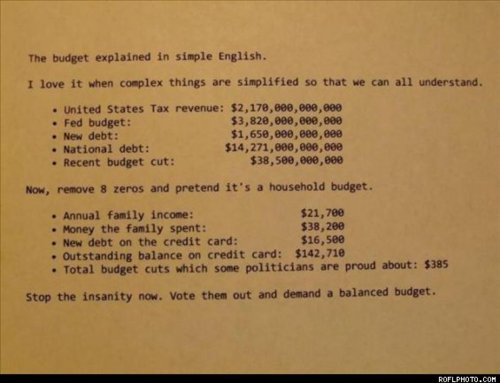
For those who want to understand the US Debt

I know, I know, there are elements of the reserve currency bits and and and other macroeconomic stuff, but hey, this is one way of simplifying it. Go figure. And if you want to see who was responsible for converting a 6 trillion surplus into a 6 trillion deficit, read on?

Its like the entire American political class has its collecting heads up where the sun doesn't shine.

Saturday, December 24

Stop Spending My Money

From ZeroHedge.

This level of debt is extraordinary. And somehow, all this has to be paid off. As I keep on saying, somebody has to pay for this, its the consumer, shareholders, taxpayer or your children. What the hell is going to happen to this country? The level of deleveraging required will be over couple of decades. And then so many people are still whining that we aren't spending enough, whether its on benefits or public sector pensions or what have you.

STOP SPENDING MY MONEY. 

Also see this graph from here.

We are so screwed. The world will be paying off its debts for decades to come. Welcome to the great debt hangover.

We owe over £900 BILLION!

Saturday, July 23

Put up the price and demand drops

Pretty straightforward, eh? When the price of petrol goes up, one starts to drive less. And for governments who end up taxing everything that moves, they end up getting lower amounts of revenue. Laffer Curve. Welcome. Well, even I, who drives very rarely, have found this behaviour. So its good to see the results here. I quote:

The government has lost almost £650m in tax revenue in the first 12 weeks of this year thanks to a drop in the amount of petrol and diesel being used by British motorists compared with the same period three years ago, according to the AA.

And this isnt going to change, the government will keep on increasing or at least not decreasing the level of taxation. The voracious monster that is the damn government and public sector will inexorably keep on increasing its level of parasitic blood sucking. When will they understand that this is frankly not sustainable?

I am actually fully cognisant of the train crash in the USA in terms of the debt ceiling and the repercussions on the economy if the debt ceiling isn't raised. But sod it, somebody has to draw the line somewhere. You simply cannot keep on spending and asking my daughter to pay for you. No thank you, you have to take the pain today, reduce spending and reduce your life style.