Showing posts with label Internet. Show all posts

Thursday, July 5

so who invented email?

Son


Another very interesting story here...who really invented email? I first used email when I landed in Manchester in 1992, way way way after all this happened. quite interesting, this debate about electronic history.
Love
baba


http://www.bostonmagazine.com/articles/2012/05/shiva-ayyaduri-email-us-postal-service/?page=all
V.A. Shiva Ayyadurai — the MIT lecturer who invented e-mail — had spent years blasting the struggling United States Postal Service for its failure to embrace the revenue potential of his creation. So when he was recruited to help save the U.S. Mail earlier this year, Ayyadurai made headlines and was suddenly a star. That’s when the trouble started.

Thursday, May 31

The Trolls Among Us

Dear son
Here is an interesting article on cyber bullying and trolling on the Internet. You will find these people everywhere. I don't have to tell you that it's not good to be a troll or a bully. You aren't one and you are too smart not to know that trolls and bullies are damaged people who rarely if ever achieve happiness.
But the question is, if you are ever on the receiving end of a bullying or troll attack what do you do? I have had quite a lot of experiences with this, specially when I was a columnist for one of the worlds largest selling newspapers.
Two ways son. The first is to make sure that you and your identity is not just tied to what you do online. Far too many people define themselves based upon their Facebook, twitter, MySpace, blog or what have you persona. Consequently when there are online attacks, there is no other place to withdraw. It's like people making an arson attack on your home. Then you don't have anywhere else to go to and as you have everything tied up at home, they attack your weakness and dependency. Which is why you need to have a very strong offline persona as well. Do charity stuff. Play games. Be with friends, do some business. Read books, physical books, Work on plants. Create a persona which isn't dependent upon your online persona. That way you don't let troll attacks impact you at all.
Second is to have confidence in yourself. These trolls attack your weaknesses. Your insecurity. What you fear sometimes is loss of other people's respect for you. What will people think of you. Don't give a shit about what others think of you son. You are a smart intelligent boy. You have done many things. You will do many more bright and good and generous things. You will make a difference to many people's lives positively. You will add value to the world. You will love other people, you will grow up to be a good man. You will love a good woman and raise good kids. What you don't need is somebody telling you bad things or more importantly you believing in what others say about you. Sod them.
So, to conclude son, if and when you get attacked by trolls, walk away and believe in yourself. Never react to them, because these psychologically damaged idiots will drag you down to their level and beat you to defeat with their far greater experience of being hateful bastards. Change the game, refuse to play their game. Laugh at them and walk away. You, my son, have far better, enjoyable, fun and important things to do.
And if everything fails, come talk to me. We will hire the best possible lawyers, investigators and hackers to obliterate their existence and lock them up. :)
Love
Baba.
"The Trolls Among Us" by Mattathias Schwartz [Send Me a Story]


The real lives of trolls.
 
 
Mattathias Schwartz | New York Times | Aug 2008
—
One afternoon in the spring of 2006, for reasons unknown to those who knew him, Mitchell Henderson, a seventh grader from Rochester, Minn., took a .22-caliber rifle down from a shelf in his parents’ bedroom closet and shot himself in the head. The next morning, Mitchell’s school assembled in the gym to begin mourning. His classmates created a virtual memorial on MySpace and garlanded it with remembrances. One wrote that Mitchell was “an hero to take that shot, to leave us all behind. God do we wish we could take it back… . ” Someone e-mailed a clipping of Mitchell’s newspaper obituary to MyDeathSpace.com, a Web site that links to the MySpace pages of the dead. From MyDeathSpace, Mitchell’s page came to the attention of an Internet message board known as /b/ and the “trolls,” as they have come to be called, who dwell there.
/b/ is the designated “random” board of 4chan.org, a group of message boards that draws more than 200 million page views a month. A post consists of an image and a few lines of text. Almost everyone posts as “anonymous.” In effect, this makes /b/ a panopticon in reverse — nobody can see anybody, and everybody can claim to speak from the center. The anonymous denizens of 4chan’s other boards — devoted to travel, fitness and several genres of pornography — refer to the /b/-dwellers as “/b/tards.”


more here


http://www.nytimes.com/2008/08/03/magazine/03trolls-t.html?_r=1&pagewanted=all

Thursday, February 9

A new Fraud: DOMAIN SERVICE NOTICE

So I got this email

imageimage

Curious to note how they have worded it.

By accepting this offer, you agree not to hold DN liable for any part. Note that THIS IS NOT A BILL. This is a solicitation. You are under no obligation to pay the amounts stated unless you accept this offer. The information in this letter contains confidential and/or legally privileged information from the notification processing department of the DN. This information is intended only for the use of the individual(s) named above. There is no pre-existing relationship between DN and the domain mentioned above. This notice is not in any part associated with a continuation of services for domain registration. Search engine submission is an optional service that you can use as a part of your website optimization and alone may not increase the traffic to your site...

lol, nice one, they will not do anything, but if you send in the money, they will quite legally accept it and use it. Reminds me of the scam when I read long time back. Apparently some chap just put in a small advertisement in the newspaper saying. Please send £100 urgently to XXX. And then at least 1000 people did that. When they complained (about what?), then the chap said, look I just asked for money..they gave it to me.

Amusing.

Saturday, September 11

My ancestral fraud

Heh, found this exceedingly funny, got an email on facebook. Check this out.


facebook

Mohamed sent you a message.

Mohamed Fahab

Mohamed Fahab

September 10, 2010 at 9:50pm

Subject: Dear Bhaskar Dasgupta,

Dear Bhaskar Dasgupta,
I am Barrister Mohamed Fahab, personal attorney to Late Mr J.C.Dasgupta,a national of your country, Who died and left some huge amount of money with a bank here in Lome West Africa, valued at US$8.5 million dollars. I have contacted you to assist. Please Reply To My Private Email Ad...(mr_mohamedfahab00@hotmail.com) Or call me +228 9177735
Your Full nam.....................................
Your private number...........................
Your private email..............................
Regard
Mohamed Fahab,

Tuesday, March 2

A new spam method

Got this in my inbox today:

So I replied back:


hmmmm, interesting, so why would you send this message from a hotmail account?


From: janetholmes64@hotmail.com [mailto:janetholmes64@hotmail.com] On Behalf Of Google Account
Sent: 06 February 2010 16:58
Subject: Important Update

Due to numerous registration of new emails by our users, Gmail is experiencing congestion and a very slow network.
Gmail needs to rectify this problem by eliminating some unused emails and also shut down some Gmail accounts that are not updated regularly. Google mail require your Gmail account information  below for verification and for Gmail to know how often you use your account so that your account will not to be shut down unexpectedly.


Account:
Password:
Birth date:
Country:

Thanks Gmail!

G MAI L BETA

Sunday, January 11

What if the New York Times did not exist?

I was reading somewhere (and now I have forgotten and am too old to rack the 2.3 neurons I have to worry about where) that the New York Times is one of the most hyperlinked and commented upon source for news for bloggers. It is indeed the most visited newspaper site in the USA. Yes, I would tend to agree. It has great quality, great coverage and is what I would call as a great newspaper. Here's a graphic showing the NYT's coverage of the world from here.


Pretty amazing coverage across the world, wouldn't you say? If you compare that with other newspapers (and I dont have any pretty graphics to show unfortunately), i would have said that this bubble graph is pretty good when you compare other newspapers ranging from the LA Times, Chicago Tribune, Washington Post, The Times, Guardian, Le Monde, etc. etc. You can forget the sub continental papers anyway. The only exception would be the English language papers in the gulf but they appeal to the expat population so I am not sure if that is applicable as a comparison.

But I digress. But blogging and web 2.0 bits (such as facebook, my space, twitter, etc. are changing the world) check out these two graphics which illustrate this issue. View from the blogosphere and from NYT. Quite an interesting difference, no? But life is changing rapidly and the financials of the newspaper world are changing rapidly. The future is not as good, have written about this issue before (see here, here, here, etc.).

But now its the economics of the situation which is seriously blighting the situation. Circulation in the USA is dropping rapidly. and there is simply not enough money. Newspapers after newspapers are simply folding or changing their business model or laying off people what have you. And I am not talking tiddlers, the LA Times and Chicago Tribune have gone bankrupt, but what about the NYT? The NYT has pawned its headquarters and the numbers are not looking good. Here's a bit of an analysis which will send shivers down any US newspaper proprietor's backside.

Take the New York Times Company. It generated $74.4m in online advertising in the third quarter, 10.2 per cent more than in the same quarter in 2007. But the $6.9m increase in online ad sales was dwarfed by the $73.7m decline in print advertising revenues, which plunged by 18.6 per cent. Even if it managed to halve its $677m quarterly operating expenses by dropping the hard copy, online ad revenues would cover just 22 per cent of its running costs.

Strip out the NYT’s other sites, such as About.com, and assume those third quarter online ad sales were generated only by NYTimes.com. That makes the 20.3m unique readers who used the site worth about $1.22 each per month, a fraction of the value of a print subscriber. To break even as an ad-funded digital-only business, with a quarterly cost base of, say, $338m, NYTimes.com – already the number one newspaper site in the US – would either need four times as many unique users or ad rates four times as high as today’s, or a bit of both.

The recession is biting and biting hard, which means that the pressure on the advertising segment is fierce. The revenue/costs scissors are simply yawning wider and wider. A Deloitte report in December 08 predicts that one out of every 10 print publications predicted to half frequency, go online-only or close down in 2009. Plus in such an IP driven business, you cannot change the costs that easily. The solutions as given by the FT are obviously not possible, they cannot quadruple their readership nor can the current (or even the 2 year future at least) think about increasing ad rates. Forget about increasing, currently even the online advertising rates are diving like a dingo down its hole. See the Ad Price Index report from October here. I quote

  • Throughout the year, display advertising pricing has generally trended downwards across website sizes and verticals
  • All categories moved down from last quarter, with the exception of Technology which stayed flat
  • Entertainment had the most significant drop of all verticals, dropping 42% from 57 cents in Q1 08 to 33 cents in Q3 08

And its not just in USA, the impact of the drop in advertising is felt across the pond as well with certain titles reporting drops of more than 50% per year. See the impact on Journalist numbers here with thousands of redundancies in the UK itself so USA will be impacted correspondingly more. You can merge newsrooms, you can adjust staffing levels, use better technology to reduce telecom costs, travel costs, etc. outsource news production to India, reduce training costs, and so on and so forth, but its not going to help much.

But to go back to the title of the post, the chances are high that the NYT is going to go under. And that will indeed be a shame. One of the crucial aspects and guarantors of a free, just, fair and democratic society is the presence of a free and transparent press. If the media suffers as it is doing now, it will cause issues for our society. Would a BBC model help? A model of publicly funded media generation and broadcasting? Hmmm, can the BBC model be enhanced? Such as splitting the production, commissioning, broadcasting and distribution arms? Something of that nature will be required because the loss of NYT will indeed leave our society a poorer place.

Technorati Tags: ,

Tuesday, December 30

Chinese internet vigilantes bring down another official

Now this is excellent news, that a bunch of internet users in China have managed to bring down corrupt crooks in power. Now why cant we do the same in other countries such as India? I am sure this can be pushed forward much more, but it will take much more efforts. Still, good stuff, very good, we need more of this. Bloody corrupt blood suckers. May you rot in prison!

Technorati Tags: ,,

Sunday, August 31

Degrees in virtual world?

One of the advantages of having friends who are now big grand pooh bahs in the academic world is that one gets a fascinating insight into what the future of our society will be. After all, these professors are putting in place policies and procedures that will impact learning, teaching, research and the development of universities now and deep into the future.

This summer, I was having a conversation with two of my friends who are both senior professors in the United Kingdom, and both in responsible management positions with a huge publication record. The conversation drifted to how universities will be reacting to structural changes such as the internet, the virtual reality world, globalisation of education, reduction in public education subsidy, globalisation per se, the business cycle, change of the student persona from dumb thankful student to demanding educational service recipient customer, and so on and so forth.

It was a fascinating conversation and I learnt a heck of a lot about how universities operate. Given the financial pressures, universities are now moving to get as many students as they can from outside of the EU. Why? That is because they are the students who pay the full whack, sometimes an eye watering 10-20 times the amount paid by local or European students. But then when somebody is forced to mortgage their house, or take a very expensive student loan, then when they come to these Universities, they naturally demand a quality education.

Faced with a university and staff which never had to justify their quality (well, not that much anyway), it is a shocking change in philosophy and operating environments. And from what I am hearing, it is not something that is being accepted easily. Both my friends were talking about how they are finding it difficult to recruit staff, or to motivate them or to keep their students interested with a good pipeline going.

I was obviously coming at this from a different perspective (see here for my previous twittering on universities). I think that the university of today will be very different from the university in say one decade time. For example, the firm where I work in is planning to set up its own business school. The firm where I worked previously had a full fledged campus and its own business schools. Large firms are starting - or already have - their own educational institutions.

But more importantly, in the dim and distant past, I got qualified as a Prince 2 practitioner. It involved me sitting in a class room and then giving examinations, two of them, over an entire week. Now I am rolling this same qualification out to my function, and we will end up with more than 100 people working on this by end of the next year. Guess what the major difference is? 70% of the previous time would now be done electronically. In other words, e-learning will replace 70% of the prior classroom teaching. And then somebody will come in and run an examination which will also be electronically administered. So what happened to the teacher?

Oh!, did I tell you that my function is worldwide, which will be deployed out to anybody who wishes to be qualified as such? Something akin to a global university? Why not? See this story as an example. For the first time, an educational certificate will be granted to people who will be trained primarily via Second Life.

Did you spot the other issue, namely that replication of knowledge delivery is now near cost less (at least to the provider, I still have to pay a few quid for every additional licence). A teacher's main rationale for existing was that knowledge transmission was a 'one to one' or at the most 'one to many', which was not replicable easily. You couldn't just read a book and be done with it, but required additional explanations and practice sessions. But now, it can be replicated and if you do want to see a face, well, you can go on Second Life to get a virtual one.

And the education on Second Life or e-learning is and can be asynchronous. You do not have to be online or active at the same time as that of the teachers, because it can be taped or replicated or delivered irrespective of whether it is night or day.

You might then say that one would still need a degree to get a job. Well, here's another issue, because that is not necessarily the case. If all that I am checking is your ability to do a job, I dont need to see your university degree. For example, if you want to trade in the financial markets and offer investment advice, all you have to prove is that you know the laws, language and know the professional standards (which is what Prince 2 type of courses do). Yes, I know I am talking about a unique type of role, but consider most of the knowledge based industries which require professional non-technical training. This is not relating to stuff like engineering, medicine or architecture.

But what if you wanted to hire a salesman for napkins? How about wanting to hire a software coder? No? How about a graphic artist? What about a weather forecaster on TV? What about a customer service representative? What is the link between t his job, a degree for it, a way of learning, or even a particular university? How will an electronic degree change this job or its earning potential? Points to ponder, eh?

Technorati Tags: Education,Universities,Internet

Saturday, July 5

Vint Cerf Says Government Needs To Encourage Internet Competition

An interesting conversation here, but I am not very sure that Vint Cerf's ideas are really right up there. I have had my conversations with him in Malaysia and I found a rather naive belief that permeates his thinking, and here's another example.

Why is it that broadband is necessary for development? And why is this idea so entrenched? that's really bad and sad that people are jumping up and down saying that we need to have broadband. Erm, why? Why must I pay my tax dollars to pay for an internet? How does India work without broadband and manage to do wonderfully well with mobiles?

then he looks at the internet as a road system. And he thinks that the private sector abuses the internet. Well, give me a reason to use it, as I have already told him. All those airy fairy pie in the sky models where money magically appears to pay for his internet toys simply will not work. You need to show and tell me how your work actually adds value to me. And if I find it valuable, then I will pay for it. The fact that the majority of the Web 2.0 companies have not made much money and very few have actually made a profit tells me that their economic model sucks. And then come along people, who after failing to get money from the open market, run crying to the government to pay for their taxes.

Sod it, no bloody way. Net neutrality be damned, you pay for what you use. As for dis-enfanchising the people, well, here's my question, since when did I as the people become responsible for everything you do? if you live in a place which does not have suitable services, well, you either go without or move to a place where there is this facility. I see no reason to support this idea that the government exists to provide every bloody service for every bloody person. No, sorry, it does not. It has to first make sure we are secure, and then stay the hell away from me.

Sunday, June 8

Gamers are scared of innovation

Two very profound things were said here.

Gamers, the very people we think are right on the bleeding edge of innovation, hate it.

and second about second life

Innovation in games is like 2nd Life. Everyone is always talking about it, but it doesn't make enough money to be anything more than an interesting discussion piece.

Who will pay for all this?

The economics of Web 2.0 banking

A curious item came through my in-box. This was the headline sentence.

half of Facebook users would use Web 2.0 applications for online banking, while a quarter would even consider switching banks to obtain Web 2.0 services

And this

However, as Worklight encourages banks to adopt Web 2.0 technologies, a new person-to-person social lending Web site is launching today, looking to take advantage of the increasing difficulties US students face securing loans from banks in the post-credit crunch market.

The credit crisis has led to traditional lenders such as banks and credit unions declining some student borrowers who would previously have qualified for college loans. The new GreenNote site is the second P2P marketplace in the US dedicated solely to student loans to launch in the last month, following in the footsteps of rival Fynanz.

To use the service, students set up an online profile and then connect to their social networks to get loans from friends, family and communities. Students must borrow as least $1000 although lenders can offer as little as $100.

Does anybody see the resemblance to microlending? Its not new, just the distribution channel (Web 2.0) is new, this allows atomisation of lending and borrowing, but it is dependent upon having sufficient volume to make money. See this as an example of how difficult it is to make money out of this kind of business:

How much will you charge? $1 per $100 loaned? Lets run with that figure for now. You have 1 website, 20 employees, funding costs, etc. etc. and you are up to a million dollars before you can say facebook.

So to just cover your costs (and assuming you do not have any other sources of funding), you need a million users actively purchasing these loans before you break even. You can sell advertisements, you can use mashups of your records with others to sell other stuff to your customers (will be illegal in many places) etc. etc.

This is not going to be easy and this is what I am struggling with, who will pay for all these whizz bang stuff on the internet?

Disjointed thoughts on the World Congress of Information Technology 2008

I had the honour of attending and speaking at the WCIT 2008 conference in Malaysia and here are some rather disjointed notes that I had while listening to the speakers. I tried to clean it up, but again, apologies for not being able to make this very professional indeed.

Monday

The conference center is big! And I got lost in the exhibition hall. Quite an impressive setup. So then finally managed to extricate myself from poking into the guts of various exciting electronics bits, went looking to find the plenary hall, and found myself sitting in the hall looking at an ant hill of activity. I could not imagine how on earth will they manage to fit 3200 people and assorted volunteers and managers into this hall but they sure did. 


Typically, there was the media scrum when a Prime Minister arrives....We were welcomed by 40 children welcoming us in 40 languages representing 90 odd countries here, but the language used through out the conference is English. Curious, no? the prevalence of English in the world?

He also said that UK and South Korea are behind Malaysia in the World Competitiveness Index, and I can well believe it. Although checking the Global Competitiveness Report here seems like the results are different. Perhaps he is talking about this report. Anyway, mere quibbling. And now the PM has left and literally the front 1/4th of the hall has emptied! Some more speeches about WITSA.

Then Dr. Craig Bennett, Chairman of Intel, started talking about how we have a billion people on the Internet and now we have to get the next billion on the Internet as well. He said that four factors are important for knowledge based economic development

  1. Physical access to technology
  2. connection to internet and connectivity
  3. content targeted at local population
  4. education on how to use the tool

He said that a well educated teacher is the magic and not the PC in the classroom. He showed a video about a Nigerian school which has embraced technology but said technology again is not really the only answer.

He talked about taking a holistic viewpoint, what's the point of giving a $200 PC while the monthly connectivity costs are $250 per month in many countries, 100kb monthly cost in Japan is 6 cents, 50 cents in USA and more than 80 dollars in Sub-Saharan Africa. Now you can get an idea how tough it will be to get these people on the intranet or to roll out the broadband revolution to them (more about the exception being that of India later on).

He talked about how Pakistan is being used as an example of pushing broadband and network connectivity out into the sticks. 60mm dollars is the budget, rolling out in untouched areas in Pakistan, he invited a Pakistani chap to the stage who is the CEO of the public company which is helping to push this (didn't catch the name). Connectivity is a challenge. Satellite is way too expensive. Fiber is the only way. Rolling out fiber is tough, so tehsils where its not remunerative for private companies, this company gives money and offers seed capital, it helps to improve the business case for the private firm. This was a good step. The Pakistani chap said that Govt should not be involved that much in this business, put power to public private consortiums or just private firms, give them a stake in the business and then it will work. But I am not holding my breath, I want to know whether connectivity actually helps or would more investment in say better teacher training help?

He video conferenced a doctor from Brazil into us, how location differences for patients versus diagnostics versus doctors versus care had disappeared, and this tele-medicine actually is helping far more people than medicine and doctors were previously. Then there was some corporate stuff with some kids brought on stage and it ended. It was a bit too slick and the questions with the kids was too obvious and that left a bit of a bad taste in my mouth. Such a senior chap shouldn't need such kind of gimmicks to play around with such an important topic, we are all adults, you don't have to take us to be children or idiots to play that game.

I was a bit impressed with what he had to say, but what he had to say was crucial (leave aside all the silly posturing and even more silly marketing of Intel stuff). His point was, throwing money at technology and expecting better performance from students was wrong, the idea is to teach the teachers to be better, that will provide better results than thousands of PC's and laptops.

Nothing much to note for the next few sessions. The post lunch session for the Ministerial panel was a bit interesting. Mainly because you could see how various governments approached this entire idea of information technology. You know what was the most disappointing? It was the Philippines MP. She came across as a complete Neanderthal, saying that in many parts of her constituency, there is no electricity power anyway, forget about PC's, and it was a whine. The Philippines government should really have thought that through. The Malaysian government minister and other ministers were smart, they obviously were pushing their countries and with due reason, telling us, the corporate folks, what we wanted to hear..., but Philippines? Pathetic. She is a blot on that country's face.

The next wireless broadband session made me go to sleep. Pure and simple, those two Rumanian scientists, bright as they were, made me doze off specially when they started talking about antenna design, and specially after that excellent lunch.

Woke up to an excellent presentation by Professor Takenaka. He talked about how he was made the Minister for Finance in Japan by a certain Lionheart PM of Japan. Fascinating tale of how he took on the entrenched might of bureaucrats and financial institutions and won. And I well believe him, given some down sides, generally that time was brilliant, it still shows that even in a consensual driven society such as Japan, you can still have mavericks who hire mavericks who really make a huge difference! Brilliant fellow. Unfortunately he was not allowed to fulfill his destiny and do all that he wanted to do but there you go, he literally broke the back of the Japanese economic stalemate.  I was personally quite impressed but I suspect that quite a lot were not as he was talking more about economics and finance than IT. The IT piece came way afterwards, a little bit and as an after thought.

Then we had Bill Gates in a hologram talking about Microsoft and then Dr. Zhang also, not very clear about what, was flagging badly by that time.... and then we went off back to the hotel, did some more emails and then some calls back home and then off to dinner, again, dinner was brilliant, and pigged out and came back and went to snore, i mean sleep.

Tuesday

The day started with perhaps one of the most interesting panel discussions I have ever attended. It was to do with how to produce innovation and creativity and what can be done to enhance it. These were the people there.

  • - Arnold Gay, Anchor, CNBC - Moderator
  • - Kamil Othman, Vice President, Multimedia Development Corporation
  • - Fritz Attaway, Executive Vice President, Motion Picture Association of America
  • - Terry Thoren, Chief Executive Officer, Rocket Fish Studios

You cannot get a better collection of people talking about the most creative of industries, motion pictures and a very educational and interesting debate happened. Terry said that the world is changing, Malaysia has twin towers now while USA no longer has it. Who knows what's going to happen in the future? He has severe distaste for politics but great admiration for tech, people, process, creativity, etc

Kamil went into deep details on how to build an innovative industry? Animation in Malaysia. Disappointing take up, long way to go, to make a Walt Disney, you need to start with one million children drawing in grade 8. You cannot create a flash laboratory, shove people in there and wait on the other side of the Lab waiting for Toy Story or Cinderella to drop out of the other side. It has to be started from the very basic levels, people cannot look down on the arts which they do at this moment.

Monetisation of opportunities and content is a challenge, how do you do it? look around you, all countries are pushing people to get educated and into the knowledge sciences, but not all people are thus inclined. Many people simply do not like mathematics or technology. Some people want to study arts, or paint or simply do not have the mathematical skills. What do you do to them? Those who want to write poems? How does he get paid? or fed?

There were conversations around how to create a movie or animated film, quite interesting to see how Hollywood and Silicon Valley literally took decades to develop, you cannot do that just by throwing technology at it. Quite thought provoking indeed. Perhaps one could question whether it is possible to force people to become creative? Or can you just provide the infrastructure and let them get on with it? or is it just let people be, and trust in them to come up with the goods?

---------------------

The next session had more ministers but I was quite interested and taken by A Raja, Minister of Communications and Information Technology, India. I have to admit, I was quite cynical at first knowing about Indian politicians, but was very impressed to see what he had to say about it all, how they are powering ahead with the licence's, what mistakes they made, how the process of governance is happening, who gets to approve what? and so on and so forth. Pretty good and well, I will think that what he is saying is right, because I have experienced the mobile phone revolution in India.

As usual, it has to be different. Rest of the world goes through scientific revolution, industrial revolution, then wars then dial up then broadband and mobile, India starts off with revolutions in 3000 years BC, then has fun, then goes into decline, then starts off with a revolution in Y2K and then the next revolution is mobile and mobile internet and mobile commerce is bigger now, how strange and unique... Very curious, loads to think about there. The technology trajectories of these two countries, based upon what Dr. Jiren of China said, are so different. One wonders what will happen in the future.

Incidentally, there was a gentleman from Saudi Arabia who made me think of the previous session. He spoke on about how much money has been pumped into the industry in Saudi Arabia, the emergence of knowledge cities, and the like. Not impressed at all. Not at all impressed. Setting up a knowledge city and throwing money at it does not solve the problem of creativity or having knowledge industries. For that, you need to have creativity at the school level. They have to inquire and challenge everything. Can you imagine something like that happening in Saudi Arabia? Which is the reason why I couldn't take it any more and went outside to grab a coffee. Perhaps the organisers should have kept coffee on tap, this was crazy, they dont want the participants to keep awake? dont they know we drink coffee by the gallon?

------------------

The next topic was rather dry, Dr. Mobius talked about where the next hotspots will be. And I lost my notes on this lecture so this part is a bit vague. I remember him showing loads of graphs about where and when returns are made. It was an asset management view, so was a bit dry. Still, was a bit interesting, specially around the returns of the various sectors in the Asian economy. That is much that I remember... if and when I get my hands on his slide deck, and have time to read it again, will comment...

--------------

For the next session, I went to the "Asia, the destination of choice for Shared Services and Outsourcing" session.

  • - Dato’ Narayanan Kanan, Senior Vice-President, Multimedia Development Corporation – Moderator
  • - Michael F. Corbett, Chairman of the International Association of Outsourcing Professionals
  • - Dr Ganesh Natarajan, Chairman, NASSCOM
  • - David Wong, Chairman, Outsourcing Malaysia
  • - Stephen Braim, Vice President Governmental Programs, IBM Asia Pacific

Very interesting, Michael spoke about the impact of the US elections on international outsourcing. I was, frankly a bit puzzled by that kind of emphasis. For two reasons. The first aspect is that the actual number of jobs which are dependent upon the classical aspect of outsourcing is reducing, and the second aspect is, did he really think that the elections will make a tiny bit of difference? Obviously yes, but I am rather disappointed that it was more American rather than International. Also, I was a bit saddened that there was no discussions about international aspects, taxation, technology which allows remote working, etc.

But overall, it was quite interesting, there was discussion about education and how that will help in various countries. What Malaysia is trying to do. What the IBM view was from the perspective of government initiatives and education and so on and so forth. But also, I was a bit disappointed that most people's perspective was the next 8 - 12 months, not more. Still, lets go to lunch, was feeling quite hungry now.

-----------

Over lunch, we had a speech by Dr. Rowe, where he was talking about how the worlds of virtual reality and real life reality meet and how they work together. Quite an interesting topic and he spoke quite a lot about his own personal experiences and the like. But not much about real life applications. I then sent him an email afterwards, and this is what I said to him.

  • At ABN AMRO, we used Second Life to actually recruit, it was very challenging and interesting but it ultimately failed because of lack of regulatory frameworks. Ended up with 5.5 FTE dedicated to Second Life but then scaled back.
  • We also used a virtual world to help mentoring. Such as when we have just 2 IT employees in Uzbekistan, then how do I get the junior chap mentored? So we setup a virtual world where mentors and mentee's can congregate in a persistent state across the world. This helps in knowledge capture and better employee retention.
  • My friend from BP is using a virtual world to track every employee in complex and potentially dangerous plants. This location tracking and graphical display of every employee is used for fire, safety, evacuation and training purposes.

Second life and other virtual lives have become really challenging world and are throwing up some seriously challenging questions for us, again which have not been fully explored just yet.

--------------

Unfortunately, I missed the next slot because we had to go and get powdered up for our session at 3. Not much to speak about in there, check out the slide deck. Also managed to miss out a large proportion of the next presentation from Dr. Pachauri because we were supposed to be in a room answering questions. But did manage to catch snippets of his talk. Quite interesting.

I had to take an office phone call so managed to miss out on the next one as well. So that was that. Nice dinner, watched a charity auction, observed some very nice and lovely looking ladies. This lady was standing 2 feet away from me. Very fragrant. Nice hair even.

Wednesday

This day was going to be challenging, specially since it was also the Champions League Final day.

The day started with me taking breakfast in the Trader Hotel Lounge, where I had been put up, its just next door to the KLCC so very convenient indeed. So took some pictures from the 34th floor lounge while having breakfast.
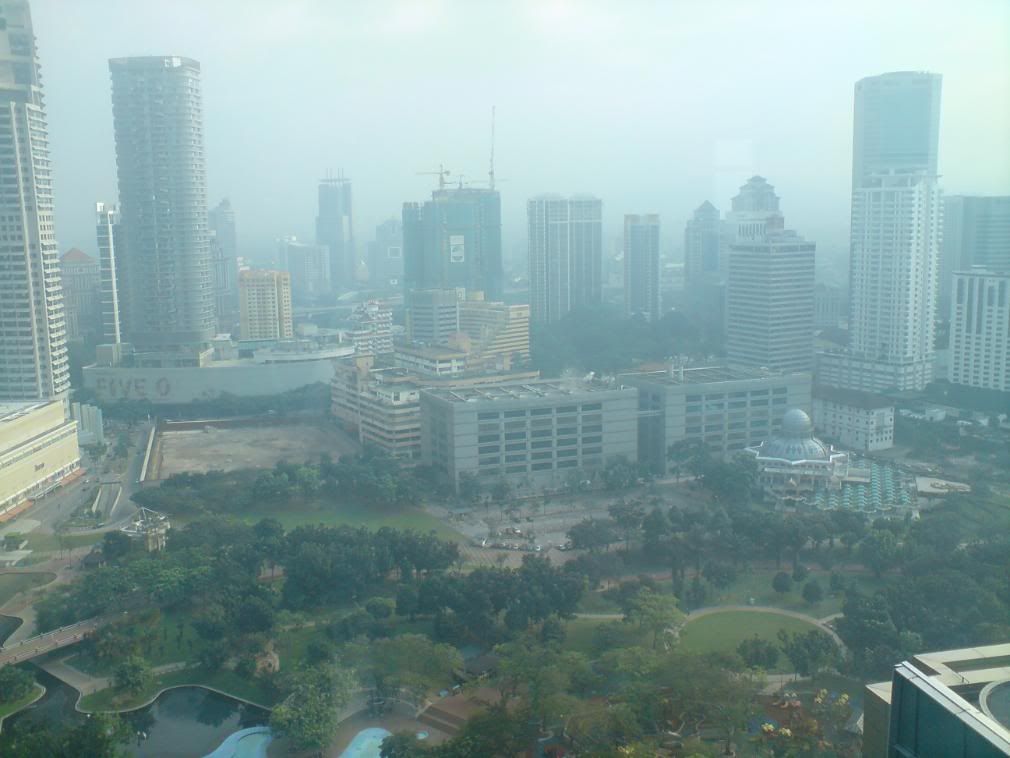



Here are the twin towers, at the base you can see the gigantic 6 story mall with two wings. It is absolutely stonkingly huge, that mall. Anyway, the twin towers, and the very well landscaped park around the buildings. The building on the left of the twin towers is the Mandarin Oriental where many other guests were also put up.
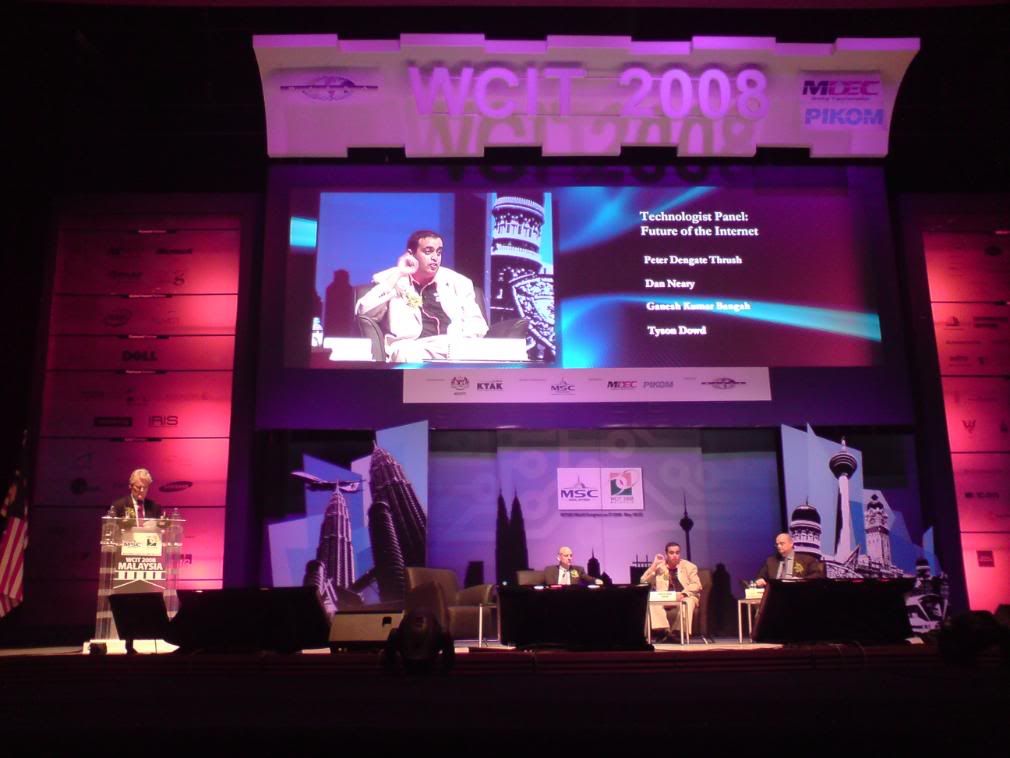
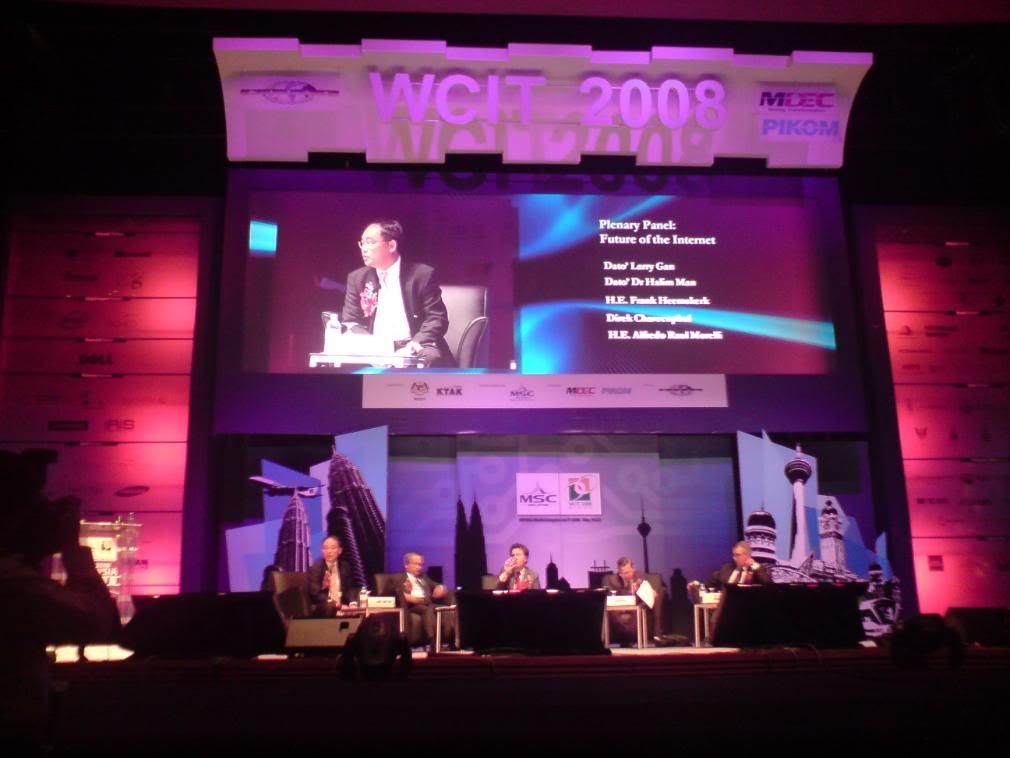
  

Then the day started with two debates on the future of the Internet. A deep discussion erupted over the net neutrality issue. To be honest, I have never really thought about it till I was forced to sit and listen to these two debates. Not that I have really firmed up my thoughts but the question is, who pays for the internet? It is my firm belief that nothing is free in this world, somebody will ultimately pay, either the taxpayer, stockholder, consumer, today you or tomorrow in the form of your child. Somebody has to pay. So this idea that the net is free is frankly stupid and more worryingly, it shows a childish view of the world.

Also, the idea that a communications network will or should be free is against human history. Do you think that the pigeon post was free to everybody? or the pony express allowed everybody to send stuff over? or how about the fact that letters still cost to send stuff to each other? Or the fact that we have public and private ownership over the postal system? Or the fact that we have regulations governing what can and cannot be sent over the posts? Or how about the fact that online classifieds are killing newspapers? Or how about the issue that emails are killing the postal system? So when we do not have any issues over that, why do we suddenly end up having an issue over the net neutrality aspect? Here is a good overview article. Very complicated matter, but I suspect it will end up like we have the health service. A Universal service provision which will provide some kind of a basic internet, which is slow and unreliable, while a paid for internet which is better and faster. Pretty much common compared to other industries, if you ask me.

Then there was a discussion about Silicon Valley, it started in 1940's, it took 10 years to know, 10 years to come, 20 years to investment, etc. etc. Takes a heck of a long time to start developing an industry. See what Taiwan did, took them decades to get to it but get to it they did. Now they are the champions, and almost every PC in the world has some Taiwanese components in it.

============

Next session I had to miss, then popped into the Mexico session for a few just to realise that they were talking about near shoring. I mean, d'oh, get on with the programme, people are now in the 5th generation of out sourcing and we are still in the terminology of the 1st generation. Crikey! that made me so depressed that I went back to the room and started my calls. Also had a quick bite to eat in the room itself, couldn't’get out of the calls but went back to catch the next great debate.

----------

Not much to report on other than the fact that one of the guests (I told you, lost all my notes because my stupid My Documents folder decided that it wants to forget all about my previous history and start afresh to synch...). said that the adoption of energy efficiency standards by California means that the energy usage per citizen has now leveled off compared to other states. But if you think about it, the lesson from this is to start imposing energy standards more and more, get people challenged to be smarter about their energy usage. So while the usage will rise, but it will level off at some point!, interesting, no?
So I went looking for some data. What does this tell you? Well, it did make me go hmmmm. We are actually seeing a dip in the energy consumption per capita in North and South America, albeit from a relatively high level. Delving deeper into North America, Canada and Mexico are showing an increase while, very surprisingly, USA is dipping down and decreasing. How curious. 40 countries out of 134 countries actually showed a dip in energy consumption between 2000 and 2003. Some of them were obviously banana republics which were facing economic downturns such as Zimbabwe, or contractions such as Argentina, Ivory Coast, Bolivia, Eritrea, etc.

But what explains this reduction for countries as varied as Belgium, Brazil, Australia, Chile, Japan, New Zealand, Singapore, UAE, United Kingdom and USA? Can it be that despite increasing populations, their energy efficiency is improving? Dont take my word for it, check out the data. It is from the IEA even, so would be ok as well. Population information from the United Nations.

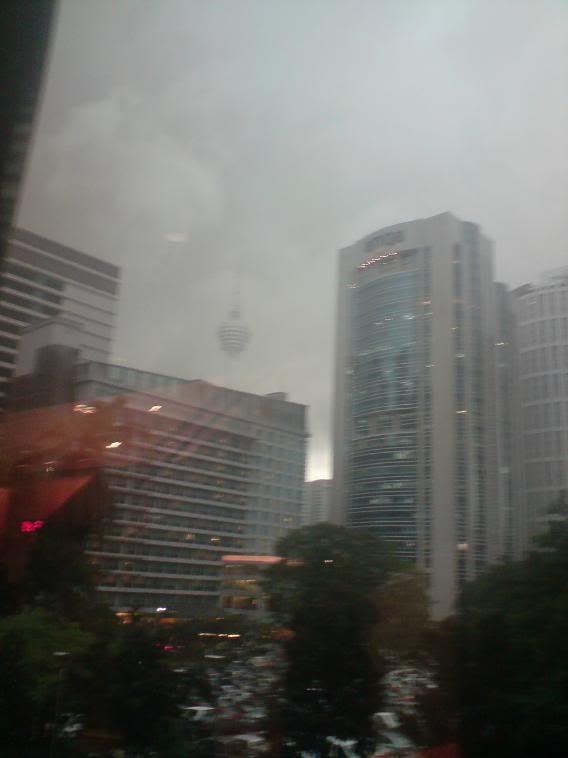
The next topic was the most interesting one, so I will put up another dedicated post for it. Came out to grab a coffee before going back in and saw that the sky was cloudy, the KL Tower was nearly hidden under clouds. Unfortunately, all the photographs with the top of the tower hidden did not come out, but hope you can make out the onion dome in the back being hazy in the mist.
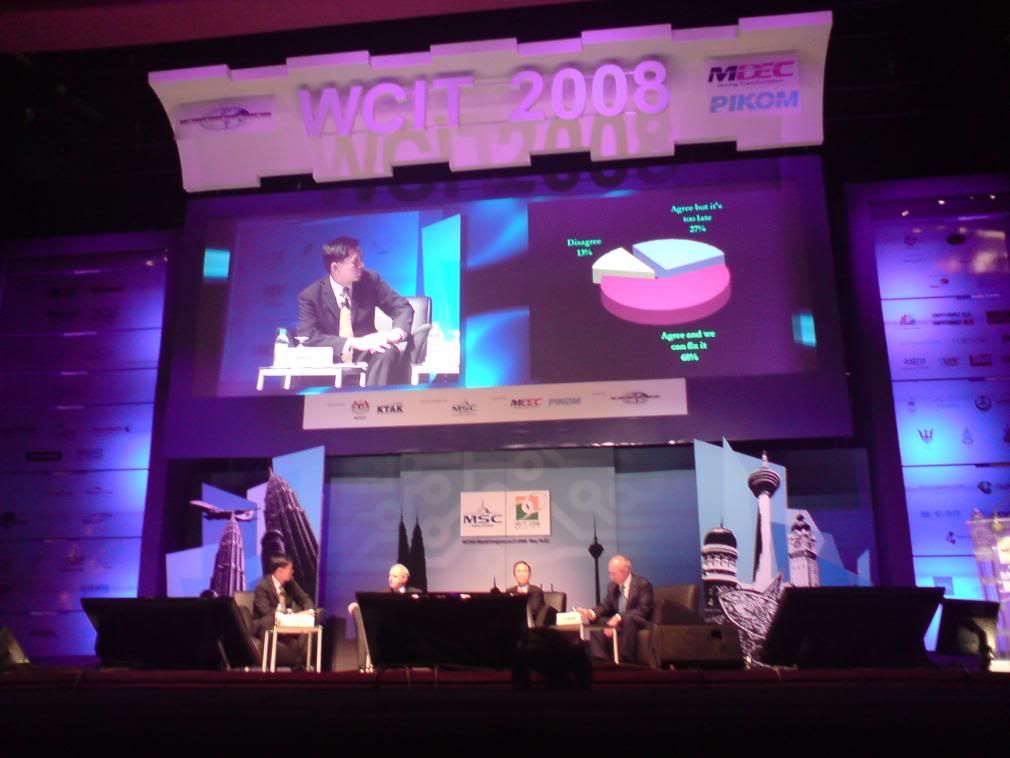
One of the living legends of the internet age, Dr Vinton Cerf, Vice-president & Chief Internet Evangelists, Google, spoke on the topic of "Tracking the Internet into the 21st Century". This was the final presentation of the WCIT and the entire hall was absolutely crowded, people were standing on the aisles waiting to hear that great man.
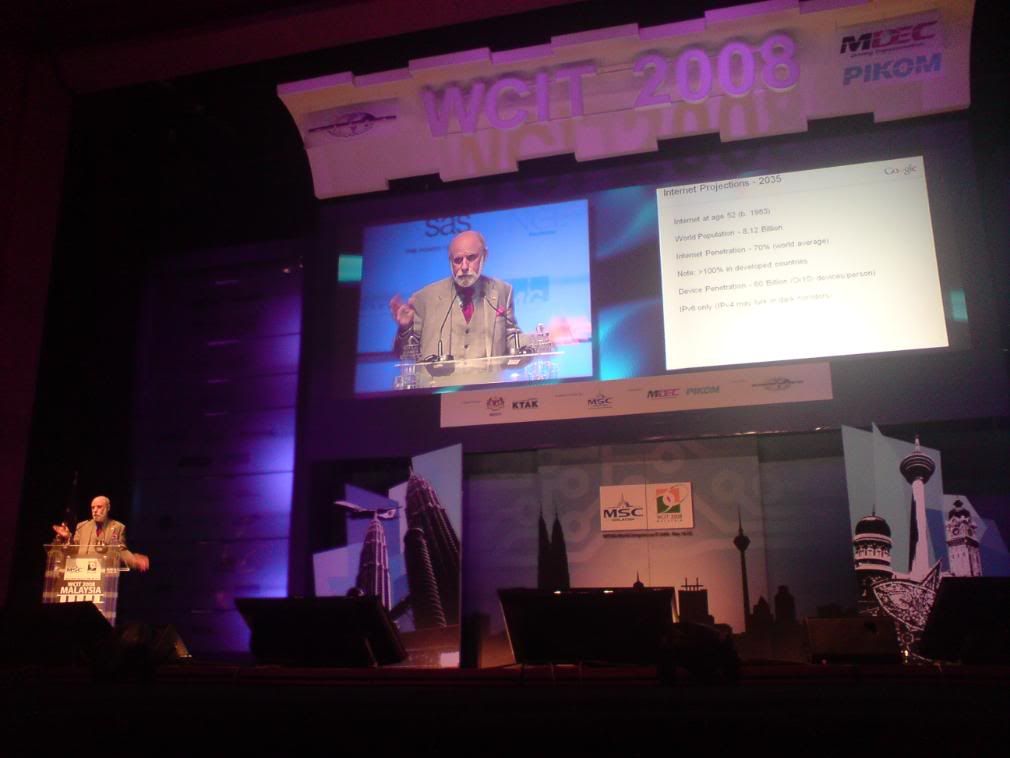
He talked about the future of the internet. Said that the internet penetration around the world is strange. Asia, Middle East and Africa are bad or low or both. Only 20% of the world is connected. He used the World Population Reports from the UN about the 2300 figures and displayed them, some interesting rises and dips. I presume he is talking about this report. See the graph on page 19 of the report. High scenario shows a horrifying 36 billion people on the planet, with a medium one of less than 10 billion. Bloody interesting report but this is not the place to go into it.

He talked about how only 20% are connected to the internet and more will grow. Incidentally, I found it much easier to observe him up on the main screen rather than watch him on the far left. Which begs the question, if this was webcast, then I wouldn't have traveled to Malaysia.... (theoretical question...). Which made me go off into a different train of thought.

My facebook, orkut, myspace, etc. accounts are nothing but very primitive clones of myself. I cannot be everywhere, so my primitive clones operate on my behalf. Just like my email system does and my voicemail system does. As a matter of fact, my home is also a sort of a clone. It has an address which is independent of me. People can communicate with me on an asynchronous basis and I can get back to them whenever. So when people are writing something on my facebook wall, are they communicating with me? or with my clone?

Say I have an active Second Life account. Is that me or is that my clone? Or both? I feed those clones with information and they act/react based upon my preferences. So I can be in another place via my robot/clone and get back information to me when it is convenient to me. I do not have to be face to face with you to get information. You can email/voicemail me and I can pick it up at my convenience.

If I communicate with my son online in Second Life via both our avatars while we are both across the world, am I still his father? to what extent? How about love? Can I show my love to him? via that medium? How does he know that it is me? Or if I was seeing Dr. Cerf across the world on a webcast, how would I know it is him? Just because somebody said so? identity problems galore. Does this mean that more friends you have, more your identify is confirmed? Like an amazon or ebay seller, more positive recommendations, the better is the identity and better is the trust. What do I do when I am dealing with a financial institution? Curiously, microcredit or microfinance rests on this premise, it lends money to people on the basis of guarantors from their community. So a person has to be social and know people and be trusted by them in order to get money. Bit different from my neural network Kohonen map based credit scoring model, eh? But I digress.

He talked about IPv6 (a network address for every device on this planet and then some, even some for your socks..), better search engines. He said something that I will come back to, he said that the monetisation and earning potential online will be less and the current business models will have to change.

He also talked about BIT rot, how on earth will you manage to open a Powerpoint 1997 file in Windows 3000? Forget about that old a problem, here is my problem. I wanted to dig out some research that I had done way back in 1990. I did not have the files here in London so had to wait till I got back to home and went to poked through my old cupboard. Besides the nostalgic kick, I finally found the floppy disks. 5 1/4 inch floppy disks to be precise. I have also operated the 8 inch floppy disk but well, the data that I had was in two formats, Lotus 1-2-3 and dbase. I remember sitting back on my haunches, looking at the dusty pile of floppies, and thinking back to those hours and days that I spent in typing in the financial data of the companies and did the basic analysis. Do you know, I even managed to calculate multiple regression on the damn things in there? Anyway, for all purposes, that data is now lost to me. I do not have a floppy drive anywhere near me, none of the 4 home pc's have it. I have an old laptop which has a floppy drive but it is 8 1/2 inch drive, not the older 5 1/4th inch drive. So I am stiffed.

Fast forward today. Financial institutions are supposed to keep data for up to 10 years. So your transactions and your records are supposed to be kept nicely and carefully within the firm for 10 years. Now the transactions are processed, on an average, via 10 odd applications. There can be many more depending upon the country and product but just think about it, 10 applications, multiple operating systems, multiple upgrades, multiple hardware requirements, multiple network systems, multiple servers, so many different types of technology stacks, and we have to maintain a record of this. Within 5 years, it becomes a major issue to keep up to date with technology, we are talking about 100's of years? No bloody way.

Museums are now struggling with electronic art. I could have taken those disks to a museum but they are also facing problems. Here's a great paper written in 2001 and the problem has become even worse now.

He also talked about the inter-planetary internet. That just blew my mind away but it needs much more thought before I can write more about it, its not fully comprehended yet. Anyway, he got a standing ovation at the end. I ran to attend his Q&A after getting distracted by an email, but still managed to get to the hall to ask him a question. I asked him, you have talked so much about what will happen in 2035 and 2300, the physical shape of the internet, the devices, the penetration rates, and and and. What do you think would be the value system, the monetary framework, the price formation or who will pay for it all? It was obvious that I had asked a wrong question immediately because it did not go anywhere fast. I did ask some follow up questions, but he is a great man, he had to rush off to meet somebody else.

This is my problem. I am supposed to think about what's going to happen in 5 years time in the financial world. This is what I am seeing currently. People who are in the 15-25 years of age category, the great unwashed herd who will be our future employees and customers, are not that well versed in value creation online. And why would they be? Look at what kids do online these days. He watches movies, plays songs, plays games, chats with people, participates in joint coding, and so on and so forth. Almost all of this is free or stolen. His email is free, his programming language is free, songs and movies are free, his video is from YouTube, his chatting is free via text and messenger, his voice is free over VoIP. So all these assets that these kids are using, they are all free at this moment.

So I am most certainly not surprised that they do not know the value of online assets. So when you ask them, how much are you worth? or how much will you work for? or how much do you wish to charge for your ideas? or how much funding will you need for your great online idea? no idea. And that is the issue that I am struggling with. In 5 or 10 years, the link between physical work, money and online assets will be inextricably broken. So how much would I pay a coder? How much would Microsoft pay a programmer when most online assets are free?

My son said something to me today that completely blew me away. He said that he will go create some online jewels and armour in World of Warcraft as birthday gifts for his friend who lives 5 houses down. No money, no nothing, just pure and simple virtual asset formation, entertainment and happiness increased but with no reference to money at all. Deeply worrying.

So to go back to Dr. Cerf, on what basis will anybody pay for a book in 2300? or a share in the company making Windows 3000? or the ability to write code? Or to create a powerpoint presentation? I do not have an answer, but I didn't get one either. I will be struggling with this as part of my job as well, but I am seriously not sure what the answer is. We saw some amazing valuation modeling during the internet boom. But they did put a value on an intangible asset, no? It was a bad value, but a value none the less. Also goes to the heart of what Mark to Market is all about. If this is all too philosophical, think about this, my son is happier getting a World of Warcraft spell rather than an intricately carved wooden box which I got for him.....Should I have gone to the local electronic fair in Kuala Lumpur and bought a user-id/password for him instead? How would I judge what is a fair amount to pay? I have no idea whatsoever. No reference points at all.

That brought me to the end of the conference. The last day, Thursday, was a trip to Cyberjaya and Putrajaya, the IT and administrative hubs of the country, but dont think that fits in here, so you can see some pictures here.  I have also written another essay on my observations on Malaysia and that should be published soon as well. End of the day, fascinating indeed and perhaps it was appropriate that that brought my professional career stint with technology to an end, now its moving back into the front office. But technology will remain with me, either with my shareholder, customer or employees. Food for thought, will try to attend the next one in 2010 in Amsterdam.

Technorati Tags: ,,

Thursday, June 5

The Beady Law of Bush Bilking

You must have heard of Godwin's Law. After having seen a huge amount of discussions and debate on the George Bush Phenomena, I am going to propose another law based upon that master, Godwin. The Beady Law of Bush Bilking states that:

Accusing somebody of being a George Bush or his supporter is guaranteed to bring the conversation to an end.

Just like people who are just too easy to accuse other people of being Nazi's show evidence of loose thinking, the Beady Law of Bush Bilking states that the person has not really thought through the argument and has just lazily reached out to a hated figure. And that's it, the conversation either stops at that point or no longer remains a conversation and degenerates into people throwing their toys out of a pram and thereby proving the adage, "many an argument is sound, just sound"

Technorati Tags: ,,

Wednesday, June 4

Don't put lipstick on a pig when our newspapers need hard surgery

This headline was so funny, but the headline referred to an important aspect, how do Newspapers innovate? what are they doing? Some very interesting observations on that post. Loved some of the ideas:

1. Be different
2. Shake things up
3. Raise hell and sell newspapers
4. Make readers smile, not depressed
5. Great stories
6. Be hyper-local
7. Integrate or die
8. Graphics, graphics, graphics
9. Try wild ideas

But what will be the newsroom be like of tomorrow?

1. a "Superdesk" at which the chiefs are accessible, visible and open.
2. a "Community desk" at which a team is in charge of integrating audience comments, pictures, videos, tips and opinions
3. an "Assignment desk" at which reporters, photographers, etc sit.
4. Integrated mini TV and radio studio
5. Digital walls on which the newsroom staff can see the online edition displayed at all times.

Now trying to think laterally, this is what actually happens on a trading floor. The heads are visible, there are technologists and people who put together integrated news, assignment is automated and we have everything integrated - voice, data, you name it and finally, large digital displays are on the wall where we see the world. Curious, does this mean that a news story will become like a financial trading transaction?

Monday, June 2

Mashing up phone records with bank records?

So you mash up your phone records with your address books and what can you potentially get?

1. You could write a plugin for Outlook or use Gmail’s API to display the last time you spoke to someone [on the phone] when you bring up an email from them.

2. Or you could go further and create an app showing in one place the history of your email, IM, Skype, and cell phone conversations with all your contacts (the cell phone is the missing piece - all the other data is already accessible).

3. You could write an app displaying every call longer than one minute in iCal at the date and time it took place, so that [a record of] all your calls appear in the same place as your in-person meetings.

4. 37Signals could add a note to the Highrise page for every call you make to a contact tagged “Business” in Skydeck.

5. RescueTime could display all the hours you spend on the phone alongside the applications you use and the web sites you visit.

6. FreshBooks could break out calls with clients on invoices for their customers.

7. LinkedIn could use ranking data to show which of the five people that we both know is best placed to introduce you to me.

8. You could write an app to bring all this data back to your smartphone. We will target some phones ourselves, but we can’t address every platform and we won’t stop anyone from trying.

9. You could write an app showing which of your Facebook friends you text [or call] most often. (You’d have to match on name because Facebook doesn’t disclose email addresses etc., but that’s not so hard.) Or use our measure of reciprocity to poke the friends that never call you back.

10. You could throttle tweets to your cell phone based on how many text messages you have left in your plan. (We track how many minutes and text messages you have left each day).

Now imagine if you managed to mash up your bank transaction records into that mix (ignoring data protection and regulatory laws). NOW we are talking, because that will allow you to literally become a bank in your own right because you can lend money to people who you correspond more often. Or microcredit is easier as the banks can identify who you speak to most often. Or I can offer you goods based upon what your friends have purchased. Or I can see what kind of fashion or spending is common amongst your most common friends and tell you how or what to spend. Or I can warn you where you are not following good spending patterns... Interesting or what?

Saturday, May 31

Tax Sensitivity in Electronic Commerce

I have talked previously about taxation on the internet. But there is quite a lot of underlying sensitivities and economics around what is the optimal level of taxation so that you do not kill the golden goose by over taxing the transactions. Here's an example of a paper which delves deeper into this issue.

Generally speaking, if you have high sales tax locally, then people will shop online more (solely based upon the situation in the USA, other countries levy online sales tax). It is a big issue, I quote:

Bruce and Fox (2001), using the concepts from these studies, estimate the annual revenue loss from business to consumer (B2C) commerce alone to be between $1.7 billion and $2.6 billion. Furthermore, each study predicts continued growth in state revenue losses in the future as the number of Internet users increases.

The author finds that actually, the tax sensitivity is not that high as previously thought. I quote further results:

Further analysis based on a splined tax rate indicates that only those facing the highest tax rates are still sensitive to rate changes. I also find that users who have been online for many years are significantly more sensitive to changes in the tax rate than are new adopters. Finally, including broadband and security variables in the model does not improve the significance

this is interesting. As it so happens, the only people who seems to be sensitive to local tax changes are those who are well experienced with the internet and/or are higher tax payers. Unfortunately, this is fairly typical in western societies, the people who really need to care about their financial situations (generally the people at the lower end of the scale) dont. So perhaps the fact that the government is stepping in to remove taxation is helping the consumers on their behalf. But that doesn't remove the problem of the slowly reducing tax income of the states. They have to think about a better way to handle this kind of issue of income shortfall. Perhaps a form of value added tax?

Technorati Tags: ,,

Has the internet increased exports for firms from low and middle-income countries?

We know globalisation has always been driven by technology. Better technology, better communications. Whether we are talking about the bronze age to the telegraph to the internet, with each jump in technology, globalisation has improved and extended.

Globalisation can be defined as increased communications, increased trade, increased resource transfers, increased knowledge, etc. on a global basis. And people do complain about globalisation mucking up the poor. Is that true? One way of answering this question is to ask whether the internet has improved exports for lower and middle income countries. This is, of course, assuming that the internet drives globalisation, which I am saying it does.

This paper checks this hypothesis and finds "a strong correlation between exporting and internet access at the enterprise level. Moreover, this correlation remains after controlling factors that might affect both exports and internet connectivity and self-selectivity".

The authors check eastern European and central Asian republics as their sample countries and most importantly, use firm level data rather than country level data (as country level data can be skewed by few very larger firms). The authors found that the firms having internet connectivity export more than firms who did not. But before you get all excited and get everybody hooked up to the internet, the authors also found that non-internet firms which already exported did not show more exports when they did get connected to the net.

But conscious of the fact that correlation does not mean causality, they further generate regression models and determine that even after controlling for various factors, the link between exports and net access is strong thereby giving credence to the fact that if you get net access, your exports will start at worst and improve at best.

So overall, it does seem to be prudent for Governments interested in pushing for better export performance to improve internet access and penetration rates across the country. Also for globalisation opponents, it might be worthwhile for them to consider the plus's of their argument as well.

I was a bit disappointed with the selection of sample countries, I would have preferred if they had added some of the lesser developed countries from Latin America and Africa but I suppose data availability was the challenge.


George R.G. Clarke, Has the internet increased exports for firms from low and middle-income countries, Information Economics and PolicyVolume 20, Issue 1, , March 2008, Pages 16-37.
Many commentators have suggested that the internet is one of the forces driving globalization. This paper assesses one aspect of these claims, looking at whether internet access appears to affect the export performance using data from enterprises in low and middle-income economies in Eastern Europe and Central Asia. The paper finds a strong correlation between exporting and internet access at the enterprise level. Moreover, this correlation remains after controlling factors that might affect both exports and internet connectivity and self-selectivity.
Keywords: Internet; Development; Exports

Sunday, May 11

Games earn more than movies

When a computer game ends up taking more than the double of the first week's takings of any movie, then you need to wonder what's happening to the world's idea of entertainment. I quote:

Grand Theft Auto IV, the latest instalment of the video game franchise published by Take-Two, racked up sales of $500m this week after seven days on release – more than double the record weekly take for any movie. Rival Activision had exceptional results on Thursday, with sales of Call of Duty 4 pushing profits well above estimates. While music companies and movie studios grapple with piracy, games publishers are in a sweet spot. It is much harder to copy software for the new generation of consoles. New instalments in a games franchise tend to be a technological and an artistic leap forward. On a cost-per-hour basis, a $60 game may be better value than a $20 CD. And, unlike the “dream factory” movie studios of the 1930s, there is no risk stars will defect to a rival producer or, even more inconveniently, die.

I keep on speaking at various conferences and with senior people and the fact that they are missing what's happening at the bottom is frankly frightening. Do you know that most of the 18-25 year olds, the feedstock of our future business, work and society spends way longer online than watching tv or films?

Do you know that the youth of today do not know how to value their online work any more because of rampant copying of films and music? I was at a board meeting recently and one of the board members (he has a private equity background) was talking about how people have no idea about how much to ask for, what's the funding requirement, etc. etc. They have no idea how to determine what costs are and what to charge for. I had to add to that, in my experience and what i have been seeing in banking and hearing, people who are coming into work have no idea about Intellectual Property and how to price it.

You are a spotty young chap, sitting in a dark bedroom, spending your time online. You get fed and watered. Then online, somebody asks you to code something, or translate something, or use your avatar to man a info stand on Second Life. These boys cannot make the link between the effort expended online, the time spend on the effort and the value of that. Also, how much should they ask for to simply exist.

Look at the numbers above, this weird economy is now in such a state that these spotty youths are spending more money on a game than a film!. Wake up folks, the world is changing under our eyes.

Thursday, May 1

Your tax details on the web

Now this is quite interesting. Would you mind exposing your tax and income details on a public website? I am slightly ambivalent over it. While on one side, I can well understand the problems of privacy, none-of-your-business, danger, etc. etc. but on the other hand, just the tax paid by individuals and companies is public income, and one could argue, that if you anonymise the individual, then we should be able to get much granularity down to a level which provides good information while saving individual privacy. Obviously, this does not apply to firms.

All this to be taken with a grain of piquant salt!!!