Tuesday, June 7

The Looking-Glass

Kids. 
When I was growing up in Bhopal, we were quite poor. Buying books was very difficult. Still used to manage to get some books from here and there, also inherited loads from didu's uncle and her fathers library. Dadu only had scientific and engineering books. Then we got the British council library but that only had British publications. 
At that time ussr was still extant and they had huge soviet publishing houses. The books they would publish would be hugely subsidised. So I would pick up whole rows of Russian literature in English plus science, mathematics and engineering texts. You may have seen them when you were there in February. 
So actually ended up getting a great grounding in Russian literature. Much more than American, European, Chinese, Japanese or Spanish literature.  Be that as it may, it was an education of sorts son. 
Russian literature is a funny one. It's frequently cold and morose. It's very long winded but full of terrible feelings which emerge slowly but when they do, they overwhelm you. 
Russian literature therefore closely mirrors Russian culture. They are a tragic people son. Their history is one of horrible pain, sorrow and great tribulation. The typical Russian peasant is perhaps one of the lost ones. Capable of great patience and great losses. 
Chekhov was one of the cosmopolitan writers. He can legitimately be called as one of the greatest short story writers son. Another chap who I rate very highly is guy de Maupassant but that's for another time. As mum what she thinks about short stories as she has won awards for her short stories which have been published. Interesting genre. 
Read his stories with care kids, it may sound depressing at first but the stories reflect some serious emotions. Huge ones. 
Happy reading. 
Love
Baba


�041.htm�þ��Øq@�8"�Øq D�€ÿÕP�Âlx�ÂqÔ�Á'è�Ãâ`��Øq@�ÂòTEXTMSWD�ÿÿÿÿ&��`³Ø‡*³Ø‡*���a
NEW YEAR'S EVE. Nellie, the daughter of a landowner and general, a young and pretty girl, dreaming day and night of being married, was sitting in her room, gazing with exhausted, half-closed eyes into the looking-glass. She was pale, tense, and as motionless as the looking-glass.
The non-existent but apparent vista of a long, narrow corridor with endless rows of candles, the reflection of her face, her hands, of the frame -- all this was already clouded in mist and merged into a boundless grey sea. The sea was undulating, gleaming and now and then flaring crimson. . . .
Looking at Nellie's motionless eyes and parted lips, one could hardly say whether she was asleep or awake, but nevertheless she was seeing. At first she saw only the smile and soft, charming expression of someone's eyes, then against the shifting grey background there gradually appeared the outlines of a head, a face, eyebrows, beard. It was he, the destined one, the object of long dreams and hopes. The destined one was for Nellie everything, the significance of life, personal happiness, career, fate. Outside him, as on the grey background of the looking-glass, all was dark, empty, meaningless. And so it was not strange that, seeing before her a handsome, gently smiling face, she was conscious of bliss, of an unutterably sweet dream that could not be expressed in speech or on paper. Then she heard his voice, saw herself living under the same roof with him, her life merged into his. Months and years flew by against the grey background. And Nellie saw her future distinctly in all its details.
Picture followed picture against the grey background. Now Nellie saw herself one winter night knocking at the door of Stepan Lukitch, the district doctor. The old dog hoarsely and lazily barked behind the gate. The doctor's windows were in darkness. All was silence.
"For God's sake, for God's sake!" whispered Nellie.
But at last the garden gate creaked and Nellie saw the doctor's cook.
"Is the doctor at home?"
"His honour's asleep," whispered the cook into her sleeve, as though afraid of waking her master.
"He's only just got home from his fever patients, and gave orders he was not to be waked."

Thursday, May 26

The Longest War in the World Had No Casualties

This was a funny episode indeed. Slightly related to my research as well as the Dutch were, by this time, shipping vast quantities of spices from the East Indies and India over to Europe. Plus the east India company and Dutch east India company (VOC) were competing as well for trade routes and spice supplies. 

Anyway, it was funny reading about how people went into a war and nobody knew it :)

Love

Baba


The Longest War in the World Had No Casualties
http://www.atlasobscura.com/articles/the-worlds-longest-war-only-ended-in-1985
(via Instapaper)


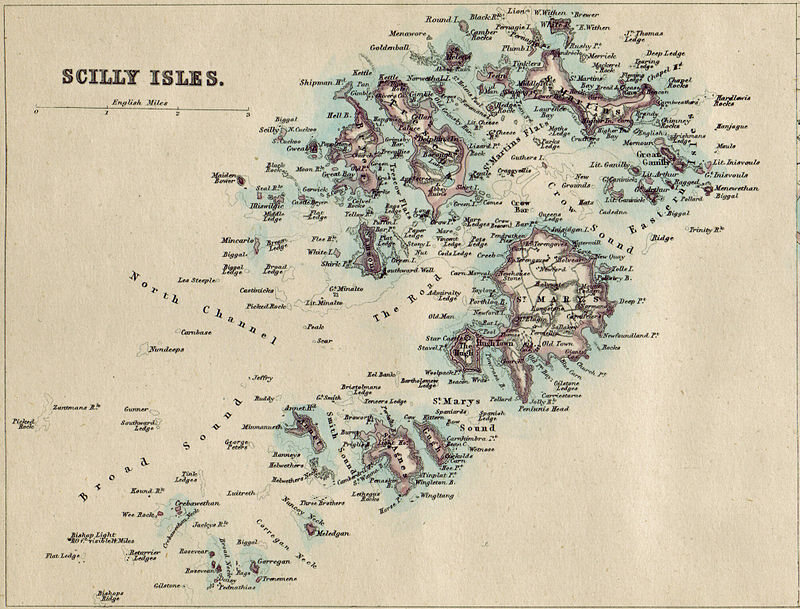
A 19th-century map of the Scilly Isles. (Photo: Public Domain/WikiCommons)

Some historians consider England's Scilly conflict to be the longest war in known history, dragging on for a staggering 335 years. Yet one side was not a country in its own right, there were no casualties for the entire duration, and not a single shot was fired. Neither side even remembered they were still at war until someone checked the paperwork.

All of which begs the question: if war is declared but neither nation remembers, does it still count?

The Isles of Scilly are five inhabited islands and a multitude of other uninhabited rocks off the coast of Cornwall at the southwestern tip of England. With a population of roughly 2,000, the islands rely on fishing and tourism as the main sources of income. It is doubtful that anyone would consider them an international threat. Yet, somehow, they were at war with the Netherlands from 1651 until a mere 30 years ago.

Cromwell's Castle, a 17th-century fort, on the island of Tresco, in the Isles of Scilly. (Photo: Nathan Siemers/flickr)

To understand the origins of the 335-Years' War, we need to go back in English history to the time of the Second Civil War (1642-1648), fought between Oliver Cromwell's Parliamentarians and the Royalists, better known as the Roundheads and the Cavaliers. Cornwall was one of the last Royalist strongholds, but in 1648, it too fell into Cromwell's hands. Britain being an island nation, it had one asset in its Navy, which had declared its support for the Royalists. And so, as the Parliamentarians swept across the country, the Navy was pushed further back until its only possible safe harbor was the Isles of Scilly. At the time, the Isles were owned by Sir John Grenville, a close friend of Prince Charles (later King Charles II), and therefore a staunch Royalist.

Meanwhile, across the English Channel, the Dutch were winning their independence from Spain in the Eighty Years War. The English had been allies with the Dutch since the war's beginning, thanks to the protestant Queen Elizabeth 1. As the Netherlands gained independence they naturally wanted to maintain good relations with England, but with Civil War underway, they had to decide whom to support. Since it looked as though the Parliamentarians would overthrow the Royalists, the Dutch chose to ally with them. This included the support of the Dutch Navy. The Royalist Navy, down in the Scilly Isles, put up quite a strong resistance, seizing a number of Dutch ships and a great deal of cargo.

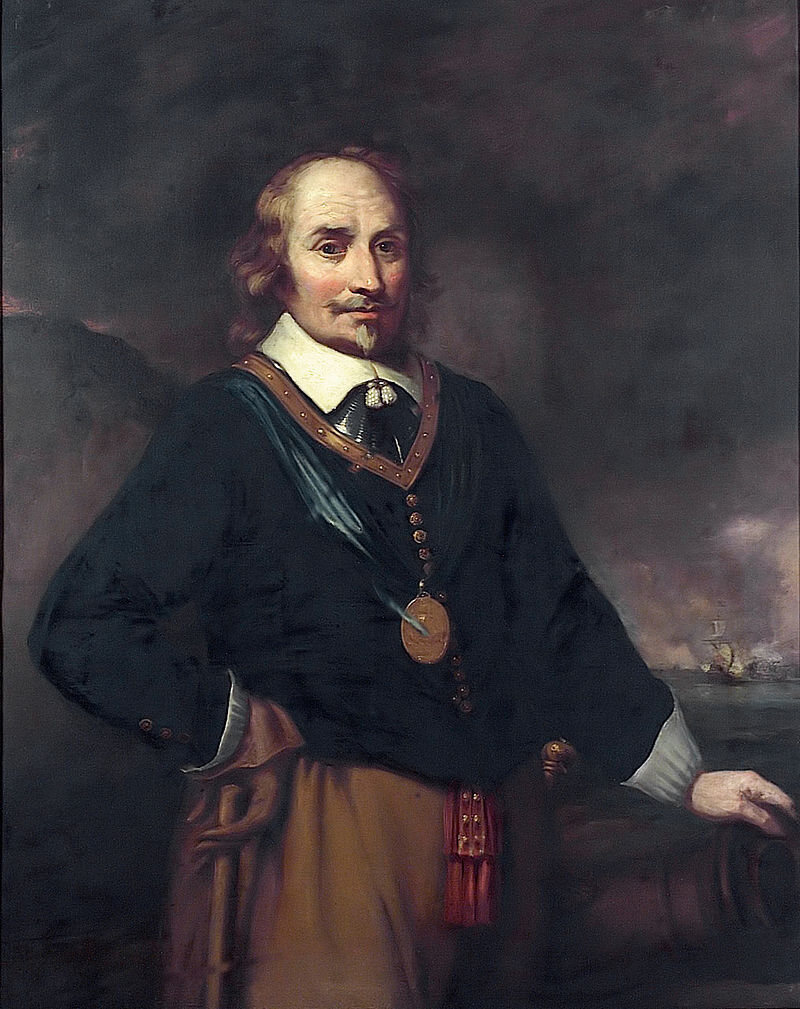
In the spring of 1651, Admiral Maarten Tromp of the Dutch Navy landed to demand reparations. Seeing that none were forthcoming, he reputedly declared war on the Isles of Scilly.

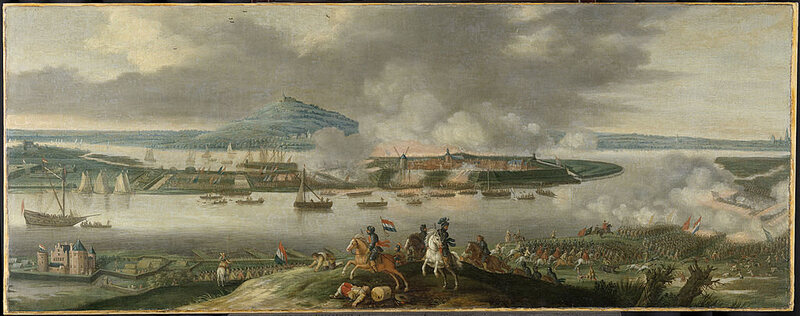
A painting showing the Siege of the Schenkenschans, part of the 80 year war between the Dutch and the Spanish. (Photo: Public Domain/WikiCommons)

Within a matter of weeks, a final push by the Parliamentarians led to the surrender of the remaining Royalist ships. The Dutch knew that they no longer faced any sort of threat and set sail for home. It seems they forgot one minor detail: the Scilly Isles weren't technically a nation in their own right and so no one remembered to make the peace.

Years turned into decades, turned into centuries, and the war with the Dutch fell into local folklore. Generations passed on the tale that the islands remained at war with the Netherlands. No officials seemed to know if it was true or not.

Admiral Maarten Tromp of the Dutch Navy, who reputedly declared war on the Isles of Scilly. (Photo: Public Domain/WikiCommons)

Finally in 1985, a member of the island council and a keen local historian, Roy Duncan, decided to investigate the story for himself. He wrote to the Dutch Embassy, asking them to look into the matter. A response came back: after much searching, it seemed that no record existed of a peace treaty ever being signed. On April 17, 1986, the Dutch Ambassador visited the Isles of Scilly to sign said peace treaty, thereby putting an end to what is now fondly referred to as the 335-Years' War.

Whether the declaration of war was legally binding remains in doubt to this day. Some historians argue that Tromp had no authority to declare war, and was simply blustering in the hopes of receiving compensation for damaged and lost goods. Furthermore, even if his declaration had merit, it surely would have been resolved in the 1654 treaty between England and the newly-formed Netherlands.

An aerial view across Tresco and the other Isles of Scilly. (Photo: Tom Corser/tomcorser.com/WikiCommons CC BY-SA 2.0 UK)

The ceremony marking the signing of the peace treaty in 1986 was more of a publicity move than it was an important event in international relations. Even Duncan admitted that the issue of the war had been "a joke for many years". The signed declaration of peace remains on display in the Council Chambers in Hugh Town on St. Mary's Island, and a quirky incident of British history has allowed the Isles of Scilly to lay claim to a place in the record books.


Wednesday, May 25

Roosevelt declares the Four Freedoms - WWII Today

This chap was one of the greatest ever. Seriously good son. His clarity of thought was amazing and gave rise to some of the greatest of ideas when some of the worst of ideas like the holocaust was around. 
I got so pissed with the Labour Party this week. The politicians were of tiny tiny minds son. The Muslim MP. Red Ken. Jeremy corbyn. The lot. Truly atrocious men and women with tiny minds. Lacking basic humanity. Racist and anti Semitic to boot. 
And then I read this uplifting statement. If there has to be a religion, then just take the universal declaration of human rights and enshrine it. 
Amazing man son. Truly great. 
Love
Baba


Roosevelt declares the Four Freedoms - WWII Today
http://ww2today.com/6th-january-1941-roosevelt-declares-the-four-freedoms
(via Instapaper)


A pre war portrait of United States President Franklin D. Roosevelt

Franklin D. Roosevelt recognised the need to support Britain and other countries in the war. At this time he sought to persuade many Americans that it was in their interests to align themselves against Nazism and dictatorship. Earlier he had argued the case for Lend Lease, which would allow military aid to foreign nations. In his fireside chat of the 29th December 1940 he had declared that America would become the 'Arsenal of Democracy'.
Now he went further with his vision of what America stood for. The Four Freedoms include two values that went beyond the United States' constitution – freedom from want and freedom from fear. The ideas expressed here were to become the cornerstone of the Universal Declaration of Human Rights, and the establishment of the United Nations. They assert a moral purpose that was in direct contradiction Hitler's rambling war aims:
In the future days, which we seek to make secure, we look forward to a world founded upon four essential human freedoms.
The first is freedom of speech and expression – everywhere in the world.
The second is freedom of every person to worship God in his own way – everywhere in the world.
The third is freedom from want – which, translated into world terms, means economic understandings which will secure to every nation a healthy peacetime life for its inhabitants – everywhere in the world.
The fourth is freedom from fear – which, translated into world terms, means a world-wide reduction of armaments to such a point and in such a thorough fashion that no nation will be in a position to commit an act of physical aggression against any neighbor – anywhere in the world.
That is no vision of a distant millennium. It is a definite basis for a kind of world attainable in our own time and generation. That kind of world is the very antithesis of the so-called new order of tyranny which the dictators seek to create with the crash of a bomb.
From Franklin D. Roosevelt's State of the Union Address to the Congress, January 6, 1941
This was not a call to war but it was an unmistakeable declaration of which side the United States stood by.

Saturday, May 14

Want to know somebody's password? offer them chocolate

Social engineering: Password in exchange for chocolate

Date:
May 12, 2016
Source:
Université du Luxembourg
Summary:
It requires a lot of effort and expense for computer hackers to program a Trojan virus and infiltrate individual or company computers. They are therefore increasingly relying on psychological strategies to manipulate computer users into voluntarily divulging their login details. These methods are known as “social engineering”. For the first time, psychologists have conducted a large-scale study (involving 1,208 people) to investigate how people are manipulated into sharing their passwords with complete strangers in return for small gifts.

Thursday, May 12

Trump’s Miss Universe Foreign Policy

Kannu

I had a lovely dinner yesterday at KCL. And I think you would have enjoyed it. It was full of historians, archivists, foreign policy chaps, generals and admirals, and so on and so forth. The conversations were fascinating and wide ranging. We talked about brexit. The afghan army. Military leadership. The Sykes picot agreement and the Russian connection. We talked about how snapchat is used for negotiations and how technology is making the job of historians so much more difficult as they don't have physical evidence any more. The first gulf war had a billion plus bits of paper evidence. The Iraq war was mostly electronic so if somebody wants to write a history or learn about how decisions were made or mistakes undone, there's simply no history to go back to. 

One of the things that KCL is doing is to start a course on grand strategy. National strategy so to say. And I was speaking to the principal and he asked me if it makes sense. I told him, yes as long as you give equal weighting to doing nothing as a strategy. Or if you want to be more pedantic, then that should be divided into three parts. 10% do. 50% don't do anything. 40% fix what you did wrong earlier. We constantly try to do things in grand strategy. Don't. Just don't. It's like a cold. You can run around like an idiot trying to cure yourself. It will take 7 days. Or leave it alone. Eat well. Sleep long. And it will take a week.

 Anyway. It was quite an interesting dinner son. I miss those long rambling discussions. I learnt so much. Each of these chaps were experts in their fields. And I knew I only had 3 hours. It was like being in a gastronomic popup food court and only have 3 hours with only one stomach. Can't really do any more than just taste a bit here and there can I? 

Hope your essays go well Kannu. I met Luca uncle day before and he was asking about you. I told him that you can meet him directly in a month or so :) 

Love

Baba


Trump's Miss Universe Foreign Policy
http://www.nytimes.com/2016/05/11/opinion/trumps-miss-universe-foreign-policy.html
(via Instapaper)


O.K., it's easy to pick on Donald Trump's foreign policy. But just because he recently referred to the attack on the World Trade Center as happening on "7/11" — which is a convenience store — instead of 9/11, and just because he claimed that "I know Russia well" because he held a "major event in Russia two or three years ago — [the] Miss Universe contest, which was a big, big, incredible event" — doesn't make him unqualified.

I'm sure you can learn a lot schmoozing with Miss Argentina. You can also learn a lot eating at the International House of Pancakes. I never fully understood Arab politics until I ate hummus — or was it Hamas?

And, by the way, just because Trump's big foreign policy speech was salted with falsehoods — like "ISIS is making millions and millions of dollars a week selling Libyan oil" — it doesn't make him unqualified.

The New York Times Magazine just profiled one of the president's deputy national security advisers, Ben Rhodes, reporting how he and his aides boasted of using social media, what the writer called a "largely manufactured" narrative, and a pliant press to, in essence, dupe the country into supporting the Iran nuclear deal. The Donald is not the only one given to knuckleheaded bluster and misrepresentation on foreign policy.

Life is imitating Twitter everywhere now.

Indeed, criticizing Trump for inconsistency when it comes to foreign policy is a bit rich when you consider that both Democrats and Republicans have treated Pakistan as an ally, knowing full well that its secret service has trucked with terrorists and coddled the Taliban — the people killing U.S. soldiers in Afghanistan; they've both treated Saudi Arabia as an ally because we needed its oil, knowing full well that its export of Salafist Islam has fueled jihadists; they both supported decapitating Libya and then not staying around to support a new security order, thus opening a gaping hole on the African coast for migrants to flow into Europe; they've both supported NATO expansion into Russia's face and then wondered aloud why the Russian president, Vladimir Putin, is so truculent.

No, if I were critiquing Trump's foreign policy views it would not be on inconsistency, hypocrisy or lying. It would be that he shows no sign of having asked the most important question: What are the real foreign policy challenges the next president will face? I don't think he has a clue, because if he did, he wouldn't want the job. This is one of the worst times to be conducting U.S. foreign policy.

Consider some of the questions that will greet the Oval Office's next occupant. For starters, what does the new president do when the necessary is impossible but the impossible is necessary? Yes, we've proved in Iraq and Afghanistan that we don't know how to do nation-building in other people's countries. But just leaving Libya, Syria and parts of Iraq and Yemen ungoverned, and spewing out refugees, has led to a flood of migrants hitting Europe and stressing the cohesion of the European Union; that refugee flood could very well lead to Britain's exit from the E.U.

President Obama has been patting himself on the back a lot lately for not intervening in Syria. I truly sympathized with how hard that call was — until I heard the president and his aides boasting about how smart their decision was and how stupid all their critics are. The human and geopolitical spillover from Syria is not over. It's destabilizing the E.U., Lebanon, Iraq, Kurdistan and Jordan. The choices are hellish. I would not want the responsibility for making them. But nobody has a monopoly on genius here, and neither Obama's victory lap around this smoldering ruin nor Trump's bombastic and simplistic solutions are pretty to watch.

And there are more of these stressors coming: Falling oil prices, climate change and population bombs are going to blow up more weak states, hemorrhaging refugees in all directions.

There's also the question of what you should do about the networked nihilists? Ever since the rise of Osama bin Laden, super-empowered angry men have challenged us. But at least Bin Laden had an identifiable cause and set of demands: cleansing the Arabian Peninsula of Western influence. But now we are seeing a mutation. Can anyone tell me what the terrorists who killed all those people in Brussels, Paris or San Bernardino wanted? They didn't even leave a note; their act was their note. These suicidal jihadist-nihilists are not trying to win; they just want to make us lose. That's a tough foe. They can't destroy us — now — but they will ratchet up the pain if they get the ammo. Curbing them while maintaining an open society, with personal privacy on your cellphone and the Internet, will be a challenge.

And then there are Russia and China. They're back in the game of traditional sphere-of-influence geopolitics. But both Russia and China face huge economic strains that will tempt their leaders to distract attention at home with nationalist adventures abroad.

The days of clear-cut, satisfying victories overseas, like opening up China or tearing down the Berlin Wall, are over. U.S. foreign policy now is all about containing disorder and messes. It is the exact opposite of running a beauty pageant. There's no winner, and each contestant is uglier than the last.

I invite you to follow me on Twitter.

Follow The New York Times Opinion section on Facebook and Twitter, and sign up for the Opinion Today newsletter.

A version of this op-ed appears in print on May 11, 2016, on page A23 of the New York edition with the headline: Trump's 'Miss' Universe.


Monday, May 9

The Amateur Cloud Society That (Sort Of) Rattled the Scientific Community

One of the downsides of being constantly on the phone kids, is that I don't look up often. But thankfully I'm working on level 37 and I get to see amazing sights and cloud formations across London. Some of the best times of my life has been when I've been lying on the grass during summer and looking up into the skies and imagining the clouds. The fantastic shapes and animals and dragons and planes. So don't let this or any other summer pass without checking out the clouds kids. Some amazing memories then :) 

Have a wonderful week kids. I love you

Baba


The Amateur Cloud Society That (Sort Of) Rattled the Scientific Community
http://www.nytimes.com/2016/05/08/magazine/the-amateur-cloud-society-that-sort-of-rattled-the-scientific-community.html
(via Instapaper)


Gavin Pretor-Pinney decided to take a sabbatical. It was the summer of 2003, and for the last 10 years, as a sideline to his graphic-design business in London, he and a friend had been running a magazine called The Idler. The Idler was devoted to the "literature for loafers." It argued against busyness and careerism and for the ineffable value of aimlessness, of letting the imagination quietly coast. Pretor-Pinney anticipated all the jokes: that he'd burned out running a magazine devoted to doing nothing, and so on. But it was true. Getting the magazine out was taxing, and after a decade, it seemed appropriate to stop for a while and live without a plan — to be an idler himself and shake free space for fresh ideas. So he swapped his flat in London for one in Rome, where everything would be new and anything could happen.

Pretor-Pinney is 47, towering and warm, with a sandy beard and pale blue eyes. His face is often totally lit up, as if he's being told a story and can feel some terrific surprise coming. He stayed in Rome for seven months and loved it, especially all the religious art. One thing he noticed: The paintings and frescoes he encountered were crowded with clouds. They were everywhere, he told me recently, "these voluptuous clouds, like the sofas of the saints." But outside, when Pretor-Pinney looked up, the real Roman sky was usually devoid of clouds. He wasn't accustomed to such endless, blue emptiness. He was an Englishman; he was accustomed to clouds. He remembered, as a child, being enchanted by them and deciding that people must climb long ladders to harvest cotton from them. Now, in Rome, he couldn't stop thinking about clouds. "I found myself missing them," he told me.

Clouds. It was a bizarre preoccupation, perhaps even a frivolous one, but he didn't resist it. He went with it, as he often does, despite not having a specific goal or even a general direction in mind; he likes to see where things go. When Pretor-Pinney returned to London, he talked about clouds constantly. He walked around admiring them, learned their scientific names and the meteorological conditions that shape them and argued with friends who complained they were oppressive or drab. He was realizing, as he later put it, that "clouds are not something to moan about. They are, in fact, the most dynamic, evocative and poetic aspect of nature."

Slowing down to appreciate clouds enriched his life and sharpened his ability to appreciate other pockets of beauty hiding in plain sight. At the same time, Pretor-Pinney couldn't help noting, we were entering an era in which miraculousness was losing its meaning. Novel, purportedly amazing things ricocheted around the Internet so quickly that, as he put it, we can now all walk around with an attitude like, "Well, I've just seen a panda doing something unusual online, what's going to amaze me now?" His fascination with clouds was teaching him that "it's much better for our souls to realize we can be amazed and delighted by what's around us."

At the end of 2004, a friend invited Pretor-Pinney to give a talk about clouds at a small literary festival in Cornwall. The previous year, there were more speakers than attendees, so Pretor-Pinney wanted an alluring title for his talk, to draw a crowd. "Wouldn't it be funny," he thought, "to have a society that defends clouds against the bad rap they get — that stands up for clouds?" So he called it "The Inaugural Lecture of the Cloud Appreciation Society." And it worked. Standing room only! Afterward, people came up to him and asked for more information about the Cloud Appreciation Society. They wanted to join the society. "And I had to tell them, well, I haven't really got a society," Pretor-Pinney said.

He set up a website. It was simple. There was a gallery for posting photographs of clouds, a membership form and a florid manifesto. ("We believe that clouds are unjustly maligned and that life would be immeasurably poorer without them," it began.) Pretor-Pinney wasn't offering members of his new Cloud Appreciation Society any perks or activities, but to keep it all from feeling ephemeral or imaginary, as many things on the Internet do, he eventually decided that membership should cost $15 and that members would receive a badge and certificate in the mail. He recognized that joining an online Cloud Appreciation Society that only nominally existed might appear ridiculous, but it was important to him that it not feel meaningless.

Within a couple of months, the society had 2,000 paying members. Pretor-Pinney was surprised and ecstatic. Then, Yahoo placed the Cloud Appreciation Society first on its 2005 list of Britain's "Weird and Wonderful websites." People kept clicking on that clickbait, which wasn't necessarily surprising, but thousands of them also clicked through to Pretor-Pinney's own website, then paid for memberships. Other news sites noticed. They did their own articles about the Cloud Appreciation Society, and people followed the links in those articles too. Previously, Pretor-Pinney proposed writing a book about clouds and was rejected by 28 editors. Now he was a viral sensation with a vibrant online constituency; he got a deal to write a book about clouds.

The writing process was agonizing. On top of not actually being a writer, he was a brutal perfectionist. But "The Cloudspotter's Guide," published in 2006, was full of glee and wonder. Pretor-Pinney relays, for example, the story of the United States Marine pilot who, in 1959, ejected from his fighter jet over Virginia and during the 40 minutes it took him to reach the ground was blown up and down through a cumulonimbus cloud about as high as Mount Everest. He surveys clouds in art history and Romantic poetry and compares one exceptionally majestic formation in Australia to "Cher in the brass armor bikini and gold Viking helmet outfit she wore on the sleeve of her 1979 album 'Take Me Home.' " In the middle of the book, there's a cloud quiz. Question No. 5 asks of a particular photograph, "What is it that's so pleasing about this layer of stratocumulus?" The answer Pretor-Pinney supplies is "It is pleasing for whatever reason you find it to be."

The book became a best seller. There were more write-ups, more clicks, more Cloud Appreciation Society members. And that cycle would keep repeating, sporadically, for years, whenever an editor or blogger happened to discover the society and set it off again. (There are now more than 40,000 paid members.) The media tended to present it as one more amusing curiosity, worth delighting over and sharing before moving on. That is, Pretor-Pinney's organization was being tossed like a pebble, again and again, into the same bottomless pool of interchangeable online content that he was trying to coax people away from by lifting their gaze skyward. But that was O.K. with him; he understood that it's just how the Internet works. He wasn't cynical about it, and he didn't feel his message was being cheapened either. It felt as if he were observing the whole thing from afar, and he tried to appreciate it.

Then Pretor-Pinney noticed something odd.

"The way I felt when I first saw it was: Armageddon," Jane Wiggins said. Wiggins was a paralegal, working in downtown Cedar Rapids, Iowa, in June 2006, when she looked out her office window and saw an impenetrable shroud of dark clouds looming over town. Everyone in the office stood up, Wiggins told me, and some drifted to the window. The cloud was so enormous, so terrible and strange, that it made the evening news. Wiggins, who had recently taken up photography, took out her camera.

Soon after that, Wiggins discovered the Cloud Appreciation Society website and posted one of her pictures in its gallery. But the anomaly Wiggins thought she had captured wasn't actually anomalous. Similar photos turned up in the Cloud Appreciation Society's gallery from Texas, Norway, Ontario, Scotland, France and Massachusetts. Pretor-Pinney assumed that this phenomenon was so rare that, until now, no one had recognized it as a repeating form and given it a name. "As the hub of this network, a network of people who are sky-aware," he said, "it's easier to spot patterns that, perhaps, weren't so easy to spot in the past."

In fact, many aspects of meteorology already rely on a global network of individual weather observers to identify cloud types with the naked eye, filing them into a long-established scientific framework: not just as cumulus, cirrus, stratus or cumulonimbus clouds, as schoolchildren learn, but within a recondite system for describing variations. Atypical clouds are either fitted into that existing map of the sky or set aside as irrelevant. Pretor-Pinney liked classifying clouds using these names; he was thankful to have that structure in place. And yet, it seemed a shame to repress the glaring, deviant beauty recorded in Wiggins's photograph by assigning it a name that didn't sufficiently describe it. He supposed, if you had to, you could call this thing an undulatus — the standard classification for a broad, wavy cloud. But that seemed to be selling the cloud tragically short, stubbornly ignoring what made it so sublime. This was "undulatus turned up to 11," he said. So he came up with his own name for the cloud: asperatus. (The word "asperatus" came from a passage in Virgil describing a roughened sea; Pretor-Pinney had asked his cousin, a high-school Latin teacher, for help.) He wondered how to go about making such a name official.

In 2008, while shooting a documentary for the BBC about clouds, Pretor-Pinney pitched his new cloud to a panel of four meteorologists at the Royal Meteorological Society. The scientists sat in a line behind a table; Pretor-Pinney stood, holding blown-up photos of asperatus for them to consider. "It was a lot like 'The X Factor,' " he said, referring to the TV talent show. The scientists were encouraging but diplomatic. A new cloud name, they explained, could be designated only by the World Meteorological Organization, an agency within the United Nations, based in Geneva, which has published scientific names and descriptions of all known cloud types in its International Cloud Atlas since 1896. The W.M.O. is exceptionally discerning; for starters, Pretor-Pinney was told, he would need more carefully cataloged incidences of these clouds, as well as a scientific understanding of their surrounding "synoptic situation." The process would take years. And even then, the chances of inclusion in the atlas were slim. The W.M.O. hadn't added a new cloud type to the International Cloud Atlas since 1953. "We don't expect to see new cloud types popping up every week," a W.M.O. official named Roger Atkinson told me. When I asked why, Atkinson said, "Because 50 or 60 years ago, we got it right."

Asperitas cloud photographed by a contributor to the Cloud Appreciation Society in Burnie, Tasmania, Feb. 20, 2004. Gary McArthur

A cloud is only water, but arranged like no other water on earth. Billions of minuscule droplets are packed into every cubic foot of cloud, throwing reflected light off their disordered surfaces in all directions, collectively making the cloud opaque. In a way, each cloud is an illusion, a conspiracy of liquid masquerading as a floating, solid object.

But for most of human history, what a cloud was, physically, hardly mattered; instead, we understood clouds as psychic refuges from the mundane, grist for our imaginations, feelings fodder. Clouds both influenced our emotions and hung above us like washed-out mirrors, reflecting them. The English painter John Constable called the sky the "chief organ of sentiment" in his landscapes. And our instinct, as children, to recognize shapes in the clouds is arguably one early spark of all the higher forms of creative thinking that make us human and make us fun. Frankly, a person too dull to look up at the sky and see a parade of tortoises or a huge pair of mittens or a ghost holding a samurai sword is not a person worth lying in a meadow with. In "Hamlet," Polonius's despicable spinelessness is never clearer than when Hamlet gets him to enthusiastically agree that a particular cloud looks like a camel, then not a camel at all, but a weasel. Then, not a weasel but a whale. Polonius will see whatever Hamlet wants him to; he is a man completely without his own vision.

We look for meaning — portents — in the clouds as well, the more grown-up version of picking out puffy animals. "There's a long history of people finding signs in the sky," Pretor-Pinney told me, from Constantine seeing the cross over the Milvian Bridge to the often-belligerent protesters outside Pretor-Pinney's talks, who are convinced that the contrails behind commercial airplanes are evidence of a toxic, secret government scheme and are outraged that Pretor-Pinney — the righteous Lorax of clouds — refuses to expose it. In short, clouds exist in a realm where the physical and metaphysical touch. "We look up for answers," Pretor-Pinney says. And yet, we often don't want empirical answers. There has always been a romantic impulse to protect clouds from our own stubbornly rational intellects, to keep knowledge from trampling their magic. Thoreau preferred to understand clouds as something that "stirs my blood, makes my thought flow" and not as a mass of water. "What sort of science," he wrote, "is that which enriches the understanding but robs the imagination."

The scientific study of clouds grew out of a collection of madly appreciating amateurs who struggled with this same tension. The field's foundational treatise was first presented to a small scientific debating society in London one evening in 1802 by a shy Quaker pharmacist named Luke Howard. Howard, then 30, was not a professional meteorologist but a devoted cloud-spotter with a perceptive, if wandering, mind. His interest in clouds started early. His biographer, Richard Hamblyn, explains that as a young student in Oxfordshire, Howard seems to have found school magnificently boring. He couldn't bring himself to pay attention, except to his Latin teacher, who punished daydreaming with beatings. Today Howard might covertly pull out his phone and read a link a friend shared about, say, an eccentric society in England that appreciates clouds. But poor Howard's boredom was analog: all he could do was look out the classroom window at the actual clouds rolling by.

Howard's intention that night in London was to bring clouds down to earth without depleting their loftiness. After years of closely observing clouds, his appreciation of them had hardened into analysis. He now insisted that, though clouds may appear to be blown around in random, ever-changing shapes, they actually take consistent forms, forms that can be distinguished from one another and whose changes correspond to changes in the atmosphere. Clouds can be used to read what Howard called "the countenance of the sky"; they are an expression of its moods, not just in a poetic way, as Constable meant, but meteorologically.

Howard's lecture was eventually published as "On the Modifications of Clouds, and on the Principles of Their Production, Suspension and Destruction." It stands as the ur-text of nephology, the branch of meteorology devoted to clouds. Howard divided clouds into three major types and many intermittent varieties of each, all similarly affixed with Latin names or compounds. (He had learned his Latin well.) Like Linnaeus, who used Latin to sort the fluidity of life into genera and species, Howard used his new cloud taxonomy to wrest our understanding of the world's diversity from superstition and religion. His signature assertion that "the sky, too, belongs to the Landscape" can be read as a call for empiricism — a conviction that science can, in fact, measure out the mystical.

Nearly a century later, Howard's work would be picked up by another energetic amateur, the Honorable Ralph Abercromby. Abercromby was the bookish great-grandson of a celebrated English war hero. He was apparently so meek and frail ("never robust, even as a boy," one tribute read after his death) that he was forced to drop out of school and was rarely able to hold a job. He served briefly in the military but seemed completely unsuited to soldiering; deployed to Newfoundland in 1864, Abercromby began theorizing about how the fog there was produced. Later, stationed in Montreal, he scrutinized the wind. It would have been tempting for his superiors to label him "absent-minded" or "unfocused" but, in retrospect, it was just another case of a young man intensely focused on something few people considered worthy of attention — another case of a young man in love with clouds.

Asperitas cloud photographed by a contributor to the Cloud Appreciation Society in Turtle Lake, Wis., July 16, 2008. Danielle Maxwell-Parker

In 1885, Abercromby took his first round-the-world voyage. He was a civilian again, and his private physician hoped the sea air would restore his pitiable health. But he worked slavishly the whole time, keeping a meticulous weather diary, photographing the clouds at sea. He published many scientific papers and a book about the clouds and weather that he encountered. And he kept traveling: Scandinavia and Russia, Asia and the United States, compelled, as he wrote, to "continue the observation and photography of cloud forms in different countries." Looking up, Abercromby came to realize that clouds looked essentially the same everywhere. Colonialism was sending goods, resources and culture around the planet; suddenly, it must have seemed obvious that we also shared the same sky.

Abercromby's primary interest was in refining the science of weather-tracking and forecasting, and he knew that meteorologists everywhere would need a standard way to discuss and share their observations. Eventually, collaborating with a Swedish cloud scientist named Hugo Hildebrand Hildebrandsson, he convened a Cloud Committee to hammer out Hildebrandsson's meticulous "Nomenclature of Clouds." They declared 1896 "the International Year of the Cloud." By year's end, the committee produced the first International Cloud Atlas.

The atlas is now in its seventh edition, and its meticulous taxonomy provides for 10 genera of clouds, 14 species, nine varieties and dozens of "accessory clouds" and "supplementary features." The atlas also establishes a grammar with which these terms can be combined to allow for the instability of clouds — the way they morph from one form into another — or to describe their general altitude. A cumulus, for example, might just be a cumulus; or it might be a cumulus fractus, if its edges are tattered; or a cumulus pileus, if a smaller cloud appears over it like a hood. An altocumulus lenticularis, meanwhile, is a vast, tightly bunched flock of clouds stretching across the sky at altitudes from 6,500 to 23,000 feet.

Of course, not everything in the sky needs to be precisely described. As a reference book for meteorologists, the atlas has been concerned only with clouds that have "operational significance" — that reliably reveal something about atmospheric conditions. As far as other clouds go, says Roger Atkinson of the W.M.O., one person might look at a cloud and say: " 'It's wonderful. It looks like an elephant,' and someone else might think, It's a camel." But the W.M.O. doesn't particularly care. It does not see its mission as settling disagreements about elephants and camels.

Soon after Pretor-Pinney appeared on the BBC, championing his asperatus cloud, the media seized on the possibility, however remote, that the W.M.O. would add asperatus to its atlas. Suddenly, there were stories about the Cloud Appreciation Society all over the place, all over again. This time, Pretor-Pinney — previously cast as a charming English eccentric with a funny website — was presented as the crusading figurehead of a populist meteorological revolt. Pretor-Pinney had initially turned defeatist after shooting the documentary and never bothered reaching out to the W.M.O.; the bureaucracy seemed too formidable. Now he didn't quite know what to say. When reporters called, he suggested they contact the W.M.O., impishly channeling them as de facto lobbyists.

Then, in 2014, the W.M.O. announced it was preparing the first new edition of the Cloud Atlas in nearly 40 years; the agency felt pressure to finally digitize the book, to reassert its authority over the many reckless cloud-reference materials proliferating online. One of the W.M.O.'s first steps was to convene an international Task Team to consider additions to the atlas. "Most public interest," a news release noted, "has focused on a proposal by the Cloud Appreciation Society" to recognize the so-called asperatus. The Task Team would report to a so-called Commission for Instruments and Methods of Observation. Last summer, the commission recommended to the World Meteorological Organization's 17th World Meteorological Congress in Geneva that the cloud be included. Everyone seemed confident that the recommendation would soon be ratified by the W.M.O.'s executive council. Except, the new cloud wasn't asperatus anymore; it was now asperitas. The Task Team had demoted it from a cloud "variety," as Pretor-Pinney had proposed, to a "supplementary feature," and the elaborate naming convention for clouds required supplementary features to be named with Latin nouns, not adjectives. "One of those things that's so close, but different," Pretor-Pinney told me, with a tinge of amusement and resentment.

When I spoke to Roger Atkinson, of the W.M.O., he stressed that asperitas would merely be "a fourth-order classification, not a primary genus, not one of the primary cloud types, not one of the Big Nine." Neither was it the only new classification the Task Team recommended adding; it was just the most famous one. The prominence of the cloud seems to have forced the scientists' hand. Asperitas didn't appear to have any operational significance, but the public enthusiasm Pretor-Pinney had gathered around the cloud ultimately made asperitas too prominent to ignore. One task-team member, George Anderson, told me that not giving such a well-known cloud a definitive name would only create more confusion.

Asperitas cloud photographed by a contributor to the Cloud Appreciation Society in Duffel, Belgium, June 9, 2014. Brecht Iliaens

Pretor-Pinney conceded all this, happily. "My argument is not that this is some hugely significant thing," he told me. By now, he was mostly using the cloud to make a point — to needle the "human vanity" inherent in "the Victorian urge to classify things, to put them into pigeonholes and give them scientific names." Clouds, he added, "are ephemeral, ever-changing, phenomenal. Here you have a discrete, scientific, analytic urge laid onto the embodiment of chaos, onto these formations within these unbounded pockets of our atmosphere where there's no beginning and no edge." All he wanted was to encourage people to look at the sky, to elevate our perception of clouds as beautiful "for their own sake."

Slowly, over the last 200 years, the impulse of cloud lovers like Howard and Abercromby to make the mystical empirical had ossified into something stringent and reductive. Pretor-Pinney wanted to clear a little more space in our collective cloudscape for less distinct feelings of delight and wonder. His championing of asperatus was, in reality, somewhat arbitrary. There were a few other unnamed cloud forms he saw repeating in the society's photo gallery. He just happened to pick this one.

The cultural history of clouds seemed to be shaped by a procession of amateurs, each of whom projected the ethos of his particular era onto those billowing blank slates in the troposphere. Pretor-Pinney was our era's, I realized — the Internet era's. He wasn't just challenging the cloud authorities with his crowdsourced cloud; he was trolling them.

I was one of the many reporters who contacted Pretor-Pinney when the first photos of asperitas made the rounds in 2009. I had seen an Associated Press article, with Jane Wiggins's photo of the cloud in Iowa, and a reference to Pretor-Pinney and his Cloud Appreciation Society and felt a kind of instant and exhilarated envy: Apparently, some people cultivated a meaningful connection to what I'd only ever regarded as vaporous arrangements of nothingness. I wanted in. Also, I was impressed that these enthusiasts seemed to be rattling the self-serious strictures of the scientific establishment. And so it was disappointing to realize, in those early days and as I checked back with him periodically, that nothing was really happening yet and that no one seemed particularly rattled. Pretor-Pinney even sounded slightly exhausted by asperitas. "It's the zombie news story that will never die!" he said.

He was, by then, closing in on his 10th year as head of the Cloud Appreciation Society and, as he'd done after 10 years with The Idler magazine, he was questioning his commitment to it. Somehow, being a cloud impresario had swallowed an enormous amount of time. He was lecturing about clouds around the world, sharing stages at corporate conferences and ideas festivals with Snoop Dogg and Bill Clinton and appearing monthly on the Weather Channel. Then there was the Cloud Appreciation Society's online store, a curated collection of society-branded merchandise and cloud-themed home goods, which turned out to be surprisingly demanding, particularly in the frenzied weeks before Christmas. The Cloud Appreciation Society was basically just Pretor-Pinney and his wife, Liz, plus a friend who oversaw the shop part time and a retired steelworker he brought on to moderate the photo gallery. It was all arduous, which Pretor-Pinney seemed to find a little embarrassing. "My argument about why cloud-spotting is a worthwhile activity is that it's an aimless activity," he said. "And I've turned it into something that is very purposeful, that is work."

At the same time, he realized that he'd conjured a genuine community of amateur cloud-lovers from all over the world but regretted never doing anything to truly nourish it; it felt so "fluffy," he said, "with no center to it, like a cloud." Soon, that spectral society — that cloud of people on the Internet — would be celebrating its 10th anniversary. "I'm thinking that it might be a nice reason to get everyone together," he said.

One morning last September, Pretor-Pinney was fidgeting and fretting in the auditorium of the Royal Geographical Society building, at the edge of Kensington Gardens in London. Escape to the Clouds, a one-day conference to celebrate the Cloud Appreciation Society's 10th anniversary, would be underway in 90 minutes, and Pretor-Pinney was impatiently supervising the small team of balloon-installation artists he had commissioned to rig inflatable cloud formations around the stage. This was the first big event that he organized for the Cloud Appreciation Society. The evening before the conference, he was expecting 315 attendees. But there was a late surge of ticket-buying, and now he was panicking about running out of artisanal Cloud-Nine Marshmallows for the gift bags. Outside, Pretor-Pinney kept pointing out, the London sky was impeccably blue. Not a single cloud. It was terrible.

Asperitas cloud photographed by a contributor to the Cloud Appreciation Society in Lofoten Islands, Norway, July 22, 2006. Ragnhild Margrethe Hansen

Bounding onstage to kick off the conference, Pretor-Pinney seemed overwhelmed but cheerful. He reminded the muddle of cloud appreciators from all over the world, now crammed into the theater, that "to tune into the clouds is to slow down. It's a moment of meteorological meditation." And he celebrated the transcendence of cloud-spotting: how it connects us to the weather, the atmosphere, to one another. "We are part of the air," he told everyone. "We don't live beneath the sky. We live within the sky."

Who were they all? Why were they there? They were a collection of ordinary people with an interest in clouds. Behind all those user names on the Cloud Society website were schoolteachers, sky divers, meteorologists, retired astronomy teachers, office workers and artists. Many people had come alone, but conversations sparked easily. ("I've just seen the best cloud dress I've seen in my life," a woman said on the stairway. A second woman turned and said, "Well, yours is quite lovely, too.") The atmosphere was comfortable and convivial and amplified by a kind of feedback loop of escalating relief, whereby people who arrived at a cloud conference not knowing what to expect recognized how normal and friendly everyone was and enjoyed themselves even more.

The program Pretor-Pinney had pulled together was a little highbrow but fun. A British author recounted the misadventures of the first meteorologist to make a high-altitude balloon ascent. An energetic literary historian surveyed "English Literary Views of the Sky." Pretor-Pinney and a professor of physics tried to demonstrate a complicated atmospheric freezing process in a plastic bottle, but failed. And between the talks, a musician named Lisa Knapp performed folk songs about wind and weather. She had saved the obvious crowd-pleaser for her final turn onstage: the melancholy Joni Mitchell classic "Both Sides, Now."

There would be one more talk after Knapp finished, but it didn't matter. This — the Joni Mitchell moment — was the conference's transformative conclusion. Knapp had an extraordinary voice, Bjork-like, but gentler, and performed the song alone, accompanying herself with only a delicate, monotonal Indian classical instrument resting in her lap, a kind of bellows, called a shruti box. It let out a mournful, otherworldly drone. After hours of lectures and uncertain socializing with strangers, something about this spare arrangement and the sorrowful lyrics felt so vulnerable that, by the time Knapp finished the first lines — "Rows and flows of angel hair, and ice cream castles in the air, and feather canyons everywhere. I've looked at clouds that way" — she was singing into an exquisite silence.

The performance moved me. But it was more than that, and weirder. Maybe, somewhere in this story about clouds and cloud lovers, I'd found a compelling argument for staying open to varieties of beauty that we can't quite categorize and, by extension, for respecting the human capacity to feel, as much as our ability to scrutinize the sources of those feelings. Whatever the case, as Knapp sang, I started to feel an inexplicable rush of empathy for the people I met that day, the people sitting around me — all these others, living within the same sky. And I let my mind wander, wondering about their lives. What I felt, really, was awe: the awe that comes when you fully internalize that every stranger's interior life is just as complicated as yours. It seemed very unlikely that a meeting of an online cloud society in a dark, windowless room could produce such a moment of genuine emotion, but there I was, in the middle of it. Just thinking about clouds, I guess, had turned a little transcendent, at least for me.

Then I heard the sniffle. It was very loud. With the room so transfixed, it easily cut through Knapp's voice from a few rows behind me, and when I turned to look, I saw Pretor-Pinney's wife fully in tears. Then, the woman right next to me, she was crying, too. And I heard others inhaling loudly, oddly, and got the impression there were more. Immediately afterward, out in the hall, the first person I walked past was bashfully apologizing to two others. It was so strange, she kept saying. She just didn't know why she'd been crying.

A couple of days later, I tried to describe it in an email to a friend: "Many people spontaneously cried, just releasing their tears like rain, and I realized that we are all human beings — that's the truth ... in all our different forms and sizes, we are expressions of the same basic currents, just like the clouds." And when I read the email back, I was mortified by how fluffy and stoned it sounded, but still — even now — I can't pretend it's not true.

Jon Mooallem is a contributing writer and the author of "Wild Ones" and "American Hippopotamus." He last wrote about Edward Burtynsky's images of copper mines.

Sign up for our newsletter to get the best of The New York Times Magazine delivered to your inbox every week.

A version of this article appears in print on May 8, 2016, on page MM28 of the Sunday Magazine with the headline: Head in the Clouds.


Friday, May 6

Women ratchet themselves up the social ladder, one high heel at a time

Heels terrify me...they are just lethal I tell you. Couple of my friends at work tried to explain how heels work but I gave up...apparently there is some deep significance to women's shoes which have a red underside but didnt quite comprehend why that is so important. 

Anyway, this research seems to say that women tend to keep up with the rich based on their heels...I quote

Fashion seems to embrace two opposite goals--fitting in with the crowd and standing out from it. Now new research reveals that the choice to fit in or stand out depends on who exactly the crowd is -- and the size of their high heels. That is, women adjust their fashion to look similar to the rich but different from the poor.Kurt Gray, a co-author at the University of North Carolina at Chapel Hill, and his colleagues investigated thousands of shoe purchases made by women who move to different cities, showing that women adopt the local trends when moving to wealthier cities but ignore them when moving to lower socioeconomic (SES) cities."In other words, women want to look like the rich girls, and different from the poor girls," said Gray, an assistant professor of psychology in UNC College of Arts and Sciences.To examine trends of conformity and individuality, Gray and his colleagues at Carnegie Mellon University and Yale University teamed up with a large-online fashion retailer. They examined five years of shoe purchases--16,236 in total--of 2007 women who moved between one of 180 U.S. cities. Because fashion choices are hard to quantify, they used a straightforward number: the size of high heels.Their analyses revealed that heel sizes changed when women moved, but not uniformly. When women moved to higher SES zip codes such as New York City or Los Angeles, the heel size closely matched the heel size that other women in that zip code had bought--showing a desire for conformity. But when women moved to lower SES zip codes, the heel size closely matched the heel size of their own past purchase--showing a desire to keep their individuality.The team of researchers, who included Jeff Galak, Nina Strohminger, Igor Elbert and Gray, label this phenomenon "trickle down conformity," because fashion preferences trickle down from the top but seldom up from the bottom. As Gray explained, "Walmart watches the styles on the runways in Milan, but Milan never watches the styles at Walmart."The explanation for this lopsided conformity is the deep human urge for status. "From the beginning of time, people have thirsted for respect and social standing, and have aligned themselves with the powerful and distanced themselves from the powerless," said Gray. "So it makes sense that they do the same with heel sizes."There is also reason to believe that this "aspirational fashion" is getting more prevalent. Inequality is increasing in America, and research reveals that the bigger the gap between rich and poor, the more people want to look rich. Such aspirations fuel the fortunes of fashion sites that provide high-status goods for low prices.This study examined only women, but there is no reason to believe it applies only to them. "Men do the same thing when they purchase clothes, electronics or cars," said Gray, "When you move from Wichita to LA, you look around and sell your Chevy for a BMW, but when you move from Los Angeles to Wichita, Kansas, you look around, and then just keep the BMW."This research builds off the past work of Gray and Strohminger, which examined what color combinations make outfits the most fashionable. "We often think of fashion as something frivolous, but it's an industry worth $1.7 trillion annually, and clothing often helps define ourselves," said Gray.With their current study, Gray and colleagues reveal that fashion industry isn't only about making money, but letting people look like they belong with money.
Story Source:The above post is reprinted from materials provided by University of North Carolina at Chapel HillNote: Materials may be edited for content and length.
Journal Reference:
  1. Jeff Galak, Kurt Gray, Igor Elbert, Nina Strohminger. Trickle-Down Preferences: Preferential Conformity to High Status Peers in Fashion ChoicesPLOS ONE, 2016; 11 (5): e0153448 DOI:10.1371/journal.pone.0153448
https://www.sciencedaily.com/releases/2016/05/160504174852.htm


Thursday, May 5

How school grooms African Americans for the underclass – D Watkins | Aeon Essays

As you know kids, I recently visited kannu's old school and Diya's current school. And I'm just so blessed with you two. You are so smart and intelligent. You work hard. You're disciplined. You love to learn and study and I can see you guys growing every day in school. 

I walk around the school corridors and see smiling teachers. I don't see security. I see happy children. It's clean. It's full of inspirational posters. I see bee jokes and puns. I see paintings of heros. I see quotes. I see photographs of students. I see a memorial to your school students who graduated and died in the service of the country. 150 years old? And it's a government school. Nothing extraordinary. A bog standard comprehensive. Paid out of general taxation. With extremely high standards. Not a private school or a grammar school. A common school. 

And then I read this article about another school. In a very rich big giant country. A totally shocking description of the school. Imagine needing to security scan children in? Smelling of pee and shit? How can kids learn? 

It is horrendous. In my work with the STEM and teach first, I've never seen anything like this in London and it does have some grotty schools. 

Just what are we raising? 

Much to think about. 

But I love both of you and I'm very proud of what you two have done with your life. I'm blessed with the bestest kids ever. Thank you kids. 

Love

Baba


How school grooms African Americans for the underclass – D Watkins | Aeon Essays
https://aeon.co/essays/how-school-grooms-african-americans-for-the-underclass
(via Instapaper)


My 13-year-old nephew Butta was getting into trouble weekly. Arguing with teachers, ignoring administrators, and walking out of class. To the point where my sister had a time-block in her schedule every month dedicated to parent-teacher conferences – but they didn't work.

Butta is as harmless as he is plump – that jolly kid who loves to split up his chips between his friends and would gladly give you the last bite of his sandwich. He's never been in trouble outside of school, which says a lot, since his dad, the rest of his uncles and I had all been arrested or kicked out of a school at least once by the time we reached his age.

'What's going on with your classes?' I asked him.

'My teachers hate me and they throw me in wit Mr Ronald, that sub who be on his phone all day, talkin' about he don't need this job, cuz he got his own company! He ain't got no company!'

Butta's in middle school so he should have more than one teacher. But they throw all the troubled kids in one class with a long-term substitute teacher all day, where they are allowed to shoot dice, play cards, IG, Tweet, Facebook, dance, stand on desks and basically do whatever they please. I've been guilty of pushing subs around – everybody taunts the sub when the normal teacher is absent, but these kids have been doing this for months.

Everyone knows how tough the middle schools in Baltimore are. I recently had a conversation with Stacey Cook, a former teacher from James McHenry Elementary/Middle in South Baltimore and she told me that they had multiple shootings last year, right in front of their building during school hours. 'One day the gym teacher was almost caught in the crossfire. He hit the buzzer, fearing for his life, begging to be let in. But the principal waited until the shooting stopped. He said we knew where we were and that's how it is. The gym teacher, me and a bunch of other educators left at the end of the year.'

I'm grateful that no one has shot up my nephew's school, but his learning experience was still criminal. Being trapped in a room for six-plus hours a day, surrounded by chaos and a sub fingering his phone sounds illegal.

I thought that Butta and his teachers probably had a communication problem that I could mediate. A lot of inner-city teachers are used to dealing with just one parent, if any – I wanted to be the objective voice considering all points of view with the hope of helping him develop a working relationship with his teacher and getting back on track, so I decided to visit.

My sister and I pulled up in front of his school on a Monday. It looked clean from the outside and was located on a nice tree-lined block.

We were buzzed into a narrow hallway. Three huge school officers in small uniforms clogged the path. They looked like COs. The built-in metal detector was cracked and unplugged, so in prison fashion one of the guards scanned us with a wand while another checked our credentials. We passed their test and were directed to the main office, a level up at the end of the same hallway.

The stairwell smelled like used rubbers and rat piss. Blunt guts, unidentifiable fluids and candy wrappers laced the floor. I stepped over all of that and made my way to the office. Some concerned-looking parents and guardians were present, probably trying to see what it would take to make sure their kids received a quality education – the same thing I wanted to do for Butta.

I got the concept of dreaming; but my ancestors came here bearing only fear, chains and uncertainty

We greeted the secretary. She seemed nice, remembered my sister and instructed us to sign in before sending us up to Butta's class. That same funky smell in the stairwell greeted us again as we advanced another level.

This school seemed like a jail, and level two – Butta's floor – was the psych ward. Students bolting up and down the hallways, desks taking flight, a trail of graded and ungraded papers scattered everywhere, fight videos being recorded on cellphones, Rich Homie Quan turned to the highest level, crap games and card games going down with children named Bitch and Fuckyou everywhere – all bottled up and sealed with that same shitty smell, so bad it was loud enough to hear, a shit stench I hoped wouldn't stick to my flannel.

'So this is it,' my sister says with an uneasy smirk. This is her only option. She's raising Butta alone and even though we all chip in, private school is still too expensive. Butta's classroom was an East Baltimore block party – slam-dancing, students leaping from tabletop to tabletop, and one of the substitutes Butta talked about texting and Facebooking. A main goal for our visit was to get Butta away from the texting sub and back to his real teacher, but she was gone that day anyway – stomped down and beat up, we later learned, by eighth-grade girls mad after she confiscated their cell phones.

It's hard to receive a good education in this environment. I'd be hard pressed to believe a good teacher could be effective. The computers were ancient, the textbooks were decayed, and the classroom felt like it was 15 degrees Fahrenheit – 30 to 35 musky, puberty-drenched kids and it was still cold. How can you learn in the cold? How can we be in the United States, in 2014, in a major metropolitan city and not have temperature-controlled rooms? I mean, the main office was nice and cozy so why were the classrooms meat freezers?

Not that I was surprised. My middle-school experience had been identical, from the smell and lack of technology to the over-worked and/or disengaged teachers who turned into a sub-hub by mid-year. Add that learning experience to the idea of being educated in a war zone. My story in conjunction with Butta's does nothing but follow a long tradition of the African-American educational experience in the US.
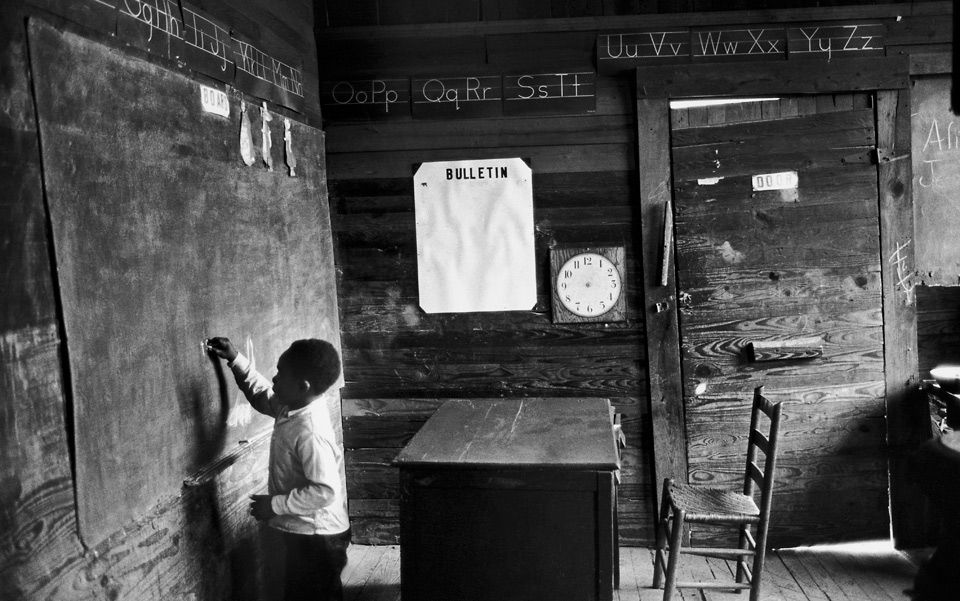
A one-room school house near Selma, Alabama in 1965. Photo by Bruce Davidson/Magnum

Back in the late 1990s, my all-American, apple-pie-faced middle school history teacher used to put us to sleep with his month-long patriotic rants. He would gaze into the sky and tell stories about how the US was the only place where you could come bearing nothing but your religion and a dream, and experience an inexhaustible amount of success. I got the concept of dreaming; but my ancestors came here bearing only fear, chains and uncertainty. They were not people in search of hope but captives forced to cultivate and construct the so-called free world.

While African slaves spent countless days cooking, cleaning, being raped, beaten, sweating in the fields, and occasionally lynched, the children of their rich masters were being educated. The 1800s saw schools pop up all over the US, and by the end of the 19th century, free public education was available for all white children. Blacks have been in America since 1619 and received virtually no schooling until after President Abraham Lincoln decreed the Emancipation Proclamation in 1863. That is a 244-year head start given to whites – 244 years of exposure to scientific reasoning and philosophical thought, hundreds of years to discover the power of books and reading, and shape dreams into reality.

'There's a myth floating around that education is white culture, books are white culture,' said Eric Rice, an expert in urban education, when I went to visit him at the Johns Hopkins University School of Education this year. 'But African Americans have a long history of wanting education. The South had laws against teaching slaves to read, and people risked beatings and death trying to learn to read during slavery. There has always been a huge demand.'

The Lincoln administration made a conscious effort to right the wrongs in education along with other social injustices through the Freedmen's Bureau, established in 1865. Charged with clothing, feeding, employing and otherwise helping the newly free people of colour become US citizens, it even had dispensation to grant land. The Reconstruction era in the US, those couple of years when the South was to rebuild itself from 1865 through 1867, would have been a great time to help blacks assimilate to the dominant culture through education. For the first time, the US was seeing the rise of black business owners, black politicians, and the black church, but our country didn't capitalise on the opportunity. None of that success led to a spark in black schools.

Instead, Lincoln's promises died with him that night at the theatre in 1865. Andrew Johnson, the next president, vetoed the Freedmen's Bureau renewal in 1866. He confiscated the land African Americans were acquiring in the South and gave it back to the white Southerners who occupied it before the war. From 1866 to 1869, Johnson depleted the Freedmen's Bureau, which was eventually dismantled in full by his successor, Ulysses Grant in 1872.

Sure, schools for freed slaves emerged. Within a year of emancipation, at least 8,000 former slaves began attending schools in Georgia; eight years later, those same black schools struggled to contain nearly 20,000 students. Scores of children piled into these shacks, trying to compete while dealing with broken or no desks, leaky ceilings and limited utensils.

'Many of the early schools for black students received hand-me-down supplies and textbooks from white schools. The class sizes were larger and the teachers had fewer qualifications. The resources devoted to black schools were fewer and lower-quality than those devoted to white schools,' Rice told me. We made it into the classrooms but not on the same level.

Jim Crow laws allowing racial segregation guaranteed that the gap would widen as years passed. By the end of the 19th century, 17 states and the District of Columbia required school segregation by law. Four others allowed the option.

That seemed poised to change when, in 1951, 13 families from Topeka, Kansas filed a lawsuit against their Board of Education. Like their ancestors, they wanted a quality education for their children – similar to what white children in the US had been receiving for decades. The case came to be known as Brown v the Board of Education and was a major victory in the fight for education for African American students. Brown v Board of Education showed an immense amount of promise, giving many blacks hope that the US could change. The landmark Supreme Court decision of 1954 overturned the Plessy v Ferguson verdict of 1896, which allowed state-sponsored segregation with a 9-0 unanimous decision declaring that separate schools for blacks and whites were unconstitutional.

They took their tax money, their resources, and their high-quality schools with them to the 'burbs

But the idea of blacks and whites being schooled together sent the nation into a frenzy. On 11 June 1963, George Wallace, Governor of Alabama, went as far as to stand in the door of the University of Alabama flanked by state troopers, so that black students couldn't get in to register, standing down only after President John F Kennedy called in the National Guard.

'White flight' was the remedy for many Caucasians petrified by the thought that their child might share class with a Negro. They took their tax money, their resources, and their high-quality schools with them to the 'burbs. Blockbusting – the practice of pushing down property values in a neighbourhood through rumours of an imminent influx of some 'undesirable' group – and redlining – the practice of denying and charging more for banking services in an effort to racially construct a neighbourhood – were the most publicised means of keeping the races separate. Banks' ability to accept and decline mortgages on the sole basis of colour were adjuncts to the effort, as well.

So there you have it; a combination of poor schools, institutionalised segregation, and minimal funding not only cultivated the deep roots of educational denial, but also strengthened the foundation upon which achievement gaps are built on today. The combination of all of these historical events led to what I call the Tradition of Failure. The tradition was not self-imposed. Obviously, African Americans can take some personal responsibility for the state of our race; however, many of us do not have a clue because we come from a tradition of people who never had a clue, leading all the way back to the day our ancestors left Elmina, the former slave port in Ghana that launched us on our turgid journey to this new world.

They did not have a clue what was waiting for them on the other side of the Atlantic Ocean. Perhaps worse, we entered America as the lazy, ungrateful, enemy without even knowing why, and it has been an uphill battle full of limitless racial and social restraints every step of the way. We didn't invent the idea of race or conceptualise the theory of free labour and what it could mean on a global scale. We just did what we were forced or told to do, and have been paying the price ever since.

The biggest price has been something that even my slave ancestors might never have imagined: while education was being withheld from blacks, the prison doors were wide open and welcomed us with open arms. The Ohio State University civil rights attorney Michelle Alexander, author of The New Jim Crow (2010), writes: 'The criminal justice system was strategically employed to force African Americans back into a system of extreme repression and control, a tactic that would continue to prove successful for generations to come.'

The pipeline from school to prison has been a hot topic in the US and the subject of many lectures and debates. M K Asante, who wrote about this loop in Buck (2013), his memoir of inner-city Philadelphia, says his own public-school experience forced many of his friends into the streets. 'There's a toxic, incestuous relationship between pipeline schools, prisons and the politicians whose campaigns are funded by corporations that directly benefit from mass incarceration, prison labour and contracts, all at the expense of black lives. Black schools are a part of the prison industrial complex,' he contends. Asante thinks that pipeline schools run through poor urban communities strictly to prepare black students for prison. 'Grade school is supposed to prepare students for college or a trade. So think about it, there's bars on the windows, prison-like guards, and metal detectors! Every thing is institutionalised just like a jail. The combination of these elements make up a breeding ground for prison.'

I thought about the things I saw as I entered Butta's school and asked about the role corporations play. 'Prisons are being privatised now, and a poor education in combination with other factors that exist in poor-black communities are making black failure profitable [for those companies],' Asante contends.

He asked the question in his memoir in the chapter 'The Pipeline': 'If schools look like prisons and prisons look like schools, will we act like students or prisoners?'

The ambience that created my schooling experience explains why many of the people I went to middle school with didn't make it to high school. And even though I finished, the bulk of my surroundings and influences make me feel like a transition into a life of crime is easier than reading on grade level, which sounds crazy, but it might be true.

I don't know what percentage of kids Butta's age sell drugs. But in April 2014, our hometown paper, The Baltimore Sun, reported our city's educational achievement: 'According to the National Assessment of Educational Progress exam, only 7 per cent of black boys in Baltimore City schools are reading at grade level in 8th grade. Even worse, in Maryland, 57 per cent of black males are currently graduating from high school compared to 81 per cent for white males. Hundreds of black boys drop out of Baltimore high schools each year. They enter the adult world unable to read and comprehend the daily newspaper or to find a job that supports the cost of food and shelter.'

Something is missing in a large number of the predominantly black schools in the US. Whatever that missing 'thing' is, the streets seem to fill the void. The streets provide an education in everything that many of these schools don't, such as survival skills, kinship, moneymaking opportunities, and love. A love that is absent from the cold hallways of schools such as the ones Butta, myself and millions of other African Americans attend.

There are schools in Philadelphia that are packed with rodents and hold classes with as many as 50 students

Butta's school has been shut down along with a few other troubled city schools since my visit. He now must attend another school in a different district full of the kids who already attended, in addition to the new students who are being packed in because their school was shut down, creating an even worse climate. Butta's new school is almost the same as his old one. He's receiving a semi-education now; even more schools in Baltimore are closing this year following Maryland's new republican Governor Larry Hogan's massive proposal to cut $35 million from Baltimore Public Schools, meaning that classes could become more crowded and all of these issues could get worse. This isn't just a Baltimore issue. There are schools in Philadelphia that are packed with rodents and hold classes with as many as 50 students.

Too often I hear people cry: 'Our schools are broken, our schools are broken!' But are they? Are our schools broken or is our system working perfectly for its creators? During the years I pursued a master of science in education at Johns Hopkins, I studied a theory called 'social reproduction', the brainchild of a Connecticut sociologist named Christopher Doob. His theory holds that we've got to produce a certain number of minimum-wage workers and inmates – a general collection of bottom-feeders – for capitalism to sustain, and so we build the social structures to keep that going.

'Social reproduction is a real thing,' Rice tells me, 'but I don't think it's intentional. The system tends to produce the people who are needed for the jobs that will be available. We hear all of this talk on how we need to teach critical thinking because the jobs of the future will be in science, technology, engineering, mathematics and computer science, but actually a huge number of jobs in the future will be in fast food, different service industries and many fields that don't require critical thinking. I'm not saying that a small group of people are planning this; however, it strikes me as interesting that we continue to produce a huge number of people fit for these jobs and they tend to come out of these school systems.'

Schools such as the one Butta and I attended are funded by property taxes from neighbourhoods full of housing projects and boarded-up homes, where the poor pay to perpetuate their own misery. The age-old system, in conjunction with law enforcement, makes the pipeline from public school to prison a reality.

I agree with Rice: I'm sure we won't find a room full of rich white men from the top 1 per cent planning to flow through the pipeline $5,000 bottles of champagne and hors d'oeuvre, but I think the system perpetuates itself. It's easy to think the whole idea of social reproduction is a drummed-up conspiracy theory, that it isn't real, but I feel sure it is. How can it be otherwise when the US – arguably the world's capital of innovation – doesn't aggressively address this problem from the top down.

And I would challenge anyone who disagrees to walk through the schools in the neighbourhoods where I grew up; if we don't need to fill up the prisons with more of Baltimore youth, then why don't we fix the schools now?

I applaud pioneers such as the charter-school pioneer Geoffrey Canada who recognised the disparities in education in the African American community and made an honest attempt to address them from the bottom up by creating schools that shattered the norms. To date, his Harlem Children's Zone has produced multiple senior classes with over 92 per cent four-year college acceptance rates. Many charter schools across the US have adopted Canada's model along with other new models that focus on creating college-ready kids and reported success. So if it works, why can't his models be adapted in all public schools? Why can't we evolve pedagogy and reach for even higher levels of success?

I posed this question to Rice, who also sits on the board of two charter schools in Baltimore. 'Geoffrey Canada's success has a lot to do with his ability to raise funds. He's found donors and supporters who traditionally don't want to give money to school systems. I don't know if that is a sustainable way to solve the bigger problems in entire urban districts. For me, if we really want to solve education, we need to decide to solve issues in poverty, all of the associated health problems, and employment challenges.'

Rice is speaking a language that reverts right back to the root of all the educational issues our country faces. The idea that communities are structured to create generations of snubbed students who go on to create generations of snubbed students makes the idea of social reproduction real.

Revamping the public school system is just half the battle, says Celia Neustadt, founder of Baltimore's Inner Harbor Project, a non-profit that works with schools and teens and specialises in social change. Neustadt says her project's success comes from stepping outside the system. 'The young people I work with are confronted by the reality of supporting their families and keeping them safe,' she says. To help such teens succeed and make it to college, a radically different toolset must be employed.

We were born into a permanent recession where making $20 last a week is not a miracle – it is a way of life

We're quick to say that the US is a fair place where anyone can excel, but that's not true. We need to acknowledge the failure so entrenched in history we cannot see it clearly, let alone root it out. African Americans are not stupid underachievers. Our accomplishments in science, innovation, athletics, business and politics are extraordinary – especially when you consider the countless constraints. As a matter of fact, we should be judged by our survival skills. I remember asking my friend Ron from West Baltimore about the recession after the market crashed in 2008, and he laughed: 'Recession? What recession? Everything is the same round here!' In fact for us it was an equaliser in some ways – people outside our communities were starting to feel the pain we're used to.

We were born into a permanent recession where making $20 last a week is not a miracle – it is a way of life. Ovens are frequently used to heat up homes, everyone works under the table, and a new hustle is created every day.

A given: African Americans want to learn and be inspired like anyone else. Scholars can help bridge the achievement gaps, but only if they take the time to see what these students are up against. My own way of tackling the problem is through literacy. I want to get more people in low-income neighbourhoods to develop a love for reading by creating literature that speaks directly to poverty-stricken people and encourages them to write.

But we all have a moral obligation to set things right. We are all responsible for challenging the system and forcing it to create a fair learning experience for all students because we are dealing with more than just a failed school system or a broken home, or even millions of broken homes: we are dealing with failure on a historic scale, spanning hundreds of years. Acknowledging that we face this kind of epic failure is the first step in bringing about real change. That's the big challenge in the US, where accepting failure has never been our strength.

No one can do everything, but if we follow the Ethiopian proverb 'When spiders unite, they can tie down a lion', we'll have a better chance of solving these issues together and creating a nation that lives up to its founders' dreams of truly offering success.


Charles Dickens and the Linguistic Art of the Minor Character

Choti 

I am sure you will love these names :) and specially since you are called as Miss Posh because you have such an extensive vocabulary, you will love how wonderfully this article has been drafted and the words she uses. Amazing, eh? I loved the names.

JSTOR Daily
where news meets its scholarly match


May 4th 2016, 15:46, by Chi Luu

Allow me to introduce Mr Plornishmaroontigoonter. Lord Podnsap, Count Smorltork, and Sir Clupkins Clogwog. Not to mention the dowager Lady Snuphanuph. As for Serjeant Buzfuz, Miss Snevellicci, Mrs. Wrymug, and the Porkenhams… who the dickens are all these people? Why do they have such weird names?

Chi Luu is a peripatetic linguist who speaks Australian English and studies dead languages. Every two weeks, she’ll uncover curious stories about language from around the globe for Lingua Obscura.
They are the best of names, they are the worst of names, from an age of onomastic wisdom and hypocoristic foolishness, an epoch of… well you get the picture. You may recognize this raggle-taggle cast of minor characters, in all their rich variety, as stemming from the fevered imaginings of one Charles Dickens.
Yes, Charles Dickens: the former child factory worker, law clerk, social justice activist, wannabe actor and famed (though not always appreciated) author of some very long novels from a more verbose Victorian age. Also, Charles Dickens: linguistic innovator.
Even the lowliest, most fleeting minor character in a Dickens novel, regardless of wealth or education, can have an individual personality and humanity.