Saturday, February 23

Say what?

1. Say what?

An Israeli MP has blamed parliament's tolerance of gays for earthquakes that have rocked the Holy Land recently.

Shlomo Benizri, of the ultra-Orthodox Jewish Shas Party, said the tremors had been caused by lawmaking that gave "legitimacy to sodomy".

2. Who?

Since Mr Ahmadinejad came to power he has repeatedly spoken of the need to plan for the Mehdi's imminent return.

Technorati Tags: ,,,,

United Nations Secretary General is a fundamentalist obscurantist

Can you imagine? the Secretary General of an organisation which was founded on the best liberal principles is now actually saying that freedom of speech must respect religion? What the fish? This man is totally moronic, and so was his predecessor. He might be a diplomat or a politician but he is not principled which is clear. That is a shame because he has the ability to influence the entire world but it is sad that he has joined with the ranks of the fundamentalist obscurantists. Next time the UN says something, my own religion of Rastafarianism will get offended because it is against my religion, what ever he says.

No I will NOT respect religion for free speech, a religion which needs protection from free speech is not a religion but a collection of rituals for a cult.

Moron.


Indian Kashmir separatists get boost from Kosovo independence

Sadly, this is what I predicted!

Read and weep!

Separatists in Indian Kashmir said Saturday Kosovo's unilateral declaration of independence has bolstered their resolve to achieve the same status for the disputed Himalayan territory.

Kosovo last Sunday declared independence from Serbia, which vowed never to recognise the move.

Kosovo's independence declaration has "strengthened our resolve to achieve freedom for Kashmir," leading Kashmiri separatist Shabir Shah told AFP.

Several countries including the United States and Britain have recognised Kosovo as a new state, but India said it was studying the legal ramifications.

India is wary of recognising Kosovo as an independent state because of its possible ramifications for scenic Kashmir, which has been racked by a nearly two-decade-old revolt against New Delhi's rule.

Nuclear-armed rivals India and Pakistan, which have fought two wars for control of the Muslim-majority region each, hold parts of the territory but claim it in full.

"Kosovo's independence is an indicator that struggles based on truth and justice never fail," Shah said, adding that the day is not "far when Kashmiris will be free."

Shah, 54, who heads the pro-independence Democratic Freedom Party, is dubbed the "Nelson Mandela" of Kashmir after spending more than 20 years in Indian jails.

Another separatist leader, Syed Ali Geelani, also said he was delighted by Kosovo's independence proclamation, saying the "creation of a Muslim state within the European heartland has strengthened our resolve to achieve our right to self-determination."

Geelani, however, wants Indian Kashmir to break away from India and join the neighbouring Islamic republic of Pakistan

Zimbabwe inflation over 100,000%

Sighs, it is like the Robert Mugabe School of Economics is plumbing greater depths! Sorry, no link!

Zimbabwe's annual inflation rate has soared to more than 100,000 per cent, according to official figures.

"The year-on-year inflation rate for the month of January 2008, as measured by the all items Consumer Price Index (CPI) stood at 100,580.2 per cent, gaining 34,367.9 percentage points on the December rate of 66,212.3 per cent," the Central Statistical Office (CSO) said in a statement.

"This means that prices as measured by the all items CPI increased by an average of 100,580.2 per cent between January 2007 and January 2008."

Inflation of food and non-alcoholic beverages reached 105,428.0 per cent while non-food inflation was 97,885.7 per cent."

The southern African country's economy has been in a tailspin for the past seven years, characterised by shortages of basic commodities such as sugar, cooking oil and petrol.

While the products are readily available on a burgeoning black market, many Zimbabweans have resorted to buying their essentials from neighbouring countries such as Botswana, South Africa and Zambia.

At least 80 per cent of the population are living below the poverty line, often skipping meals to stretch their income, which frequently fails to cover basic needs.

The Government has introduced several measures to try and curb inflation, including imposing a ceiling on the prices of some goods and services and knocking three zeros off the country's currency.

The CSO last released monthly inflation statistics to the media in September. The November figure was released by the central bank chief in a statement last month.

Technorati Tags: ,,

Why China hates and Taiwan loves Kosovo?

Read and weep! I quote:

The U.S. and other governments that are backing Kosovo's
independence stress that it sets no precedent for other situations worldwide, but the move already is stoking the long-simmering sovereignty dispute between China and Taiwan.

In the aftermath of Kosovo's declaration of independence from Serbia early this week, Taiwan's government issued a statement welcoming the move. That drew a quick rebuke from the mainland government, which said that Taiwan, "as a part of China," has no right to recognize Kosovo's decision. Undeterred, the Taiwanese government then went a step further, declaring in a statement its formal recognition of the new Balkan state.

Technorati Tags: ,,,

The difference between stupid and smart

I have spoken before (and here) about the attempts of Reliance Fresh to set up a highly efficient set of retail stores in India and how a bunch of moronic politicians managed to kill off this initiative in certain parts of India. But recently I went to India and actually managed to take some photo's which show up this difference clearly.

The first set is from Lucknow where the lords of stupid rule, it is one of the heartlands where this special genus seems to spring forward with startling regularity. Given the fact that a huge amount of Indian intellectual thought actually emerged from this region makes is so interesting that idiots also come out from there who have, lets be polite, just a passing acquaintance with common sense and economics.

They have even formed suicide squads against Reliance Fresh in Orissa. Well, why not? if you can do suicide bombing for inner struggle objectives or secessionist objectives, why can you not do it for opposing Reliance Fresh Stores? (the mind boggles)

But let us move on.

Just next to my father in law's office, I spotted this door.

Moving closer, it looked a bit sad, with bricks piled up, and the shutters down.

Moving closer to the store, I went down the stairs and peeked through the glass door. Everything was pristine, new, but coated with dust. For some reason, I was feeling a bit like Howard Carter and Lord Carvanon.

The shelves were empty if stacked up, the glass was incredibly dirty and you can see yours truly the hulking fat git shadowed on the glass.

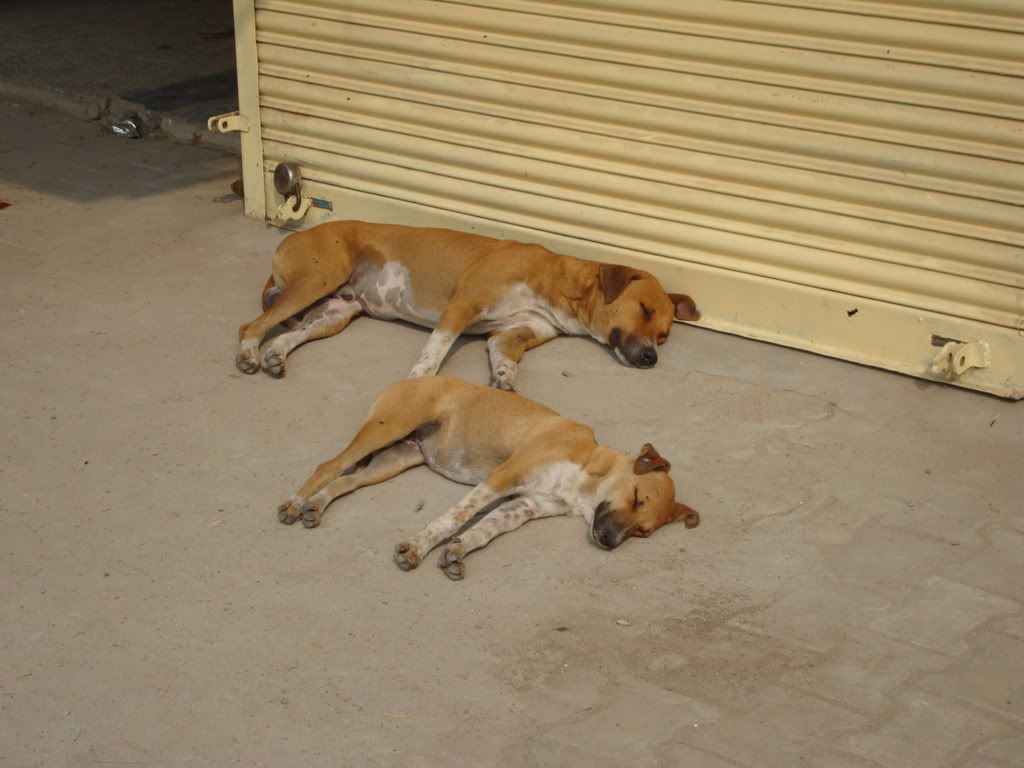
I looked around and even though it was the middle of the day in the middle of a commercial part of town, it was a nice dozy place, no jobs, no activity, no nothing. Even the bloody dogs were spooning!

And now compare it with this Reliance store in Indore. Unfortunately, I did not have a chance to get down and take some pictures as we were under severe time pressure (sod's law, we reached the school on time, but there was nobody there, I guess I have forgotten the chalta hai timekeeping system that I grew up with!). It was early morning, about 0845 hours. And you can see the store open, guards outside, well lighted store, all shelves piled high with goods, clean windows and shoppers already making a bee-line to shop.

Sad, very sad. One part of the country is flourishing and another part has dogs snoring. And the tragedy is that both cities are in states which are equally pushing each other aside in the bottom rankings of all Human Development Indicators of States in India. But one is doing something (very little but something!) while the other?

Did Yahweh Share a Throne with His Consort Asherah?


Biblical Archaeoloy Review  34:02, Mar/Apr 2008

A Temple Built for Two

Did Yahweh Share a Throne with His Consort Asherah?

By William G. Dever

Picture

The small house shrine published here for the first time provides significant support for the contention that the Israelite God, Yahweh, did indeed have a consort. At least this was true in the minds of many ordinary ancient Israelites, in contrast to the priestly elite.1 In what I call folk religion, or "popular religion," Yahweh's consort is best identified as "Asherah," the old Canaanite mother goddess.2

Some of the most powerful evidence for this contention is in the Bible itself. The fact that the Bible condemns the cult of Asherah (and other "pagan" deities) demonstrates that such cults existed and were perceived as a threat to Israelite monotheism. Based on the Biblical texts alone, we can conclude that many ancient Israelites, perhaps even the majority, worshiped Asherah, Astarte, the "Queen of Heaven" and perhaps other female deities. Their sanctuaries (ba¯môt, or "high places"), we are told, were "on every hill and under every green tree." (The phrase recurs numerous times in Kings and the Prophets.)

Some of the clearest physical evidence for the existence of a cult of Asherah is the growing collection of small house shrines. The technical name is naos (plural, naoi), a Greek word that means "temple" or "inner sanctum."

Most of these naoi share several iconographic motifs: (1) two tree-like columns flank the doorway into the inner chamber (the cubiculum); (2) crouching lions serve as column bases near the entrance; (3) a large, flat entablature sits over the doorway, occasionally painted in geometric motifs; (4) doves with extended wings perch on top of the façade or parapet.

The examples recently published in BAR are only the latest to be presented to the public.a Not long after the Six-Day War in 1967, the distinguished classicist Saul S. Weinberg acquired a splendid example on the Jerusalem antiquities market.3 I happened to be with Saul at the time, since he was the outgoing visiting director and I was director-elect of the Nelson Glueck School of Biblical Archaeology at Hebrew Union College in Jerusalem. Other examples have appeared in catalogs and scholarly analyses in French and German.4 These publications have been largely overlooked by most biblicists and even by archaeologists, perhaps because they are reluctant to address "theological" issues.

Picture

Most, if not all, of these examples are said to have come from Transjordan and are identified as Moabite (or perhaps Ammonite). They are generally thought to date from the ninth (or perhaps eighth) century B.C.E. According to an article in late 2007 by Larry Herr, the first well-stratified naos was discovered in the 11th–10th-century B.C.E. levels at Tall al-`Umayri in Jordan.5

But there is also an indisputable Israelite example. It comes from a professional excavation led by Père Roland de Vaux shortly after World War II at Tell el-Far`ah (north), the early northern Israelite capital of Tirzeh. The naos was published in 1984,6 but has been largely overlooked by Biblical scholars until recently.

The new naos being published here in BAR (see First Publication: A Newly Discovered House Shrine) bears striking resemblances to the examples from the Moussaieff collection previously published in BAR, although it comes from another antiquities collector. These resemblances suggest to me, however, that they all come from the same source, probably Biblical Moab in southern Jordan (perhaps even from the same site, looted as long ago as the 1960s).

Before discussing the naoi from the Moussaieff collection and the one being published here, I should say that I have agreed to make these comments despite the predictable objections of some colleagues. I would not want to be the one to present these objects in a scholarly journal because of professional principles. Yet I am convinced that once artifacts of such potential significance are known to the public, scholars have a right, perhaps even an obligation, to draw out their meaning.

Picture

The Moussaieff naoi, like the one published in this issue of BAR, are so unexpected, so exotic, if you will, and so fraught with potential importance that some may regard them as the work of skillful forgers. Having examined a few of the naoi in private collections, I am convinced that they are genuine.

Both the Moussaieff naoi and the new one published here exhibit many of the same iconographic motifs: (1) two tree-like columns with drooping fronds flanking the doorway; (2) lion bases for the columns; and (3) a dove with extended wings perched on the roof of the large façade over the entrance.

One motif, however, sets this new example— perhaps we can call it the BAR naos— apart from all the other Transjordanian (or Israelite) examples. It is the clear double throne in the cubiculum. I know of no other double thrones like this. Obviously it is for two figures, sitting side by side in a model temple.

Picture

Are the gods, in this case paired, "at home"? Who are they? And why are they not graphically represented, rather than only by the outline of the throne? After all, we have hundreds and hundreds of examples of graphically represented Iron Age terra-cotta figurines of deities.

Picture

Picture

Oddly enough, there is no description or even allusion to these naoi, or house shrines, in the Hebrew Bible. That they are model temples is beyond reasonable doubt. They are clearly miniature "houses for the gods," as witnessed both by their clear architectural form and by the fact that in all West Semitic languages (Canaanite, Phoenician, Punic, Aramaic, Hebrew, etc.) the word ba¯yit/bêt is translated as both "house" and "temple."

Picture

But what deity was worshiped in these house shrines? All of their motifs, fortunately, are reasonably well attested and understood. And nearly all are connected with well-known female deities, particularly Canaanite/Israelite Asherah and Phoenician Tanit (Asherah's later reflex in the wider Mediterranean world).

The palmette capitals of the tree-like columns are not lotus-blossom capitals, as Weinberg and other classicists once supposed, much less "proto-Aeolic" capitals as William F. Albright thought. The late Israeli archaeologist Yigal Shiloh clearly demonstrated that they are stylized palm trees, especially typical of Iron Age royal and temple architecture.7 More recent research has shown that the symbolism responsible for the adaptation of the tree motif for columns in ancient Israel (and in Aramean and Phoenician monumental architecture) is probably deeply rooted in the old Canaanite identification of Asherah as a tree-goddess.

Picture

In an important article in BAR, for example, the late Ruth Hestrin brilliantly established the connection between the symbols of a stylized tree, a pubic triangle and a nurturing goddess. She even found representations in Egyptian art of the goddess with a tree trunk as a torso, a branch offering a breast to a nursing infant (in this case, the Pharaoh's son).b

In short, these tree-like columns were thought to be particularly appropriate in model temples dedicated to the tree-goddess Asherah.

Picture

Picture

Picture

To clinch the argument that tree-columns are associated with the goddess Asherah, in one of the Moussaieff naoi two nude female figures face directly to the front of the functioning tree-columns, complete with palm-volutes. Who are these nude females? Priestesses? Temple prostitutes? Unlikely. Ordinary human worshipers? Hardly. Most likely, these females are symbolic of Asherah, "at home in her house," and beckoning to her devotees.

The most explicit link between these naoi and Asherah can be seen in roughly contemporary Phoenician examples from Cyprus. In one complete naos from Idalion, now in the Louvre, a nude goddess stands in the doorway and also looks out the windows.8

The identification of these house shrines with the tree-goddess Asherah is further buttressed by a second iconographic motif, the lion, which is also widely associated with Asherah. In one of the now-famous Kuntillet `Ajrud inscriptions found in the Sinai, there is a reference to "Asherah," and a drawing portrays a lion. In the equally famous tenth-century B.C.E. Israelite cult stand from Taanach, Asherah is pictured between two lions with a hand on the head of each of them.

Thus, the lions as column bases and as guardians at the entrance to the naos temples are particularly appropriate as symbols of Asherah "at home in her house."

Finally, the dove perched on the parapet of the naoi— presiding, as it were, over the whole cultic scene— is transparent. Everywhere in the Mediterranean world, the dove is the symbol par excellence of Tanit, the Phoenician and later Punic embodiment of Asherah (and also of her old counterpart Astarte). Hundreds and hundreds of such doves as symbols of Tanit and her shrines are known.9

Picture

Picture

The links between these naoi and the goddess Asherah lead us back to the original query about the identification of the unique double throne in the BAR naos being published here. That there are two chairs is clear from the two panels, emphasized by the clearly visible upright on the back. If this is a throne in a model temple, it was obviously intended for the observer to imagine two deities sitting there: Asherah— and who else but her consort Yahweh, at least in the Israelite example?

Picture

That Asherah was coupled with a male deity, especially Yahweh, in ancient Israel should be no surprise in view of the overall picture we now have of folk religion. Thousands of terra-cotta figurines are known from Israel and Judah. Virtually all of them are female, identified by most scholars as Asherah, either directly or seen as votives functioning in her cult. Yet not a single indisputably male figurine from a clear Israelite context has ever been found. What does this phenomenon mean? It suggests that while representational or anthropomorphic depictions of Asherah, the female deity, were widely tolerated, similar representations of the male deity Yahweh were proscribed.

In short, "true" Israelite religion was not "aniconic," despite traditional scholarship and synagogue and church traditions that have maintained otherwise. I have recently argued that there are plenty of anthropomorphic symbols of Yahweh in the artifacts that have survived from ancient Israel.10 Yet if Israelite religion was not completely aniconic, there does seem to have been a certain reluctance to portray Yahweh himself, "in person," as it were. That reticence may explain our invisible deities in the BAR naos: Only the outline of the double throne is depicted.

Recently, a terra-cotta pair of figurines seated on a sort of throne has come to light. It was acquired on the antiquities market and published by Christoph Uehlinger.11 It nicely illustrates what the throne on the BAR naos might have looked like if it had been portrayed rather than outlined.

I have already mentioned the one clear Israelite naos— from Tell el-Far`ah. Like the other naoi that may have come from Transjordan, the Israelite example features tree columns topped by curving palmette volutes. On the entablature is a crescent moon and stylized stars. Like a dove on other naoi, these symbols are often connected with embodiments of the great Mother Goddess, specifically Astarte, as well as later Tanit.12 The Tell el-Far`ah naos was probably dedicated either to Astarte or Asherah.

Although the Tell el-Far`ah naos is the only complete Israelite example, another Israelite naos has recently been recognized from fragments recovered in 1935 at Megiddo. It is still to be properly appreciated. Only partially restorable, this naos features two tree-columns topped by female-capitals.13

Asherah was, of course, finally driven underground by the reformist parties that edited the Hebrew Bible. In its final form she is written out of the text. Hence, she disappeared and all her cult imagery with her when Jewish monotheism at last triumphed in the period after the Israelites returned from the Babylonian exile.c But Asherah was once alive and well; modern archaeology has in fact resurrected her. Her "houses," now vacant, were once occupied. Here she was "at home" for many of the masses in ancient Israel.

The Untouchables: Scholars Fear to Publish Ancient House Shrine
BAR 31:06, Nov/Dec 2005

Understanding Asherah—Exploring Semitic Iconography, by Ruth Hestrin
BAR 17:05, Sep/Oct 1991

The Universal God, by André Lemaire
BAR 31:06, Nov/Dec 2005

Technorati Tags: ,

Separatist Movements Seek Inspiration in Kosovo

A whole bunch of comments on various places (here and here for example) were placed on my previous essay where I said that the current Kosovo declaration will cause problems. Here's a well argued article on this topic. The six cases they quote are:

Spain: The Basques and the Catalans

Cyprus: The Turkish Cypriots

Romania: The Magyars in Székely Land

Bulgaria: The Muslim Pomaks

Greece: The Turks of Western Thrace

Slovakia: The Hungarian Minority

I wonder if those who are getting all excited about Kosovo independence will also join in asking for independence for these and the other minorities such as here, here, here and here.


Technorati Tags:

The problem of conversion, can you be Danish and Muslim at the same time?

The fact that Immigrant Muslims and native Europeans are at loggerheads is not in doubt. Just look at the current huge hoo-haa around the Archbishop's silly statement. The Muslims are firmly noted as the "other" and this is across most of the countries in Europe. Specially in Denmark, where the feeling is much stronger than other countries (it has even elected clearly racist parliamentarians!). But what about the native Danes who covert to Islam? I got some very interesting clues from this paper.

Converts are seen as dangerous and possible traitors because (1) they have abandoned the Lutheran Protestantism and (2) they violate the unspoken rule of not showing their religion in public by wearing veils, praying at work, using different language, etc..

I would have thought that conversion would not show up that dramatically but apparently it does. The author talks about women changing clothing by wearing the veil, changing names, growing beards (for men that is), wearing different headgear, changing social locations such as pubs and churches to mosques etc. Estimates run from 2100-2800 Danes who have converted over the past 3 decades.

So why did they convert? Well, reasons range from a religious quest, search for the meaning of life, identification with the "other", rebellion against the common, and identification with the downtrodden/oppressed Muslims, identification with Islam as opposed to materialism, capitalism and modernity.

An interesting if unrelated joke point about this illness which converts seem to face called as convertitis and I quote, "which is at the same time an allusion to the generally assumed pathological nature of the conversion and a partial affirmation of this....The newly converted often exhibit a so-called fanaticism with their new religion, which is expressed in very ritualised behaviour such as only wearing Islamic dress and a preoccupation with the Islamic rules of what is haram ('forbidden') and halal ('allowed') - of doing things 'right'. This often leads to ironic situations where converts repudiate people who are born Muslims for not doing things in 'the right way' or not living up to what is defined as being 'Muslim'..

But all jokes have a kernel of truth. Converts who are going down the Islam route to find God usually end up in the Sufi or spiritualist camp. The other way is the literalist way and it shows itself with a pre-occupation with rules and regulations, it involves huge amounts of fixations and unquestioned beliefs and relates more to the Salafi or Hizb-ut-Tahrir type of fundamentalist school.

But when asked about their conversion and the path to/following conversion. Converts frequently talk about conversion as a love story which is very beautiful to hear personally. I quote,

This is especially reflected in the many cases that involve the relationship to a Muslim man or woman, where physical love conflates with metaphysical and spiritual love, both initiating identical processes of radicalism and transformation. It can also be seen in the various metaphors of love used to describe the conversion process, such as in the phrase 'Allah opened my heart to Islam', as well as other terms revolving around religiosity and conversion like 'submission', 'surrender', 'attraction', 'fascination', 'admiration', seduction', and 'willingness'.

But the converts are usually very hesitant to talk about their relationships with Muslims of immigrant background and would prefer to keep it secret. Why? I quote, "The avoidance of talking about one's often intimate interactions with people who belong to the immigrant minority population seems to be related to converts' reproduction of a public discourse that associates Islam with alienation, forming an enemy image that threatens Danish society"

Seems like there is serious psychological trauma involved, with converts being deeply defensive or offensive when asked about their conversions. Awkwardness and defiance is frequent on one end while on the other end, out and out rebellion is visible. Curiously, while some Dane converts have consciously and totally rejected Danish culture (as defined by pork eating, alcohol drinking sexual promiscuity...), others have not and say that they dont see any harm in being Danish and Muslim.

Family reaction seem to be a major factor in conversion, and there is unfortunately and sadly far too much family breakdown after conversion. But that just means that after conversion, the relationship to the original family breaks down and a new relationship with the "others" begins.

There is an amusing interlude about how a convert woman removed the legs of the sofa because her Muslim Husband did not like to sit on tall sofa's but then made it taller by padding it up by cushions and padding. But seems like converts then take on the racial overtones that is common, for example, referring (in a bad way) to "Arabs".

Religious observances such as Iftar during Ramadan being celebrated in the way they used to celebrate Danish Christmas (without, obviously with the church bits) with the same kind of food, discussions, drinks, etc. And in the end, integration proceeds quietly. Quite a sensitive and interesting paper, very well written without prejudice or discrimination on this small minority in steadily and increasingly Islamaphobic Denmark.

JO - Journal of Ethnic and Migration Studies, Routledge, Jensen, Tina Gudrun, To Be ‘Danish’, Becoming ‘Muslim’: Contestations of National Identity? 1369-183X, 2008, 34, 3, 389-409
AB - This article discusses the relationship between national, ethnic and religious identities as embodied by so-called ethnic Danes who convert to Islam. The point of departure is the constructed polarisation between Islam and the West. The article explores how converts experience their apparently contradictory identities as ‘Danish’ and ‘Muslim’. Identity is dealt with as processes of both difference and similarity, whereby the constructions of ‘self’ as ‘same’ and ‘other’ as ‘different’ are questioned. In exploring the space between ‘self’ and ‘other’ among Danish converts, it is argued that they negotiate their identities as both Danish and Muslims by engaging in an ideological struggle over otherwise commonsense meanings. This process opens a space for re-making identity by connecting relations between these identities, which are otherwise perceived as having nothing in common.


PS: Denmark is burning for the past many days and this has a direct bearing on the above. 

Friday, February 22

Home owner sued for junk mail injury

This completely blew me apart. You walk to my front door, you poke your fingers through to dump junk mail that i neither wanted or asked for, you are clumsy enough to get injured and it becomes MY fault? What the fish?