Wednesday, November 14

What do you do with your dead people on your planet?

Thanks for Chris Skinner, this joke is brilliant. But here's a thought for all in financial services. Why do you think this is funny? This is funny because we all have faced this scenario and can well face it. 10 Questions for you:
  1. Customer Services review?
  2. Level of responsibility given to front line staff?
  3. Level of responsibility given to front line staff's supervisor?
  4. Level of automation relating to customer events on credit card systems?
  5. Are large customer events (hatched, matched, dispatched) handled extra-specially? that is a high risk event but also a high return event.
  6. How do you think you as senior management are capturing events like this? For example, I can type up my conversation with Mesh Computers when I had a gigantic snafu with them and then can send it out on the web and my friends. In other words, the probability of senior management receiving this joke email from outside is higher than them receiving information like this from inside. I know you are taping this conversation, but how is this information reaching senior management? Ok, so the senior management does not get to hear it, who does? beyond the supervisor?
  7. And if it does reach you, what do you do? what have you done previously?
  8. Have you personally, as a senior manager, tried out your own company's products in an anonymous manner? I realise this wont be possible in investment and corporate banking but you can still do it in asset management, private banking, SME banking and retail banking.
  9. Your risk and control people must have asked for many of the risks/controls identified in this conversation. How many of those risks/controls have actually gone through a cost benefit analysis based upon customer service, reputational risk, revenue, etc.?
  10. Say this joke email comes out with an explicit name attached to it, say XYZ Bank. And when you are travelling into work in the train, you read this joke in the newspapers and your friends across the train are giggling at you. What do you do when you enter the office? What can you do to address this problem?

A lady died in January, and the bank billed her for their annual service charges on her credit card for February and March. When these were unpaid, the bank added late fees and penalty interest fees on top of the monthly charge. The balance had been $0.00 and is now over $60.00, and increasing every month, so her nephew calls the bank:

Nephew: “Hello there. My aunt died recently, and I am calling to tell you that she died as you keep mailing charges to her.”

Bank: “Well, the account was never closed and the late fees and charges still apply.”

Nephew: “Maybe you should turn it over to collections.”

Bank: “Since it is over two months past due, it already has been.”

Nephew: “So, what will they do when they find out she is dead?”

Bank: “Either report her account to the frauds division or report her to the credit bureau, maybe both.”

Nephew: “Do you think God will be mad at her?”

Bank: “Excuse me?”

Nephew: “Did you just get what I was telling you . . . The part about her being dead?”

Bank: “Sir, you’ll have to speak to my supervisor.”

Supervisor gets on the phone.

Nephew: “Hi. I’m calling about my aunt and am trying to tell you that she died in January.”

Bank: “Well, the account was never closed and the late fees and charges still apply.”

Nephew: “You mean you want to collect from her estate?”

Bank: (Stammer) “Are you her lawyer?”

Nephew: “No, I’m her nephew.”

Bank: “Could you fax us a certificate of death?”

Nephew: “Sure.”

After they get the fax.

Bank: “Our system just isn’t set up for death, sir. I don’t know what more I can do to help.”

Nephew: “Well, if you figure it out, great! If not, you could just keep billing her. I don’t think she will care.”

Bank: “Well, the late fees and charges do still apply.”

Nephew: “Would you like her new billing address?”

Bank: “That might help.”

Nephew: “Rookwood Memorial Cemetery, 1249 Centenary Road, Plot Number 1049.”

Bank: “Sir, that’s a cemetery!”

Nephew: “Well, what do you do with dead people on your planet?”


All this to be taken with a grain of piquant salt!!!

Tuesday, November 13

Inflation now killing and wounding in China

I have been warning about Inflation in China for some time now. But the situation is getting pretty bad. There have been stampedes to purchase half price cooking oil which have injured nineteen people. Before this, three people were trampled to death when a store offered 20% discount on rapeseed oil and people just invaded the store. Given that the Chinese government is now freezing lending in many sectors, it will have a significant ripple effect across the world.

Not happy and curiously, no multi-lateral institution is seeing this. The closest I can think of is the BIS, the Bank of International Settlement, or the World Bank. But there is not even a peep from either. Why are they sleeping?

Technorati Tags: ,

Rape reduced by 85%, porn to thank possibly!

Professor D'Amato, a very learned man from all what it seems from his cv, has written an very thought provoking paper. In this paper, he claims that rape in the USA has reduced by 85% in the last 25 years. And there seems to be a correlation between the availability of porn and rape. While it is not clear, he argues:

Correlations aside, could access to pornography actually reduce the incidence of rape as a matter of causation? In my article I mentioned one possibility: that some people watching pornography may “get it out of their system” and thus have no further desire to go out and actually try it. Another possibility might be labeled the “Victorian effect”: the more that people covered up their bodies with clothes in those days, the greater the mystery of what they looked like in the nude. The sight of a woman’s ankle was considered shocking and erotic. But today, internet porn has thoroughly de-mystified sex.

Times have changed so much that some high school teachers of sex education are beginning to show triple-X porn movies to their students in order to depict techniques of satisfactory intercourse.

I am sure there will be other explanations forthcoming as to why access to pornography is the most important causal factor in the decline of rape. Once one accepts the observation that there is a precise negative correlation between the two, the rest can
safely be left to the imagination.

Now the problem is that I cannot replicate this study with other countries. Rape is considered to be a power trip, something that is related to men dominance while religious chaps think it is due to lust. See here for the causes of rape (mind you, the article is disputed on Wikipedia but it does not detract from the argument I am making!). So while the author is fulminating against religious reasons for the previous research, his pointing to availability of porn seems to further point to religious reasons behind raising lust (assuming that porn satisfies lust....).

On the other hand, countries where porn is banned or is severely limited still show incidents of rape. So not sure, what do you think?

Technorati Tags: ,

Free Speech Lost in Spain - cartoonists fined

Now this is so strange, here Europe is fighting a principled battle against free speech in the cases of hate crime and Mohammad cartoons, then Spain goes and does something spectacularly stupid like this!

Shame! Criminal!

Technorati Tags: , ,

US Financial Regulatory Framework Future: More Comments

Further to my long note about the future of US regulation, seems like the market is also thinking the same! I quote:

It appears as if Europe’s got it right; the push for a regulatory model closely mirroring Europe ’s was all the rage at the annual Securities Industry and Financial Markets Association meeting.
According to MarketWatch.com, the US regulation community is simply looking for an approach that is based on principles… the same approach that UK ’s Financial Services model has used for years. Here, companies do not have to concern themselves with the constant burden of having to answer to regulatory examinations. Instead of being forced to adhere to specific rules, corporations would have the luxury of sticking to guidelines.
With more and more freedom to de-list now materializing for foreign companies, many are doing exactly that.
“Given that freedom, they are leaving,” said Hal Scott, a professor at Harvard University, who spoke of the exodus of business to foreign markets.
Also on the regulatory reform side of the fence is John Thain, chief executive at NYSE Euro next (NYX) and his counterpart at CME Group Inc. (CME), Craig Donohue, who both praise the push for such changes.


All this to be taken with a grain of piquant salt!!!

India keen to usher in currency futures

Very good step, its better for corporates to manage the exposure to exchange rates via hedging rather than hope that the government will take a very blunt macroeconomic weapon to trying to manage the exchange rates.

India’s financial market regulators and stock exchanges are speeding up the introduction of currency futures amid government concern that a sharp appreciation in the rupee against the dollar is hurting politically sensitive export sectors.

Ravi Narain, managing director and chief executive of the National Stock Exchange, India’s largest bourse, said talks were under way with regulators about bringing in currency futures, possibly by early next year. The timing seems a no-brainer,” he said. “Everyone is keen to see this introduced sooner rather than later.”

A strengthening of more than 10 per cent in the rupee against the dollar this year has prompted layoffs in India’s textile, jewellery and other labour-intensive export industries.

In its battle to sterilise a flood of foreign dollars into the country’s booming equity and real estate markets, the Reserve Bank of India has accumulated a record $95.4bn in reserves over the past 12 months, bringing the total to $262.5bn.

There are concerns the RBI can slow but not stop the rise of the rupee, leading regulators to conclude that exporters need more tools with which to hedge foreign exchange risk, such as a large and liquid currency futures market.

Mr Narain said regulators were also working on developing interest rate futures, seen as crucial to the development of the country’s debt markets.

Bankers welcomed the moves. Sanjay Nayar, Citigroup chief executive officer for India and head of Nepal, Sri Lanka and Bangladesh, said: “If Mumbai is to become a financial centre, the development of the bond, currency and derivative markets is critical. People need to be able to hedge their risk, and regulators seem to be gaining traction in that direction.”

The stock market regulator, the Securities and Exchange Board of India, has promised to fast-track new products following measures last month aimed at curbing the use of offshore derivative instruments, or P-notes, that allowed investors to trade Indian stocks without registering locally.

Mr Narain said he was cautious about the prospect of consolidation among global exchanges, including those in Asia, partly because of a “stratospheric” rise in valuations on some bourses.

He said he had not seen a departure of liquidity from India following the crackdown on the use of P-notes, which were favoured by hedge funds.

The NSE accounts for 85 per cent of India’s combined equities and derivatives trading. In the year ending March, it made revenues of about $450m and profits of about $200m.

All this to be taken with a grain of piquant salt!!!

Unbelievable, Northern Rock will need government support till 2010

This is unbelievable. Northern Rock will need government support till 2010!!!!!

words fail me, I find this so amazing!, what on earth were we thinking when we thought that Gordon Brown was a good economic manager? He has turned out to be a complete idiot!, THIS is his idea of managing crisis's? Chuck him out, we need somebody else.

All this to be taken with a grain of piquant salt!!!
How to make a small fortune? start with a large one!

Goldman Sachs is being sued by a dot-com entrepreneur who claims that the bank took £6 million he invested with them, turned it into less than £3 million and then closed his account and told him to get lost. Steve Ronksley says he made the money from stock options he was given for setting up the UK offshoot of a US business. The gain left him with a £2.4 million tax bill to find, he told Goldman. “Within a year the amount was worth less than that £2.4 million.”

He claims that the bank mis-classified him as a professional investor, which he wasn’t, because this got round the duty of care owed to private clients. The case is due to reach the High Court next week, and he is represented by a small specialist law firm. He is suing the bank for professional negligence.

Goldman refused to say whether it is defending the action. “We never comment on litigation, alleged or otherwise.”


All this to be taken with a grain of piquant salt!!!

How much capital should a bank keep?

I have been thinking about corporate performance, capital and corporate governance for some time now. These three are very tightly linked together. In almost every case of a bank getting into difficulties, it was because the firm had bad capital controls and bad capital management. And thus it leads to bad performance and the balance sheet looks like Swiss cheese.

More importantly, if you control the amount of capital you can have very tightly based upon the risk factor, then counter-intuitively, in times of market turmoil, you make the problem worse. For example, say based upon their internal risk measures, you have determined that the capital I need to keep aside is 10 quid. So far so good. But say the markets have dived like a dingo down its hole. Now the risk measures would be saying that I have to either get rid of positions or I have to increase my capital. In the case of the former, I will be exacerbating the market problem by increasing the selling pressure. In case of the latter, you will end up with no take-up of your capital increase (either by a rights issue or bond issue or what have you) (who wants to purchase in a selling market?).

Furthermore, as we have seen in the case of the Northern Rock (btw, did you know that we have spent more on this stupid incompetent fiasco of Northern Rock than the entire military budget of this year? our squaddies are dying because they do not have equipment and our taxpounds are going to save the collective patooties of the government, FSA and the central bank - makes me furious, I tell you!), corporate governance problems kicks in, who wants to purchase it? Hedge Funds? Private Equity? Other banks? What? So what do you do?

Well, here’s one answer: In other words, it is not sufficient to just meet Basel II requirements, but also to go ahead and have a buffer over and above it! But more importantly, certain economies which have a preponderance of bank lending compared to market lending (such as Germany or countries with less developed capital markets such as China and India) will be hit harder despite having buffer capital!. I quote the full conclusion as it is worthwhile reading it.

The problem of cyclicality of the Basel II minimum capital requirements is currently the subject of an intense discussion in the financial and supervisory community. This paper provides two important contributions to the debate. First, whereas previous research has largely focused on fluctuations in capital charges only, it finds that the behavior of capital buffers is crucial to assess the impact of capital requirements on bank lending. Second, it provides an analysis of macroeconomic consequences emphasizing the conceptual difference between the cyclicality of regulatory capital ratios and lending and their pro-cyclical effect on the real economy.

With regard to the cyclicality of lending I find that the capital buffers are likely to mitigate the impact of changes in capital charges. I find that by ignoring this effect one might substantially overestimate any potential lending volatility. At the same time, the capital buffer will only partially absorb the fluctuations in minimum capital (roughly by 50%). It is worth noting that the cyclical effects of regulatory capital on lending are not unique to Basel II, but that they are also present in the old framework with time invariant risk weights.

While pro-cyclical effects occur or are to be expected under the old and the new framework, the capital buffer is found to differ completely. Under the old framework this paper predicts an increase in the capital buffer during an economic downturn due to a reduction in lending (which is in line with previous empirical research). Under Basel II, however, the capital buffer will actually decrease, because the rise in the average risk weights will usually overcompensate the reduction in lending. I think that this finding has important implications for further empirical research on Basel II. In my view, it would be wrong to look at the movements of capital buffers under the old framework and assume a similar pattern under Basel II, as some previous papers seem to suggest.

As to macroeconomic fluctuations, the impact of Basel II on aggregate demand can be significant – even if banks hold significant capital buffers – in particular for economies where bank lending plays an important role in the firms’ investment decisions. However, the pro-cyclical effects on macroeconomic fluctuations will vary among countries. In general, bank-based economies will most probably experience the biggest effects, while the effects in financial markets-based economies will be smaller. The magnitude of any such pro-cyclical effect will depend on various factors, which are not specifically modelled in this paper, such as the firms’ access to outside capital for instance. Among other things, the average size of firms, the sectoral specialization of a particular economy, its accounting framework and the competitive condition in the banking industry play an important role in this regard.16

Finally, I need to mention some other qualifications of the model presented above. First, it assumes that the riskless interest rate remains constant over the business cycle. This assumption was made to separate the pro-cyclical effects of Basel from any potential counter-cyclical measures of the central bank. In the present context this means that the central bank needs to accommodate any income-induced changes in money demand in order to keep the interest rate fixed, and this has an additional effect on real demand. Further research is necessary to assess the interdependence of the prudential regulation of banks and monetary policy. Secondly, the model is not explicitly dynamic but makes interpretations that are dynamic in nature. However, augmenting the model with a dynamic specification is unlikely to change the basic results in principle unless one assumes very high portfolio adjustment costs on behalf of the bank.17 Deviating from the assumption of full flexibility in the portfolio adjustment – for example if assets are illiquid – it suffices to assume that a sufficiently large fraction of loans expires every year.


Frank Heid, The cyclical effects of the Basel II capital requirements, Journal of Banking & Finance, Volume 31, Issue 12, , December 2007, Pages 3885-3900.
Abstract:
Capital requirements play a key role in the supervision and regulation of banks. The Basel Committee on Banking Supervision is in the process of changing the current framework by introducing risk sensitive capital charges. Some fear that this will unduly increase the volatility of regulatory capital. Furthermore, by limiting the banks' ability to lend, capital requirements may exacerbate an economic downturn. The paper examines the problem of capital-induced lending cycles and their pro-cyclical effect on the macroeconomy in greater detail. It finds that the capital buffer that banks hold on top of the required minimum capital plays a crucial role in mitigating the impact of the volatility of capital requirements.


All this to be taken with a grain of piquant salt!!!

When are dead bodies sacrosanct?

My sister sent me this article. The article asks where the dignity in the display of this corpse is? The mummy does look strange and rather sad. I have to admit, the presence of the puffed up slimy popinjay, Indiana Jones wannabe Dr. Zahi Hawass, Secretary General of the Supreme Council of Antiquities and Director of the Giza Pyramids Excavation, really detracted from the whole thing. But I digress!


But what about publicly displayed bodies in general? What is the feeling? Was it bad? horrible? disgusting? undignified? People have very strong reactions when they see dead bodies. And these reactions span the entire spectrum from utter distaste to satisfaction to nostalgia to glee or Schadenfreude to pity or compassion, all the way to actual love as we will see.


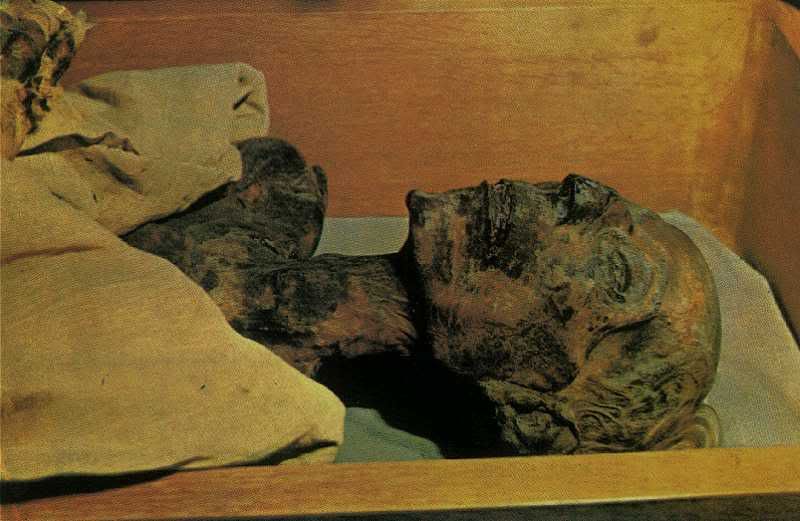
See this picture of King Tut which has sparked off this debate.


I can see why he can look scary to some, but that was not what the commentator was complaining about. He was complaining about the fact that dead people should have their dignity and should be buried or cremated and generally kept out of sight post death and have their peace.

But I found it curiously sad and tender. Here is a man who died in his youth, had a very very torrid family history, and lived through turbulent times and his mummy with the fine tapestry of cracks on the chin, the slightly squished nose, the sunken eyes, all raise a feeling of pity and tenderness inside me towards Boy King Tut.


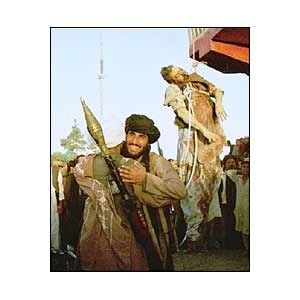
How about this one? The hanging body of Former President Mohammed Najibullah of Afghanistan displayed in Kabul publicly?


What about the bodies of American Contractors in Falluja?


How about the pictures distributed by the Americans of the dead bodies of Qusay and Uday Saddam Hussein?


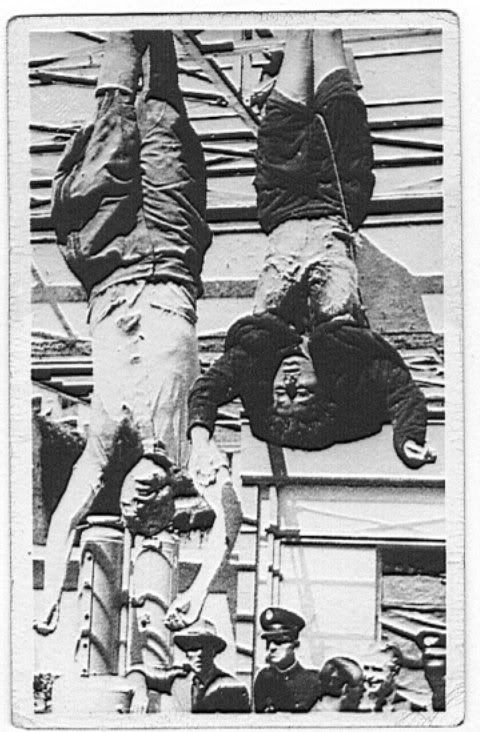
No? how about this one of IL duce of Italy, Mussolini and his mistress, Clara Petacci?


This photo is coming from the civilised Christian west, which was responsible for the Holocaust and then this very barbaric hanging of the two bodies after Italy was liberated. It was a scene of ferocious joy, of revenge even, celebrating a monster getting what he justly deserves. Same with Najibullah, who was a monster by all accounts in Afghanistan. What about the American Contractors? They are also monsters in the eyes of the Iraqi's, so that is why they hung up those dead bodies and danced around the remains. The fact that they could do that to dead bodies and break the natural taboo of respect to the dead, means that the feeling of hatred and wanting revenge was extra-ordinarily high. And in the case of the Hussein brothers it was mainly cold hard political calculation. Curious, no? The lengths one can go to mistreat- even already dead - bodies?


But to go back to old geezers. The mummy of Ramses II and other mummies in Cairo Museum?


Ramses II is one of my heroes. I look at this shriveled body and think about the man who strode the world like a colossus. The man who fathered hundreds of children, and whose exploits were written down in stone and have come down to us thousands of years later. The man who was celebrated by Percy Bysshe Shelley in his immortal poem, Ozymandias.


I look upon his patrician visage, that hooked nose, that pointed chin and I do not see the wisps of red hennaed hair, nor the blackened skin or the thin neck. I see a Pharaoh. A Pharaoh striding down Thebes, in his white linen skirt, in his majesty, ruling over most of the then known universe. Now that dead body - to me - is simply a reminder for us to think about the greatness of his reign, not the shriveled body left behind.


Or the Iceman?


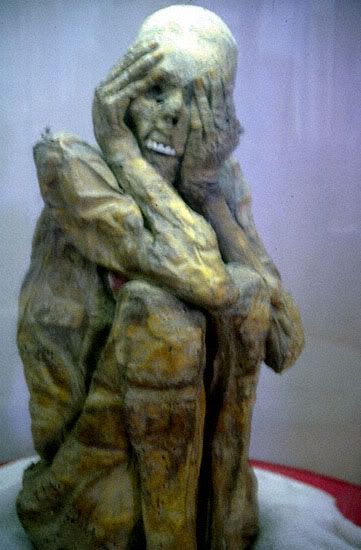
Or the Inca Mummy?


The above are prehistoric people. They are almost like museum exhibits or almost like they are like art objects, so you can look upon them without flinching. But what about people who become Gods after death? They were scientifically embalmed, with guards around them, modern mausoleums built for them and pilgrimages made to see their bodies after deaths. What about the man called Lenin?


Or Chairman Mao?


But then both were rather 'godless', no? So what about the 'godful'? Here's something/someone that I have seen personally in Prague. The Sedlec Ossuary. It is a church made out of the bones of 40,000 people. A church!!!!!!


And you see the same with Buddhist Monks.


If you think this public display of dead bodies is horrible, how about pets? Here is a selection of dead pets embalmed for life after death:


How cute, you say, no? So you can embalm your pets post death and find it nostalgic or just a bit strange. Its even comedic as evidenced in the Comedy series Scrubs.


If you do not like the display of bodies after death, can you use the bodies after death, for example for organ donation? or anatomy classes? or for use in testing Improvised Explosive Devices? Here's some very interesting advice on what to do if you find a dead body. I liked this part:

3: Do not - Do not set your camera on auto-timer, lie down next to the body and make rabbit-fingers behind the remnants of the victim's bloodied head as you have your picture taken. I'm not sure if this is illegal or not but it's in very poor taste.


But I understand there are certain type / classes of people who love, erm, making love to dead people, a condition called as Necrophilia. Here's Anthony Merino who was caught having sex with a corpse of a 92 year old woman inside a NY Morgue.


I do not really have an issue with the display of dead bodies. After you are dead, you are just some chemical components. You do not / cannot really care about what happens to your body after you are dead. It is not you, but other people who get all squeamish about your dead body or dead bodies in general. The distaste about dead bodies was burnt out of me when I was exposed to the Bhopal Gas Disaster. Here are two very famous images from that tragedy.


So I don't think that King Tut would mind his body being put on display. Dead bodies are not sacrosanct at all.


Technorati Tags: