I did a bit of work in this book in couple of places with an old friend of mine, we did our PhD’s together way back in the early 1990’s in Manchester, he went on to do great and brilliant stuff. Here is the table of contents. Go buy :)
Sunday, August 22


Friday, August 20
Low European Donations to Pakistan – Islamophobia or bad Pakistani reputation?
Found these 3 links on the Pakistani Floods situation.
1. Most Germans reluctant to donate to Pakistan
2. Why Europe Has Been Slow to Help Flood Victims. Quote:
"Many Pakistanis are struggling to understand why the response in the West has been so inadequate," writes Pakistani historian Tariq Ali in the columns of Süddeutsche Zeitung. "Some among them," he explains, "argue that Europe and the United States are reluctant to release funds because their country is now viewed as refuge for terrorists. In fact the issue is more complex, but it is clear that the problem has not been solely caused by Pakistan. The reality is that the main factor limiting international aid is the flagrant Islamaphobia that has that has emerged in Europe and North America since Sept. 11. In a recent poll, more than 50 percent of respondents associated the word "Islam" with terrorism.
"Of course," Tariq Ali remarks, "all of the people interviewed were in the UK, but the British, the French, the Germans, the Dutch and the Danes all think alike. Pakistan is under water and the rest of the world remains indifferent." And he bitterly insists, "Yes, latent prejudice against Muslim countries is one of the reasons for the lack of international aid. But the problem has also been compounded by another factor which is a specifically local: many Pakistanis themselves are reluctant to hand over money because they fear it will end up lining the pockets of the country's corrupt politicians."
In response, the implacable Jyllands Posten points out that "for years Pakistan has contributed to its terrible international reputation." The country "is now viewed as one of the most dangerous places in the world: a nuclear power with an army that is unwilling or unable to stand up to the Taliban and al-Qaida, and a secret service that supports the Taliban." Having said that, even if "it does not benefit from much sympathy, Pakistan still needs massive humanitarian aid," points out the Danish daily.
3. Record rains – but Pakistan is dying for water. Quote:
To put matters in their depressing context, the number of children who perish daily from water-related diseases is several times higher than the rate at which people perished in last week's devastating floods.
The poor Pakistani’s, somebody needs to save them from not only the floods, but their leaders, both civil and military, but the Islamophobia argument is very weak, based upon what I have read and figured, its more to do with the reputation of Pakistan due to corruption, terrorism and general incompetence all around.
Update: 21 August 2010: BBC asked some talking heads on this issue. I quote:
Dr Marie Lall, Pakistan expert at the Royal Institute of International Affairs (Chatham House) and senior lecturer at the Institute of Education, says: "I think there is donor fatigue all around. The [2004] Indian Ocean tsunami, the Burmese Cyclone [Nargis, 2008], the [2005] Pakistan earthquake, and [this year's] Haiti earthquake. It is getting too much; we are in a recession and people are short of money."
Rebecca Wynn, Pakistan specialist for UK-based aid agency Oxfam, says: "Many donors have made substantial contributions in humanitarian assistance to Pakistan over the years, particularly in response to the conflict-related displacements over the last two years. Of course, the fact that the people of Pakistan have been hit time and again by disaster is even more reason to give."
Dr Elizabeth Ferris, senior fellow at the US-based Brookings Institution, a foreign policy think tank, says: "It should also be noted that the international humanitarian system isn't set up to deal with more than one major crisis a year. USAID, for example, committed one-third of its annual budget to the Haitian earthquake response. And among the general public there may be a feeling of, 'Well, I donated to the victims of the Haitian earthquake and Haiti is a far needier country than Pakistan.'"
Corruption
Yale University economics professor Dean Karlan, an expert on charitable giving, says: "Corruption concerns may explain why giving is lower to developing countries than many would like it to be, but it does not explain why there is less money pouring into Pakistan now than does to disaster relief causes in other developing countries with similar governance issues."
Dr Marie Lall says: "People in Pakistan are sceptical the government will be transparent. But they are giving to philanthropic organisations. In the UK, I think people are sceptical of [non-governmental organisations'] overheads and costs. They don't know which ones are transparent and reliable, even though local organisations such as TCF [The Citizens' Foundation] are doing an incredible job."
Dr Elizabeth Ferris says: "People are always sceptical about their money reaching flood victims, particularly in countries with reputations for corruption. But Haiti didn't have a very good reputation in this regard. [Pakistan] President [Asif Ali] Zardari trip to Europe [during the floods] was not a good move. For a few days, that was the 'story' of the Pakistani floods, which doesn't inspire people to be generous, particularly in this economic climate."
Terrorism
Dr Marie Lall says: "British Prime Minister David Cameron's comments in India [when he said Islamabad promoted the export of terror] did not help."
Dr Elizabeth Ferris says: "People are less likely to donate to any country seen as a haven for terrorism. And more generally, the fact that so much Western news coverage in recent years about Pakistan has been negative, stressing its links with the conflict in Afghanistan. I think this is the major reason for the slow public response - the image of Pakistan in our media. There may also be a feeling, particularly in the US, that Islamic governments and charities should be stepping up to the plate to donate."
Timing
Rebecca Wynn says: "This disaster has come at a bad time, following the financial crisis and the Haiti earthquake. Many donors made huge commitments to Haiti, so may find it hard to fund another major disaster, particularly in the same year."
Dr Marie Lall says: "Timing may be a factor, but I think it's more to do with not realising the scale of the disaster, and the attitude by the British government; the UK should be leading the aid effort, given the Pakistani diaspora here and the fact that we need Pakistan for the war in Afghanistan."
'Wrong' disaster
Professor Dean Karlan says: "Sudden events seem to generate more funds. A flood (and droughts) happen gradually and build. There isn't any one single day in which news is huge. For the same reason, this pushes the story away from the media spotlight. But massive and sudden earthquakes or tsunamis draw our immediate attention and shock us."
Dr Elizabeth Ferris says: "It's important to note that in general people are likely to give more to emergencies occurring in countries geographically closer to them - although this didn't hold true for the tsunami. But when you trace contributions over time, you find that Americans and Canadians are more likely to respond to disasters in the Western hemisphere while Europeans tend to be more responsive to African countries (and their former colonies, in particular)."
Dr Marie Lall says: "This was not one cataclysmic event, but one which grew over three weeks. The fact that 25% of the country was or is under water is not understood. The low numbers of dead, relatively speaking, mask the disaster on the ground. The crisis has destroyed crops, dead livestock and damaged homes and infrastructure. Food prices are through the roof and there won't be a normal harvest. It will get worse. Farmers will starve."
So pretty much everything, eh?
Sunday, August 15
A revolt over Halal & Kosher Food
I came back home and found that somebody had handed over this crumpled up pamphlet to Diya outside her school.
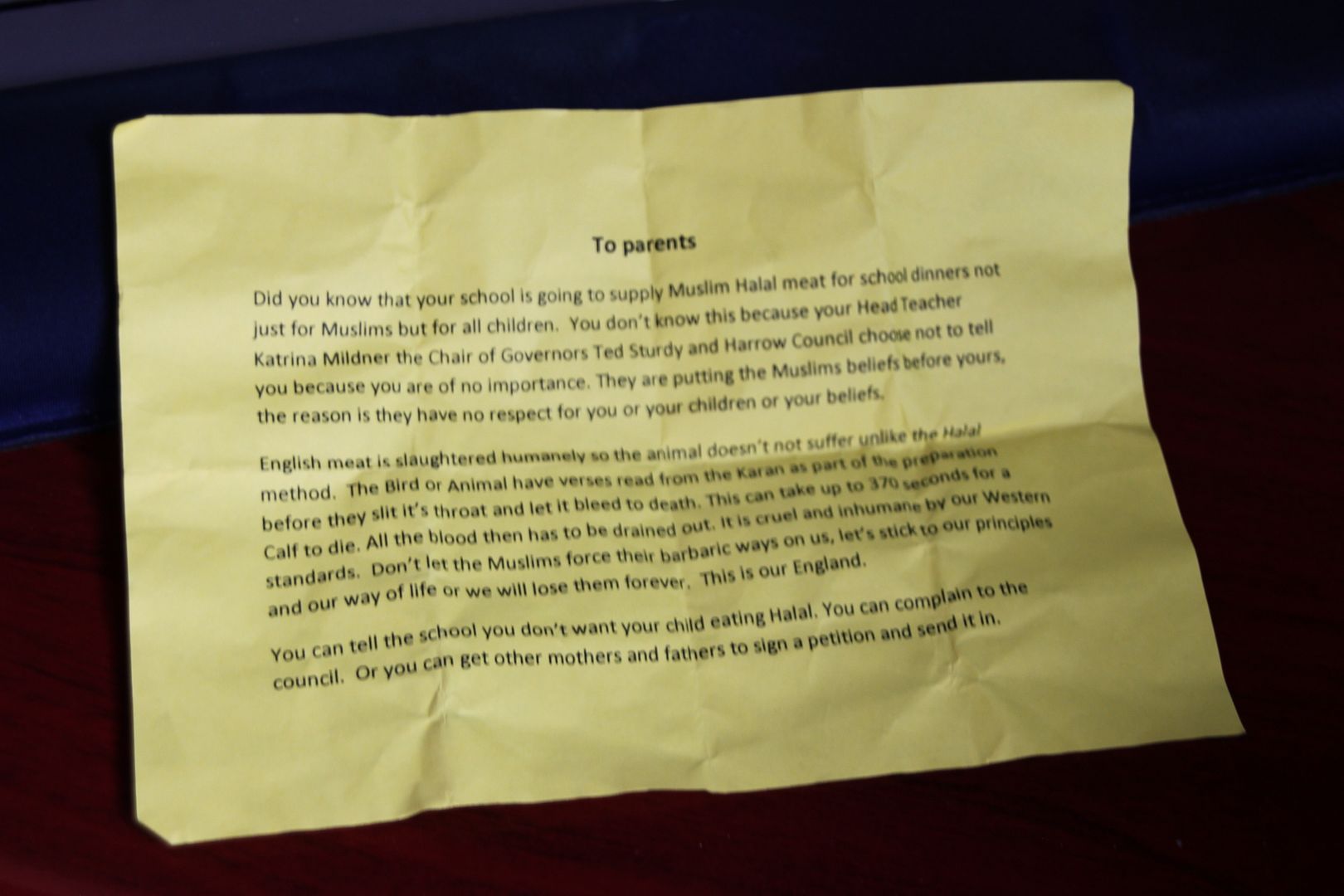
This says:
To Parents
Did you know that your school is going to supply Muslim Halal meat for school dinners not just for Muslims but for all children. You dont know this because your Head Teacher, Katrina Mildner the Chair of Governors Ted Sturdy and Harrow Council choose not to tell you because you are of no importance. They are putting the Muslims beliefs before yours, the reason is they have no respect for you or your children or your beliefs.
English meat is slaughtered humanely so the animal doesn’t not suffer unlike the Halal method. The Bird of Animal have verses read from the Karan as part of the preparation before they slit it’s throat and let it bleed to death. This can take up to 370 seconds for a Calf to die. All the blood then has to be drained out. It is cruel and inhumane by our Western standards. Don’t let the Muslims force their barbaric ways on us, let’s stick to our principles and our way of life or we will lose them forever. This is our England.
You can tell the school you don’t want your child eating Halal. You can complain to the council. Or you can get other mothers and fathers to sign a petition and send this in.
Leave aside the painful grammar and strange punctuation, this made me wonder. What on earth is going on? This sounds ridiculous, but not for the stated reasons. Why haven't we been asked about this? They ask about everything ranging from temperature in the school rooms to colour of the damn school balls, but not about this. Curiously, this came just a few days after I read about the hoo haa about Kosher meat preparation in New Zealand. Here is one report on this issue. I quote:
On 28 May 2010, New Zealand became the fourth country in the world to outlaw shechita, the slaughtering of animals according to Jewish law to produce kosher meat and poultry.
New Zealand’s ban on kosher slaughter isn’t the first - it follows a position first adopted during the 1920s in Iceland, Norway and Switzerland, and most infamously by Nazi Germany during the early 1930s.
The New Zealand ban comes about as a direct consequence, apparently deliberate, not to consider kosher slaughter under the new Animal Welfare Commercial Slaughter Code as a humane method, and to disregard the scientific consensus supporting the humaneness of the method. New Zealand’s position not only runs counter to preexisting New Zealand laws, but is also contrary to the legal position in Australia and the United States.
The new Code, announced by New Zealand Agriculture Minister David Carter and prepared by the National Animal Welfare Advisory Committee (NAWAC), mandates that commercially killed animals must be stunned before slaughter to “ensure that the animals are treated humanely and in accordance with good practice and scientific knowledge”. The Code took effect immediately following his announcement on 27 May.
So, what do we have here? We have a situation that the current standards of humanity and avoidance of senseless pain and cruelty is considered to be at variance with religious practise. And not just that, here in Harrow, because of somebody wanting to follow THEIR religion which leads to senseless pain and cruelty to animals, gets my daughter involved who doesnt even belong to that religion. Freedom of religion to freedom from cruelty to animals to freedom of choice, etc. etc. seem to have gotten into a right little tangle.
I hate cruelty to animals but then I love eating meat. So I would find it hypocritical to complain about animals being killed for meat anyway. But the question isnt about killing animals or not, its HOW they are killed. The fact that animals and plants do feel pain and have responses to it mean that that argument is not part of the equation, whether you are vegan or not, you will inflict pain on living creatures, both animals and plants.
But then, just because you have a donkey to carry your goods around does not mean that you can beat it mercilessly. Is that what the argument is with kosher or halal meat? There have been quite a lot of online and newspaper arguments about this. Here are some examples here, here, here. The Harrow Council has released a statement recently waffling around on this. The Jewish Chronicle is also worried about this.
Well, after due consideration, this is what I think. The fact that its religiously mandated is neither here nor there, there are many things in Islam and Judaism which are religiously mandated like slavery but we dont allow that, so the idea that everything that any odd sod religion says is fine has nothing to do with freedom of religion. There are rules and modern concepts about cruel and unjustified punishment and treatment towards animals. Here is a good overview of the laws in various countries. Here is a nice overview from the BBC on this. So you can take your halal and kosher food and shove it.
Second, no, I am not happy that my daughter is now a party to this inhumane and cruel practise without even consulting us. So Harrow Council, you can shove it too.
Rahu and Ketu in mythological and astronomological contexts
Fascinating paper. Publicly available, go check. And a great set of references tracking the development of Rahu and Ketu as mythological, astronomical and astrological aspects.
Saturday, August 14
What is the reason behind high & increasing rates of suicide for Muslim Middle Eastern Women?
Now this is a rather sad if interesting result. Well, not so surprising if one thinks deeply about this. There is an increase in tensions in the middle east, globalisation is happening, media intrusion is happening, religiosity is increasing. So changes in suicide rate, in hindsight, should happen as well. But this paper does a review of the PubMed database and extracts a shed load of papers relating to this phenomena.
The author finds clear evidence that the rate of suicide or even attempted suicide has shot up. What are the reasons? Well, the reasons that the researcher proposes are psychiatric disorders, marriage and the role of the man / patriarchal perspectives. The author closes by saying, and I quote:
Higher suicide rates among young Middle Eastern Muslim females must be considered an important issue, and their root causes should be dealt with properly and without delay.
Out of the three main root causes that the researcher identified, the first one seems to be easiest to address. Psychiatric disorders: improve health care systems, train more doctors and psychiatric analysts, provide help and assistance, teach the family to be more receptive of these disorders and understand the problems, help and support the women. But this is not easy. As long as women in the Middle East are (and I am exaggerating here), meant not even to be seen forget about being heard, the second and third factors are not going to be fixed that easily.
The author talks about Muslim women only and given the patriarchal perspectives in Muslim worlds (there is a current blow up in India about this), how on earth are you going to remove it? This has religious sanction and we all know how tough it is to apply equal rights to woman in the face of religious facts (here is a list of jaundiced points which purport to shed light on how women are seen).
Very long way to go on this fight, and in the meantime, more suicides will keep on happening.
Photo Essay: An evening with a chocolatier
We were invited to a charity event to raise funds for VSO where a chocolatier would show us the art of making chocolate. Me being the original piggy wiggy, signed up post haste. Well, it's all for a great cause, no?
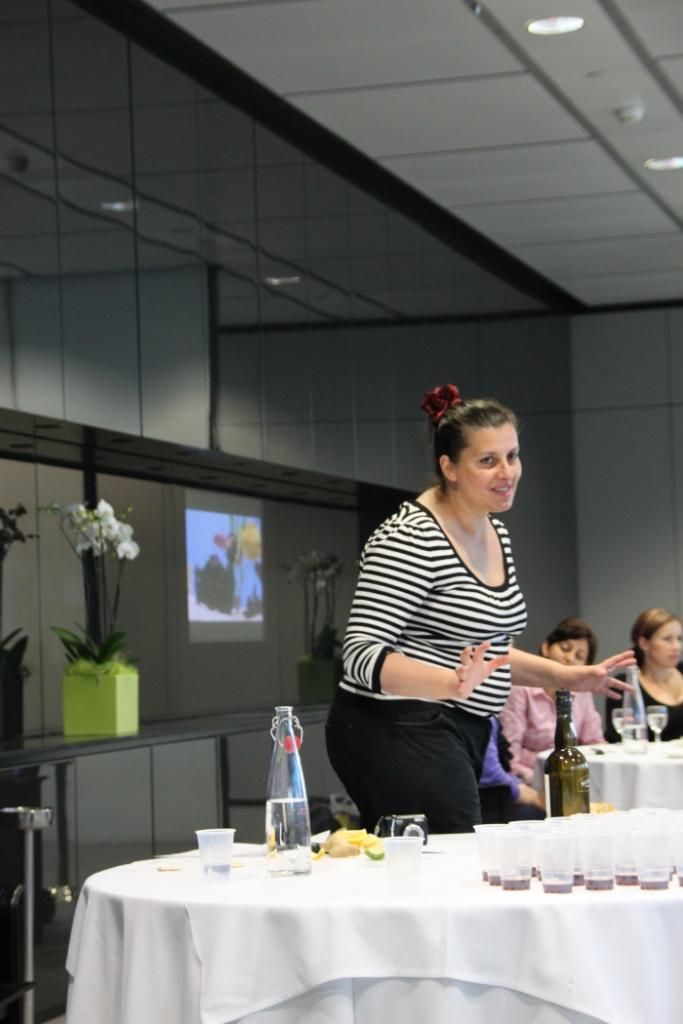
The chocolatier lady in question was brilliant, originally from France (yes, notice the T Shirt) she had training in the USA and on the continent. She is just brilliant. Did I mention she was brilliant? No? well, she was, her fascinating French American accent was just perfect. You can see small glasses of port in front of her. This is something we drank at the end to enjoy with the final chocolate taste of pure chocolate and Madeira Port wine, it was extraordinary, the combination was breathtaking. Put the chocolate in yout mouth, then leave for one minute.
The melting point of good chocolate is 35 degrees so it will slowly start melting in your mouth. Tilt your head back so that it starts to slowly move from the tongue down the back of your tongue and down your throat. At this time, take a sip of the port (or any other liqueur as you wish). The two flavours will mix. Hot diggity dog. Brilliant stuff. She did say that it's good that you don't smoke, because apparently smoking kills the taste buds. My taste buds belong to a donkey, so that ship has sailed.
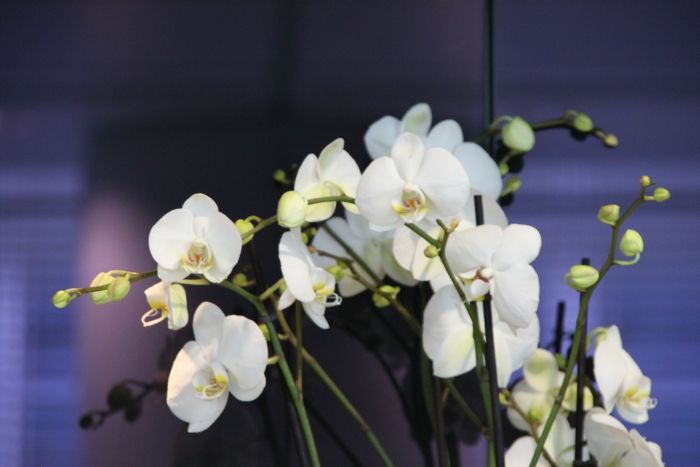
Anyway, we were lead into a room which was quite tastefully decorated with orchids. She first gave a nice little overview. Chocolate consists of cocoa butter and cocoa powder. Adding milk makes it white and if not, then it's dark chocolate. Chocolate tastes seriously different depending upon where it is grown. Cuban chocolate has tobacco overtones, chocolate grown in Papua New Guinea has flowery overtones. Wow, I had no idea, I will have to check this out. Then she went on a bit of a rampage on Europe and its silly labelling laws for what is and what isn't chocolate. The fat/butter content is what makes the difference. English chocolates are not chocolates, they are sweet stuff, and that’s as far as she would go. So why are people using fat instead of cocoa butter?
Well, it turns out that cocoa butter is also used in cosmetics. And the best cocoa butter is used there as it's far more remunerative to plonk it into lipstick and other skin creams rather than use in chocolate. So cheaper chocolate is usually made out of animal or vegetable fats or both. So if you are a vegetarian, check the ingredients and she said that almost all fats have animal fats in there. I had an evil chuckle there.
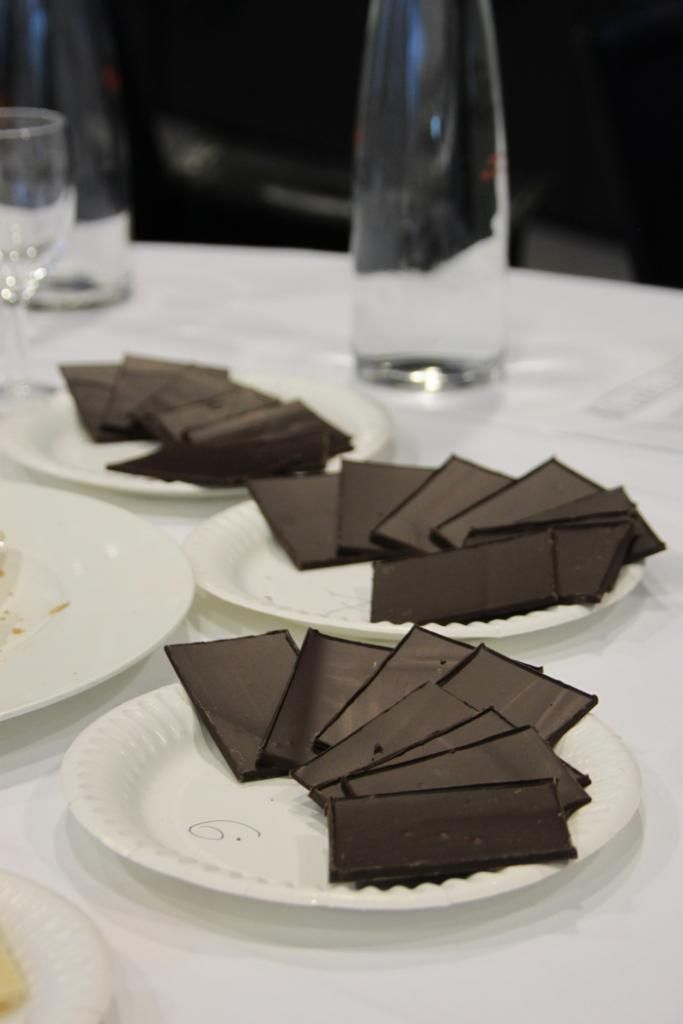
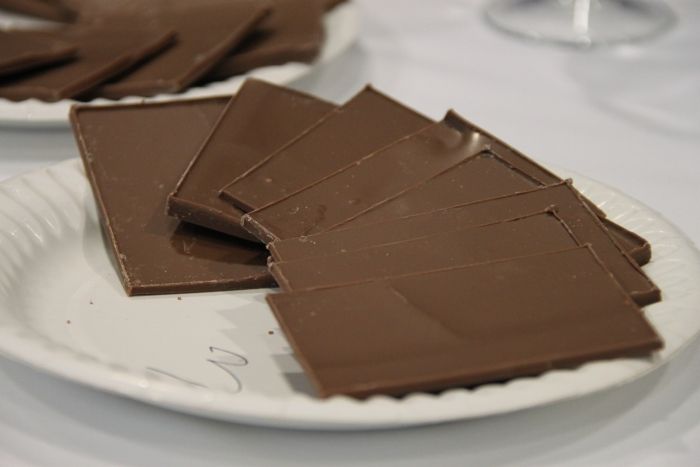
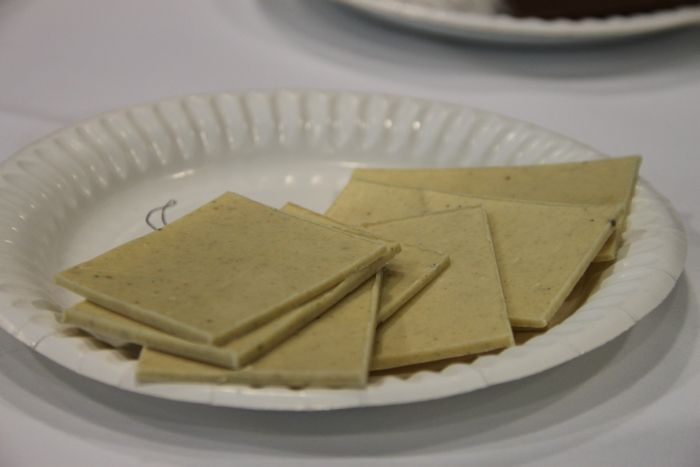
There were eight plates on each table, each plate was numbered and had chocolate wafers, weighing about 10-15 grams each.
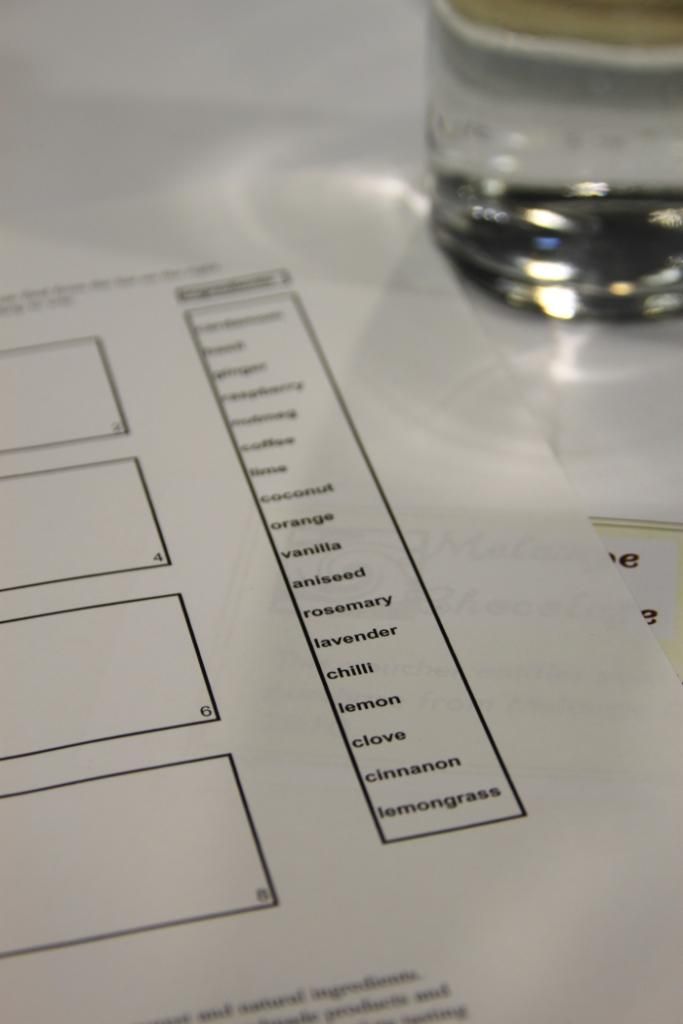
She made a game out of it. We had a sheet of paper each where a list of ingredients were listed on the right and then there were eight boxes. So the idea was that we pick up one, smell and sniff it – do a Count Snifferu on it. Then take a bite and taste. Flavours were primary and secondary. So we had to identify which flavours were mixed up.
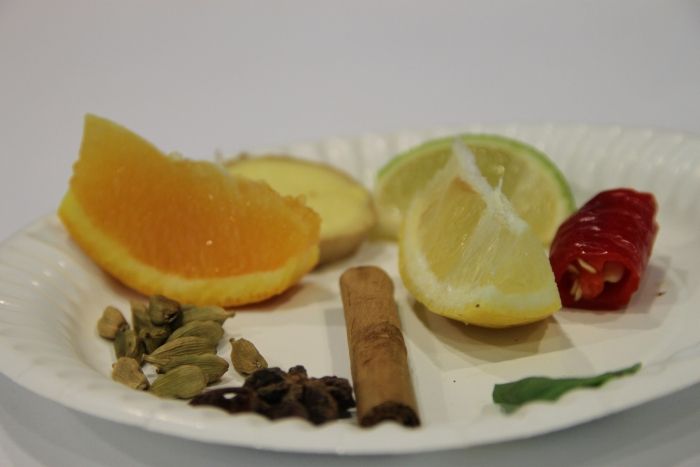
These were some of the ingredients, cardamom, chilly, basil, lemon, garlic, cloves, ginger, nutmeg, lime, coconut, aniseed, rosemary, lemongrass, cinnamon, etc. Can you just imagine the smorgasbord of tastes and flavours?
So we had vanilla and coconut; nutmeg and cardamom; lavender and lemon; lime and ginger; aniseed and coffee. These were for the light and milk chocolate. Then came the dark chocolates. They contain 71% cocoa. Lemon and basil; raspberry and rosemary; orange and chilli. By this time, I was feeling queasy, too much chocolate, man. Not good for my tummy at all.
Did you know men and kids prefer white or vanilla chocolates, while women prefer dark and complex chocolates? I didn't know that. She said that is what she observes in her shop, but then I prefer dark chocolate. Maybe its my latent feminine tendencies coming out. HA!. Also, guess what? Out of the 40 odd people in the room, only two were men. Go figure.
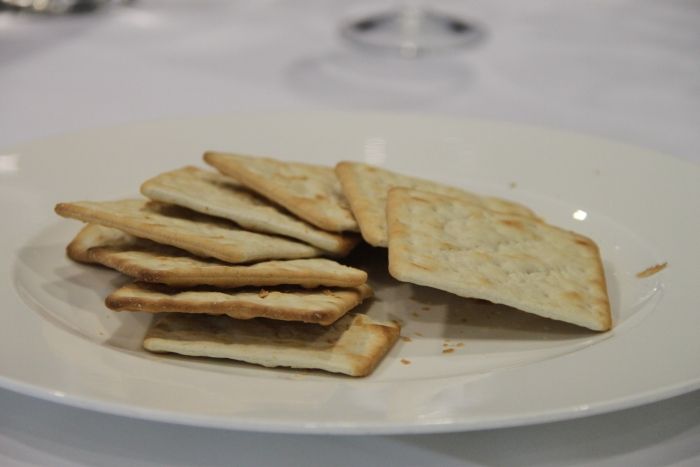
After each taste, she would ask us to eat a cracker and then drink some water to cleanse the palate and make sure that there is no after effects of the chocolate lingering around in your mouth. It was a brilliant exercise and something that I recommend highly. Next stop for me would be to try to join a chocolate cooking class or something. But here’s a small piece of advice, take it easy, you can really ruin it if you barf after eating too much chocolate. As it so happens, the weekend after that, I got to see Chocolat again. I love this movie. I think chocolate is one of the bestest things in life, but not too much, gives one a tummy ache.

The chocolatier lady in question was brilliant, originally from France (yes, notice the T Shirt) she had training in the USA and on the continent. She is just brilliant. Did I mention she was brilliant? No? well, she was, her fascinating French American accent was just perfect. You can see small glasses of port in front of her. This is something we drank at the end to enjoy with the final chocolate taste of pure chocolate and Madeira Port wine, it was extraordinary, the combination was breathtaking. Put the chocolate in yout mouth, then leave for one minute.
The melting point of good chocolate is 35 degrees so it will slowly start melting in your mouth. Tilt your head back so that it starts to slowly move from the tongue down the back of your tongue and down your throat. At this time, take a sip of the port (or any other liqueur as you wish). The two flavours will mix. Hot diggity dog. Brilliant stuff. She did say that it's good that you don't smoke, because apparently smoking kills the taste buds. My taste buds belong to a donkey, so that ship has sailed.

Anyway, we were lead into a room which was quite tastefully decorated with orchids. She first gave a nice little overview. Chocolate consists of cocoa butter and cocoa powder. Adding milk makes it white and if not, then it's dark chocolate. Chocolate tastes seriously different depending upon where it is grown. Cuban chocolate has tobacco overtones, chocolate grown in Papua New Guinea has flowery overtones. Wow, I had no idea, I will have to check this out. Then she went on a bit of a rampage on Europe and its silly labelling laws for what is and what isn't chocolate. The fat/butter content is what makes the difference. English chocolates are not chocolates, they are sweet stuff, and that’s as far as she would go. So why are people using fat instead of cocoa butter?
Well, it turns out that cocoa butter is also used in cosmetics. And the best cocoa butter is used there as it's far more remunerative to plonk it into lipstick and other skin creams rather than use in chocolate. So cheaper chocolate is usually made out of animal or vegetable fats or both. So if you are a vegetarian, check the ingredients and she said that almost all fats have animal fats in there. I had an evil chuckle there.


There were eight plates on each table, each plate was numbered and had chocolate wafers, weighing about 10-15 grams each.

She made a game out of it. We had a sheet of paper each where a list of ingredients were listed on the right and then there were eight boxes. So the idea was that we pick up one, smell and sniff it – do a Count Snifferu on it. Then take a bite and taste. Flavours were primary and secondary. So we had to identify which flavours were mixed up.

These were some of the ingredients, cardamom, chilly, basil, lemon, garlic, cloves, ginger, nutmeg, lime, coconut, aniseed, rosemary, lemongrass, cinnamon, etc. Can you just imagine the smorgasbord of tastes and flavours?
So we had vanilla and coconut; nutmeg and cardamom; lavender and lemon; lime and ginger; aniseed and coffee. These were for the light and milk chocolate. Then came the dark chocolates. They contain 71% cocoa. Lemon and basil; raspberry and rosemary; orange and chilli. By this time, I was feeling queasy, too much chocolate, man. Not good for my tummy at all.
Did you know men and kids prefer white or vanilla chocolates, while women prefer dark and complex chocolates? I didn't know that. She said that is what she observes in her shop, but then I prefer dark chocolate. Maybe its my latent feminine tendencies coming out. HA!. Also, guess what? Out of the 40 odd people in the room, only two were men. Go figure.

After each taste, she would ask us to eat a cracker and then drink some water to cleanse the palate and make sure that there is no after effects of the chocolate lingering around in your mouth. It was a brilliant exercise and something that I recommend highly. Next stop for me would be to try to join a chocolate cooking class or something. But here’s a small piece of advice, take it easy, you can really ruin it if you barf after eating too much chocolate. As it so happens, the weekend after that, I got to see Chocolat again. I love this movie. I think chocolate is one of the bestest things in life, but not too much, gives one a tummy ache.
Sunday, August 1
Making the eldest cost centre into a hedge fund manager
You remember what I talked about last time about my son getting educated on stock investments? Well, now we started on a new experiment. The genesis of this comes from the last parents teacher association meeting that I attended and the fact that I got him a summer internship at a friend’s software development shop to learn about website design for his business. Anyway, the teachers told us that the students have to make a good cv for the formal internship next year and concentrate on the extra-curricular activities to differentiate himself from the others. He is ok in sports, but not championship / trophy level, he is much better at the mental stuff. He does like playing football and guitar but not to that extent.
Anyway, so the idea was sparked in my head and I fired off an email to some friends asking if they would be interested in investing money in a UK Stock market fund run by Karn, say £200 per head investment, 3 year lock-in period, quarterly investor calls, with an independent investment committee of non subscriber experts and we pay him on an agreed % return basis.
So he has agreed to do so, he is now busy thinking up a name of the fund. Told him to think of a good name, it has to reflect solidity and trust, also explain what it does, but also has to give a frisson of excitement. He will line up the portfolio on www.iii.co.uk and send a spreadsheet around every 3 months, get the independent investment committee to help and guide, and have a quarterly call.
So aiming for him to come up with the first list of stocks for about £1000, about seven people have already signed up, and one friend’s son also wants to invest. I did warn everybody that he is still a kid and he could lose the lot, there could be a double dip recession, there could be horrible returns in the UK, so they have to be warned that this should be looked upon as lost money. That did not worry the friends that much and looks like its a good start. And even if he loses the money, I think it would be an invaluable lesson on how to protect capital at the very least and try to make alpha. I will keep on reporting on the progress of the fund and what kind of returns he is making. Lets see if this experiment works out.
But more importantly, if you had to advice him, what would you say he would invest in? What kind of stocks do you think would be good for a good return over the next 3 years?
Working from home
I am currently starting a new transformation programme and will end up with approximately 20-25 people additional people in the building. A significant number will be consultants but many will be internal permanent and contractor employees as well. Number of desks that are allocated to me? Zero. So I am having to beg borrow steal sneak and squat in about 4 different floors in the building.
This is obviously not beneficial and has been escalated to senior management. Although given the seat situation, I really dont know where they will find the space. I hear there are some spaces in the window cleaner's boat, but not sure how many will like to work there. So homeworking it is.
But that's good when you have an established unit working and people know each other and a team has been formed, when you are forming a team, then its much more difficult.
I was speaking to a friend of mine who has young children and he said that its tough to do calls with babies at home. I recalled what I used to do, try to bunch up calls to take at home, open the call and announce that you are at home and have a baby. Made a sling out of my ma's sari and put the baby in the sling, lying down or up against my left shoulder. Bought one of those phone headsets which has a mute button and off you go.
Its not pretty or hunky dory, you can end up with a shoulder full of drool, or suddenly you hear "abababdbssaababababab" or the baby grabs your pencil while you are trying to take notes or you suddenly find that your baby has decided that your ear makes for a perfectly good teether or decides to use your head as a drum or wants to participate in a call about budgets. All which has happened to me and its not fun, but there you have it.
Having had the joys of home working for the past 12-13 years, I am still not sure if anybody has really cracked the home working situation properly, specially within the financial services world. Also came across this article on the differences between men and women home working. I quote:
Everybody knows that men and women think differently in a lot of ways. But do those differences matter when it comes to working remotely and managing remote teams? According to Sally Helgesen, it matters a lot. Managers who don’t appreciate those distances can do themselves, their companies and those employees a great disservice.
What do you think? What have been your experiences with homeworking and managing output with teams who are homeworking?
Monday, July 26
Capturing Histories
Sent out this email to the wider Dasgupta clan. Lets see how this experiment works out.
I thought of sending this email to all the wider Dasgupta clan because I need help with this. I am going to try to do an experiment while Baba and Ma are here. I am going to give them 2 copies of the same book.
http://www.amazon.co.uk/o/ASIN/0811843270?tag=betteraddons-20
This is a book which helps in capturing the memories of a grandparent for their grandchild. All our respective parents are now getting quite old and we should try to capture their histories in Bangladesh, Nepal and Jubbly so that we can pass this on to our grandchildren. Once Baba and Ma have filled this out, I will get it scanned and put up on a dedicated website. I already have reserved a domain name,
http://dasguptaonline.com/
But I need help, I am pretty sure that given their failing health, memory and eye sight problems and and and, they will need help to get this going. And that means that somebody has to volunteer to guide them through filling out this book. If we have some volunteers, I am happy to purchase more copies of this book and then send them back with Ma/Baba when they go back in September. Only thing is, I need them to be then scanned and then we will put it up on the website so that all our children can read up on their family histories.
Any volunteers to look at Jethima, Boro Pishi, Pishi, Itu, Choto Kaku and Kaki, and and and?
On a separate note, we have loads of old photographs but they are currently mouldering away in albums in various cupboards. I would like to propose that we try to scan them, send them to me, I will get a dedicated website constructed and pay for it, and then we have it all.
We are all quite busy at the moment with our lives, our careers and are spread out all over the world. What keeps us together is the sense of family and the history together. It would be regretful if we reach our old age and then think, damn, I wish I had captured my parents memories. Its already quite late, we have lost so many and their memories have gone with them.
What do you think of both ideas? Any volunteers for the first and suggestions for the second? If it is a question of cost of scanning, please do not worry, just take the albums to the nearest photographer, ask them for a cost of the scan of all the photographs and I am happy to assist in this. Only proviso, the photographer has to send the photographs to me via the internet or something. And will need people's assistance in identifying the people.
Sunday, July 25
A debate over climate change
We had a presentation on climate change in the office and I just want to pick up on one part of it. Here is the particular slide.
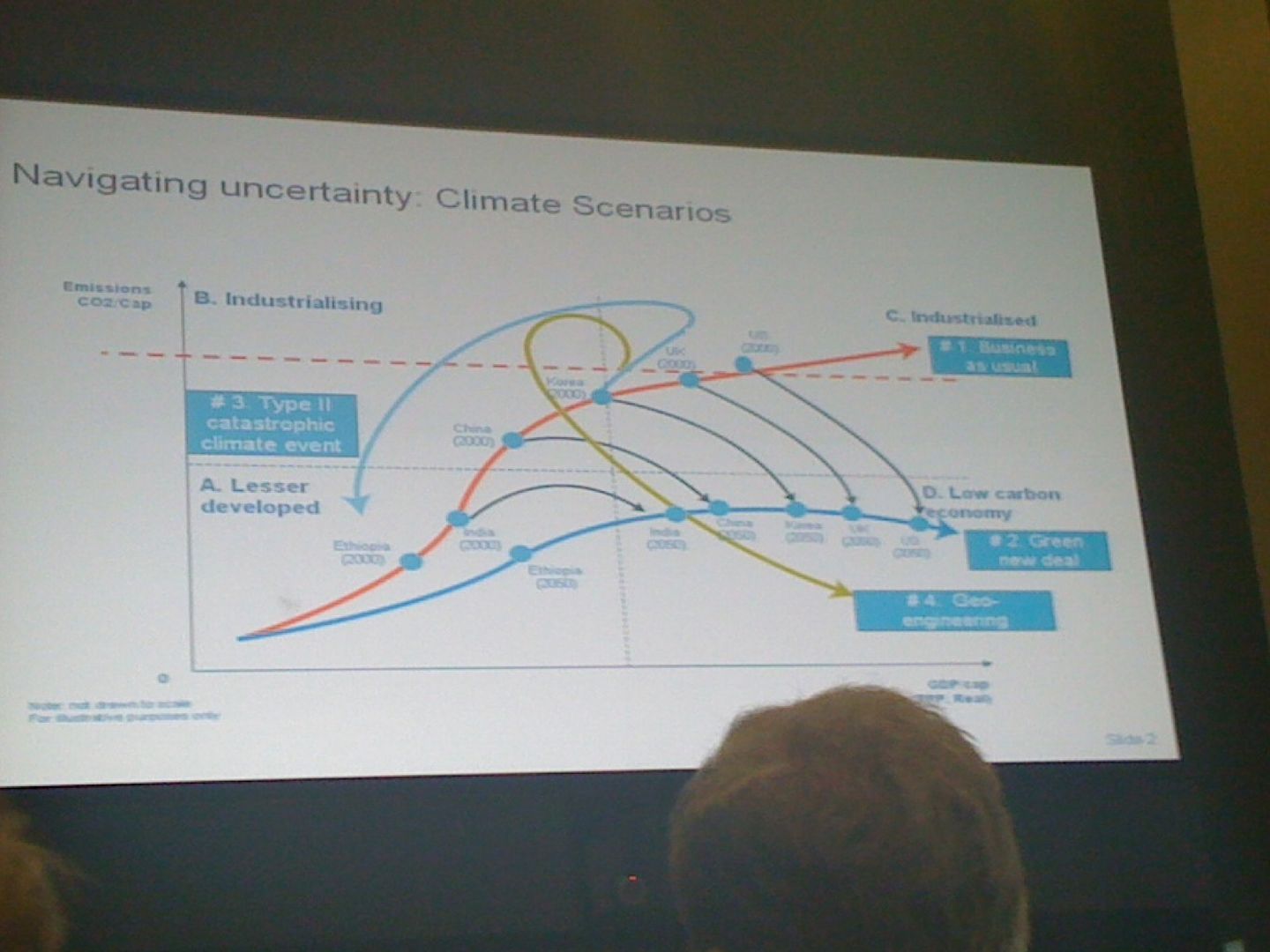
Let me explain the slide first. The X axis shows GDP growth while the Y axis shows the Emissions CO2 per capita. So you end up with (a) Lesser Developed, (b) Industrialising, © Industrialised, and (d) Low Carbon Economy. The last fourth quadrant being the nirvana land, yes?
So what’s the trajectory like? If we do nothing, then the red line is operational and we will keep on going up the increased wealth with increased emissions route. The parallel bottom descending lines from the red line to the dark blue line are due to green new deals, a climate change deal if you will. The top light blue line relates to a catastrophic climate event which will pull the entire world or the country back into lesser developed status while the yellow line exhibits what will happen if we have a technological breakthrough via carbon sequestration or some other fancy technology.
This is just an illustrative slide to show what potential trajectories there can be, but I have 3 issues
1. cost: This slide does not talk about what will be the impact of adopting the green deals or the geo engineering technical solutions. If you factor that in, then the optimistic blue line at the bottom will be pulled up sharply increasing the trend line. In other words, if a country like India has to actually pay for carbon storage or other carbon emission technologies, it can very well decrease its growth rate.
2. combination: There is a strong possibility that all four elements are simultaneously applied, we can have growth, we can have new green deals, we can have geo engineering and we can end up with a catastrophic climate event such as typhoons or cyclones or something like that. Then where do we go? In other words, the choice is frankly now out of our hands.
3. Other factors such as water shortage: What happens if we have a catastrophic non climate event such as volcanic eruptions? Or severe drought? or water shortage? What then?
I further pointed out that the cost of getting people to work on this via the private sector seems to be a bit wonky, the PE ratio’s of green tech companies are hovering around the 60-100 mark. That’s ridiculous. What on earth are those valuations telling me? That’s a clear and present danger of a huge bubble.
So I am going to sit this one out I am afraid, not very clear and until and unless there is more clarity, not going to invest in this sector. This doesnt mean that I am going to stop my attempts to reduce pollution and the like, that’s on the supply side but on the demand and fixing side? Jury is still out.
Subscribe to:
Posts (Atom)