Saturday, September 11

My ancestral fraud

Heh, found this exceedingly funny, got an email on facebook. Check this out.


facebook

Mohamed sent you a message.

Mohamed Fahab

Mohamed Fahab

September 10, 2010 at 9:50pm

Subject: Dear Bhaskar Dasgupta,

Dear Bhaskar Dasgupta,
I am Barrister Mohamed Fahab, personal attorney to Late Mr J.C.Dasgupta,a national of your country, Who died and left some huge amount of money with a bank here in Lome West Africa, valued at US$8.5 million dollars. I have contacted you to assist. Please Reply To My Private Email Ad...(mr_mohamedfahab00@hotmail.com) Or call me +228 9177735
Your Full nam.....................................
Your private number...........................
Your private email..............................
Regard
Mohamed Fahab,

Thursday, September 9

Some references on population and fertility growth

An email which i sent around.

Population forecasting (and all the attendant and associated aspects) is a strange research area, and almost impossible to predict with any degree of accuracy. The variables are just too many to  cater for, leave alone trying to establish the degree of correlation or causality between them. But economic conditions do have a bearing on population, so do cultural aspects. Here are some more examples:

1. Russia
http://www.williams.edu/Economics/brainerd/papers/fertility_rf.pdf

2. more links on fertility decline

http://scholar.google.co.uk/scholar?hl=en&rlz=1B3MOZA_en-GBGB353GB354&q=reasons%20for%20fertility%20decline&um=1&ie=UTF-8&sa=N&tab=ws

3. Belligerence produces more fertility for example in Israel and Palestine

http://onlinelibrary.wiley.com/doi/10.1111/j.1728-4457.2000.00441.x/abstract

4. Iran is an example of where population shifts have happened quite often.

http://en.wikipedia.org/wiki/Family_planning_in_Iran

5. Here is another view on Egypt's fertility situation.

http://www.demogr.mpg.de/papers/working/wp-2006-011.pdf

6. And , here's an interesting research article on India, albeit a bit old. I quote:
http://www-histecon.kings.cam.ac.uk/docs/female.pdf

There has been a significant decline in fertility in many parts of India since the early 1980s.
This paper reexamines the determinants of fertility levels and fertility decline, using panel data
on Indian districts for 1981 and 1991. We find that women's education is the most important
factor explaining fertility differences across the country and over time. Low levels of child
mortality and son preference also contribute to lower fertility. By contrast, general indicators
of modernization and development such as urbanization, poverty reduction and male literacy
bear no significant association with fertility.

Also look at this chapter for a good overview of the theories behind fertility, population in India.

http://www.corecentre.co.in/Database/Docs/DocFiles/fertility_decline.pdf

The UN Population Division does some excellent work in this area.

http://www.un.org/esa/population/

Finally, the question of food availability is yet another major issue in its own right. Intensive farming is a must and food / dietary changes which accompany economic growth has also important implications on this issue. Incidentally, I was trying to find a good stock opportunity to invest in global food producing firms given this change and missed out on that. But that's an argument for another day.

Sunday, September 5

Charity Photographic competitions and other news on the charitable front

I am conscious that i haven't posted here for some time, it has been manically busy at work and then I left for holiday so wanted to drop a line on what I have been up to in the past month or so.

  1. The IT4CH charity is now moving from up north down to London, it just makes it easier for our CEO and our team to do this from London.
  2. We are also negotiating with several local authorities to lease their buildings for us to keep our spare equipment in, this promises to be of much use.
  3. I put in some funding proposals for carbon change improvement products back in the firm, but dont think they got selected. Shame, next time I will do better :). Am trying to see if we can get some of this stuff formally pushed and funded in a separate matter
  4. SIFE is powering up for this academic year, as usual, I will be at LSE but have also offered to help Essex out. As I mentioned before, i am considering doing something with them on the academic and research front and I thought it might be able to kill 2 birds with one stone.
  5. The discussions with Manchester Business School proceed sporadically, I am specially happy about an internship/graduate recruitment proposal, lets see, early days yet.
  6. And finally, am thinking about submitting my photo essay on the Whittington Hospital in North London to this photo competition. I realise what we do with the kids is not so visually attractive, perhaps Disha would have been better but its way out in India and dont know when I will be there next. I quote from the site:
  7. PhotoPhilanthrophy believes in the power of photography to inspire hope and understanding and to connect people around the world. All subjects photographed should be treated with respect, compassion and dignity. PhotoPhilanthropy reserves the the right to reject any submission based on quality, content or theme. All submissions will be reviewed by the PhotoPhilanthropy team for accuracy of information. Written essays may be edited for clarity.

    Submitted photos must depict the work of a charitable organization (designated by 501c3 in the US, or international equivalent) and be presented as a photo essay. All photographs in the essay must have been taken within the last 3 years. Photographers may enter two essays in the same year. An essay entered in a previous year of the competition may not be re-entered.

    For all submissions, collaboration with the charitable organization will be verified.  For this reason it is mandatory to submit a contact name and email of the person you worked with at the organization.

    Upon completion of review, accepted photo essays will be posted on the PhotoPhilanthropy website.

    What do you think? do you think I have a shot at it with the photographs from the hospital? I realise the differences between the visual impact of a hospital in north London versus say a charity in a hauntingly beautiful but bloody poor place in say Nepal or hot/dry/dusty Sudan, but what the heck, all part of the learning, eh?

Tuesday, August 31

Somewhere along the route from Liberty Hall to Austerity Towers #ukpolitics

This was a brilliant column on how frankly silly CFO’s and wrongful ideas on austerity can screw up perfectly good pragmatic solutions. I quote:

what is not in dispute is that the second most important man in the British government travels second-class…..Then Gordon Brown, then prime minister, expelled generals and admirals from first-class compartments. After the election in May, when Mr Brown was deposed, the pace increased. The new regime imposed the same ban on civil servants……

Somewhere along the route from Liberty Hall to Austerity Towers, one passes the dividing line between common prudence and blithering idiocy, and it seems to me that the British government has now crossed it……..

The fastest journey from London to Sheffield takes more than two hours. Second-class compartments on British trains are cramped, generally noisy, usually crowded and sometimes standing-room only. It is difficult to use a laptop or, unless you have the temperament of a Buddhist monk, switch off and nap. The exception to this are the “quiet carriages”, which are always noisy, acting, as they do, as a magnet for large families with small children, serial telephoners, chatterboxes and officials from the Welsh Environment Agency giving hour-long lectures to their colleagues (I am not making this up).

Mr Clegg is paid a modest £137,000 a year. Say he travels to his constituency every fortnight. That means he would be spending not far off 5 per cent of his working time on these trains. If he can’t work in those hours he is not saving the taxpayer money…..

This is by no means just a British phenomenon, nor confined to railways. The fashion for hair-shirt travel may be traced back to the dotcom boom of the 1990s when the bosses of then-new companies such as Microsoft and Cisco helped to establish their image by conspicuously travelling in the back of planes themselves and expecting employees to follow suit.

This was a minor inconvenience to Bill Gates (who nonetheless travelled business class to Europe), at least until he got his own plane, and to senior executives who were expected to pay for their own upgrades.

It also roughly coincided with three other developments. First, the income of such executives exploded, so paying the extra became a minor detail. Second came the discovery of the pack-’em-in principle. It is now largely forgotten just how roomy the original 1970s jumbo jets were. Then airlines realised that no matter how ghastly they made the experience of travel, passengers were too price-obsessed and (appropriately enough for cattle class) too cowed to rebel. The third trend was the rise of the corporate CFO, trained to know the price of everything and the value of nothing, who found travel costs the easiest item of all to cut.

I used to have this stupidity all the time due to corporate travel policies whenever I would be working outside a bank. They would force people to travel in cattle class for long distances (at one stage, all flights below 10 hours). So what happens? I would be basically be unusable for 2 days for one flight. The result being that they would end up paying more for hotels, the wasted time, the catchup time etc. etc. And when the company is being stupid like this, why would they expect me to fly on a weekend? I wouldnt, so they would lose out on even more business time, week days would just be 1-2 days out of 5. This was when I was flying around the world on a very regular basis. Anyway, I agree, stupidity is not restricted to corporates but also to politics.

Sunday, August 22

Doing Business in India

I did a bit of work in this book in couple of places with an old friend of mine, we did our PhD’s together way back in the early 1990’s in Manchester, he went on to do great and brilliant stuff. Here is the table of contents. Go buy :)

Friday, August 20

Low European Donations to Pakistan – Islamophobia or bad Pakistani reputation?

Found these 3 links on the Pakistani Floods situation.

1. Most Germans reluctant to donate to Pakistan

2. Why Europe Has Been Slow to Help Flood Victims. Quote:

"Many Pakistanis are struggling to understand why the response in the West has been so inadequate," writes Pakistani historian Tariq Ali in the columns of Süddeutsche Zeitung. "Some among them," he explains, "argue that Europe and the United States are reluctant to release funds because their country is now viewed as refuge for terrorists. In fact the issue is more complex, but it is clear that the problem has not been solely caused by Pakistan. The reality is that the main factor limiting international aid is the flagrant Islamaphobia that has that has emerged in Europe and North America since Sept. 11. In a recent poll, more than 50 percent of respondents associated the word "Islam" with terrorism.

"Of course," Tariq Ali remarks, "all of the people interviewed were in the UK, but the British, the French, the Germans, the Dutch and the Danes all think alike. Pakistan is under water and the rest of the world remains indifferent." And he bitterly insists, "Yes, latent prejudice against Muslim countries is one of the reasons for the lack of international aid. But the problem has also been compounded by another factor which is a specifically local: many Pakistanis themselves are reluctant to hand over money because they fear it will end up lining the pockets of the country's corrupt politicians."

In response, the implacable Jyllands Posten points out that "for years Pakistan has contributed to its terrible international reputation." The country "is now viewed as one of the most dangerous places in the world: a nuclear power with an army that is unwilling or unable to stand up to the Taliban and al-Qaida, and a secret service that supports the Taliban." Having said that, even if "it does not benefit from much sympathy, Pakistan still needs massive humanitarian aid," points out the Danish daily.

3. Record rains – but Pakistan is dying for water. Quote:

To put matters in their depressing context, the number of children who perish daily from water-related diseases is several times higher than the rate at which people perished in last week's devastating floods.

The poor Pakistani’s, somebody needs to save them from not only the floods, but their leaders, both civil and military, but the Islamophobia argument is very weak, based upon what I have read and figured, its more to do with the reputation of Pakistan due to corruption, terrorism and general incompetence all around.


Update: 21 August 2010: BBC asked some talking heads on this issue. I quote:

Dr Marie Lall, Pakistan expert at the Royal Institute of International Affairs (Chatham House) and senior lecturer at the Institute of Education, says: "I think there is donor fatigue all around. The [2004] Indian Ocean tsunami, the Burmese Cyclone [Nargis, 2008], the [2005] Pakistan earthquake, and [this year's] Haiti earthquake. It is getting too much; we are in a recession and people are short of money."

Rebecca Wynn, Pakistan specialist for UK-based aid agency Oxfam, says: "Many donors have made substantial contributions in humanitarian assistance to Pakistan over the years, particularly in response to the conflict-related displacements over the last two years. Of course, the fact that the people of Pakistan have been hit time and again by disaster is even more reason to give."

Dr Elizabeth Ferris, senior fellow at the US-based Brookings Institution, a foreign policy think tank, says: "It should also be noted that the international humanitarian system isn't set up to deal with more than one major crisis a year. USAID, for example, committed one-third of its annual budget to the Haitian earthquake response. And among the general public there may be a feeling of, 'Well, I donated to the victims of the Haitian earthquake and Haiti is a far needier country than Pakistan.'"

Corruption

Yale University economics professor Dean Karlan, an expert on charitable giving, says: "Corruption concerns may explain why giving is lower to developing countries than many would like it to be, but it does not explain why there is less money pouring into Pakistan now than does to disaster relief causes in other developing countries with similar governance issues."

Dr Marie Lall says: "People in Pakistan are sceptical the government will be transparent. But they are giving to philanthropic organisations. In the UK, I think people are sceptical of [non-governmental organisations'] overheads and costs. They don't know which ones are transparent and reliable, even though local organisations such as TCF [The Citizens' Foundation] are doing an incredible job."

Dr Elizabeth Ferris says: "People are always sceptical about their money reaching flood victims, particularly in countries with reputations for corruption. But Haiti didn't have a very good reputation in this regard. [Pakistan] President [Asif Ali] Zardari trip to Europe [during the floods] was not a good move. For a few days, that was the 'story' of the Pakistani floods, which doesn't inspire people to be generous, particularly in this economic climate."

Terrorism

Dr Marie Lall says: "British Prime Minister David Cameron's comments in India [when he said Islamabad promoted the export of terror] did not help."

Dr Elizabeth Ferris says: "People are less likely to donate to any country seen as a haven for terrorism. And more generally, the fact that so much Western news coverage in recent years about Pakistan has been negative, stressing its links with the conflict in Afghanistan. I think this is the major reason for the slow public response - the image of Pakistan in our media. There may also be a feeling, particularly in the US, that Islamic governments and charities should be stepping up to the plate to donate."

Timing

Rebecca Wynn says: "This disaster has come at a bad time, following the financial crisis and the Haiti earthquake. Many donors made huge commitments to Haiti, so may find it hard to fund another major disaster, particularly in the same year."

Dr Marie Lall says: "Timing may be a factor, but I think it's more to do with not realising the scale of the disaster, and the attitude by the British government; the UK should be leading the aid effort, given the Pakistani diaspora here and the fact that we need Pakistan for the war in Afghanistan."

'Wrong' disaster

Professor Dean Karlan says: "Sudden events seem to generate more funds. A flood (and droughts) happen gradually and build. There isn't any one single day in which news is huge. For the same reason, this pushes the story away from the media spotlight. But massive and sudden earthquakes or tsunamis draw our immediate attention and shock us."

Dr Elizabeth Ferris says: "It's important to note that in general people are likely to give more to emergencies occurring in countries geographically closer to them - although this didn't hold true for the tsunami. But when you trace contributions over time, you find that Americans and Canadians are more likely to respond to disasters in the Western hemisphere while Europeans tend to be more responsive to African countries (and their former colonies, in particular)."

Dr Marie Lall says: "This was not one cataclysmic event, but one which grew over three weeks. The fact that 25% of the country was or is under water is not understood. The low numbers of dead, relatively speaking, mask the disaster on the ground. The crisis has destroyed crops, dead livestock and damaged homes and infrastructure. Food prices are through the roof and there won't be a normal harvest. It will get worse. Farmers will starve."

So pretty much everything, eh?

Sunday, August 15

A revolt over Halal & Kosher Food

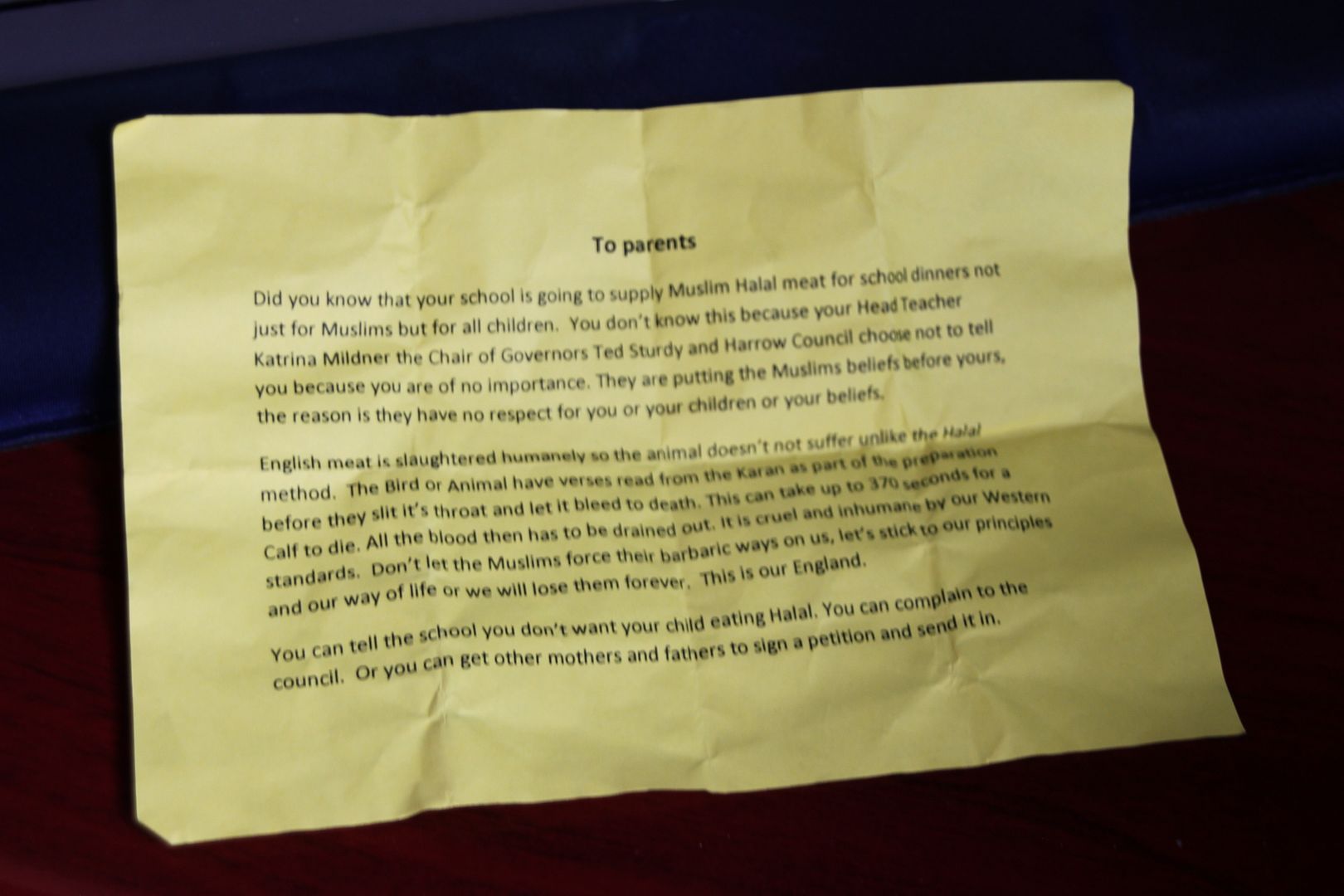
I came back home and found that somebody had handed over this crumpled up pamphlet to Diya outside her school.

This says:

To Parents

Did you know that your school is going to supply Muslim Halal meat for school dinners not just for Muslims but for all children. You dont know this because your Head Teacher, Katrina Mildner the Chair of Governors Ted Sturdy and Harrow Council choose not to tell you because you are of no importance. They are putting the Muslims beliefs before yours, the reason is they have no respect for you or your children or your beliefs.

English meat is slaughtered humanely so the animal doesn’t not suffer unlike the Halal method. The Bird of Animal have verses read from the Karan as part of the preparation before they slit it’s throat and let it bleed to death. This can take up to 370 seconds for a Calf to die. All the blood then has to be drained out. It is cruel and inhumane by our Western standards. Don’t let the Muslims force their barbaric ways on us, let’s stick to our principles and our way of life or we will lose them forever. This is our England.

You can tell the school you don’t want your child eating Halal. You can complain to the council. Or you can get other mothers and fathers to sign a petition and send this in.

Leave aside the painful grammar and strange punctuation, this made me wonder. What on earth is going on? This sounds ridiculous, but not for the stated reasons. Why haven't we been asked about this? They ask about everything ranging from temperature in the school rooms to colour of the damn school balls, but not about this. Curiously, this came just a few days after I read about the hoo haa about Kosher meat preparation in New Zealand. Here is one report on this issue. I quote:

On 28 May 2010, New Zealand became the fourth country in the world to outlaw shechita, the slaughtering of animals according to Jewish law to produce kosher meat and poultry.

New Zealand’s ban on kosher slaughter isn’t the first - it follows a position first adopted during the 1920s in Iceland, Norway and Switzerland, and most infamously by Nazi Germany during the early 1930s.

The New Zealand ban comes about as a direct consequence, apparently deliberate, not to consider kosher slaughter under the new Animal Welfare Commercial Slaughter Code as a humane method, and to disregard the scientific consensus supporting the humaneness of the method. New Zealand’s position not only runs counter to preexisting New Zealand laws, but is also contrary to the legal position in Australia and the United States.

The new Code, announced by New Zealand Agriculture Minister David Carter and prepared by the National Animal Welfare Advisory Committee (NAWAC), mandates that commercially killed animals must be stunned before slaughter to “ensure that the animals are treated humanely and in accordance with good practice and scientific knowledge”. The Code took effect immediately following his announcement on 27 May.

So, what do we have here? We have a situation that the current standards of humanity and avoidance of senseless pain and cruelty is considered to be at variance with religious practise. And not just that, here in Harrow, because of somebody wanting to follow THEIR religion which leads to senseless pain and cruelty to animals, gets my daughter involved who doesnt even belong to that religion. Freedom of religion to freedom from cruelty to animals to freedom of choice, etc. etc. seem to have gotten into a right little tangle.

I hate cruelty to animals but then I love eating meat. So I would find it hypocritical to complain about animals being killed for meat anyway. But the question isnt about killing animals or not, its HOW they are killed. The fact that animals and plants do feel pain and have responses to it mean that that argument is not part of the equation, whether you are vegan or not, you will inflict pain on living creatures, both animals and plants.

But then, just because you have a donkey to carry your goods around does not mean that you can beat it mercilessly. Is that what the argument is with kosher or halal meat? There have been quite a lot of online and newspaper arguments about this. Here are some examples here, here, here. The Harrow Council has released a statement recently waffling around on this. The Jewish Chronicle is also worried about this.

Well, after due consideration, this is what I think. The fact that its religiously mandated is neither here nor there, there are many things in Islam and Judaism which are religiously mandated like slavery but we dont allow that, so the idea that everything that any odd sod religion says is fine has nothing to do with freedom of religion. There are rules and modern concepts about cruel and unjustified punishment and treatment towards animals. Here is a good overview of the laws in various countries. Here is a nice overview from the BBC on this. So you can take your halal and kosher food and shove it.

Second, no, I am not happy that my daughter is now a party to this inhumane and cruel practise without even consulting us. So Harrow Council, you can shove it too.

Rahu and Ketu in mythological and astronomological contexts

Fascinating paper. Publicly available, go check. And a great set of references tracking the development of Rahu and Ketu as mythological, astronomical and astrological aspects.

Saturday, August 14

What is the reason behind high & increasing rates of suicide for Muslim Middle Eastern Women?

Now this is a rather sad if interesting result. Well, not so surprising if one thinks deeply about this. There is an increase in tensions in the middle east, globalisation is happening, media intrusion is happening, religiosity is increasing. So changes in suicide rate, in hindsight, should happen as well. But this paper does a review of the PubMed database and extracts a shed load of papers relating to this phenomena.

The author finds clear evidence that the rate of suicide or even attempted suicide has shot up. What are the reasons? Well, the reasons that the researcher proposes are psychiatric disorders, marriage and the role of the man / patriarchal perspectives. The author closes by saying, and I quote:

Higher suicide rates among young Middle Eastern Muslim females must be considered an important issue, and their root causes should be dealt with properly and without delay.

Out of the three main root causes that the researcher identified, the first one seems to be easiest to address. Psychiatric disorders: improve health care systems, train more doctors and psychiatric analysts, provide help and assistance, teach the family to be more receptive of these disorders and understand the problems, help and support the women. But this is not easy. As long as women in the Middle East are (and I am exaggerating here), meant not even to be seen forget about being heard, the second and third factors are not going to be fixed that easily.

The author talks about Muslim women only and given the patriarchal perspectives in Muslim worlds (there is a current blow up in India about this), how on earth are you going to remove it? This has religious sanction and we all know how tough it is to apply equal rights to woman in the face of religious facts (here is a list of jaundiced points which purport to shed light on how women are seen).

Very long way to go on this fight, and in the meantime, more suicides will keep on happening.

Photo Essay: An evening with a chocolatier

We were invited to a charity event to raise funds for VSO where a chocolatier would show us the art of making chocolate. Me being the original piggy wiggy, signed up post haste. Well, it's all for a great cause, no?
Chocolate
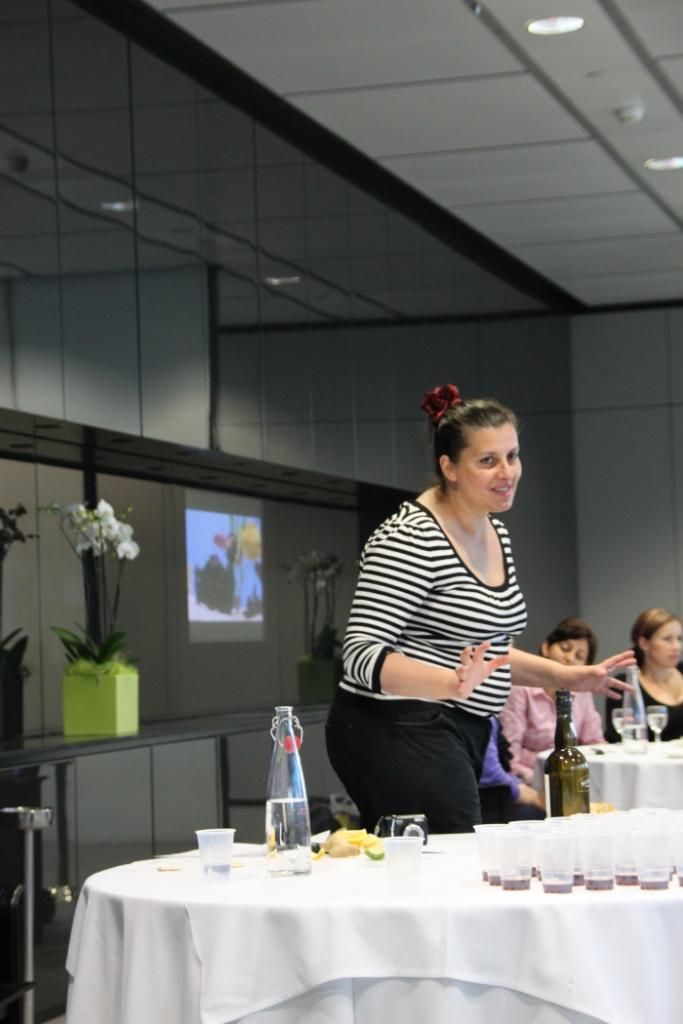
The chocolatier lady in question was brilliant, originally from France (yes, notice the T Shirt) she had training in the USA and on the continent. She is just brilliant. Did I mention she was brilliant? No? well, she was, her fascinating French American accent was just perfect. You can see small glasses of port in front of her. This is something we drank at the end to enjoy with the final chocolate taste of pure chocolate and Madeira Port wine, it was extraordinary, the combination was breathtaking. Put the chocolate in yout mouth, then leave for one minute.
The melting point of good chocolate is 35 degrees so it will slowly start melting in your mouth. Tilt your head back so that it starts to slowly move from the tongue down the back of your tongue and down your throat. At this time, take a sip of the port (or any other liqueur as you wish). The two flavours will mix. Hot diggity dog. Brilliant stuff. She did say that it's good that you don't smoke, because apparently smoking kills the taste buds. My taste buds belong to a donkey, so that ship has sailed.

Chocolate
Anyway, we were lead into a room which was quite tastefully decorated with orchids. She first gave a nice little overview. Chocolate consists of cocoa butter and cocoa powder. Adding milk makes it white and if not, then it's dark chocolate. Chocolate tastes seriously different depending upon where it is grown. Cuban chocolate has tobacco overtones, chocolate grown in Papua New Guinea has flowery overtones. Wow, I had no idea, I will have to check this out. Then she went on a bit of a rampage on Europe and its silly labelling laws for what is and what isn't chocolate. The fat/butter content is what makes the difference. English chocolates are not chocolates, they are sweet stuff, and that’s as far as she would go. So why are people using fat instead of cocoa butter?
Well, it turns out that cocoa butter is also used in cosmetics. And the best cocoa butter is used there as it's far more remunerative to plonk it into lipstick and other skin creams rather than use in chocolate. So cheaper chocolate is usually made out of animal or vegetable fats or both. So if you are a vegetarian, check the ingredients and she said that almost all fats have animal fats in there. I had an evil chuckle there.
Chocolate
Chocolate Chocolate
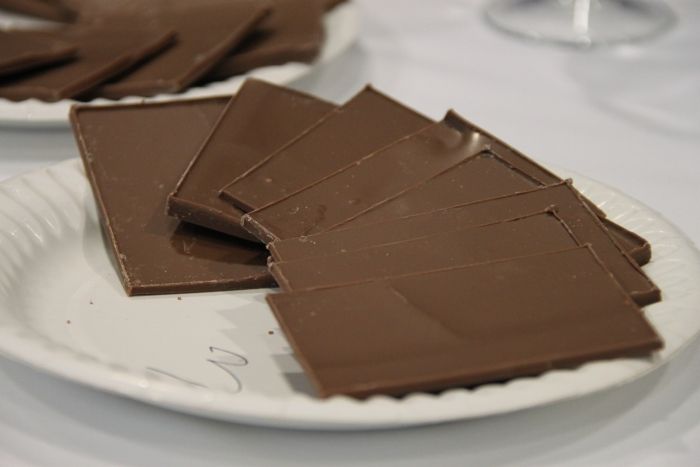
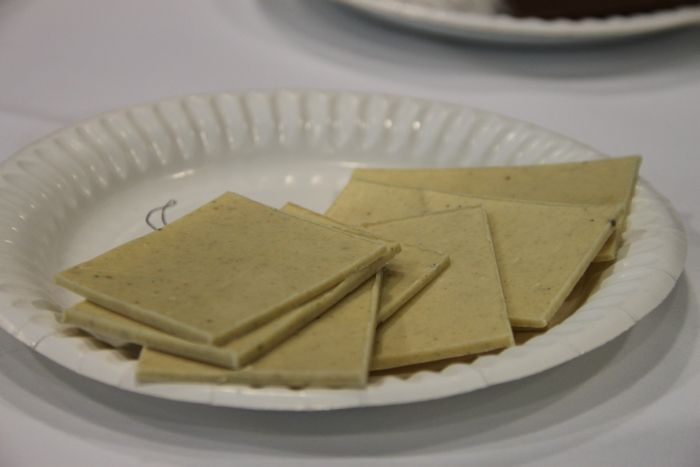
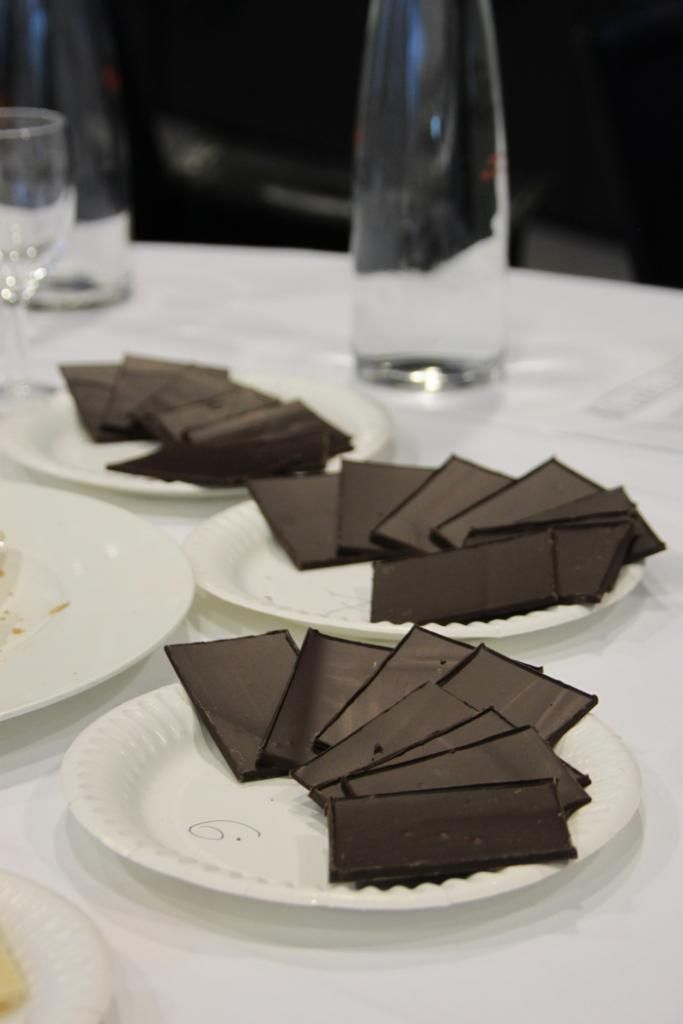
There were eight plates on each table, each plate was numbered and had chocolate wafers, weighing about 10-15 grams each.
Chocolate
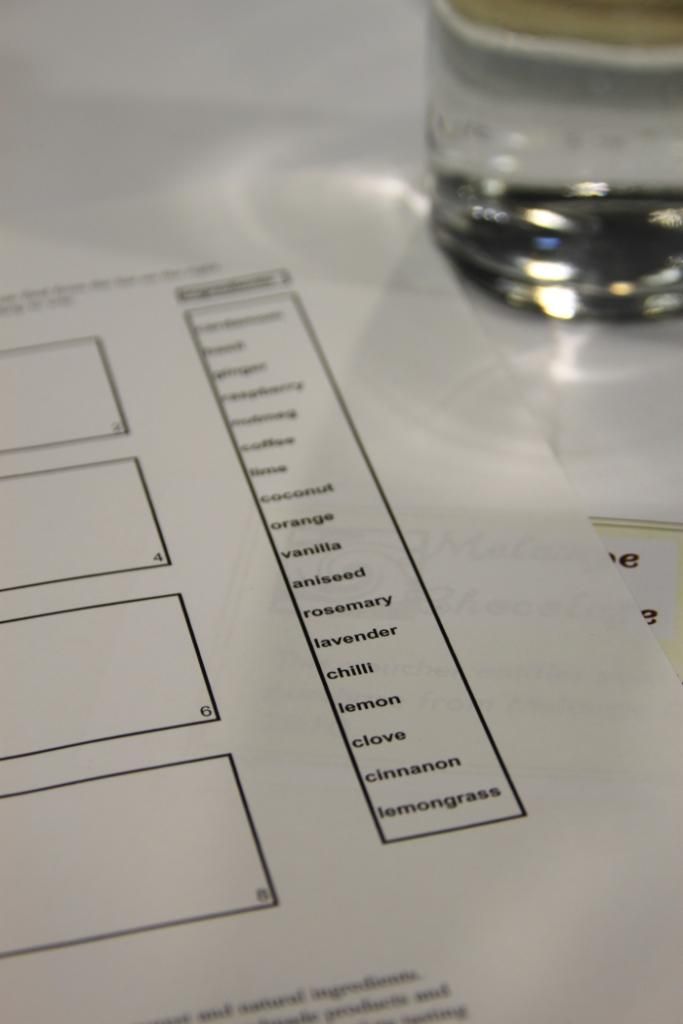
She made a game out of it. We had a sheet of paper each where a list of ingredients were listed on the right and then there were eight boxes. So the idea was that we pick up one, smell and sniff it – do a Count Snifferu on it. Then take a bite and taste. Flavours were primary and secondary. So we had to identify which flavours were mixed up.
Chocolate
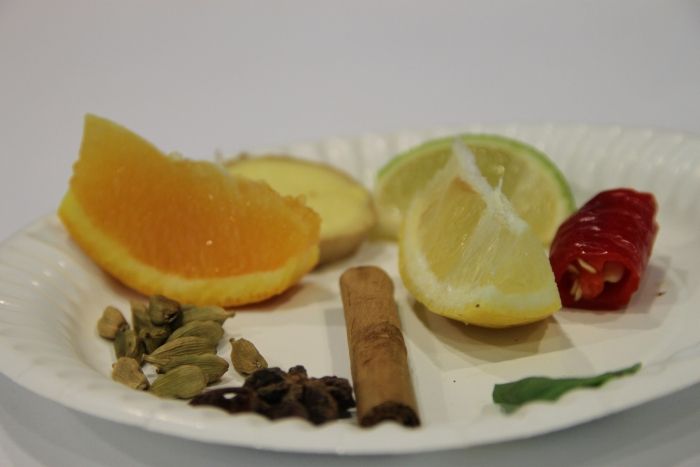
These were some of the ingredients, cardamom, chilly, basil, lemon, garlic, cloves, ginger, nutmeg, lime, coconut, aniseed, rosemary, lemongrass, cinnamon, etc. Can you just imagine the smorgasbord of tastes and flavours?
So we had vanilla and coconut; nutmeg and cardamom; lavender and lemon; lime and ginger; aniseed and coffee. These were for the light and milk chocolate. Then came the dark chocolates. They contain 71% cocoa. Lemon and basil; raspberry and rosemary; orange and chilli. By this time, I was feeling queasy, too much chocolate, man. Not good for my tummy at all.
Did you know men and kids prefer white or vanilla chocolates, while women prefer dark and complex chocolates? I didn't know that. She said that is what she observes in her shop, but then I prefer dark chocolate. Maybe its my latent feminine tendencies coming out. HA!. Also, guess what? Out of the 40 odd people in the room, only two were men. Go figure.
Chocolate 

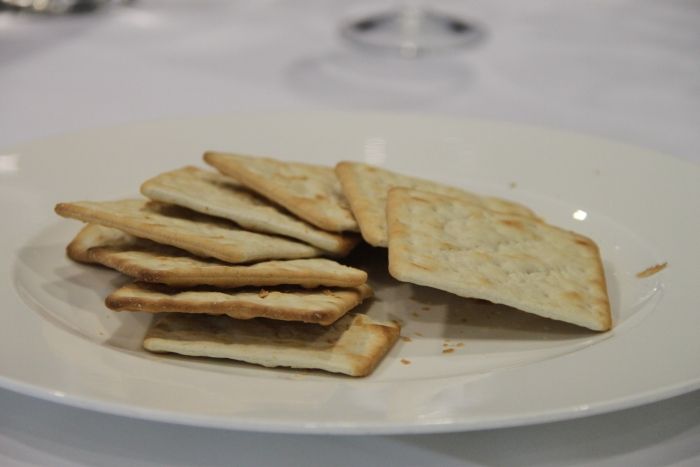
After each taste, she would ask us to eat a cracker and then drink some water to cleanse the palate and make sure that there is no after effects of the chocolate lingering around in your mouth. It was a brilliant exercise and something that I recommend highly. Next stop for me would be to try to join a chocolate cooking class or something. But here’s a small piece of advice, take it easy, you can really ruin it if you barf after eating too much chocolate. As it so happens, the weekend after that, I got to see Chocolat again. I love this movie. I think chocolate is one of the bestest things in life, but not too much, gives one a tummy ache.