Friday, October 7

how do bystanders react to emergencies?

Now I am not going to give you the article, Son, because that's way too heavy. But the abstract is given below. Now you might be wondering why I sent this to you? Well, for couple of reasons. First is to talk about what I have observed about you and second is to develop my own thoughts.

You wont usually be faced with emergency situations, but if you were, then you should know what to do. Your old dad has had a fair number of emergencies to deal with in his short life and unfortunately, I have the tendency to barrel in. Mainly because of my knee issue, I was helped by very many people so I have been trying to pay back since then. As you know, i am a qualified first aider as well and have been called to assist few times at work at people who have fallen ill or have had an accident. So when I observe you, you are careful. You observe the situation and are careful not to get involved in something that is beyond your ability to handle. Like when you were mugged, your behaviour was spot on, you came back home, you were not too excited and you assisted the police calmly and coolly. That is good and prudent. But remember son, sometimes you have to break this habit and be prepared for that.

Its like being a boy scout, be prepared always. You didn't join the scouts but I was one, long time back. Did the dip dip dah and knots and the bandana around my neck thing. Be prepared, always carry a rope with you for example. You never know. But the key thing to always carry around is your brains and smarts. For example, we have a book on how the SAS deal with emergency situations. You should read that. There could well be absolutely no reason for you to know how to skin a rabbit or know how to light a fire in a wood, but you never know when you might need it. I would have advised you to carry a Swiss knife as well, but in these days of terrorism and security checks, that might not be a good idea.

Also as you can see from the research, bystanders don't usually help out. This is also the reason why idiots slow down on the highway when there is an accident. So the way I see it, either help out or walk away, standing there like a gaping idiot doesn't help anybody.

Abstract

  1. Research on bystander intervention has produced a great number of studies showing that the presence of other people in a critical situation reduces the likelihood that an individual will help. As the last systematic review of bystander research was published in 1981 and was not a quantitative meta-analysis in the modern sense, the present meta-analysis updates the knowledge about the bystander effect and its potential moderators. The present work (a) integrates the bystander literature from the 1960s to 2010, (b) provides statistical tests of potential moderators, and (c) presents new theoretical and empirical perspectives on the novel finding of non-negative bystander effects in certain dangerous emergencies as well as situations where bystanders are a source of physical support for the potentially intervening individual. In a fixed effects model, data from over 7,700 participants and 105 independent effect sizes revealed an overall effect size of g = –0.35. The bystander effect was attenuated when situations were perceived as dangerous (compared with non-dangerous), perpetrators were present (compared with non-present), and the costs of intervention were physical (compared with non-physical). This pattern of findings is consistent with the arousal-cost-reward model, which proposes that dangerous emergencies are recognized faster and more clearly as real emergencies, thereby inducing higher levels of arousal and hence more helping. We also identified situations where bystanders provide welcome physical support for the potentially intervening individual and thus reduce the bystander effect, such as when the bystanders were exclusively male, when they were naive rather than passive confederates or only virtually present persons, and when the bystanders were not strangers.

Tuesday, October 4

ALGERIA: PROTESTS IN FRANCE FOR WOMEN IN HASSI MESSAOUD

Its sad what these purveyors of religion are reduced to. I quote:

(ANSAmed) - PARIS, MAY 4 - Protests in France against the daily aggression against women working in Hassi Messaoud, the oil city in the heart of Algeria, continue. These women are considered to be prostitutes by fundamentalist imams, only because they live on their own. The imams set people against them in fiery sermons, which are always followed by punitive expeditions in which the women are robbed, beaten, tortured and raped. Today Francés Grand Lodge for women in a statement denounced "the silence that reigns on this extreme violence, aggression, the rapes and even murders" and deplores "the indifference of the media regarding these dramatic and barbaric events". The violence has also been denounced by other French associations, particularly that tragic night in 2001 when around a hundred women ended up in hospital after an expedition of men armed with clubs, steel bars, knives. The story was recently told in a book by Algerian writer Nadia Kaci, unveiling the drama to France. But the drama still continues according to articles in Algerian dailies in the oil city, which denounced the impunity of the aggressors, the silence of the institutions and local authorities, the laxity of the community regarding the general condition of women in Algeria.

These parasitical misogynistic patriarchal imams should be removed, they are ruining the religion. Good way to develop your image and treat womankind, chaps. I spotted this quote on a fb page:

"i stopped wearing skirts, for their eyes would haunt me/ salwar kurta could not keep their hands away from me/ hair opened or tied, they did not stop hounding me/ legs, arms and face covered, my existence was dead/ but they were flourishing all around me/ their hands could reach me even in the dark/ i screamed, my eyes searched for help/ but they looked on, laughed for i was an entertainment for them.  "

Poor girls

A Knack for Bashing Orthodoxy

Kannu

this is a good article. Talks about how at a certain point, science has to deal with philosophy as well. plus gives you some indication on how oxford works...

Monday, October 3

Muslims convicted of disrupting Israeli envoy's speech

First the story, Son.

Ten Muslim students have been convicted of unlawfully disrupting a speech last year by Israel's ambassador to the US.

They shouted prepared statements at Michael Oren in February 2010, defying calls for order from officials at the University of California, Irvine.

The students' lawyers say they had a right to protest, but prosecutors said it curbed Mr Oren's right to be heard.

The 10 could face up to six months in jail, in a case that has sparked a heated debate about free speech.

The students stood up one by one, shouting slogans such as: "It's a shame this university has sponsored a mass murderer like yourself."

Their supporters say the case has unfairly criminalised student protest.

About 150 people attended Friday's hearing at Orange County Superior Court.

Some of them were visibly upset when the verdict was delivered, reports the Associated Press news agency.

Erwin Chemerinsky, the dean of the law school at the university, believed the conviction was heavy-handed.

Shakeel Syed, of the Islamic Shura Council of Southern California, said it was "yet another reaffirmation that Islamophobia is intensely and extensively alive and thriving in Orange County".

As you know, I am firmly in favour of free speech. An absolutist as a matter of fact. Freedom of speech has to be sacrosanct till it impinges on some other rights or somebody else’s rights. And the default should be to allow freedom of speech, as much as it offends and bothers people. So what do you do in this case? The Muslim students are claiming that they have freedom of speech to curtail somebody else’s freedom of speech. As you can appreciate, this logic does not work. You cannot use your freedom of speech to curtail somebody else’s freedom of speech. One can quibble over the sentence but generally, this is what i firmly believe, you cannot stop anybody else from speaking.

As for Shakeel Syed, he is talking out of his backside, he is confusing freedom of speech and liberal thought with islamophobia but usually you will find that Islamists institutions absolutely hate freedom of speech, after all, their entire philosophy rests on just their interpretation of life, world, truth and religion. So the best things to do is to ignore these idiots.

But I was reminded of the joke, a man kills his parents and then begs for mercy claiming to be an orphan. Interesting dilemma, eh?

Incidentally, check out this news story about freedom of speech.

The pains taken by the education secretary Michael Gove to conceal email exchanges from his civil servants, and from discovery under the Freedom of Information (FoI) Act, illuminates a cross-party consensus among senior politicians that the law is asinine. Tony Blair, the former prime minister, famously berates himself in his memoirs for being a “naïve, foolish, irresponsible nincompoop” in bringing in the Act:. In a Guardian interview, he argued, less vividly, that “if you are trying to take a difficult decision and you’re weighing up the pros and cons, you have frank conversations ... And if those conversations then are put out in a published form that afterwards are liable to be highlighted in particular ways, you are going to be very cautious. That’s why it’s not a sensible thing.”

Mr. Gove and his advisers agreed: one of these advisers, Dominic Cummings, wrote that he would no longer answer messages through his official departmental account, but only from Gmail accounts held by people known to him – for reasons, he writes, “I can explain in person”. The reason is no mystery: once discovered through FoI requests, or leaked, thinking of the blue-sky kind can, as Mr.Blair writes, “be highlighted in particular ways”.

In this past year (or so) of living transparently, that which has been esteemed by journalists, campaigners and many academics as a good – greater openness of government, corporations and institutions – seems to have reached some kind of limit. One has been the limit of the law: the News of the World’s efforts to discover ever-more intimate secrets of their journalistic subjects have led to a civil and a police inquiry into how pervasive the practice was – with testimony that it was far more common than a few “rotten apples” at the Sunday tabloid.

A second has been the limits of government secrecy, dramatised by last year’s release by the WikiLeaks website of hundreds of thousands of US files relating to Iraq and Afghanistan, and drawn from the confidential cables of US diplomats. This has seen discussion on how to make such material at once more secure and less extensive: the scholar and former Department of Defense assistant secretary Joe Nye wrote in the FT in March that “we should learn from more advanced approaches, in banks and other companies, to develop systems that classify less and protect data better. Better procedures should also be developed for dealing with things that are likely to be leaked, and how in turn this relates to our laws and to principles we are trying to establish for the internet…”

More recently, the fear many had of WikiLeaks’s actions – that diplomatic sources, speaking in what they thought to be secure confidence, would be at risk – has been realised. WikiLeaks founder Julian Assange released the entire trove of cables earlier this month: already, arrests of suspected sources in authoritarian states are reported. The newspapers that published redacted cables culled from the WikiLeaks store last year – The Guardian, Le Monde, the New York Times, El País and Der Spiegel – issued a statement saying they could not defend “the needless publication” of the complete data and were “united in condemning it”.

Now, the workings of FoI are at issue: and while the damage of phone hacking and WikiLeaks are easy to see and condemn, this one is harder – depending as it does on the public’s right to know, and the concept of the public interest – both at the heart of the democratic mission of good journalism.

Probably the first to properly articulate the right of citizens to see the documents of their state was the 18th century Finnish/Swedish polymath, Peter Forsskål, whose Thoughts on Civil Liberty (1759) claimed that it was “an important right in a free society to be freely allowed to contribute to society’s well being. However, if that is to occur, it must be possible for society’s state of affairs to become known to everyone, and it must be possible for everyone to speak his mind freely about it. Where this is lacking, liberty is not worth its name”. This became ingrained into Swedish law and practice, and in recent decades, its spirit became a general one in the democratic world. Indeed, it was Mr Blair’s view when leader of the opposition: he once spoke in Forsskål’s vein, arguing that “The very fact of its (FoI’s) introduction will signal a new relationship between government and people: a relationship which sees the public as legitimate stakeholders in the running of the country...”

He – and Mr Gove, a former journalist – learned the limits, from a cabinet room acutely conscious of the unwelcome transparency of its words and deeds. Yet government passed the law, and must live with it: to flout it, as may have occurred in the Department of Education, is to render law nugatory when inconvenient.

There is much evidence – including from Sweden – that governments cope with laws on transparency by circumventing them, keeping frank discussion off paper or the screen, and recording only that scrubbed of potential embarrassment. If this is so, and the law deprives citizens of efficient government, then it must be confronted, argued through and a consensus gained for change. Until then, the burden of proof is with those who deplore it – to show that, in Forsskål’s phrase, liberty is worth its name if a defined set of inner government conversations remain for their eyes only.

Sunday, October 2

Can you statistically model Mysticism?

I would never have imagined this but looks like you can. Amazing.

Hood developed a Mysticism Scale based on the theoretical work of Stace. The scale was tested by Hood and others in a comparative perspective. Using an abridged version of Hood's Mysticism Scale, we join the debate with a study of a much larger number of Christian, Muslim, and Hindu respondents (1,920 college students) living in Tamil Nadu, India. Our empirical analysis yields a moderately reliable model of mystical experience that permits comparison between the three religious traditions. We argue for the usefulness of a comparative model of vertical mysticism that combines with the complementary common characteristics of noetic quality and ineffability. Vertical mysticism has a revelatory, ineffable character and is comparable in the experience of adherents of the Christian, Islamic, and Hindu traditions.

So what’s this scale, eh? I quote:

Hood's Mysticism Scale is based in part on the conceptual framework of mysticism propounded by Stace. Stace (1961) outlines a conceptualization of mysticism that is cross-cultural, a-historical, and unbiased by religious ideology. His conceptual framework rests on three constructs: (a) a distinction between mystical consciousness and its interpretation; (b) a distinction between the core characteristics of extrovertive and introvertive mysticism; and (c) identification of universal common characteristics…….Hood's Mysticism Scale comprises 32 items, half of which are formulated negatively to prevent response set. Eight common core characteristics were operationalized with four items each from Stace's concept of mystical experience.

Some very interesting results came up: For example:

We found that item 12 (“Did you ever have an experience in which you realized the oneness of yourself with all things?”) yielded low commonality for Christians and Muslims. The factor loading for Hindus, by contrast, was quite high (.51).

Looks like, well, as the numbers say, Hindu’s have a greater affinity to Mysticism. Agreed. All those bloody rules and regulations in Christianity and Islam, heh. Next one:

Are there significant differences in the levels of mystical experiences between Christian, Muslim, and Hindu students?

As shown in Table 3, the experience of vertical mysticism reported by Hindus tends slightly toward ambivalence (mean 2.89), whereas Christians and Muslims affirm it as “probably yes” (means 3.13 and 3.05, respectively).

While saying that, this tends to mean that Hindu’s are more blasé about it as its more part of their worldview and day to day experience??

Next question:

Which personal (sociocultural, socioeconomic, and socioreligious) characteristics are related to the level of mystical experiences among Christian, Muslim, and Hindu college students?

Among Christian students, female students report a higher level of vertical mysticism (r  = .12). Four socioreligious characteristics are also associated with vertical mysticism: perceived favorable influence of friends, religious community, teachers/professors, and media. The association between the influence of teachers/professors on the religiosity of Christians and vertical mysticism is strongest (r = .19).

Among the Muslim students, only the socioreligious characteristics are associated with vertical mysticism: influence of relatives, religious community, teachers/professors, and media. The strongest associations are with regard to the favorable influence of relatives (r = .23) and of media (r = .20).

Among Hindu students, female respondents report a higher level of vertical mysticism (r = .10) as do those who speak the Tamil language (r  = .09). In the case of Hindus all socioreligious characteristics are significantly connected with vertical mysticism. The strongest association refers to the perceived favorable influence of teachers/professors on the religiosity of Hindu students (r = .18).

Curious divergences, eh?

Fascinating study, maybe one day I can delve deeper into this area.

Saturday, October 1

Philip wasnt Greek, says Demosthenes

As you might heard, there is a big fight between Macedonia and Greece. Greece thinks that the Macedonians are gobbing on their proud history of Alexander and company. Macedonia says that Alexander was born in Macedonia so he is theirs. Here is one view. Its an amusing and totally ridiculous argument, but I came across this quote:

Demosthenes, (died in 322 BC) describes Philip (Alexander's father) as one "who is not only not a Greek and has nothing to do with Greeks, but is not even a barbarian from a place it would be honorable to name -- a cursed Macedonian, who comes from where it used to be impossible even to buy a decent slave" (Third Philippic 9.30f).

Pausanias, a second-century CE Greek, says "reverse that befell all the Greeks at Chaeronea" (Description of Greece, 9.6.5). Which clearly distinguishes Greeks from Macedonians.

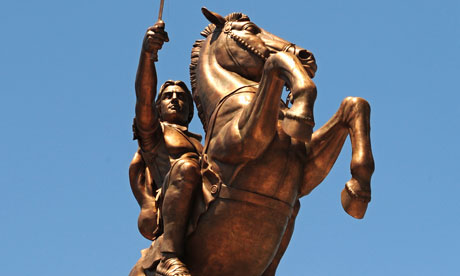
Perhaps we need Demosthenes to walk around some more with a lantern. What a funny story. And then, in the meantime, the Macedonians tweaked Greece’s nose by installing this giant statue.

They are calling it as a Warrior Statue, lol. Naughty naughty. I quote:

"This is our way of saying [up yours] to them," Antonio Milososki, the state's former foreign minister, told the Guardian in an interview in October 2010.

Poor Greeks, they just cant catch a break, eh? Perhaps the Turks should take them over again Smile with tongue out

heh

Welsh Education–some thoughts

As you know, I am closely associated with Swansea University Business School for many years now, am on their advisory board and am a visiting professor there. As a matter of fact I will be going over there again in November to deliver a lecture to the post graduate MBA students. Most probably I will talk about what do you do in your first 100 days of a job. But I digress.

Let me get the initial thoughts out of the way. I think Welsh education is in serious crisis. What it does, what its designed to do and what it feeds back to society, I am not sure that it is working well. Wales to me seem to reduced to some advertisements on BA flights, far too many photographs of puking mewling unconscious drunk young people on the streets of Swansea and Cardiff, heavy unemployment, and generally bad figures all around. But do not take my word for it, see what the Welsh Education Minister Leighton Andrews has to say on this matter. I quote:

"I will be blunt and I will be candid. In the first six months I have been in this post, I have begun to wonder whether the Higher Education sector in Wales actually wants the Assembly Government to have a higher education strategy, or whether it even believes that there is such a thing as a Welsh higher education sector ..."

"Indeed, I am not clear - eleven years after the National Assembly was created, and thirteen years after our historic referendum vote - that the higher education sector in Wales welcomes devolution or democratic accountability at all. Since our education agenda in Wales is based on the principle of democratisation, that is problematic."

"We have had more higher education institutions per head in Wales than any other part of the UK but have failed to break free from the bottom end of the UK growth and prosperity table. Our HE institutions are small compared with those just over the border. For all the achievements of higher education institutions, they have had only a very limited transformative impact on our economy, and on our global presence and reputation · We are not having a high enough impact in terms of the quality and quantity of our research · For too many in Wales, higher education remains a distant, and irrelevant activity, clouded in mystery.

"If we are to make the changes needed; we also have to be willing to question what may not be needed. We do not want governing bodies that act simply as a bunch of cheer-leaders for university management.

"I was interested to learn recently that some members of university governing bodies have been appointed on the basis of a phone call. Who you know not what you know. It appears that HE governance in post devolution Wales has become the last resting place of the crachach".

For me, a university governing body or advisory board is like the board of directors. They are the trustees for society to ensure that the university sector develops and delivers. If the universities and schools havent delivered, what does that say about the great and good of Wales? (the crachach)?

Did you know that 52% of the funding goes to administration and support services in the Higher Education Sector based upon a PwC Report? Chemistry and Modern languages departments are closing down. Also guess what? Most of the research being done in the universities is public sector research funded by the public sector. I am simply gobsmacked. Where is the value add? Where are the people who create jobs and scientific discoveries and innovation and and and? Where is the research to support that? Where are the students who are taught to be entrepreneurs, engineers and scientists?

I try to do what I can. In my lectures, I bang on about the students going and setting up their own units. Investing their own monies. Teach them about sales. How to generate more revenue. Bang on in these pages about it. And so on and so forth, but if we have to do more, we need people to realise that there is a crisis. I dont think people have realised it at all. And because they havent realised it, the funding is going to start getting cut. At end of the day, this entire convoy of public sector oriented very inefficient and ineffective education is being paid for by the taxpayer. And they are starting to revolt. By that time, we will have ended up with a group of highly useless drunk people who are lying around the streets of Cardiff and Swansea. Like now.

Friday, September 30

Dutch doctors urge end to male circumcision

Quite right too, this is a barbaric custom to snip off the foreskin. And no, just because it has been shown to help avoid AIDS is not a good reason. Nor is it a good reason that its culturally or religiously mandated. In Hinduism, people argued that women need to jump into the funeral pyre of their husbands. Same old same old. Muppets. I quote:

AMSTERDAM: Dutch doctors want politicians and human rights groups to speak out and discourage the practice of male circumcision in the Netherlands because they say it is a “painful and harmful ritual,” and a violation of children’s rights.

Between 10,000 and 15,000 boys are circumcized in the Netherlands each year, mostly for religious reasons and not always with an anesthetic, according to the Royal Dutch Medical Association (KNMG) which represents surgeons, pediatricians, general practitioners and urologists.

“We want to discourage male circumcision, because it is an unnecessary procedure with complications, which violates the integrity of the child,” Lode Wigersma, a spokesman for the association, told Reuters on Friday.

“This is not an innocent procedure, we see complications in about 5 percent of the cases, as well as some long-term and psychological implications,” he said.

Male circumcision involves the removal of all or part of the foreskin of the penis. It is a ritual obligation for infant Jewish boys, and is also a common rite among Muslims, who account for the largest share of circumcised men worldwide.

The Dutch medical association has urged religious leaders to find alternative rites of passage that are not irreversible and which are not painful for the child.

The practice of female genital mutation has been prohibited by law in the Netherlands since 1993 for all ages.

Thursday, September 29

Secularism, Fundamentalism, or Catholicism? The Religious Composition of the United States to 2043

Where will USA end up in the middle of this century? This article tries to give it a shot.

We provide a cohort-component projection of the religious composition of the United States, considering differences in fertility, migration, intergenerational religious transmission, and switching among 11 ethnoreligious groups. If fertility and migration trends continue, Hispanic Catholics will experience rapid growth and expand from 10 to 18 percent of the American population between 2003 and 2043. Protestants are projected to decrease from 47 to 39 percent over the same period, while Catholicism emerges as the largest religion among the youngest age cohorts. Liberal Protestants decline relative to other groups due to low fertility and losses from religious switching. Immigration drives growth among Hindus and Muslims, while low fertility and a mature age structure causes Jewish decline. The low fertility of secular Americans and the religiosity of immigrants provide a countervailing force to secularization, causing the nonreligious population share to peak before 2043.

Reminds me of Samuel P Huntington’s book on the challenges to America’s National Identity. Mind you, the previous research article’s get out of jail card is “if fertility and migration trends continue”. These are notoriously difficult to predict, but then, the attempts by the Tea Party, anti immigration, reduce taxes and all that which is roiling USA has some roots in this debate as well. This promises to be fascinating.

Tuesday, September 27

Religious Practices Among Islamic Immigrants: Moroccan and Turkish Men in Belgium

One of the most common mistakes people make is to assume that Muslims are monolithic. For that matter, the far too many people also think that the “west” is monolithic. I attended a book launch at SOAS recently where there was this book on framing Muslims. I have to admit that I wasn't really impressed. The whole concept to me sounded very woolly and from what the authors said, there was clear ideological bias. So I dont think I will be buying the book.

Speaking to somebody after the event, I explained why I think this was so. You see, man is a social animal and will form social groups (so far so good). Social groups are formed based upon two concepts. First is to define what they are and second is what they are not. So when, for example, the blurb on amazon says something like this, “Can Muslims ever fully be citizens of the west?” that immediately tells me that the authors themselves are now guilty of framing Muslims themselves. When the basic research question is not independent, then the entire argument is a solution in search of a problem. In effect, they are themselves part of the problem of stereotyping. You might as well as ask, Can people who speak Serbo Croat or whatever fully be citizens of the west? They are not monolithic.

They also do not consider the flip side of stereotyping, the one done on the West. The West is also not a monolithic character? Mixing together everybody from Chile to China, India to Scotland aint making sense to me. No doubt stereotyping happens. No doubt framing happens. All I am saying is that that is human behaviour and there are many more dimensions to this than what the authors consider.

And then Orientalism was brought into the picture and that was the death kneel for me. I dont understand that orientalism logic at all but what do I know.

But I was reminded of an interesting article which I read last year. Here is the link. and abstract:

This study examines the religious participation of Islamic immigrants in Belgium using data from the Migration History and Social Mobility Survey collected in 1994–1996 from 2,200 men who had immigrated from Turkey and Morocco. Religious participation is measured as mosque attendance, fasting during Ramadan, and sacrificing a sheep at the Festival of Sacrifice. Results show that the religious participation of Islamic immigrants depends on both premigration and postmigration characteristics. Religious participation is higher among immigrants who: (1) attended a Koranic school in their country of origin, (2) were socialized in a religious region of their home country, (3) received little schooling, (4) currently live in an area of Belgium with a greater number of mosques, and (5) associate with a high number of co-ethnics. These results suggest that the religious participation of Islamic immigrants in Belgium is an outcome of characteristics unique to immigrants as well as processes common among the general population.

Curious, eh? to extend the results of this survey in Belgium and to try to answer the question raised in this book, one not only has to look at what better integration mechanisms to do in Belgium but also the factors behind the country of origin of the immigrants. (assuming that the level of religiousity is somehow linked to integration).

But complicated stuff and no simple answers. But look at this article on why are Jews so powerful.

Why are the Jews so powerful ? By: Dr Farrukh Saleem. (The writer is a Pakistani, an Islamabad-based freelance columnist.) January 12, 2009

Posted by ibnmahadi in Uncategorized.
trackback

There are only 14 million Jews in the world; seven million in the Americas , five million in Asia, two million in Europe and 100,000 in Africa . For every single Jew in the world there are 100 Muslims. Yet, Jews are more than a hundred times more powerful than all the Muslims put together. Ever wondered why ?

Jesus of Nazareth was Jewish. Albert Einstein, the most influential scientist of all time and TIME magazine’s ‘Person of the Century’ was a Jew; Sigmund Freud — id, ego, and super-ego, the father of psychoanalysis was a Jew; So were Karl Marx, Paul Samuelson and Milton Friedman.

Here are a few other Jews whose intellectual output has enriched the whole humanity:

  • Benjamin Rubin gave humanity the vaccinating needle.
  • Jonas Salk developed the first polio vaccine.
  • Alert Sab in developed the improved live polio vaccine.
  • Gertrude Elion gave us a leukaemia fighting drug.
  • Baruch Blumberg developed the vaccination for Hepatitis B.
  • Paul Ehrlich discovered a treatment for syphilis.
  • Elie Metchnikoff won a Nobel Prize in infectious diseases.
  • Bernard Katz won a Nobel Prize in neuromuscular transmission.
  • Andrew Schally won a Nobel in endocrinology (disorders of the endocrine system; diabetes, hyperthyroidism. Aaron Beck founded Cognitive Therapy (psychotherapy to treat mental disorders, depression and phobias).
  • Gregory Pincus developed the first oral contraceptive pill.
  • George Wald won a Nobel for furthering our understanding of the human eye.
  • StanleyCohen won a Nobel in embryology (study of embryos and their development) .
  • Willem Kolff came up with the kidney dialysis machine.

Over the past 105 years, 14 million Jews have won 15-dozen Nobel Prizes while only three Nobel Prizes have been won by 1.4 billion Muslims (other than Peace Prizes).

Stanley Mezor invented the first micro-processing chip. Leo Szilard developed the first nuclear chain reactor. Peter Schultz, optical fibre cable; Charles Adler, traffic lights; Benno Strauss, Stainless steel; Isador Kisee, sound movies; Emile Berliner, telephone microphone and Charles Ginsburg, videotape recorder.

Famous financiers in the business world who belong to Jewish faith include Ralph Lauren (Polo), Levis Strauss (Levi’s Jeans), Howard Schultz (Starbuck’s) , Sergey Brin (Google), Michael Dell (Dell Computers), Larry Ellison (Oracle), Donna Karan (DKNY), Irv Robbins (Baskin & Robbins) and Bill Rosenberg (Dunkin Donuts).


Richard Levin, President of Yale University, is a Jew. So are Henry Kissinger (American secretary of state), Alan Greenspan (fed chairman under Reagan, Bush, Clinton and Bush), Joseph Lieberman, Madeleine Albright (American secretary of state), Maxim Litvinov (USSR foreign Minister), David Marshal (Singapore’s first chief minister), Isaac Isaacs (governor-general of Australia), Benjamin Disraeli (British statesman and author), Yevgeny Primakov (Russian PM), Jorge Sampaio (president of Portugal), Herb Gray (Canadian deputy PM), Pierre Mendes (French PM), Michael Howard (British home secretary), Bruno Kreisky (chancellor of Austria) and Robert Rubin (former American secretary of treasury).

In the media, famous Jews include Wolf Blitzer (CNN), Barbara Walters (ABC News), Eugene Meyer (Washington Post), Henry Grunwald (editor-in-chief Time), Katherine Graham (publisher of The Washington Post), Joseph Lelyyeld (Executive editor, The New York Times), and Max Frankel (New York Times).

Can you name the most beneficent philanthropist in the history of the world ?  The name is George Soros, a Jew, who has so far donated a colossal $4 billion most of which has gone as aid to scientists and universities around the world. Second to George Soros is Walter Annenberg, another Jew, who has built a hundred libraries by donating an estimated $2 billion.

At the Olympics, Mark Spitz set a record of sorts by winning seven gold medals. Lenny Krayzelburg is a three- time Olympic gold medallist. Spitz, Krayzelburg and Boris Becker are all Jewish.

Did you know that Harrison Ford, George Burns, Tony Curtis, Charles Bronson, Sandra Bullock, Billy Crystal, Woody Allen, Paul Newman, Peter Sellers, Dustin Hoffman, Michael Douglas, Ben Kingsley, Kirk Douglas, William Shatner, Jerry Lewis and Peter Falk are all Jewish?

As a matter of fact, Hollywood itself was founded by a Jew. Among directors and producers, Steven Spielberg, Mel Brooks, Oliver Stone, Aaron Spelling (Beverly Hills 90210), Neil Simon (The Odd Couple), Andrew Vaina (Rambo 1/2/3), Michael Man (Starsky and Hutch), Milos Forman (One flew over the Cuckoo’s Nest), Douglas Fairbanks (The thief of Baghdad) and Ivan Reitman (Ghostbusters) are all Jewish.

To be certain, Washington is the capital that matters and in Washington the lobby that matters is The American Israel Public Affairs Committee, or AIPAC. Washington knows that if PM Ehud Olmert were to discover that the earth is flat, AIPAC will make the 109th Congress pass a resolution congratulating Olmert on his discovery.

William James Sidis, with an IQ of 250-300, is the brightest human who ever existed. Guess what faith did he belong to ?

So, why are Jews so powerful ?

Answer: Education.

Why are Muslims so powerless ?

There are an estimated 1,476,233,470 Muslims on the face of the planet: one billion in Asia, 400 million in Africa,44 million in Europe and six million in the Americas . Every fifth human being is a Muslim; for every single Hindu there are two Muslims, for every Buddhist there are two Muslims and for every Jew there are one hundred Muslims. Ever wondered why Muslims are so powerless ?

Here is why: There are 57 member-countries of the Organisation of Islamic Conference (OIC), and all of them put together have around 500 universities; one university for every three million Muslims. The United States has 5,758 universities and India has 8,407. In 2004, Shanghai Jiao Tong University compiled an ‘Academic Ranking of World Universities’ , and intriguingly, not one university from Muslim-majority states was in the top-500.

As per data collected by the UNDP, literacy in the Christian world stands at nearly 90 per cent and 15 Christian- majority states have a literacy rate of 100 per cent. A Muslim-majority state, as a sharp contrast, has an average literacy rate of around 40 per cent and there is no Muslim-majority state with a literacy rate of 100 per cent. Some 98 per cent of the ‘literates’ in the Christian world had completed primary school, while less than 50 per cent of the ‘literates’ in the Muslim world did the same.

Around 40 per cent of the ‘literates’ in the Christian world attended university while no more than two per cent of the ‘literate s’ in the Muslim world did the same.

Muslim-majority countries have 230 scientists per one million Muslims. The US has 4,000 scientists per million and Japan has 5,000 per million. In the entire Arab world, the total number of full-time researchers is 35,000 and there are only 50 technicians per one million Arabs (in the Christian world there are up to 1,000 technicians per one million). Furthermore, the Muslim world spends 0.2 per cent of its GDP on research and development, while the Christian world spends around five per cent of its GDP.

Conclusion: The Muslim world lacks the capacity to produce knowledge.

Daily newspapers per 1,000 people and number of book titles per million are two indicators of whether knowledge is being diffused in a society. In Pakistan , there are 23 daily newspapers per 1,000 Pakistanis while the same ratio in Singapore is 360. In the UK , the number of book titles per million stands at 2,000 while the same in Egypt is 20.

Conclusion: The Muslim world is failing to diffuse knowledge.

Exports of high technology products as a percentage of total exports are an important indicator of knowledge application. Pakistan ‘s exports of high technology products as a percentage of total exports stands at one per cent. The same for Saudi Arabia is 0.3 per cent; Kuwait , Morocco , and Algeria are all at 0.3 per cent while Singapore is at 58 per cent.


Conclusion: The Muslim world is failing to apply knowledge.

Why are Muslims powerless?  Because we aren’t producing knowledge.
Why are Muslims powerless?  Because we aren’t diffusing knowledge.
Why are Muslims powerless?  Because we aren’t applying knowledge.

And, the future belongs to knowledge-based societies.

Interestingly, the combined annual GDP of 57 OIC-countries is under $2 trillion. America , just by herself, produces goods and services worth $12 trillion; China $8 trillion, Japan $3.8 trillion and Germany $2.4 trillion (purchasing power parity basis).

Oil rich Saudi Arabia, UAE, Kuwait and Qatar collectively produce goods and services (mostly oil) worth $500 billion; Spain alone produces goods and services worth over $1 trillion, Catholic Poland $489 billion and Buddhist Thailand $545 billion. (Muslim GDP as a percentage of world GDP is fast declining).

So, why are Muslims so powerless ?

Answer: Lack of Education ! All we do is shout to Allah whole day and blame everyone else for our multiple failures..!

I ask you, if this isnt stereotyping, then what is? At one shot, Jews are stereotyped. Muslims are stereotyped. As I responded to the mailing group, I said. If this logic is right, then the root cause of this is the religion. Then all Muslims need to do to become good and smart is to convert to Judaism. If Islam is the rationale behind this grouping and frame, then it leads inexorably to that argument. Which is obviously stupid, reductio ad absurdum, eh? See why I find books like this and arguments like this very strange?