Saturday, June 20

Happy Special Day Kannu June 2020


So this time I am going to be sending you your special day letter a day or two earlier than normal instead of the usual delayed letter. It’s the weekend and I was missing you so much. Last time I went to Al Forsan Shooting club was with you where you shot off all those guns and then we had that huge sushi dinner.

Anyway, I shared the Economic Facts and Fallacies book by Thomas Sowell with you. If you need the epub/pdf, I can send that to you. I had read the first edition and then again read the second edition long time back. And then I was discussing economic fallacies with a bunch of friends on a mailing list. One of my friends wanted to know what are the common fallacies that Indians see and work on. I wrote these

1. it’s the government's job to create jobs rather than create the eco-system to create jobs
2. Sarkar ki sampatti apni sampatti hai, maine mera hissa le liya (basically that government assets or public commons are free for all and nobody cares about them)
3. doing business is grubby business
4. buy gold
5. buy real estate
6. tax evasion
7. queuing
8. foreign capital is bad
9. improving product quality is useless
10. you cannot compromise on development over environment
11. a high fx reserve is a good thing
12. exchange rates don't matter
13. the entire case of agricultural subsidies being good
14. state owned banking system is required for a developing country like India

Some of the above obviously needs to be expanded but then Amit shared the book reference and I read it again. Fascinating. I have now read the book 3 times and every time, I shake my head at the ridiculousness of so many public and private policies that are embedded in day to day life. At the beginning, I used to get upset and used to fulminate and moan and complain with a passion. Then I figured, I should take advantage of it and started to dis/invest in companies, markets and sectors which had issues. And now, whenever I see these and other economic fallacies being pushed around (and I was asked many questions during my recent lectures), I just laugh and walk away. No point, meh. But you are in a different stage, Kannu, in your line of work, you could think about how you can leverage your investments on these economic fallacies. It’s a nice short book and you can easily go through it in less than a day. People who work outside them or can recognise these fallacies are frankly very priviledged (there’s another issue that gets my goat, this stupidity called as “check my priviledge” but will talk about that another day).

More importantly, your own worldview changes. For example, Indians are boycotting Chinese goods which I find ridiculous. Its all a way to keep the hoi polloi occupied with miserably stupid things. It does not add a single additional Indian job, save an Indian Soldiers life or increases anybody’s earnings. I told the students who asked me, I said, sod that stupidity, you are smart. Instead of deleting the Chinese apps, learn how they have made those apps and make a better app. Add value to your country by establishing a company and building jobs. Fallacies, son, fallacies. It focuses your mind on important things, son. And when you start getting involved in charity or in proper business, you will do things that actually matter, which actually make a difference.

Let me know what you think after reading the book. It would be good to hear your fresh thoughts on how the world treats them.

By the way, the photos of you and Choti in the garden were so lovely, I must have seen them 200 times again and again. You two have turned out so well, that I am so happy. All credit to Mamma of course! And other than that regrettable tendency to purchase turnips. What is with that? Of all the things you two can do, you decide to mess about with turnips? Terrible.

Anyway, hope you have a lovely special day, Kannu. Love you and miss you terribly.

Baba

Wednesday, June 10

happy special day APril 2020


My lovely chotisi

I am missing you so much, I would have squished you and loved you and cuddled you and combed your hair and told you dad jokes and and and! Not to mention make you faint!. Good to hear that you arent being bored and have much to do J

So, I thought of sharing few things which you might like

1.     https://www.the-tls.co.uk/articles/who-is-the-draco-in-draconian-measures/ quite an interesting background. I keep on telling people that my little girl will become Mary Beard, version 2.0, but so much better looking and better in communications J Its so amazing what the Athenians managed to get up to in so many forms of human civilisation. Its very obvious why Greek civilisation is considered to be the foundation of modern civilisation and how much it spread via colonisation, gutenberg’s press and and and. But we shouldn’t forget the work done by other civilisations but their contributions didn’t stick.
2.    Second was this: I was discussing with a mate about discussing sieges in classical times where similar situations would happen. There would be an enemy at the gate and the city or town would be locked down. Fear and terror would stalk the streets. But people would still go out to fight. Thucydides was discussed. But I pointed her to somethings that come out well despite when sieges happen. We see the emergence of heroes. Like the doctors and nurses and ambulance drivers and the checkout assistants and the policemen who have to go out to work despite the dangers. I pointed her to what Homer wrote about Hector. Thanks to Brad Pitt and Homer, people admire and like Achilles but he was a demi-god. The man was a confirmed baersark and a nutter but he was good looking so he was given a hospital pass (pun intended). But Hector? ah! now there's a brave man. Who knew that Troy will fall. Who soothed his fearful wife Andromache after she begged him to stay back, saying, "“Hector, thus it is you are father to me, and my honored mother, you are my brother, and you it is who are my young husband. Please take pity upon me then, stay here on the rampart, that you may not leave your child an orphan, your wife a widow … “ He replied...Then tall Hector of the shining helm answered her: “All these things are in my mind also, lady; yet I would feel deep shame before the Trojans, and the Trojan women with trailing garments, if like a coward I were to shrink aside from the fighting … for I know this thing well in my heart, and my mind knows it: there will come a day when sacred Ilion will perish, and Priam, and the people of Priam of the strong ash spear. But it is not so much the pain to come of the Trojans that troubles me, not even of Priam the king nor Hecabe … as troubles me the thought of you, when some bronze-armoured Achaian leads you off, taking away your day of liberty, in tears; and in Argos you must work at the loom of another, and carry water from the spring Messeis or Hypereia, all unwilling, but strong will be the necessity upon you; and some day seeing you shedding tears a man will say of you: ‘This is the wife of Hector, who was ever the bravest fighter of the Trojans, breakers of horses, in the days when they fought about Ilion.’ “So will one speak of you; and for you it will be yet a fresh grief, to be widowed of such a man who could fight off the day of your slavery. But may I be dead and the piled earth hide me under before I hear you crying and know by this that they drag you captive.” So speaking glorious Hector held out his arms to his baby, who shrank back to his fair-girdled nurse’s bosom screaming, and frightened at the aspect of his own father, terrified as he saw the bronze and the crest with its horse-hair, nodding dreadfully, as he thought, from the peak of the helmet. Then his beloved father laughed out, and his honoured mother, and at once glorious Hector lifted from his head the helmet and laid it in all its shining upon the ground. Then taking up his dear son he tossed him about in his arms, and kissed him, and lifted his voice in prayer to Zeus and the other immortals: “Zeus, and you other immortals, grant that this boy, who is my son, may be as I am, pre-eminent among the Trojans, great in strength as I am, and rule strongly over Ilion; and some day let them say of him: ‘He is better by far than his father,’ as he comes in from the fighting; and let him kill his enemy and bring home the blooded spoils, and delight the heart of his mother.’ Pretty fascinating, isnt it?
4.    Well, i will reserve judgement till the paper comes out, but Sappho is seriously good. This is my favourite poem of her's.
He seems to me equal in good fortune to the
whatever man, who sits on the opposite side to you
and listens nearby to your

sweet replies
and desire-inducing laugh: indeed that
gets my heart pounding in my breast.
For just gazing at you for a second, it is impossible
for me even to talk;
my tongue is broken, all at once a soft
flame has stolen beneath my flesh,
my eyes see nothing at all,
my ears ring,
sweat pours down me, a tremor
shakes me, I am more greenish than
grass, and I believe I am at
the very point of death.

Hope you have a fantastic day, choti

Love you

Baba

Happy Special Day April 2020


Good morning Kannu

Happy special day to you. I am missing you and Choti and Mamma, it’s been such a long time that I have been away from you. I know you are now all grown up and will soon move into your flat (btw, did you find out if you can get a rent holiday?) and you will soon form your own life and it has to happen that you will have your own family.

But as I speak to Dadu and Didu every day morning, I see both sides. They are so happy to hear from me and then I can see the happiness in their eyes which is how I feel when I see you. You make me so proud. You are all and more that a father would ever need or want. They are getting on in years. I was teasing Dadu after Didu and I were talking about Ira going to college. She and him were saying that they will be dead and buried by then. He used to say when he was 50 that he is going to die soon and then we will remember him or we will learn some random lesson. And I told him, you have been saying that now for so many decades, you are 86 now, so I think you can well live on for another 15 years till Ira gets into college. He didn’t know how to take it. But given his age, he is really spry, no medical issues, other than the usual squabbles with Didu. Good you two are speaking to them on a weekly basis, son.

It was funny to see the reactions of people who have been working from home, they really hate it. I didn’t have a problem and frankly my productivity has gone by at least by 25%! Huge work being done. I guess once you have worked in London managing global teams – you don’t have an issue for working from home that much. That said, besides productivity, weight is also going up…I am now up to 122 kilos!!! Despite exercising every day and trying to go for long walks when I can, it’s the sitting around snacking which is killing me.

On the longer term, this covid19 will change the operating model for the world hugely. I don’t know what will be the situation for the next 20-25 years. Those will be some of my final business years whilst they will be your first 2 decades at work. So I am thinking around on what I would have said for you and I to think and remember and do?

1.     Keep cash in hand, our investments need to be much better timed and sectors oriented
2.     Family has become even more important. I am so lucky to have Mamma, you and Choti but you will need your own family as well son. The support you get in times of trouble is unbelievable. Not just times of trouble but also day to day. So do think about that. You need to approach it as scientifically as with everything else. Having a partner and kids – don’t rely on luck – that’s too vague and the damage from a bad choice can be too much.
3.     Languages are good son. Spend a bit of time to learn one more language. Chinese might be too tough, but maybe an European language or Hindi – Mamma knows Hindi and speak to her and Choti at home and you will keep picking this up.
4.     I am not sure if an MBA will help at the moment. It is too vague and generalist at the moment. But if you are thinking about future studies, then you have to only go for an Harvard MBA or Stanford or Yale. Just the top 2-3, and yes in the USA. You have coverage and knowledge of Europe and India is in your genes, but you need to spend some quality time in USA to build up your cv, son.
5.     You can also think about a CIMA perhaps? But maybe later. Optional.
6.     Another thing that will help will be to join a charity of some kind. Doesn’t matter which one but it will seriously enrich your life, son. Hugely. The thing is, you are in danger of being in a bubble. You spend your time with some very rich people on the phone and in meetings. Your spare time is with your friends, who are also quite comfortably well off, middle class, in London. So the issue is that you aren’t seeing the down, the poor, the dying, the sick, the distressed. That isn’t right because you run the risk of forming a world view which doesn’t include them. If you want to become a CEO or a Board Member, you need to be connected to more sections and sectors of society. Your decision making powers and capability will be hugely enhanced.

Anyway< I think this is long enough now, son. Have a lovely day, look after the girls

Love you

Baba


Happy Special Day son. May 2020


Kannu

Happy Special Day to you. I was so happy to see you cook and cook well. I shared the photos of your dishes and our talk about my presentations on FB and boasted about how proud and happy I am with my adorable son who has turned out so well. Well, for most of the things, but he still goes out into the public without his mask. You will get a scolding for it. You don’t wear a mask for yourself but for others! And he doesn’t know how to put the compost bag back together properly. Now that you have been scolded, good work son on being well balanced with the lockdown, working and eating and looking after the girls. And not too many explosions at the internet quality. I love you and happy special day. I hope you are having your yogurt and vakult thingamabob? What happened to you visiting the doctor for your tummy?

Anyway, I thought of sharing this article, well more like an extended essay.


I have quite a lot to say about this but I think you and Diya should take some time to read this through. You know my concerns about national debt. USD 17 Trillion is the estimate that is being made for how much governments have spent over the past 2 months on trying to handle the corona virus. The Debt GDP ratio for OCED is now going to go beyond 100%. Whilst we are good to keep investing in the USA (I still think it’s the best investment opportunity), other countries, without the benefit of the USD as the reserve currency are going to suffer. As you mentioned, the UK has given up all the gains for the past 4 years and lord only knows where it will be going. Well, we do know where it will be going, it will be going into money printing like a nutter. That said, the negative interest rates are a puzzle and not quite sure why that is going on.

The interest payments on all that debt is also lower now so I think the British Government will load up more debt. Which will slowly mean that as they start cranking the money presses open, inflation will rise and then try to deflate away the debt. UK still has loads of good assets like good education, good infrastructure, good people, trust is there, etc. etc. so it’s not too bad a place. But for the next 30-50 years of your life and the remainder of your parents lives, it will be beset with major political and economic upheavals. So you have to be prepared hugely.

I know you are investing in equities and stocks, but you should start thinking about diversifying a bit as well. Especially into real estate and government bonds, and also in other countries to diversify your investments. Also investing in yourself, kids. Much much work to be done there over the coming many moons, but what I meant was that you need to think about diversifying your sources of income as well. Either by writing something or investing in other companies or starting your own, etc. etc.

This isn’t new as the author says, this has happened so many times. Every empire has over-extended itself and then fights break out. Which is terrible. I am sure Diya might have heard about the Thucydides trap, where a rising power (Athens) fights an older power (Sparta) and then both become weaker hugely. In that case, Sparta won but then dribbled away into insignificance. People tend to refer to China and USA as one of the Thucydides trap examples but I think that is needlessly limited, China has seen many an economic model, many political models, many different enemies and is still alive and rising. Not many empires can claim to do that. Think about it, which other empire has been up to that extent so many times? Not many, once an empire goes out, it goes out, very little is left of it. What’s the difference? The people, education, its inventiveness, its ability to create new things and buzz with energy. USA also has that so I wouldn’t bet against it either.

Anyway, take some time to read the article Kannu (and you too, Choti, you will need to know this. Don’t forget to setup the trading account, ok?

Love

Baba

happy special day - sculptures


Choti

I didn’t get a chance to send you the happy special day email J bit late but there you go. I thought of sending you something about sculptures. First, you should read this article


You get to see amazing sculptures in museums and it has been a fascinating journey for me. It started with, of coruse, reading the agony and the ecstacy by irvine stone, the story of michelangelo. We have a copy at home and you should read it. It is not quite a biography but it reads very well indeed. Loved how his life was described. Anyway, you saw David when you went to Florence and you can read the story behind it in the book about how he managed to carve it. But before that, you need to see what Donatello did with his David. Michelangelo’s works are brilliant anyway and do take a look at his works. We have the Pieta hanging on our wall above your desk. Just gaze at it and think about how wonderfully he put that together.

The other most amazing sculptor that I love is Canova. He did some extraordinary work. https://en.wikipedia.org/wiki/Antonio_Canova. His Psyche Revived by Cupid’s kiss is such an amazing piece of tender loving care. His three graces is also exquisite.

And then the final one for you to think about is the Veiled Christ by Giuseppe Sanmartino. https://en.wikipedia.org/wiki/Veiled_Christ

This is perhaps the most amazing piece of sculpture which exists in my mind. Mamma might be able to tell you about the veiled sculpture called as the Veiled Rebekah which was in Salar Jung Museum in Hyderabad. One of the biggest and most amazing collections by one single person in that museum. We will go there one day. Similar in concept to the veiled Christ, you can see it here. https://en.wikipedia.org/wiki/Veiled_Rebecca

When I first saw Rebekah, I was taken aback but the Veiled Christ is absolutely amazing. The work which has been done is extraordinary. I am useless at art, so whenever I see this kind of work, I am stunned at the way somebody can literally convert stone to living flesh, show expressions and come up with emotions.

The next one that I really really love and adore is the bust of Nefertiti. We don’t know who made this but its one of the most famous Ancient Egyptian works of art, copied and painted and shared all over the world. https://en.wikipedia.org/wiki/Nefertiti_Bust such an amazingly beautiful piece of art, look at that neck, that patrician nose, that regal expression. Amazing!

Another really really fascinating, at least to me, is Bernini’s Ecstasy of Saint Teresa. https://en.wikipedia.org/wiki/Ecstasy_of_Saint_Teresa nothing other than her face. Just that religious ecstasy is mindbogglingly amazing, Choti. The quote is best: I saw in his hand a long spear of gold, and at the iron's point there seemed to be a little fire. He appeared to me to be thrusting it at times into my heart, and to pierce my very entrails; when he drew it out, he seemed to draw them out also, and to leave me all on fire with a great love of God. The pain was so great, that it made me moan; and yet so surpassing was the sweetness of this excessive pain, that I could not wish to be rid of it. The soul is satisfied now with nothing less than God. The pain is not bodily, but spiritual; though the body has its share in it. It is a caressing of love so sweet which now takes place between the soul and God, that I pray God of His goodness to make him experience it who may think that I am lying.

Still, I would say Canova wins for me hands down, Bernini and Michelangelo are also rans J but its just exquisite work. Once I grow up, I will learn how to sculpt but I doubt that I have that kind of an innate skill or even patience to do something like this. As for the modern sculptures, meh, bleah and puke!

Love you choti, missing you terribly.

Baba

Friday, August 4

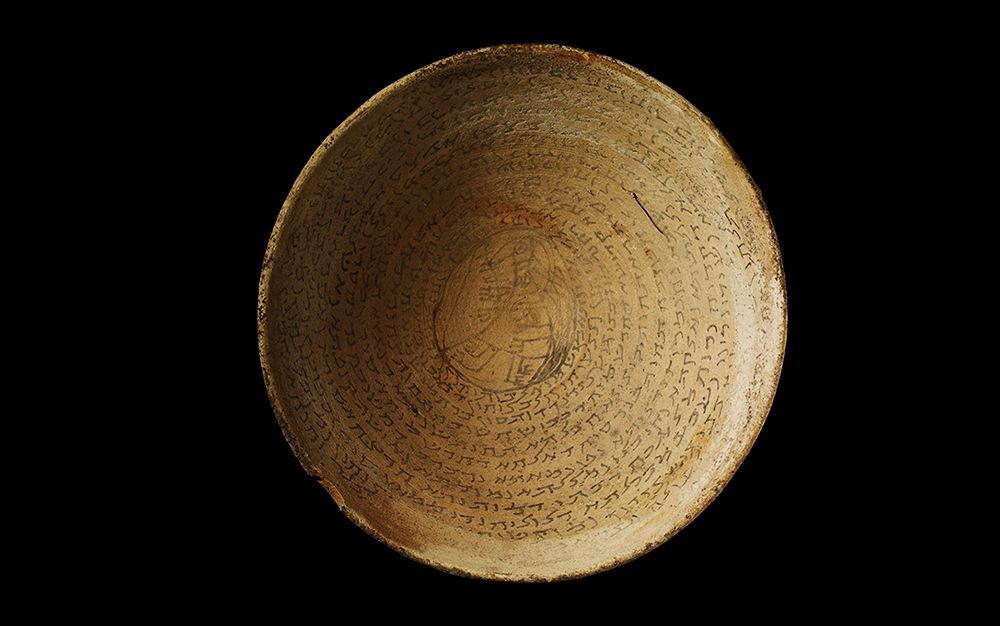
What should be done with the magic bowls of Jewish Babylonia? – Samuel Thrope | Aeon Essays

Choti is reading Harry Potter and by all counts she is loving it. Btw choti, mamma hasn't read the Harry Potter books either but you have and you loved them! 
Do try to read the 20,000 leagues under the sea. The books by Jules Verne are amazing for their adventures, their imagination and they really get me excited. Even now. Life should be full of adventure. 
And then think of how many times there were bowls in Harry Potter. That bowl which contained the memories. So many myths are connected to bowls. Like the goblet of fire. Or the mythical goblet which gives ever lasting life. 
Here is the foundational myth behind those bowls. 
Love
Baba


What should be done with the magic bowls of Jewish Babylonia? – Samuel Thrope | Aeon Essays
https://aeon.co/essays/what-should-be-done-with-the-magic-bowls-of-jewish-babylonia
(via Instapaper)

Sometime around 650 AD, Mahdukh, daughter of Newandukh, had a headache. I first read about Mahdukh's migraines – excruciating and debilitating – on the inside of a bowl. Her name is written in black ink among spiralling, partially faded lines of Jewish Aramaic, the language of late antique Mesopotamia's Jews, on an unglazed clay vessel's inside surface.
Just beneath the lip of the bowl, a black circle surrounds the 15 lines of text. 'By your name, I act, great holy one,' the scribe, who was also the magical practitioner, begins in the first person. 'May there be healing from heaven for Mahdukh daughter of Newandukh.' The incantation calls powerful intercessors to her aid: divine names, magical words, angels and spirits and biblical verses.
Surprising though it might seem, Mahdukh's headaches have changed how scholars understand a crucial period in Jewish history. At the same time, her migraines have become entangled in debates over ethics, ownership and our responsibility to the past.­
Thousands of similar incantation bowls, also known as magic bowls, were produced in the area of today's Iraq between the fifth and eighth centuries. Like Mahdukh – who commissioned dozens of bowls – clients used incantation bowls to protect and heal, to frighten off demons and evil spirits, and, in a few cases, to enlist demons to help secure love or money, or to harm adversaries.
In addition to the magical texts, scribes sketched drawings of bound and chained demons – pictorial representations of the spells' desired effect – on the bottom of about a quarter of the bowls.
Late-antique Mesopotamia was religiously and linguistically diverse. Most of the population, including Christians, Manichaeans and those who still followed the ancient Babylonian religion, used a dialect of Aramaic known as Syriac. The Mandaeans, a small, Gnostic religious community whose members have now mostly fled Iraq, had their own, closely related Aramaic dialect. So did the Jews, a longstanding minority whose presence, the Bible tells us, goes back to the Judean exiles first deported to Babylonia by Nebuchadnezzar in the sixth century BC. The region, an important province of the Iranian Sasanian empire, whose capital was located near present-day Baghdad, was also home to Persian-speaking Zoroastrians.
The bowls reflect this diversity, though not in the way we might expect. The largest number of known incantation bowls are written not in Syriac, but in Jewish Aramaic by Jewish scribes (though not necessarily for Jewish clients). Mandaean bowls are the second most numerous, only then followed by bowls in Syriac. A handful of bowls in Arabic and Persian are also known, in addition to bowls – perhaps 10 per cent – that can only be called ancient forgeries. These latter are filled with scribbles that mimic cursive writing but are not, in fact, in any language at all; perhaps they were made by illiterate scribes preying on equally illiterate clients.
The prevalence of Jewish Aramaic bowls are what makes these artefacts so important for Jewish history. They provide the sole piece of epigraphic evidence documenting Jewish language and religion at one of the most important times in Jewish history: the period of the composition of the Babylonian Talmud.
The Babylonian Talmud is a massive collection of law, commentary, exegesis, legend and myth. Passed down and expanded orally by generations of rabbis, the Talmud, committed to writing only in the early Middle Ages, became the ultimate arbiter of Jewish life and practice for communities from Spain to India. Today, almost without exception, Judaism is Talmudic Judaism. Even Jews who reject Judaism are in effect rejecting a religion cast in the Talmud's mould.
The Talmud itself contains a number of stories about demonic encounters and rabbis using magic to heal and harm (though it never refers to incantation bowls specifically). Scholars once dismissed these passages as anomalies meant to placate the rabbis' unsophisticated flock. But the incantation bowls unequivocally show that there was much rabbinic culture shared with such magical traditions. Demons mentioned in the Talmud, such as Ashmedai and Lilith, also appear in the bowls, as do stories about rabbinic sages and wonderworkers. Mahdukh's bowl contains just such a story, similar, though not identical, to others found in the Talmud, about the Jewish sage Hanina ben Dosa vanquishing a demon by reciting a biblical verse. Rabbis are even named in a few cases as the bowls' clients.
However, the incantation bowls do not simply confirm the picture of Babylonian Jewish life that the Talmud presents. The Talmud, like other late-antique theological works, is concerned with protecting the boundaries of the faith from outside influence. Magicians adhered to a different standard.
Though written by Jewish scribes, many of the clients of the Jewish Aramaic bowls were not themselves Jews. Mahdukh, daughter of Newandukh, for instance, has a typically Zoroastrian name: Mahdukh means 'daughter of the Moon', a Zoroastrian deity, and Newandukh is Persian for 'daughter of the brave'. Other bowls were made for clients with similar names, including Ispendarmed, the Zoroastrian goddess of the Earth; Burznai, meaning 'high' or 'elevated'; and Gushnasp, the name of a sacred Zoroastrian fire.
But the interest in foreign magic went in more than one direction; Jews, including rabbis, purchased bowls from non-Jewish scribes. 'Everyone goes to everyone,' said Gideon Bohak, an expert on ancient religion at Tel Aviv University. 'You visit healers and magicians who are from different religious and social traditions. It's something that happens all the time, partially because the neighbour's grass is always greener; the neighbour's magic is always more powerful.'
Magicians of all stripes also incorporated foreign influences in their work. Though written in different dialects, the Jewish, Mandaean and Syriac incantation texts often share extended passages and use the same spells. One striking example is found on an otherwise unexceptional Jewish Aramaic bowl that invokes, among other protective spirits, 'Jesus, who conquered the height and the depth with his Cross, and in the name of the Exalted Father, and in the name of the Holy Spirits, forever and ever, Amen Amen Selah.' Bohak noted that the client might have been a Christian for whom the Jewish scribe included a special paean to the Trinity.
This openness to influence, said Siam Bhayro, professor of theology at the University of Exeter, was probably a function of the market. 'If Christian practitioners have the latest fad, of course Jewish practitioners or pagan practitioners are going to want it as well, to make themselves more marketable. You can see this being driven by economic imperatives.'
We don't know where or when Mahdukh's bowl was discovered. This recent history, while fragmentary and contentious, is as much a part of the artefact's story as the rabbis and magicians of late antiquity. For incantation bowls are, of course, not just texts. They are artefacts of considerable interest – and value – to collectors and dealers in the global antiquities trade.
Nearly every museum in the world contains such unprovenanced antiquities. This abundance can partially be explained by the fact that scientific archaeology, with its emphasis on artefacts' context, is so new. Current archaeological methods began to be widely employed in Iraq only in the 1920s, and museums are full of Assyrian statues, Babylonian tablets and Sasanian seals amassed by earlier collectors. The first published reference to the incantation bowls, Austen Henry Layard's Discoveries in the Ruins of Nineveh and Babylon (1853), reads more like an Orientalist adventure than an academic tome. The description and translation of the bowls he discovered is sandwiched between accounts of a precocious 12-year-old Arab sheikh and the Ottoman governor's tame lion.
'The tragedy is that these bowls would have contributed so much to knowledge if their context had been known'
But is also because of looting. The practice of swiping valuables from tombs and ancient sites is nothing new, but in recent decades the looting and smuggling of antiquities has grown into a major problem worldwide. Advances in technology, communications and transportation have made it possible for objects from illicit excavations to reach dealers and collectors abroad within days. This is especially true in antiquities-rich but governance-poor places such as Iraq, where the authorities that could protect sites and prosecute smugglers are weak or nonexistent. Iraqi antiquities began entering the market on a massive scale in 1991, in the political chaos and economic collapse that followed the first Gulf War and, as the 2003 looting of the National Museum of Iraq demonstrated, the looting only increased after the US-led invasion that year.
For archaeologists, unprovenanced antiquities have little to tell us. 'It's not just the objects that are interesting, it's the detailed circumstances of the discovery,' explained Colin Renfrew, now senior fellow of the McDonald Institute for Archaeological Research at the University of Cambridge. 'The tragedy is that all these incantation bowls would have contributed so much to knowledge and understanding if [the details of] their context and discovery had been known.'
However, Renfrew and others say that not only are these bowls not worth studying, but that they shouldn't be studied. They argue that the study of these incantations, innocent as it might seem, is the last link in a chain of lawbreaking that begins with looting, theft and cultural destruction.
Mahdukh's bowl, catalogued as MS 1927/45, is now owned by the Norwegian collector Martin Schøyen. He has amassed the world's largest private collection of manuscripts, from cuneiform tablets to Scandinavian seals and Mayan vases. His collection includes 654 incantation bowls, the most in private hands.
In 1996, Schøyen invited Shaul Shaked, professor emeritus at the Hebrew University of Jerusalem and a leading expert in the field, to work on the incantation bowls. For Shaked's convenience, the Norwegian collector arranged with University College London's department of Hebrew and Jewish Studies for the bowls to be kept at a university warehouse. For nearly a decade, Shaked worked on the bowls and published the fruits of his research.
Meanwhile, Norwegian journalists and academics were becoming suspicious about the origins of Schøyen's collection. In September 2004, the Norwegian Broadcasting Corporation aired the documentary The Manuscript Collector. It alleged that Schøyen's incantation bowls had been looted from Iraq in 1992 in violation of international sanctions and British law. In the wake of the documentary, in October that year, UCL officials announced that they had contacted London's Metropolitan Police, who informed them that they saw 'no reason to take the matter further' and that there was 'no objection to the return of the material to Schøyen'.
However, acknowledging a UNESCO treaty banning the sale of antiquities whose ownership history before 1970 could not be demonstrated (a treaty that the UK had ratified in 2002), UCL appointed an independent inquiry tasked with establishing the provenance of the bowls. The committee was made up of London lawyer David Freeman; Sally MacDonald, then director of UCL Museums and Collections; and Renfrew. It delivered its report in July 2006. Though suppressed as part of the settlement of Schøyen's 2007 lawsuit against UCL for return of the bowls, Renfrew deposited a copy in the House of Lords Library in 2009, and it became available on WikiLeaks that same year.
According to the report, Schøyen began buying incantation bowls from various London antiquities dealers in the early 1990s. All these dealers, in turn, had bought their bowls from a Jordanian named Ghassan Rihani.
Rihani, who died in 2001, was well-known in the antiquities community. He'd been head of the Jordanian Antiquities Association, and in 2003 The New York Times described him as a middleman dealing in looted Iraqi antiquities. A knowledgeable Jerusalem dealer also told me that Rihani was perhaps the main conduit in bringing stolen Iraqi artefacts to market.
For his part, Schøyen told the inquiry that the bowls came, not from Iraq, but from Rihani's family collection, in existence since 1965, with origins going back to 1935. The report discusses at length two Jordanian documents presented as evidence of Schøyen's claim. These documents are so vague that they could refer to any number of antiquities, or almost anything at all. Alone, they do fall far short of establishing a provenance for the bowls, though a London dealer told me that other documents, not mentioned in the report, paint a more complicated picture.
Nonetheless, the UCL report concluded that 'on the balance of probabilities' the bowls were removed from Iraq after 1990, in violation of Iraqi law and international sanctions. It cites Iraq's first antiquities law, from 1924, granting the Iraqi state primary ownership over all antiquities and prohibiting unauthorised export, and recommends that UCL return the 654 incantation bowls to the department of antiquities of the state of Iraq.
The report also calls on UCL to follow 'not merely the dictates of legal doctrine, but the demands of ethical principle and public decency'. But, in fact, what do ethics and decency demand? While Renfrew and others are adamant that the incantation bowls should be returned to Iraq, other scholars argue that Jewish Aramaic bowls are part of Jewish history, not of the modern Iraqi state. Considering Iraq's treatment of its own Jewish citizens, they say, returning the bowls would be foolhardy and unjust.
If the bowls were in Iraq, many of the leading scholars in the field, including Shaked in Jerusalem, would no longer have access to them. Jewish scholars, Israeli or otherwise, have never been given permission to study the National Museum of Iraq's 600 incantation bowls, the largest publicly owned collection in the world. Under Saddam, Jewish archaeologists were specifically excluded from working in Iraq. The attitude among some Iraqi archaeologists, it seems, remains unchanged. In September, Ali al-Nashmi, professor of history at Al-Mustansiriya University in Baghdad, said that an international Jewish conspiracy 'reinforced following the 1897 Zionist Congress in Basel, Switzerland' was plotting to steal the Middle East's antiquities and destroy its Arab heritage. 'That,' he said in an interview with Al Mayadeen TV network, 'is why the most prominent archaeologists in the world are Jews.'
'A British person doesn't feel it very much,' Shaked said. 'But Jews aren't allowed to enter certain parts of the world. And sometimes the things are connected to them personally – to their history and their tradition.' The bowls, he continued 'can be anywhere, as long as they allow access to the material'.
Neil Brodie, one of the foremost researchers on the illicit antiquities trade, was sympathetic to this point. 'We recognise the realities of the situation on the ground at the moment,' he said. 'We realise that this body of material is unusual: it's Jewish, not cuneiform tablets. There are questions hanging over its fate if it is returned to Iraq.'
Brodie also argued that the situation is not as stark as Shaked implied. Returning the bowls to Iraqi ownership, he said, does not necessarily mean returning them to Iraqi territory. They could be housed in an institution outside the country until the political situation improves – the British Museum, the Louvre and other institutions have offered to serve as safe havens for material from war zones – and until all researchers are granted access to them. 'People could accuse me of being a bit idealistic and naive,' he added, 'but it's actually a very pragmatic approach.'
Brodie cautioned, however, that there are even more serious ethical issues. When scholars publish unprovenanced antiquities, or museums exhibit them, the market value of the objects increases – 10 times, he has written, in the case of the incantation bowls. There is a common-sense logic to this: Mahdukh's bowl, which has been translated, published and deemed important to Jewish history, will command a higher price than a bowl no one has read about and that might well be covered with meaningless scribbles. As the value of these objects rises, so does the demand for more, similar antiquities. The increase in demand is met with an increased supply: more looting on the ground.
I asked Brodie how this could apply to the particular bowls owned by Schøyen, which – assuming they were looted – were removed from Iraq so long ago.
'There might be an equivalent site or a better site and we don't want the same thing to happen to that,' he answered. 'If we keep falling back and saying: "Well, that's already happened so we might as well carry on with business as usual," in 10 or 20 years we might be dealing with another similar or worse situation. So to stop it happening in the future we have to deter people from buying this material now.'
'If you destroy the market entirely, then someone will come and just blow up all the bowls'
But the London dealer I spoke with said that, in the particular case of the incantation bowls, scholarly activity did not cause more looting. 'That's not an unrealistic thought, but it's not reality,' he said. 'There was no secondary market for them. There wasn't a third collector or a fourth collector. There was only these two collectors' – referring to Schøyen and the recently deceased Shlomo Moussaieff. 'By the time that both of them had stopped buying, there were enough problems with magic bowls that nobody would buy them anyway.'
As stricter guidelines make it harder to buy and sell unprovenanced antiquities in London – once a centre of the trade – the market is moving east. Singapore has become a transit point for looted artefacts from Iraq and elsewhere, and others mentioned collectors in the Gulf, China and Japan. In Brodie's eyes, this is a success. 'In the end, there will be nowhere to run and nowhere to hide,' he said. As the market for antiquities moves, attention and pressure has to shift to those new environments.
In the meantime, though, until trading unprovenanced antiquities becomes inviable everywhere, scholars say that important discoveries will simply disappear, and that the looting continues on the ground regardless of how strictly ethical policies are enforced in the UK. 'The crimes are happening in any case,' said Bohak. 'It's happening whether you like it or not and whether you're collaborating or not. Then the question is: are your steps helping at all, or is it only a way of clearing one's conscience: the crimes are happening but not with British pounds so we don't care.
'In some cases, it seems that they've caused more damage than not,' he continued. If recognised institutions are unable to purchase unprovenanced antiquities, it means that they will be traded only among private collectors. Access to material in private hands depends on the owner's good will, and that of his or her heirs. 'And if you destroy the market entirely, then someone will come and just blow up all the bowls.'
For Brodie, though he did not describe it as dramatically, the sacrifice of a certain number of antiquities would be a small price to pay in exchange for many more remaining underground, unexcavated and not looted. 'Imagine if strong action had been taken in 1990, how much heritage would have been saved,' he wrote to me after we spoke. 'It would include, perhaps, a unique incantation bowl site.'
Shaked, for his part, is adamant that he will continue studying and publishing the bowls. 'As a researcher, I won't allow anything that has historical meaning and importance to rot someplace and not touch it, or be destroyed because someone can't sell it,' he said. 'I think that it is a crime against humanity to allow this material to be lost.'

what did religions do to Economic Development?

this was a fascinating read...how religions actually helped in the literacy and development in Europe but when we take the argument to Africa, the message is much more complicated.

read the full thing

Throughout history, religious change is known to have brought about significant economic change in many countries. This column, taken from a recent Vox eBook, looks at the effects of the Christian missionary activity that expanded throughout African countries from the middle of the 19th century. It shows how the diversity of investments brought by Christian missionaries to the region had different, and sometimes conflicting, effects on long-term development.

Sunday, March 5

Why does the Vatican accept the Big Bang but not evolution? – John Farrell | Aeon Essays

Here's something that you'd not find usually kids. An exposition why religions co-exist uneasily with science. All religions have foundational myths and when you have scientific ideas and facts coming through, they cannot handle it. Hinduism is also similar before you think it doesn't have the issues faced by the Abhrahamic religions. For example the idea of beef eating is very clearly established in ancient times and has been mentioned in many books but then over time, somehow the idea of vegetarianism and in particular cow worship reached into a state that some people get violently upset if you claim to eat beef. It's all rubbish of course. 
In this particular case, this is a brilliant essay on why the church cannot accept evolution and the price it pays for not doing so. Good arguments. 
Love
Baba


Why does the Vatican accept the Big Bang but not evolution? – John Farrell | Aeon Essays
https://aeon.co/essays/why-does-the-vatican-accept-the-big-bang-but-not-evolution
(via Instapaper)

There was a moment in the recent history of the Roman Catholic Church when an influential Jesuit tried to forge a deep synthesis between religion and modern science. But he was muzzled by the Vatican, and Catholics have been paying for it ever since.
Sunday 10 April was the 60th anniversary of the death of Pierre Teilhard de Chardin (1881-1955), the priest-paleontologist who struggled to reconcile his beloved Catholic faith with evolution, but failed. Though born and educated in France, Teilhard was exiled for most of his adult life from his native country, and neither his Jesuit superiors nor the officials at the Vatican ever allowed him to publish a single word of his theological reflections on the challenge of Darwinian evolution and what it meant for Christian beliefs: letting go of the majestic but static medieval cosmos of Dante, where Earth was poised perilously between the timeless vault of Heaven above and the abyss of Hell below.
Teilhard laid out the most ambitious synthesis of Christianity and evolution by a Catholic scholar up to that time. His view was truly cosmic, embedding humanity in a dynamic universe whose evolutionary direction from the very beginning of life on Earth was groping its way towards consciousness. In his view, the evolution of consciousness in humanity was but a first step toward the entire cosmos achieving its own universal consciousness, or what he termed an Omega Point.
This optimistic vision hardly inspired Teilhard's fellow scientists. In a brutal assessment in 1961 , the British Nobel Prize-winning immunologist Sir Peter Medawar wrote that the greater part of Teilhard's ideas were nonsense, 'tricked out with a variety of metaphysical conceits, and its author can be excused of dishonesty only on the grounds that before deceiving others he has taken great pains to deceive himself'.
Many in the Roman Catholic hierarchy agreed, but for different reasons. Teilhard incurred the particular displeasure of Rome because he suggested that the Bible's account of Adam and Eve in the Garden of Eden, and their Fall from grace as the ultimate origin and explanation for evil in the world, needed to be reinterpreted. Once you adopted an evolutionary perspective, Teilhard argued, evil can be considered a natural feature of the world – a sort of inevitable secondary effect of the creation process itself. As for the age-old belief in a founding couple and an act of disobedience that universally brought sin and death into the world? It was no longer necessary, or even credible, in his view.
In 1950, five years before Teilhard's death, Pope Pius XII issued the Vatican's first – and to date, only – official comments on evolution. Here the pope reiterated the Church's commitment to belief in a historical Adam as the unique father all of humanity, and the man responsible for transmitting sin to the entire species. He did accept, in a provisional sense, the legitimacy of scientific research into the material origins of the human body, but he rejected explicitly the 'opinion' that modern humans could have descended from a founding population rather than a single pair.
For as long as he lived, Teilhard's work was suppressed by the Congregation of the Index, the Vatican office that collaborated with the Holy Office (formerly known as the Inquisition) in monitoring books. After he died, his friends and students began publishing his work – but the Church's position on evolution remained grudging and reserved.
Indeed, when it comes to human evolution, the Vatican of 2015 is stuck in a time warp, unable to integrate the explosion of new knowledge about humanity's origins and its potential future into a meaningful narrative for the Catholic Church, whose 1.2 billion members worldwide look to it for guidance in a changing world.
The inability to adapt to basic knowledge is a monumental failure on the part of Rome and its theologians, one that, in the prophetic words of the late Pope John Paul II, can only lead to the continuing fragmentation of human culture – not to mention the fragmentation of the Church itself. In fact, refusal to accept the findings of science threatens the Church and its membership not just in Europe and the US (where one in 10 of every Americans is already an ex-Catholic), but in Latin America, Asia and Africa, in almost every populated part of the Earth.
If the Vatican were not a powerhouse, it wouldn't mean much. But without a more rigorous integration of science into theology, the Church is hobbling its ability to serve as a voice of clarity in worldwide debates about climate change, genetically modified crops, vaccinating children, and the controversial nature of assisted reproductive technologies, including human cloning.
It's true that rhetoric from the Vatican often paints a more congenial picture when it comes to the compatibility of faith and evolution. Pope Francis recently declared that: 'Evolution in nature is not opposed to the notion of Creation, because evolution presupposes the creation of beings that evolve.' But this is really an obfuscation, fooling some optimists into thinking that the Vatican has genuinely moved forward.
ironically, Darwin's own book never made it to the Church's Index of Prohibited Books
In reality, the Church has been on the wrong side of history ever since the 17th century when Galileo was brought up on charges by the Inquisition for defying the pope and sentenced to house arrest for the remainder of his life.
After Charles Darwin published On the Origin of Species (1859), some bold theologians sought to reconcile those ideas with Christianity, arguing that, as long as Catholics retained the notion of humanity's exalted status as a special creation of God, there was nothing wrong with accepting the notion of the world having been created through a gradual process of evolution, as Darwin had outlined. Their efforts were quickly muzzled, although the Church was careful not to repeat its highly publicised mistreatment of Galileo. Between the years 1878 and 1899, books on evolution and Christianity by Father Raffaello Caverni in Italy, Father Dalmace Leroy in France and Father John Zahm in the US were censured. Caverni's book was placed on the Church's Index of Prohibited Books. (Ironically, Darwin's own book never made it onto the list.) Leroy and Zahm's books escaped the Index, but they were both forced to retract them.
A decade after de Chardin's death almost a century later, the Dominican priest and scientist Raymond J Nogar in the US reflected ruefully on the damage done to the Church by the silencing of the priest-scientist. 'The matter would simply be pitiful or laughable,' Nogar wrote in Lord of the Absurd, 'if it were not for the fact that censorship within the Christian theological tradition… still has the power of cutting off a man's life work and delivering his final years to the melancholy of failure.'
Today, popular attitudes toward evolution and religion take three forms, and the Vatican sits uneasily between two of them. The first, and most widely touted in recent years by prominent atheists, is that science in general and evolution in particular have completely debunked the claims of the major monotheistic religions.
The second, what might be called the deist alternative, acknowledges that Darwinian evolution undermines key beliefs of Christianity but is completely compatible with a generally theistic view of the cosmos, one that owes its creation to a God who is content to wind up the clock, as it were, launch the Big Bang, and let the Universe run by itself. This view does not embrace the traditional understanding of a benevolent deity who takes a personal interest in human history and answers people's prayers. But it's a middle ground between atheism and theism – and it tends to annoy atheists as much as it does religious traditionalists.
The third position, one embraced by many fundamentalist Christians and more conservative adherents of both the Roman Catholic and Eastern Orthodox Churches, is the frank rejection of science where and when it directly contradicts Christian doctrine or scripture, such as the belief that God created the world in six days, the story of Noah and the flood, or that Adam and Eve were the first parents of the entire human race.
For ample reasons, the Vatican is unwilling to embrace this third option. It has long had a proud tradition of balancing faith with reason, as in the classic works of St Augustine and St Thomas Aquinas. It is clear, however, that when it comes to evolution, Rome is not sure how to find a way to balance a continued support for the Catholic tradition and the consensus of science.
But such a way must be found. In 1988, Pope John Paul II wrote a remarkable letter to the head of the Vatican Observatory. It was a document later made public and can still be found on the Vatican's website, though few really appreciate its audacity. The late pontiff not only found evolution to be compatible with Christianity, he directly challenged Catholic theologians to mine the science of evolution for deeper insights into the human condition.
'Do we dare to risk the honesty and the courage that this task demands?' he wrote. 'We must ask ourselves whether both science and religion will contribute to the integration of human culture or to its fragmentation. It is a single choice and it confronts us all.'
He wondered whether an evolutionary perspective could bring new light to bear upon what the Church has always taught to be the special status of the human person, made, as the Bible states, in the image and likeness of God. A few years later, the Pope made worldwide headlines – and also irked many Catholic conservatives – when he publicly declared that evolution was more than just a hypothesis. 'It is indeed remarkable,' he said, 'that this theory has been progressively accepted by researchers, following a series of discoveries in various fields of knowledge. The convergence, neither sought nor fabricated, of the results of work that was conducted independently is in itself a significant argument in favour of this theory.'
how should people in the pews harmonise their faith with the modern evolutionary view of the world?
Blander acknowledgements of evolution's importance have come from the mouths of both Pope Benedict XVI and more recently Pope Francis. The media often has a field day with such utterances, but they have little impact on official Church doctrine. There's the rub: the Church's official manual of Catholic beliefs, the Catechism of the Catholic Church, simply does not discuss evolution. Where the Catechism does mention science, it's usually to affirm in bland terms how scientific discoveries can inspire people to appreciate 'the greatness of the Creator, prompting us to give him thanks for all his works and for the understanding and wisdom he gives to scholars and researchers'.
But that's the extent of engagement. The Catechism has nothing to say on questions such as: What are Catholics today to make of genomics? Of the recent discovery that humans interbred with more than one vanished lineage of early hominins such as the Neanderthals? And where do Adam and Eve fit in this picture? It makes no acknowledgment of what genetics and paleoanthropology have determined about the physical origins of the earliest populations of modern humans and how this squares with belief in a single founding couple.
And there are members of the Church hierarchy who simply don't want to address these questions, including one of the leading co-editors of the Catechism. Not long after John Paul II died in 2005, Cardinal Christoph Schönborn of Austria wrote in an op-ed for The New York Times Magazine that the pontiff's endorsement of evolution was 'vague and unimportant', and he explicitly denied that evolution occurred according to Darwinian theory. Many Catholics in the US seem to be following his lead: according to a 2013 Pew Forum on Religion and Public Life survey taken within the US, 26 per cent of white Catholics and 31 per cent of Hispanic Catholics believe humans have existed in their present state since the beginning of time.
What is more, several leading proponents of the 'intelligent design' pseudo-science movement in the US are Catholics. This includes Bruce Chapman who heads the Discovery Institute, the Seattle-based think tank that not only promotes intelligent design as a supposedly credible alternative to evolution, but repeatedly denigrates the scientific consensus in self-published books, articles and videos – and attacks the very methodology of modern science itself. Their writings are often cited and picked up by parish bulletins throughout the US (including churches in my home town, Newton, MA).
Monsignor Tomasz Trafny, director of the Vatican's Science and Faith Foundation, is all too familiar with this creationist strain within the ranks of believers. In our discussion, he dismissed intelligent design as a sad hybrid of bad science, philosophy and theology. But he could not tell me whether Pope Francis might soon weigh in with a more official acceptance of evolution.
'We provide the cultural analysis of the development of the natural sciences,' he said. 'My job is to look for those discoveries or for research – whatever is made in the scientific environment – that can be relevant for philosophical or theological or simply the cultural dimension.' This pertains primarily to biotechnology and bioethics. The same goes for the Vatican's Pontifical Academy of Sciences, whose president Werner Arber told me that it arranges meetings but plays no role in advising the pontiff on how the Church should treat evolutionary theory.
Father Giuseppe Tanzella-Nitti, an astrophysicist teaching theology at the Pontifical University of the Holy Cross in Rome, has expressed far more concern. In addition to his teaching duties and his own research, Tanzella-Nitti edits an online database called The Interdisciplinary Encyclopedia of Religion and Science. If his team's efforts are to be judged purely on the basis of the extensive entry on evolution, the site is first-rate. Not only is its historical account of the development of Darwin's ideas excellent, but also its attention to the mechanisms other than natural selection.
Over the past decade and more, Tanzella-Nitti has been a rather lonely voice, arguing in lectures and books that Catholic theology must incorporate more scientific insight if it's to have any lasting impact.
'To be convinced of how relevant this issue is,' he writes, 'it would suffice to think how deep is the need to propose a language on God that may sound more meaningful to today's people, whose culture is shaped by scientific rationality. The implications in the pastoral domain are obvious to all.'
how can the continuity of evolution be reconciled with God's creation of human beings in one miraculous event?
It is a real challenge, according to William Carroll, a theology professor at Oxford: 'How do we then speak of man being created in the image and likeness of God, if man is simply a biological and chemical continuity with all the rest of nature?' he asked me.
Ilia Delio, a Franciscan nun and director of Catholic Studies at Georgetown University, suggests that the notion of an immortal soul, in its classical formulation at least, is difficult to reconcile with evolutionary theory. 'Teilhard de Chardin described evolution as a "biological ascent" from matter to spirit, a movement toward more complex life forms,' she writes in The Emergent Christ (2011). But from the beginning, Teilhard insisted that spirit is present, even in lifeless matter. There's no absolute separation between the two.
With doctorates in pharmacology and historical theology, Delio has written several books on the interface between science and religion, most recently editing the collection From Teilhard to Omega: Co‑creating an Unfinished Universe (2014). In her view, theologians need to forge a deeper synthesis between the science and the faith, but almost all of them tacitly accept the old cosmos of the medieval church, the old view of spirit and matter as completely distinct.
'When I ask theologians,' she told me, 'many of them say to me: "Oh… I don't have time to read on science. I'm not a trained scientist, I would have to take a sabbatical and read up."' Few want to venture outside of their comfort zone. An exception is one of her colleagues at Georgetown: the theologist John Haught, author of Deeper Than Darwin (2003), and Making Sense of Evolution (2010).
If Catholic theologians took seriously the Universe as a drama still unfolding, they could rekindle people's sense of hope for the future
Haught sees himself as picking up where Teilhard left off. In his view, the problem of the immortal soul and the physical body being distinct entities is a holdover from old theology, which tends to divide reality between the eternity of Heaven and the time-bound vicissitudes of life on Earth. Such a view, Haught told me, is almost destined to see the human being as a lonely exile.
'It's a beautiful story,' he admitted. 'The problem is it leaves out the dramatic history of the development of humans from the Big Bang up until today.' And that story is not over, he said. Not by a long shot. If Catholic theologians would take seriously the fact that the Universe is a drama still unfolding, and that we are a key part of the drama, they could rekindle people's sense of hope for the future.
There has to be hope, Haught says, or theology is meaningless. In a universe that is still evolving, still not finished, there is a real sense of an open-ended future – and with that comes hope, and freedom. That has to be part of theology if it's going to be relevant to people today.
None of Haught's or Delio's work is getting any official encouragement from the Church hierarchy. But neither are they being censured. Indeed, Delio believes that the Vatican is making a greater effort to listen, and she appreciates the work of Trafny's office. 'It will listen to all the latest scientific insights. It will bring in quantum physicists and astronomers; it's done some wonderful publications.'
But more is needed than academic discussions and publishing, she said. 'We need a new way to actually implement some of these things.' In Delio's view, the Church is still too much of a closed system, unable to evolve and adapt to its environment. But she feels optimistic that Pope Francis is trying to steer it in this direction, at least in terms of making the Vatican's operations more transparent.
Since the Galileo debacle, the Church has been more accepting when it comes to physics and the other hard sciences. These are 'safe' areas. What happens in the Universe outside of Earth has little impact on doctrinal questions. The science behind the Big Bang is largely congenial to the religious view that the world had a beginning in time. And the successive stages of cosmological development suggest a goal-directedness about the Universe that fits comfortably with Catholic doctrine.
Evolution is different: biology is messy. The lines between species in the long extinction-ridden, trial-and-error aeons of evolution are much fuzzier than textbook diagrams of the 'tree of life' suggest. And the more we learn about the contingencies involved in the evolution of life, the less and less privileged the human species seems to be.
How are such facts to be incorporated into the faith? How are they to be treated? A new papal encyclical? Pope Francis has already got conservatives worried about his upcoming encyclical on the environment. Is he the pope to finally write a new Letter on Darwin and the Church? Would the Vatican officially mothball its vague and embarrassing disclaimer on Teilhard's work? Would it consider whether the French Jesuit is a candidate for sainthood?
Perhaps in the end, the Vatican cannot integrate evolutionary science because it really is too threatening. It would require a thoughtful reinterpretation of the Church's understanding of the doctrine of original sin – the fundamental idea that Adam and Eve's epic act of disobedience wounded human nature for all who came after. Theologians from St Paul and St Augustine down to the present day have viewed the life, death and resurrection of Jesus of Nazareth as God's ultimate response – the redemption for this sin.
Can such a theology be maintained within an evolutionary understanding of human origins? The few, scattered Catholic theologians exploring the issue largely believe that it can. But the Vatican's long silence on the question suggests that it doesn't agree.
And there's a price to be paid for stalling. Millions of people are walking away from the Church. Not just because of the clerical abuse scandal, and not just because of disagreement over points of morality such as gay marriage or abortion. But because the Church no longer speaks to people in a way that is meaningful to humanity in this scientific age.
The result is a slow but steady implosion. The Church is slowly collapsing from within, in a sort of progressive diminution. 'Instead of evolving, it is devolving,' Delio writes, 'its very presence is thinning out to the extent that in some areas of the world, such as parts of western Europe, it is dissolving into history.'
The Church has accepted the Big Bang, the start of the world's evolutionary journey – but this isn't enough. It must follow in Teilhard's footsteps. Unless it embraces not just the evolution of the Universe, but the evolution of all life, including humans, and reclaims a truly cosmic view in which the faith makes sense, the Church is pulling the wool over its own eyes as its people continue to file out the door.

Tuesday, January 31

curiosity is the wick in the candle of learning

Now isn't this a lovely little quote? It reminds me of the famous Einstein saying, 'genius and children share one attribute, curiosity. Always be asking is my motto. This is the sad thing about growing up. People stop being curious. They don't like asking questions. Why? Because they think that it's below their dignity. Because it's going to make them feel small. Because it might diminish them. Utter rubbish. Total bollocks. 

Asking and being curious makes you grow. Makes you stretch. Makes you happy. See people who are unhappy. One thing you'll notice about them is that they aren't curious. They aren't interested in what's going on in and around them. Weird people. But they are worthy of curiosity :) 

Happy questioning children. Today I'm off to see the Greenwich international maritime museum. It's been on my bucket list for years. A place so awesomely filled with history of people who were curious. 

Love

Baba

Monday, January 30

Ashokavadana

Btw son, if you get a chance, read the Charles Allan book on Ashoka which we have. It's a good, perhaps the best available book on this Indian emperor. I came across references to this particular text Ashokavandana while trying to track down a vicious rumour about him being pretty nasty to some folks after his conversion to Buddhism. 
Ashoka is an amazing man. He lives on even now as his symbol of the four lions on a lotus flower is the national symbol of India. His works engraved in stone across India can still be seen. By all accounts, he was a good king, ruling justly for all of his reign. Yes of course he killed and raped and conquered but then we have to be careful not to judge the ancients by our standards. 
It's interesting how religions try to control people and pitch the best. This book, written around 200 AD is a good example of trying to push the religious view. 
But good fascinating read none the less. 
Love
Baba


Ashokavadana - Wikipedia, the free encyclopedia
http://en.wikipedia.org/wiki/Ashokavadana
(via Instapaper)

Ashokavadana
The Ashokavadana (Sanskrit: अशोकावदान, "Narrative of Ashoka") is a 2nd-century CE text that describes the birth and reign of the Maurya Emperor Ashoka the Great. It contains legends as well as historical narratives, and glorifies Ashoka as a Buddhist emperor whose only ambition was to spread Buddhism far and wide.[1]
Ashokavadana is one of the avadana texts contained in the Divyavadana ("Divine Narrative"), an anthology of several Buddhist legends and narratives. According to Jean Przyluski, the text was composed by the Buddhist monks of the Mathura region, as it highly praises the city of Mathura, its monasteries and its monks.[2][3] Also known as Ashokarajavadana, it was translated into Chinese by Fa Hien in 300 CE as A-yu wang chuan, and later as A-yu wang ching(zh:阿育王经) in 500 CE.[4]:16 It was translated into French by Jean Przyluski in 1923, and in English by John S. Strong in 1983.