Saturday, November 7

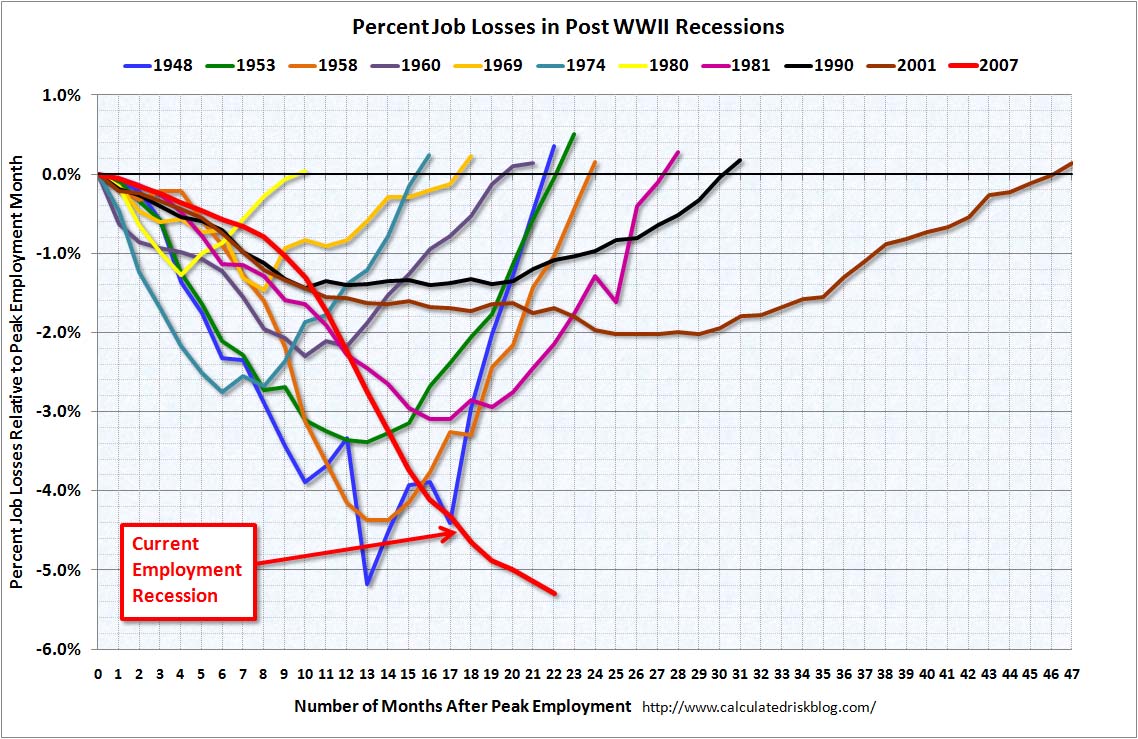
Job Losses in USA post recessions

You can click on the graph to show the full resolution. Its getting worse than previous recessions. One additional bit which you might notice is that by and large, as time goes on, the length of time it takes to get back to the previous top employment levels is stretching. In other words, this huge fall of unemployment which you are seeing can well take over another 2-3 years to recover. Can you imagine the repercussions? Think about the fact that the unemployment will still be lower and hurting when President Obama is going for re-election. I am going to hazard a guess that his re-election is not guaranteed, silver tongue orator notwithstanding. To get people to work in jobs, President Obama has to do something drastic but where is the fiscal firepower to actually fire a bigger gun? I suspect he will let the dollar depreciate, sod the status of reserve currency and let inflation help him out.

But whichever way you look at this, life is going to be fun.

Friday, November 6

God has always been planning things for me'

A simple honest story. h/t ac. Power of dreams, power of teachers, power of motivation.


'God has always been planning things for me'
Shobha Warrier
Rediff
July 28, 2008
http://specials.rediff.com/news/2008/jul/28sl1.htm
Naga Naresh Karutura has just passed out of IIT Madras in Computer
Science and has joined Google in Bangalore.
You may ask, what's so special about this 21-year-old when there are
hundreds of students passing out from various IITs and joining big
companies like Google?
Naresh is special. His parents are illiterate. He has no legs and moves
around in his powered wheel chair. (In fact, when I could not locate his
lab, he told me over the mobile phone, 'I will come and pick you up'.
And in no time, he was there to guide me)
Ever smiling, optimistic and full of spirit; that is Naresh. He says,
"God has always been planning things for me. That is why I feel I am
lucky."
Read why Naresh feels he is lucky.
Childhood in a village
I spent the first seven years of my life in Teeparru, a small village in
Andhra Pradesh, on the banks of the river Godavari. My father Prasad was
a lorry driver and my mother Kumari, a house wife. Though they were
illiterate, my parents instilled in me and my elder sister (Sirisha) the
importance of studying.
Looking back, one thing that surprises me now is the way my father
taught me when I was in the 1st and 2nd standards. My father would ask
me questions from the text book, and I would answer them. At that time,
I didn't know he could not read or write but to make me happy, he helped
me in my studies!
Another memory that doesn't go away is the floods in the village and how
I was carried on top of a buffalo by my uncle. I also remember plucking
fruits from a tree that was full of thorns.
I used to be very naughty, running around and playing all the time with
my friends. I used to get a lot of scolding for disturbing the elders
who slept in the afternoon. The moment they started scolding, I would
run away to the fields!
I also remember finishing my school work fast in class and sleeping on
the teacher's lap!
January 11, 1993, the fateful day
On the January 11, 1993 when we had the sankranti holidays, my mother
took my sister and me to a nearby village for a family function. From
there we were to go with our grandmother to our native place. But my
grandmother did not come there. As there were no buses that day, my
mother took a lift in my father's friend's lorry. As there were many
people in the lorry, he made me sit next to him, close to the door.
It was my fault; I fiddled with the door latch and it opened wide
throwing me out. As I fell, my legs got cut by the iron rods protruding
from the lorry. Nothing happened to me except scratches on my legs.
The accident had happened just in front of a big private hospital but
they refused to treat me saying it was an accident case. Then a police
constable who was passing by took us to a government hospital.
First I underwent an operation as my small intestine got twisted. The
doctors also bandaged my legs. I was there for a week. When the doctors
found that gangrene had developed and it had reached up to my knees,
they asked my father to take me to a district hospital. There, the
doctors scolded my parents a lot for neglecting the wounds and allowing
the gangrene to develop. But what could my ignorant parents do?
In no time, both my legs were amputated up to the hips.
I remember waking up and asking my mother, where are my legs? I also
remember that my mother cried when I asked the question. I was in the
hospital for three months.
Life without legs
I don't think my life changed dramatically after I lost both my legs.
Because all at home were doting on me, I was enjoying all the attention
rather than pitying myself. I was happy that I got a lot of fruits and
biscuits.
'I never wallowed in self-pity'
July 28, 2008
The day I reached my village, my house was flooded with curious people;
all of them wanted to know how a boy without legs looked. But I was not
bothered; I was happy to see so many of them coming to see me,
especially my friends!
All my friends saw to it that I was part of all the games they played;
they carried me everywhere.
God's hand
I believe in God. I believe in destiny. I feel he plans everything for
you. If not for the accident, we would not have moved from the village
to Tanuku, a town. There I joined a missionary school, and my father
built a house next to the school. Till the tenth standard, I studied in
that school.
If I had continued in Teeparu, I may not have studied after the 10th. I
may have started working as a farmer or someone like that after my
studies. I am sure God had other plans for me.
My sister, my friend
When the school was about to reopen, my parents moved from Teeparu to
Tanuku, a town, and admitted both of us in a Missionary school. They
decided to put my sister also in the same class though she is two years
older. They thought she could take care of me if both of us were in the
same class. My sister never complained.
She would be there for everything. Many of my friends used to tell me,
you are so lucky to have such a loving sister. There are many who do not
care for their siblings.
She carried me in the school for a few years and after a while, my
friends took over the task. When I got the tricycle, my sister used to
push me around in the school.
My life, I would say, was normal, as everyone treated me like a normal
kid. I never wallowed in self-pity. I was a happy boy and competed with
others to be on top and the others also looked at me as a competitor.
Inspiration
I was inspired by two people when in school; my Maths teacher Pramod Lal
who encouraged me to participate in various local talent tests, and a
brilliant boy called Chowdhary, who was my senior.
When I came to know that he had joined Gowtham Junior College to prepare
for IIT-JEE, it became my dream too. I was school first in 10th scoring
542/600.
Because I topped in the state exams, Gowtham Junior College waived the
fee for me. Pramod Sir's recommendation also helped. The fee was around
Rs 50,000 per year, which my parents could never afford.
Moving to a residential school
Living in a residential school was a big change for me because till then
my life centred around home and school and I had my parents and sister
to take care of all my needs. It was the first time that I was
interacting with society. It took one year for me to adjust to the new
life.
There, my inspiration was a boy called K K S Bhaskar who was in the top
10 in IIT-JEE exams. He used to come to our school to encourage us.
Though my parents didn't know anything about Gowtham Junior School or
IIT, they always saw to it that I was encouraged in whatever I wanted to
do. If the results were good, they would praise me to the skies and if
bad, they would try to see something good in that. They did not want me
to feel bad.
They are such wonderful supportive parents.
Life at IIT- Madras
Though my overall rank in the IIT-JEE was not that great (992), I was
4th in the physically handicapped category. So, I joined IIT, Madras to
study Computer Science.
Here, my role model was Karthik who was also my senior in school. I
looked up to him during my years at IIT- Madras.
He had asked for attached bathrooms for those with special needs before
I came here itself. So, when I came here, the room had attached bath. He
used to help me and guide me a lot when I was here.
I evolved as a person in these four years, both academically and
personally. It has been a great experience studying here. The people I
was interacting with were so brilliant that I felt privileged to sit
along with them in the class. Just by speaking to my lab mates, I gained
a lot.
'There are more good people in society than bad ones'
July 28, 2008
Words are inadequate to express my gratitude to Prof Pandurangan and
all my lab mates; all were simply great. I was sent to Boston along with
four others for our internship by Prof Pandurangan. It was a great
experience.
Joining Google R&D
I did not want to pursue PhD as I wanted my parents to take rest now.
Morgan Stanley selected me first but I preferred Google because I wanted
to work in pure computer science, algorithms and game theory.
I am lucky
Do you know why I say I am lucky?
I get help from total strangers without me asking for it. Once after my
second year at IIT, I with some of my friends was travelling in a train
for a conference. We met a kind gentleman called Sundar in the train,
and he has been taking care of my hostel fees from then on.
I have to mention about Jaipur foot. I had Jaipur foot when I was in 3rd
standard. After two years, I stopped using them. As I had almost no
stems on my legs, it was very tough to tie them to the body. I found
walking with Jaipur foot very, very slow. Sitting also was a problem. I
found my tricycle faster because I am one guy who wants to do things
faster.
One great thing about the hospital is, they don't think their role ends
by just fixing the Jaipur foot; they arrange for livelihood for all.
They asked me what help I needed from them. I told them at that time, if
I got into an IIT, I needed financial help from them. So, from the day I
joined IIT, Madras, my fees were taken care of by them. So, my education
at the IIT was never a burden on my parents and they could take care of
my sister's Nursing studies.
Surprise awaited me at IIT
After my first year, when I went home, two things happened here at the
Institute without my knowledge.
I got a letter from my department that they had arranged a lift and
ramps at the department for me. It also said that if I came a bit early
and checked whether it met with my requirements, it would be good.
Second surprise was, the Dean, Prof Idichandy and the Students General
Secretary, Prasad had located a place that sold powered wheel chairs.
The cost was Rs 55,000. What they did was, they did not buy the wheel
chair; they gave me the money so that the wheel chair belonged to me and
not the institute.
My life changed after that. I felt free and independent.
That's why I say I am lucky. God has planned things for me and takes
care of me at every step.
The world is full of good people
I also feel if you are motivated and show some initiative, people around
you will always help you. I also feel there are more good people in
society than bad ones. I want all those who read this to feel that if
Naresh can achieve something in life, you can too.
"Every man is guilty of all the good he did not do."
Tuesday, October 27

Relative Priorities

When is a mobile phone more important than food? Or when is having a satellite dish antenna based TV system more important than having a better house? When you are talking about Iraqi Refugees

image

On the other hand, the World Food Programme has announced that it will let Iraqi refugees in Syria know that food aid is available over sms on mobile phones.

Iraqi refugees in Syria will this week start receive U.N. text messages they can redeem for fresh food in local shops, the World Food Programme said on Tuesday.

The "virtual vouchers" worth $22 per family every two months will supplement traditional aid which rarely includes perishable goods, WFP spokeswoman Emilia Casella said, announcing the pilot project supported by the mobile company MTN.

...

The Syrian pilot will initially reach 1,000 beneficiaries in and around Damascus, and may be extended, the WFP said. Casella described it as a way to help refugees eat a more diversified diet while also supporting local farmers and businesses.

"We are not giving food away, we are actually creating an additional market for local shopkeepers," she said.

Quite an interesting situation, eh? where entertainment and communications are of higher priority than food and shelter. World is definitely changing for the better? (I think)

Why doesnt education actually help Africans?

This paper made me sit up. If a country like Nigeria, which contains 1/5th of the population of the entire African continent, one of the best educated countries, with perhaps one of the best resourced landscapes shows a return for education of approximately 2-3% (the increase in personal  income for every additional year of schooling) compared to approximately 10% for the USA, then its not surprising that quite a lot of the educated middle class of Nigeria (and rest of Africa) is trying to emigrate out of Africa into the western nations.

The abstract of the paper is as follows:

In the last two decades, the social and economic benefits of formal education in Sub-Saharan Africa have been debated. Anecdotal evidence points to low returns to education in Africa. Unfortunately, there is limited econometric evidence to support these claims at the micro level. In this study, I focus on Nigeria, a country that holds 1/5 of Africa's population. I use instruments based on the exogenous timing of the implementation and withdrawal of free primary education across regions in this country to consistently estimate the returns to education in the late 1990s. The results show the average returns to education are particularly low in the 90s, in contrast to conventional wisdom for developing countries (2.8% for every extra year of schooling between 1997 and 1999). Surprisingly, I find no significant differences between OLS and IV estimates of returns to education when necessary controls are included in the wage equation. The low returns to education results shed new light on both the changes in demand for education in Nigeria and the increased emigration rates from African countries that characterized the 90s.

Are you going to blame bad governments? corruption? bad technology? health problems? Geo political issues? Or what have you? At end of the day, the policy prescription has always been to increase the spend in education. See this graph for the implementation of free education in Nigeria:

The author states that the African continent lost 60,000 professionals in just 5 years between 1985 and 1990. That is a huge migration and loss for the countries concerned, specially when you consider how difficult it would be to train a lawyer, doctor, university lecturers in countries with resource constraints. And if this happens constantly, then the continent will be going into reverse! If this is what happens when you are educated, then its obvious that the enrolment rates are going to fall and economic development will fall.

Monday, October 26

Does greater education actually increase generational conflict?

This was quite an interesting if controversial paper. Its basically explained by the following chart.


As the authors state:

The flow chart illustrates the transition to a vicious cycle of population aging and a decline in public education. In the early phases of industrialization, compulsory schooling regulated child labor and promoted technological progress, thereby discouraging fertility. A major education reform was eventually triggered by the rise in the young's demand for skill acquisition. However, the increased population share of the old enlarged their political power to curtail the government budget for education. The resulting positive response of private education induced further fertility decline.

The authors review the Japanese, USA, British, French, German situations with respect to economic development, ageing, public education, child labour, poverty, etc. The basic premise is given above. I am not sure that this has been thought before but this requires much thought. Actually, what else can one do? Public education is required. Its important to educate society as the economic development happens to move from labour and agriculture intensive sector to intellectual property / knowledge sector employment. Increased automation will anyway force people to work on higher value add jobs or get demoted out of the labour market.

But running the statistics on the overall education spend on the OECD countries here, I am not sure that the level of educational spending is falling. I think this needs to be reviewed a bit more

Sunday, October 25

Seafood medley

I was sort of told off last week from one of my chaps in India that I have stopped blogging and I should start it off. Well, here’s a tentative dip back into the wide world of blogging, lol.

Yesterday we were shopping for the Halloween Birthday party for the 2 witches at home (Joey’s birthday is 31st Oct and Diya’s birthday is 1st Nov) so we mix it up on Halloween day and then have decided to have a costume party :). Anyway, had quite a lot of fun with Karn in shopping for Halloween decorations.

Then we went to place an order for the cake at Waitrose. BTW, guys, Waitrose makes the bestest and greatest cakes :) Here’s one from last year when Ma was here and we celebrated her birthday. She is as ferocious and old as dinosaurs :)


DSC09716.

So there Kannu told me off for not having cooked for a long time. Ok, so asked him what he wants to eat and he expressed a desire for Salmon. So, went off to get a good set of Salmon fillets, then got some mussels and large prawns, some spring onions, some sugar snap peas (no spinach, they were all a bit limp), a small tin of 4 cheese sauce and some mushroom soup. It was a quick meal, heated up the soup, then cooked the mussels in some butter and garlic, tossed the prawns in some lemon and garlic. Grilled the fillets for 15 minutes. Boiled up some water with some vegetable stock and plonked the spring onions and sugar snap peas into it to steam a bit. Then all served up on a nice warm plate. He gobbled it all up and then, surprise of surprise, he kissed me, hugged me and said, thanks Dad for a great meal. Now we are talking, nice to know that his old dad can still get him up and going :)

Then we went for dessert. Ma (whom I met last weekend in Mumbai) made some of my favourite laddu’s. Sesame Laddu’s and Coconut Laddu’s. This tin was full up when she gave me last weekend and over the past week and here, you can see the depredations on this.


DSC03397

Tuesday, September 29

What factors drive Mathematics Achievement of students?

Quite an interesting paper, this one. The chaps analysed more than 100000 15 year old students and what did they find? Well, quite interestingly, they found that your scores in mathematics are better when:

  • richer or more egalitarian countries;
  • when living with two parents,
  • without grandparents,
  • with fewer siblings (especially fewer older siblings);
  • with higher family SES,
  • more books,
  • cultural possessions,
  • or cultural communication;
  • or when they had greater interest in mathematics,
  • more effort and perseverance,
  • and higher self-efficacy or self-concept

Quite an interesting medley of factors, eh? Some surprises were there obviously. What on earth is the connection with grandparents? And nothing direct on teachers?

Arabs bear brunt of gene disorders

I am not sure if I mentioned this before but in the dim and distant past, i worked in the magic kingdom of Saudi Arabia and there, the wife of a friend of mine used to work in a maternity hospital. My friend is an expatriate with an international bank and has worked around the globe so his wife has experience of birthing internationally. Something that she said to me stuck to my mind, that she has never experienced the level of genetic disorders that she found in Saudi Arabia. I knew they usually go about marrying their cousins and frankly incestuous marriages are quite common, but…..

Here’s a more medically accurate report on this issue. I quote:

Arabs suffer from one of the highest rates of genetic disease in the world, according to a research institute. Some 906 genetic disorders have been identified in Arabs and their descendants, reports the Centre for Arab Genomic Studies (CAGS), and about 200 of those are prevalent among Arabs in the GCC alone.

So how big is this consanguinity problem?

About 63 per cent of the genetic conditions in Arab populations are due mostly to marriage between close relatives such as first cousins, clinically known as consanguinity.Such marriages, deeply ingrained in Arab culture, are on the rise in the UAE, where the rate is the fifth-highest in the Arab world. In Dubai, 40 per cent of marriages are between relatives, according to the latest statistics. In Al Ain that figure reaches 54 per cent, and in Abu Dhabi 32 per cent. Across the Arab world, Sudan and Mauritania have the highest rates, amounting to two-thirds of all marriages. However, consanguinity is on the decline in, for example, Egypt and Tunisia.

Will it change? I doubt it. In any case, I am sure it will turn out to be just a crusader or Zionist plot (just joking, for crissake!)

Are female students 'a perk of the job'?

Ouchie. The man is in trouble. I quote:

"Normal girls – more interested in abs than in labs, more interested in pecs than specs, more interested in triceps than tripos – will abjure their lecturers for the company of their peers, but nonetheless, most male lecturers know that, most years, there will be a girl in class who flashes her admiration and who asks for advice on her essays. What to do?

"Enjoy her! She's a perk."

Flashing a few literary allusions, he continued: "She doesn't yet know that you are only Casaubon to her Dorothea, Howard Kirk to her Felicity Phee, and she will flaunt you her curves. Which you should admire daily to spice up your sex, nightly, with the wife."

Displaying a more surprising familiarity with the etiquette at lapdancing clubs, Kealey added: "As in Stringfellows, you should look but not touch.

And the chap is a Vice Chancellor at a British University. Horny old goat. Well, there you go. BTW, no, its not allowed and most certainly one shouldn't do anything of this kind. Bad mistake and doesnt help out at all.

Monday, September 28

Does teacher quality affect student performance?

Yep, it sure does. As the old quote goes, the influence of a teacher ends at eternity. So what exactly is the impact? This paper investigated the impact of teacher quality on 1000 students in one Italian university. Guess what they found?

the researchers found that there is a statistically significant impact on student performance in subsequent courses. In other words, if you have a good teacher in the first year, then your performance in the later years would be much better than students who had crap teachers in the first year.

Another interesting result they found was that doing research doesnt really make that much of an impact on the students, and worse, if you are a teacher who does too much research, then the performance of a student actually gets impacted negatively.

Pretty sad, no? Our universities are rather mucked up, we drive our best teachers into the damn research organisations where they are worse for the students. And all the best teachers rarely teach the first years.