I found this article very thought provoking, because it not only looked back into the past but also tried to show what may happen in the future. A most fascinating article.
Physics in 100 Years Frank Wilczek March 27, 2015 MIT-CTP-4654 Abstract Here I indulge in wide-ranging speculations on the shape of physics, and technology closely related to physics, over the next one hundred years. Themes include the many faces of unification, the re-imagining of quantum theory, and new forms of engineering on small, intermediate, and large scales.
http://arxiv.org/pdf/1503.07735.pdf
if you can, do read the entire article because for you, Kannu, it would be of intellectual interest. For you, Diya, it will help you base your history and sciences properly. Much of the maths is beyond me, but I did read up on several elements as much as I could and frankly it was spectacular…and of course, watching Big Bang Theory with the physicists in there made it even more interesting :)
Kannu, it was so nice speaking to you today, you looked so nice and handsome and I miss you horribly. I think you should come home and study at the Harrow College :)
have a lovely week son.
Love
Baba
Monday, May 2


Saturday, April 30
Lunatic Science: Umberto Eco's Library
Yes. I agree I'm a lunatic when it comes to books kids. But I found such a great explanation here and it's from the amazing Umberto Eco. His perspective is that he collects books which aren't a collection of books he's read but books about knowledge he wants to acquire.
I'm now starting a new collection over the past few months. Cookbooks and books relating to food and spices and history. And it's amazing to watch them and salivate (no pun intended). These are amazing books. They talk about food. How people ate. What they did. How they cooked. How they felt. And so many I haven't read. And can't wait. And will buy more books :)
Love
Baba
Lunatic Science: Umberto Eco's Library
http://blog.bookstellyouwhy.com/lunatic-science-umberto-ecos-library
(via Instapaper)
Lunatic Science: Umberto Eco's Library
By . Jan 5, 2016. 9:00 AM.
Topics: Umberto Eco, Book Collecting
If the 30,000 volume book collection housed in Umberto Eco's Milan apartment can be said to inspire one response, it might well be awe. Lila Azam Zanganeh, who interviewed Eco for The Paris Review described Eco's abode as "a labyrinth of corridors lined with bookcases that reach all the way up to extraordinarily high ceilings," and makes mention of the library as "a legend in and of itself." Most commonly, when a visitor is first shown the veritable universe of books that expands throughout the author's home, they can think of only one question: "have you read all of these?"
 Though the question is common, it is not a particularly welcome one for Eco. Each time, he gives the same deadpan response: "No, these are the ones I have to read by the end of the month. I keep the others in my office." It is only with some rarity that a visitor remarks on the library's potential as a research tool. This, of course, is much closer to the sort of enquiry that Eco hopes for. After all, the acclaimed author of The Name of the Rose (1980) is a strong proponent of the idea that one's library should be "as much of what you do not know" as is feasibly possible. Most of what's contained within his awe-inspiring library (not to mention its 20,000 volume counterpart at his vacation home near Urbino) the accomplished thinker has yet to read, with the proportion of unread volumes increasing year after year as his reading pushes him deeper and deeper into the territory of that which he does not know.
 Eco's conception of what a personal library should be is an illuminating one. Specifically, it points to a sizable gap to be bridged in how we use the word 'library'. After all, public and university libraries offer precisely the sort of experience that Eco describes: many and manifold books containing knowledge that the inhabitant can only lay claim to a tiny fraction of. When we describe someone's personal library, on the other hand, we are almost never referring to something that has value as a research tool. Rather, personal libraries can often be testaments to the knowledge that its owner already has (or believes herself to have). By filling one's shelves with unknown knowledge, however, a personal library can become, like a public one, a place for aspirations. Whether you're researching a novel rooted in medieval history like Eco's Baudolino (2000) or simply hoping to learn new things, Eco correctly shows the way in which such a thing can be an obvious boon.
The question remains, of course, that if Eco hasn't read most of the books in his collection, why and how does he choose the books he chooses? Some of his collection is devoted to his own personal history. For instance, he has spent years trying to replicate a collection of the Italian travel magazine Giornale illustrato dei viaggi e delle avventure di terra e di mare that his grandfather had amassed and which Eco himself had lost in his earlier years. The strongest guiding principles of his collecting, however, have to do with his investigations into human thought. In his own words:
"As a rare books collector I am fascinated by the human propensity for deviating thought. So I collect books about subjects in which I don't believe, like kabbalah, alchemy, magic, invented languages. Books that lie, albeit unwittingly. I have Ptolemy, not Galileo, because Galileo told the truth. I prefer lunatic science."
Writer and all around book nerd, Brian puts his English degree to good use turning words into magic. A great lover of beer, baseball, and books, he can write on Baltic Porter and Katherine Anne Porter with equal ease.
Which is the strongest religion?
So to determine which religion is the strongest, subject the adherents to bench press experiments. I was laughing helplessly when i read this research paper. Only in India.
For the purpose of the study Two hundred ten (210) men from Buddhist monastery, Vaisanab and Tantrik(seventy from each group), age ranged from 30 to 35 years were selected randomly as the subject for the study from Uttar Pradesh, India. All the subjects belong to three different religion of India. The subjects were categorized into three groups, namely group (A) Himalayan Buddhist (B) Vaisanabs and (C) Tantriks. All the subjects chosen for the study had completed at least five years in their respective religious field. To measure Upper Body Muscular Strength YMCA Bench Press Test was used. To compare the significance difference in mean One-Way analysis of variance (ANOVA) with LSD Post Hoc test was employed at 0.05 level of significance and it was found significant for all the three groups. In Post Hoc compassion of bench press test Buddhist and Tantric, Buddhist and Vaisanab and also Tantric and Vaisanab have significance differs among each other’s.
Wednesday, April 27
Goldman Sachs Guide to being a man
This was a really funny list son. Many items were funny but some of them were quite thought provoking. You don't usually find them in the usual coming of age or other lists.
Love
Baba
Goldman Sachs Guide to being a man
http://thebaumlist.com/goldman-sachs-guide-to-being-a-man/
(via Instapaper)

The Gents over at Goldman Sachs have a put together a guide to being a man's man. Some you might not agree with, some you NEED to do right now… and without further ado…
The Unofficial Goldman Sachs guide to being a man:
- Stop talking about where you went to college.
- Always carry cash. Keep some in your front pocket.
- Rebel from business casual. Burn your khakis and wear a suit or jeans.
- It's ok to trade the possibility of your 80s and 90s for more guaranteed fun in your 20s and 30s.
- Never stay out after midnight three nights in a row… Unless something really good comes up on the third night.
- You will regret your tattoos.
- Never date an ex of your friend.
- Join Twitter; become your own curator of information.
- If riding the bus doesn't incentivise you to improve your station in life, nothing will.
- Time is too short to do your own laundry.
- When the bartender asks, you should already know what you want to drink.
- If you perspire, wear a damn undershirt.
- Hookers aren't cool, but remember, the free ones are a lot more expensive.
- When people don't invite you to a party, you really shouldn't go. And sometimes even when you are invited, you shouldn't go.
- People are tired of you being the funny, drunk guy.
- When in doubt, always kiss the girl.
- Tip more than you should.
- You probably use your mobile phone too often and at the wrong moments.
- Buy expensive sunglasses. Superficial? Yes, but so are the women judging you. And it tells these women you appreciate nice things and are responsible enough not to lose them.
- Do 50 push-ups, sit-ups, and dips before you shower each morning.
- Eat brunch with friends at least every other weekend. Leave Rusty and Junior at home.
- Be a regular at more than one bar.
- Act like you've been there before. It doesn't matter if it's in the end zone at the Super Bowl or on a private plane.
- A glass of wine or two with lunch will not ruin your day.
- Learn how to fly-fish.
- No selfies. Aspire to experience photo-worthy moments in the company of a beautiful woman.
- Own a handcrafted shotgun. It's a beautiful thing.
- There's always another level. Just be content knowing that you are still better off than most who have ever lived.
- You can get away with a lot more if you're the one buying the drinks.
- Ask for a salad instead of fries.
- Don't split a check.
- Pretty women who are unaccompanied want you to talk to them.
- When a bartender buys you a round, tip double.
- Be spontaneous.
- Find a Times New Roman in the streets and a Wingdings in the sheets. She exists.
- Piercings are liabilities in fights.
- Do not use an electric razor.
- Desserts are for women. Order one and pretend you don't mind that she's eating yours.
- Buy a tuxedo before you are 30. Stay that size.
- One girlfriend at a time is probably enough.
- #StopItWithTheHastags
- Your ties should be rolled and placed in a sectioned tie drawer.
- Throw parties. But have someone else clean up the next day.
- Measure yourself only against your previous self.
- Take more pictures. With a camera.
- Place-dropping is worse than-name dropping.
- Your clothes do not match. They go together.
- Yes, of course you have to buy her dinner.
- Staying angry is a waste of energy.
- If she expects the person you are 20% of the time, 100% of the time, then she doesn't want you.
- Always bring a bottle of something to the party.
- Don't use the word "closure" or ever expect it in real life.
- If you are wittier than you are handsome, avoid loud clubs.
- Date women outside your social set. You'll be surprised.
- If it's got velvet ropes and lines, walk away unless you know someone.
- You cannot have a love affair with whiskey because whiskey will never love you back.
- If you believe in evolution, you should know something about how it works.
- No-one cares if you are offended, so stop it.
- Never take an ex back. She tried to do better and is settling with you.
- Eating out alone can be magnificent. Find a place where you can sit at the bar.
- Read more. It allows you to borrow someone else's brain, and will make you more interesting at a dinner party — provided that you don't initiate conversation with, "So, who are you reading…"
- Ignore the boos. They usually come from the cheap seats.
- Don't ever say, "it is what it is."
- Don't gamble if losing $US100 is going to piss you off.
- Remember, "rules are for the obedience of fools and the guidance of wise men."
John LeFevre is the creator of @GSElevator on Twitter, and the author of the New York Times bestselling book, Straight To Hell: True Tales of Deviance, Debauchery, And Billion-Dollar Deals
Monday, April 18
Crossing the Alps
Kids
I just love the Punic wars. There's something about this particular set of wars and its history and the personalities that just sets it apart. Two giants of the ancient world, battling across the sea and land. Spectacular. And then Hannibal. What a man. Just think about it. He's a general with soldiers and mercenaries and a very long baggage trail with bloody elephants very long distance away from home and now wanting to cross the Alps? Reminds me of the trek Alexander did. You need to be an extraordinary general to command such troops and their loyalty.
And then this little story comes along about the fabled Alps crossing. Throughly interesting. Imagine studying history by studying crap :)
Love
Baba
Begin forwarded message:
Begin forwarded message:
From: Agade@listserv.unc.edu
Date: 4 April 2016 at 18:42:03 BST
To: "The Agade mailing list." <agade@listserv.unc.edu>
Subject: [agade] FEATURES: Crossing the Alps
Reply-To: "Sasson, Jack M" <jack.m.sasson@Vanderbilt.Edu>
From < https://www.theguardian.com/science/2016/apr/03/where-muck-hannibals-elephants-alps-italy-bill-mahaney-york-university-toronto>:
[Go there for pix]
=================================
The truth about Hannibal's route across the Alps
How exactly did the Carthaginian general and his elephants reach Italy? Scientists have got their hands dirty to come up with an answer
Having battled their deadly rivals the Romans in Spain, in 218BC the Carthaginian army made a move that no one expected. Their commander Hannibal marched his troops, including cavalry and African war elephants, across a high pass in the Alps to strike at Rome itself from the north of the Italian peninsula. It was one of the greatest military feats in history.
The Romans had presumed that the Alps created a secure natural barrier against invasion of their homeland. They hadn't reckoned with Hannibal's boldness. In December he smashed apart the Roman forces in the north, assisted by his awesome elephants, the tanks of classical warfare. Many of the animals died of cold or disease the following winter, but Hannibal fought his way down through Italy. For 15 years he ravaged the land, killing or wounding over a million citizens but without taking Rome. But when he faced the Roman general Scipio Africanus at Zama in north Africa in 202BC, his strategic genius met its match. So ended the second Punic war, with Rome the victor.
Saturday, April 16
A 3,800-year journey from classroom to classroom
http://news.yale.edu/2016/04/11/3800-year-journey-classroom-classroom
what a fascinating piece of news, for a man who is looking for his first clay tablet to somebody who loves history and mathematics and teaching, this is amazing news.
and this weekend I am going to go see the film on Ramanujam :)

what a fascinating piece of news, for a man who is looking for his first clay tablet to somebody who loves history and mathematics and teaching, this is amazing news.
and this weekend I am going to go see the film on Ramanujam :)
Thirty-eight hundred years ago, on the hot river plains of what is now southern Iraq, a Babylonian student did a bit of schoolwork that changed our understanding of ancient mathematics. The student scooped up a palm-sized clump of wet clay, formed a disc about the size and shape of a hamburger, and let it dry down a bit in the sun. On the surface of the moist clay the student drew a diagram that showed the people of the Old Babylonian Period (1,900–1,700 B.C.E.) fully understood the principles of the “Pythagorean Theorem”1300 years before Greek geometer Pythagoras was born, and were also capable of calculating the square root of two to six decimal places.
Today, thanks to the Internet and new digital scanning methods being employed at Yale, this ancient geometry lesson continues to be used in modern classrooms around the world.
“This geometry tablet is one of the most-reproduced cultural objects that Yale owns — it’s published in mathematics textbooks the world over,” says Professor Benjamin Foster, curator of the Babylonian Collection, which includes the tablet. It’s also a popular teaching tool in Yale classes. “At the Babylonian Collection we have a very active teaching and learning function, and we regard education as one of the core parts of our mission,” says Foster. “We have graduate and undergraduate groups in our collection classroom every week.”
The tablet, formally known as YBC 7289, “Old Babylonian Period Mathematical Text,” came to Yale in 1909 as part of a much larger collection of cuneiform tablets assembled by J. Pierpont Morgan and donated to Yale. In the ancient Mideast cuneiform writing was created by using a sharp stylus pressed into the surface of a soft clay tablet to produce wedge-like impressions representing pictographic words and numbers. Morgan’s donation of tablets and other artifacts formed the nucleus of the Yale Babylonian Collection, which now incorporates 45,000 items from the ancient Mesopotamian kingdoms.
Discoverying the tablet's mathematical significance
The importance of the geometry tablet was first recognized by science historians Otto Neugebauer and Abraham Sachs in their 1945 book “Mathematical Cuneiform Texts.”
“Ironically, mathematicians today are much more fascinated with the Babylonians’ ability to accurately calculate irrational numbers like the square root of two than they are with the geometry demonstrations,” notes associate Babylonian Collection curator Agnete Lassen.
Thursday, April 14
Touch (Stanford Encyclopedia of Philosophy)
Kannu
This article was truly amazing. I never knew how much complicated touch was. As a sense, I don't think we use it enough son. Cultural reasons no doubt but that's a shame. I think you draw closer to a person if you touch them. Keep touching them to be with them. Feel them. It's warmer. You feel better. A hug is like that. Full body touch. Wrapping yourself around somebody is a great feeling and it's related to touch.
Here's a test you can do. Have you touched somebody with your eyes closed? Stop the other senses and just focus on how the touch feels. You'll feel different. It's a very subtle feeling.
That doesn't mean you go about being creepy and touching everybody:)
Hope you feel better today son.
Love
Baba
Touch (Stanford Encyclopedia of Philosophy)
http://plato.stanford.edu/entries/touch/
(via Instapaper)
(null)
This article was truly amazing. I never knew how much complicated touch was. As a sense, I don't think we use it enough son. Cultural reasons no doubt but that's a shame. I think you draw closer to a person if you touch them. Keep touching them to be with them. Feel them. It's warmer. You feel better. A hug is like that. Full body touch. Wrapping yourself around somebody is a great feeling and it's related to touch.
Here's a test you can do. Have you touched somebody with your eyes closed? Stop the other senses and just focus on how the touch feels. You'll feel different. It's a very subtle feeling.
That doesn't mean you go about being creepy and touching everybody:)
Hope you feel better today son.
Love
Baba
Touch (Stanford Encyclopedia of Philosophy)
http://plato.stanford.edu/entries/touch/
(via Instapaper)
(null)
Wednesday, April 13
Scientists reveal six elements for giving the perfect apology
I make a giant Number of mistakes kids. So many that it's spectacular. Combine that with my horrendous memory and number of interests, I'm usually pissing off somebody or other. And then I have to apologise. I'm now pretty good at it. Specially with all the practise I get.
But I liked what this article had to say. I think it makes perfect sense to use this to make the perfect apology. No point in standing your ground. Apologise and move on.
One to learn indeed.
I'm so looking forward to the movie :) my hero! I just hope he is represented well in the film otherwise I'll be so disappointed.
Love
Baba
Scientists reveal six elements for giving the perfect apology
via MailOnline for iPhone
Fisher College of Business devised a six element list for giving the perfect apology. But if you're pressed for time, researchers say admitting fault and offering to repair the damage are critical.
Read full article
How the Universal Symbols for Escalators, Restrooms, and Transport Were Designed
Choti
This is a fascinating story about how these symbols came up. You may want to consider how other symbols would be drawn.
You draw them in the birthday cards as well :) I just love your imagination and skill there :)
Love
Baba
How the Universal Symbols for Escalators, Restrooms, and Transport Were Designed
http://www.atlasobscura.com/articles/how-the-universal-symbols-for-escalators-restrooms-and-transport-were-designed
(via Instapaper)

In 1977, several nursing mothers wrote to the U.S. Department of Transportation (DOT). They weren't happy. They objected to the new standardized symbol for "nursery," which depicted a baby bottle, and they wanted it changed.
Today, travelers rushing through an airport or pausing at a roadside rest stop barely notice the standard symbols that direct the flow of human traffic. The little rounded man indicating the restroom and his female partner with her triangular dress are too familiar to think twice about. The same goes for the ubiquitous No Smoking logo and the knife and fork symbol that point towards dinner.
But 40 years ago, when the DOT received the letters, the symbols were new, launched to help manage the crush of visitors for the U.S's Bicentennial celebrations. Symbols have long been helpful in transcending cultural and linguistic barriers—in the 20th century, they became particularly common in cities hosting the Olympics. When planning for the Bicentennial, the DOT realized that standard symbols could be used to direct international tourists as they enjoyed everything the country had to offer 200 years after its founding.
To determine what these symbols ought to look like, DOT approached the American Institute of Graphic Arts (AIGA), the nation's oldest and largest professional design organization. Together, they reviewed hundreds of symbols in use around the world and set out to develop their own set that could convey diverse messages to America's tourists.
"I think about it as another assignment we did," says Roger Cook, whose graphic design firm Cook and Shanosky Associates Inc., was contracted by the AIGA to design the symbols. Today, Cook is 85 and retired but continues to work as an artist out of his home in rural Bucks County, Pennsylvania. "We didn't make a killing on it," he laughs. But he acknowledges the thrill of knowing that his firm's work has reached so many people and will live on long after he and his partner, Don Shanosky, are gone.
Designing the initial 34 symbols took nearly a year, and the project was so intense that the firm worried they might lose other clients. In the pre-computer era, Cook and Shanosky drew hundreds of sketches on tracing paper and discussed them with the AIGA's project committee, turning in version after version of each symbol. The committee discussed each draft in exacting detail, returning pages of notes to Cook and Shanosky, which today fill a giant, overstuffed binder that Cook has kept for years.
The yellowing, typewritten notes cover nuances that most travelers today don't even notice. But that's good, Cook says. "People don't have time to sit and figure out what the symbol means." Good design should be about simplicity, and the committee's notes demonstrate the intensive process of what Cook describes as "deleting all the unnecessary dingbats and doodads without losing the impact of the message."

Simplicity began with the male figure. The character built upon previous stylized figures from earlier symbol sets, but Cook and Shanosky's own sleek, no-details figure set the tone for the other symbols in the DOT set. The figure has since been dubbed Helvetica Man by the designers Ellen Lupton and J. Abbott Miller, a name Cook appreciates. Like many designers, he has a deep respect for the font Helvetica and its clean, no-frills appearance.
Creating simple, easily understood symbols required that the designers grasped the essence of what they were trying to communicate. Understanding the basics of the human form is relatively easy, and even differentiating gender with Helvetica Woman's dress seemed a straightforward enough task. But the design team also needed to tackle more complex, abstract subjects. For example, how do you portray authority—what makes Helvetica Man official? Apparently, a hat is the answer, and a sash across his chest and waist, as shown in the symbols for customs and immigration (in the pre-TSA days, the design group dismissed a similar symbol for airport security, noting that it's "not an official person who does security"). It's strangely effective; there's nothing like an official-looking hat to give a person an air of authority.

The discussions at the meetings covered the minutiae of Helvetica Man's many escapades as the designers placed him in the various situations needed to convey messages to travelers. His posture as he sits in a waiting room chair was of concern, and the notes on the Waiting Room symbol are filled with maternal chiding: "Make person sit up straight," and "Figure should not be too slouched." Waiting rooms, it turns out, are not happy places. Helvetica Man shouldn't be too comfortable, or people might get confused.
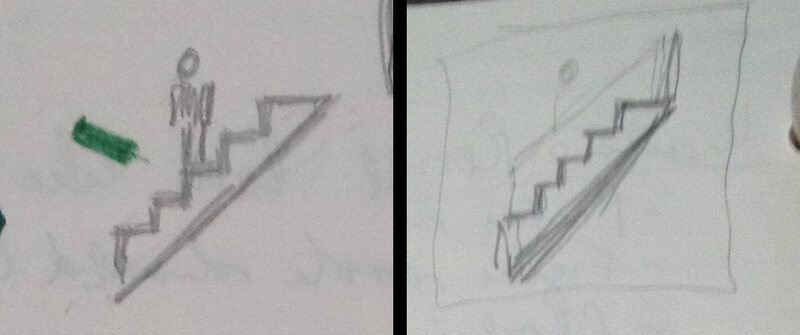
There was also a debate about whether to include Helvetica Man in the symbol for stairs. Look at the design we know today—a single line, bent into ascending or descending right angles—and it's hard to think anything except "stairs." But before there was a universal symbol, it was unclear how much detail was necessary, and the committee thought a figure using the stairs might make the symbol clearer. Eventually, they took him out, concerned that his inclusion leaned too much towards an illustration, rather than a symbol. But they made the opposite decision for the escalator symbol, deeming the escalator without Helvetica Man too abstract to be specific.

The committee debated whether to include Helvetica Man's arm as he takes a drink from a water fountain, eventually deciding that the arm was needed to show he's not bowing to the fountain. Should the No Dogs dog have a rounded nose or a squared off one? Rounded, consistent with Helvetica Man, won. Did the man with a raised arm and a suitcase, signaling passenger pick-up at arriving flights, look like he's hailing a cab or waving to a friend? Could he be mistaken for curbside check-in? The symbols were drawn and redrawn until everyone—the DOT, the AIGA, the designers, even the friends and family the designers sometimes ran their ideas by—was satisfied.
When the committee had finalized 34 symbols, the DOT initially debuted them in New York, Boston, Philadelphia, Washington D.C., and Williamsburg, VA. The department also urged their adoption by federal, state, and transportation authorities, and soon they were everywhere. The New York Times announced their arrival, and they were introduced to millions of schoolchildren in the classroom magazine My Weekly Reader. Johnny Carson even did a segment on them.
Requests rolled in for symbols to meet unaddressed needs—a fire extinguisher; a "no weapons" icon. The Consulate General of Iran wrote to request a "no photography" symbol. Cook and Shanosky worked with the AIGA and the DOT to add 16 additional symbols in 1979 and five more in 1985. They changed one of the three male figures riding in an elevator to a female figure. And they assented to the requests of the nursing mothers, swapping the bottle for Helvetica Baby, who today tells parents all over the world where they can change their own babies' diapers.

In 1985, Cook and Shanosky's firm won an inaugural Presidential Design Excellence Award for the symbol project. But for Cook, there's also a less tangible reward. "We've told more people where to go," he says. "We probably have the record on that."
Monday, April 11
Indian Cotton Textiles and the Senegal River Valley in a Globalising World: Production, Trade and Consumption, 1750- 1850
this was a fascinating phd dissertation
Most fascinating story of Indian Ocean trade in textiles and interconnections with slavery
This thesis addresses how and why West African consumers, especially those along the Senegal River valley, imported and consumed Indian cotton textiles from the eighteenth to mid-nineteenth century, despite the fact that they produced textiles of various kinds. Using quantitative and qualitative sources collected from France, India, Senegal and the United Kingdom, the thesis fulfils this gap in the existing literature. Throughout this study, it will be shown that local textile production and consumption in West Africa based on factor endowments and natural environment shaped consumer demand and preferences for Indian cotton textiles whose quality was perceived to be more suitable to the life of inhabitants in the region (especially in the savannah and desert areas) than European textiles. In addition, Indian textiles not only suited conspicuous consumption among Africans but also regional economies in which cloth was used as an exchange medium. In the eighteenth century, West African demand for Indian cotton textiles of various types was central to the purchase by European merchants of slaves along coastal areas of West Africa. In the early nineteenth century, which witnessed the transition from the Atlantic slave trade to the trade in commercial agriculture, dark-blue cotton textiles produced in Pondicherry, called ‘guinées’, were of essential importance in the trade in gum Arabic in the lower Senegal River as a currency that replaced a domestically-produced cloth currency. The gum from the region was indispensable in the development of the textile industry in Western Europe at that time. This regional demand influenced the Euro-West African trade and the procurements by Europeans of cotton textiles in India. The thesis argues that historically constructed consumer agency in pre-colonial West Africa had global repercussions from the eighteenth to midnineteenth century.
Most fascinating story of Indian Ocean trade in textiles and interconnections with slavery
Subscribe to:
Posts (Atom)