By Niall Ferguson
Published: January 1 2008 18:37 | Last updated: January 2 2008 08:07
Future historians will look back on the current decade as a turning point comparable with that of the Seventies. No, not the 1970s. This is not going to be another piece pointing out the coincidence of an unpopular Republican president, soaring oil prices, a sagging dollar and an unwinnable faraway war. I am talking about the 1870s.
At first sight, the resemblances across 130 years may not seem obvious. The 1870s were a time when conservative leaders such as Benjamin Disraeli, British prime minister, were powerful and popular. It was a time of falling commodity prices, after the financial crash of 1873 and the opening up of the American plains to agriculture. And it was an era of currency stability, as one country after another followed the British lead by pegging to gold.
Yet, on closer inspection, we are indeed living through a global shift in the balance of power very similar to that which occurred in the 1870s. This is the story of how an over-extended empire sought to cope with an external debt crisis by selling off revenue streams to foreign investors. The empire that suffered these setbacks in the 1870s was the Ottoman empire. Today it is the US.
In the aftermath of the Crimean war, both the sultan in Constantinople and his Egyptian vassal, the khedive, had begun to accumulate huge domestic and foreign debts. Between 1855 and 1875, the Ottoman debt increased by a factor of 28. As a percentage of expenditure, interest payments and amortisation rose from 15 per cent in 1860 to 50 per cent in 1875. The Egyptian case was similar: between 1862 and 1876, the total public debt rose from E£3.3m to E£76m. The 1876 budget showed debt charges accounting for more than half of all expenditure.
The loans had been made for both military and economic reasons: to support the Ottoman military position during and after the Crimean war and to finance railway and canal construction, including the building of the Suez canal, which had opened in 1869. But a dangerously high proportion of the proceeds had been squandered on conspicuous consumption, symbolised by Sultan Abdul Mejid’s luxurious Dolmabahçe palace and the spectacular world premiere of Aïda at the Cairo Opera House in 1871. In the wake of the financial crisis that struck the European and American stock markets in 1873, a Middle Eastern debt crisis was inevitable. In October 1875 the Ottoman government declared bankruptcy.
The crisis had two distinct financial consequences: the sale of the khedive’s shares in the Suez canal to the British government (for £4m, famously advanced to Disraeli by the Rothschilds) and the hypothecation of certain Ottoman tax revenues for debt service under the auspices of an international Administration of the Ottoman Public Debt, on which European bondholders were represented. The critical point is that the debt crisis necessitated the sale or transfer of Middle Eastern revenue streams to Europeans.
The US debt crisis has taken a different form, to be sure. External liabilities have been run up by a combination of government and household dis-saving. It is not the public sector that is defaulting but subprime mortgage borrowers.
As in the 1870s, though, the upshot of this debt crisis is the sale of assets and revenue streams to foreign creditors. This time, however, creditors are buying bank shares not canal shares. And the resulting shift of power is from west to east.
Since September, Middle Eastern and east Asian sovereign wealth funds have made a succession of investments in four US banks: Bear Stearns, Citigroup, Morgan Stanley and Merrill Lynch. Most commentators have been inclined to welcome this global bail-out : better to bring in foreign capital than to shrink balance sheets by reducing lending. Yet we need to recognise that these “capital injections” represent a transfer of the revenues from the US financial services industry into the hands of foreign governments. This is happening at a time when the gap between eastern and western incomes is narrowing at an unprecedented pace.
In other words, as in the 1870s the balance of financial power is shifting. Then, the move was from the ancient oriental empires (not only the Ottoman but also the Persian and Chinese) to western Europe. Today the shift is from the US – and other western financial centres – to the autocracies of the Middle East and east Asia.
In Disraeli’s day, the debt crisis turned out to have political as well as financial implications, presaging a reduction not just in income but also in sovereignty.
In the case of Egypt, what began with asset sales continued with the creation of a foreign commission to manage the public debt, the installation of an “international” government and finally, in 1882, to British military intervention and the country’s transformation into a de facto colony. In the case of Turkey, the debt crisis was followed by the sultan’s abdication and Russian military intervention, which dealt a lethal blow to the Ottoman position in the Balkans.
It remains to be seen how quickly today’s financial shift will be followed by a comparable geopolitical shift in favour of the new export and energy empires of the east. Suffice to say that the historical analogy does not bode well for America’s quasi-imperial network of bases and allies across the Middle East and Asia. Debtor empires sooner or later have to do more than just sell shares to satisfy their creditors.
The writer is a professor at Harvard University and Harvard Business School and a senior fellow of the Hoover Institution, Stanford
All this to be taken with a grain of piquant salt!!!
Monday, January 7


Guns or butter?
A fascinating study from the FT here: I quote:
Guns or butter? It is a question that has framed national debates over how economies should allocate resources and provided a neat introduction for textbooks on macroeconomics, for the best part of a century. For the market, the choice so far this decade is clear: take guns.
In 2007, for the eighth year in a row, the S&P aerospace and defence index beat the market. While the S&P 500 is still, remarkably, down slightly for the decade, the defence sector has risen 111.5 per cent (with a total return of 141.6 per cent). The broader Spade defence index, which includes smaller stocks, has done better, with a 161.3 per cent rise since 1999.
Consumer staples have beaten the market as well, but butter has come nowhere near to beating guns. The S&P consumer staples index rose only 44 per cent for the first eight years of this decade. Defence again emerged victorious in 2007
All this to be taken with a grain of piquant salt!!!
Guns or butter? It is a question that has framed national debates over how economies should allocate resources and provided a neat introduction for textbooks on macroeconomics, for the best part of a century. For the market, the choice so far this decade is clear: take guns.
In 2007, for the eighth year in a row, the S&P aerospace and defence index beat the market. While the S&P 500 is still, remarkably, down slightly for the decade, the defence sector has risen 111.5 per cent (with a total return of 141.6 per cent). The broader Spade defence index, which includes smaller stocks, has done better, with a 161.3 per cent rise since 1999.
Consumer staples have beaten the market as well, but butter has come nowhere near to beating guns. The S&P consumer staples index rose only 44 per cent for the first eight years of this decade. Defence again emerged victorious in 2007
All this to be taken with a grain of piquant salt!!!
Sunday, January 6
Cross-border M&As in the financial sector: Is banking different from insurance?
Well, the answer seems to be yes according to this research paper.
Dario Focarelli and Alberto Franco Pozzolo, Cross-border M&As in the financial sector: Is banking different from insurance, Journal of Banking & Finance Volume 32, Issue 1, , Dynamics of Insurance Markets: Structure, Conduct, and Performance in the 21st Century, January 2008, Pages 15-29.()Abstract: This paper investigates what factors might help explain the internationalisation strategy of banks and insurance companies, by comparing the determinants of cross-border M&As in the two sectors in a unified framework. The empirical analysis shows that between 1990 and 2003 the internationalisation of banks and insurance companies followed similar patterns. Distance and economic and cultural integration are important determinants for both the banks' and the insurance companies' expansion abroad. Comparative advantage also has a prominent role, the more so for banks. The evidence is less supportive of the view that cross-border M&As are more frequent between similar countries, as predicted by the new trade theory. Finally, and most interestingly, we find indirect evidence consistent with the hypothesis that implicit barriers to foreign entry are more important in explaining the behaviour of banks than that of insurance companies.
Absolutely amazing nano pictures

This image of "Nano-Explosions" won first prize in this year's "Science As Art" competition. Fanny Beron from the École Polytechnique de Montréal used an electron scanning micrograph to record the explosion that happened when a CoFeB magnetic array was overloaded. The chaotic blasts are a "reminder that nanoscale research can have unpredicted consequences at a high level."
Here are more nano pictures. Check them out, absolutely gobsmacking!
Technorati Tags: Photo Essay
Cartoons and the Fundamentalist Hindu!
Yesterday night, this cartoon came across my in-box.

Besides the fact that the cartoonist does not know Hinduism from a hole in the ground, I am sure people are going to leap on top of this. Some idiot somewhere is going to get offended by a cartoon. (See my previous essay on rage boys!). I just hope people have a sense of humour and just laugh at the ignorance. And it is freedom of speech!, let the cartoonist be.
But then, the joke is unfortunately on the Republicans and American People. The fact that Mike Huckabee and Barack Obama seem to be in the lead in the US Presidential Race is a direct indictment that the great nation of USA is now facing a choice between an amiable silly sod with stupid economic policies and a vague man whose political and economic policies frankly scare the crap out of me. I thought that we will get somebody good after the Dubya disaster, but no such luck, I am afraid. Still, lets hope and see what happens.
Birds at sunset!
On the way back from Sanchi, I took this photo. Click on the thumbnail to see a bigger picture.
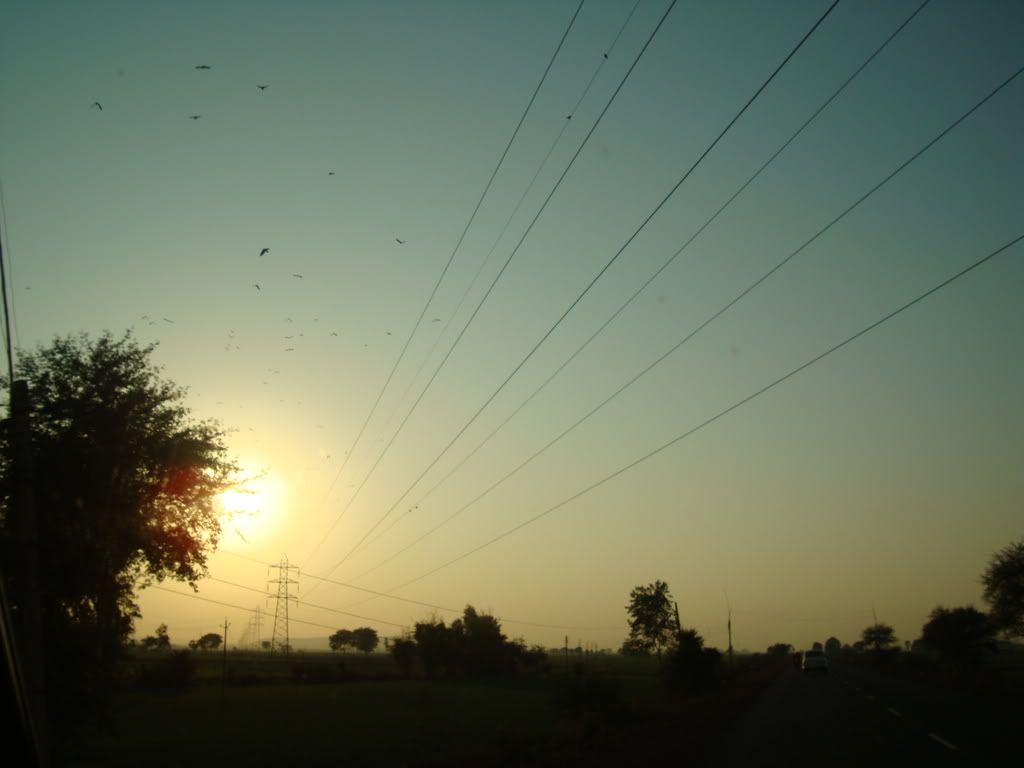
It was very evocative, seeing the birds over the tree, with the electricity lines providing almost like roads for the birds, and the IndRa settling wearily down for the night. The electricity power lines sort of end where the sun will set. Couple of birds sitting on the lines themselves. And not a cow to be seen! :)
Technorati Tags: Personal,Photo Essay
Muslim Women To Curb Terror in the UK
I found this too funny, this British government has seriously lost its marbles. The holes in the argument are so many that one fails to know where to start. So why would a fundamentalist Muslim actually listen to a woman? Or how will this £70million be used?
Blears will tell local authorities to use part of a £70m government fund set up to combat extremism to pay for the courses in confidence building, communication and mediation skills.
Muslim women will be offered work placements with business leaders and top athletes to imbue assertiveness and leadership and help them to advance their careers. Funding will be available to set up local Muslim women’s groups to provide a “safe space” where they can discuss their concerns. The plan is likely to attract criticism from some Muslim men who will see it as a threat to cultural traditions about the role of women in society.
Of course, this would really help in removing terrorists. Another hair brained idea from this silly government. By all means, help them to improve themselves, but this is frankly stupid, it will create more problems than it resolves. How about say poor Hindu or Sikh women? or say poor Christian Women who are almost equally in need of such help? This kind of stupid non-secular, non-liberal, moronic thinking is what leads the counter-terrorism effort to go astray. And at end of the day, Al Queda will simply point to this effort as a crusader effort to convert Muslim Women to modern sins.... Bah!
81% of Israelis back increasing targeted killings
Curious but not surprising poll released today in the Haaretz. I quote:
A vast majority - 81 percent - of Israelis support increasing the targeted killings of Palestinian militants, according to a poll administered by Tel Aviv University's "Peace Index" survey.
Leaving aside the other issues, when political processes do not provide security, people will reach out for the military option. Also see my comments on the review on the car bomb. Also see my previous longer length essay on ratio's and proportions, targeted assassinations by Israel. Given the political coalition's challenges, and the expected elections to happen soon, I would posit that the dial will be turned to the right and more assassinations and military options will be taken by everybody to show that they care looking after security.
Technorati Tags: Israel,Counter-Terrorism
Focusing on the customer: An interview with the head of Merrill Lynch’s operations and IT
A very interesting interview. Some excerpts
The Quarterly: You’re in a somewhat unique position, with technology and operations both reporting to you. Why is it better to have technology and operations together than apart? What does this structure enable you to do?
Diane Schueneman: I try to remember that we’re not a technology company; we’re a financial-services company that supplies solutions to our customers around their financial needs—simple as that. Customers don’t say, “You do a really great job creating an equity product.” They ask, “How well do you deliver it to me?” and “Does it meet my needs?”
So the whole reason to combine technology and operations rests on the customer’s needs. And to deliver against those needs requires the best operational processes and the best technology. But you can’t start with one and graft on the other. It’s the integration of technology and operations, from beginning to end, that really allows you to serve customers effectively, anywhere in the world. It’s one example of how we’re transforming our organization to think differently from the ways that financial-services companies have thought in the past—which is to say you have to move beyond an individual silo mentality.
The Quarterly: So you’re saying that when you redraw the organizational chart from a customer perspective, it looks very different?
Diane Schueneman: That’s the guiding principle: don’t connect the dots according to your whims but around the interests of the one who pays the bills. After all, customers are not buying technology or process from us; they’re buying a solution.
The Quarterly: Has this reorientation to the customer viewpoint been more challenging than you would have thought as far as changing people’s perspectives?
Diane Schueneman: No question. I think anytime you ask people to change, they wonder if they’ve done something wrong. To move past that, you explain the rationale and the vision of where you want to go—in our case, moving from an internal focus to an external one centered on the customer’s perspective. Once you get people excited about change and give them the freedom to think, you unleash their intellectual capabilities. They do amazing things, and that’s how you get innovation.
The Quarterly: You’ve talked about the pathway you’re providing for the people below you, but how do you see your role evolving?
Diane Schueneman: I think any CIO role has to evolve to become an integral part of the business’s fabric. There’s a lot of talk about whether CIOs have a seat at the table, but in a way that misses the point. You don’t get the seat at the table and then suddenly succeed; you have to drive a capability in a company, and then you get a seat at the table. Ask yourself what are you doing that is transformational? What are you doing that’s a differentiator? Are you thinking differently or are you an order taker?
That aspiration, I find, is lacking in some CIOs. But the opportunity is there for them to think like CEOs and to use the power of the organization to achieve greatness. To do that, they have to work broadly across the company—with the CFO, the head of sales, and other functional leaders. They have to understand these different roles and be very involved in bringing new ideas to them.
I believe that’s what is expected of me and I certainly am not waiting for somebody to tell me what to do. I see my role as leading people through significant change, to focus on the client.
Technorati Tags: Management,Financial Institutions
A tiny Buddhist temple in Bhopal

We have a tiny Buddhist Stupa next door to our home in Bhopal, India. It is about 10 feet in height, the base platform being about 5.5 feet in height, and then the brass statue which is about a feet in height and then the chattri or umbrella on top.

The temple has been constructed by this group of dwellers who live behind the statue. As you can see, they are slowly converting their kaccha, or unfinished/mud houses slowly into permanent dwellings and mostly belong to a Chattisgarh based lower caste "kurs".

Apparently they came over 18 years ago when they were facing problems with the tendu patta policy of the government and then came over to Bhopal to act as casual labourers on building sites. Now, they are government employees or running small businesses. In other words, lower middle class employees, they have postal addresses and have now established an identity and the temple was built about 5 odd years ago. Good for them!
Last time I saw it, about 2 years ago, it had a clay statue, but then they replaced it with a metal one. It is NOT this one.

Quite a detailed statue, no? There is a curious story behind this particular statue. Apparently, few weeks ago, there was a spate of thefts in the neighbourhood and the metal statue was stolen (think about the global rise in commodities striking a tiny poor temple in a poor place in the depths of India, the cost of the metal itself is now so high that its worth stealing it for the intrinsic value itself rather than the artistic value). So anyway, the people in the neighbourhood got very upset and did demonstrations and protests, blocked traffic and and and. Guess what the police did? They went and purchased a new statue, plonked it on the pillar and requested that they do not file a compliant! Only in India.
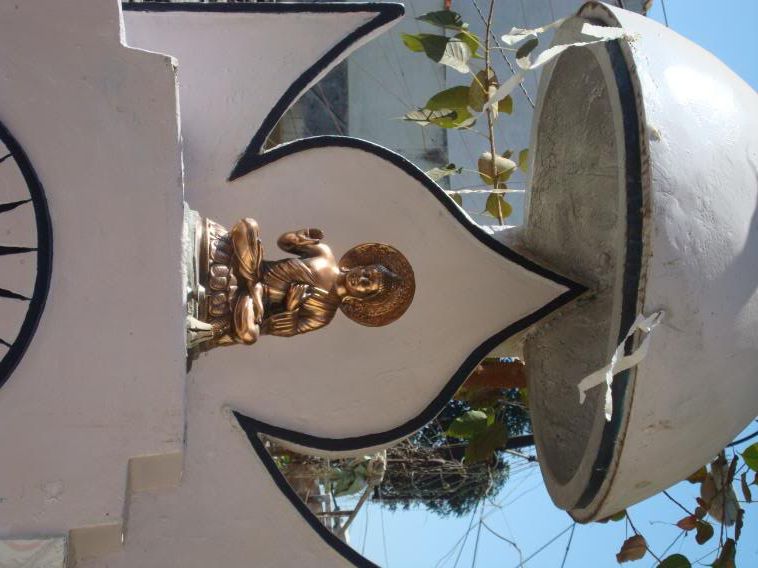
Notice now its cemented in, but it has reasonably fine detailing now. Also note the incence stick holders. Very nice, I love the serene expression on the face of the buddha. Also notice the wheel of time, or karm chakra on the front of the stupa.
Subscribe to:
Posts (Atom)